ANVISA Brazil Medical Device Registration
Last reviewed:
With around 50% of medical devices and IVDs imported, Brazil presents a lucrative opportunity for global manufacturers. Recent changes to ANVISA Brazil medical device registration requirements have made it more accessible, especially to manufacturers with authorizations in other markets.
Pure Global simplifies the process with AI workflows that accelerate ANVISA submission preparation, along with local support and representation, all for a flat annual fee.

How to register a medical device in Brazil
Medical devices and IVDs sold in Brazil are regulated by the Agência Nacional de Vigilância Sanitária (ANVISA), Brazil’s national health surveillance agency. The medical device regulatory framework is governed primarily by RDC 751/2022, which outlines classification rules, documentation requirements, and Good Manufacturing Practice (GMP) expectations. IVDs are governed by RDC 830/2023.
Foreign manufacturers must appoint a Brazil license holder (also known as a Brazil Registration Holder) to represent them. This representative submits the Notification or Registration to ANVISA and serves as the main point of contact for all regulatory activities, including inspections, post-market surveillance, and importation.
ANVISA medical device regulatory pathways
ANVISA has established two primary regulatory pathways based on product risk classification. Devices and IVDs are classified into four risk-based classes: Class I, II, III, and IV.
Notification Route (Class I & II devices and IVDs)
Process: Manufacturers of low- and moderate-risk devices submit a Notification to ANVISA via their Brazil license holder.
Requirements: Documentation includes a Notification Form, Manufacturer Authorization Letter (for imported products), proof of compliance with applicable technical regulations, and a Certificate of Compliance (SBAC) if required.
Timeline: Once all compliant documentation is submitted, the Notification is usually processed within 30-45 days.
Renewal: Notifications do not expire.
Registration Route (Class III & IV devices and IVDs)
Process: For higher-risk products, ANVISA requires full Registration, including a technical dossier and Brazil Good Manufacturing Practices (BGMP) compliance, which usually involves an ANVISA inspection of the manufacturing site.
Requirements: Required documentation includes a technical dossier (including design, manufacturing, performance, and safety data), Manufacturer Authorization Letter, Certificate of Free Sale (for imported products), BGMP certificate, proof of compliance with technical regulations, and SBAC certificate if applicable.
Timeline: ANVISA review for Class III and IV devices typically takes 4 to 12 months, depending on device type and complexity.
Renewal: Registrations must be renewed every 10 years. BGMP certificates must be renewed every two years, or every four years if issued under the Medical Device Single Audit Program (MDSAP).
Other ANVISA registration requirements
Brazil license holder: All foreign manufacturers must appoint a Brazil-based license holder to submit the Notification or Registration to ANVISA.
Additional certifications: Some devices may need to obtain INMETRO, ANATEL, or INCQS certification based on their functionality prior to ANVISA submission.
Distributor information: Distributors are authorized by and act under the regulatory oversight of the Brazil license holder.
Translation: Instructions for Use (IFUs) must be uploaded in Brazilian Portuguese to ANVISA’s digital portal.
Quality system evidence: Class III and IV products must comply with Brazil Good Manufacturing Practices (BGMP). Certification is issued by ANVISA following inspection or accepted under MDSAP.
Post-market obligations: Manufacturers and license holders must conduct post-market surveillance and vigilance reporting through the National System of Health Surveillance (SNVS).
UDI: Brazil’s national Unique Device Identifier (UDI) requirements are being phased in starting July 2025 for Class IV devices; Class III is required as of January 2026, Class II in 2027, and Class I in 2028.
What documentation is required to register a medical device or IVD in Brazil?
Documentation depends on whether the product is subject to Notification or Registration:
For Notification (Class I & II devices):
Notification Form
Manufacturer Authorization Letter (for imported devices)
Certificate of Compliance (SBAC), if applicable
Proof of compliance with applicable technical regulations
For Registration (Class III & IV devices):
Technical Dossier
Manufacturer Authorization Letter
Certificate of Free Sale (for imported devices)
Good Manufacturing Practices (BGMP) Certificate
Certificate of Compliance (SBAC), if applicable
Proof of compliance with applicable technical regulations
Additional documents such as INMETRO, ANATEL, or INCQS certifications may be required depending on the device type.
Does my device need INMETRO, ANATEL, or INCQS certification?
It depends on your device’s technical characteristics and intended use:
INMETRO certification is required for devices that include electrical components or fall under safety-critical categories, such as electromedical equipment. Compliance typically involves third-party testing and factory audits by an accredited Certification Body. Some Materials also need INMETRO certification, for example, hypodermic needles, breast implants, surgical gloves and gloves for non-surgical procedures, condoms.
ANATEL certification is mandatory for devices that use telecommunications technology, including Wi-Fi, Bluetooth, or other wireless communication. Devices must undergo technical testing and type approval through a Designated Certification Body.
INCQS evaluation may apply to certain In Vitro Diagnostic products related to the diagnosis of Dengue, Chikungunya, Sars-Cov 2 (self-test), as well as those intended for screening tests in blood banks: reagents for immunohematology (ABO system, Rh system and irregular antibodies), Hepatitis B and C, Syphilis, HIV, Chagas and HTLV.
If your device falls under any of these categories, certification must be obtained in addition to ANVISA registration, and you must have a legal representative in Brazil to manage the process. Compliance marks must be visible on the device.
What is a Brazil license holder and why do you need one?
A Brazil license holder (or Brazil Registration Holder (BRH)) is a legal entity based in Brazil that acts on behalf of a foreign manufacturer to interface with ANVISA. This representative is responsible for submitting the device Notification or Registration, ensuring regulatory compliance, and coordinating pre- and post-market activities. This includes managing BGMP inspections, submitting recalls and vigilance reports, uploading labeling in Portuguese, and issuing import authorizations. Only Brazilian entities can act as license holders, making them a mandatory partner for foreign manufacturers.
 Regulatory Update · Oct 1, 2026ANVISA–Hong Kong DH Cooperation MoURegulatory Update · Sep 10, 2026ANVISA Recognized Technical StandardsRegulatory Update · Aug 26, 2026ANVISA IVD and Class I/II ManualsRegulatory Update · Aug 17, 2026ANVISA Solicita 80326 Manufacturer RecordsCase Study · Aug 11, 2026One Balloon-Catheter Line, Two ANVISA RoutesCase Study · Jul 22, 2026One Endoscopy Platform, Six ANVISA NotificationsBlog · Aug 24, 2026Medical Device Registration Verification 2026Blog · Aug 17, 2026Coronary Stents: Eight Highest-Tier FilesBlog · Aug 10, 2026Surgical Robots: Eight Markets, Eight Regulatory FilesBlog · Jul 27, 2026IVD Global Market Access 2026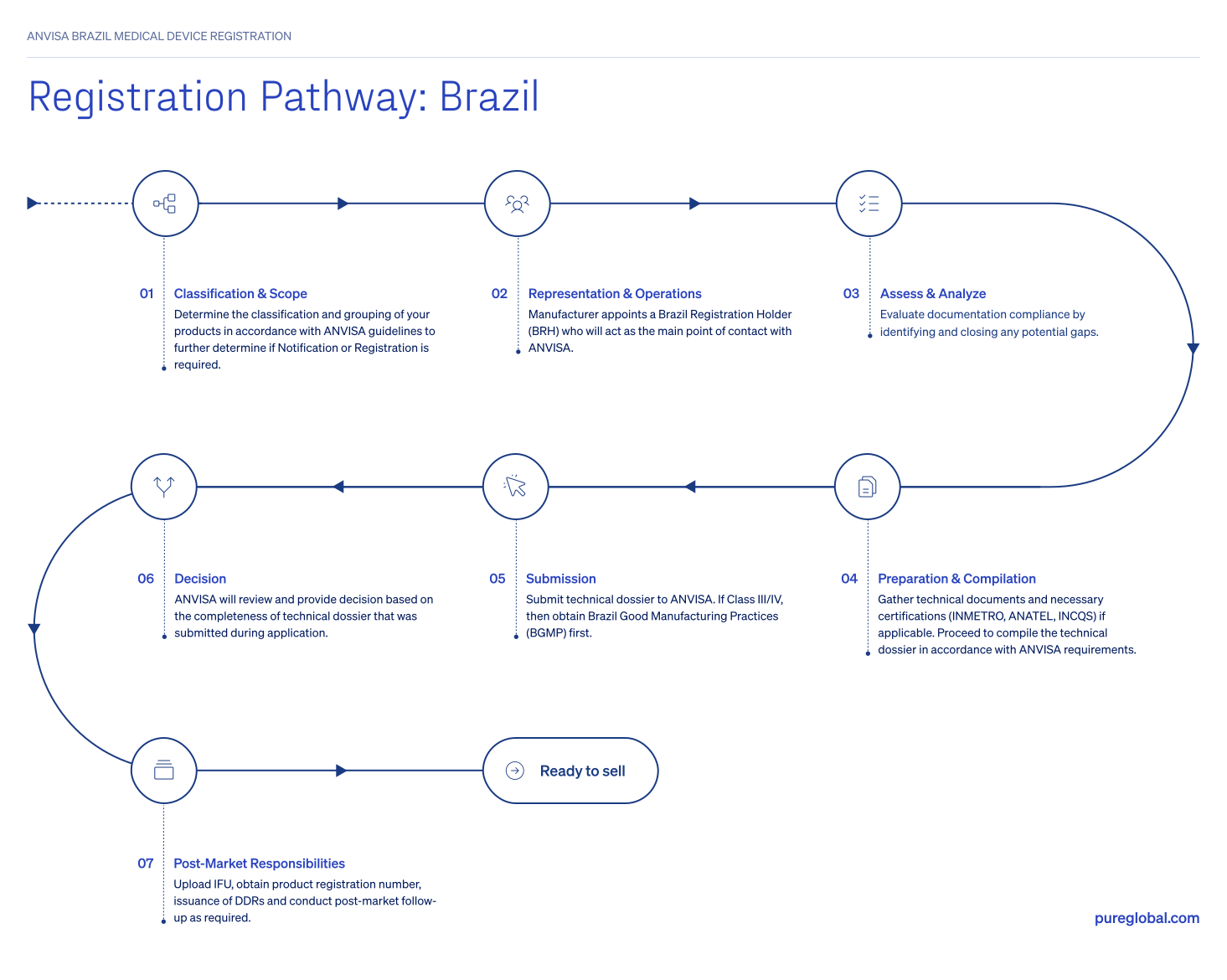
Faster submissions. Predictable costs. Local support.
We leverage proprietary AI to expedite your entry into Brazil's healthcare market:

ANVISA submissions are ready in half the time with our AI workflow.
Expert reviews ensure your submission is compliant and ready for approval.
We act as your license holder and submit your dossier to ANVISA from our Brazil office.
Flat fee includes translation from English to Portuguese, submission, and distributor authorizations. Starting at $2,000/year.

Frequently asked questions
Timelines for ANVISA registration vary by device class and certification requirements:
- Class I/II Devices (Notification): Dossiers can be compiled and submitted within about 1 week, with ANVISA approval typically granted within 30 days. These notifications do not require renewals.
- Class III/IV Devices (Registration): Dossiers usually take 2 weeks to compile and submit. ANVISA review and approval typically require 4–12 months, depending on device type and submission quality. Registrations are valid for 10 years.
- BGMP Certification: Required for Class III/IV devices, this process can take ~2 months if leveraging an existing MDSAP certificate, or up to 6 months if using the ABIMED injunction route through a local registration holder. BGMP certification is valid for 2 years, or 4 years when supported by MDSAP.
In summary, low-risk devices can reach market in about a month, while higher-risk devices may require up to a year, particularly when BGMP certification is included.
ANVISA charges mandatory government fees based on device risk class and regulatory pathway:
For Class I and Class II medical devices, a notification fee of BRL 1,406 (approximately USD 262) applies per product.
For Class III and Class IV medical devices, ANVISA charges a registration fee of BRL 8,510 (approximately USD 1,584) per product when submitted as a standard device family, or BRL 19,856 (approximately USD 3,696) per product when submitted as a large family.
B-GMP certification is mandatory for all Class III and IV devices. For manufacturers outside Brazil, the B-GMP fee is BRL 72,805 (approximately USD 13,552). Manufacturers located in MERCOSUL countries qualify for a reduced B-GMP fee of BRL 10,637 (approximately USD 1,980).
ANVISA may also assess a procedural review fee of BRL 1,406 (approximately USD 262) if additional regulatory review steps are required.
All fees listed are government fees only and do not include consulting services, dossier preparation, translations, or in-country regulatory representation. Additional fees can apply; fees can also change without notice.
Check our Fee Calculator for up-to-date government fees in 14 markets.
Pure Global offers flat-fee annual pricing for bundled medical device and IVD registration and representation in Brazil, starting at $2,000/year. The flat fee includes dossier preparation and submission, in-country representation, translation, modifications, distributor authorization, and post-market support. The fee does not include ANVISA or other government fees, certified translations, or translations from languages other than English.
Flat fee structure for Class I/II Risk devices:
1 device = $2,000/year
2-5 devices = additional $1,000 per device per year (e.g., 4 devices = $5,000/year)
6-10 devices = additional $500 per device per year (e.g., 8 devices = $7,500/year)
Flat fee structure for Class III/IV Risk devices:
1 device = $3,000/year
2-5 devices = additional $1,500 per device per year (e.g., 4 devices = $7,500/year)
6-10 devices = additional $1000 per device per year (e.g., 8 devices = $12,000/year)
Contact us for a custom quote if you have 11+ devices.
A three-year contract is required to lock in the fees quoted above. However, other contractual arrangements are available. Use our Fee Calculator for an instant estimate and more information about flat fee terms.
Single Process,
Multiple Markets
When you partner with Pure Global, a single registration process opens doors to multiple countries. Our global subsidiaries make this streamlined path possible.











Canal de Denúncias Confidencial
Let's Talk,
Anywhere You Are.
Whether looking for more information or ready to partner with us, we're here to guide you through every step of the regulatory process.
Contact us