EU MDR Consulting
Last reviewed:
Under the EU Medical Device Regulation (MDR 2017/745), all devices must bear a CE marking before being placed on the EU market, and all manufacturers are required to register in EUDAMED. Low‑risk Class I devices (non‑sterile, non‑measuring) may be self‑declared, but all other device classifications must undergo conformity assessment by a Notified Body and maintain an ISO 13485‑certified quality management system. Compliance extends into EUDAMED’s modules for UDI/device registration, vigilance, and post‑market surveillance.
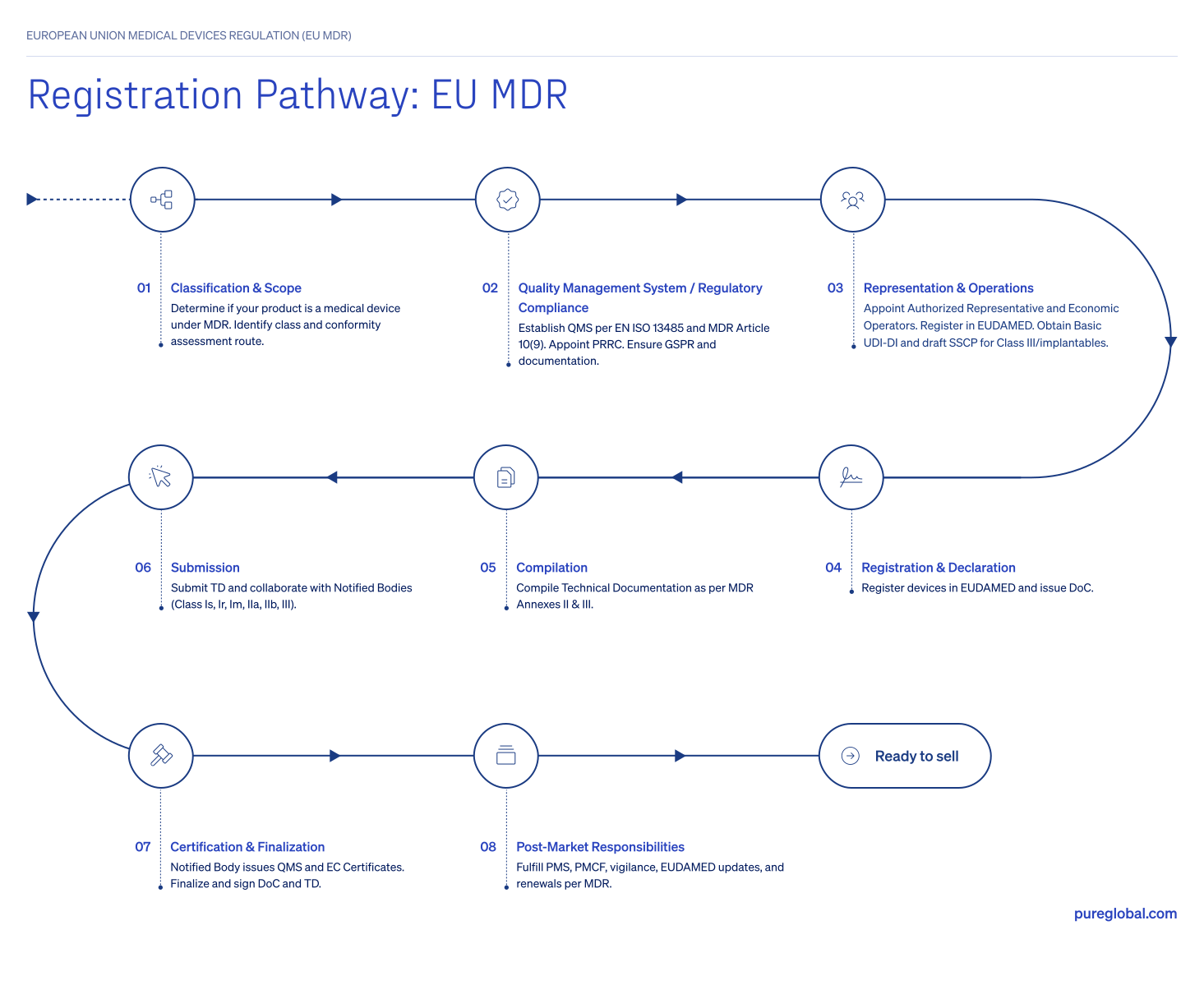
Medical Device Registration Process in the European Union (EU MDR)
STEP 1: CLASSIFICATION & SCOPE Determine whether the product qualifies as a medical device under the EU Medical Device Regulation (MDR) 2017/745 by assessing its intended purpose. Confirm the device classification (Class I (including Is, Ir, Im), IIa, IIb, or III) based on the rules in Annex VIII of the MDR. Finally, select the appropriate conformity assessment route.
STEP 2: QUALITY MANAGEMENT SYSTEM & COMPLIANCE Establish a Quality Management System (QMS) that conforms to EN ISO 13485. Appoint a Person Responsible for Regulatory Compliance (PRRC) as required under Article 15. Demonstrate conformity with the General Safety and Performance Requirements (GSPRs) outlined in Annex I and apply relevant EU legislation, state-of-the-art standards and common specifications to support compliance. Obtain the Basic UDI-DI from a designated UDI issuing entity, such as GS1, HIBCC, or ICCBBA.
STEP 3: REPRESENTATION & OPERATIONS For foreign manufacturers without an EU entity, appoint an Authorized Representative (AR). The AR serves as the legal liaison with EU Competent Authorities and is responsible for ensuring that the manufacturer’s devices comply with MDR requirements. Appoint Economic Operators (distributors, importers), as needed, and ensure that each party understands their MDR obligations under Articles 11–16.
STEP 4: REGISTRATION & DECLARATION Register the manufacturer and applicable Economic Operators as actors and register devices in the EUDAMED modules now required. Mandatory use of the first four modules began on 28 May 2026; legacy-device data remains subject to its applicable transition deadline. Ensure the Actor and UDI/device records stay aligned with the certified product. Draft the Declaration of Conformity (DoC), a legally binding document that affirms the device meets the applicable requirements of the MDR. For Class III and implantable devices, prepare a Summary of Safety and Clinical Performance (SSCP) and upload to EUDAMED after NB Technical Documentation Assessment.
STEP 5: COMPILATION Compile Technical Documentation (TD) in accordance with Annexes II and III of the MDR. The TD must demonstrate conformity with all applicable GSPRs and provide clear, auditable evidence that the device meets EU regulatory expectations.
STEP 6: SUBMISSION Manufacturers of Class Is, Ir, Im, and Class IIa, IIb, and III devices must submit their TD and engage with an accredited Notified Body (NB) for conformity assessment. The specific type of assessment depends on the device class and selected conformity assessment route (e.g., Annex IX, Annex X, or Annex XI). The NB will assess the QMS, review the TD, and may conduct audits or request additional testing or clinical data. The review process may include expert panels or additional scrutiny per MDR Article 54 for high-risk devices. Class I devices can self-certify (i.e., prepare the full TD, draw up the DoC, and affix the CE mark without involvement from a NB), though documentation must fully comply with MDR and be ready for inspection by Competent Authorities at any time.
STEP 7: CERTIFICATION & FINALIZATION For Class Is, r, m and Class IIa, IIb and III, the NB issues a QMS certificate and EC Certificate. Once certification is granted, the manufacturer must finalize and sign the DoC, which serves as the legal basis for affixing the CE mark and placing the device on the EU market. The TD must remain complete, version-controlled, and aligned with the final certified configuration and intended purpose of the device.
STEP 8: POST-MARKET RESPONSIBILITIES Manufacturers must maintain a comprehensive Post-Market Surveillance (PMS) system, including PMS Plans, PMS Reports (Class I), and Periodic Safety Update Reports (Class IIa and higher), as required under Annex III. Post-Market Clinical Follow-up (PMCF) may also be necessary to monitor long-term safety and performance. Vigilance obligations include timely reporting of serious incidents and field safety corrective actions (FSCA). Other responsibilities include EUDAMED data maintenance, certificate renewals, surveillance audits, and ensuring continued compliance with MDR and applicable standards.
Regulatory authority and source of truth
This service sits within the current requirements administered by the relevant regulator. Use that glossary entry for the authority's remit, official portal, and contact points; use this page for the task-specific workflow and deliverables.
 Regulatory Update · Sep 14, 2026COMBINE: Combined-Study Safety ReportingRegulatory Update · Sep 14, 2026MDCG Rule 7: IVD Quality ControlsRegulatory Update · Aug 26, 2026EU AI Act Annex I Date 2028Regulatory Update · Aug 12, 2026EU MDR Well-Established Technology Exemptions ExpandCase Study · Aug 11, 2026Basic UDI-DI Grouping for Contrast DevicesCase Study · Aug 11, 2026Class III Dermal Fillers Under the EU MDRCase Study · Aug 5, 2026EU Authorized Representative for Surgical RobotsBlog · Sep 21, 2026Risk Files and EvidenceBlog · Sep 6, 2026One Device, Three UDI DatabasesBlog · Aug 31, 2026Technical File Compilation Cost: Build, Buy, or Hybrid?
Pure Global’s MDR consultants can help you create an MDR compliance strategy from device development to post-market surveillance.
We operate 15 offices across five continents, where we offer local support in the industry’s largest markets.

Frequently asked questions
Start by looking for a consultant with a proven track record of successful MDR submissions, especially in your device’s classification and category, though experience with a broad range of device types shows versatility and familiarity with the range of evidence and documentation requirements for different products.
Most Class IIa, IIb, and III devices require Notified Body conformity assessment. Class I devices can generally self-declare, but sterile devices, measuring devices, and reusable surgical instruments require limited Notified Body involvement for the applicable aspects. The selected body must be designated for the relevant MDR codes and technology.
The manufacturer needs Annex II and III technical documentation covering device description, GSPR conformity, risk management, verification and validation, clinical evaluation, labeling, UDI, and post-market surveillance. The package must align with the quality system and chosen conformity-assessment route; higher-risk and novel devices usually need deeper clinical and review planning.
Single Process,
Multiple Markets
When you partner with Pure Global, a single registration process opens doors to multiple countries. Our global subsidiaries make this streamlined path possible.











Let's Talk,
Anywhere You Are.
Whether looking for more information or ready to partner with us, we're here to guide you through every step of the regulatory process.
Contact us