Aesthetic Device Global Market Access 2026: Registration Pathways, Timelines & Fees for Injectables and Energy-Based Devices
The same aesthetic device can face a different risk class, evidence burden and registration route in every major market. This research report compares fillers and energy-based platforms across the United States, European Union, China, Korea, Brazil and Japan — including realistic timelines, regulator fees, reliance routes and mandatory in-country-representative costs.
A reference-grade guide to registering injectables and energy-based aesthetic devices across five core markets, with Japan included as a stretch market: how one device is classified five different ways, the pathways and realistic timelines, the 2026-2028 EU and China regulatory cliffs, and the real all-in cost — government fee plus the mandatory in-country-representative fee — in one place.
TL;DR
Aesthetic devices — hyaluronic-acid (HA) dermal fillers and energy-based platforms (RF, laser, IPL, HIFU) — are one of the fastest-growing cohorts of first-time cross-border registrants. The problem for a manufacturer scaling internationally is structural: the same device is a different regulatory animal in every major market. A US clearance does not travel cleanly, reliance is a partial and asymmetric lever, and every jurisdiction legally requires an in-country representative before product can be placed on the market. No public resource combines classification, pathway, timeline, and the real all-in cost — the government fee plus the recurring in-country-rep fee — in one place. This briefing maps that terrain across the five core markets, beginning with the wave itself and the classification divergence at its core.
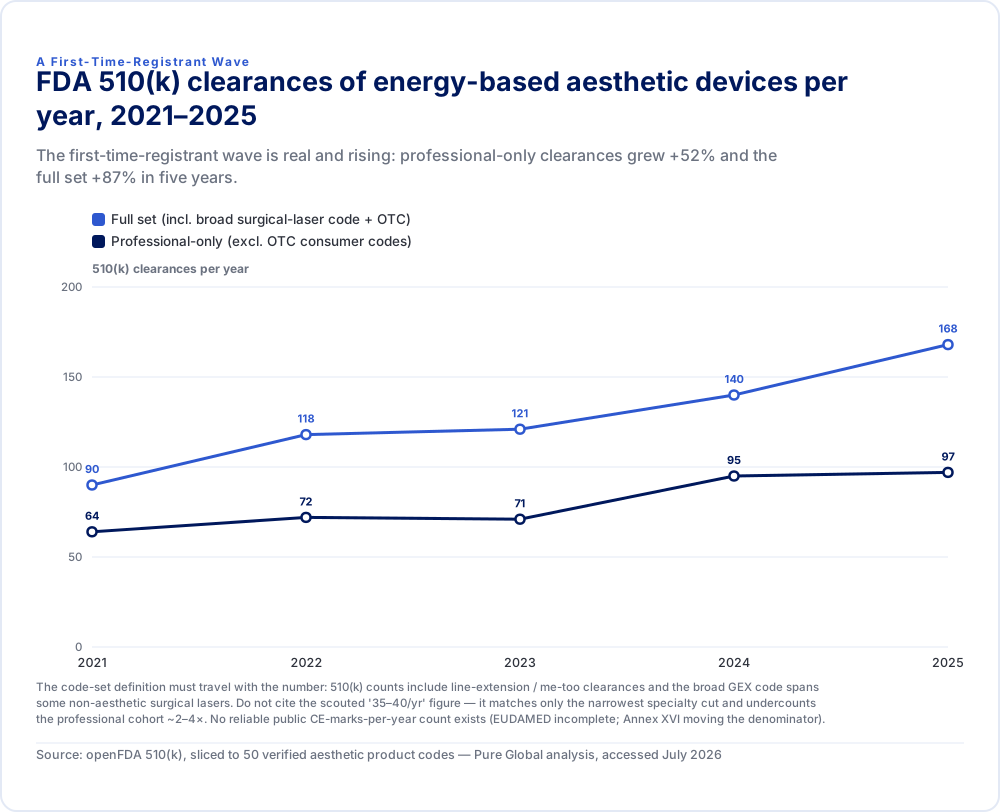
- The wave is real and rising. FDA cleared roughly 80–170 energy-based aesthetic 510(k)s per year over 2021–2025; the professional-only cohort grew 64 → 97 (+52%) and the full set 90 → 168 (+87%) — a first-time-registrant curve that climbs almost every year. 1
- One filler, five rulebooks. The identical HA filler is Class III / PMA in the US, Class III under EU MDR (now doubly regulated via Annex XVI), Class III plus a mandatory domestic clinical trial in China, Class III–IV, depending on intended use and composition, in Brazil, and Class III–IV — the top tier either way — in Korea. 2 3 4 5 6
- Every market forces a mandatory local representative — US Agent, EU Authorised Representative, China Domestic Agent, Korea License Holder, Brazil Registration Holder — and that legally required role is where competitors bury variable, opaque pricing. Pure Global prices it flat: US Agent $1,000/yr, most markets $2,000, up to $3,000 for higher-risk classes — one device across four markets is $9,000/yr flat. Source
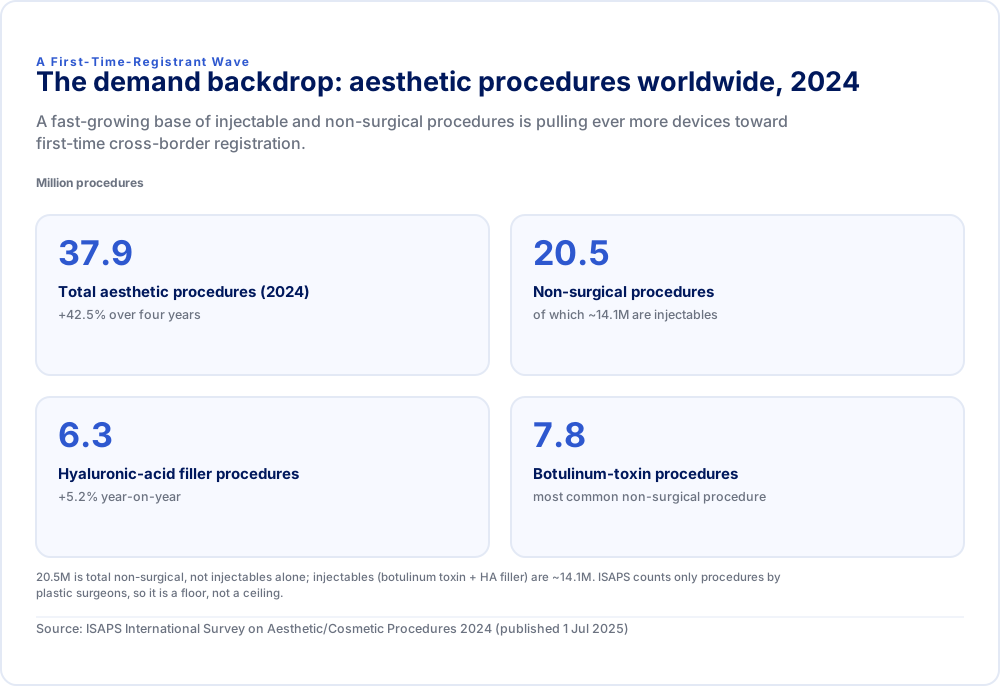
- The demand backdrop is a floor, not a ceiling. ISAPS counted 37.9M aesthetic procedures in 2024 (+42.5% over four years), of which 20.5M were non-surgical and ~14.1M injectable — botulinum toxin 7.8M and HA filler 6.3M, with HA up +5.2% year-on-year. 7
1. Why now: a first-time-registrant wave
A structural wave of first-time cross-border registrants is forming, and the clearest leading indicator sits inside the FDA's own record. The number of energy-based aesthetic devices clearing the US 510(k) pathway has risen in almost every year of this decade — not because incumbents are re-filing, but because new entrants keep arriving at the front door. Depending on how tightly the aesthetic-energy code set is drawn, the FDA cleared between roughly 80 and 170 of these devices per year across 2021–2025, and both defensible cuts point the same way. The full set (all energy, light, RF, HIFU and laser codes) climbed 90 → 168, up 87%; the professional-only cut (excluding OTC consumer codes) rose 64 → 97, up 52%. 1
One methodological caution must travel with the number: the code-set definition has to be stated alongside it, because 510(k) tallies fold in line-extension and me-too clearances, and the broad surgical-laser code spans some non-aesthetic lasers. A narrower "35–40 per year" figure that sometimes circulates comes from trade-press estimates rather than an openFDA tally, and undercounts the professional cohort by roughly 2×. There is no reliable European counterpart — no public CE-marks-per-year count exists, because EUDAMED is incomplete and Annex XVI is actively moving the denominator — so the EU wave can only be described qualitatively. 1
| Full set (incl. broad surgical-laser code + OTC) | Professional-only (excl. OTC consumer codes) | |
|---|---|---|
| 2021 | 90 | 64 |
| 2022 | 118 | 72 |
| 2023 | 121 | 71 |
| 2024 | 140 | 95 |
| 2025 | 168 | 97 |
The code-set definition must travel with the number: 510(k) counts include line-extension / me-too clearances and the broad GEX code spans some non-aesthetic surgical lasers. Do not cite the scouted '35–40/yr' figure — it matches only the narrowest specialty cut and undercounts the professional cohort ~2–4×. No reliable public CE-marks-per-year count exists (EUDAMED incomplete; Annex XVI moving the denominator).
Source: openFDA 510(k), sliced to 50 verified aesthetic product codes — Pure Global analysis, accessed July 2026
The demand base is deep, and it is injectable-led
The registration wave rides on a large and fast-growing pool of procedures. ISAPS counted 37.9M aesthetic procedures worldwide in 2024, up 42.5% over four years, split into 17.4M surgical and 20.5M non-surgical. Injectables dominate the non-surgical side at roughly 14.1M — botulinum toxin 7.8M and HA filler 6.3M, with HA growing 5.2% year-on-year. 7 Two precision flags matter for anyone quoting these figures: 20.5M is total non-surgical, not injectables alone; and because ISAPS captures only procedures performed by plastic surgeons, the count is a floor, not a ceiling. The direction of travel, however, is unambiguous — demand is compounding, and it skews toward exactly the injectable and energy-based device categories that face the steepest cross-border registration walls.
A First-Time-Registrant WaveThe demand backdrop: aesthetic procedures worldwide, 2024A fast-growing base of injectable and non-surgical procedures is pulling ever more devices toward first-time cross-border registration.Million procedures
- Total aesthetic procedures (2024)
- 37.9+42.5% over four years
- Non-surgical procedures
- 20.5of which ~14.1M are injectables
- Hyaluronic-acid filler procedures
- 6.3+5.2% year-on-year
- Botulinum-toxin procedures
- 7.8most common non-surgical procedure
20.5M is total non-surgical, not injectables alone; injectables (botulinum toxin + HA filler) are ~14.1M. ISAPS counts only procedures by plastic surgeons, so it is a floor, not a ceiling.
Source: ISAPS International Survey on Aesthetic/Cosmetic Procedures 2024 (published 1 Jul 2025)
Market access, not market size
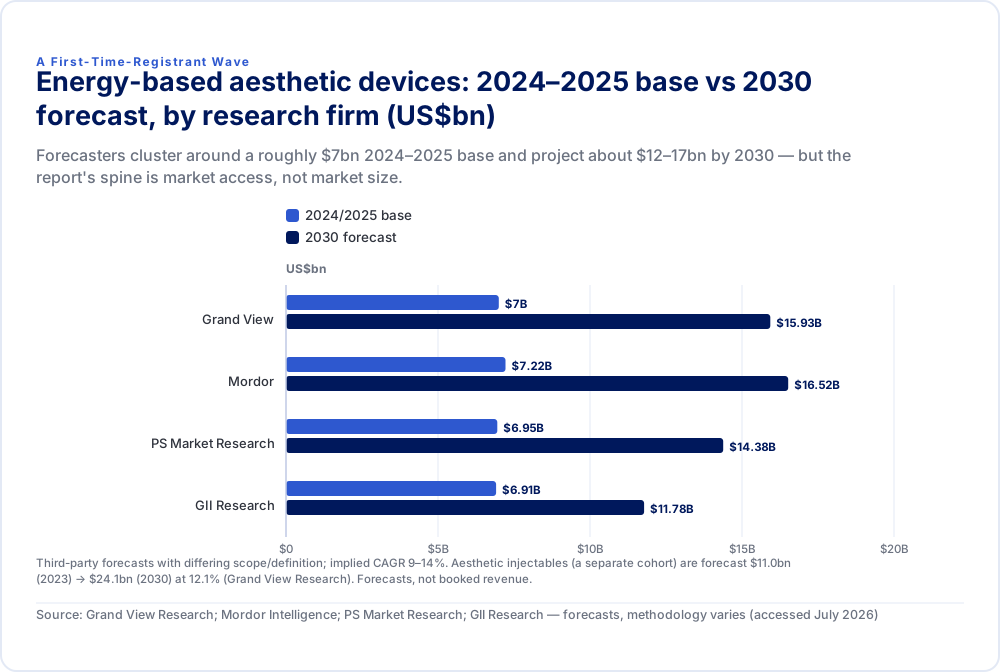
The dollar forecasts confirm the momentum without being the point of this report. Third-party analysts cluster around a ~$7bn (2024–2025) energy-based-device market roughly doubling to ~$14–16bn by 2030, at implied CAGRs of 9–14%. 8 9 10 The aesthetic-injectables cohort is on a similar trajectory — Grand View Research projects $11.0bn (2023) → $24.1bn (2030) at 12.1%. 11 These are forecasts, not booked revenue, and methodologies differ; treat them as backdrop. The spine of this briefing is deliberately market access, not market size — the growth curve is only interesting here because it means more manufacturers, more often, hitting the registration barrier for the first time.
| 2024/2025 base | 2030 forecast | |
|---|---|---|
| Grand View | $7B | $15.93B |
| Mordor | $7.22B | $16.52B |
| PS Market Research | $6.95B | $14.38B |
| GII Research | $6.91B | $11.78B |
Third-party forecasts with differing scope/definition; implied CAGR 9–14%. Aesthetic injectables (a separate cohort) are forecast $11.0bn (2023) → $24.1bn (2030) at 12.1% (Grand View Research). Forecasts, not booked revenue.
Source: Grand View Research; Mordor Intelligence; PS Market Research; GII Research — forecasts, methodology varies (accessed July 2026)
That barrier is not evenly distributed. Trade data underline why: on 2024 UN Comtrade figures, the large aesthetics-consuming markets are net importers of the relevant device categories — Brazil imports across the board, and even the US runs a net-import position in electro-medical devices — while production concentrates in a few exporters (China for consumables, Germany for electro-medical equipment). 12 The practical implication is that most sellers are cross-border sellers, and every cross-border seller hits the same in-country-representative-plus-registration wall the moment they leave home.
2. One filler, five rulebooks
"Aesthetic device" is not one regulatory animal — and the divergence starts inside a single market before it ever crosses a border. In the United States, the same catalogue can hold a Class III device and a Class II device that a lay observer would call cousins. An HA dermal filler is Class III / PMA: FDA product code LMH ("Implant, Dermal, For Aesthetic Use"), requiring Premarket Approval backed by a controlled US pivotal clinical study. FDA carries the classification on the product code itself — the 21 CFR node for LMH is not populated in the agency's classification database — so the correct reader-facing anchor is the product-code record, not a numbered CFR section. 2 13 An RF or laser energy device is Class II / 510(k): cleared to a predicate on special controls, a five-figure fee and a months-long timeline rather than a six-figure fee and a multi-year study. 14 Same "aesthetic device" shelf; two entirely different regulatory animals.
A Class II world with a small, high-barrier Class III core
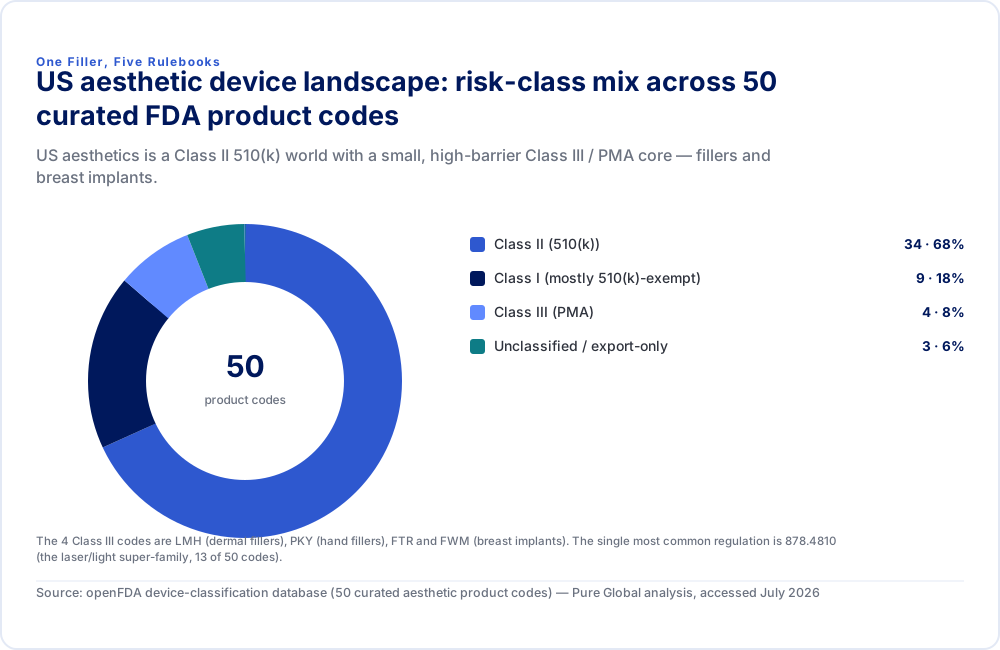
Zooming out to the full US aesthetic landscape sharpens the picture. Across 50 curated aesthetic FDA product codes, the distribution is Class II 34, Class I 9, Class III 4, with 3 unclassified or export-only — a Class II 510(k) world with a small, high-barrier Class III / PMA core. 15 The four Class III codes are the usual high-stakes suspects: LMH (dermal fillers), PKY (hand fillers), and FTR/FWM (breast implants). Energy-based devices, by contrast, ride a well-worn 510(k) lane — the broad surgical-laser code alone accounts for 2,865 of 3,864 aesthetic 510(k)s, and RF, IPL, HIFU and powered microneedling are all Class II. 1
| Class distribution | |
|---|---|
| Class II (510(k)) | 34 |
| Class I (mostly 510(k)-exempt) | 9 |
| Class III (PMA) | 4 |
| Unclassified / export-only | 3 |
The 4 Class III codes are LMH (dermal fillers), PKY (hand fillers), FTR and FWM (breast implants). The single most common regulation is 878.4810 (the laser/light super-family, 13 of 50 codes).
Source: openFDA device-classification database (50 curated aesthetic product codes) — Pure Global analysis, accessed July 2026
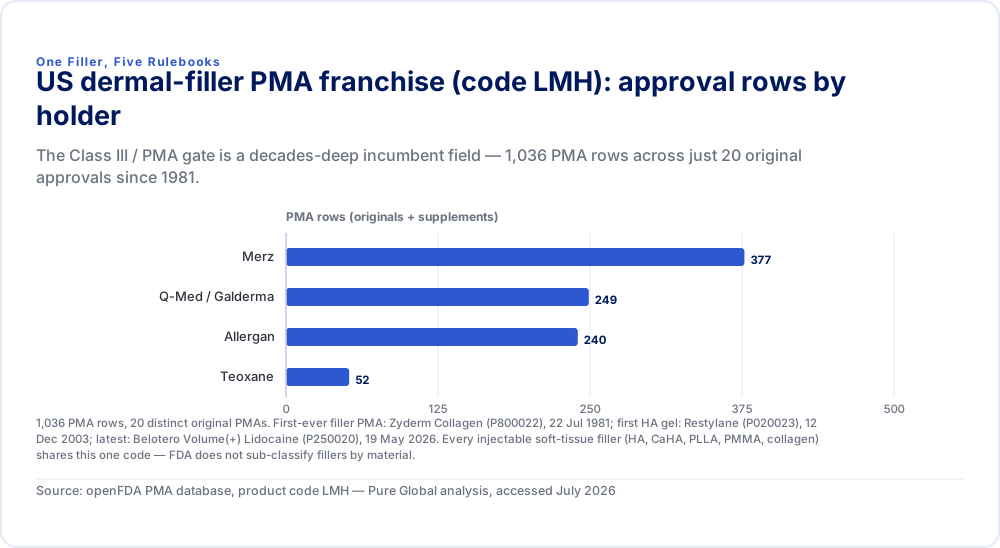
The Class III filler gate is not a formality; it is a decades-deep incumbent moat. The dermal-filler PMA franchise runs to 1,036 PMA rows across just 20 distinct original PMAs, from the first-ever filler approval (Zyderm Collagen, 1981) through the first HA gel (Restylane, 2003) to the latest 2026 entries. Four holders dominate — Merz 377, Q-Med/Galderma 249, Allergan 240, Teoxane 52 rows — and the FDA does not sub-classify fillers by material, so every cross-linked HA, CaHA, PLLA, PMMA and collagen product funnels through the same code. 16 For a first-time registrant, the read is blunt: the Class III PMA barrier is real, active (13 filler PMAs approved for new products or indications, March 2021 to May 2025), and expensive to clear. 17
| PMA rows | |
|---|---|
| Merz | 377 |
| Q-Med / Galderma | 249 |
| Allergan | 240 |
| Teoxane | 52 |
1,036 PMA rows, 20 distinct original PMAs. First-ever filler PMA: Zyderm Collagen (P800022), 22 Jul 1981; first HA gel: Restylane (P020023), 12 Dec 2003; latest: Belotero Volume(+) Lidocaine (P250020), 19 May 2026. Every injectable soft-tissue filler (HA, CaHA, PLLA, PMMA, collagen) shares this one code — FDA does not sub-classify fillers by material.
Source: openFDA PMA database, product code LMH — Pure Global analysis, accessed July 2026
The same filler, five markets, five rulebooks
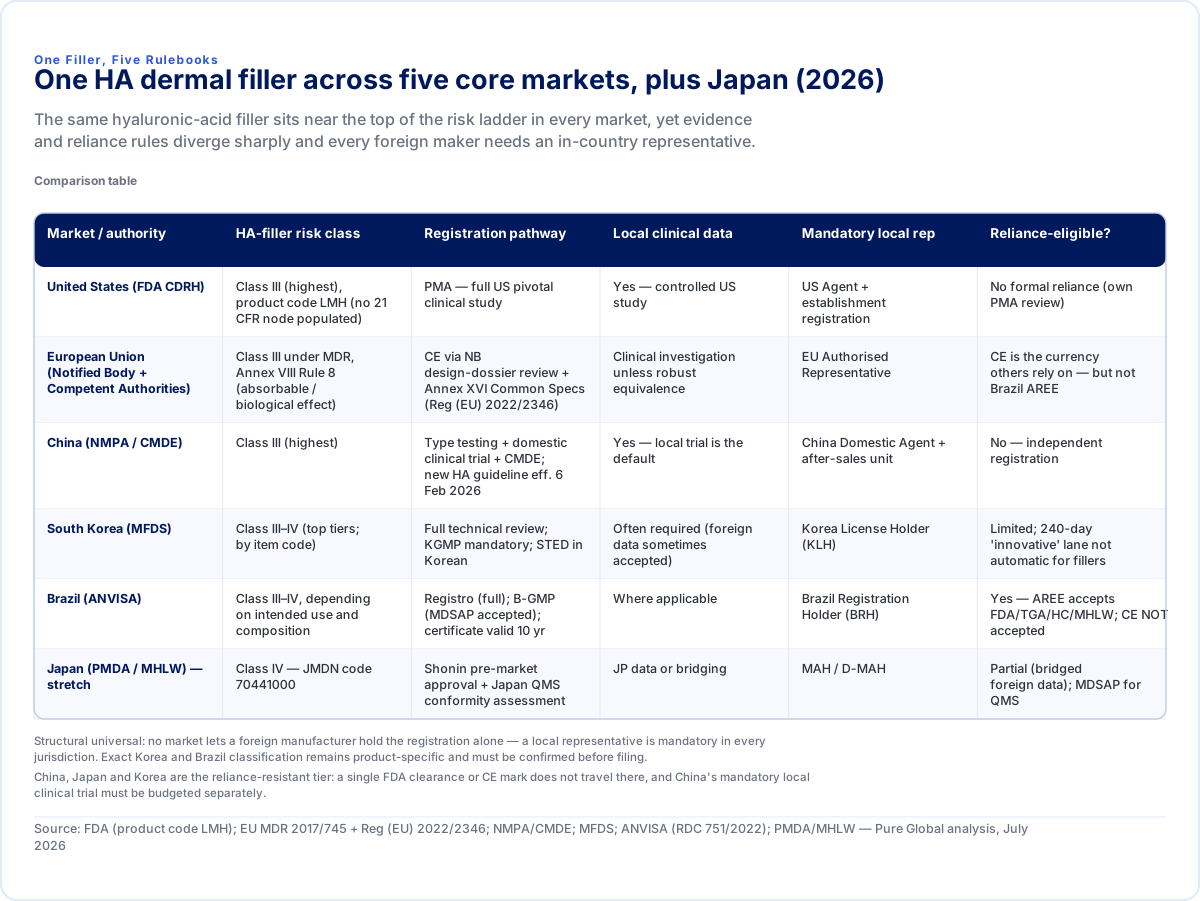
Now cross the borders, and the domestic two-tier split multiplies. Take the identical HA filler and run it through the five largest markets: it is Class III in the US (PMA, US pivotal study), Class III in the EU (MDR Annex VIII Rule 8, now also swept under Annex XVI's Common Specifications for products with no medical purpose), Class III plus a mandatory domestic clinical trial in China (with the CMDE HA-filler review guideline tightened effective 6 February 2026), Class III–IV, depending on intended use and composition, in Brazil, and Class III–IV in Korea depending on the item code — Korea's top tiers either way. 2 3 18 4 5 6 Japan, treated here as a stretch market, classifies injectable hyaluronic-acid soft-tissue material as Class IV under JMDN code 70441000. 19 20 The pathways diverge as sharply as the classes: PMA, CE via Notified Body design-dossier, China type-testing-plus-local-trial, Korea KGMP-plus-full-technical-review, Brazil registro. Underneath every one of them sits the same non-negotiable structure — no market lets a foreign manufacturer hold the registration alone. A local representative is legally mandatory in each.
| Market / authority | HA-filler risk class | Registration pathway | Local clinical data | Mandatory local rep | Reliance-eligible? |
|---|---|---|---|---|---|
| United States (FDA CDRH) | Class III (highest), product code LMH (no 21 CFR node populated) | PMA — full US pivotal clinical study | Yes — controlled US study | US Agent + establishment registration | No formal reliance (own PMA review) |
| European Union (Notified Body + Competent Authorities) | Class III under MDR, Annex VIII Rule 8 (absorbable / biological effect) | CE via NB design-dossier review + Annex XVI Common Specs (Reg (EU) 2022/2346) | Clinical investigation unless robust equivalence | EU Authorised Representative | CE is the currency others rely on — but not Brazil AREE |
| China (NMPA / CMDE) | Class III (highest) | Type testing + domestic clinical trial + CMDE; new HA guideline eff. 6 Feb 2026 | Yes — local trial is the default | China Domestic Agent + after-sales unit | No — independent registration |
| South Korea (MFDS) | Class III–IV (top tiers; by item code) | Full technical review; KGMP mandatory; STED in Korean | Often required (foreign data sometimes accepted) | Korea License Holder (KLH) | Limited; 240-day 'innovative' lane not automatic for fillers |
| Brazil (ANVISA) | Class III–IV, depending on intended use and composition | Registro (full); B-GMP (MDSAP accepted); certificate valid 10 yr | Where applicable | Brazil Registration Holder (BRH) | Yes — AREE accepts FDA/TGA/HC/MHLW; CE NOT accepted |
| Japan (PMDA / MHLW) — stretch | Class IV — JMDN code 70441000 | Shonin pre-market approval + Japan QMS conformity assessment | JP data or bridging | MAH / D-MAH | Partial (bridged foreign data); MDSAP for QMS |
Structural universal: no market lets a foreign manufacturer hold the registration alone — a local representative is mandatory in every jurisdiction. Exact Korea and Brazil classification remains product-specific and must be confirmed before filing.
China, Japan and Korea are the reliance-resistant tier: a single FDA clearance or CE mark does not travel there, and China's mandatory local clinical trial must be budgeted separately.
Source: FDA (product code LMH); EU MDR 2017/745 + Reg (EU) 2022/2346; NMPA/CMDE; MFDS; ANVISA (RDC 751/2022); PMDA/MHLW — Pure Global analysis, July 2026
And the energy device inverts the logic
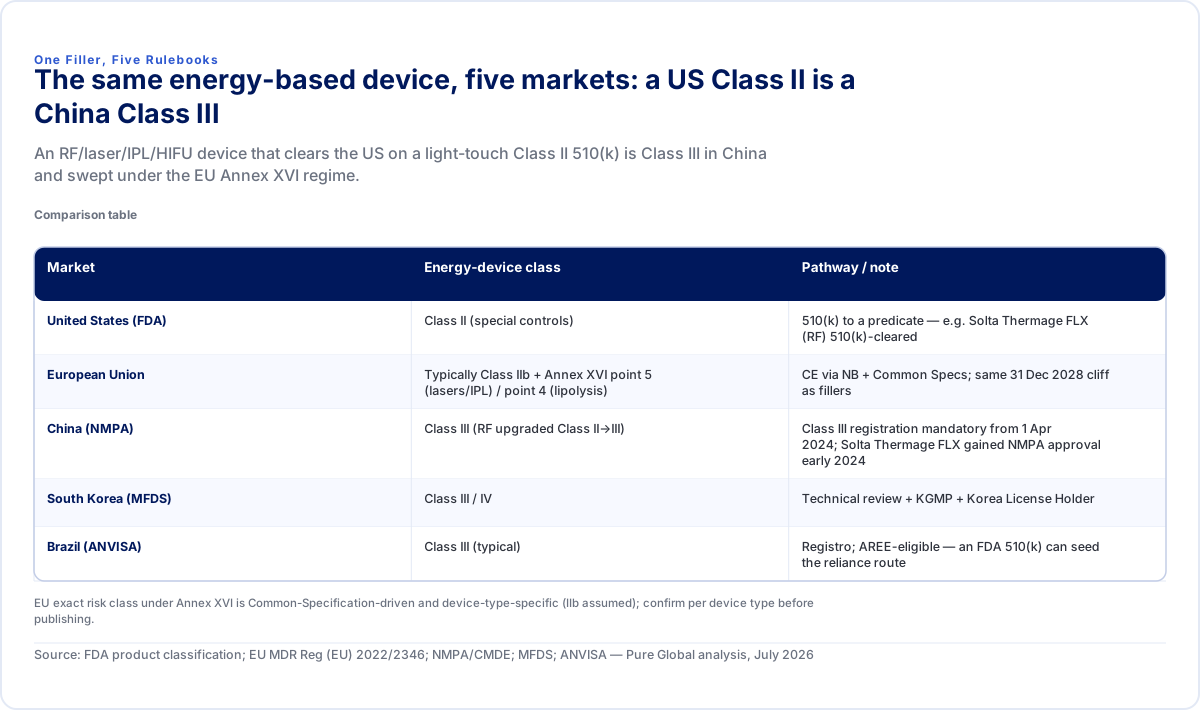
The energy-based device tells the mirror-image story: the light-touch US pathway becomes the heavy one abroad. What clears the US on a Class II 510(k) is Class III in China — NMPA upgraded RF aesthetic devices from Class II to Class III, and from 1 April 2024 they cannot be manufactured, imported or sold without a Class III registration certificate (Solta's Thermage FLX, US 510(k)-cleared, secured NMPA Class III approval in early 2024). 21 14 In the EU, the same laser/IPL platform is typically Class IIb and pulled under Annex XVI point 5, facing the same 31 December 2028 transition cliff as fillers. 18 The lesson for sequencing an international rollout: a US 510(k) is a fast, cheap anchor at home that buys far less abroad than its holder expects.
| Market | Energy-device class | Pathway / note |
|---|---|---|
| United States (FDA) | Class II (special controls) | 510(k) to a predicate — e.g. Solta Thermage FLX (RF) 510(k)-cleared |
| European Union | Typically Class IIb + Annex XVI point 5 (lasers/IPL) / point 4 (lipolysis) | CE via NB + Common Specs; same 31 Dec 2028 cliff as fillers |
| China (NMPA) | Class III (RF upgraded Class II→III) | Class III registration mandatory from 1 Apr 2024; Solta Thermage FLX gained NMPA approval early 2024 |
| South Korea (MFDS) | Class III / IV | Technical review + KGMP + Korea License Holder |
| Brazil (ANVISA) | Class III (typical) | Registro; AREE-eligible — an FDA 510(k) can seed the reliance route |
EU exact risk class under Annex XVI is Common-Specification-driven and device-type-specific (IIb assumed); confirm per device type before publishing.
Source: FDA product classification; EU MDR Reg (EU) 2022/2346; NMPA/CMDE; MFDS; ANVISA — Pure Global analysis, July 2026
3. The EU MDR Annex XVI cliff
For two decades, the cheapest way to sell an aesthetic filler or an IPL device in Europe was to call it cosmetic. A product marketed for a purely cosmetic purpose — no medical claim — fell outside device law entirely, sidestepping Notified Body review, clinical evidence and CE marking. That runway ends on 31 December 2028. The EU has deliberately closed the "it's cosmetic, not a device" loophole, and both of this report's representative products — the HA filler and the energy-based device — are caught by the same regime, on the same clock.
The mechanism: no-medical-purpose products, now inside the MDR
The lever is Annex XVI of the Medical Device Regulation (MDR 2017/745), which lists groups of products without an intended medical purpose and brings them under full device law 22. The operative rulebook is Commission Implementing Regulation (EU) 2022/2346, adopted 1 December 2022, which lays down the Common Specifications these products must meet 18. Those Common Specifications became applicable on 22 June 2023 18. From that date, a filler sold for looks alone is regulated exactly as if it carried a medical claim — the cosmetic-versus-medical distinction no longer changes the compliance burden.
For an absorbable HA filler, that burden is the top of the risk ladder. Under Annex VIII Rule 8, an implantable device that is wholly or mainly absorbed, or that has a biological effect, is Class III 3. The practical consequence: a full Notified Body design-dossier review, clinical evidence, and a mandatory EU Authorised Representative for any non-EU manufacturer before the product can be placed on the market 23.
Scope: both representative products are caught
The Annex XVI list is specific, and it sweeps in both device families this report tracks:
- Point 3 — dermal and mucous-membrane fillers: substances or items for facial or other dermal or mucous-membrane filling by subcutaneous, submucous or intradermal injection 22.
- Point 4 — equipment for lipolysis and adipose-tissue reduction 22.
- Point 5 — high-intensity electromagnetic radiation (lasers and intense pulsed light) for skin resurfacing, tattoo or hair removal 22.
The significance is that the cliff is not a filler-only event. A laser or IPL device that clears the US on a light-touch Class II 510(k) faces the same Common Specifications and the same transition deadline in Europe 18. One product, two regulatory identities — and the European identity just got heavier.
The timeline: a 2028/2029 hard stop, gated in 2027
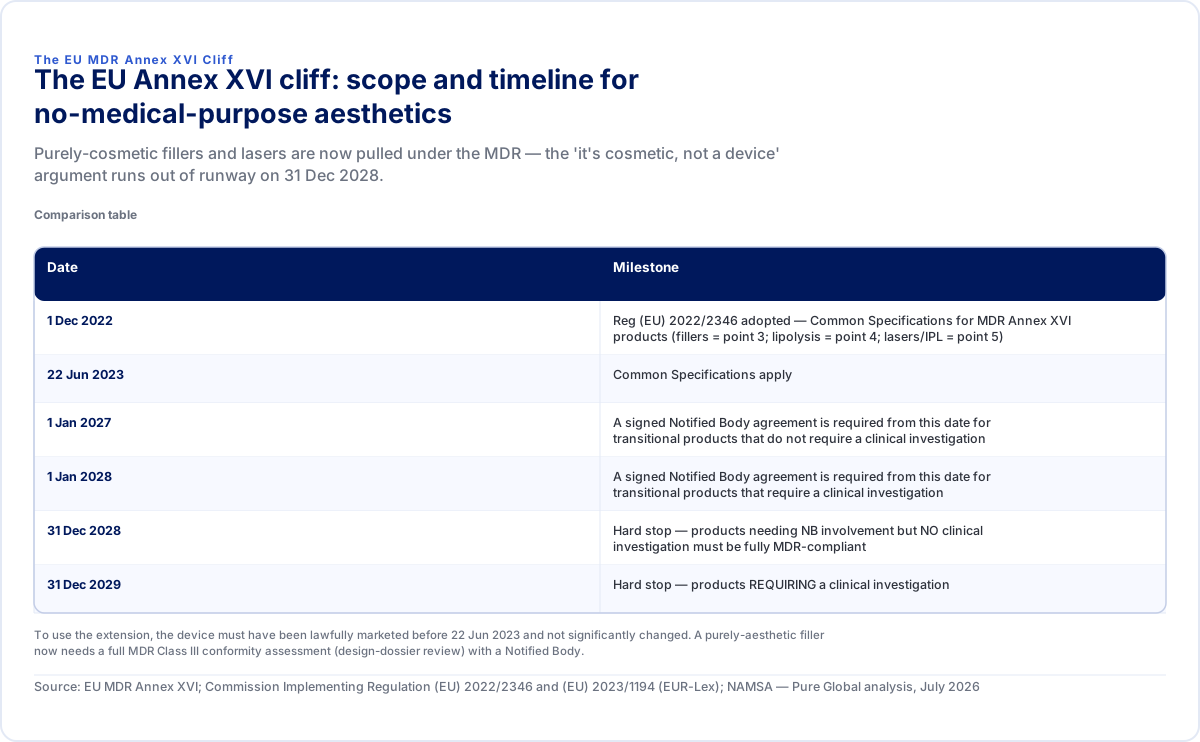
The original hard stop was 22 June 2025 for products that need Notified Body involvement but no clinical investigation. Commission Implementing Regulation (EU) 2023/1194 (21 June 2023) extended that to 31 December 2028; products that require a clinical investigation get until 31 December 2029 24. The extension is not automatic. To claim it, the device must have been lawfully marketed before 22 June 2023 and not significantly changed since, and the manufacturer must have a signed written agreement with a Notified Body for the conformity assessment — from 1 January 2027 for products that do not require a clinical investigation, and from 1 January 2028 for products that do 24 25.
| Date | Milestone |
|---|---|
| 1 Dec 2022 | Reg (EU) 2022/2346 adopted — Common Specifications for MDR Annex XVI products (fillers = point 3; lipolysis = point 4; lasers/IPL = point 5) |
| 22 Jun 2023 | Common Specifications apply |
| 1 Jan 2027 | A signed Notified Body agreement is required from this date for transitional products that do not require a clinical investigation |
| 1 Jan 2028 | A signed Notified Body agreement is required from this date for transitional products that require a clinical investigation |
| 31 Dec 2028 | Hard stop — products needing NB involvement but NO clinical investigation must be fully MDR-compliant |
| 31 Dec 2029 | Hard stop — products REQUIRING a clinical investigation |
To use the extension, the device must have been lawfully marketed before 22 Jun 2023 and not significantly changed. A purely-aesthetic filler now needs a full MDR Class III conformity assessment (design-dossier review) with a Notified Body.
Source: EU MDR Annex XVI; Commission Implementing Regulation (EU) 2022/2346 and (EU) 2023/1194 (EUR-Lex); NAMSA — Pure Global analysis, July 2026
Read the dates as a funnel, not a single deadline. The 2028/2029 hard stops are what most sellers watch, but the binding action is the Notified Body agreement window — 2027 for products without a clinical investigation and 2028 for products that require one: with European NB capacity already strained under the MDR, a manufacturer that has not started conformity work by 2026 risks missing the agreement window and losing the transition entirely. The strategic takeaway for a first-time EU registrant is that "cosmetic" is no longer a positioning choice with regulatory upside — it is a full MDR Class III (filler) or Class IIb (energy) conformity assessment, and the meter is running.
4. China's tightening frontier, 2024-2026
China is moving in the same direction as the EU — toward higher classes and harder evidence — but on its own, reliance-resistant track. Over roughly four years, the NMPA has classed HA fillers at the highest tier, upgraded radiofrequency devices a full class, rewritten the core filler-review guideline to demand human clinical proof, and — via Hong Kong — pulled cosmetic injectables into device law for the first time. None of this can be shortcut with a foreign clearance: China grants no pre-market reliance for these Class III devices, so every tightening compounds directly into local time and cost.
HA fillers: Class III since 2022, and the evidence bar just rose
The NMPA's 10 November 2022 classification notice fixed the baseline: an injection filler intended to increase tissue volume is a Class III medical device, and a filler with added lidocaine is treated as a drug-device combination acting primarily as a device 26. Class III is the highest of China's three risk tiers, and it triggers the full apparatus — domestic type testing, a China clinical trial, and CMDE technical review, with a mandatory China legal agent and after-sales unit, on a certificate valid five years 27.
The freshness hook is what happened on 6 February 2026. CMDE issued the "Registration Review Guideline for Aesthetic Sodium Hyaluronate Injectable Fillers (2026 Revision)" (Announcement No. 5 of 2026), effective on publication and replacing the 2016 guideline 4. It raises the bar in four concrete ways: product-specific in vivo degradation studies, dosing that is justified by data, efficacy endpoints that must be supported by human clinical data, and labeling that exactly matches the clinically validated indications and injection sites 4 27. CMDE now evaluates the dossier as an integrated system rather than a stack of separable documents 27. The direction is unambiguous: local human clinical evidence is the default, and label-to-trial alignment removes the old habit of claiming broadly and testing narrowly. A rare 2024 CER-based approval exists as a narrow precedent, not a durable alternative pathway 27.
RF and energy: a live Class II-to-III reclassification
The energy side saw an even sharper move. The NMPA's "Registration Guideline for Radiofrequency Aesthetic Devices" (12 April 2023) upgraded RF aesthetic equipment from Class II to Class III, and, after a transition, from 1 April 2024 an RF device cannot be manufactured, imported or sold without a Class III registration certificate 21. This is the sharpest edge of the report's core thesis: the very device that rides a five-figure Class II 510(k) in the US now sits in China's highest tier, with type testing, a local clinical trial and CMDE review. Solta's Thermage FLX, a US 510(k)-cleared RF system, secured NMPA approval in early 2024 — a concrete marker of the higher bar clearing in practice 21.
Hong Kong: cosmetic injectables pulled into device law
The frontier extended again in mid-2026. On 13 May 2026, Hong Kong's Medical Device Division updated GN-00 (GN-00:2026-1(E)), adding an Appendix 1 that lists injectable dermal and mucous-membrane fillers as medical devices under the MDACS framework — reversing the prior practice of excluding cosmetic-only injectables 28 29. Hong Kong's regime is administrative rather than a full pre-market approval, but the signal matters: the last major "cosmetic, not a device" carve-out in Greater China is closing, and it closes in the same window as the EU cliff.
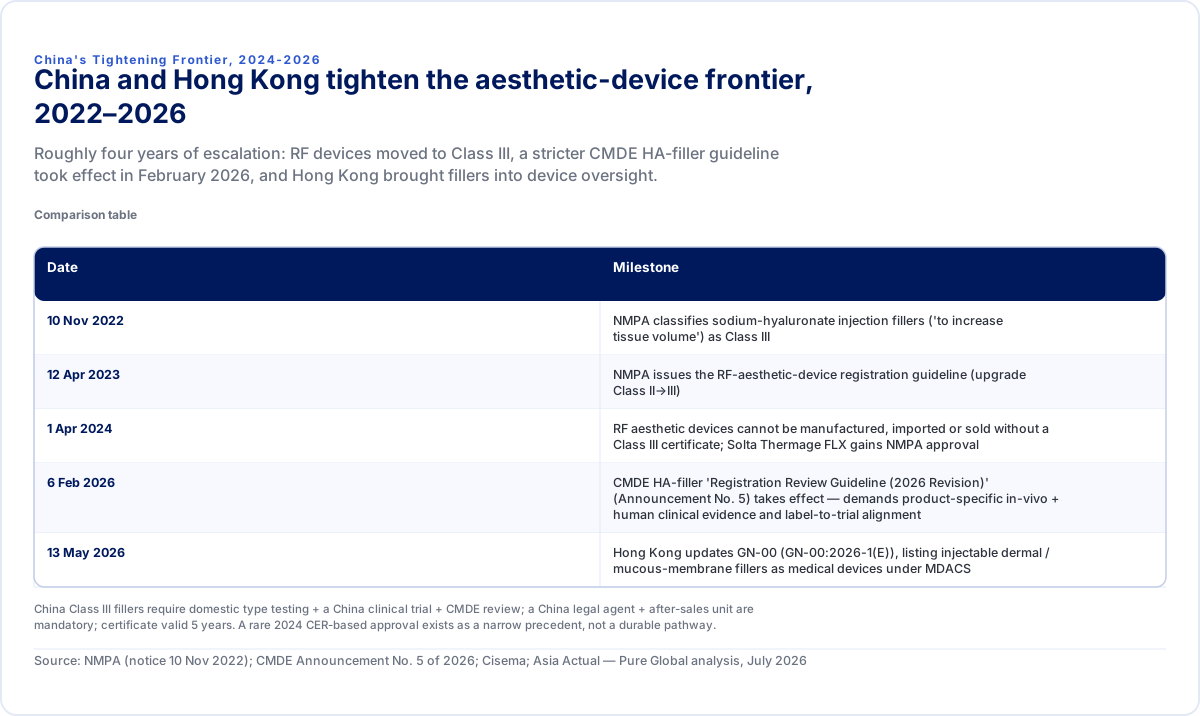
| Date | Milestone |
|---|---|
| 10 Nov 2022 | NMPA classifies sodium-hyaluronate injection fillers ('to increase tissue volume') as Class III |
| 12 Apr 2023 | NMPA issues the RF-aesthetic-device registration guideline (upgrade Class II→III) |
| 1 Apr 2024 | RF aesthetic devices cannot be manufactured, imported or sold without a Class III certificate; Solta Thermage FLX gains NMPA approval |
| 6 Feb 2026 | CMDE HA-filler 'Registration Review Guideline (2026 Revision)' (Announcement No. 5) takes effect — demands product-specific in-vivo + human clinical evidence and label-to-trial alignment |
| 13 May 2026 | Hong Kong updates GN-00 (GN-00:2026-1(E)), listing injectable dermal / mucous-membrane fillers as medical devices under MDACS |
China Class III fillers require domestic type testing + a China clinical trial + CMDE review; a China legal agent + after-sales unit are mandatory; certificate valid 5 years. A rare 2024 CER-based approval exists as a narrow precedent, not a durable pathway.
Source: NMPA (notice 10 Nov 2022); CMDE Announcement No. 5 of 2026; Cisema; Asia Actual — Pure Global analysis, July 2026
Taken together, the 2022-2026 sequence is a one-way ratchet. Every milestone raises the class, the evidence bar, or the scope — and because China, Hong Kong (and the wider East-Asian tier) do not accept a foreign clearance in lieu of local review, each step lands as real local trial time and cost, not paperwork that a US or EU approval can absorb. A first-time registrant should treat China as a separately budgeted, trial-gated market from day one, on a 24-48 month horizon rather than the months a US 510(k) implies.
5. What it costs and how long it takes
The government fee is a rounding error in every market except one. For an aesthetic-device manufacturer budgeting a cross-border launch, the instinct is to fixate on the fee an authority charges to review a file. That instinct is correct in exactly one jurisdiction — the United States — and misleading everywhere else.
The US: the one large government fee
Under MDUFA V, the FDA's fee schedule for fiscal year 2026 (effective 1 October 2025 through 30 September 2026) puts a filler's Premarket Approval at $579,272 for a standard applicant and $144,818 for a qualified small business 30 30. The energy-device number is an order of magnitude lower: a 510(k) is $26,067 ($6,517 small business), and a De Novo request is $173,782. Even the recurring annual establishment registration fee of $11,423 — which every foreign establishment pays, with no small-business discount and up 23.1% year over year — dwarfs the entire government cost of registering the same device across most of Asia or Latin America. 30
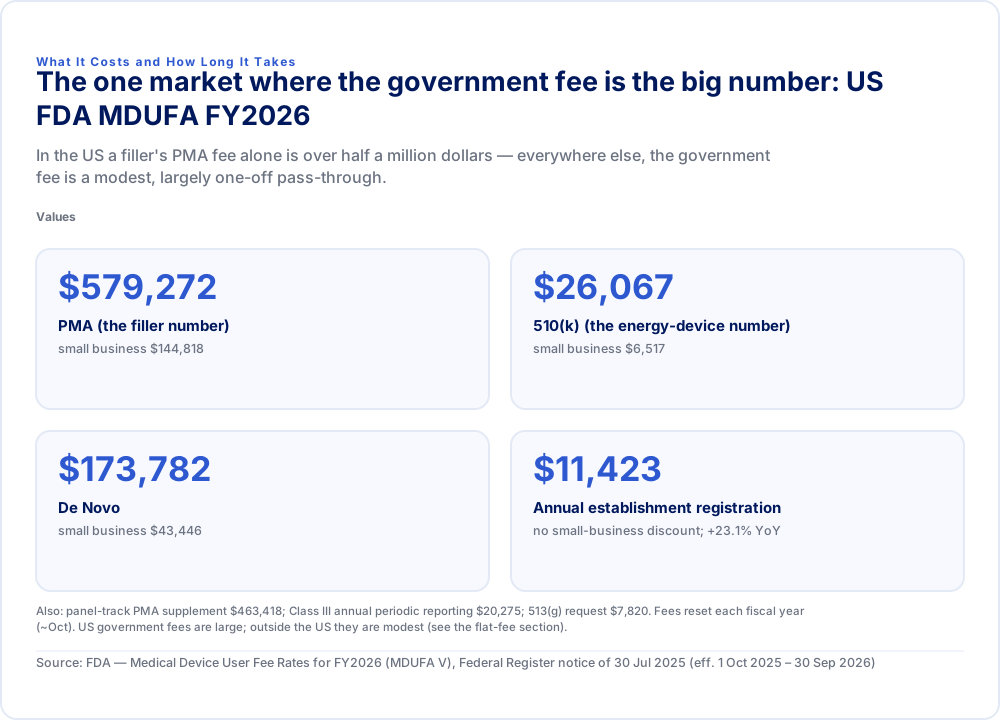
What It Costs and How Long It TakesThe one market where the government fee is the big number: US FDA MDUFA FY2026In the US a filler's PMA fee alone is over half a million dollars — everywhere else, the government fee is a modest, largely one-off pass-through.Values
- PMA (the filler number)
- $579,272small business $144,818
- 510(k) (the energy-device number)
- $26,067small business $6,517
- De Novo
- $173,782small business $43,446
- Annual establishment registration
- $11,423no small-business discount; +23.1% YoY
Also: panel-track PMA supplement $463,418; Class III annual periodic reporting $20,275; 513(g) request $7,820. Fees reset each fiscal year (~Oct). US government fees are large; outside the US they are modest (see the flat-fee section).
Source: FDA — Medical Device User Fee Rates for FY2026 (MDUFA V), Federal Register notice of 30 Jul 2025 (eff. 1 Oct 2025 – 30 Sep 2026)
These figures reset each fiscal year, typically in October, so any budget built on them carries a roughly twelve-month shelf life.
Everywhere else: a modest pass-through
Outside the US, the government fee is small and largely one-off. Brazil's ANVISA notification runs about BRL 1,405.73 (~US$280) and a full registro for a small/medium device family about BRL 8,509.92 (~US$1,700); Malaysia's MDA charges MYR 500–3,000; Vietnam's fee is VND 0.5M–3M (~US$20–120) Source. These are illustrative pass-through anchors from the Pure Global Master Price List, 2026 (a dated company figure) — paid at cost, never marked up. They are order-of-magnitude anchors, not authority-published quotes: confirm the current figure against the issuing authority's own schedule (ANVISA, Malaysia MDA, Vietnam MoH) before committing a budget. The strategic read: outside the US, the authority's fee is not where the money or the risk sits.
Timelines: one to five years, and the tails are clinical
Cost is only half the frame; time is the other. Realistic durations to register a high-risk HA filler span roughly 12 to 60 months — about a fivefold range — and the long tails are the two markets that demand fresh human data. Pure Global market-access data, cross-checked against the authorities, puts the US PMA-plus-clinical path at 30–60 months and China's Class III-plus-domestic-trial path at 24–48 months, with the EU Class III Notified-Body route at 18–36 months, Brazil's Class IV registro at 14–24 months, and Korea's Class IV-plus-KGMP review at 12–24 months (attributed estimates, not commitments). Source
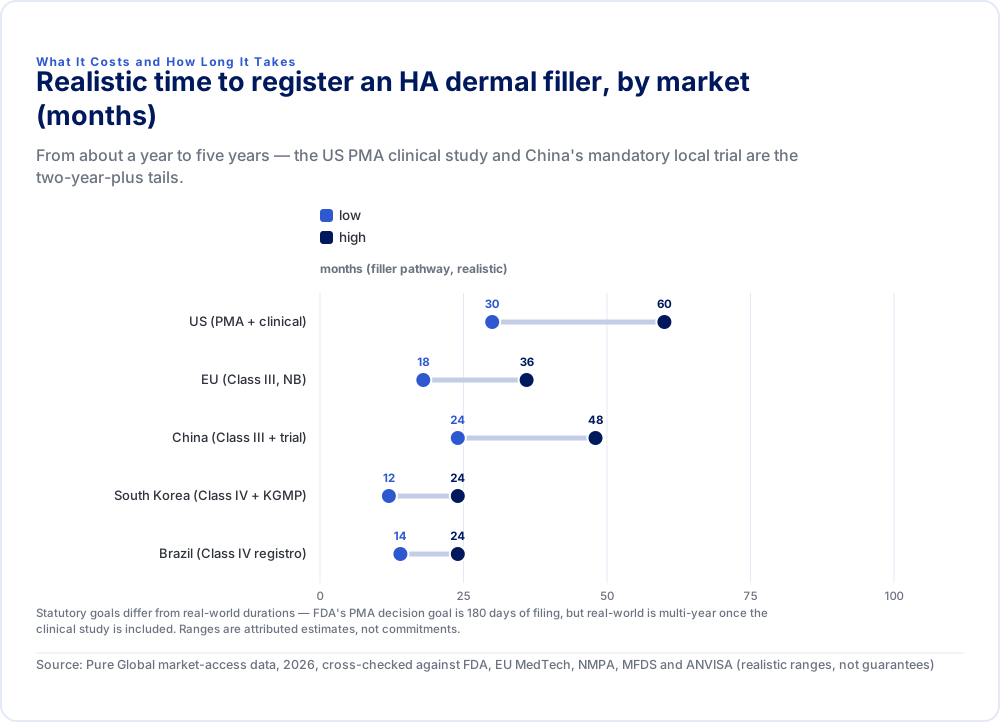
| low | high | |
|---|---|---|
| US (PMA + clinical) | 30 | 60 |
| EU (Class III, NB) | 18 | 36 |
| China (Class III + trial) | 24 | 48 |
| South Korea (Class IV + KGMP) | 12 | 24 |
| Brazil (Class IV registro) | 14 | 24 |
Statutory goals differ from real-world durations — FDA's PMA decision goal is 180 days of filing, but real-world is multi-year once the clinical study is included. Ranges are attributed estimates, not commitments.
Source: Pure Global market-access data, 2026, cross-checked against FDA, EU MedTech, NMPA, MFDS and ANVISA (realistic ranges, not guarantees)
A caution on reading statutory goals as delivery dates: the FDA's PMA decision goal is 180 days from filing, but the real-world clock is multi-year once the pivotal clinical study is built into it. 30 The gap between a published review-clock and an actual go-to-market date is exactly where under-budgeted launches stall.
6. The Pure Global flat-fee model
Every market forces a legally-mandatory in-country representative — and that recurring fee, not the government fee, is where the real cost and the real opacity live. A foreign manufacturer cannot hold a registration or place product on the market in the US, EU, China, Korea or Brazil without a designated local role. The only open question is whether the fee for that role is flat and disclosed, or variable and buried.
The mandatory role in each market
The requirement is statutory, not optional. In the US, every foreign establishment must designate a US Agent (FD&C Act §510; 21 CFR 807.40(b)) 31. A non-EU manufacturer must appoint a sole EU Authorised Representative before placing a device on the market (MDR 2017/745, Article 11) 23. An overseas registrant in China must name a domestic legal-person agent plus an after-sales unit (State Council Order 739, Article 20; NMPA Order 47) 32. Korea requires a licensed-importer Korea License Holder to hold the registration (Medical Devices Act) 33, and Brazil requires a locally-incorporated Registration Holder with a valid AFE (RDC 751/2022; RDC 16/2013) 34.
Priced flat, everything included
Where competitors bill this legally-required role hourly or as a percentage of sales, Pure Global publishes a flat annual fee: US Agent $1,000; most markets $2,000; up to $3,000 for higher-risk classes (Pure Global Master Price List, 2026 — a dated company figure). Source "Everything included" means the preparation and submission of the registration on a reference approval (for example a CE mark), renewals, modifications, and all correspondence with the authority — the same number in year one and in year five.
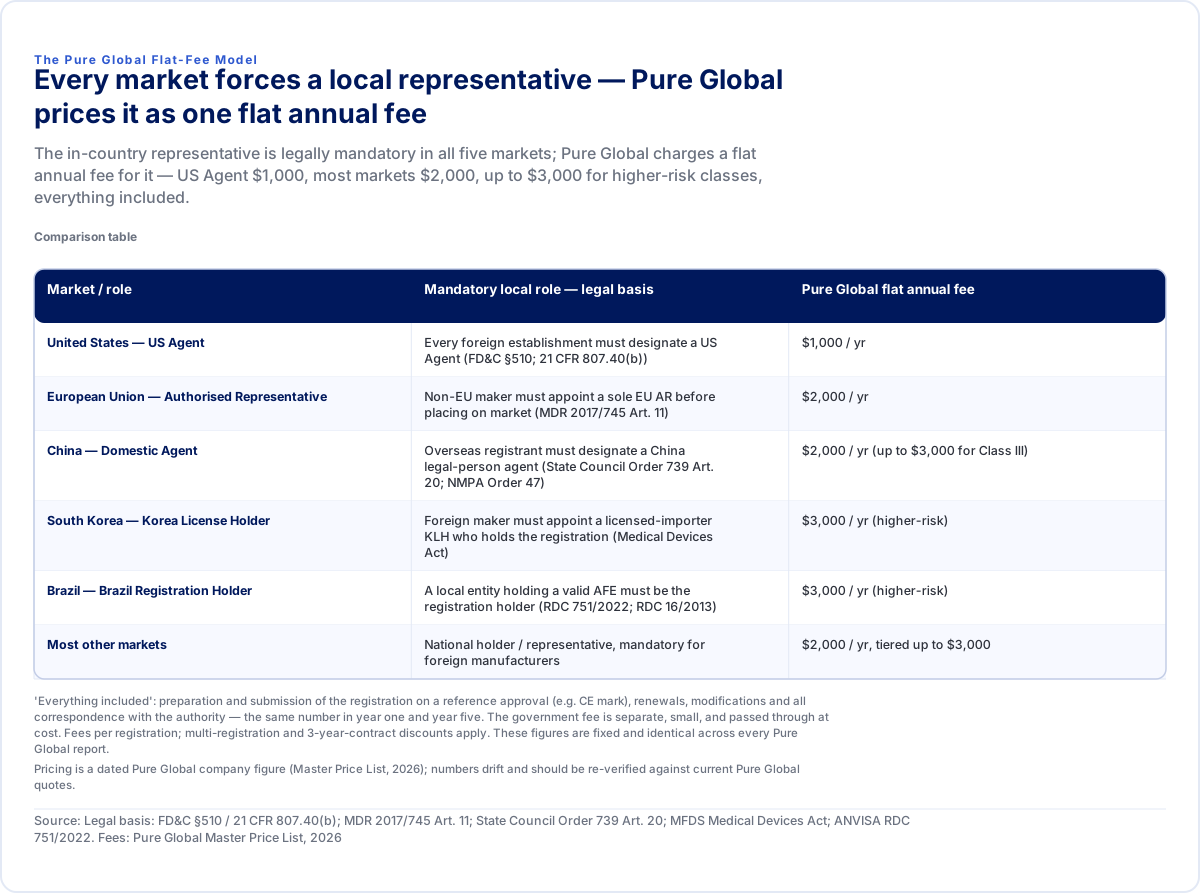
| Market / role | Mandatory local role — legal basis | Pure Global flat annual fee |
|---|---|---|
| United States — US Agent | Every foreign establishment must designate a US Agent (FD&C §510; 21 CFR 807.40(b)) | $1,000 / yr |
| European Union — Authorised Representative | Non-EU maker must appoint a sole EU AR before placing on market (MDR 2017/745 Art. 11) | $2,000 / yr |
| China — Domestic Agent | Overseas registrant must designate a China legal-person agent (State Council Order 739 Art. 20; NMPA Order 47) | $2,000 / yr (up to $3,000 for Class III) |
| South Korea — Korea License Holder | Foreign maker must appoint a licensed-importer KLH who holds the registration (Medical Devices Act) | $3,000 / yr (higher-risk) |
| Brazil — Brazil Registration Holder | A local entity holding a valid AFE must be the registration holder (RDC 751/2022; RDC 16/2013) | $3,000 / yr (higher-risk) |
| Most other markets | National holder / representative, mandatory for foreign manufacturers | $2,000 / yr, tiered up to $3,000 |
'Everything included': preparation and submission of the registration on a reference approval (e.g. CE mark), renewals, modifications and all correspondence with the authority — the same number in year one and year five. The government fee is separate, small, and passed through at cost. Fees per registration; multi-registration and 3-year-contract discounts apply. These figures are fixed and identical across every Pure Global report.
Pricing is a dated Pure Global company figure (Master Price List, 2026); numbers drift and should be re-verified against current Pure Global quotes.
Source: Legal basis: FD&C §510 / 21 CFR 807.40(b); MDR 2017/745 Art. 11; State Council Order 739 Art. 20; MFDS Medical Devices Act; ANVISA RDC 751/2022. Fees: Pure Global Master Price List, 2026
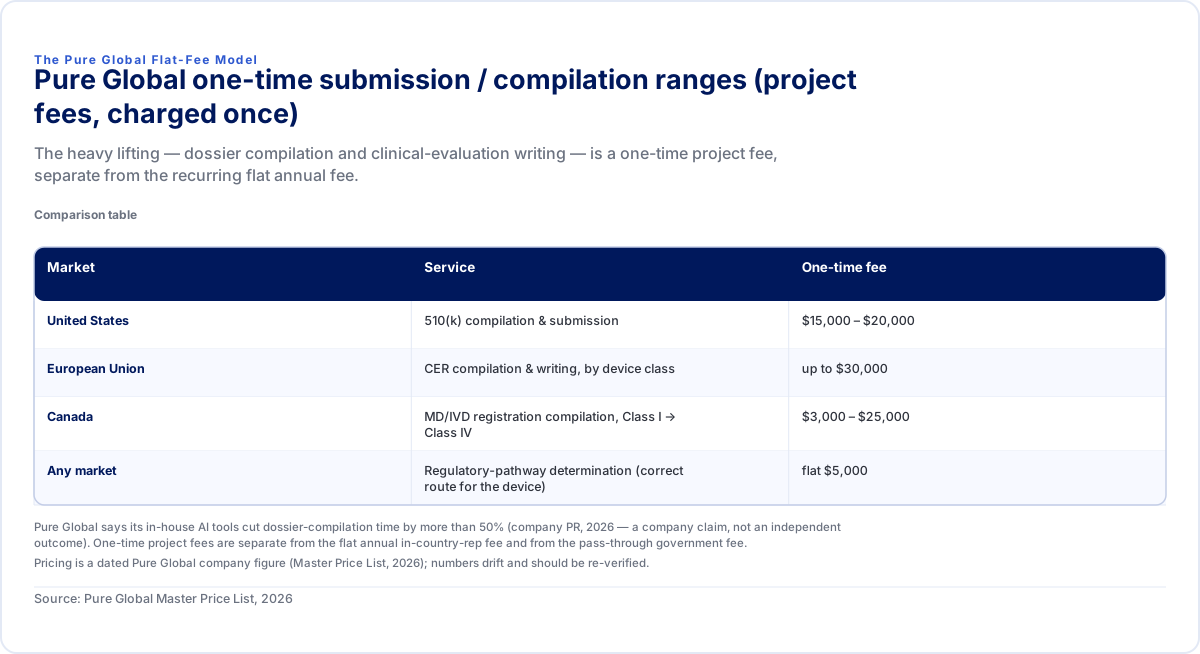
The heavy one-time lifting is priced separately, as a project fee charged once: US 510(k) compilation $15,000–$20,000; EU clinical-evaluation-report writing up to $30,000 by device class; Canadian registration compilation $3,000–$25,000 across Class I to IV; and a flat $5,000 regulatory-pathway determination to fix the correct route before any file is built (Pure Global Master Price List, 2026). Source Pure Global says its in-house AI tooling cuts dossier-compilation time by more than half — a company claim from its 2026 PR, not an independently verified outcome. Source
| Market | Service | One-time fee |
|---|---|---|
| United States | 510(k) compilation & submission | $15,000 – $20,000 |
| European Union | CER compilation & writing, by device class | up to $30,000 |
| Canada | MD/IVD registration compilation, Class I → Class IV | $3,000 – $25,000 |
| Any market | Regulatory-pathway determination (correct route for the device) | flat $5,000 |
Pure Global says its in-house AI tools cut dossier-compilation time by more than 50% (company PR, 2026 — a company claim, not an independent outcome). One-time project fees are separate from the flat annual in-country-rep fee and from the pass-through government fee.
Pricing is a dated Pure Global company figure (Master Price List, 2026); numbers drift and should be re-verified.
Source: Pure Global Master Price List, 2026
Worked example: one device, four markets
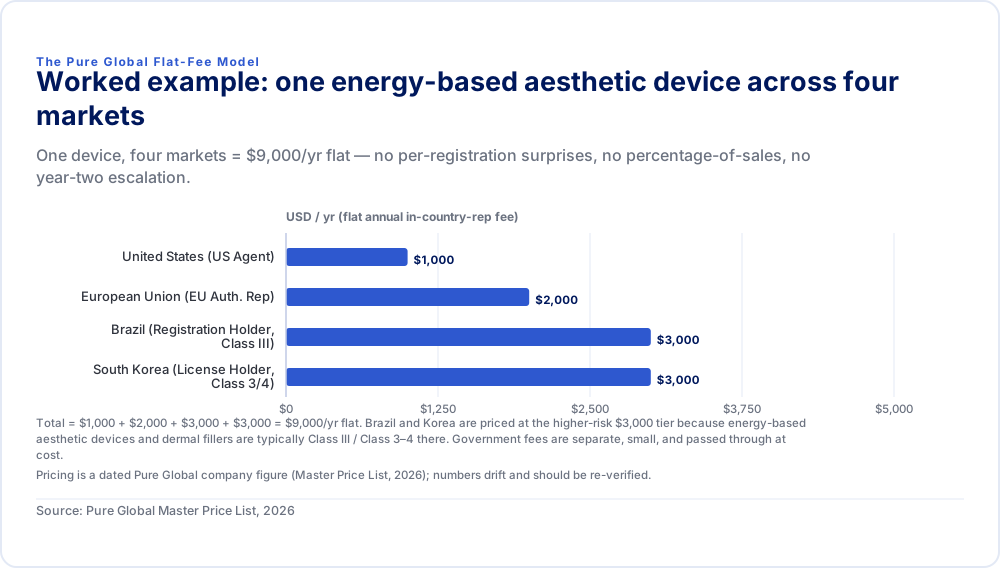
Consider a single energy-based aesthetic device — an RF or laser platform — launching across four markets. The in-country-representation cost is the sum of four flat annual fees: US Agent $1,000, EU Authorised Representative $2,000, Brazil Registration Holder $3,000 (energy devices are typically Class III there), and Korea License Holder $3,000. The arithmetic is exact — $1,000 + $2,000 + $3,000 + $3,000 = $9,000 per year, flat. Source
| Flat annual in-country-rep fee | |
|---|---|
| United States (US Agent) | $1,000 |
| European Union (EU Auth. Rep) | $2,000 |
| Brazil (Registration Holder, Class III) | $3,000 |
| South Korea (License Holder, Class 3/4) | $3,000 |
Total = $1,000 + $2,000 + $3,000 + $3,000 = $9,000/yr flat. Brazil and Korea are priced at the higher-risk $3,000 tier because energy-based aesthetic devices and dermal fillers are typically Class III / Class 3–4 there. Government fees are separate, small, and passed through at cost.
Pricing is a dated Pure Global company figure (Master Price List, 2026); numbers drift and should be re-verified.
Source: Pure Global Master Price List, 2026
There are no per-registration surprises, no percentage-of-sales, and no year-two escalation; the government fees sit separately, are small outside the US, and pass through at cost. Pure Global positions the model as an industry-first flat annual fee starting from US$2,000 per registration (company claim, PRNewswire 2026). Source For a first-time cross-border registrant, the value is less the headline number than the predictability: the recurring cost of staying compliant in four markets becomes a line item known in advance, not a variable that grows with the business.
7. Reliance: the lever and its limits
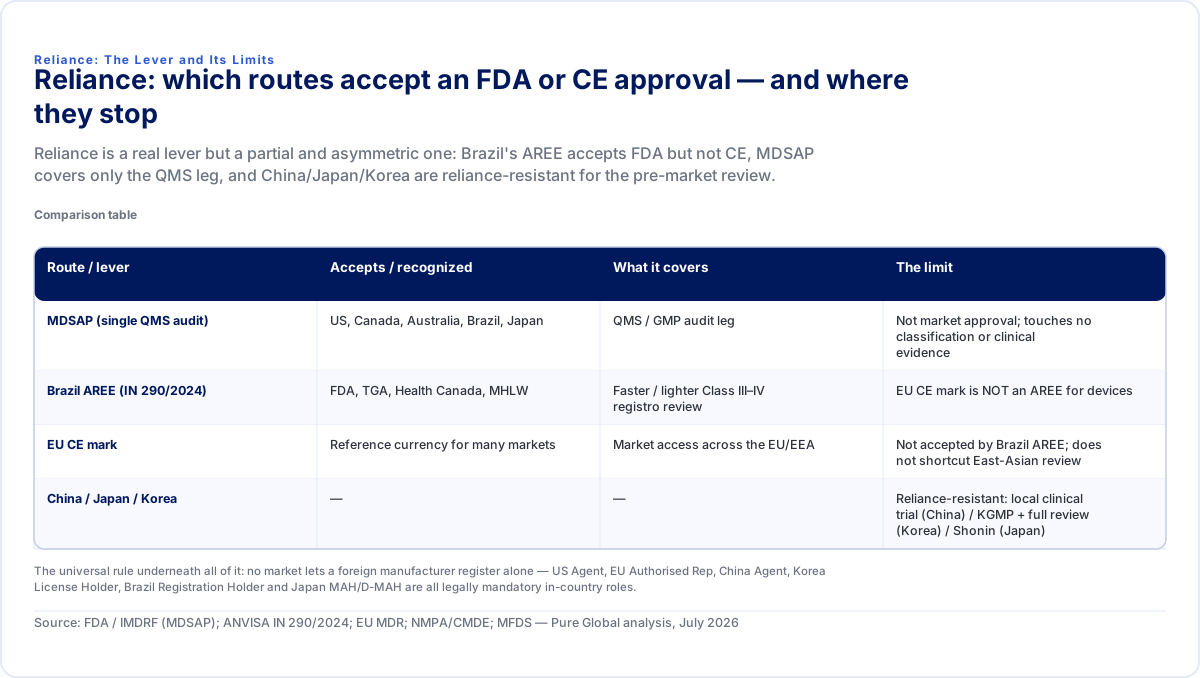
Reliance is real, but it is partial and asymmetric — it never travels the whole distance, and it never travels the same distance twice. Three global mechanisms let a maker reuse work done for one regulator elsewhere: MDSAP for the quality-system audit, Brazil's AREE for a foreign pre-market approval, and the CE mark as a reference currency. Each carries a hard boundary. None of them lets a foreign manufacturer register alone.
MDSAP covers the QMS leg — and only the QMS leg
The Medical Device Single Audit Program turns one ISO 13485-based quality-system audit into currency accepted by five regulators: US FDA, Health Canada, Australia's TGA, Brazil's ANVISA, and Japan's MHLW/PMDA 35. That is genuine leverage: Brazil accepts the MDSAP report toward a B-GMP certificate, and the FDA accepts it in lieu of a routine inspection 35. But MDSAP satisfies the quality-system leg only. It does not grant market approval, and it touches neither classification nor clinical evidence 35. It shortens one lane of the race; it does not enter the others.
Brazil AREE is the sharpest asymmetry: FDA yes, CE no
Brazil's IN 290/2024 (published 8 April 2024, effective 3 June 2024) lets Class III and IV registro applicants leverage a prior approval from an Equivalent Foreign Regulatory Authority (AREE) for a materially faster, lighter review 34. The four recognized AREEs are US FDA, Australia's TGA, Health Canada, and Japan's MHLW — and the EU CE mark is explicitly not an AREE for devices 34. This is the single biggest reliance asymmetry in the aesthetic-device set. An FDA-cleared energy device seeds a fast Brazil route; a CE-only version of the identical device does not. The anchor you choose first determines whether the second market opens cheaply — and choosing CE over FDA quietly forfeits the Brazil shortcut.
China, Japan and Korea are the reliance-resistant tier
For the Class III/IV aesthetic devices at the center of this report, China, Japan and Korea grant no pre-market reliance. China mandates a domestic clinical trial under the tightened CMDE HA-filler guideline effective 6 February 2026 4. Korea requires a full technical review plus mandatory KGMP 5. Japan requires Shonin pre-market approval, typically on bridged Japanese clinical data 20. In this tier a lone FDA or CE approval buys little beyond the MDSAP quality-system leg — the pre-market review is run from scratch, locally.
The universal rule underneath all of it
No market lets a foreign manufacturer register alone. A US Agent 31, an EU Authorised Representative 23, a China Domestic Agent 32, a Korea License Holder 33, a Brazil Registration Holder 34, and a Japan MAH/D-MAH are each a legally mandatory in-country role. Reliance can compress the review; it never removes the representative. That structural, non-negotiable local role is precisely the gap Pure Global's in-country-representation product fills.
| Route / lever | Accepts / recognized | What it covers | The limit |
|---|---|---|---|
| MDSAP (single QMS audit) | US, Canada, Australia, Brazil, Japan | QMS / GMP audit leg | Not market approval; touches no classification or clinical evidence |
| Brazil AREE (IN 290/2024) | FDA, TGA, Health Canada, MHLW | Faster / lighter Class III–IV registro review | EU CE mark is NOT an AREE for devices |
| EU CE mark | Reference currency for many markets | Market access across the EU/EEA | Not accepted by Brazil AREE; does not shortcut East-Asian review |
| China / Japan / Korea | — | — | Reliance-resistant: local clinical trial (China) / KGMP + full review (Korea) / Shonin (Japan) |
The universal rule underneath all of it: no market lets a foreign manufacturer register alone — US Agent, EU Authorised Rep, China Agent, Korea License Holder, Brazil Registration Holder and Japan MAH/D-MAH are all legally mandatory in-country roles.
Source: FDA / IMDRF (MDSAP); ANVISA IN 290/2024; EU MDR; NMPA/CMDE; MFDS — Pure Global analysis, July 2026
8. A market-entry sequencing playbook
Because no clearance travels cleanly, sequencing beats simultaneity — enter in three deliberate tiers rather than filing everywhere at once. The logic follows directly from Section 7: anchor where the approval becomes reusable currency, fan out fast where reliance is accepted, and quarantine the reliance-resistant markets into a separately budgeted tier. This is advisory framing, not a guarantee; timelines and fees are dated ranges that should be re-verified before commitment.
Tier 1 — Anchor on a reusable approval
Secure one strong reference approval first, because it is both the credibility signal and the raw material for every reliance route downstream. For an energy-based device, the FDA 510(k) is the fastest anchor: it rides the Class II lane at a US government fee of $26,067 (MDUFA FY2026) 30 and, critically, it seeds the Brazil AREE route 34. For an HA filler, the anchor is heavier — a Class III PMA at $579,272 with a controlled US pivotal study and a realistic 30–60-month clock 30 — so the CE mark may be the more practical first anchor for a European-based maker. The choice is strategic, not administrative: an FDA anchor unlocks Brazil, a CE anchor does not 34.
Tier 2 — Fast fan-out via reliance
With the anchor in hand, use it to compress the markets that accept reliance. An FDA approval accelerates the Brazil registro through AREE 34, while a single MDSAP audit clears the quality-system leg for Canada, Australia, Japan and Brazil in one pass 35. In each of these markets the mandatory in-country representative is appointed in parallel — the reliance shortens the review, but the representative is still required to hold or place the registration 3134. One caveat governs the whole tier: a CE-only maker cannot use the Brazil AREE lane, so the Tier 1 anchor choice must be made with Tier 2 in view.
Tier 3 — The trial-gated tier, budgeted separately
Treat China, Korea and Japan as a distinct programme with its own money and its own calendar. China requires a domestic clinical trial under the 2026 CMDE guideline 4 and runs a 24–48-month filler timeline (a Pure Global market-access estimate, not a commitment) Source; Korea layers KGMP onto a full technical review 5; Japan requires Shonin, usually on bridged local data 20. The anchor does not shortcut any of them — so the local-trial cost and the two-to-four-year timeline belong in a separate line of the budget, not folded into the reliance tiers. The energy-device case makes the point sharply: a US Class II 510(k) device is a Class III registration in China, mandatory since 1 April 2024 21. Even the "easy" anchor requires a fresh, higher-class filing to reach the China market.
Conclusion
The same device is a different regulatory animal in every major market, and the cost that decides a multi-market program is rarely the one buyers watch. Four takeaways carry the analysis:
- Same device, different class. One HA dermal filler is Class III in the US, EU and China, Class III–IV in Brazil and Korea depending on the exact product, and Class IV in Japan under JMDN code 70441000 19; a light-touch US Class II 510(k) energy device becomes Class III in China — so classification, not the product, sets the pathway, timeline and fee in each market 256421.
- The government fee is the small number. Outside the US PMA outlier of $579,272 30, government fees are modest, largely one-off pass-throughs — Brazil runs roughly $280–$1,700 (an illustrative company anchor; re-verify against ANVISA's own schedule) Source. The recurring, legally mandatory in-country-representative fee is the line item that compounds year over year.
- Every market forces a mandatory local rep. A US Agent, EU Authorised Representative, China Agent, Korea License Holder and Brazil Registration Holder are each non-optional; a foreign maker cannot hold the registration or place product without one 312334.
- Reliance is a partial, asymmetric lever. MDSAP covers only the quality-system leg across five regulators 35; Brazil's AREE accepts FDA but not the CE mark 34; and China, Japan and Korea remain reliance-resistant for the pre-market review 45.
Put together, the map is legible but unforgiving: the clearance you already hold travels only as far as each market's reliance rules allow, and every stop still demands a local representative. Pure Global provides that mandatory in-country representation as a published flat annual fee — competitors bill it as variable, opaque time — across 15+ markets directly and 30+ through its partner network SourceSource. For a first-time cross-border registrant weighing where to anchor and how to sequence, having classification, pathway, timeline and the real all-in cost in one place is the difference between a plan and a guess.
If you are mapping a specific injectable or energy-based device across markets, a good first step is a regulatory-pathway determination — a flat, one-time exercise that fixes the correct route, class and evidence bar in each target market before any dossier is built. Pure Global's team can walk your device through this classification-and-cost map market by market, and the current flat-fee schedule provides a transparent budgeting baseline; the figures above are dated ranges, so treat this as a starting point to pressure-test against the current authority schedules, not a commitment.
References
- openFDA 510(k) database, sliced to 50 verified aesthetic FDA product codes — Pure Global analysis, accessed July 2026 open.fda.gov ↩ ↩ ↩ ↩
- FDA — Product Classification database, product code LMH ("Implant, Dermal, For Aesthetic Use," Class III / PMA; the 21 CFR node is not populated for this code), accessdata.fda.gov, accessed July 2026 accessdata.fda.gov ↩ ↩ ↩ ↩
- EU MDR — Regulation (EU) 2017/745, Annex VIII classification rules (Rule 8: absorbable/biological-effect implants = Class III), medical-device-regulation.eu, accessed July 2026 medical-device-regulation.eu ↩ ↩ ↩
- CMDE (NMPA) — "Registration Review Guideline for Aesthetic Sodium Hyaluronate Injectable Fillers (2026 Revision)," Announcement No. 5 of 2026, effective 6 Feb 2026 cmde.org.cn ↩ ↩ ↩ ↩ ↩ ↩ ↩ ↩
- Emergo by UL — South Korea medical device classification (MFDS 4-tier system; HA filler top tier; Korea License Holder), accessed July 2026 emergobyul.com ↩ ↩ ↩ ↩ ↩ ↩
- ANVISA — dermal fillers are registered as Class III or IV medical devices under RDC No. 751/2022, updated 12 March 2026 gov.br ↩ ↩ ↩
- ISAPS — International Survey on Aesthetic/Cosmetic Procedures 2024 (37.9M procedures; 20.5M non-surgical; ~14.1M injectables), published 1 Jul 2025 isaps.org ↩ ↩
- Grand View Research — Energy-Based Aesthetic Devices Market report (2024 base ~$7bn; 2030 forecast $15.93bn @ 14.2% CAGR) — forecast grandviewresearch.com ↩
- Mordor Intelligence — Energy-Based Aesthetic Devices Market ($7.22bn 2025 → $16.52bn 2030 @ 14.4% CAGR) — forecast mordorintelligence.com ↩
- PS Market Research / GII Research — Energy-Based Aesthetic Devices Market ($6.95bn→$14.38bn @ 13.0%; GII $6.91bn→$11.78bn @ 9.4%) — forecasts psmarketresearch.com ↩
- Grand View Research — Aesthetic Injectables Market report ($11.0bn 2023 → $24.1bn 2030 @ 12.1% CAGR) — forecast grandviewresearch.com ↩
- UN Comtrade 2024 annual (HS6 medtech buckets 9018.31/32/39/90) — Pure Global analysis, accessed July 2026; directional only (broad codes, not aesthetic-specific) comtradeplus.un.org ↩
- FDA — "Dermal Fillers (Soft Tissue Fillers)," Aesthetic (Cosmetic) Devices, fda.gov, accessed July 2026 fda.gov ↩
- Solta Medical / PR Newswire — "Solta Medical Receives FDA 510(k) Clearance for Thermage FLX System" (RF energy-based device, Class II 510(k)) prnewswire.com ↩ ↩
- openFDA device-classification database (50 curated aesthetic product codes) — Pure Global analysis, accessed July 2026 open.fda.gov ↩
- openFDA PMA database (dermal-filler code LMH) — Pure Global analysis, accessed July 2026 open.fda.gov ↩
- FDA — Executive Summary, General Issues Panel on Dermal Fillers (13 dermal-filler PMAs approved Mar 2021–May 2025), 2025 fda.gov ↩
- Commission Implementing Regulation (EU) 2022/2346 — Common Specifications for MDR Annex XVI products (adopted 1 Dec 2022; applied 22 Jun 2023), EUR-Lex eur-lex.europa.eu ↩ ↩ ↩ ↩ ↩
- PMDA — Japanese Medical Device Nomenclature: hyaluronic-acid injectable soft-tissue material, JMDN code 70441000, Class IV std.pmda.go.jp ↩ ↩
- RC Market Analytics — "Regulatory Landscape for Hyaluronic Acid in Medical and Cosmetic Applications" (Japan PMD Act / Shonin / class), 2024–2026 rcmarketanalytics.com ↩ ↩ ↩
- Cisema — "China radio-frequency beauty devices regulated as Class III" (RF upgraded Class II→III, mandatory registration certificate from 1 Apr 2024; Solta Thermage FLX NMPA approval early 2024) cisema.com ↩ ↩ ↩ ↩ ↩
- EU MDR — Annex XVI (products without an intended medical purpose; point 3 fillers, point 4 lipolysis, point 5 lasers/IPL), medical-device-regulation.eu, accessed July 2026 medical-device-regulation.eu ↩ ↩ ↩ ↩
- EU MDR — Regulation (EU) 2017/745, Article 11 (mandatory EU Authorised Representative for non-EU manufacturers), EUR-Lex eur-lex.europa.eu ↩ ↩ ↩ ↩
- Commission Implementing Regulation (EU) 2023/1194 (21 Jun 2023) — amends 2022/2346; transition extended to 31 Dec 2028 (no clinical investigation) / 31 Dec 2029 (with), EUR-Lex eur-lex.europa.eu ↩ ↩
- NAMSA — "MDR Implementing Regulation for Annex XVI Published" (transition dates and Notified Body agreement requirement), 2023 namsa.com ↩
- NMPA — classification notice on medical sodium-hyaluronate products (injection filler to increase tissue volume = Class III), 10 Nov 2022 nmpa.gov.cn ↩
- Cisema — "China CMDE Releases 2026 Revision Guideline for Aesthetic HA Fillers," 2 Mar 2026 cisema.com ↩ ↩ ↩ ↩
- Cisema — "Hong Kong dermal fillers update" (GN-00 revision adds injectable fillers to MDACS), 2026 cisema.com ↩
- Asia Actual — "Hong Kong Updates MDACS Definition of Medical Device" (GN-00:2026-1(E), Appendix 1, 13 May 2026) asiaactual.com ↩
- FDA — "Medical Device User Fee Rates for Fiscal Year 2026" (MDUFA V), Federal Register notice of 30 July 2025; FDA MDUFA Fees page fda.gov ↩ ↩ ↩ ↩ ↩ ↩ ↩
- FDA — 21 CFR 807.40(b), designation of a US Agent for foreign device establishments (FD&C Act §510) accessdata.fda.gov ↩ ↩ ↩ ↩
- State Council Order No. 739, Regulations for the Supervision and Administration of Medical Devices (eff. 1 Jun 2021), Art. 20; NMPA Order No. 47 (2021) — mandatory China domestic agent for overseas registrants nmpa.gov.cn ↩ ↩
- MFDS — Medical Devices Act (의료기기법) and Enforcement Rule; import-licensing provisions requiring a Korea License Holder to hold the registration mfds.go.kr ↩ ↩
- ANVISA — RDC No. 751/2022 (Brazil Registration Holder requirement) and RDC No. 16/2013 (AFE — Autorização de Funcionamento) gov.br ↩ ↩ ↩ ↩ ↩ ↩ ↩ ↩ ↩ ↩
- FDA / IMDRF — Medical Device Single Audit Program (MDSAP): one QMS audit accepted by US FDA, Health Canada, Australia TGA, Brazil ANVISA and Japan MHLW/PMDA (QMS/GMP leg only) fda.gov ↩ ↩ ↩ ↩ ↩
 Market · Jul 24, 2026FDA US Medical Device RegistrationMarket · Jul 24, 2026EU Medical Device Classification & Regulation (MDR/IVDR)Market · Jul 24, 2026NMPA China Medical Device Registration & ApprovalCase Study · Aug 11, 2026Basic UDI-DI Grouping for Contrast DevicesCase Study · Aug 11, 2026Class III Dermal Fillers Under the EU MDRDevice Type · Jul 20, 2026Aesthetic Devices Regulation: FDA, EU MDR & Global GuideRegulatory Update · Oct 11, 2026EU First Device JCA SelectionRegulatory Update · Oct 1, 2026ANVISA–Hong Kong DH Cooperation MoURegulatory Update · Sep 17, 2026China NMPA GMP Inspection CriteriaRegulatory Update · Sep 17, 2026FDA Buffy Coat System Guidance
EUDAMED Registration Deadlines for Devices and Certificates in 2026
Separate mandatory use, device-registration backlog and certificate deadlines before judging an EUDAMED record or planning the next submission.

China GMP inspections: outsourcing registrants from November 2026
Prepare for 1 November 2026 with a verified comparison of the registrant’s and manufacturer’s minimum inspection chapters, graded requirements and release responsibilities.
QMSR Warning Letters 2026: The ISO 13485 Records FDA Named
Four posted FDA warning letters cite ISO 13485:2016 Clause 7.1 and name the missing records. Pull those first, then management-review and audit reports.
Let's Talk,
Anywhere You Are.
Whether looking for more information or ready to partner with us, we're here to guide you through every step of the regulatory process.
Contact us