Continuous Glucose Monitors: The Global Map of Regulation, Registration, and Market Access
The continuous glucose monitor is the fastest-scaling category in diabetes technology, and in 2024 it broke out of diabetes entirely — onto pharmacy shelves as an over-the-counter wellness product. Yet the same sensor is Class II in the U.S. (now sold OTC), Class IIb in the EU, and Class III in China. This report maps how every major regulator classifies, approves, and reimburses CGM — and why a single FDA clearance or CE mark clears none of the three gates (approval, reimbursement, intellectual property) by itself — with registration costs, timelines, and reliance routes across 30+ markets.
An evidence-based field guide to how the world's regulators classify, approve, reimburse, and litigate the wearable glucose sensor — and why a single FDA clearance or CE mark opens far fewer doors than it looks.
TL;DR
The continuous glucose monitor is the fastest-scaling category in diabetes technology, and in 2024 it broke out of diabetes entirely — onto pharmacy shelves as an over-the-counter wellness product. Yet the same sensor that a US consumer can now buy without a prescription is a higher-risk, prescription-only device almost everywhere else. Here is the argument of this report, and the six numbers that prove it.
- The US regulatory estate is a two-company club, and it is closed to China. In eight years the FDA has issued 37 CGM authorizations — exactly one De Novo and 36 subsequent 510(k) clearances — and 100% are held by US companies, with Dexcom (22) and Abbott (12) forming a 92% duopoly. Chinese CGM brands, which now outnumber imported brands inside China's own market, hold zero US clearances 1.
- Same sensor, three classes. A transcutaneous CGM is a Class II special-controls device in the US 2, a Class IIb in-body medical device in the EU — explicitly not an in-vitro diagnostic 3 — and a Class III device in China, Japan and Canada, with China demanding a local clinical trial 4. The class inflates as the device travels east.
- The 2024 OTC breakout ran on ordinary clearances, not new law. Dexcom's Stelo (cleared 5 March 2024) — the first OTC CGM in US history — plus Abbott's Lingo (cleared 29 May 2024) and Libre Rio (7 June 2024) were 510(k) clearances, not De Novos, filed under new consumer product codes inside the 2018 framework 56.
- A ~$13-billion market growing ~15% a year, on a 589-million-person base. Mainstream analyst estimates cluster at ~$12–14 billion for 2025 at roughly a 15% CAGR 78 — cross-checked by public company sales — sitting on a diabetes population of 589 million adults in 2024, heading for 853 million by 2050, 43% of them undiagnosed 9.
- Coverage is a second gate, and it does not open with approval. A clearance only puts a sensor on the shelf; a separate national reimbursement decision drives the volume. US Medicare opened coverage to non-insulin patients on 16 April 2023 10; England's NICE recommended CGM for all adults with type 1 diabetes in March 2022 11; Australia made it universal for type 1 on 1 July 2022 12. Reimbursement travels even less than approval.
- Intellectual property is a third gate, and it can shut overnight. Having ended a decade-long war with Dexcom in a 10-year truce (December 2024) 13, Abbott has won Unified Patent Court injunctions against SiBionics (across ~14 EU states, February 2025) and Sinocare/Menarini (The Hague, October 2025) — CE-marked Chinese sensors walled out of Europe by patent, not by regulator 14.
Three gates — approval, reimbursement, intellectual property — and no single clearance crosses any of the three by itself. The winners are not the companies with the best sensor; they are the ones that industrialize multi-market registration, reimbursement, and IP-aware sequencing. That is the gap Pure Global closes, across 30+ markets. The rest of this report is the map.
What a CGM actually is
Start with what the device measures, because it decides everything downstream. A continuous glucose monitor is a wearable that reads glucose in interstitial fluid — the fluid between cells just under the skin — not blood, via a thin sensor filament, and reports a new value every one to fifteen minutes for a fixed wear period 15. Because it reads interstitial rather than capillary glucose, there is a physiological lag of roughly five to ten minutes. That single fact — glucose measured in the body rather than in a drawn sample — is why, as we will see, the EU regulates a CGM as an in-body medical device and not as a blood test.
Everything a regulator or a buyer cares about turns on a small set of technical and labeling distinctions. Each one is a fork that can move the device up or down a risk class, add or remove a clinical-trial requirement, or decide whether a doctor must be in the loop.
| Distinction | The two options | Why it changes the regulatory answer |
|---|---|---|
| Data delivery | Real-time CGM (auto-pushes readings and alarms) vs. flash / intermittently-scanned CGM (the user must scan to see a value) | Automatic alarms raise the human-factors and safety bar; "flash" was historically the lower-cost, no-alarm tier 15 |
| Therapeutic claim | Adjunctive ("complements fingersticks") vs. non-adjunctive ("dose insulin on the sensor value alone") | The single most consequential label. A dosing claim demands far more accuracy evidence and unlocks reimbursement and closed-loop use 16 |
| Interoperability | Standalone sensor vs. integrated CGM (built to interoperate with insulin pumps and automated insulin delivery) | The FDA created "integrated CGM" as a distinct Class II special-controls category in 2018 so that compliant sensors clear via 510(k) rather than full premarket approval 17 |
| Calibration | User-calibrated (one to two daily fingersticks) vs. factory-calibrated (no fingersticks) | Factory calibration is a prerequisite for a credible no-fingerstick and over-the-counter product; it raises the manufacturing-consistency bar 18 |
| Form factor | Transcutaneous (disposable filament, 7–15 days) vs. implantable (surgically inserted, 90–365 days) | Implantable is higher-risk. In the US it stays Class III / premarket approval, not the Class II route the transcutaneous sensors use 19 |
| Access | Prescription (the historical default) vs. over-the-counter (the 2024 US breakout) | OTC removes the clinician from the loop and rewrites the go-to-market; the FDA created OTC-specific product codes in 2024 5 |
| Accuracy (MARD) | ~7–10% for modern sensors | Mean Absolute Relative Difference — the sensor's average error against a blood reference — is the headline number guideline bodies and buyers track. Lower is better 15 |
The distinction that matters most is the second one. In December 2016 the FDA cleared Dexcom's G5 for a non-adjunctive indication — the first CGM permitted to dose insulin without a confirmatory fingerstick 16. That "therapeutic" claim is what turned the CGM from a coaching tool into a device you can bet a life on, and it is the reason accuracy, alarms, and change control are policed so tightly.
Accuracy has quietly converged
The specification that regulators and payers weigh is MARD, and it has fallen to the point where the argument is nearly over. Abbott's Libre 3 reports roughly 7.9%, Dexcom's G7 roughly 8.2%, Senseonics' implantable Eversense E3 about 8.5–9.1%, and Medtronic's Guardian 4 under 9% 15. A decade ago a CGM at 15% MARD was a monitoring aid; a modern sensor near 8% is accurate enough to drive an automated insulin pump. The technology bar is largely settled. The regulatory bar, as the rest of this report shows, is anything but.
One note on the FDA's plumbing
Because the US data below rests on it, one point of vocabulary. The FDA files transcutaneous CGMs under a handful of three-letter product codes inside a single regulation — including the mainstream factory-calibrated integrated-CGM code used for Dexcom and Abbott sensors, and, new in 2024, two dedicated over-the-counter codes. The implanted Eversense sits in a separate, higher Class III code. We translate these into plain English throughout and never lean on the jargon; the point to hold is that one 2018 decision created the Class II highway that all 36 later clearances have driven down.
How we got here: two waves
The modern CGM is the product of two structural unlocks in the late 2010s, followed by two simultaneous breakouts — one on the supply side, one on the demand side — that between 2021 and 2024 changed who makes these sensors and who buys them.
From a blinded hospital tool to an over-the-counter sensor: 25 years of CGM (1999–2026)
CGM took 25 years to travel from a blinded 3-day hospital device (1999) to the first over-the-counter sensor (Dexcom Stelo, 2024) — a clinical foundation, then a Chinese supply wave, then a consumer-wellness breakout.
| Date | Milestone | Wave |
|---|---|---|
| 15 Jun 1999 | MiniMed CGMS (US PMA) — the first CGM ever; retrospective, professional, 3-day, patient blinded | Foundations |
| 2006 | First real-time consumer CGMs — Dexcom STS, Medtronic Paradigm | Foundations |
| 2015 | Dexcom G5 streams glucose to a phone | Foundations |
| 28 Sep 2016 | Medtronic MiniMed 670G — first hybrid closed-loop system | Foundations |
| 20 Dec 2016 | Dexcom G5 non-adjunctive — first CGM cleared to dose insulin without a confirmatory fingerstick | Foundations |
| 27 Sep 2017 | Abbott FreeStyle Libre (US) — first flash/is-CGM, factory-calibrated, mass market | Foundations |
| 27 Mar 2018 | Dexcom G6 iCGM De Novo — creates the Class II iCGM category, down-classifies from III to II and builds the 510(k) highway | Foundations |
| 21 Jun 2018 | Senseonics Eversense — first implantable CGM (US PMA, Class III; EU CE since 2016) | Foundations |
| Jun 2020 | Libre 2 iCGM (US) | Foundations |
| Sep 2020 | Libre 3 CE mark (EU) — roughly 2 years before its US clearance; the CE-before-FDA norm | Foundations |
| 4 Nov 2021 | Microtech AiDEX NMPA approval — first calibration-free CGM approved in China; the domestic supply wave begins | Supply wave (China) |
| 8 Dec 2022 | Dexcom G7 (US; CE Mar 2022) | Supply wave (China) |
| Oct 2023 | SiBionics GS1 CE (MDR) — a leading Chinese sensor enters Europe | Supply wave (China) |
| 5 Mar 2024 | Dexcom Stelo — the first OTC CGM in US history | Demand wave (OTC) |
| 29 May 2024 | Abbott Lingo — consumer wellness CGM | Demand wave (OTC) |
| 7 Jun 2024 | Abbott Libre Rio — OTC for T2D adults not on insulin | Demand wave (OTC) |
| 17 Sep 2024 | Eversense 365 — first 1-year CGM | Demand wave (OTC) |
| 21 Mar 2025 | Signos OTC — first non-incumbent OTC entrant | Demand wave (OTC) |
Source: US FDA PMA/510(k)/De Novo databases; company press releases; NMPA; EU CE notices — Pure Global, July 2026.
The category was born in the doctor's office. In June 1999 the FDA approved the Medtronic MiniMed CGMS — the first CGM ever — as a retrospective, professional, three-day sensor whose data the patient could not even see, and which lived, like every CGM for the next nineteen years, in Class III with full premarket approval 20. Real-time consumer sensors arrived in 2006 with Dexcom's STS and Medtronic's Paradigm, and Dexcom's G5 first streamed glucose to a phone in 2015 21.
Two events in 2016–2018 built the modern market. First, Medtronic's MiniMed 670G (September 2016) became the first hybrid closed-loop "artificial pancreas," letting a CGM drive automated insulin dosing 22. Second — and this is the single most consequential US CGM event — in March 2018 the FDA granted a De Novo for the Dexcom G6 and, with it, created the Class II integrated-CGM category with special controls, down-classifying interoperable CGM from III to II 17. That De Novo published accuracy thresholds a sensor must hit; any later sensor that meets them can reach market through an ordinary 510(k) instead of a novel classification. It is the on-ramp that made the US the world's fastest CGM approval regime — and, as we will keep returning to, it is exactly the elasticity the EU and China never built.
Mass-market Abbott arrived in between: the FreeStyle Libre, cleared in the US in September 2017, was the first factory-calibrated flash sensor to replace routine fingersticks and drove the category into the millions 23. The one deliberate exception to the Class II story is Senseonics' Eversense, the only implantable CGM, which entered US premarket approval as a Class III device in June 2018 and by September 2024 became the first year-long sensor 1924.
Then the two breakouts. On the supply side, China's domestic wave began in November 2021, when Microtech Medical's AiDEX became the first calibration-free CGM approved for sale in China 25; by October 2023 SiBionics' GS1 had won an EU CE mark under the MDR, the first leading Chinese sensor to enter Europe 26. On the demand side, the US OTC wave opened in March 2024 with Stelo, the first over-the-counter CGM in history, followed within three months by Abbott's Lingo and Libre Rio 56. Note the correction that matters: those OTC launches were 510(k) clearances under new consumer product codes, not De Novos. The only CGM De Novo remains the 2018 Dexcom G6. The OTC breakout is proof of how far the 2018 framework could stretch — a whole new consumer category absorbed without a single new classification proceeding.
Between the two incumbents there is one telling asymmetry. The CE mark routinely precedes the FDA clearance: Abbott's Libre 3 and Dexcom's G7 were both CE-marked in Europe months to years before they cleared in the US 2728. Europe is easier to enter first and harder to stay in — a theme the reimbursement and IP gates will sharpen.
How big, how fast, and where it is sold, made, and approved
The headline is simple and the sub-headline is the whole report: CGM is a roughly $13-billion market compounding at about 15% a year, and the places where these sensors are sold, made, and approved are three different maps that do not overlap.
The market: a range, not a number
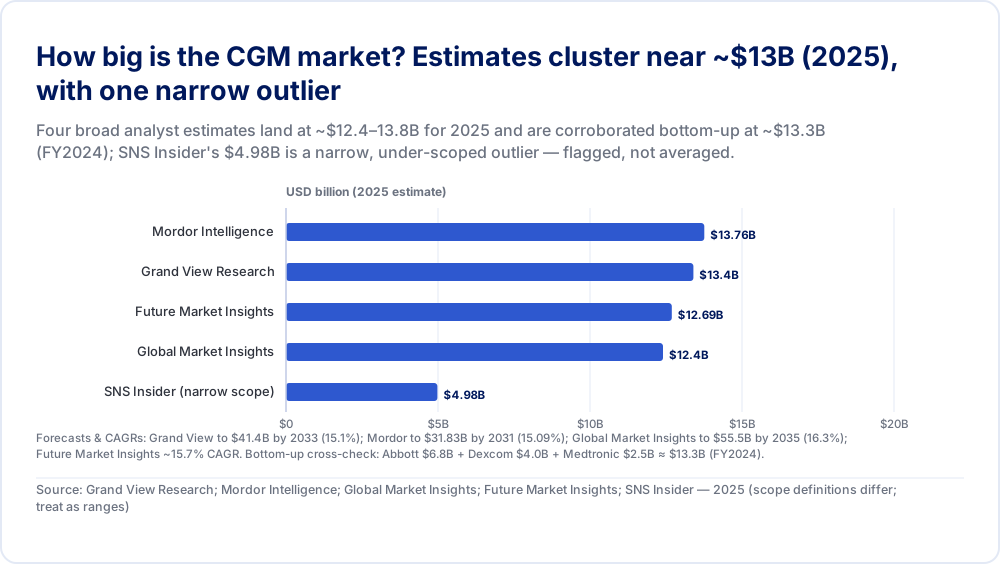
Analyst estimates for the CGM market split into two clusters that differ by scope, not by disagreement about growth. The mainstream broad cluster puts 2025 revenue at roughly $12.4–13.8 billion growing at ~15–16% a year: Grand View Research at $13.4 billion (to $41.4 billion by 2033, 15.1%) 7; Mordor Intelligence at $13.76 billion (to $31.83 billion by 2031, 15.1%) 8; Global Market Insights at $12.4 billion (16.3%) 29; and Future Market Insights at $12.69 billion (15.7%) 30. A narrow cluster — SNS Insider at $4.98 billion for 2024 (7.8%) — sits materially below the others 31; we flag it as under-scoped rather than average it in.
| 2025 CGM market size estimate | |
|---|---|
| Mordor Intelligence | $13.76B |
| Grand View Research | $13.4B |
| Future Market Insights | $12.69B |
| Global Market Insights | $12.4B |
| SNS Insider (narrow scope) | $4.98B |
Forecasts & CAGRs: Grand View to $41.4B by 2033 (15.1%); Mordor to $31.83B by 2031 (15.09%); Global Market Insights to $55.5B by 2035 (16.3%); Future Market Insights ~15.7% CAGR. Bottom-up cross-check: Abbott $6.8B + Dexcom $4.0B + Medtronic $2.5B ≈ $13.3B (FY2024).
Source: Grand View Research; Mordor Intelligence; Global Market Insights; Future Market Insights; SNS Insider — 2025 (scope definitions differ; treat as ranges)
Present as a range, attributed: the mainstream cluster lands at ~$12–14 billion for 2025 at ~15% CAGR, with the lone ~$5 billion print flagged as narrow. The forecasts are forecasts.
The tie-breaker is audited company revenue. Add the FY2024 diabetes franchises of the four public players — Abbott $6.805 billion, Dexcom $4.033 billion, Medtronic $2.488 billion, and Senseonics $22.5 million — and you reach roughly $13.3 billion for FY2024 alone 32333435. That bottom-up figure validates the broad cluster and quietly retires the narrow one. Sensors, not hardware, are the economic core: recurring-sensor sales are 63% to 89% of the market depending on the source, the classic razor-and-blade model 78.
The demand base is enormous and mostly untapped
The denominator behind all of this is the diabetes epidemic. The IDF Diabetes Atlas, 11th edition, counts 589 million adults living with diabetes in 2024 — about one in nine — rising to a projected 853 million by 2050, a 46% increase 9. Two features of that base drive the strategy of every player in this report: 43% are undiagnosed (over 250 million people unaware they have the disease), and 81% live in low- and middle-income countries — exactly the markets where reimbursement is weakest, price sensitivity is highest, and low-cost sensors have the most room. China and India carry the largest absolute counts. Diabetes-related health spending reached $1.015 trillion in 2024 9.
The base CGM sits on: global diabetes, 2024
CGM rides a vast, fast-growing base — 589M adults have diabetes today, a projected 853M by 2050, and 43% don't yet know they have it.
| Metric | Value |
|---|---|
| Adults with diabetes (2024) — about 1 in 9 worldwide | 589 million |
| Projected by 2050 — +46% vs 2024 | 853 million |
| Undiagnosed — unaware they have diabetes | 43% |
| Live in low/middle-income countries — where CGM access is thinnest | 81% |
| Global diabetes health spend (2024) — China and India carry the largest absolute counts | USD 1.015 trillion |
| Deaths attributed (2024) — diabetes and its complications | 3.4 million |
Source: IDF Diabetes Atlas, 11th ed., 2025.
The OTC breakout: a real new lane, a forecast-sized prize
The 2024 over-the-counter launches did something the incumbents had never done — sold a CGM to people who do not have diabetes. Stelo (launched at roughly $89–99 a month) and Abbott's Lingo are cleared for adults not on insulin, with Abbott explicitly splitting Lingo for general wellness and Libre Rio for type 2 6. The theoretical prize is large: roughly 97 million US adults are prediabetic and about 25 million have type 2 diabetes without using insulin — pools that sat outside CGM's reach entirely.
But keep this honest. That prize is a forecast, not booked revenue. Grand View sizes the current US OTC CGM segment at just $48.6 million in 2024, growing about 8% a year in its model 7. The multi-billion metabolic-wellness market is a bet on non-diabetic adoption that is unproven at scale. The regulatory significance of the OTC lane is bigger than its near-term dollars: it lets consumer-health and wellness brands, not just diabetes-device firms, enter the category — Signos, a non-incumbent, cleared its own OTC sensor in March 2025 1.
Where they are approved: a US duopoly, and zero Chinese clearances
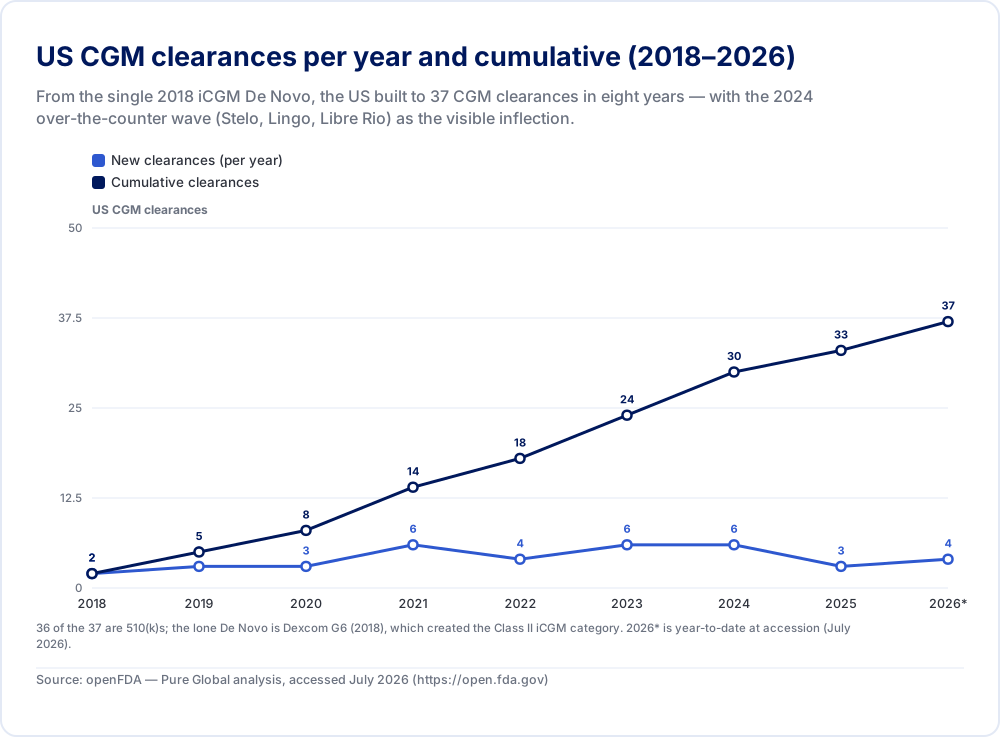
Now the first of the three maps. The US CGM regulatory estate has grown from 2 authorizations in 2018 to 37 by mid-2026 — one De Novo and 36 subsequent 510(k) clearances — with a clear inflection in 2024 when the OTC codes were born 1.
| New clearances (per year) | Cumulative clearances | |
|---|---|---|
| 2018 | 2 | 2 |
| 2019 | 3 | 5 |
| 2020 | 3 | 8 |
| 2021 | 6 | 14 |
| 2022 | 4 | 18 |
| 2023 | 6 | 24 |
| 2024 | 6 | 30 |
| 2025 | 3 | 33 |
| 2026* | 4 | 37 |
36 of the 37 are 510(k)s; the lone De Novo is Dexcom G6 (2018), which created the Class II iCGM category. 2026* is year-to-date at accession (July 2026).
Source: openFDA — Pure Global analysis, accessed July 2026 (https://open.fda.gov)
New and cumulative US CGM authorizations by year: 2/2 in 2018, 14 cumulative by 2021, 30 by 2024 (the OTC inflection), 37 by mid-2026. The 2018 De Novo built the highway; ordinary 510(k)s did the rest.
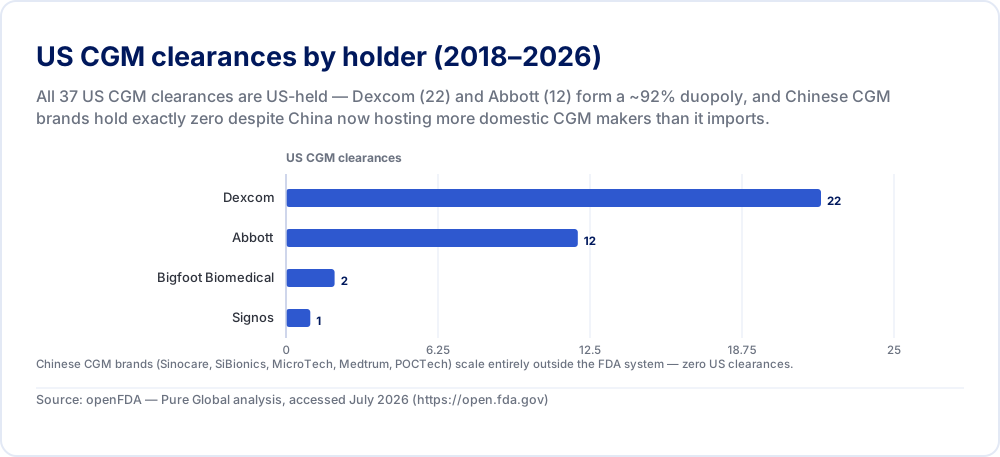
Who holds them is the striking part. Every one of the 37 is held by a US company — in fact, all four holders are headquartered in California: Dexcom (22), Abbott (12), Bigfoot Biomedical (2), and Signos (1). Dexcom and Abbott alone are 92% of the estate 1.
| US CGM clearances by holder | |
|---|---|
| Dexcom | 22 |
| Abbott | 12 |
| Bigfoot Biomedical | 2 |
| Signos | 1 |
Chinese CGM brands (Sinocare, SiBionics, MicroTech, Medtrum, POCTech) scale entirely outside the FDA system — zero US clearances.
Source: openFDA — Pure Global analysis, accessed July 2026 (https://open.fda.gov)
100% of US CGM clearances are US-held; Dexcom and Abbott form a 92% duopoly. Not one Chinese-applicant CGM clearance exists — despite China now hosting more domestic CGM makers than imported ones.
That absence is the finding. Chinese brands — SiBionics, Sinocare, Microtech, Medtrum, Yuwell, POCTech — manufacture CGM at scale for the domestic, EU, and emerging markets, yet have zero US regulatory footprint in this category. The entire modern US CGM estate, prescription and over-the-counter, sits in Class II under a single special-controls regulation; only the implanted Eversense remains Class III 12.
| Class II CGM 510(k)s by product code | |
|---|---|
| QBJ (iCGM, Class II) | 18 |
| QLG (Class II) | 9 |
| QDK (Class II) | 4 |
| SAF (OTC, Class II) | 4 |
| SBH (OTC, Class II) | 2 |
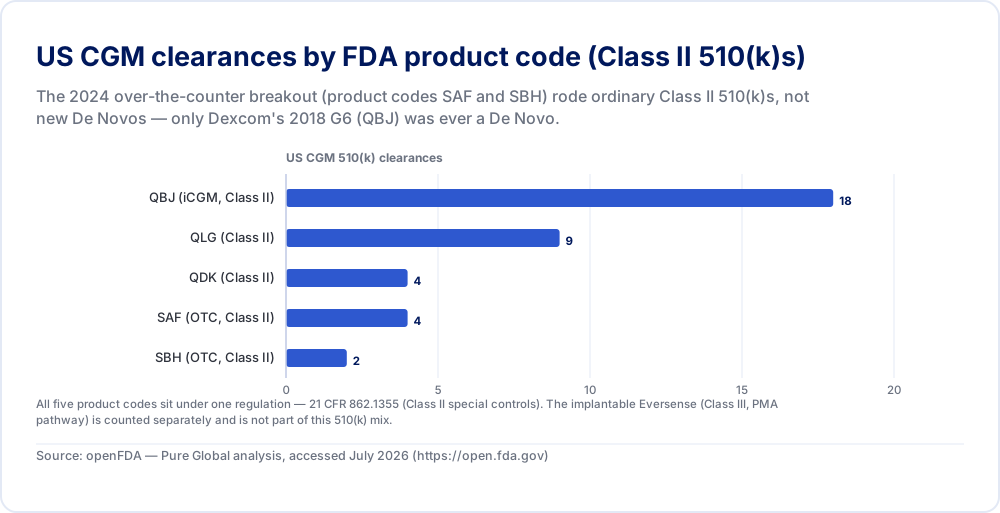
All five product codes sit under one regulation — 21 CFR 862.1355 (Class II special controls). The implantable Eversense (Class III, PMA pathway) is counted separately and is not part of this 510(k) mix.
Source: openFDA — Pure Global analysis, accessed July 2026 (https://open.fda.gov)
The US code mix: of the 37 Class II authorizations, 31 are mainstream prescription integrated-CGM clearances and 6 sit in the new 2024 OTC branch; the implanted Eversense sits apart, in its own Class III premarket-approval track.
Where they are made: the West and Malaysia, not (yet) China
The second map contradicts a popular assumption. Because the two volume leaders build largely outside China, the manufacturing geography is US–Ireland–Malaysia–Mexico, not China. Abbott's sensor engine is Ireland, where its new Kilkenny plant — opened 18 November 2024 and billed as its largest Libre facility — joins an expanded Donegal site as part of a ~$450 million CGM investment 36. Dexcom opened its first offshore plant in Penang, Malaysia in November 2024 (a ~$600 million site) alongside a €300 million build in Athenry, Ireland 37. Medtronic builds in Northridge, California.
The Chinese shift is real, but it lives in the count of makers, not export value. As of the ~2023 domestic wave, China's home market held roughly seven domestically made CGMs against two imported ones — the manufacturer count had already flipped Chinese-majority even as the imported brands led installed base 38. Sinocare's Changsha facility is described as the largest blood-glucose-monitoring production base in Asia, and it was the first Chinese CGM brand certified under EU CE-MDR 39.
The trade data, honestly: China is mid-tier and flat
This is where analysts go wrong, so we will be explicit. There is no dedicated customs code for CGM sensors. The closest fit — HS 9018.19, "other electro-diagnostic apparatus" — is a broad basket that also holds patient monitors, ECG, EEG, and pulse oximeters, so every trade figure here is a directional proxy for that whole family, not a CGM count. Read only for direction. On that line, 2023 exports were led by the United States ($6.18 billion, ~41%), then Japan ($2.0 billion), the Netherlands ($1.4 billion), Ireland ($1.08 billion), and Mexico ($0.96 billion) — with China sixth, at $639 million (~4%) and flat-to-declining since a COVID-era 2020 spike 40. By export value, the device family that contains CGM flows from where Abbott and Dexcom build, not from China.
So the "made in China" story is genuine but specific: it is a story about the number of manufacturers, the tempo of patent filing, and low-cost sensor supply into the EU and emerging markets — not about aggregate export dominance. Any chart that implied China out-exports the world in CGM would be wrong. The competitive pressure Chinese makers create shows up not in the trade data but in the courtroom, as the intellectual-property section will show.
The competitors, as neutral facts
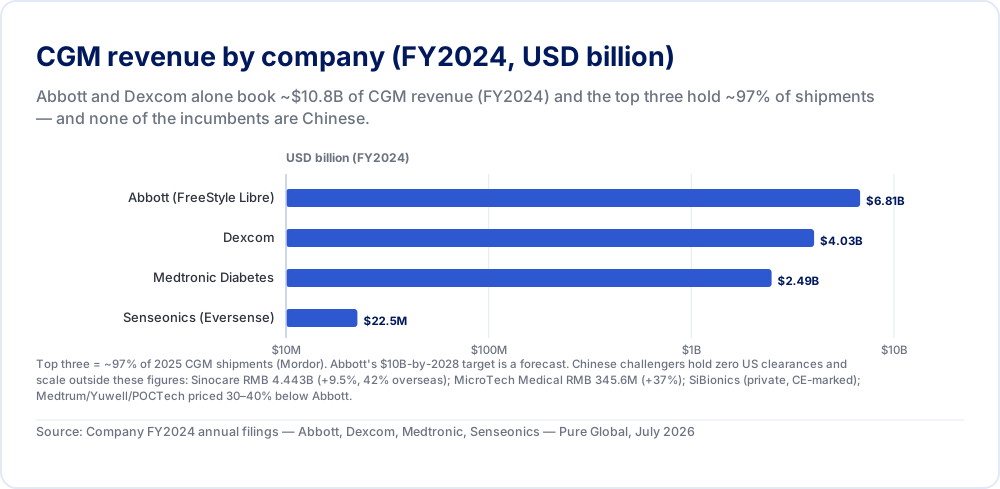
The top of the market is an oligopoly. On 2025 shipments, Abbott holds about 52.8%, Dexcom 33.9%, and Medtronic 10.1% — a combined 96.8% 8. Their FY2024 franchises: Abbott Diabetes Care $6.805 billion (+18.1%), with a stated target — a forecast — of $10 billion in annual Libre sales by 2028 32; Dexcom $4.033 billion (+11%), which launched Stelo 33; Medtronic Diabetes $2.488 billion in FY2024, rising to $2.755 billion in FY2025 34; and Senseonics $22.5 million on roughly 6,000 implant patients 35.
| CGM / diabetes-care revenue | |
|---|---|
| Abbott (FreeStyle Libre) | $6.81B |
| Dexcom | $4.03B |
| Medtronic Diabetes | $2.49B |
| Senseonics (Eversense) | $22.5M |
Top three = ~97% of 2025 CGM shipments (Mordor). Abbott's $10B-by-2028 target is a forecast. Chinese challengers hold zero US clearances and scale outside these figures: Sinocare RMB 4.443B (+9.5%, 42% overseas); MicroTech Medical RMB 345.6M (+37%); SiBionics (private, CE-marked); Medtrum/Yuwell/POCTech priced 30–40% below Abbott.
Source: Company FY2024 annual filings — Abbott, Dexcom, Medtronic, Senseonics — Pure Global, July 2026
FY2024 diabetes-franchise revenue: Abbott $6.8B, Dexcom $4.0B, Medtronic $2.5B, Senseonics $22.5M — the four summing to ~$13.3B, the bottom-up check on the market range. Chinese challengers are an order of magnitude smaller but growing faster.
The challengers are smaller and cheaper. Sinocare (Shenzhen-listed) reported FY2024 revenue of RMB 4.443 billion (+9.5%), 42% overseas, and signed a distribution deal carrying its CGM into roughly fifteen European markets through Menarini 39. Microtech Medical (Hong Kong-listed) grew to RMB 345.6 million (+37%) 41. SiBionics is private, has raised roughly $165 million, and holds a CE mark for its 14-day GS1 sensor 42. Chinese sensors are commonly priced 30–40% below Abbott 8. Each of these firms holds an NMPA license and, increasingly, a CE mark — and wants many more markets. That is precisely the multi-market registration problem the rest of this report maps.
The safety and accuracy reckoning
The takeaway first: modern CGMs are accurate enough to dose insulin, the adverse-event record is dominated by benign consumable failures rather than danger, and the one genuine safety theme is the software that decides when to fire an alert — the exact failure mode that OTC, no-clinician use makes riskier.
On accuracy, the case is largely closed. MARD has converged near 8% across the leading sensors 15, which is why regulators were willing to permit non-adjunctive dosing, closed-loop integration, and, eventually, over-the-counter sale.
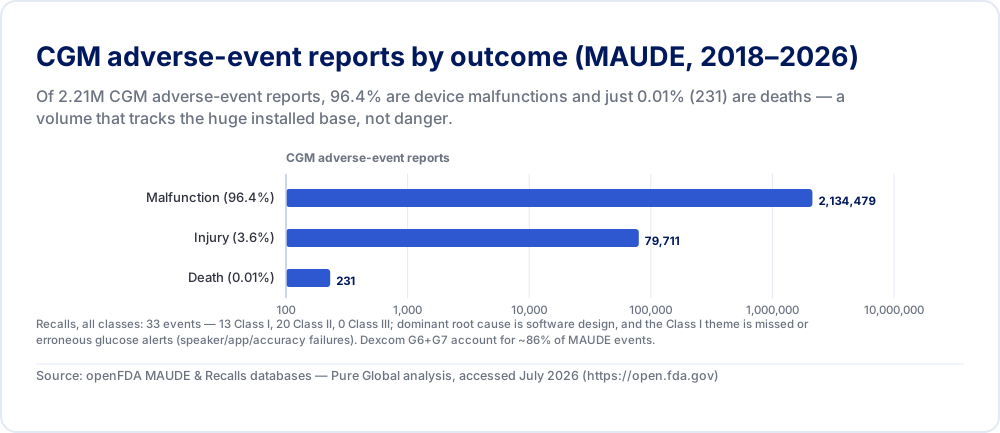
On adverse events, the numbers are enormous and must be read with care. The FDA's public MAUDE database holds about 2.21 million CGM-related event reports through mid-2026 — but 96.4% are "malfunction," 3.6% "injury," and 0.01% (231) death 1. That distribution is the story: with tens of millions of disposable sensors sold, each sensor that reads low or fails can generate a report, so a 96% malfunction share reflects consumable failure reporting, not a dangerous device. MAUDE is passive, unverified, and duplicative; its yearly volume tracks the explosion in the user base, not a worsening product. Dexcom's G6 and G7 alone account for roughly 86% of all reports — because they are the most-worn sensors, not the most dangerous.
| CGM MAUDE reports by outcome | |
|---|---|
| Malfunction (96.4%) | 2,134,479 |
| Injury (3.6%) | 79,711 |
| Death (0.01%) | 231 |
Recalls, all classes: 33 events — 13 Class I, 20 Class II, 0 Class III; dominant root cause is software design, and the Class I theme is missed or erroneous glucose alerts (speaker/app/accuracy failures). Dexcom G6+G7 account for ~86% of MAUDE events.
Source: openFDA MAUDE & Recalls databases — Pure Global analysis, accessed July 2026 (https://open.fda.gov)
Two signals, both caveated: 2.2M MAUDE reports skew 96% malfunction / 3.6% injury / 0.01% death (volume tracks adoption, not danger), while 33 recalls split 13 Class I / 20 Class II / 0 Class III, with software design the dominant root cause.
Recalls are the sharper signal. There have been 33 CGM recall events — 13 of them the most-serious Class I, 20 Class II, and none Class III 1. The dominant root cause is software design, and the recurring Class I theme is missed or erroneous glucose alerts: Abbott's Libre 3 recall over erroneously high readings (July 2024), and Dexcom recalls tied to an app defect and to a receiver whose speaker could lose contact and miss audible low-glucose alarms (2025) 1. For a connected, app-driven sensor whose whole value is telling you when your glucose is dangerous, the alerting logic is the safety-critical component.
This is why the over-the-counter move draws regulatory scrutiny out of proportion to its current revenue. A CGM in a clinic is interpreted by a clinician; a CGM bought off a shelf is interpreted by the wearer, who may over-react to a lagging interstitial reading or a false alarm. The sensor got safe enough for consumers before the system around the consumer did — and regulators outside the US have been notably slower to follow the US into the OTC lane, as the next section shows.
The regulatory map: same sensor, three classes
This is the reference core of the report. The same transcutaneous sensor that clears as a Class II device in the US is a Class IIb device in the EU and a Class III device across China, Japan, and Canada — and that single divergence cascades into everything: heavier evidence, longer timelines, higher cost, local clinical data, and a mandatory local representative in every market. A consolidated matrix follows the country detail.
Same sensor, three classes: how 12 markets regulate one CGM (2026)
The identical sensor is Class II in the US, Class IIb in the EU, and Class III in China, Japan, Canada and Brazil — and China alone demands a domestic clinical trial before it can be sold.
| Market | CGM risk class | Pathway | Local rep required | OTC allowed | Reliance-eligible |
|---|---|---|---|---|---|
| US (FDA) | Class II (special controls) | De Novo created the category; 510(k) after; OTC codes since 2024 | US Agent | Yes (2024) | Own review; accepts MDSAP for QMS |
| EU (Notified Body) | Class IIb (MDR device, not an IVD) | CE mark via Notified Body; EUDAMED/UDI; clinical unless equivalence | EU Authorized Rep | De facto (wellness) | CE is itself the currency others rely on |
| UK (MHRA) | ~IIb | CE mark accepted on GB market to 30 Jun 2028; UKCA optional | UK Responsible Person | As EU | Yes — accepts CE |
| China (NMPA) | Class III | Type testing + domestic clinical trial + CMDE review; 5-yr cert | China legal agent | De facto via e-commerce | No |
| Japan (PMDA) | Class III (Highly Controlled) | Shonin approval + J-QMS; local or bridged clinical data | MAH / D-MAH | No | Partial (bridged clinical) |
| Korea (MFDS) | Grade 3 | Full technical review + KGMP; dossier in Korean | Korea License Holder | No | Accepts foreign clinical data |
| India (CDSCO) | Class C | Import licence MD-15 | Indian Authorized Agent | Retail | FDA/CE predicate helps |
| Brazil (ANVISA) | Class III | Registro; MDSAP for GMP; 10-yr cert | Brazil Registration Holder | No | Yes (AREE accepts FDA; not CE) |
| Canada (Health Canada) | Class III | Medical Device Licence; MDSAP mandatory | MDEL importer | No | Yes (MDSAP) |
| Australia (TGA) | Class IIb | ARTG; EU NB cert / comparable-overseas | Australian Sponsor | Emerging | Yes |
| Singapore (HSA) | Class C | Abridged/immediate reliance if ≥1–2 reference agencies | Singapore Registrant | Mainly Rx | Yes (explicit) |
| Gulf (SFDA / MOHAP) | ~Class C | Marketing authorization; reliance on CE/FDA but full file | Authorized Rep / LAR | Rx | Partial |
Source: US FDA; EU MDR; UK MHRA; NMPA; PMDA/MHLW; MFDS; CDSCO; ANVISA; Health Canada; TGA; HSA; SFDA — Pure Global analysis, July 2026.
United States — the Class II anchor
The US runs the world's most permissive major CGM regime, and it is built on one regulation. The FDA's identification is worth reading verbatim: "An integrated continuous glucose monitoring system (iCGM) is intended to automatically measure glucose in bodily fluids continuously or frequently for a specified period of time," classified as "Class II (special controls)" 2. Those special controls — banded accuracy thresholds, alert-rate limits, secure data transmission, interference and human-factors testing — are the bar a new sensor must clear, and clearing them via 510(k) is what makes the US fast. First-of-a-kind devices take the De Novo route (the 2018 G6); everything since is a 510(k). Foreign manufacturers need US establishment registration, device listing, and a designated US Agent. In 2024 the FDA kept OTC CGMs in Class II and simply created dedicated consumer product codes 5. The elasticity is the point: a new consumer market arrived with no new law.
European Union — a Class IIb device, explicitly not a blood test
The EU is where the classification diverges first, and the reason is physiological. A CGM is regulated under the Medical Device Regulation (MDR 2017/745) as a Class IIb device — not under the IVD Regulation — because it measures glucose in vivo, in interstitial fluid worn inside the body, whereas a fingerstick meter examines a drawn blood sample and is an in-vitro diagnostic 343. That is not a technicality; it decides which regulation, which annex, and which conformity route applies. CE marking runs through a Notified Body conformity assessment (ISO 13485 quality system plus technical-documentation review), with EUDAMED registration and UDI, and a clinical investigation unless equivalence to a CE-marked predicate is shown. A non-EU manufacturer must appoint an EU Authorized Representative. Tellingly, clinical researchers argue the CE accuracy bar is looser than the FDA's iCGM special controls and have proposed harmonized minimum thresholds — so a CE mark and an FDA clearance are not the same evidentiary achievement 43. The implanted Eversense is Class III in the EU, as in the US.
United Kingdom — a reliance market on the CE mark
Post-Brexit, Great Britain accepts CE-marked devices on its market until 30 June 2028, with UKCA marking optional; a non-UK manufacturer must appoint a UK Responsible Person to register with the MHRA 44. In practice the UK is a CE-recognition market through the end of the decade — one of the cleaner "your existing approval travels here" cases in this report.
China — Class III, and the local trial is the wall
China is the hardest reliance-resistant market, and the reason is a mandatory local clinical trial. The NMPA classifies CGM as Class III, its highest tier, governed by a dedicated CGM guideline finalized 18 July 2023 that applies to invasive (transcutaneous) systems 4. Registration requires type testing by an NMPA-recognized lab, a domestic clinical trial, and technical review by the Center for Medical Device Evaluation, with a certificate valid five years. Foreign manufacturers must appoint a China-based legal agent and an after-sales unit, and China does not rely on FDA or CE approvals 4. The domestic clinical-trial requirement is the single biggest reason foreign CGMs lag domestic ones inside China — and the reason China's own makers, who can run those trials at home, have the structural advantage there.
Japan and Korea — Class III, with bridged evidence
Japan treats CGM as a "Highly Controlled Medical Device" (Class III), requiring Shonin premarket approval through the PMDA and MHLW, a Japanese quality-system audit, and a local Marketing Authorization Holder; clinical data may be Japanese or foreign data accepted with bridging, and flash CGM has historically been approved for adjunctive use only 45. Korea classifies CGM as Grade 3, requiring full MFDS technical review, mandatory KGMP certification, a Korean-language dossier, and a Korea License Holder; it generally accepts foreign clinical data 46. Both are partial-reliance markets — the evidence can travel, the classification and the local representative cannot.
India — Class C, registered on a foreign predicate
India's CDSCO classifies CGM as Class C, registered through an import licence (Form MD-15) held by a local Indian Authorized Agent, with clinical-validation and post-market requirements tightened since October 2023; an FDA or CE predicate materially eases the evidence bar 47. It is a retail-available, reliance-leaning market — a useful early revenue stop while the harder Class III filings run.
Brazil, Canada, and Australia — Class III (mostly), but reliance-friendly
Brazil places CGM at Class III under RDC 751/2022 (which mirrors EU MDR), requires a Brazilian Registration Holder, and accepts MDSAP audit reports in lieu of an on-site GMP inspection — and, crucially, its AREE reliance pathway (IN 290/2024) accepts an FDA clearance to collapse the timeline, though notably not a CE mark 48. Canada classifies CGM as Class III, requires a Medical Device Licence, and was the first country to make MDSAP certification mandatory — no Class II–IV device sells without it 49. Australia is the outlier that stays Class IIb (its rules align with the EU), lets conformity assessment lean on an EU Notified Body certificate or a comparable overseas regulator, and requires an Australian Sponsor 50.
Singapore and the Gulf — the fast reliance lanes
Singapore runs among the clearest reliance frameworks in the world: an abridged or immediate route is available when a device is already approved by one or two of five reference agencies (US FDA, EU Notified Bodies, TGA, Health Canada, Japan PMDA), with a local Singapore Registrant to file 51. Saudi Arabia (SFDA) and the UAE (MOHAP) both lean heavily on CE and FDA approvals but still require a full technical file and a local Authorized Representative 52. These are the markets where a strong anchor approval genuinely accelerates entry.
The one universal: no market lets a foreign maker register alone
Read down the "local rep" column of the matrix and the pattern is total. Every market requires an in-country legal representative — a US Agent, EU Authorized Representative, UK Responsible Person, China legal agent, Japan Marketing Authorization Holder, Korea License Holder, Indian Authorized Agent, Brazilian Registration Holder, Australian Sponsor, Singapore Registrant, or Gulf Authorized Representative — to hold the registration and front the health authority 53. Reliance can shrink the evidence and audit burden; it never removes the local representative. Standing up a dozen such entities in a dozen jurisdictions is the operational wall that separates a company with one approval from a company with thirty. It is also, precisely, the gap Pure Global exists to close.
What it costs and how long it takes
The classification differences translate directly into money and months, and CGM is a near-perfect illustration of the rule "the first approval is expensive, the rest are cheap — except where a local trial resets the meter."
| Approx. government fee, CGM-mapped class | |
|---|---|
| United States (PMA, implantable Class III) | $579,272 |
| United States (De Novo, first-of-kind) | $173,782 |
| Japan (Class III, PMDA) | $70,000 |
| China (Class III, NMPA + trial application) | $49,200 |
| EU (Class IIb, Notified Body, low end) | $33,000 |
| United States (510(k), Class II) | $26,067 |
| Brazil (Class III + B-GMP) | $14,920 |
| Canada (Class III) | $10,340 |
| Australia (Class IIb + audit) | $8,000 |
| Korea (Grade 3 + KGMP) | $6,100 |
| Saudi Arabia (Class C) | $5,600 |
| Singapore (Class C, full) | $5,190 |
| India (Class C) | $3,000 |
US fees (FDA MDUFA FY2026): De Novo $173,782 to subsequent 510(k) $26,067 (~85% step-down); implantable PMA $579,272. EU has no state fee — Notified Body charges ~$33k–130k+. China ~$43,200 NMPA + ~$6,000 trial application + local type-testing, before the trial itself. Fees are USD approximations (July 2026) and reset FY2027 (~Oct 2026).
Source: FDA MDUFA FY2026 (Fed. Reg. 30 Jul 2025); NMPA; PMDA; MFDS; ANVISA; Health Canada; TGA; HSA; CDSCO; SFDA — Pure Global analysis, July 2026 (USD approx.; CGM class noted)
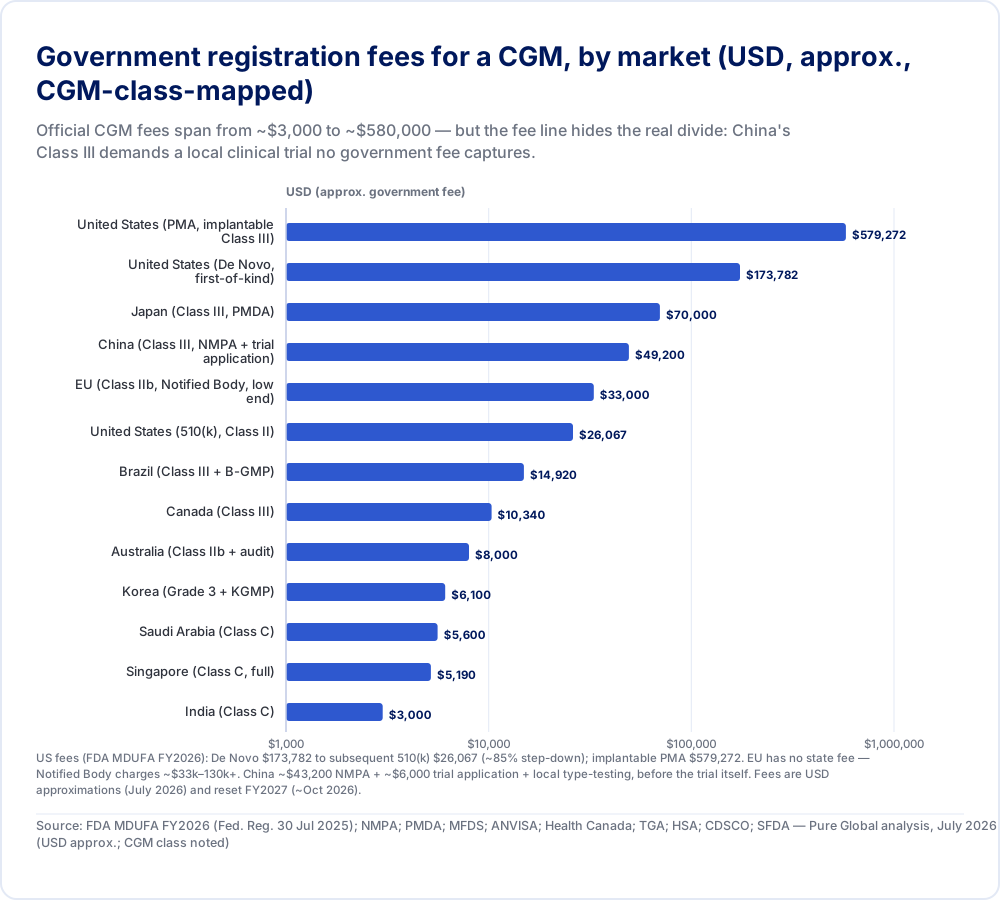
Government fees mapped to CGM's real class per market: the US front-loads the category into one ~$174k De Novo, later 510(k)s drop to ~$26k, and China stacks a ~$43k fee on top of a mandatory local clinical trial — the most expensive place to put a CGM.
The US De Novo-to-510(k) step-down
Because iCGM is a De Novo-created Class II category, the US cost curve is dramatic. Under the FDA's FY2026 fee schedule, the first-of-a-kind De Novo costs $173,782 (small business $43,446), while every subsequent 510(k) costs $26,067 (small business $6,517) — a roughly 85% step-down of about $148,000, plus a shorter review clock 54. The OTC devices pay the same 510(k) schedule; what changes is the business model, from reimbursement-gated prescription to cash-pay retail. The one exception is the implanted Eversense, which as a Class III premarket-approval device faces a $579,272 PMA fee — an order of magnitude above the transcutaneous path 54. A flat annual establishment fee of $11,423 applies regardless of route.
The rest of the world: small fees, large evidence bills
Government fees elsewhere are mostly modest — the real cost hides in conformity assessment, audits, and clinical data. The EU charges no central state fee; the cost is the Notified Body conformity assessment, commonly $33,000 to $130,000 and up. China stacks an NMPA registration fee near $43,000 plus a clinical-trial application fee and local type testing — on top of the trial itself. Brazil's Registro runs about $1,560 plus a ~$13,000 GMP-certification fee; Canada's Class III licence about $10,000; Australia's fees near $1,000 plus possible audit; Singapore about $415 plus $2,890 abridged to $6,250 full; Korea, India, and Saudi Arabia sit in the low thousands (Pure Global)54. The pattern: the cheap-to-file markets bury their cost in evidence and audit, while the US front-loads the whole category into one De Novo and China stacks a substantial fee on top of a trial.
Time is the number that actually hurts
| Low (with reliance / lower class) | High (full route / no reference approval) | |
|---|---|---|
| United States (510(k), Class II) | 6 | 12 |
| EU (Class IIb) | 16 | 24 |
| United Kingdom | 4 | 8 |
| China (Class III) | 24 | 48 |
| Japan (Class III) | 12 | 17 |
| Korea (Grade 3) | 6 | 18 |
| Brazil (Class III, full) | 14 | 22 |
| Canada (Class III) | 6 | 12 |
| Australia (Class IIb) | 6 | 9 |
| India (Class C) | 9 | 12 |
| Singapore (Class C, full) | 6 | 12 |
| Saudi Arabia (Class C) | 6 | 9 |
Ranges are realistic elapsed time mapped to each market's CGM class. Reliance collapses the low end: Brazil AREE 14–22 mo to a few months; Singapore immediate route ~days; Mexico equivalence ~30 working days. China's ~2–4 yr is driven by the local clinical trial, not the review queue.
Source: Pure Global market-access data, July 2026, cross-checked vs FDA, EU/MedTech Europe, NMPA, PMDA, MFDS, ANVISA, Health Canada, TGA, HSA, CDSCO
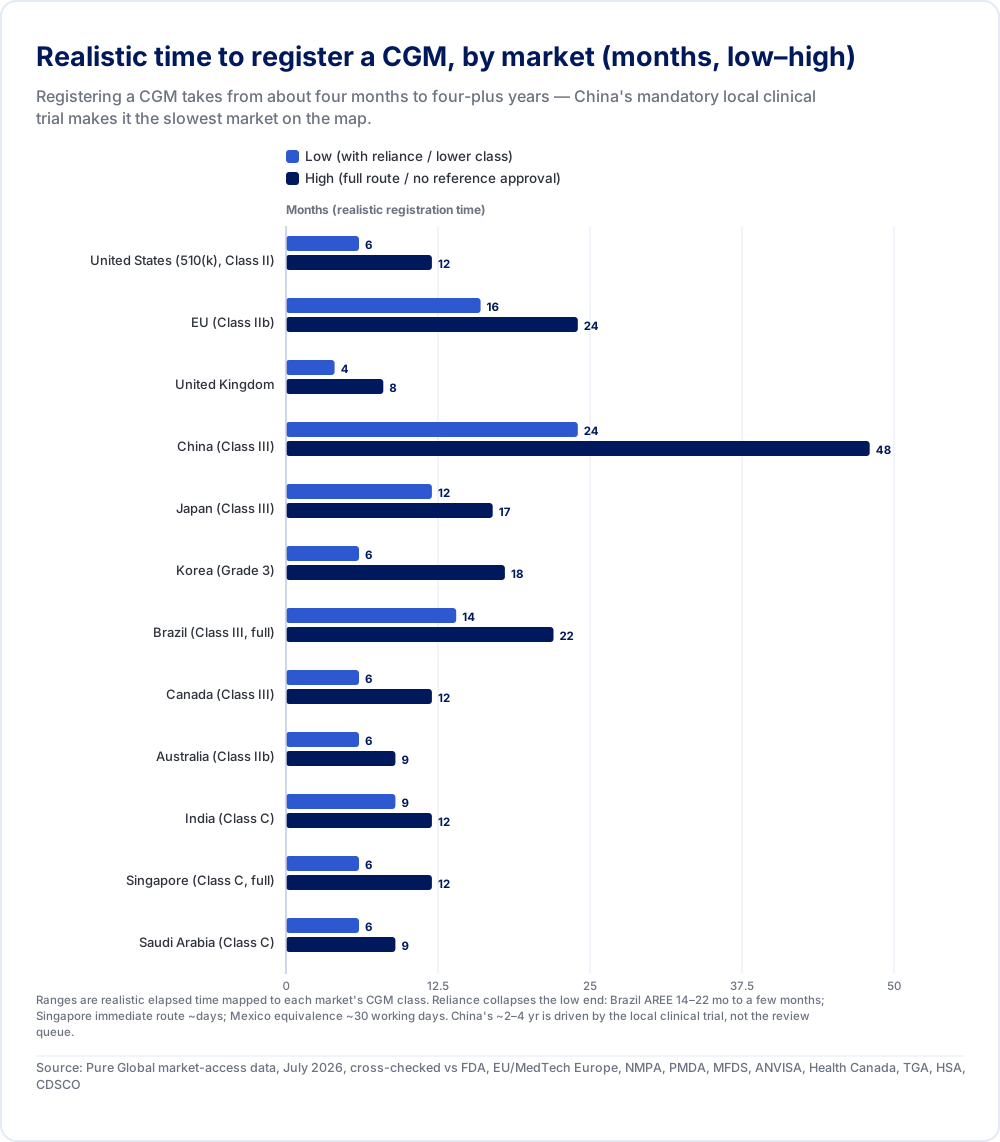
Realistic elapsed timelines on the same sensor: US ~6–15 months, EU ~1.3–2 years, and China ~2–4 years — because the local clinical trial, not the fee, is the schedule killer.
Fees are recoverable; calendar time is not. On the same sensor, a realistic US 510(k) runs 6–12 months (a De Novo 8–15), an EU CE project 1.3–2 years against the Notified Body bottleneck, the UK 4–8 months (or near-immediate on CE recognition), and Japan, Korea, Brazil, Canada, and Australia between six months and roughly two years (Pure Global). China stands apart at roughly 2–4 years, because of the local type testing and clinical trial. The gap between an FDA clearance and an NMPA Class III approval — potentially three years — is the single biggest scheduling problem a CGM maker has, and it is the one gap reliance cannot close.
Reliance is the lever, and it is uneven
Which reliance routes accept an FDA clearance or CE mark (CGM)
An FDA clearance or CE mark unlocks fast-track routes across a dozen markets — but never in China, Japan or Korea, where a CGM's Class III status blocks reliance entirely.
| Reliance route | Markets | Accepts FDA / CE? | Effect |
|---|---|---|---|
| MDSAP (single QMS audit) | US, Canada, Brazil, Japan, Australia | QMS reliance (not product approval) | One audit accepted by all five; satisfies Brazil B-GMP and Canada's mandatory GMP |
| Singapore abridged / immediate | Singapore (HSA) | FDA, CE, TGA, Health Canada, MHLW | ~38% cost cut; immediate route ~days |
| Brazil AREE (IN 290/2024) | Brazil (ANVISA) | FDA yes; CE not accepted for AREE | 14–22 mo full route to a few months |
| Mexico equivalence | Mexico (COFEPRIS) | IMDRF members + MDSAP | ~30 working days vs 15–31 mo |
| TGA comparable-overseas | Australia (TGA) | FDA, CE, Health Canada, PMDA | 30–50% faster abridged assessment |
| UK CE recognition | Great Britain (MHRA) | CE accepted to 30 Jun 2028 | Avoids duplicate UKCA testing |
| ASEAN reference (Vietnam) | Vietnam MOH | FDA, EU, PMDA, TGA, HC, MFDS | 12–18 mo to 4–5 mo |
Source: HSA; ANVISA; COFEPRIS; TGA; UK MHRA; Vietnam MOH; MDSAP program — Pure Global analysis, July 2026.
The counter-current to all this divergence is reliance, and for a CGM the anchor is an FDA clearance or a CE mark. MDSAP lets a single quality-system audit satisfy five regulators at once — the US, Canada, Brazil, Japan, and Australia — killing duplicate GMP inspections 53. Singapore cuts fee and time by roughly a third on its abridged route and can register in days on the immediate route; Brazil's AREE collapses a 14–22-month timeline toward a few months, but accepts an FDA clearance and not a CE mark; Mexico's equivalence route targets 30 working days; Australia's comparable-overseas route runs 30–50% faster; the UK accepts CE through 2028; and ASEAN reference routes (for example, Vietnam) can compress a 12–18-month Class III timeline to 4–5 months (Pure Global)48. Two hard limits remain. Reliance never erases the divergent classification or the local-representative requirement, and the China–Japan–Korea Class III trio — with its local trials and testing — stays largely outside it. The optimal shape, then, is an anchor plus a fast fan-out plus a separately budgeted East-Asian tier — which is the playbook this report closes on.
How much does it cost to register a CGM in different countries?
The government fees above are only half the invoice. The other half is the specialist work — building the dossier, holding the local registration, fielding every question from the authority, and filing each renewal and label change. This is where the industry is at its most opaque: most regulatory consultancies bill by the hour or quote each submission separately, so the true multi-market cost only surfaces once the change orders arrive.
Pure Global is the first medical-device market-access firm to publish a single, flat annual fee per registration. From USD $2,000 per device, per market, per year, that one fee consolidates services normally billed hourly — in-country representation, submission (on a reference approval), renewals, modifications, and all health-authority correspondence. No timesheets, no per-email surprises.
Here is exactly what it costs to have Pure Global act as your local representative and hold a CGM registration, market by market. A CGM is Class II in the US, Class IIb in the EU, and Class III in China, Japan, and Korea, so in tiered markets the higher figure applies.
Pure Global in-country representation — flat annual fee per CGM
One transparent number per market, per year — everything for that registration included.
| Market | Local role Pure Global provides | Flat annual fee (USD) |
|---|---|---|
| United States | FDA US Agent | $1,000 |
| European Union | EU Authorized Representative | $2,000 |
| United Kingdom | UK Responsible Person (UKRP) | $2,000 |
| Australia | TGA Sponsor | $2,000 |
| Singapore | Registrant | $2,000 · $3,000 (Class C/D) |
| Malaysia | Authorized Representative | $2,000 · $3,000 (Class C/D) |
| Thailand | Authorized Representative | $2,000 · $3,000 (Class 3/4) |
| Indonesia | Authorized Representative | $2,000 |
| Vietnam | Market Authorization Holder | $2,000 |
| Hong Kong | Local Responsible Person | $2,000 · $3,000 (Class III/IV) |
| Macau | License holder & registration | $2,000 · $3,000 (Class III) |
| Brazil | Brazil Registration Holder (BRH) | $2,000 · $3,000 (Class III/IV) |
| Mexico | Mexico Registration Holder | $2,000 · $3,000 (Class II/III) |
| Colombia | INVIMA Representative | $2,000 · $3,000 (Class IIb/III) |
Flat annual fee for in-country representation of one CGM; includes submission on a reference approval, renewals, modifications, and authority correspondence. Source: Pure Global Master Price List, 2026 (per registration; multi-registration and 3-year-contract discounts apply).
One-time submission and compilation work — where a market needs a full dossier built — is published just as transparently: a US 510(k) compilation runs $15,000–$20,000, an EU technical-documentation or CER project is listed by class (up to $30,000 for a Class IIb CGM), a Canadian registration compilation is $3,000–$25,000 by class, and a regulatory-pathway determination is a flat $5,000. Every figure is quoted up front, never by the hour (Pure Global).
A worked example — one CGM sensor, four markets. Take a single CGM already cleared by the FDA (Class II) and CE-marked (Class IIb) that you want to keep live across the United States, European Union, Brazil, and Singapore for a year. Pure Global's in-country representation totals $1,000 (US) + $2,000 (EU) + $3,000 (Brazil) + $3,000 (Singapore) = $9,000 for the year — flat, with every renewal, modification, and authority exchange included; you add one-time submission work only where a market actually requires a fresh dossier. The China–Japan–Korea tier sits outside this — its Class III status forces local type testing and clinical trials, and a separately budgeted engagement — which is exactly why the playbook below treats East Asia as its own line item.
The second gate: reimbursement
Here is the fact that reorders every CGM market-entry plan: a clearance puts the sensor on the shelf, but a separate national reimbursement decision — made by a different body, on a different clock, against a different evidence bar — decides whether it sells at volume. And reimbursement travels even less than approval.
The proof is in the revenue steps. Every major national coverage expansion of the past decade was followed by a step-change in incumbent CGM sales, because coverage, not clearance, is what moves a CGM from an out-of-pocket luxury to a standard of care.
The second gate: national CGM reimbursement milestones
Every national coverage expansion — US, England, France, Germany, Australia, Japan — step-changed incumbent CGM revenue; coverage, not clearance, is the volume lever, and it travels least.
| Market / payer | Date | Coverage expansion |
|---|---|---|
| United States (Medicare) | 16 Apr 2023 | Non-insulin T2D with hypoglycemia added (~+2M eligible); built on 2017 therapeutic coverage and Jul 2021 removal of the 4x/day-testing rule |
| England (NICE, NG17/NG28) | Mar 2022 | rt-CGM / Flash recommended for all adults with T1D; T2D on criteria; Libre 2 dominant on the NHS |
| France (HAS) | 2017 | FreeStyle Libre reimbursed — first EU country to cover all basal-insulin users |
| Germany (G-BA / GKV) | 2016 | rt-CGM reimbursed |
| Australia (NDSS) | 1 Jul 2022 | Universal subsidised CGM for all people with type 1 diabetes, via NDSS access points for a subsidised co-payment |
| Japan (MHLW) | Aug 2017 to Mar 2022 | Libre reimbursed (2017), expanded to all insulin users (2022) |
Source: US CMS; NICE (NG17/NG28); French HAS; German G-BA/GKV; Australia NDSS; Japan MHLW — Pure Global, July 2026.
- United States (Medicare). Coverage widened in stages: therapeutic CGM in 2017 (gated to intensive insulin and four-plus daily fingersticks), the fingerstick rule dropped in July 2021, and then on 16 April 2023 an expansion to all patients on any insulin plus non-insulin patients with a history of problematic hypoglycemia — an estimated two million additional people 10.
- England and Wales (NICE / NHS). In March 2022, NICE guidelines recommended offering real-time or flash CGM to all adults with type 1 diabetes, with type 2 covered on criteria; Abbott's Libre 2 became the dominant device on the NHS 11.
- France (HAS). France reimbursed FreeStyle Libre from 2017 and was the first in Europe to extend national coverage to all patients on basal insulin 55.
- Germany (G-BA). Real-time CGM has been reimbursed under statutory health insurance since 2016 for intensive insulin therapy 56.
- Australia (NDSS). From 1 July 2022, CGM became universally subsidised for everyone with type 1 diabetes, available through NDSS access points for a subsidised co-payment 12.
- Japan (MHLW). FreeStyle Libre has been nationally reimbursed since August 2017 for insulin-treated diabetes, with coverage expanded in March 2022 to all patients using insulin at least once daily 57.
The punchline for anyone planning a rollout: a sensor can be simultaneously FDA-cleared, CE-marked, and NMPA-approved and still fail commercially in a market until that market's payer — Medicare, NICE, HAS, G-BA, the NDSS, the MHLW — issues its own decision, each with its own eligibility scope and timing. Even within a single country coverage fragments; Canadian CGM reimbursement varies province by province. Approval is necessary; reimbursement is what pays. The market-access dossier has to be built for both gates at once, because the reimbursement evidence a payer wants is not the same evidence the regulator accepted.
The third gate: intellectual property
The last gate is the one most market-entry plans ignore, and it is the one that can shut instantly. A CE mark grants the right to sell; it does not grant the right to sell without infringing someone's patent — and in Europe, Abbott is now demonstrating that a patent injunction can wall a fully CE-marked Chinese sensor out of roughly fourteen states overnight.
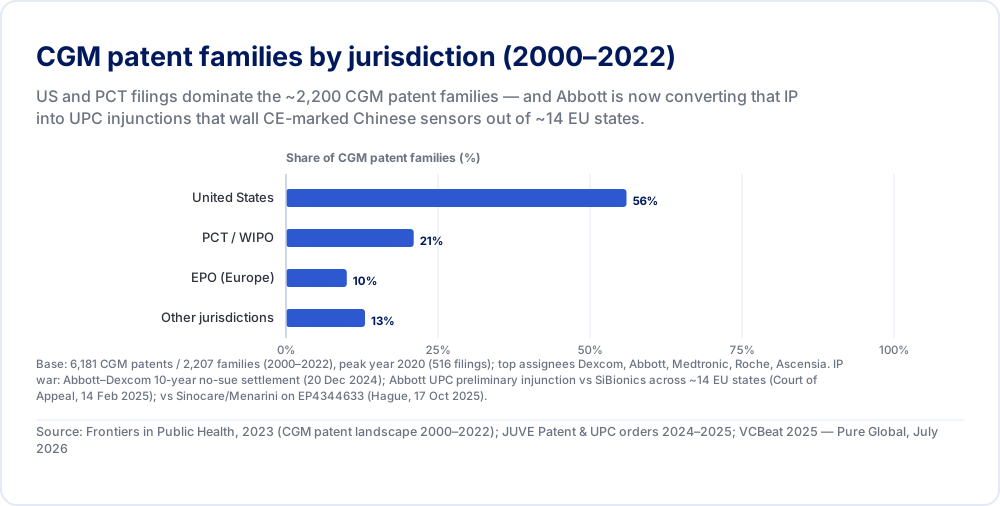
| Share of CGM patent families | |
|---|---|
| United States | 56% |
| PCT / WIPO | 21% |
| EPO (Europe) | 10% |
| Other jurisdictions | 13% |
Base: 6,181 CGM patents / 2,207 families (2000–2022), peak year 2020 (516 filings); top assignees Dexcom, Abbott, Medtronic, Roche, Ascensia. IP war: Abbott–Dexcom 10-year no-sue settlement (20 Dec 2024); Abbott UPC preliminary injunction vs SiBionics across ~14 EU states (Court of Appeal, 14 Feb 2025); vs Sinocare/Menarini on EP4344633 (Hague, 17 Oct 2025).
Source: Frontiers in Public Health, 2023 (CGM patent landscape 2000–2022); JUVE Patent & UPC orders 2024–2025; VCBeat 2025 — Pure Global, July 2026
CGM patents cluster in the US (~56% of families), then PCT (~21%) and EPO (~10%); the IP-war timeline runs from the 2024 Abbott–Dexcom peace to Abbott's 2025 injunctions against SiBionics and Sinocare.
The landscape first. A peer-reviewed analysis counted 6,181 CGM patents in 2,207 families filed between 2000 and 2022, peaking at 516 filings in 2020, concentrated by family in the United States (~56%), PCT/WIPO (~21%), and the EPO (~10%), with Dexcom, Abbott, Medtronic, Roche, and Ascensia leading the assignee tables by a wide margin 58. China is under-counted in these family-based figures — they down-weight domestic-only filings and stop in 2022 — but even industry commentators concede China's CGM patent stock still trails the US, while rising fast in company portfolios 59. The IP surge from China shows up less in the patent counts than in the litigation it has provoked.
There are two theaters. The first is now peaceful. Abbott and Dexcom fought a patent war from July 2021 — Abbott sued over twelve patents, seeking $1.4 billion — through a mixed Delaware jury verdict in March 2024 (Dexcom found to infringe one of four patents tried, with no damages) 60, to a global settlement on 20 December 2024: a ten-year mutual covenant not to sue, royalty-free cross-licenses, and dismissal of every pending case worldwide 13. (Note for the record: despite occasional secondhand claims, no US International Trade Commission case in this dispute is confirmed in the public record.)
The second theater is active and escalating, and it is aimed at China. As Chinese CGMs entered Europe, Abbott moved to block them through the Unified Patent Court. Against SiBionics, Abbott filed preliminary-injunction claims in March 2024; SiBionics settled and exited several national markets by July 2024; and on 14 February 2025 the UPC Court of Appeal granted Abbott a preliminary injunction across roughly fourteen EU member states 14. Against Sinocare and its European partner Menarini — whose CGM sells as GlucoMen iCan — the Hague division of the UPC granted a preliminary injunction on a unitary patent (EP 4 344 633) on 17 October 2025 — with unitary effect across the UPC territory — while denying a second application, and the UPC Court of Appeal subsequently upheld the injunction 14.
The lesson for any manufacturer — Chinese or not — is that IP is a market-access gate on par with the regulator and the payer. A CE mark you cannot lawfully sell behind is worth nothing, and a single UPC injunction can erase a European launch regardless of where the sensor is made or how it is classified. The countermeasure is not litigation after the fact; it is IP-aware market sequencing — a freedom-to-operate assessment before you commit a launch budget to a jurisdiction, and a sequence that enters the patent-dense markets with eyes open. Approval, reimbursement, and IP are three separate clearances, and this is the one that fails silently.
The market-access playbook
If the problem is that one approval crosses none of the three gates by itself, the answer is a system that crosses all three deliberately. Across every pattern in this report, a repeatable sequence emerges for taking a CGM to the world and keeping it there.
1. Classify against the strictest target first, then build the evidence once. The same sensor is Class II in the US, IIb in the EU, and III in China, Japan, and Canada — and the higher class demands the heavier evidence. Map the target markets' classifications before you design the pivotal study, and build the accuracy and clinical evidence to the most demanding market you actually intend to enter, so you are not rebuilding the dossier later.
2. Win a strong anchor, then run the reliance fan-out. An FDA iCGM clearance and a CE mark are the two anchors. An FDA clearance unlocks Brazil's AREE, Mexico's equivalence route, Singapore's abridged and immediate routes, and Australia's comparable-overseas pathway; a CE mark unlocks the UK, Singapore, Australia, and the ASEAN reference markets — but not Brazil's AREE, which does not list CE. Know which anchor each market recognizes and route the dossier accordingly. This is where a fifteen-market rollout stops being fifteen ground-up projects and becomes one anchor plus a dozen accelerated filings.
3. Budget the reliance-resistant tier separately. China, Japan, and Korea will not take a shortcut. China needs a domestic clinical trial and local type testing (2–4 years); Japan and Korea need local or bridged clinical data and in-country audits. Treat this East-Asian Class III trio as its own workstream with its own timeline and its own budget line, and start it early — because it will finish last no matter what.
4. Build the reimbursement dossier in parallel, not after. Clearance is not revenue. The payer evidence — cost-effectiveness, outcomes, the specific population a national scheme will fund — is different from the regulatory evidence and takes its own years. In a market like the UK or Australia, the reimbursement decision is the market; plan for it from the start.
5. Clear the IP before you commit the launch budget. A freedom-to-operate check in the patent-dense markets — the EU above all, where a UPC injunction can wall you out of fourteen states — belongs at the front of the sequence, not after a cease-and-desist lands. Sequence entries so an IP dispute in one market does not strand inventory or approvals in others.
6. Stand up the mandatory local representative in every market — which is the operational wall. No market lets a foreign manufacturer register alone. A US Agent, EU Authorized Representative, UK Responsible Person, China legal agent, Japan Marketing Authorization Holder, Korea License Holder, Indian Authorized Agent, Brazilian Registration Holder, Australian Sponsor, Singapore Registrant, and Gulf Authorized Representative are each a mandatory in-country legal entity. Standing up a dozen of them independently is impractical; consolidating them under one partner is how the sequence above becomes executable at all.
A typical CGM rollout, then, runs: secure the FDA clearance and the CE mark as anchors; file at home and in one fast reliance market (Singapore or Australia) to bank early revenue; use those approvals to open the abridged routes in Brazil, Mexico, and the Gulf; take on the China–Japan–Korea Class III trio early because it is slowest; build the reimbursement dossier for the markets where coverage is the market; and run an IP clearance ahead of every patent-dense launch — all coordinated through a single set of in-country representatives and a shared renewal, change-notification, and vigilance calendar.
This is the work Pure Global is built to do: in-country representation plus multi-market registration across 15+ direct and 30+ partner markets, delivered on a flat annual fee from USD $2,000 per year rather than the open-ended hourly model the industry defaults to, with AI-assisted dossier preparation the company reports cuts more than 50% of dossier-prep time (all company figures dated to 2026, offered as claims, not guarantees) (Pure Global). The market-by-market classification, cost, timeline, reliance, reimbursement, and IP intelligence in this report is the same intelligence used to sequence a client's rollout. The point of mapping the maze this thoroughly is to be able to walk a manufacturer through it quickly.
Conclusion: four takeaways
One clearance clears one gate, not the market. A CGM must pass approval, reimbursement, and intellectual property in every jurisdiction, and no single FDA clearance or CE mark crosses all three anywhere but at home. The same sensor is Class II in the US, Class IIb in the EU, and Class III across China, Japan, and Canada — and the class inflates as it travels east, dragging cost, timeline, and a local-trial requirement with it.
Reimbursement is the gate that pays, and it travels least. Every national coverage expansion — Medicare in 2023, NICE in 2022, Australia's universal type-1 subsidy in 2022, France, Germany, Japan — step-changed incumbent revenue, because coverage, not clearance, is what moves a CGM to standard of care. It is decided market by market, on a separate clock, against evidence the regulator never asked for.
Intellectual property is the gate that shuts silently. Abbott's UPC injunctions against SiBionics and Sinocare prove that a fully CE-marked sensor can be walled out of most of Europe by patent alone, overnight, regardless of where it is made. The China story in CGM is not export dominance — by trade value China is a mid-tier, flat exporter of the broad device family — it is a surge in the number of makers and in IP-driven litigation. Freedom-to-operate is now a market-access decision, not a legal afterthought.
The durable advantage is industrialized registration, not the registration. When the rules differ in every market, the payer differs in every market, and the patent map differs in every market — and every one of them demands a local representative — the edge belongs to whoever can register fast, everywhere, secure coverage, clear IP, and keep each approval alive as one connected operation. The best sensor does not win the world. The best registration machine does.
Talk to us
If you are building or scaling a CGM and weighing which markets to enter, in what order, and how to clear approval, reimbursement, and IP in each, that is exactly the problem we solve. Talk to Pure Global about a market-access plan built on the data above — or explore our market-by-market registration guides to go deeper on any single country.
References
- openFDA open.fda.gov ↩ ↩ ↩ ↩ ↩ ↩ ↩ ↩
- eCFR ecfr.gov ↩ ↩ ↩
- EUR-Lex eur-lex.europa.eu ↩ ↩
- China Med Device chinameddevice.com ↩ ↩ ↩
- Dexcom investors.dexcom.com ↩ ↩ ↩ ↩
- Beyond Type 1 beyondtype1.org ↩ ↩ ↩
- Grand View Research grandviewresearch.com ↩ ↩ ↩ ↩
- Mordor Intelligence mordorintelligence.com ↩ ↩ ↩ ↩ ↩
- IDF Diabetes Atlas diabetesatlas.org ↩ ↩ ↩
- MCT2D mct2d.org ↩ ↩
- Diabetes UK diabetes.org.uk ↩ ↩
- Diabetes Australia diabetesaustralia.com.au ↩ ↩
- Abbott abbott.mediaroom.com ↩ ↩
- JUVE Patent juve-patent.com ↩ ↩ ↩
- ADCES danatech adces.org ↩ ↩ ↩ ↩ ↩
- Dexcom investors.dexcom.com ↩ ↩
- FDA prnewswire.com ↩ ↩
- PMC pmc.ncbi.nlm.nih.gov ↩
- FierceBiotech fiercebiotech.com ↩ ↩
- Int'l J. Diabetes & Technology journals.lww.com ↩
- Diabetes Technology & Therapeutics liebertpub.com ↩
- Medtronic news.medtronic.com ↩
- Abbott abbott.mediaroom.com ↩
- FDA fda.gov ↩
- MarketScreener marketscreener.com ↩
- PR Newswire prnewswire.com ↩
- Abbott abbott.mediaroom.com ↩
- Dexcom investors.dexcom.com ↩
- Global Market Insights gminsights.com ↩
- Future Market Insights futuremarketinsights.com ↩
- SNS Insider globenewswire.com ↩
- Abbott abbott.mediaroom.com ↩ ↩
- Dexcom investors.dexcom.com ↩ ↩
- Medtronic news.medtronic.com ↩ ↩
- Senseonics globenewswire.com ↩ ↩
- Drug Delivery Business drugdeliverybusiness.com ↩
- New Straits Times nst.com.my ↩
- Jiemian jiemian.com ↩
- Sinocare sinocare.com ↩ ↩
- UN Comtrade comtradeplus.un.org ↩
- Simply Wall St simplywall.st ↩
- Medical Device Network medicaldevice-network.com ↩
- Diabetes, Obesity & Metabolism pmc.ncbi.nlm.nih.gov ↩ ↩
- GOV.UK gov.uk ↩
- PMDA pmda.go.jp ↩
- Emergo emergobyul.com ↩
- CDSCO cdsco.gov.in ↩
- ANVISA gov.br ↩ ↩
- Health Canada canada.ca ↩
- TGA tga.gov.au ↩
- HSA hsa.gov.sg ↩
- SFDA sfda.gov.sa ↩
- IMDRF imdrf.org ↩ ↩
- FDA fda.gov ↩ ↩ ↩
- MDDI mddionline.com ↩
- G-BA g-ba.de ↩
- Abbott abbott.mediaroom.com ↩
- Frontiers in Public Health doi.org ↩
- VCBeat vcbeathealth.com ↩
- FierceBiotech fiercebiotech.com ↩
 Market · Jul 24, 2026FDA US Medical Device RegistrationMarket · Jul 24, 2026EU Medical Device Classification & Regulation (MDR/IVDR)Market · Jul 24, 2026NMPA China Medical Device Registration & ApprovalCase Study · Aug 11, 2026Basic UDI-DI Grouping for Contrast DevicesCase Study · Aug 11, 2026Class III Dermal Fillers Under the EU MDRDevice Type · Jul 20, 2026CGM Regulation: FDA, EU MDR/IVDR & Global RegistrationRegulatory Update · Oct 1, 2026ANVISA–Hong Kong DH Cooperation MoURegulatory Update · Oct 1, 2026HSA Regulatory Partnerships September 2026Regulatory Update · Sep 17, 2026China NMPA GMP Inspection CriteriaRegulatory Update · Sep 17, 2026FDA Buffy Coat System Guidance
China GMP inspections: outsourcing registrants from November 2026
Prepare for 1 November 2026 with a verified comparison of the registrant’s and manufacturer’s minimum inspection chapters, graded requirements and release responsibilities.
QMSR Warning Letters 2026: The ISO 13485 Records FDA Named
Four posted FDA warning letters cite ISO 13485:2016 Clause 7.1 and name the missing records. Pull those first, then management-review and audit reports.

ISO 14971 Risk Files: Evidence and Review
Use recall data, regulatory sources and worked examples to review risk controls and the evidence supporting release.
Let's Talk,
Anywhere You Are.
Whether looking for more information or ready to partner with us, we're here to guide you through every step of the regulatory process.
Contact us