TL;DR
On February 2, 2026, the U.S. Food and Drug Administration (FDA) replaced its legacy Quality System Regulation with the ISO 13485:2016–aligned Quality Management System Regulation (QMSR, 21 CFR Part 820) and retired the Quality System Inspection Technique in favor of Compliance Program 7382.850 1 2 3 4. That alignment narrowed the textual gap between U.S. quality rules and international standards, yet the core funding decision for a VP of Regulatory Affairs or QA Director at a Class II–III medical device manufacturer remains sharply asymmetrical across the five Medical Device Single Audit Program (MDSAP) jurisdictions.
Only one participating authority—Health Canada—legally mandates MDSAP as an OEM market-entry gate for Class II, III, and IV medical devices under Medical Devices Regulations (SOR/98-282 §32), with qualifying private-label applicants permitted to reference the original manufacturer's MDSAP certificate 5 6 7 8. On Health Canada's November 28, 2026 Medical Devices Active Licence Listing (MDALL), 36,183 active Class II–IV licences sit across 3,461 licence-holding company IDs (2,901, or 83.82%, listing non-Canadian company addresses), though MDALL identifies licence holders rather than counting directly AO-certified manufacturers 7 8. Across the four remaining authorities—the United States (FDA), Brazil (ANVISA), Japan (MHLW/PMDA), and Australia (TGA)—MDSAP operates strictly as a voluntary quality-system pathway. In Brazil's November 28, 2026 ANVISA register (101,396 active registrations), 17,157 (16.92%) fall into Classes III and IV requiring Brazilian Good Manufacturing Practices (CBPF/BGMP) certification, and 74.78% (12,827 of 17,152 known-origin Class III–IV registrations) list foreign manufacturing sites where continuous MDSAP participation doubles CBPF validity from two years to four years under RDC 850/2024 (effective April 1, 2024) 9 10. In the United States, 15,443 of 25,678 active FDA device establishments (60.14%, September 21, 2026) operate outside the United States and 15,812 (61.58%) list Class II or Class III devices 11.
MDSAP substitutes strictly for specified quality-system audits; it leaves premarket product reviews, statutory user fees, retained regulatory inspections, and local representation intact. Holding FY 2026/FY 2027 statutory tariffs constant, U.S. FDA establishment registration alone rose to $13,785/yr and standard 510(k) user fees reached $28,653 effective October 1, 2026 ($7,163 small business) 12. Under the Pure Global Master Price List, 2026, flat annual independent in-country representation costs $1,000/yr (U.S. Agent), $2,000/yr (Australian Sponsor, all classes), and $2,000/yr (Class I–II) or $3,000/yr (Class III–IV) for a Brazil Registration Holder ($6,000/yr or $18,000 over three years across U.S., Australia, and Brazil Class III–IV) Pure Global pricing. When Canada Class II–IV is in scope, MDSAP is a mandatory OEM licensing cost; in voluntary-only multi-market rollouts, MDSAP justifies its Auditing Organization (AO) premium only when avoided Brazil CBPF renewal fees plus realistic avoided inspection and plant-disruption costs clear the incremental AO gap analyzed in this workpaper.
The Post-QMSR MDSAP Architecture: Mandatory Gate vs. Four Voluntary Pathways
Regulatory teams often pitch MDSAP to finance committees as a single-audit shortcut across five markets. Boards approve an Auditing Organization (AO) quote expecting one certificate to eliminate factory inspections, compress product authorizations, and contain international regulatory spend. Months later, budgets absorb separate statutory invoices for U.S. FDA FY 2027 establishment registration ($13,785/yr) and 510(k) user fees ($28,653 standard) 12, Health Canada Class III Medical Device Licence (MDL) fees (CAD 14,163) 13, Brazil non-Mercosur CBPF fees (BRL 72,804.90) and Class III Registro fees (BRL 8,509.92 Group IV or BRL 21,274.80 Group I under RDC 857/2024) 14, Australian ARTG application and annual charges 15 16, Japanese Marketing Authorization Holder (MAH) engagements, and separate national technical dossiers.
To anchor every statutory boundary, break-even test, and compliance task in operating terms, this workpaper tracks an explicitly hypothetical mid-sized manufacturer: VerveMed Systems AG ("VerveMed"). VerveMed operates one ISO 13485:2016–certified manufacturing plant in Germany, holds EU MDR CE marking for its products, maintains zero subsidiaries outside Europe, and plans a 2026–2027 commercial expansion across MDSAP jurisdictions with two product families:
- Product A (VerveMonitor C2): An active multi-parameter arrhythmia and vital-signs patient monitor classified as U.S. FDA Class II (510(k)), Health Canada Class III, Brazil ANVISA Class III (Registro, CBPF-mandatory), Australia TGA Class IIb, and Japan Class III.
- Product B (VerveCath S1): A sterile, single-use diagnostic sensor catheter classified as U.S. FDA Class II (510(k)), Health Canada Class II, Brazil ANVISA Class II (Notificação, CBPF-exempt though subject to substantive GMP), Australia TGA Class IIa, and Japan Class II (Registered Certification Body certified).
Because VerveMed already holds EU MDR CE marking from a European Notified Body, its VP of Regulatory Affairs faces a real counterfactual rather than a theoretical one. In Australia, VerveMed already possesses a Comparable Overseas Regulator (COR) pathway through EU MDR CE marking 17. In the United States, QMSR aligns 21 CFR Part 820 with ISO 13485:2016 regardless of MDSAP participation 1 2. Deciding whether to fund MDSAP therefore splits cleanly into two distinct questions: (1) whether Canada Class II–IV enters the commercial plan as a mandatory OEM gate, and (2) for voluntary-only expansion (such as U.S. + Australia + Brazil, or U.S. + Japan), whether avoided statutory renewal charges and inspection disruption outweigh the incremental AO cost over a standalone ISO 13485 cycle.
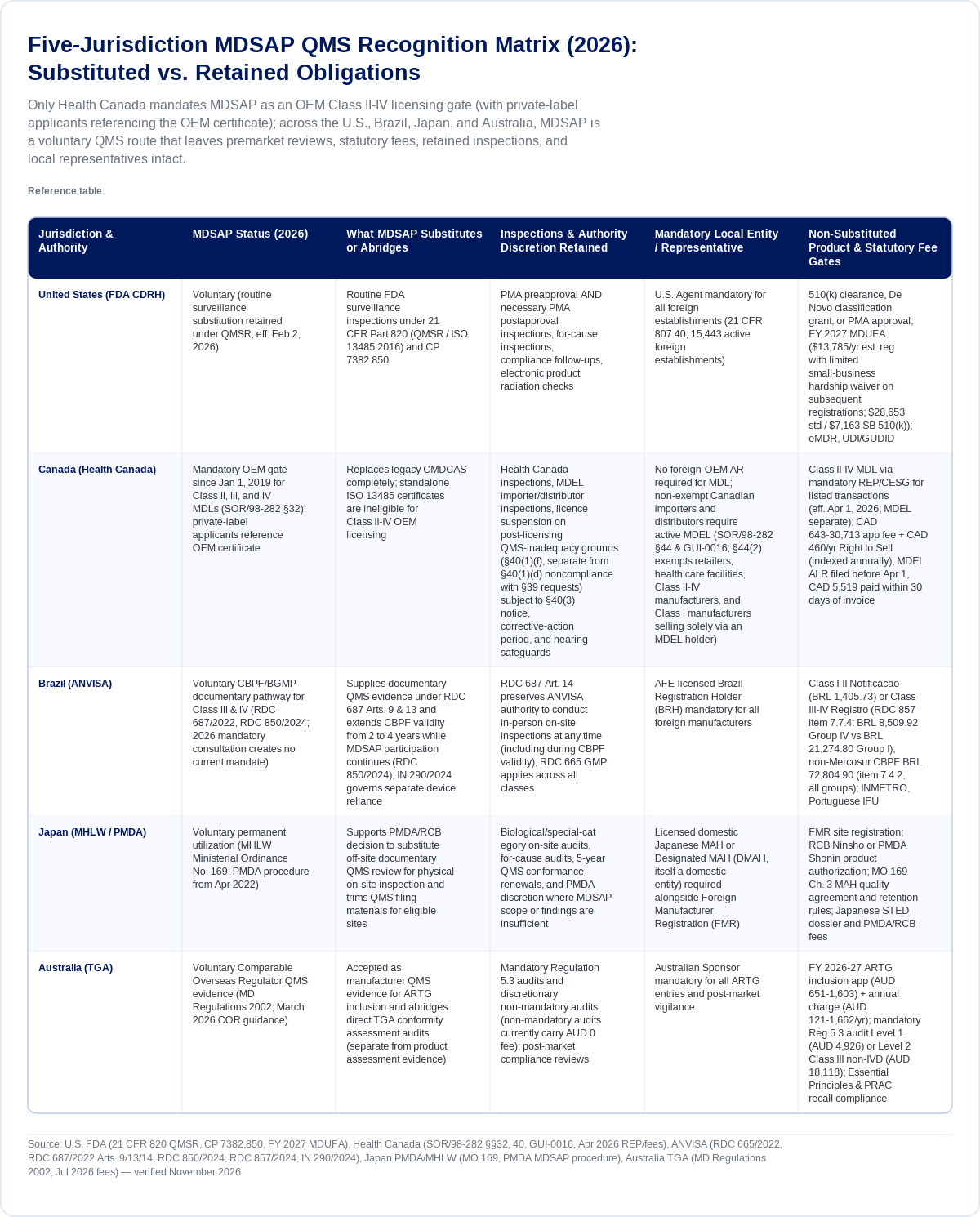
| Jurisdiction & Authority | MDSAP Status (2026) | What MDSAP Substitutes or Abridges | Inspections & Authority Discretion Retained | Mandatory Local Entity / Representative | Non-Substituted Product & Statutory Fee Gates |
|---|---|---|---|---|---|
| United States (FDA CDRH) | Voluntary (routine surveillance substitution retained under QMSR, eff. Feb 2, 2026) | Routine FDA surveillance inspections under 21 CFR Part 820 (QMSR / ISO 13485:2016) and CP 7382.850 | PMA preapproval AND necessary PMA postapproval inspections, for-cause inspections, compliance follow-ups, electronic product radiation checks | U.S. Agent mandatory for all foreign establishments (21 CFR 807.40; 15,443 active foreign establishments) | 510(k) clearance, De Novo classification grant, or PMA approval; FY 2027 MDUFA ($13,785/yr est. reg with limited small-business hardship waiver on subsequent registrations; $28,653 std / $7,163 SB 510(k)); eMDR, UDI/GUDID |
| Canada (Health Canada) | Mandatory OEM gate since Jan 1, 2019 for Class II, III, and IV MDLs (SOR/98-282 §32); private-label applicants reference OEM certificate | Replaces legacy CMDCAS completely; standalone ISO 13485 certificates are ineligible for Class II-IV OEM licensing | Health Canada inspections, MDEL importer/distributor inspections, licence suspension on post-licensing QMS-inadequacy grounds (§40(1)(f), separate from §40(1)(d) noncompliance with §39 requests) subject to §40(3) notice, corrective-action period, and hearing safeguards | No foreign-OEM AR required for MDL; non-exempt Canadian importers and distributors require active MDEL (SOR/98-282 §44 & GUI-0016; §44(2) exempts retailers, health care facilities, Class II-IV manufacturers, and Class I manufacturers selling solely via an MDEL holder) | Class II-IV MDL via mandatory REP/CESG for listed transactions (eff. Apr 1, 2026; MDEL separate); CAD 643-30,713 app fee + CAD 460/yr Right to Sell (indexed annually); MDEL ALR filed before Apr 1, CAD 5,519 paid within 30 days of invoice |
| Brazil (ANVISA) | Voluntary CBPF/BGMP documentary pathway for Class III & IV (RDC 687/2022, RDC 850/2024; 2026 mandatory consultation creates no current mandate) | Supplies documentary QMS evidence under RDC 687 Arts. 9 & 13 and extends CBPF validity from 2 to 4 years while MDSAP participation continues (RDC 850/2024); IN 290/2024 governs separate device reliance | RDC 687 Art. 14 preserves ANVISA authority to conduct in-person on-site inspections at any time (including during CBPF validity); RDC 665 GMP applies across all classes | AFE-licensed Brazil Registration Holder (BRH) mandatory for all foreign manufacturers | Class I-II Notificacao (BRL 1,405.73) or Class III-IV Registro (RDC 857 item 7.7.4: BRL 8,509.92 Group IV vs BRL 21,274.80 Group I); non-Mercosur CBPF BRL 72,804.90 (item 7.4.2, all groups); INMETRO, Portuguese IFU |
| Japan (MHLW / PMDA) | Voluntary permanent utilization (MHLW Ministerial Ordinance No. 169; PMDA procedure from Apr 2022) | Supports PMDA/RCB decision to substitute off-site documentary QMS review for physical on-site inspection and trims QMS filing materials for eligible sites | Biological/special-category on-site audits, for-cause audits, 5-year QMS conformance renewals, and PMDA discretion where MDSAP scope or findings are insufficient | Licensed domestic Japanese MAH or Designated MAH (DMAH, itself a domestic entity) required alongside Foreign Manufacturer Registration (FMR) | FMR site registration; RCB Ninsho or PMDA Shonin product authorization; MO 169 Ch. 3 MAH quality agreement and retention rules; Japanese STED dossier and PMDA/RCB fees |
| Australia (TGA) | Voluntary Comparable Overseas Regulator QMS evidence (MD Regulations 2002; March 2026 COR guidance) | Accepted as manufacturer QMS evidence for ARTG inclusion and abridges direct TGA conformity assessment audits (separate from product assessment evidence) | Mandatory Regulation 5.3 audits and discretionary non-mandatory audits (non-mandatory audits currently carry AUD 0 fee); post-market compliance reviews | Australian Sponsor mandatory for all ARTG entries and post-market vigilance | FY 2026-27 ARTG inclusion app (AUD 651-1,603) + annual charge (AUD 121-1,662/yr); mandatory Reg 5.3 audit Level 1 (AUD 4,926) or Level 2 Class III non-IVD (AUD 18,118); Essential Principles & PRAC recall compliance |
Source: U.S. FDA (21 CFR 820 QMSR, CP 7382.850, FY 2027 MDUFA), Health Canada (SOR/98-282 §§32, 40, GUI-0016, Apr 2026 REP/fees), ANVISA (RDC 665/2022, RDC 687/2022 Arts. 9/13/14, RDC 850/2024, RDC 857/2024, IN 290/2024), Japan PMDA/MHLW (MO 169, PMDA MDSAP procedure), Australia TGA (MD Regulations 2002, Jul 2026 fees) — verified November 2026
The recognition matrix establishes the statutory boundary across all five authorities in late 2026:
- Canada (Health Canada — Mandatory OEM Gate): Under SOR/98-282 §32, every original equipment manufacturer seeking or maintaining a Class II, III, or IV Medical Device Licence must submit a valid MDSAP certificate issued by a recognized AO; standalone ISO 13485 certificates are ineligible 5 6 18. Qualifying private-label applicants rely on the original manufacturer's MDSAP certificate details rather than securing their own AO audit 8.
- United States (FDA CDRH — Voluntary Surveillance Substitution): FDA accepts MDSAP audit reports as a substitute for routine surveillance inspections under 21 CFR Part 820 (QMSR) and CP 7382.850, while explicitly preserving PMA preapproval inspections, necessary PMA postapproval inspections, for-cause inspections, compliance follow-up inspections, and electronic product radiation checks 3 19 20.
- Brazil (ANVISA — Voluntary Documentary CBPF & 4-Year Validity): Under RDC 687/2022 Articles 9 and 13, ANVISA accepts MDSAP reports as documentary QMS evidence for Class III and IV CBPF certification, and under RDC 850/2024 extends CBPF validity from two years to four years while MDSAP participation continues 10 21. RDC 687/2022 Article 14 expressly preserves ANVISA's authority to conduct in-person on-site inspections at any time, including during certificate validity, while IN 290/2024 separately governs optimized medical device registration reliance 21 22.
- Japan (MHLW / PMDA — Voluntary Permanent Utilization): Under PMDA's permanent MDSAP utilization procedure (applicable to applications from April 2022 under MHLW Ministerial Ordinance No. 169), submitting an MDSAP report supports PMDA or Registered Certification Body (RCB) decisions to substitute off-site documentary review for physical on-site QMS inspection and trim required QMS materials for eligible sites 23 24. Foreign Manufacturer Registration (FMR), domestic MAH or Designated MAH (DMAH) governance, and MO 169 Chapter 3 obligations remain mandatory 23 25 26.
- Australia (TGA — Voluntary COR QMS Evidence): Under the Therapeutic Goods (Medical Devices) Regulations 2002 and TGA's March 2026 COR guidance, TGA accepts MDSAP certificates as manufacturer QMS evidence (distinct from product assessment evidence) for ARTG inclusion and abridges direct TGA conformity assessment audits, while keeping Australian Sponsor responsibilities, mandatory Regulation 5.3 audits, and discretionary non-mandatory audits intact 27 17.
Jurisdiction-by-Jurisdiction Decisions: Where MDSAP Changes Outcomes and Where National Gates Stay Fixed
Evaluating VerveMed's roadmap requires examining each regulator's controlling 2026 rules, fee structures, and inspection exceptions individually.
United States (FDA CDRH): Post-Feb 2, 2026 QMSR Alignment, CP 7382.850, and FY 2027 MDUFA Tariffs
On February 2, 2026, FDA's QMSR Final Rule (89 FR 7496, published February 2, 2024) amended 21 CFR Part 820 to incorporate ISO 13485:2016 and ISO 9000:2015 Clause 3 by reference 1 2. On the same date, FDA retired the Quality System Inspection Technique (QSIT) and activated Compliance Program 7382.850 (Inspection of Medical Device Manufacturers), consolidating routine surveillance, compliance follow-up, for-cause, and PMA preapproval and postapproval inspections under a risk-based Total Product Life Cycle framework 3 4.
Two legal changes under QMSR directly influence an MDSAP decision in 2026:
- Both PMA Inspection Stages Remain Outside MDSAP: FDA reaffirmed that valid U.S.-scoped MDSAP audit reports continue to substitute for routine FDA surveillance inspections under QMSR 4 20. However, official MDSAP U.S. participation boundaries and CP 7382.850 explicitly exclude PMA preapproval inspections, necessary PMA postapproval inspections, for-cause inspections, and compliance follow-up inspections from routine substitution 3 19. A Class III PMA manufacturer funding MDSAP must still budget and prepare for FDA investigators during both preapproval and postapproval PMA reviews.
- Internal Audits and Management Reviews Are Open to FDA: Former 21 CFR 820.180(c) shielded internal quality audit reports, management review minutes, and supplier audit reports from routine FDA investigator inspection. QMSR removed that carve-out on February 2, 2026 2 4. As documented in Pure Global's review of QMSR warning letters and ISO 13485 records FDA cited in 2026, FDA investigators inspect internal audits, management reviews, and supplier audits directly under CP 7382.850. Because MDSAP AOs already examine those records annually under ISO 13485:2016, the historical disclosure asymmetry that once deterred U.S. firms from entering MDSAP ended in February 2026.
Live U.S. registry metrics show the scale of the foreign QMSR cohort. Aggregating all 335,224 product-establishment listing rows in the September 21, 2026 openFDA Registration and Listing dataset across 25,678 unique active establishments reveals 15,443 foreign establishments (60.14% of known-country facilities) versus 10,234 domestic U.S. facilities (1 unknown) 11. Every active foreign establishment (15,443 of 15,443, 100.0%) lists a mandatory U.S. Agent under 21 CFR 807.40 11 28. Across all listed products per facility, 15,812 establishments (61.58%) list at least one Class II (14,491 highest) or Class III (1,321 highest) device, with China (5,013), Germany (1,082), South Korea (891), Canada (657), the United Kingdom (626), Taiwan (624), Japan (534), Italy (516), and France (458) leading foreign facility counts alongside Australia (193) and Brazil (114) 11.
Filtering the November 27, 2026 openFDA 510(k) extract cleanly against FDA's device-clearance field dictionary—excluding 174 DEN-prefixed De Novo grants (DENG) from the 15,861 extract records dated 2022 through November 27, 2026—yields 15,687 K-prefixed 510(k) substantially-equivalent clearances (15,640 SESE, 23 SESU, 22 SESK, and 2 SESD): 3,187 in 2022, 3,299 in 2023, 3,082 in 2024, 3,198 in 2025, and 2,921 in 2026 YTD 29. Non-U.S. applicants accounted for 8,132 of those 15,687 clearances (51.84%), versus 7,555 U.S. applicants, led by China (2,696), South Korea (889), Germany (528), Israel (422), France (330), Japan (328), Switzerland (292), Taiwan (290), the United Kingdom (270), Canada (247), Italy (245), Australia (127), and Brazil (87) 29.
MDSAP alters zero U.S. statutory fees or marketing-authorization gates. Manufacturers must still obtain a 510(k) clearance, De Novo classification grant, or PMA approval, maintain annual FURLS registration, and comply with 21 CFR Part 803 (eMDR), Part 806 (Corrections and Removals), Part 830 (UDI/GUDID), and U.S. Customs ACE entry controls covered in Pure Global's 2026 U.S. FDA foreign manufacturer launch workpaper 28. Effective October 1, 2026, FDA's FY 2027 MDUFA V user fees stand at $13,785 for annual establishment registration (with zero standard small-business discount, though FDA offers a limited financial-hardship waiver for qualifying small businesses on subsequent establishment registrations), $28,653 for a standard 510(k) ($7,163 small business), $191,020 for a standard De Novo request ($47,755 small business), and $636,732 for a standard PMA ($159,183 small business) 12.
Canada (Health Canada): Mandatory OEM Gate, SOR/98-282 §40 Safeguards, and April 1, 2026 REP & Fee Rules
Canada creates the clearest structural divide in MDSAP planning. Under SOR/98-282 §32, Health Canada retired CMDCAS permanently on January 1, 2019, requiring every original equipment manufacturer applying for or holding a Class II, III, or IV Medical Device Licence to maintain a valid MDSAP certificate from a Health Canada–recognized AO 5 6 18. Standalone ISO 13485 certificates, EU MDR CE certificates, and FDA inspection reports are ineligible. Qualifying private-label licence applicants, however, supply the original manufacturer's valid MDSAP certificate details rather than purchasing an independent AO certificate of their own 8.
On Health Canada's November 28, 2026 MDALL register, 36,183 active Class II–IV licences (26,679 Class II [73.73%], 7,907 Class III [21.85%], and 1,597 Class IV [4.41%]) map to 3,461 unique licence-holding company IDs (3,326 unique normalized company-name keys) 7. Across those 3,461 licence-holding company IDs, 2,901 (83.82%) list mailing addresses outside Canada (1,247 U.S., 560 Canada, 388 China, 238 Germany, 107 UK, 107 France, 92 South Korea, 85 Switzerland, 82 Italy, 64 Israel, 58 Japan, 31 Australia, 6 Brazil) 7. Because MDALL records licence-holding companies (combining OEMs and private-label licence holders) and company mailing addresses rather than verified manufacturing-site identifiers, the exact subset of directly AO-certified manufacturers and physical plants is unknown from MDALL alone 7 8. For an OEM such as VerveMed placing VerveMonitor C2 (Class III) and VerveCath S1 (Class II) on the Canadian market under its own name, the SOR/98-282 §32 OEM MDSAP requirement is absolute.
Four Canadian operational rules govern post-licensing compliance and budgeting in 2026:
- Suspension Standards and Corrective-Action Safeguards (SOR/98-282 §40): Health Canada separates statutory suspension grounds across distinct paragraphs of §40(1): §40(1)(f) applies when post-licensing information provides reasonable grounds to believe that the quality management system under which the device was designed (Class III or IV) or manufactured, assembled, processed, packaged, refurbished, or modified (Class II, III, or IV) is inadequate to ensure that the device meets its specifications, whereas failure to comply with a Minister's request under §39 falls separately under §40(1)(d) (with insufficient §39 samples or information under §40(1)(d.1)) 30. Subject to emergency suspension under §41, §40(3) bars suspension until Health Canada sends written notice stating the reason, any required corrective action, and the specified period to complete that corrective action, that period elapses without completion, and the licensee receives an opportunity to be heard 30.
- Scoped April 1, 2026 Mandatory REP / CESG Transition: Effective April 1, 2026, Health Canada mandated electronic submission via the Regulatory Enrolment Process (REP) and Common Electronic Submissions Gateway (CESG) for specified Class II–IV medical device licence transactions (including new licence applications and listed amendments) 31. Medical Device Establishment Licence (MDEL) applications and excluded regulatory activities remain on separate submission channels 31.
- FY 2026–2027 Statutory MDL Tariffs and Annual Indexation: Effective April 1, 2026, Health Canada MDL application fees stand at CAD 643 (Class II, VerveCath S1), CAD 14,163 (Class III, VerveMonitor C2), CAD 30,169 (Class III near-patient IVD), and CAD 30,713 (Class IV), alongside an annual Right to Sell fee of CAD 460 per licensed device or family Pure Global pricing 13. Finance teams building multi-year forecasts should account for Health Canada's statutory annual CPI indexation, which adjusts base rates each April 1 (as documented in Health Canada's fiscal fee reporting, moving Right to Sell from CAD 460 toward CAD 473 across fiscal cycles) 13.
- Importer MDEL Scope, §44(2) Exemptions, and Clocks (GUI-0016): Foreign OEMs hold Class II–IV MDLs directly without appointing a Canadian Authorized Representative, while Canadian importers and distributors generally require an active MDEL under SOR/98-282 §§44–51 and GUI-0016—subject to §44(2) statutory exemptions for retailers, health care facilities, Class II–IV manufacturers, and Class I manufacturers that import or distribute solely through an MDEL holder 5 6 32. Effective April 1, 2026, the MDEL fee is CAD 5,519; holders must submit their Annual Licence Review (ALR) package before April 1 each year and pay the invoiced fee within 30 calendar days of Health Canada's invoice 13 32.
Brazil (ANVISA): Separate Instruments for GMP (RDC 665), Inspection (RDC 687), 4-Year CBPF (RDC 850), and Device Reliance (IN 290)
Brazil illustrates why imprecise statutory citations can derail both a regulatory submission and a capital-budget business case. Five distinct ANVISA instruments govern VerveMed's Class II and Class III strategy in 2026:
- RDC 751/2022 (Classification, Notificação, and Registro): Class I and II devices follow Notificação (exempt from CBPF/BGMP certification), whereas Class III and IV devices require full Registro backed by an active CBPF/BGMP certificate 33 34.
- RDC 665/2022 (Substantive Good Manufacturing Practices): Sets Brazil's substantive BGMP requirements across all medical device classes—including Classes I and II. Class I and II relief from CBPF certification leaves underlying RDC 665 GMP compliance mandatory 33 34.
- RDC 687/2022 Articles 9, 13, and 14 (Documentary Certification & Retained Inspection Power): Authorizes ANVISA to grant or renew Class III–IV CBPF certificates via documentary evaluation of international audit reports—including MDSAP reports and other risk-based documentary mechanisms—without automatically queuing a physical inspection for non-MDSAP sites 21. Crucially, Article 14 expressly preserves ANVISA's authority to conduct an in-person on-site inspection at any time, including while a valid CBPF certificate is in force 21.
- RDC 850/2024 (Conditional 4-Year CBPF Validity): Article 1 (amending RDC 497/2021 Article 8, effective April 1, 2024) doubles CBPF validity from two years to four years exclusively for certificates granted or renewed via MDSAP, strictly conditioned on continuous participation in MDSAP 10.
- IN 290/2024 (Device Registration Reliance — Distinct from IN 292/2024): Governs ANVISA's optimized medical device registration analysis relying on prior market authorizations for an essentially identical device from Equivalent Foreign Regulatory Authorities (AREEs: Australia TGA, Health Canada, U.S. FDA, and Japan MHLW/PMDA) 22 35. (By contrast, IN 292/2024 addresses pharmaceutical GMP inspection reliance rather than medical device registration 35.)
Coalescing all 116,874 raw product-site rows in ANVISA's November 28, 2026 public dataset (applying full DD/MM/YYYY expiry filtering against 2026-11-28) produces 101,396 unique active registrations (36,708 Class I, 47,531 Class II, 11,292 Class III, and 5,865 Class IV) across 4,313 active Brazil Registration Holders (BRHs by unique CNPJ) and 10,952 unique normalized manufacturer names 9. Comparing Brazil's risk-tier structure beside Australia's November 28, 2026 ARTG (63,107 active inclusions) highlights how sharply CBPF certification triggers narrow in Brazil.
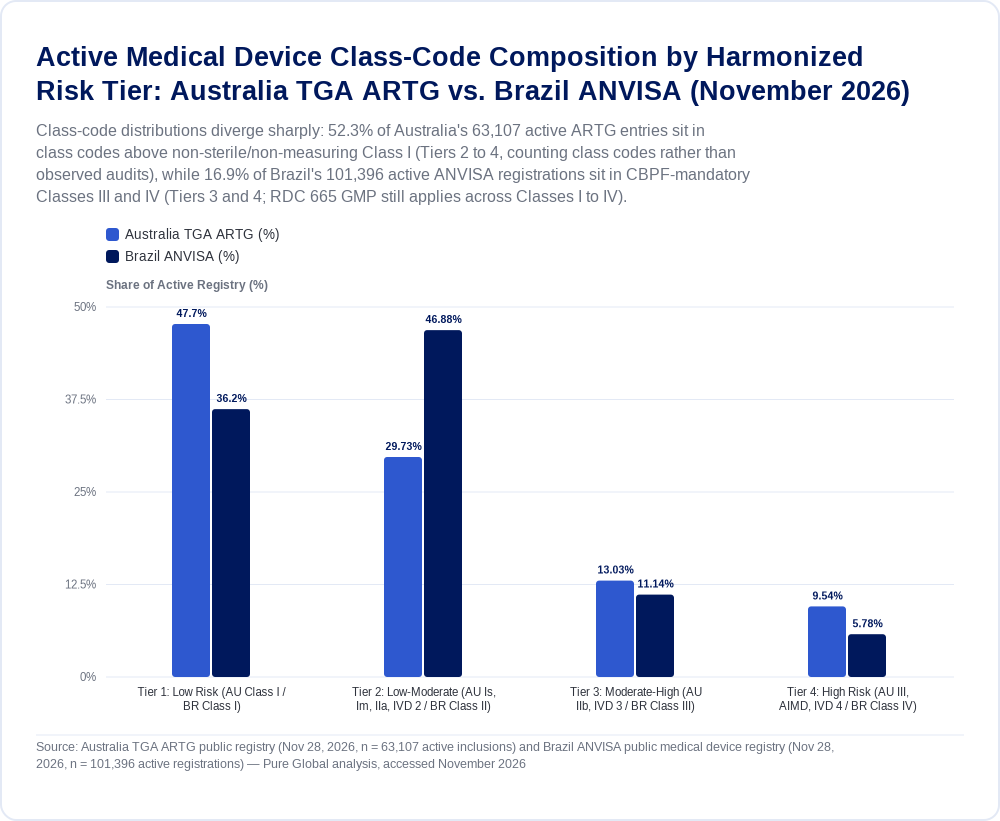
| Australia TGA ARTG (%) | Brazil ANVISA (%) | |
|---|---|---|
| Tier 1: Low Risk (AU Class I / BR Class I) | 47.7% | 36.2% |
| Tier 2: Low-Moderate (AU Is, Im, IIa, IVD 2 / BR Class II) | 29.73% | 46.88% |
| Tier 3: Moderate-High (AU IIb, IVD 3 / BR Class III) | 13.03% | 11.14% |
| Tier 4: High Risk (AU III, AIMD, IVD 4 / BR Class IV) | 9.54% | 5.78% |
Source: Australia TGA ARTG public registry (Nov 28, 2026, n = 63,107 active inclusions) and Brazil ANVISA public medical device registry (Nov 28, 2026, n = 101,396 active registrations) — Pure Global analysis, accessed November 2026
Only 16.92% (17,157 of 101,396) of active ANVISA registrations sit in CBPF-mandatory Classes III and IV (83.08%, or 84,239, sit in Classes I and II) 9. Inside Classes III and IV, foreign-site exposure is concentrated: 74.78% (12,827 of 17,152 known-origin Class III–IV registrations, excluding 5 blank-country records) list at least one foreign manufacturing site—71.35% in Class III (8,054 of 11,288) and 81.39% in Class IV (4,773 of 5,864) 9. Counting each manufacturing country once per active Class III–IV registration mentioning it (so a multi-country registration can enter more than one country count), leading manufacturing countries are Brazil (4,378), United States (4,160), China (2,201), Germany (1,723), South Korea (656), France (581), Switzerland (557), Italy (436), and the United Kingdom (378) 9. Across the 1,069 CNPJ BRH holders managing active Class III–IV filings, ANVISA's July 2026 AFE establishment census independently records 2,855 active domestic medical device manufacturers (4,258 combined manufacturers and exporters) 9.
Two Brazilian statutory fee and policy points directly affect 2026–2027 budgeting:
- Petitioner Revenue Tiers Under RDC 857/2024 Annex I: ANVISA's statutory TFVS registration tariff depends on both device category and the Brazilian Registration Holder's corporate revenue group (Articles 13–14) 14. For a Class III/IV small-to-medium device family (Registro, item 7.7.4), a Group IV petitioner (the discounted small-revenue tier shown in Pure Global's Master Price List) pays BRL 8,509.92, whereas a Group I (large-enterprise) BRH pays BRL 21,274.80 for the exact same product family (+BRL 12,764.88, or ≈$2,234 USD at 0.175 BRL/USD) Pure Global pricing 14. By contrast, item 7.4.2 fixes the non-Mercosur international CBPF/BGMP fee at BRL 72,804.90 across all petitioner revenue groups (whereas BRL 10,637.40 represents one Mercosur-specific tier column) 14. Under RDC 850/2024, qualifying for four-year CBPF validity via MDSAP skips one BRL 72,804.90 (≈$12,741 USD) biennial renewal petition—a concrete statutory cash saving separate from ANVISA's retained Article 14 inspection discretion 10 21.
- Live 2026 Scenario Risk — ANVISA Consultation on Mandatory MDSAP: In 2026, ANVISA broadened industry discussions evaluating regulatory alternatives following proposals to make MDSAP mandatory for medical device manufacturers 35. While the 2026 consultation creates no current mandate, VPs of Regulatory Affairs committing capital to Brazil Class III–IV portfolios for 2026–2028 should track ANVISA's rulemaking closely as an upside-protection factor for MDSAP adoption 35.
Japan (MHLW / PMDA): Permanent MDSAP Utilization Under MO 169 and Measured Registry Fields
Japan transitioned from pilot trials to permanent utilization of MDSAP audit reports across PMDA and Registered Certification Bodies (RCBs) under procedures governing applications from April 2022, alongside the March 25, 2024 completion of MHLW Ministerial Ordinance No. 169 (MO 169) Chapter 2 alignment with ISO 13485:2016 23. Under Section 3 of PMDA's MDSAP utilization procedure, applicants submit distinct documentation sets—first, materials enabling PMDA or the RCB to decide whether an on-site inspection can shift to an off-site documentary review, and second, the streamlined QMS review materials for the off-site conformity investigation itself 23 24. Biological-derived devices, radioactive IVDs, reprocessed single-use devices, and sites with unresolved scope or compliance gaps remain subject to on-site QMS scrutiny 23.
Public Japanese registry data must be read strictly at its measured status and field filters rather than extrapolated into unproven route-dominance claims. PMDA's November 25, 2026 third-party RCB certification extract (27,074 rows across 26,228 unique certificate numbers) tracks separate status and transfer dates: 46 rows carry a cancellation date (cancelled_date), 10,126 rows carry a retirement date (arranged_date, retiring 10,020 certificate numbers on every row plus 1 multi-row certificate retaining an unretired successor row), and 3,246 rows record succession (inheritance_date) 25 26. Applying an explicitly labeled diagnostic filter—retaining rows carrying neither cancelled_date nor arranged_date and aggregating all eligible rows by certificate_number—yields 16,162 non-cancelled, non-retired certificate numbers (a reproducible row-level diagnostic pending formal PMDA confirmation of active-status schema rules) 25 26. Across those 16,162 certificate numbers, 580 (3.59%) populate foreign_holder_name on at least one eligible row across 127 distinct populated strings, while 15,582 (96.41%) leave foreign_holder_name blank on all eligible rows (1,185 distinct holder_name strings in that blank-field subset out of 1,439 distinct holder_name strings across all 16,162 retained certificates) 25 26. Because the public extract publishes no completeness rule requiring foreign_holder_name on every foreign-origin device, because a Designated Marketing Authorization Holder (DMAH) is itself a Japanese domestic legal entity, and because an RCB third-party certification (Ninsho) is legally distinct from a Foreign Special Approval (Tokurei Shonin), blank foreign_holder_name rows measure only recorded field presence rather than proving domestic-only market entry 25 26. Across PMDA's 18 FY2017–FY2025 generic and improved-without-clinical Shonin approval workbooks (which carry no per-row risk-class column), exact action parsing shows 3,811 new approvals (2,428 generic + 1,383 improved) and 5,017 partial-change approvals (4,349 generic + 668 improved), totaling 8,828 recorded approval actions across 5,976 combined unique approval numbers (4,802 generic; 1,703 improved) 25 26.
For VerveMed, MDSAP reduces Japanese QMS inspection friction without removing any local statutory architecture: the German plant still requires Foreign Manufacturer Registration (FMR), a licensed domestic Japanese MAH or DMAH, written MO 169 Chapter 3 quality-control and vigilance agreements (GQP/GVP), Japanese-language STED product dossiers, and PMDA or RCB product and QMS fees 23 24 25 26.
Australia (TGA): Class-Code Composition, QMS vs. Product Evidence, and Zero-Fee Non-Mandatory Audits
Under the Therapeutic Goods (Medical Devices) Regulations 2002, Australia requires Conformity Assessment evidence above non-sterile, non-measuring Class I 27. Across all 63,107 active medical device inclusions in TGA's November 28, 2026 ARTG register, 30,105 (47.70%) hold class code CLAS1 (Class I non-sterile/non-measuring), whereas 33,002 (52.30%) sit in higher-scrutiny class codes: 2,604 CLAS1S (Class Is), 496 CLAS1M (Class Im), 14,521 CLAS2A (Class IIa), 7,459 CLAS2B (Class IIb), 5,794 CLASS3 (Class III), 7 AIMD, 1,141 CLAS2 (Class 2 IVD), 762 CLAS3 (Class 3 IVD), and 218 CLAS4 (Class 4 IVD) 36. That 33,002 figure counts statutory class codes rather than observed QMS audits or MDSAP certificates, because bulk ARTG exports omit which overseas certificate backed each inclusion 36. Across all 63,104 known-origin ARTG inclusions (every class combined), 92.89% (58,615) list foreign or multi-site manufacturing addresses—led by the United States (20,190 address citations), Germany (8,471), China (8,440), Australia (4,491), the United Kingdom (2,818), Switzerland (2,530), Italy (2,096), France (1,825), South Korea (1,313), and Japan (982)—supported by 3,403 Australian Sponsors serving 10,247 unique normalized manufacturer names 36.
Three TGA rules directly govern VerveMed's Australian comparison under TGA's March 2026 COR guidance and July 1, 2026 fee schedule:
- QMS Evidence vs. Product Assessment Evidence: TGA distinguishes manufacturer QMS evidence (satisfied by an MDSAP certificate) from product assessment evidence (such as design examination or comparable overseas product approvals from EU MDR/IVDR Notified Bodies, U.S. FDA, Health Canada, Japan MHLW/PMDA, Singapore HSA, or UK-designated Approved Bodies, distinct from MHRA itself) 17. Because VerveMed already holds EU MDR CE marking for VerveMonitor C2 (Class IIb) and VerveCath S1 (Class IIa), EU MDR already supplies an Australian COR pathway without requiring MDSAP 17.
- Mandatory vs. Zero-Fee Non-Mandatory Application Audits: Effective July 1, 2026 (Tables 40, 41, and 43), TGA application fees stand at AUD 651 (Class I), AUD 1,244 (Class IIa/IIb and all IVDs), and AUD 1,603 (Class III), plus annual ARTG charges of AUD 121 (Class I other), AUD 879 (Class Is/Im), AUD 1,305 (Class IIa/IIb), AUD 1,662 (Class III/AIMD), and AUD 948 (IVDs) Pure Global pricing 15 16. Under TGA's application-audit selection guidance, non-mandatory (discretionary) application audits currently carry zero TGA assessment fee (AUD 0)—meaning a discretionary audit of VerveMed's Class IIb VerveMonitor C2 incurs no TGA audit charge 15 16. Paid Level 1 (AUD 4,926) and Level 2 (AUD 18,118, restricted specifically to mandatory Class III non-IVD audits) fees apply strictly to mandatory audits triggered under Regulation 5.3 27 15 16.
- Separate 2026 UDI Compliance Track: Australia's phased Unique Device Identification (UDI) rollout introduces mandatory database and labelling obligations for higher-risk devices starting in 2026, which sponsors must budget as a separate compliance deliverable rather than conflating with a documented paid application-audit trigger 17.
Cross-Registry Context: Name-Key Overlap Across Four Latin-Script MDSAP Registers
To inspect how frequently company names appearing in Canada's Class II–IV licence cohort recur across other MDSAP registers, we matched the 3,326 unique normalized company-name keys from Health Canada's November 28, 2026 MDALL register (3,461 licence-holding company IDs across 36,183 licences) against normalized name keys in U.S. FDA Registration & Listing (comparing both owner/operator and establishment names, 2026-09-21), Australia TGA ARTG manufacturer names (2026-11-28), and Brazil ANVISA manufacturer names (2026-11-28) 7 9 11 36.
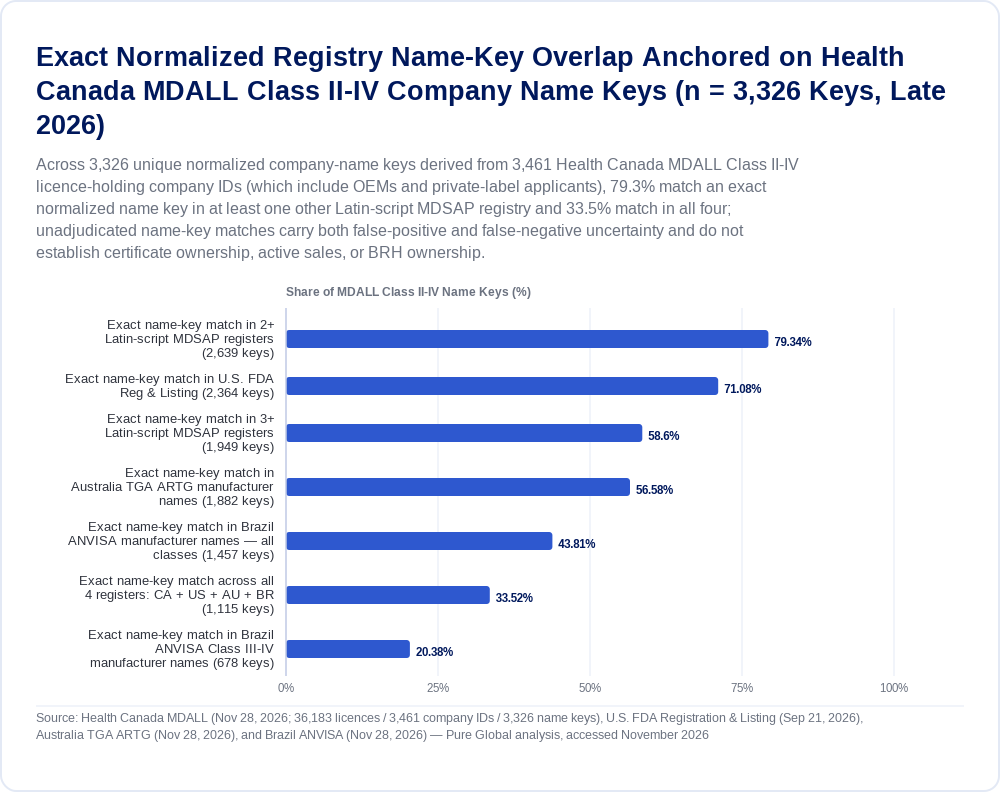
| Share of MDALL Class II-IV Name Keys (%) | |
|---|---|
| Exact name-key match in 2+ Latin-script MDSAP registers (2,639 keys) | 79.34% |
| Exact name-key match in U.S. FDA Reg & Listing (2,364 keys) | 71.08% |
| Exact name-key match in 3+ Latin-script MDSAP registers (1,949 keys) | 58.6% |
| Exact name-key match in Australia TGA ARTG manufacturer names (1,882 keys) | 56.58% |
| Exact name-key match in Brazil ANVISA manufacturer names — all classes (1,457 keys) | 43.81% |
| Exact name-key match across all 4 registers: CA + US + AU + BR (1,115 keys) | 33.52% |
| Exact name-key match in Brazil ANVISA Class III-IV manufacturer names (678 keys) | 20.38% |
Source: Health Canada MDALL (Nov 28, 2026; 36,183 licences / 3,461 company IDs / 3,326 name keys), U.S. FDA Registration & Listing (Sep 21, 2026), Australia TGA ARTG (Nov 28, 2026), and Brazil ANVISA (Nov 28, 2026) — Pure Global analysis, accessed November 2026
Across those 3,326 MDALL Class II–IV company-name keys, 79.34% (2,639 keys) match an exact normalized name key in at least one other Latin-script MDSAP register: 71.08% (2,364) in U.S. FDA Registration & Listing, 56.58% (1,882) in Australia ARTG manufacturer names, 43.81% (1,457) in Brazil ANVISA manufacturer names across all classes, and 20.38% (678) in Brazil ANVISA Class III–IV manufacturer names 7 9 11 36. Overall, 58.60% (1,949 keys) match across three or more Latin-script registers and 33.52% (1,115 keys) match in all four (687 keys, 20.66%, appear only in MDALL) 7 9 11 36.
Two strict methodological boundaries govern this overlap table. First, normalization strips legal suffixes (INC, LLC, GMBH, LTD, etc.), punctuation, non-ASCII characters, and tokens such as OF and DE, and compares MDALL licence-holder names against FDA owner/operator and establishment names and AU/BR manufacturer names. That rule can generate both false positives (same-key collisions or role mismatches across registries) and false negatives (multinational groups registering distinct regional subsidiaries), so it measures unadjudicated registry name-key overlap rather than a directional lower bound on verified entity operations 7 11. Second, a name-key match in Brazil's manufacturer column establishes zero inference about MDSAP certificate ownership (given private-label applicants in Canada), active commercial sales, or Brazil Registration Holder ownership (since foreign manufacturers appoint local CNPJ BRHs) 8 9. Establishing audited entity-level counts across borders requires shared legal identifiers (such as LEI/DUNS) or adjudicated positive and negative sample validation.
The Single-Audit Risk Amplifier: MDSAP P0037.002 Grading, P0027.007 Clocks, and AO Selection
Consolidating quality audits into one program reduces audit duplication while concentrating regulatory exposure: one serious facility breakdown can become visible across every participating authority listed on the certificate 37 38 39 40 41 42.
Task-Based Audit Duration Under MDSAP AU P0002.011 and AU P0008.009
MDSAP audits execute a fixed seven-process sequence under MDSAP AU P0002.011 (MDSAP Audit Approach, dated August 3, 2026): Management; Device Marketing Authorization and Facility Registration; Measurement, Analysis, and Improvement; Medical Device Adverse Events and Advisory Notices Reporting; Design and Development; Production and Service Controls; and Purchasing 37 38 39. Revision.011 refined Chapter 1 Management tasks by moving QMS risk-based thinking into Management Task 1, refocusing Management Task 6 on personnel competence rather than narrow training-record checks, and keeping Management Task 7 focused on top-management product-risk oversight 37 38 39. Audit duration follows MDSAP AU P0008.009 (Audit Time Determination Procedure, dated November 12, 2026; Form F0008.2), summing task-based time weights across applicable jurisdictions and complexity modifiers—including the retained 25% initial certification audit allowance under §5.2.2—across a three-year cycle (Stage 1 + Stage 2 initial, Surveillance 1, Surveillance 2, and Year 3 Recertification) 37 38 39. Because P0008.009 governs audit-time calculation rather than commercial pricing, actual dollar fees depend on each AO's negotiated day rates and site scope 37 38 39.
Exact Nonconformity Grading (P0037.002 Annex 2) and Separate AO vs. Manufacturer Clocks (P0027.007)
QA directors frequently misgrade mock-audit findings by assuming a simple ISO clause cut-off or treating recommended manufacturer response targets as statutory AO clocks. MDSAP AU P0037.002 (§5.2.3 & Annex 2) and MDSAP AU P0027.007 (§§5.1, 5.5–5.6) define precise rules that diverge from legacy GHTF heuristics 40 41 42:
- ISO 13485:2016 Clause Exceptions (P0037.002 Annex 2): Indirect QMS clauses cover ISO 13485 Clauses 4.1–6.3 except Clause 4.2.3 (Medical Device File), which is Direct, plus Clause 8.2.4 (Internal Audit), which is Indirect 40 41 42. Thus a first-time 8.2.4 internal-audit failure starts at Grade 1 (indirect), whereas a first-time 4.2.3 Medical Device File failure starts immediately at Grade 3 (direct) 40 41 42.
- Two-Report Repeat Lookback and Conjunctive Escalation Modifiers (P0037.002 §5.2.3): Repeat status checks the preceding two audit reports that evaluated the same subclause, adding +1 point if repeated 40 41 42. Step 2 modifiers each add +1 point (capped at Grade 5): (a) both absence of a required documented process or procedure and noncompliant implementation of the corresponding activity—P0037.002 §5.2.3 expressly modified the legacy GHTF rule so missing documentation alone adds zero escalation points (with no other modifier, a repeated direct finding remains Grade 4 when the required document is absent yet the corresponding activity is properly implemented)—or (b) confirmed release of a nonconforming medical device to market without adequate technical justification 40 41 42. Shipping an affected device during an administrative or reporting-procedure gap alone never establishes release of a nonconforming device unless the product itself failed specifications without justification 40 41 42.
- Separate AO Mandatory Clocks vs. Manufacturer Recommended Targets (P0027.007 §§5.1, 5.5–5.6 & FAQ):
- Manufacturer targets (recommended, not statutory AO deadlines): MDSAP recommends submitting a remediation plan within 15 calendar days of audit end (D0) and objective remediation evidence for Grade 4 or 5 findings within 30 calendar days 40 41 42. Per MDSAP's manufacturer-response FAQ, full implementation may take longer than 30 days; the AO evaluates the evidence available at day 30 40 41 42.
- One or two isolated Grade 4 NCs (absent another trigger): Triggers zero 5-working-day notice; the AO submits its full audit report package under the standard 90-calendar-day deadline 40 41 42.
- Three or more Grade 4 NCs OR one or more Grade 5 NCs: Binds the AO to file Form MDSAP AU F0019.2 via REPs within 5 working days of D0 and submit the complete expedited audit package within 45 calendar days of D0 40 41 42.
- Public health threat, fraud, or counterfeit (even with zero Grade 4 or Grade 5 NCs): Binds the AO to submit Form F0019.2 PLUS a written report describing the circumstances within 5 working days of D0, followed by the expedited 45-calendar-day full audit package 40 41 42.
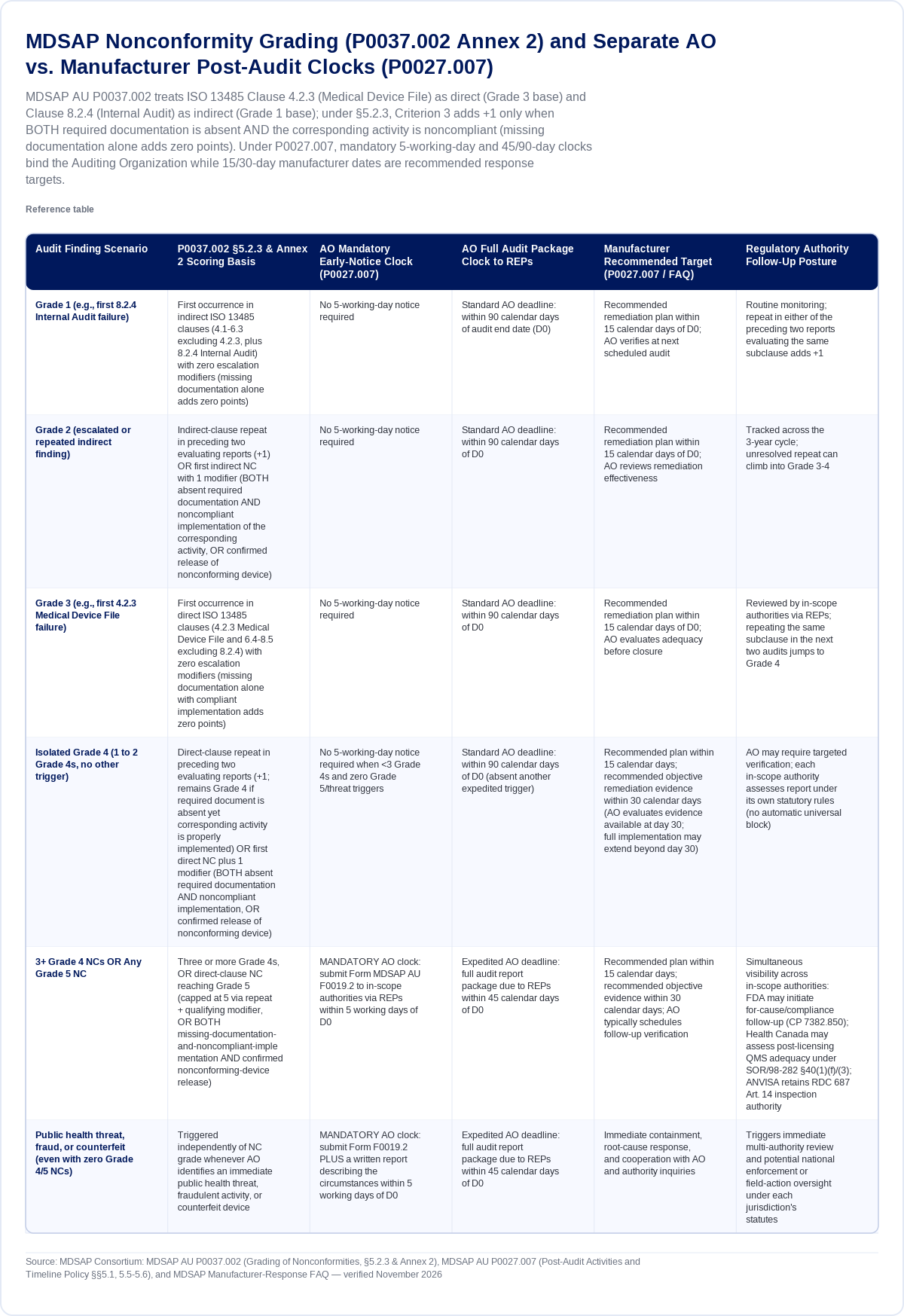
| Audit Finding Scenario | P0037.002 §5.2.3 & Annex 2 Scoring Basis | AO Mandatory Early-Notice Clock (P0027.007) | AO Full Audit Package Clock to REPs | Manufacturer Recommended Target (P0027.007 / FAQ) | Regulatory Authority Follow-Up Posture |
|---|---|---|---|---|---|
| Grade 1 (e.g., first 8.2.4 Internal Audit failure) | First occurrence in indirect ISO 13485 clauses (4.1-6.3 excluding 4.2.3, plus 8.2.4 Internal Audit) with zero escalation modifiers (missing documentation alone adds zero points) | No 5-working-day notice required | Standard AO deadline: within 90 calendar days of audit end date (D0) | Recommended remediation plan within 15 calendar days of D0; AO verifies at next scheduled audit | Routine monitoring; repeat in either of the preceding two reports evaluating the same subclause adds +1 |
| Grade 2 (escalated or repeated indirect finding) | Indirect-clause repeat in preceding two evaluating reports (+1) OR first indirect NC with 1 modifier (BOTH absent required documentation AND noncompliant implementation of the corresponding activity, OR confirmed release of nonconforming device) | No 5-working-day notice required | Standard AO deadline: within 90 calendar days of D0 | Recommended remediation plan within 15 calendar days of D0; AO reviews remediation effectiveness | Tracked across the 3-year cycle; unresolved repeat can climb into Grade 3-4 |
| Grade 3 (e.g., first 4.2.3 Medical Device File failure) | First occurrence in direct ISO 13485 clauses (4.2.3 Medical Device File and 6.4-8.5 excluding 8.2.4) with zero escalation modifiers (missing documentation alone with compliant implementation adds zero points) | No 5-working-day notice required | Standard AO deadline: within 90 calendar days of D0 | Recommended remediation plan within 15 calendar days of D0; AO evaluates adequacy before closure | Reviewed by in-scope authorities via REPs; repeating the same subclause in the next two audits jumps to Grade 4 |
| Isolated Grade 4 (1 to 2 Grade 4s, no other trigger) | Direct-clause repeat in preceding two evaluating reports (+1; remains Grade 4 if required document is absent yet corresponding activity is properly implemented) OR first direct NC plus 1 modifier (BOTH absent required documentation AND noncompliant implementation, OR confirmed release of nonconforming device) | No 5-working-day notice required when <3 Grade 4s and zero Grade 5/threat triggers | Standard AO deadline: within 90 calendar days of D0 (absent another expedited trigger) | Recommended plan within 15 calendar days; recommended objective remediation evidence within 30 calendar days (AO evaluates evidence available at day 30; full implementation may extend beyond day 30) | AO may require targeted verification; each in-scope authority assesses report under its own statutory rules (no automatic universal block) |
| 3+ Grade 4 NCs OR Any Grade 5 NC | Three or more Grade 4s, OR direct-clause NC reaching Grade 5 (capped at 5 via repeat + qualifying modifier, OR BOTH missing-documentation-and-noncompliant-implementation AND confirmed nonconforming-device release) | MANDATORY AO clock: submit Form MDSAP AU F0019.2 to in-scope authorities via REPs within 5 working days of D0 | Expedited AO deadline: full audit report package due to REPs within 45 calendar days of D0 | Recommended plan within 15 calendar days; recommended objective evidence within 30 calendar days; AO typically schedules follow-up verification | Simultaneous visibility across in-scope authorities: FDA may initiate for-cause/compliance follow-up (CP 7382.850); Health Canada may assess post-licensing QMS adequacy under SOR/98-282 §40(1)(f)/(3); ANVISA retains RDC 687 Art. 14 inspection authority |
| Public health threat, fraud, or counterfeit (even with zero Grade 4/5 NCs) | Triggered independently of NC grade whenever AO identifies an immediate public health threat, fraudulent activity, or counterfeit device | MANDATORY AO clock: submit Form F0019.2 PLUS a written report describing the circumstances within 5 working days of D0 | Expedited AO deadline: full audit report package due to REPs within 45 calendar days of D0 | Immediate containment, root-cause response, and cooperation with AO and authority inquiries | Triggers immediate multi-authority review and potential national enforcement or field-action oversight under each jurisdiction's statutes |
Source: MDSAP Consortium: MDSAP AU P0037.002 (Grading of Nonconformities, §5.2.3 & Annex 2), MDSAP AU P0027.007 (Post-Audit Activities and Timeline Policy §§5.1, 5.5-5.6), and MDSAP Manufacturer-Response FAQ — verified November 2026
Each participating authority evaluates reported findings under its own statute rather than applying one automatic cross-border block: FDA may trigger a for-cause or compliance follow-up inspection under CP 7382.850 3, Health Canada evaluates QMS adequacy under SOR/98-282 §40(1)(f) subject to §40(3) safeguards 30, ANVISA retains RDC 687 Article 14 on-site inspection authority 21, and PMDA assesses whether on-site QMS review is warranted under its MDSAP utilization procedure 24.
Verifying Active Status Across 15 Auditing Organizations (14 Recognized + 1 Authorized)
On the official MDSAP Auditing Organizations directory (mdsap.global/contact/ao-contact-details), 15 active Auditing Organizations conduct MDSAP audits as of late 2026: 14 Recognized AOs (BSI Group America, DEKRA Certification, DNV MEDCERT, DNV Product Assurance, DQS Medizinprodukte, GMED/LNE, IMQ, Intertek Testing Services NA, NSAI, SGS United Kingdom, TÜV Rheinland of North America, TÜV SÜD America, TÜV USA / TÜV NORD Group, and UL Solutions) plus 1 Authorized AO (mdc medical device certification GmbH), with Kiwa Ltd. listed as an Accepted Applicant 43. Before signing a three-year contract, QA directors should confirm that the exact contracting AO legal entity holds active scope for every target jurisdiction and check whether their existing EU MDR Notified Body can co-schedule EU MDR and MDSAP audits to limit plant disruption.
Pre-Audit Country-Specific Addenda and Non-Substituted Dossier Workpaper
Per the MDSAP Jurisdiction Scope FAQ, manufacturers implement country-specific QMS addenda strictly for the MDSAP jurisdictions where they market or intend to market devices (including jurisdictions where existing authorizations stay active)—never blindly across all five authorities 37 38 39.
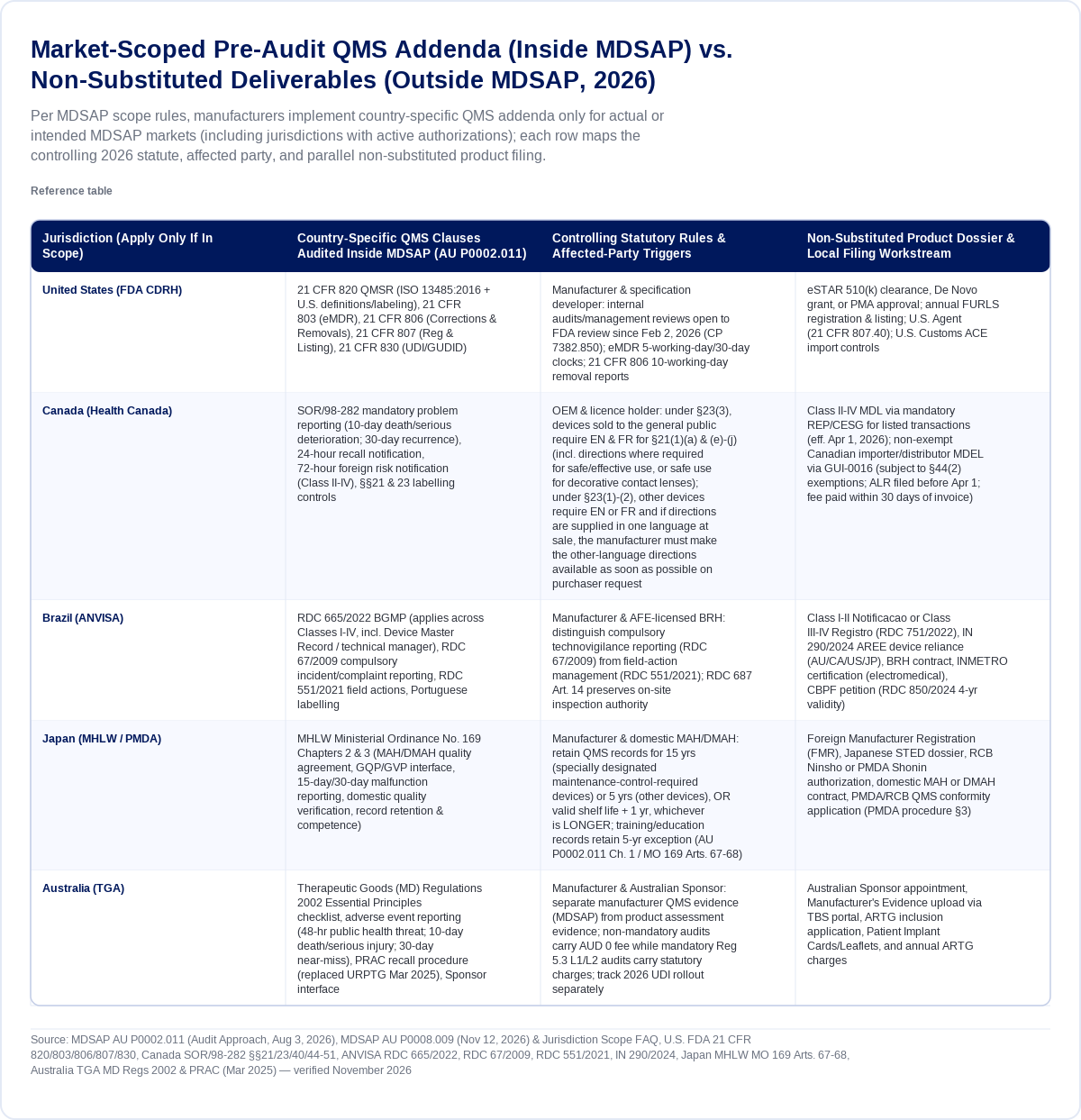
| Jurisdiction (Apply Only If In Scope) | Country-Specific QMS Clauses Audited Inside MDSAP (AU P0002.011) | Controlling Statutory Rules & Affected-Party Triggers | Non-Substituted Product Dossier & Local Filing Workstream |
|---|---|---|---|
| United States (FDA CDRH) | 21 CFR 820 QMSR (ISO 13485:2016 + U.S. definitions/labeling), 21 CFR 803 (eMDR), 21 CFR 806 (Corrections & Removals), 21 CFR 807 (Reg & Listing), 21 CFR 830 (UDI/GUDID) | Manufacturer & specification developer: internal audits/management reviews open to FDA review since Feb 2, 2026 (CP 7382.850); eMDR 5-working-day/30-day clocks; 21 CFR 806 10-working-day removal reports | eSTAR 510(k) clearance, De Novo grant, or PMA approval; annual FURLS registration & listing; U.S. Agent (21 CFR 807.40); U.S. Customs ACE import controls |
| Canada (Health Canada) | SOR/98-282 mandatory problem reporting (10-day death/serious deterioration; 30-day recurrence), 24-hour recall notification, 72-hour foreign risk notification (Class II-IV), §§21 & 23 labelling controls | OEM & licence holder: under §23(3), devices sold to the general public require EN & FR for §21(1)(a) & (e)-(j) (incl. directions where required for safe/effective use, or safe use for decorative contact lenses); under §23(1)-(2), other devices require EN or FR and if directions are supplied in one language at sale, the manufacturer must make the other-language directions available as soon as possible on purchaser request | Class II-IV MDL via mandatory REP/CESG for listed transactions (eff. Apr 1, 2026); non-exempt Canadian importer/distributor MDEL via GUI-0016 (subject to §44(2) exemptions; ALR filed before Apr 1; fee paid within 30 days of invoice) |
| Brazil (ANVISA) | RDC 665/2022 BGMP (applies across Classes I-IV, incl. Device Master Record / technical manager), RDC 67/2009 compulsory incident/complaint reporting, RDC 551/2021 field actions, Portuguese labelling | Manufacturer & AFE-licensed BRH: distinguish compulsory technovigilance reporting (RDC 67/2009) from field-action management (RDC 551/2021); RDC 687 Art. 14 preserves on-site inspection authority | Class I-II Notificacao or Class III-IV Registro (RDC 751/2022), IN 290/2024 AREE device reliance (AU/CA/US/JP), BRH contract, INMETRO certification (electromedical), CBPF petition (RDC 850/2024 4-yr validity) |
| Japan (MHLW / PMDA) | MHLW Ministerial Ordinance No. 169 Chapters 2 & 3 (MAH/DMAH quality agreement, GQP/GVP interface, 15-day/30-day malfunction reporting, domestic quality verification, record retention & competence) | Manufacturer & domestic MAH/DMAH: retain QMS records for 15 yrs (specially designated maintenance-control-required devices) or 5 yrs (other devices), OR valid shelf life + 1 yr, whichever is LONGER; training/education records retain 5-yr exception (AU P0002.011 Ch. 1 / MO 169 Arts. 67-68) | Foreign Manufacturer Registration (FMR), Japanese STED dossier, RCB Ninsho or PMDA Shonin authorization, domestic MAH or DMAH contract, PMDA/RCB QMS conformity application (PMDA procedure §3) |
| Australia (TGA) | Therapeutic Goods (MD) Regulations 2002 Essential Principles checklist, adverse event reporting (48-hr public health threat; 10-day death/serious injury; 30-day near-miss), PRAC recall procedure (replaced URPTG Mar 2025), Sponsor interface | Manufacturer & Australian Sponsor: separate manufacturer QMS evidence (MDSAP) from product assessment evidence; non-mandatory audits carry AUD 0 fee while mandatory Reg 5.3 L1/L2 audits carry statutory charges; track 2026 UDI rollout separately | Australian Sponsor appointment, Manufacturer's Evidence upload via TBS portal, ARTG inclusion application, Patient Implant Cards/Leaflets, and annual ARTG charges |
Source: MDSAP AU P0002.011 (Audit Approach, Aug 3, 2026), MDSAP AU P0008.009 (Nov 12, 2026) & Jurisdiction Scope FAQ, U.S. FDA 21 CFR 820/803/806/807/830, Canada SOR/98-282 §§21/23/40/44-51, ANVISA RDC 665/2022, RDC 67/2009, RDC 551/2021, IN 290/2024, Japan MHLW MO 169 Arts. 67-68, Australia TGA MD Regs 2002 & PRAC (Mar 2025) — verified November 2026
Before booking Stage 1 for VerveMed's active target scope, regulatory and quality teams should close five exact SOP controls:
- U.S. QMSR Transparency and Reporting (21 CFR 820, 803, 806, 807, 830 — If U.S. In Scope): Audit internal audits, management reviews, and supplier audits from the past 24 months assuming direct FDA review under CP 7382.850 2 3, and verify 21 CFR 803 eMDR (5 working days / 30 calendar days) and 21 CFR 806 (10 working days) reportability records 28.
- Canada Enumerated Bilingual Labelling and Problem Reporting (SOR/98-282 §§21, 23 — If Canada In Scope): Configure English/French labelling controls strictly to §§21(1) and 23: under §23(3), for a medical device sold to the general public, the enumerated information in §21(1)(a) and (e)–(j) (device name, package contents where not readily apparent, "Sterile" status, expiry date, intended conditions/purposes/uses and necessary performance specifications unless self-evident, directions for use where required for safe and effective use [or safe use for decorative contact lenses], and special storage conditions) must appear in both English and French 44 45. Under §23(1)–(2), for devices outside general-public sale, §21(1) information must appear in at least English or French; where directions for use are supplied in only one official language at sale, the manufacturer must make directions in the other official language available as soon as possible upon purchaser request 44 45. Align mandatory problem reporting (10 days / 30 days), 24-hour recall notice, and 72-hour Class II–IV foreign risk notifications inside controlled SOPs 5 6.
- Brazil Separate Incident vs. Field-Action Instruments (RDC 67/2009 & RDC 551/2021 — If Brazil In Scope): Maintain separate SOP mappings for compulsory adverse-event and technical-complaint notification under RDC 67/2009 and **field-action (ação de campo) management under RDC 551/2021 , alongside substantive ** RDC 665/2022 GMP compliance across all device classes (including Class I/II) 33 34 46 47 48.
- Japan MO 169 Retention Floor and Training Exception (MDSAP AU P0002.011, Chapter 1 / MO 169 Arts. 67–68 — If Japan In Scope): Set QMS record-retention periods to 15 years for specially designated maintenance-control-required medical devices (or 5 years for other devices), OR the device's valid shelf life plus 1 year, whichever is LONGER, explicitly incorporating the statutory 5-year retention exception for training/education records alongside written MO 169 Chapter 3 MAH quality agreements and Management Task 6 competence records 23 37 38 39.
- Australia Essential Principles and PRAC Recall Procedure (If Australia In Scope): Replace any legacy references to the superseded Uniform Recall Procedure for Therapeutic Goods (URPTG) with TGA's Procedure for Recalls, Product Alerts and Product Corrections (PRAC, effective March 2025) 49, map an explicit Australian Essential Principles checklist separate from EU MDR GSPRs, and separate manufacturer QMS evidence (MDSAP) from product assessment evidence 27 17.
How Much Does MDSAP Multi-Market Market Access Cost Across Four Core Jurisdictions in 2026?
Evaluating MDSAP financially requires separating mandatory Canadian licensing costs from voluntary-market break-even math, and separating non-substituted statutory government fees (which recur regardless of QMS audit choice) from incremental AO audit fees and independent in-country representation.
Under the Pure Global Master Price List, 2026, Pure Global publishes flat annual in-country representation fees rather than open-ended hourly retainers Pure Global pricing. For Australia, Brazil, EU, and UK, the price list specifies a three-year contract (early termination permitted at 50% payoff of remaining contract value; single-year contracts carry a +50% first-year fee), consolidating registration preparation and submission (based on reference approvals where applicable), required translations in Brazil, importation letters, modifications, renewals, and authority correspondence Pure Global pricing. The U.S. Agent schedule states a flat $1,000/yr fee (covering FDA fee processing, establishment registration support, and official correspondent services) without the three-year/50% termination clause stated on the Australia, Brazil, EU, and UK sheets Pure Global pricing. Japan representation and filing fees remain quote-dependent rather than published on the Master Price List Pure Global pricing.
Statutory Government Tariffs vs. Pure Global Flat Annual Representation & Compilation Fees (2026)
| Jurisdiction | Statutory Government Fees (Base Year 2026 / FY 2027 — Paid to Authority) | Pure Global Flat Annual In-Country Rep (1 Reg) | Pure Global Flat Annual In-Country Rep (3 Regs) | Pure Global One-Time Compilation & Consulting Ranges | Scope & Contract Terms Stated in Master Price List (2026) |
|---|---|---|---|---|---|
| United States (FDA CDRH) | FY 2027 MDUFA (eff. Oct 1, 2026): $13,785/yr Est. Reg (limited SB hardship waiver on subsequent renewals); $28,653 std / $7,163 SB 510(k); $191,020 De Novo (FY 2026 ref: $11,423 / $26,067 / $6,517) 12 Pure Global pricing | $1,000 / yr (U.S. Agent, All Classes) | $1,000 / yr (Entity-level U.S. Agent) | 510(k) compilation & submission: $15,000–$20,000; Q-Sub support: $10,000–$15,000; Pathway determination: $5,000 flat; Ad-hoc $250/hr Pure Global pricing | Annual FDA fee processing, establishment registration support, official correspondent services (annual fee; no 3-year/50% surcharge clause stated) |
| Canada (Health Canada) | Eff. Apr 1, 2026 (indexed annually): MDL CAD 643 (Class II), CAD 14,163 (Class III), CAD 30,169 (Class III NP-IVD), CAD 30,713 (Class IV); Right to Sell CAD 460/yr (indexing to CAD 473); Importer MDEL CAD 5,519/yr (paid within 30 days of invoice) Pure Global pricing 13 32 | No foreign-OEM AR required for MDL | N/A (OEM holds MDL; non-exempt Canadian importer holds MDEL) | Class I registration compilation only (per registration; MDEL preparation not separately itemized in published schedule): $3,000; MDL compilation only: $8,000–$10,000 (Class II), $12,000–$15,000 (Class III), $20,000–$25,000 (Class IV); Ad-hoc $200/hr Pure Global pricing | One-time compilation per registration; non-exempt Canadian importers/distributors maintain an active MDEL under SOR/98-282 §44 and GUI-0016 |
| Brazil (ANVISA) | RDC 857/2024 Annex I: Class I–II Notificação BRL 1,405.73; Class III–IV Registro (item 7.7.4, small/med family) BRL 8,509.92 (Group IV) vs. BRL 21,274.80 (Group I); non-Mercosur CBPF (item 7.4.2) BRL 72,804.90 across all groups (valid 4 yrs via MDSAP vs. 2 yrs standard) 10 Pure Global pricing 14 | $2,000 / yr (Class I–II) / $3,000 / yr (Class III–IV) | $4,000 / yr (Class I–II) / $6,000 / yr (Class III–IV) | Ad-hoc support $150/hr; Temporary Importation Letter included for new BRH clients ($300 existing / $500 non-BRH) Pure Global pricing | Prep & submission, required translation, importation letters, modifications, renewals, UDI, filing of BGMP certification, local certifier coordination (3-yr contract terms) |
| Australia (TGA) | FY 2026–27 (eff. Jul 1, 2026): App AUD 651 (Class I), AUD 1,244 (Class IIa/IIb/IVD), AUD 1,603 (Class III); Annual AUD 121–1,662/yr; non-mandatory audit AUD 0; mandatory Reg 5.3 L1 AUD 4,926 / Class III non-IVD L2 AUD 18,118 Pure Global pricing 15 16 | $2,000 / yr (Australian Sponsor, All Classes) | $3,000 / yr (All Classes; $4,000/yr for 5 regs) | Ad-hoc support $200/hr Pure Global pricing | Prep & submission of ARTG registration (based on reference approval), modifications, renewals, TGA correspondence (3-yr contract terms) |
| Japan (MHLW / PMDA) | Statutory PMDA/RCB product review, FMR, and QMS conformity investigation fees (variable by pathway and device category) 23 24 | Quote-dependent | Quote-dependent | Quote-dependent (outside published Master Price List schedules) Pure Global pricing | Requires domestic Japanese MAH or DMAH contract and FMR site registration |
| EU / UK (Reference Benchmark) | EU Notified Body fees separate; UK MHRA GBP 300/yr per Level 2 GMDN category in FY 2026/27 (Level 1 fallback where no Level 2 exists) Pure Global pricing 50 | $2,000 / yr (EU AR or UKRP, 1 group/reg) | $3,000 / yr (3 groups/regs; $4,000/yr for 5) | EU MDR CEP-CER compilation & writing: $15,000 (Class I), $25,000 (Is/Im/Ir/IIa), up to $30,000 (Class IIb/III); EU Pathway $5,000 Pure Global pricing | Document review, free sale certificates, EUDAMED / MHRA portal maintenance, authority correspondence (3-yr contract terms; EU manufacturers need no EU AR) |
Source: Pure Global Master Price List, 2026 paired with FY 2027 FDA MDUFA, April 2026 Health Canada, July 2026 TGA, ANVISA RDC 857/2024, and UK FY 2026/27 MHRA schedules.
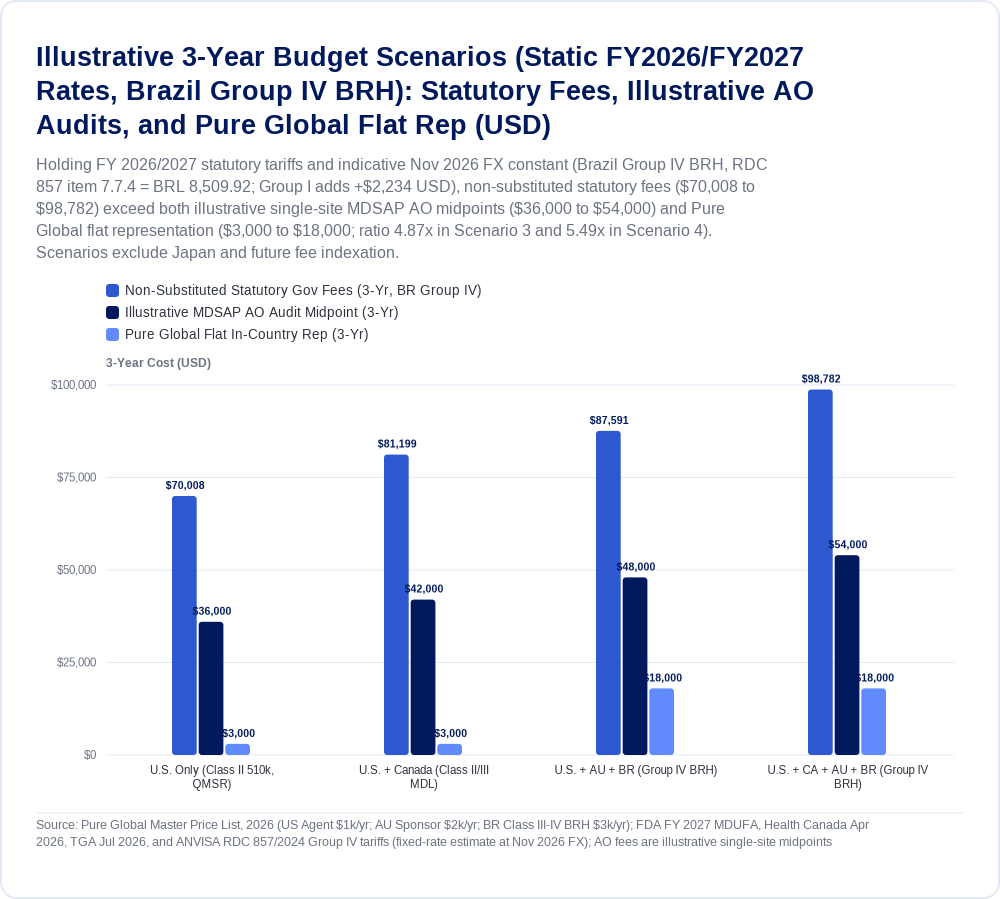
| Non-Substituted Statutory Gov Fees (3-Yr, BR Group IV) | Illustrative MDSAP AO Audit Midpoint (3-Yr) | Pure Global Flat In-Country Rep (3-Yr) | |
|---|---|---|---|
| U.S. Only (Class II 510k, QMSR) | $70,008 | $36,000 | $3,000 |
| U.S. + Canada (Class II/III MDL) | $81,199 | $42,000 | $3,000 |
| U.S. + AU + BR (Group IV BRH) | $87,591 | $48,000 | $18,000 |
| U.S. + CA + AU + BR (Group IV BRH) | $98,782 | $54,000 | $18,000 |
Source: Pure Global Master Price List, 2026 (US Agent $1k/yr; AU Sponsor $2k/yr; BR Class III-IV BRH $3k/yr); FDA FY 2027 MDUFA, Health Canada Apr 2026, TGA Jul 2026, and ANVISA RDC 857/2024 Group IV tariffs (fixed-rate estimate at Nov 2026 FX); AO fees are illustrative single-site midpoints
Worked Three-Year Budget and Voluntary Break-Even Test (Static Rates, Fixed FX, Brazil Group IV vs. Group I)
The four scenarios below model three-year spend for VerveMonitor C2 (one Class II U.S. / Class III Canada & Brazil / Class IIb Australia product family, standard business), holding FY 2026/FY 2027 statutory tariffs and indicative November 2026 FX rates (CAD 0.72, AUD 0.65, BRL 0.175) constant across three years and excluding Japan, future annual fee indexation, and conditional mandatory TGA Class III audits 12 Pure Global pricing 13 14 15 16. Because AO day rates are commercially negotiated (MDSAP AU P0008.009 defines audit time—retaining the 25% initial certification allowance under §5.2.2—rather than prices), AO audit costs ($36,000 to $54,000) and the standalone ISO 13485 baseline ($18,000) are explicitly labeled illustrative single-site midpoints 37 38 39.
Part A: Mandatory Canada Gate Scenarios (Scenarios 2 and 4)
- Scenario 2 — U.S. + Canada (Class II U.S. / Class III Canada): Static three-year manufacturer-paid statutory fees total $81,199 ($70,008 U.S. = 3 × $13,785 + $28,653 standard 510(k), plus ≈$11,191 Canada = CAD 14,163 Class III MDL + 3 × CAD 460 Right to Sell; Canadian importers separately carry CAD 5,519/yr MDEL) 12 13. Pure Global U.S. Agent costs $3,000 ($1,000/yr × 3), plus optional one-time Canada Class III MDL compilation ($12,000–$15,000; $8,000–$10,000 for Class II VerveCath S1) Pure Global pricing. Because SOR/98-282 §32 mandates MDSAP for OEM Class II–IV MDLs, standalone ISO 13485 is legally ineligible; the illustrative $42,000 two-country AO cycle is a required market-entry cost that also qualifies for FDA routine surveillance substitution 5 6 20.
- Scenario 4 — Four Core Markets (U.S. + Canada + Australia + Brazil, Group IV BRH): Static three-year statutory fees total $98,782 under a Brazil Group IV BRH ($70,008 U.S. + $11,191 Canada + $3,353 Australia Class IIb ARTG [AUD 1,244 + 3 × AUD 1,305, discretionary audit AUD 0] + $14,230 Brazil Class III Registro BRL 8,509.92 + one four-year BRL 72,804.90 CBPF fee; sum of separately rounded country components) 12 13 14 15 16. Under a Brazil Group I (large-enterprise) BRH (BRL 21,274.80, item 7.7.4), the Brazilian Registro adds +$2,234 USD, lifting four-market statutory fees to $101,016 14. Pure Global flat representation across U.S. ($1,000/yr), Australia ($2,000/yr), and Brazil Class III–IV ($3,000/yr) totals $6,000/yr ($18,000 over three years)—a 5.49× statutory-to-representation ratio in Scenario 4 (Group IV) Pure Global pricing. (Note: As a German manufacturer, VerveMed needs no EU Authorized Representative; a non-EU manufacturer adding Pure Global EU AR at $2,000/yr pays $8,000/yr or $24,000 over three years across U.S., Australia, Brazil Class III–IV, and EU, or $7,000/yr / $21,000 over three years for a Class II device where Brazil BRH drops to $2,000/yr Pure Global pricing.)
Part B: Voluntary-Only Break-Even Comparison (Scenarios 1 and 3)
When Canada is outside commercial scope, MDSAP competes directly against a standalone ISO 13485:2016 audit cycle (illustrative $18,000 three-year baseline):
- Scenario 1 — U.S. Only (Class II 510(k), QMSR): Both choices pay identical $70,008 FDA FY 2027 statutory fees ($48,518 with Small Business Determination on the 510(k)) and $3,000 U.S. Agent fees 12 Pure Global pricing. Because FDA charges zero user fee for routine inspections, an illustrative $36,000 single-country MDSAP AO cycle adds an $18,000 incremental premium over standalone ISO 13485 with zero direct statutory fee offset in a U.S.-only Class II rollout.
- Scenario 3 — Voluntary Three-Market Rollout (U.S. + Australia + Brazil Class III, Group IV BRH): Static three-year statutory fees with MDSAP total $87,591 under a Group IV BRH ($89,825 under a Group I BRH) versus $18,000 in Pure Global flat representation (4.87× statutory-to-representation ratio under Group IV) 12 Pure Global pricing 14 15 16. Comparing incremental costs directly:
- Illustrative three-market MDSAP AO midpoint ($48,000) minus illustrative standalone ISO 13485 baseline ($18,000) = $30,000 incremental three-year AO premium.
- Minus one skipped Brazilian biennial CBPF renewal (BRL 72,804.90 = ≈$12,741 USD under RDC 850/2024 four-year validity) 10 14.
- Remaining voluntary break-even threshold: ≈$17,259 in additional avoided costs over three years must come from reduced plant disruption, avoided FDA routine surveillance preparation, lower ANVISA on-site inspection exposure (noting RDC 687 allows non-MDSAP documentary routes too while Article 14 retains on-site discretion), or Japanese PMDA off-site QMS review if Japan is added 21 24. For an EU MDR CE–marked manufacturer like VerveMed, Australia adds minimal incremental QMS savings because EU MDR CE already satisfies TGA's COR evidence pathway 17. Conversely, for a non-CE-marked U.S. or Asian manufacturer entering Australia and Brazil Class III, MDSAP supplies QMS conformity evidence across both markets simultaneously without duplicating an existing EU MDR route.
Pure Global operates directly in 15+ markets and through partners in 30+ markets (company profile, 2026), and reported in its February 5, 2026 PR Newswire announcement that early adoption of its in-house AI tools delivered an over 50% reduction in dossier-compilation time—a dated company claim evaluated alongside technical-file cost benchmarks in Pure Global's 2026 technical-file compilation cost analysis and 2026 global in-country representative guide 51. Neither MDSAP certification nor external dossier compilation guarantees regulatory approval, fixed review timelines, or exemption from authority inspections.
Methodology and Registry Boundaries
All empirical counts, foreign-origin shares, class-code distributions, and name-key overlaps come from reproducible Python computations across six official national registries supplemented by verified 2026 primary legal texts:
- Canada Health Canada MDALL (2026-11-28): Analyzed 36,183 active Class II–IV licences (26,679 Class II, 7,907 Class III, 1,597 Class IV) across 3,461 unique licence-holding company IDs (2,901 non-Canadian mailing addresses; 0 unknown) and 3,326 unique normalized company-name keys 7. Class I devices sit outside MDALL; MDALL includes both OEMs and private-label licence holders, so the exact number of directly AO-certified manufacturers is unknown 8.
- Brazil ANVISA Public Medical Device Registry (2026-11-28) & AFE Census (2026-07-13): Coalesced 116,874 raw product-site rows by NUMERO_REGISTRO_CADASTRO using full DD/MM/YYYY expiry checks against 2026-11-28, yielding 101,396 active registrations, 10,952 unique normalized manufacturer names, 4,313 CNPJ BRHs, and 17,157 Class III–IV registrations (17,152 known-origin denominator; 12,827 listing at least one foreign plant, 4,325 domestic-only, 5 blank) 9. Class III–IV country rankings count each country once per active registration mentioning it, so multi-country registrations can enter multiple country totals.
- Australia TGA ARTG Medical Device Inclusions (2026-11-28): Deduplicated 63,107 active inclusions by licence_id, separating 30,105 CLAS1 entries from 33,002 entries in higher-scrutiny class codes (CLAS1S, CLAS1M, CLAS2A, CLAS2B, CLASS3, AIMD, CLAS2, CLAS3, CLAS4)—strictly a class-code distribution rather than observed audits or MDSAP share 36. Foreign/multi-site origin (58,615 of 63,104 known-origin rows, 92.89%) covers all active medical device classes combined 36.
- U.S. FDA Registration & Listing (2026-09-21) and 510(k) Decisions (2026-11-27): Aggregated 335,224 listing records across 25,678 unique active establishments (15,443 foreign, 100.0% listing a U.S. Agent; 15,812 listing Class II or III devices) 11. From 15,861 extract records dated 2022 through November 27, 2026 (176,747 historical records), excluded 174 DEN-prefixed DENG De Novo grants per FDA's extract field dictionary to isolate 15,687 K-prefixed substantially-equivalent 510(k) clearances (15,640 SESE, 23 SESU, 22 SESK, 2 SESD; 8,132 non-U.S. applicants) 29.
- Japan PMDA Third-Party Certifications (2026-11-25) & Shonin Approval Lists (FY2017–FY2025): Aggregated all 27,074 rows (26,228 unique certificate numbers; 46 cancelled via cancelled_date; 10,126 retirement-dated rows via arranged_date retiring 10,020 certificate numbers on every row plus 1 mixed certificate; 3,246 succession-dated rows via inheritance_date) by retaining rows carrying neither cancelled_date nor arranged_date and coalescing all eligible rows per certificate_number—yielding 16,162 non-cancelled, non-retired certificate numbers (580, or 3.59%, populating foreign_holder_name across 127 distinct strings; 15,582 blank across 1,185 distinct holder_name strings out of 1,439 overall) without inferring domestic-only origination 25 26. Parsed all 18 generic and improved-without-clinical Shonin workbooks cleanly into 3,811 new approvals and 5,017 partial-change approvals across 5,976 combined unique approval numbers (no per-row risk-class column) 25 26.
- Name-Key Overlap & Budget Assumptions: Name-key matching strips suffixes, punctuation, non-ASCII characters, and tokens (OF, DE) across four Latin-script registers and yields unadjudicated name-key overlap (subject to both false positives and false negatives, with deterministic sorted display names in the analyzer). Three-year cost scenarios hold FY 2026/FY 2027 statutory tariffs constant at indicative November 2026 FX (CAD 0.72, AUD 0.65, BRL 0.175), specify Brazil Group IV (BRL 8,509.92) with Group I (BRL 21,274.80, +$2,234 USD) sensitivity, exclude Japan and future fee indexation, and label AO fees ($36,000–$54,000) and standalone ISO 13485 ($18,000) as illustrative single-site midpoints.
Frequently Asked Questions
Under FDA's QMSR (effective February 2, 2026), does an ISO 13485:2016 certificate exempt a factory from FDA inspections?
No. Although QMSR incorporates ISO 13485:2016 by reference into 21 CFR Part 820, a standalone ISO 13485 certificate from an ordinary certification body never substitutes for an FDA inspection 1 4. Only a valid MDSAP audit report issued by a recognized or authorized MDSAP Auditing Organization with U.S. scope qualifies for FDA's routine surveillance substitution policy—and FDA explicitly retains authority to conduct PMA preapproval inspections, necessary PMA postapproval inspections, for-cause inspections, compliance follow-up inspections, and electronic product radiation checks under Compliance Program 7382.850 3 19 20.
If a company markets only Class I devices—or private-label Class II–IV devices—in Canada, must it buy its own MDSAP certificate?
No in both cases, for different statutory reasons. Class I medical devices are exempt from Medical Device Licences and MDSAP under SOR/98-282 §32, though non-exempt Canadian importers, distributors, and foreign Class I manufacturers importing directly without an MDEL-licensed distributor require an active MDEL under SOR/98-282 §44 and GUI-0016 (subject to §44(2) exemptions for retailers, health care facilities, Class II–IV manufacturers, and Class I manufacturers selling solely through an MDEL holder; CAD 5,519/yr, ALR filed before April 1, paid within 30 days of invoice) 5 6 32. For qualifying private-label Class II–IV medical devices, Health Canada's private-label guidance permits the private-label applicant to reference the original manufacturer's valid MDSAP certificate rather than obtaining a separate AO certificate 8.
What happens to a four-year ANVISA CBPF/BGMP certificate if a manufacturer leaves MDSAP in Year 2?
Under ANVISA RDC 850/2024 (Article 1, effective April 1, 2024), the extended four-year CBPF validity applies strictly while the manufacturer maintains continuous participation in MDSAP 10. Exiting MDSAP forfeits the four-year condition, returning the facility to standard two-year CBPF renewal intervals (BRL 72,804.90 per non-Mercosur site under RDC 857 item 7.4.2), while ANVISA always retains RDC 687 Article 14 authority to conduct an on-site inspection at any time 21 14.
In Australia, if TGA selects a Class IIb application backed by MDSAP or EU MDR for a non-mandatory audit, must the Sponsor pay AUD 18,118?
No. Under TGA's application-audit selection guidance and July 1, 2026 fee schedule, non-mandatory (discretionary) application audits currently carry zero TGA assessment fee (AUD 0) 15 16. The AUD 18,118 Level 2 application-audit fee applies strictly to mandatory Regulation 5.3 application audits for Class III non-IVD medical devices (while mandatory Level 1 audits carry AUD 4,926) 27 15 16.
Conclusion and Next Steps
Four decision rules anchor MDSAP budgeting and QMS execution for Class II–III medical device manufacturers in 2026:
- Separate Canada's mandatory OEM gate from voluntary-market break-even math. If Canada Class II–IV OEM licensing sits in your 24-month plan, SOR/98-282 §32 makes MDSAP obligatory 5 6 18. Outside Canada, test your voluntary business case rigorously: on an illustrative $48,000 vs. $18,000 three-year AO comparison across U.S., Australia, and Brazil Class III, skipping one BRL 72,804.90 (≈$12,741) Brazilian CBPF renewal under RDC 850/2024 still leaves ≈$17,259 of incremental AO cost to justify via avoided FDA/ANVISA/PMDA inspection disruption—especially if existing EU MDR CE marking already covers Australia 10 17.
- Budget non-substituted statutory fees and petitioner tiers upfront. Holding FY 2026/FY 2027 tariffs constant, four-market statutory government fees reach $98,782 under a Brazil Group IV BRH ($101,016 under Group I, +$2,234 USD), outweighing Pure Global flat in-country representation ($18,000 over three years across U.S., Australia, and Brazil Class III–IV) by 4.87× in Scenario 3 and 5.49× in Scenario 4 12 Pure Global pricing 14. Build future annual fee indexation (FDA MDUFA, Health Canada CPI, TGA July updates) and quote-dependent Japan budgets separately.
- Implement country-specific QMS addenda strictly for actual or intended MDSAP markets—using exact 2026 rules. Align SOPs to post-QMSR open internal-audit records (U.S.), §§21(1)(a),(e)–(j) and 23 enumerated bilingual labelling and on-request directions rules (Canada), RDC 67/2009 incident reporting vs. RDC 551/2021 field actions plus RDC 665 across all classes (Brazil), MO 169's longer-of-15/5-years-or-shelf-life-plus-1-year retention rule with its 5-year training exception under MDSAP AU P0002.011 (Japan), and TGA's March 2025 PRAC recall procedure (Australia) 37 38 39 44 45 46 47 48 49.
- Engineer pre-audit readiness around P0037.002 clause exceptions, conjunctive Criterion 3, and P0027.007 5-working-day clocks. Treat Clause 4.2.3 (Medical Device File) as direct (Grade 3 base), track two-report repeat lookbacks, apply the conjunctive missing-documentation-and-noncompliant-implementation modifier accurately under §5.2.3, and separate AO mandatory 5-working-day / 45-day / 90-day clocks from recommended 15/30-day manufacturer targets 40 41 42.
If your regulatory affairs or quality team is evaluating an MDSAP AO contract—or modeling non-substituted U.S., Canadian, Brazilian, Australian, and Japanese filing budgets across Class II–III device families—review Pure Global's global regulatory representation and flat-fee pricing to structure your multi-market budget and local representation strategy.
References
- U.S. Food and Drug Administration (FDA). Medical Devices; Quality System Regulation Amendments (Quality Management System Regulation — QMSR Final Rule), 89 FR 7496, published February 2, 2024, effective February 2, 2026, Federal Register. federalregister.gov ↩ ↩ ↩ ↩
- U.S. Electronic Code of Federal Regulations (eCFR). Title 21, Part 820 — Quality Management System Regulation (QMSR) (incorporating ISO 13485:2016 and ISO 9000:2015 Clause 3 by reference, effective February 2, 2026), accessed November 2026. ecfr.gov ↩ ↩ ↩ ↩ ↩
- U.S. Food and Drug Administration (FDA). Compliance Program Guidance Manual — Program 7382.850: Inspection of Medical Device Manufacturers (effective February 2, 2026; replacing QSIT and covering surveillance, for-cause, compliance follow-up, and PMA preapproval/postapproval inspections), accessed November 2026. fda.gov ↩ ↩ ↩ ↩ ↩ ↩ ↩
- U.S. Food and Drug Administration (FDA). Quality Management System Regulation: Final Rule Amending the Quality System Regulation — Frequently Asked Questions (removal of former § 820.180(c) internal-audit carve-out and transition from QSIT), accessed November 2026. fda.gov ↩ ↩ ↩ ↩ ↩
- Government of Canada. Medical Devices Regulations (SOR/98-282), Sections 32 and 44–51 (Class II–IV QMS/MDSAP mandate, mandatory problem reporting, foreign risk notifications, and MDEL scope with §44(2) exemptions), Justice Laws Website. laws-lois.justice.gc.ca ↩ ↩ ↩ ↩ ↩ ↩ ↩ ↩
- Government of Canada. Section 44 (MDEL prohibition and exemptions). laws-lois.justice.gc.ca ↩ ↩ ↩ ↩ ↩ ↩ ↩ ↩
- Health Canada. Medical Devices Active Licence Listing (MDALL) Public Registry, November 28, 2026 snapshot (36,183 active Class II–IV licences across 3,461 licence-holding company IDs and 3,326 unique normalized company-name keys) — Pure Global analysis, accessed November 2026. health-products.canada.ca ↩ ↩ ↩ ↩ ↩ ↩ ↩ ↩ ↩ ↩
- Health Canada. Guidance Document: Applications for Medical Device Licences and Amendments for Private Label Medical Devices (private-label applicant supplies the original manufacturer's MDSAP certificate details), Government of Canada, accessed November 2026. canada.ca ↩ ↩ ↩ ↩ ↩ ↩ ↩ ↩
- National Health Surveillance Agency (ANVISA), Brazil. Public Medical Device Registrations Open Dataset (TA_PRODUTO_SAUDE_SITE), November 28, 2026 snapshot (116,874 raw rows coalesced into 101,396 active registrations; 17,157 Class III–IV; 10,952 unique normalized manufacturer names; paired with July 2026 AFE census 2,855 active domestic manufacturers) — Pure Global analysis, accessed November 2026. dados.anvisa.gov.br ↩ ↩ ↩ ↩ ↩ ↩ ↩ ↩ ↩ ↩ ↩
- National Health Surveillance Agency (ANVISA), Brazil. Resolution RDC No. 850 of March 20, 2024 (Article 1 amending RDC 497/2021 Article 8, effective April 1, 2024: extending CBPF/BGMP validity from 2 to 4 years for certificates granted via MDSAP while continuous participation persists), ANVISA Legis. anvisalegis.datalegis.net ↩ ↩ ↩ ↩ ↩ ↩ ↩ ↩
- U.S. Food and Drug Administration (FDA). openFDA Device Registration and Listing Public Dataset, September 21, 2026 snapshot (335,224 listing records aggregated across 25,678 unique active establishments; 15,443 foreign establishments; 15,812 listing Class II or III devices) — Pure Global analysis, accessed November 2026. open.fda.gov ↩ ↩ ↩ ↩ ↩ ↩ ↩ ↩ ↩
- U.S. Food and Drug Administration (FDA). Medical Device User Fee Amendments (MDUFA V) — FY 2027 User Fee Rates (effective October 1, 2026 through September 30, 2027: $13,785 establishment registration with limited financial-hardship waiver for qualifying small-business subsequent renewals; $28,653 standard / $7,163 small business 510(k); $191,020 De Novo; $636,732 PMA), accessed November 2026. fda.gov ↩ ↩ ↩ ↩ ↩ ↩ ↩ ↩ ↩ ↩
- Health Canada. Report on Fees 2025–2026 and Medical Device Fees Effective April 1, 2026 (Class II–IV MDL CAD 643–30,713, MDEL CAD 5,519, and annual fiscal fee indexation such as Right to Sell CAD 460 to CAD 473), Government of Canada, accessed November 2026. canada.ca ↩ ↩ ↩ ↩ ↩ ↩ ↩ ↩
- National Health Surveillance Agency (ANVISA), Brazil. Resolution RDC No. 857/2024 (Articles 13–14 petitioner revenue tiers and Annex I TFVS schedule: item 7.7.4 Group IV BRL 8,509.92 vs. Group I BRL 21,274.80; item 7.4.2 non-Mercosur CBPF BRL 72,804.90 constant across all revenue groups), ANVISA Legis. anvisalegis.datalegis.net ↩ ↩ ↩ ↩ ↩ ↩ ↩ ↩ ↩ ↩ ↩ ↩
- Therapeutic Goods Administration (TGA), Australia. Summary of Fees and Charges (Effective 1 July 2026) (Tables 40, 41, and 43: ARTG fees, annual charges, mandatory Level 1 AUD 4,926, and mandatory Level 2 AUD 18,118 restricted to Class III non-IVDs). tga.gov.au ↩ ↩ ↩ ↩ ↩ ↩ ↩ ↩ ↩ ↩
- Therapeutic Goods Administration (TGA), Australia. Understanding the Medical Device Application Audit Process (mandatory vs. zero-fee non-mandatory audits and selection criteria), accessed November 2026. tga.gov.au ↩ ↩ ↩ ↩ ↩ ↩ ↩ ↩ ↩ ↩
- Therapeutic Goods Administration (TGA), Australia. Using Assessments from Comparable Overseas Regulators for Medical Devices (March 2026 guidance distinguishing manufacturer QMS evidence from product assessment evidence, and recognizing MDSAP, EU MDR/IVDR, U.S. FDA, Health Canada, Japan MHLW/PMDA, Singapore HSA, and UK-designated Approved Bodies), accessed November 2026. tga.gov.au ↩ ↩ ↩ ↩ ↩ ↩ ↩ ↩
- Health Canada. Transition to the Medical Device Single Audit Program (MDSAP) (CMDCAS replacement completed January 1, 2019; mandatory MDSAP certificate for Class II–IV OEM licensing), Government of Canada, accessed November 2026. canada.ca ↩ ↩ ↩
- Medical Device Single Audit Program (MDSAP) Consortium. MDSAP U.S. FDA Inspection Boundaries Statement (preserving PMA preapproval inspections, necessary PMA postapproval inspections, for-cause inspections, and compliance follow-up inspections), MDSAP Official Portal, accessed November 2026. mdsap.global ↩ ↩ ↩
- U.S. Food and Drug Administration (FDA). Medical Device Single Audit Program (MDSAP) (participating authorities and routine surveillance inspection substitution policy), accessed November 2026. fda.gov ↩ ↩ ↩ ↩
- National Health Surveillance Agency (ANVISA), Brazil. RDC No. 687/2022 Annotated Guidance (RDC 687/22 Comentada) (Articles 9, 13, and 14: documentary CBPF evaluation routes and retained ANVISA authority to conduct in-person inspections at any time, including during certificate validity), accessed November 2026. gov.br ↩ ↩ ↩ ↩ ↩ ↩ ↩ ↩
- National Health Surveillance Agency (ANVISA), Brazil. Normative Instruction (IN) No. 290/2024 Webinar and Implementation Presentation (optimized medical device registration analysis relying on Australia TGA, Health Canada, U.S. FDA, and Japan MHLW/PMDA authorizations for an essentially identical device), accessed November 2026. gov.br ↩ ↩
- Pharmaceuticals and Medical Devices Agency (PMDA) and Ministry of Health, Labour and Welfare (MHLW), Japan. Use of MDSAP Audit Reports in QMS Conformity Investigations (permanent utilization framework for applications from April 2022 under MHLW Ministerial Ordinance No. 169; ISO 13485:2016 Chapter 2 alignment completed March 25, 2024), accessed November 2026. pmda.go.jp ↩ ↩ ↩ ↩ ↩ ↩ ↩ ↩
- Pharmaceuticals and Medical Devices Agency (PMDA), Japan. Procedure for Utilizing MDSAP Audit Reports in QMS Conformity Assessment (Section 3 separating materials required to determine on-site vs. off-site review from materials required for off-site documentary review), accessed November 2026. pmda.go.jp ↩ ↩ ↩ ↩ ↩ ↩
- Pharmaceuticals and Medical Devices Agency (PMDA), Japan. Approved Medical Devices Lists (FY2017–FY2025) (3,811 new and 5,017 partial-change Shonin actions across 5,976 unique approval numbers). pmda.go.jp ↩ ↩ ↩ ↩ ↩ ↩ ↩ ↩ ↩
- Pharmaceuticals and Medical Devices Agency (PMDA), Japan. Third-Party RCB Certification Registry (November 25, 2026 snapshot: 16,162 non-cancelled, non-retired certificate numbers after excluding cancelled_date and arranged_date rows; 580 populating foreign_holder_name across 127 distinct strings) — Pure Global analysis, accessed November 2026. pmda.go.jp ↩ ↩ ↩ ↩ ↩ ↩ ↩ ↩ ↩
- Australian Government. Therapeutic Goods (Medical Devices) Regulations 2002 (Federal Register of Legislation F2002B00237: Essential Principles, Conformity Assessment procedures, adverse event reporting, and Regulation 5.3 mandatory application audit provisions), accessed November 2026. legislation.gov.au ↩ ↩ ↩ ↩ ↩
- U.S. Food and Drug Administration (FDA). U.S. Agents (21 CFR 807.40) and Mandatory Reporting Requirements (21 CFR 803 eMDR, 21 CFR 806 Corrections and Removals, 21 CFR 830 UDI/GUDID), accessed November 2026. fda.gov ↩ ↩ ↩
- U.S. Food and Drug Administration (FDA). openFDA Premarket Notification 510(k) Public Dataset (November 27, 2026 snapshot: 15,687 K-prefixed substantially-equivalent clearances 2022–Nov 2026 YTD across SESE/SESU/SESK/SESD after excluding 174 DEN-prefixed DENG De Novo grants) and Device Clearance Extract Field Dictionary — Pure Global analysis, accessed November 2026. open.fda.gov ↩ ↩ ↩
- Government of Canada. Medical Devices Regulations (SOR/98-282), Section 40 (separating §40(1)(d)/(d.1) noncompliance with §39 requests from §40(1)(f) post-licensing QMS inadequacy to ensure device specifications, subject to §40(3) written notice, corrective-action period, and opportunity to be heard), Justice Laws Website. laws-lois.justice.gc.ca ↩ ↩ ↩
- Health Canada. Notice to Industry: Mandatory Use of the Regulatory Enrolment Process (REP) for Medical Device Regulatory Activities (effective April 1, 2026 for listed Class II–IV MDL transactions; MDEL and excluded activities separate), Government of Canada, accessed November 2026. canada.ca ↩ ↩
- Health Canada. Guidance on Medical Device Establishment Licensing (GUI-0016): How to Apply and Renew (Annual Licence Review submitted before April 1; invoiced MDEL fee due within 30 calendar days of invoice), Government of Canada, accessed November 2026. canada.ca ↩ ↩ ↩ ↩
- National Health Surveillance Agency (ANVISA), Brazil. Resolution RDC No. 665 of March 30, 2022 (Good Manufacturing Practices for Medical Devices and IVDs — applicable across Classes I–IV). anvisalegis.datalegis.net ↩ ↩ ↩
- National Health Surveillance Agency (ANVISA), Brazil. Resolution RDC No. 751 of September 15, 2022 (Risk Classification, Notificação, and Registro), ANVISA Legis, accessed November 2026. anvisalegis.datalegis.net ↩ ↩ ↩
- National Health Surveillance Agency (ANVISA), Brazil. ANVISA Expands Industry Participation in Discussion on MDSAP (2026 Public Consultation) (evaluating regulatory alternatives without creating a current mandate) and ANVISA 2024 Management Report (distinguishing device reliance IN 290/2024 from pharmaceutical inspection reliance IN 292/2024), accessed November 2026. gov.br ↩ ↩ ↩ ↩
- Therapeutic Goods Administration (TGA), Australia. Australian Register of Therapeutic Goods (ARTG) Medical Device Inclusions, November 28, 2026 snapshot (63,107 active inclusions; 33,002 in class codes above CLAS1; 63,104 known-origin rows) — Pure Global analysis, accessed November 2026. tga.gov.au ↩ ↩ ↩ ↩ ↩ ↩ ↩ ↩
- Medical Device Single Audit Program (MDSAP) Consortium. MDSAP AU P0002.011: MDSAP Audit Approach (dated August 3, 2026; 7-process ISO 13485:2016 and national tasks, including Chapter 1 Management Tasks 1/6/7 and Japan MO 169 retention rules). mdsap.global ↩ ↩ ↩ ↩ ↩ ↩ ↩ ↩ ↩
- Medical Device Single Audit Program (MDSAP) Consortium. MDSAP AU P0008.009: Audit Time Determination Procedure (dated November 12, 2026; §5.2.2 retaining the 25% initial certification allowance). mdsap.global ↩ ↩ ↩ ↩ ↩ ↩ ↩ ↩ ↩
- Medical Device Single Audit Program (MDSAP) Consortium. MDSAP Audits FAQ — Jurisdiction Scope Exclusion, accessed November 2026. mdsap.global ↩ ↩ ↩ ↩ ↩ ↩ ↩ ↩ ↩
- Medical Device Single Audit Program (MDSAP) Consortium. MDSAP AU P0027.007: Post-Audit Activities and Timeline Policy (§§5.1, 5.5–5.6). mdsap.global ↩ ↩ ↩ ↩ ↩ ↩ ↩ ↩ ↩ ↩ ↩ ↩ ↩
- Medical Device Single Audit Program (MDSAP) Consortium. MDSAP AU P0037.002: Grading of Nonconformities (§5.2.3 conjunctive documentation-and-implementation rule & Annex 2). mdsap.global ↩ ↩ ↩ ↩ ↩ ↩ ↩ ↩ ↩ ↩ ↩ ↩ ↩
- Medical Device Single Audit Program (MDSAP) Consortium. MDSAP Manufacturer-Response FAQ (15- and 30-Calendar-Day Timeframes), accessed November 2026. mdsap.global ↩ ↩ ↩ ↩ ↩ ↩ ↩ ↩ ↩ ↩ ↩ ↩ ↩
- Medical Device Single Audit Program (MDSAP) Consortium. Auditing Organizations Contact Details Directory (14 Recognized AOs + 1 Authorized AO mdc = 15 active AOs, plus Kiwa Ltd. as Accepted Applicant), accessed November 2026. mdsap.global ↩
- Government of Canada. Medical Devices Regulations (SOR/98-282), Section 23 (official-language labelling duties: §23(3) general-public bilingual fields and §23(2) manufacturer obligation to supply other-language directions as soon as possible upon purchaser request). laws-lois.justice.gc.ca ↩ ↩ ↩
- Government of Canada. Section 21 (enumerated label fields §21(1)(a) and (e)–(j) and applicability limits for directions for use), Justice Laws Website. laws-lois.justice.gc.ca ↩ ↩ ↩
- National Health Surveillance Agency (ANVISA), Brazil. Resolution RDC No. 67 of December 21, 2009 (Compulsory Technovigilance Adverse-Event and Technical-Complaint Reporting). anvisalegis.datalegis.net ↩ ↩
- National Health Surveillance Agency (ANVISA), Brazil. Resolution RDC No. 551 of August 30, 2021 (Field Actions — Ação de Campo). anvisalegis.datalegis.net ↩ ↩
- National Health Surveillance Agency (ANVISA), Brazil. ANVISA Field Action Guidance Portal, accessed November 2026. gov.br ↩ ↩
- Therapeutic Goods Administration (TGA), Australia. Procedure for Recalls, Product Alerts and Product Corrections (PRAC) — Questions and Answers (replacing URPTG effective March 2025), accessed November 2026. tga.gov.au ↩ ↩
- Medicines and Healthcare products Regulatory Agency (MHRA), United Kingdom. Register Medical Devices to Place on the Market (FY 2026/27 annual registration charge of GBP 300 per Level 2 GMDN category, with Level 1 fallback where no Level 2 exists), GOV.UK, accessed November 2026. gov.uk ↩
- Pure Global. Pure Global Introduces Industry-First Flat-Fee Pricing Model for Full-Service Global MedTech Market Access (PR Newswire, February 5, 2026: 15+ direct / 30+ partner footprint and dated company claim of >50% dossier-compilation time reduction via in-house AI tools). prnewswire.com ↩