One Balloon-Catheter Line Through Two ANVISA Routes
A three-product balloon-catheter line crossed ANVISA's notification-registration boundary. We re-cut it into two workstreams, scoped BGMP certification to the right manufacturing sites, and carried all three into force.
This anonymized case study is built around a real Pure Global registration outcome. Client identity is withheld, and project details have been generalized or reconstructed to illustrate realistic regulatory challenges and solutions. It is not a literal account of one client's private history. Regulatory and pricing information is dated and sourced separately.
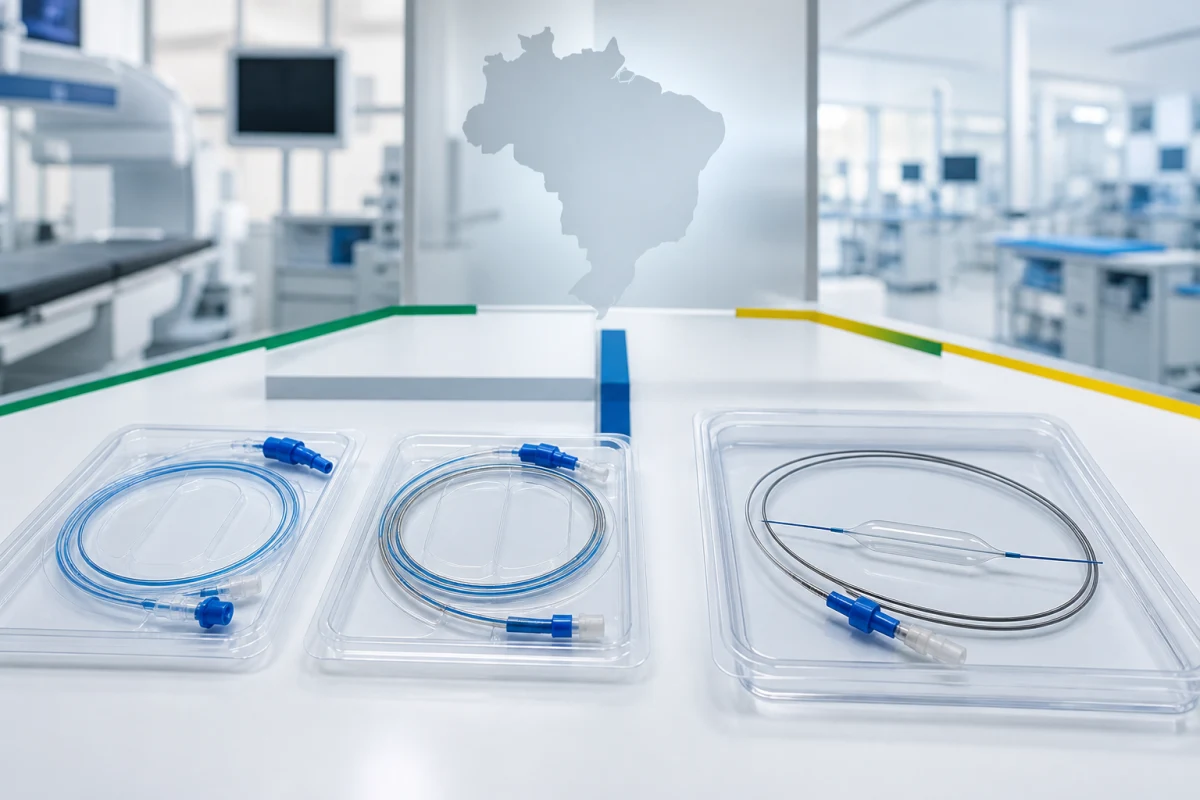
A cardiovascular device manufacturer asked us to bring a balloon-catheter line into Brazil: three products sold into the same interventional suites, two peripheral PTA dilatation catheters and one coronary PTCA balloon. The company had a compact regulatory team, an established home market, and a Brazilian plan that treated the line as a single object — one document set, one budget line, one launch date.
Pure Global acted as the Brazil Registration Holder for the program. Our first job was to tell the client that the plan described one commercial line and two regulatory programs, and that the difference between them would reach into its budget, its factory and its calendar for the next decade.
One catalog, two ANVISA doors
Brazil sorts market entry by risk class before it sorts it by anything else. Under RDC 751/2022, Class I and II devices enter by notification, while Class III and IV devices require registration with substantive technical assessment. Our ANVISA classification page sets out the full rule set.
The decisive rules for this line are the ones covering surgically invasive devices. A balloon dilatation catheter used transiently falls into Class II by default — unless it is specifically intended for use in direct contact with the heart or the central circulatory system, in which case the rules place it in Class IV. RDC 751/2022 does not leave "central circulatory system" to interpretation: it names the vessels, and the coronary arteries are on the list. The peripheral vasculature the two PTA catheters were built for is not.
The same technology, made on the same production floor and sold on the same sales call, therefore entered Brazil through two different doors. The classification analysis also exposed a documentation problem before it caused one. The manufacturer's global intended-purpose statement covered all three catheters in a single sentence about dilating stenotic lesions in the vasculature. That wording was too loose to hold a Class II position for the peripheral products and too vague to anchor a Class IV dossier. We rewrote intended purpose product by product before anything was filed, because in Brazil the classification, the dossier and the labeling all hang from it.
A budget built on the wrong unit
The commercial plan carried one government-cost line: an ANVISA fee, multiplied by three products. Brazil does not charge that way.
The health surveillance inspection fee attaches to petition subjects, not to products. Each notification is a petition. The registration is a petition. The manufacturing-site certification is its own petition, filed separately. So are the required-approval changes and the renewal this line will generate over the coming years. The amount due for each depends on the economic-size band of the applicant company in Brazil — the legal entity that actually files — and reduced bands are not automatic. The applicant has to establish its size with ANVISA in advance and re-establish it annually, or the full band applies to every petition it submits in the meantime.
We replaced "fee times three" with a petition inventory running to the end of the registration's validity period, with government fees kept separate from our service fees and confirmed for the filing entity. The correction mattered less for its size than for its shape: a program budgeted per product will always under-plan a Class IV entry, because most of the petitions it generates are not product filings at all.
The notification route files less than it requires
The two peripheral catheters went through notification, and the manufacturer expected a formality. The filing itself nearly is one: a form, a legalized declaration from the legal manufacturer authorizing the Brazilian applicant to represent and market the products, conformity evidence where a specific technical regulation applies, and publication.
What is not a formality is what the route assumes you already have. The notification holder must keep a complete, current technical dossier and produce it for health-surveillance inspection, and ANVISA can call for it when a question arises. The dossier structure for a Class II device covers substantially the same ground as a registration file: risk management, the list of essential safety and performance requirements, physical and mechanical characterization, material characterization, biocompatibility, sterilization validation, packaging validation and shelf life, usability, a clinical evidence summary and relevant clinical literature. The difference between the two routes is not what has to exist. It is who reads it, and when.
The one filing detail that did bite was documentary rather than technical. The manufacturer's authorization declaration has to be consularized or apostilled and, when it carries no stated validity, cannot be more than two years old. Several of the legalized originals in the company's files were outside that window, and legalization is not a same-week activity. We restarted that chain early enough that it never became the critical path. Our single-use endoscopy case study follows the notification route across a larger portfolio.
Rebuilding the coronary file so it could be read
The Class IV dossier is filed, structured to a defined table of contents and assessed by a reviewer. For a coronary balloon that meant an evidence chain that had to stand on its own: characterization and performance against the standards that apply to balloon dilatation catheters — rated burst pressure, diameter against inflation pressure, balloon fatigue, deflation time — alongside biocompatibility, sterilization validation, packaging and shelf-life validation, the clinical evidence summary, and the Brazilian labeling and instructions for use.
Almost all of it existed. What did not exist was agreement between the pieces. The compliance chart in the instructions for use, the sizing matrix in the sales catalogue and the model list in the technical file had been maintained separately across several product generations, and they no longer matched at the edges of the range. On the notification side that inconsistency had never been tested by anyone. On the registration side those documents are read next to each other, and the instructions for use are published on ANVISA's portal, where a Brazilian user can compare them with the label in front of them. Reconciling them was unglamorous work that had to happen before submission rather than in response to a question about it.
BGMP turned a product filing into a factory program
Class IV approval depends on something no product dossier can supply: an ANVISA certificate of good manufacturing practice covering the manufacturing site, with the underlying requirements set by RDC 665/2022 and the certification mechanics by RDC 687/2022. Our Brazil regulations page explains the framework.
The manufacturer considered this box ticked. The company participated in MDSAP, and ANVISA accepts reports from recognized audit programs in place of its own inspection. Two features of the certification rules made that assumption incomplete.
First, scope. An audit report supports certification only if it was issued within the three years before the petition and covers the risk classes and the production lines named in the certification request. A report that covered the site in general, or covered its Class II output, would not carry the coronary line.
Second, which sites count. Certification attaches to manufacturing units that produce the finished product or perform final release together with at least one production step. Design, distribution, sterilization, packaging and labeling are excluded as standalone activities — but packaging a product declared sterile into its sterile barrier system is treated as a production step, which pulls that operation's location into scope. For a sterile single-use catheter, that distinction decides which addresses appear on the petition.
So we mapped the coronary product's production flow site by site, established which units the certification had to name, and checked the audit evidence against those units and classes before filing anything. The petition itself is a disclosure exercise as much as a technical one: it asks for the site layout, a production flowchart marking which steps happen where, the full list of products made at that site — including the highest-risk product made there, even if it is never sold in Brazil — and every regulatory inspection or audit at that site over the previous three years, with conclusions and any regulatory action that followed. Open findings need closure evidence. Assembling that history is the manufacturer's work, and it is far easier before a petition than during one.
Two critical paths, one approval condition
A registration cannot be granted until a valid certificate for the site has been published. It can be filed and reviewed on the certification request: the certification protocol is accepted both for petitioning and for the start of the analysis, and only the final approval is conditioned on the certificate.
That provision decides the shape of a Class IV program. Read as a waterfall — certify the factory, then write the dossier — the project idles for as long as certification takes. Read as two critical paths, dossier and certification advance together, with the certificate as a condition to be satisfied by the end of the review rather than a gate at the beginning. We ran the workstreams that way, with the dependency between them owned explicitly rather than assumed.
Meanwhile the peripheral products had no certification dependency at all. Because the programs were separated rather than bundled into one launch, the two Class II notifications were published in 2024 under our Brazilian entity without waiting behind the coronary product's factory work.
The completed program left two calendars in one product line
The engagement ended with all three catheters lawfully in the Brazilian market under one holder: two Class II notifications published in 2024, in force with no scheduled expiry, and one Class IV coronary registration active from 2025 with a ten-year term. ANVISA's public records confirm the classes, routes and current status.
What the manufacturer now operates is not one lifecycle but two.
The notifications never expire and are exempt from renewal, but the dossier behind them has to stay current, and changes are filed according to ANVISA's change taxonomy — required approval, immediate implementation, or not reportable. The registration expires ten years after publication, and its renewal must be requested in a window that opens twelve months and closes six months before expiry, with a valid site certificate in hand at that moment. That certificate runs on a much shorter cycle than the registration — two years, or four where it rests on MDSAP — so a ten-year authorization sits on top of a two-to-four-year certification rhythm. Any later change of manufacturing site, or addition of a model to the Class IV record, is itself conditioned on a published certificate.
Even the label calendars diverge. Brazil's UDI requirements are phased by risk class: the Class IV date of 10 July 2025 has passed, while Class II devices have until 10 January 2027. One commercial line, two label-change dates. Post-market surveillance and vigilance duties, by contrast, run across all three devices through the holder.
What we would tell a similar manufacturer
Classify before you budget, and classify product by product. A shared technology, a shared production line and a shared customer do not produce a shared regulatory route: in Brazil the intended anatomy alone can move one product out of three into the highest class and change everything downstream of it.
Treat manufacturing-site certification as a company program with its own inputs and lead time, and check what your existing audit evidence actually covers — classes, production lines, dates and addresses — before assuming it covers the product you are registering. Then design the post-market calendar before approval, because a mixed-class portfolio hands you obligations that arrive on different dates for products your commercial team thinks of as one thing.
Start with our Brazil market page, see how we support cardiovascular devices, or talk to our team about the line you are planning to launch.
 Blog · Aug 17, 2026Coronary Stents: Eight Highest-Tier FilesBlog · Aug 24, 2026Medical Device Registration Verification 2026Case Study · Aug 11, 2026Class III Dermal Fillers Under the EU MDRBlog · Aug 10, 2026Surgical Robots: Eight Markets, Eight Regulatory FilesBlog · Jul 27, 2026IVD Global Market Access 2026Case Study · Jul 22, 2026One Endoscopy Platform, Six ANVISA NotificationsRegulatory Update · Sep 14, 2026MDCG Rule 7: IVD Quality ControlsRegulatory Update · Aug 27, 2026INVIMA Wearable Medical Device ClassificationRegulatory Update · Aug 26, 2026ANVISA IVD and Class I/II ManualsRegulatory Update · Aug 17, 2026ANVISA Solicita 80326 Manufacturer Records
Plan your interventional line for Brazil
We map ANVISA routes product by product, run Class III and IV dossiers alongside BGMP certification, and act as your Brazil Registration Holder.

Route mapping for mixed-class portfolios under RDC 751/2022
Class III and IV dossiers built for substantive review
BGMP site scoping, audit-evidence review and certification filing
Brazil Registration Holder, Portuguese labeling, vigilance and renewals

Frequently asked questions
Because Brazil classifies by intended anatomy, not by product family. Under RDC 751/2022, a surgically invasive device for transient use sits in Class II unless it is specifically intended for direct contact with the heart or the central circulatory system, and the resolution names the coronary arteries in its definition of that system. The two peripheral PTA catheters therefore entered through notification, while the coronary balloon required a Class IV registration with substantive technical assessment and a manufacturing-site certificate.
No. The notification filing itself is short, but the holder must keep a complete, current technical dossier and produce it for health-surveillance inspection, and ANVISA can ask for it at any point. Its structure covers much the same ground as a registration file, including risk management, essential safety and performance requirements, biocompatibility, sterilization validation, shelf life and clinical evidence. The route changes who reads the file and when, not whether it has to exist.
Not automatically. An audit report can support certification only if it was issued within the three years before the petition and covers the risk classes and production lines named in the certification request, so a report that does not reach the Class IV line will not carry it. Certification also attaches to specific manufacturing units, including the site that packages a sterile device into its sterile barrier system. ANVISA may still inspect a certified site on-site at any time.
Two calendars inside one product line. The notifications do not expire and are exempt from renewal, but their dossier must stay current and changes are filed under ANVISA's change taxonomy; the Class IV registration runs ten years, and its renewal must be requested between twelve and six months before expiry with a valid site certificate in hand. That certificate is itself renewed every two years, or four where it rests on MDSAP, and UDI labeling deadlines arrive on different dates for Class IV and Class II devices.
Single Process,
Multiple Markets
When you partner with Pure Global, a single registration process opens doors to multiple countries. Our global subsidiaries make this streamlined path possible.











Let's Talk,
Anywhere You Are.
Whether looking for more information or ready to partner with us, we're here to guide you through every step of the regulatory process.
Contact us