Medical Device Technical File Compilation Cost (2026): Build, Buy, or Hybrid?
Technical-file quotes are incomparable until scope, writing, gap closure, reviewer responses, lifecycle maintenance, and authority fees are separated. This report combines public price lines, FDA workload data, EU survey evidence, and a break-even model to show when to build internally, buy a project, or use a hybrid team.
TL;DR
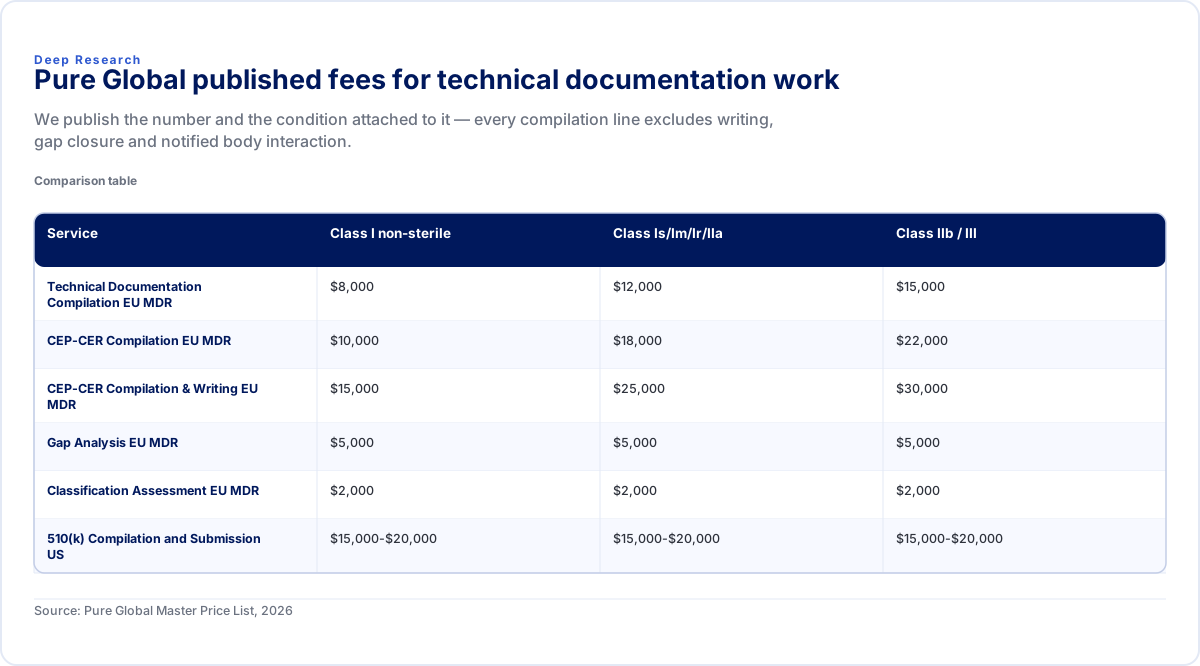
Nobody can quote you a "technical file compilation cost" because the phrase does not name a deliverable. It names a range of deliverables that differ by a factor of three or more, and the difference is not visible in the price. In our own published price list, EU MDR Technical Documentation Compilation for a Class IIa device is $12,000 and carries the note "This service does not include writing of documents or gap closure or NB interaction." CEP-CER Compilation & Writing for the same class is $25,000 Pure Global pricingPure Global pricing. Those are two different jobs wearing one search term.
The European Commission agrees, and has now legislated against it. Commission Implementing Regulation (EU) 2026/977, adopted 4 May 2026, states in its recitals that "Notified bodies showed significantly differing practices when issuing quotations to manufacturers for specific conformity assessment activities. As a result, manufacturers are not provided with a reliable estimation of the overall requested services and costs" 1. From 2028 every notified body must publish its median total cost in euro and its median duration in days 1.
Until then the best available figures come from the buyers, not the sellers, and they are worth knowing. The Commission's own 3rd Economic Operator Survey — published 1 July 2026, data status 31 October 2025, 152 manufacturer responses — reports a median total cost of €100,000 for an initial MDR product certificate against a mean of €194,785, with notified body fees a median of €50,000 against a mean of €83,782, and yearly maintenance of €30,000 median per certificate 23. The observed range for the initial certificate runs from €15,000 to €1,300,000, which is why the mean is roughly double the median and why a single quoted average is close to useless. The same survey found 48% of responding manufacturers had withdrawn at least one product from the EU market since 2021, and 63% of those cited product revenue not justifying the cost of MDR re-approval 2.
Four computed facts set the shape of the decision.
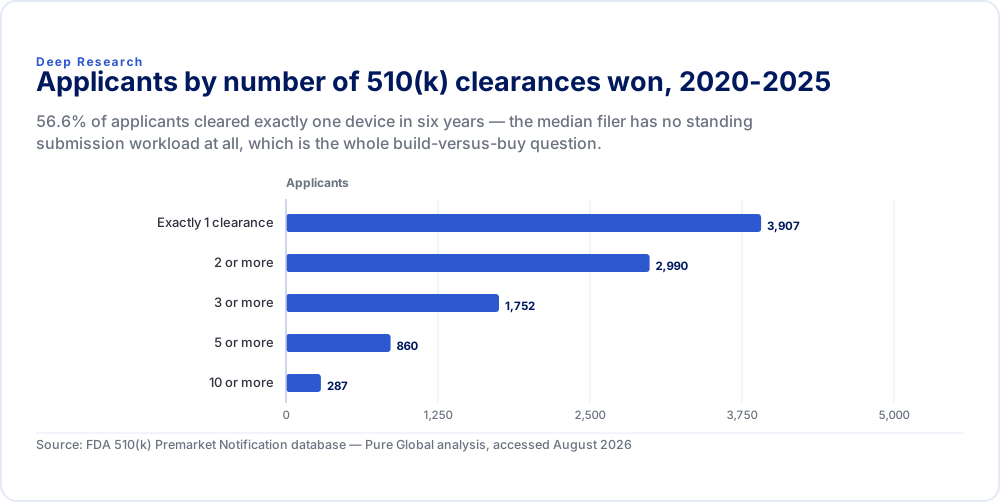
The in-house option usually fails on arithmetic, not on capability. In the FDA 510(k) export (snapshot 24 August 2026), decisions from 2020 through 2025 comprise 18,855 clearances from 6,897 distinct applicants after name normalisation. 3,907 applicants — 56.6% — cleared exactly one 510(k) in six years. Only 287 applicants (4.2%) cleared ten or more, and the twenty largest filers together account for just 7.5% of all clearances. The modal US device company faces a technical-file event roughly once every six years. Pure Global analysis of the FDA 510(k) database, snapshot 24 August 2026 45.
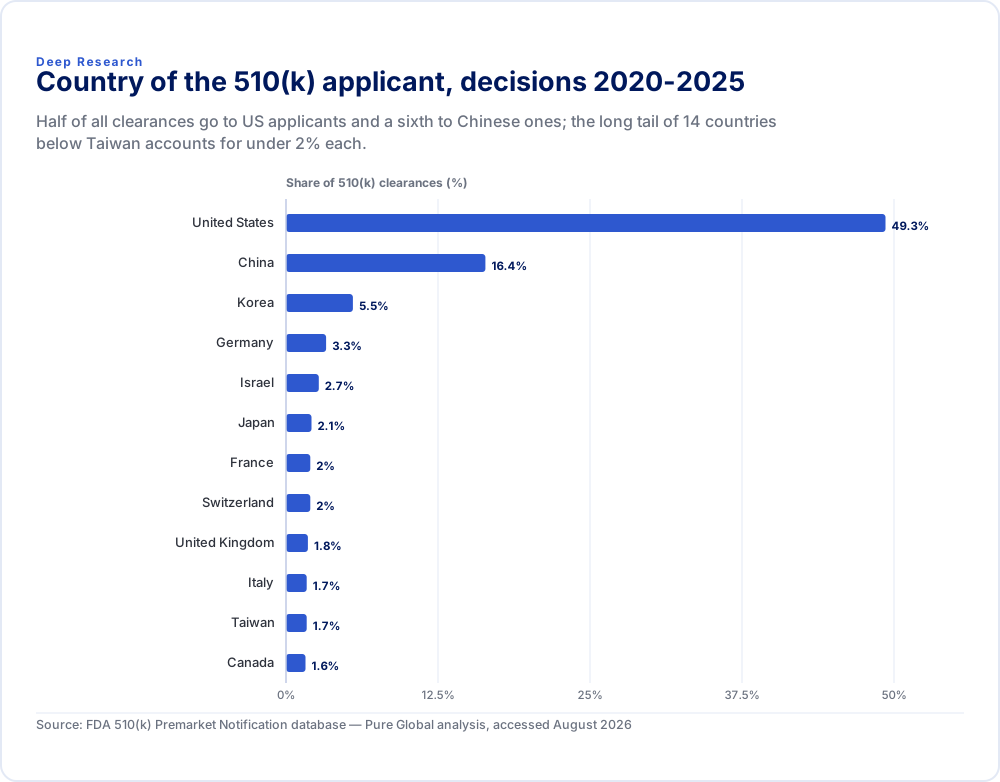
Half the cost stack is invisible to half the market. In the same window, 49.3% of clearances list a US applicant address. 16.4% list China, 5.5% Korea, 3.3% Germany, 2.7% Israel. For more than half the cohort, "compilation cost" excludes a US Agent, an establishment registration fee, and an English-language dossier produced by a team whose working language is not English 4.
The single largest controllable line item is a form, not a service. The MDUFA standard 510(k) review fee is $26,067 in FY2026 and $28,653 in FY2027. The FDA-qualified small-business fee is $6,517 and $7,163 respectively — a saving of $21,490 in FY2027 678. Small-business status must be granted before you submit and expires every 30 September 9. The annual establishment registration fee — $11,423 in FY2026, $13,785 in FY2027 — has no small-business reduction at all 78.
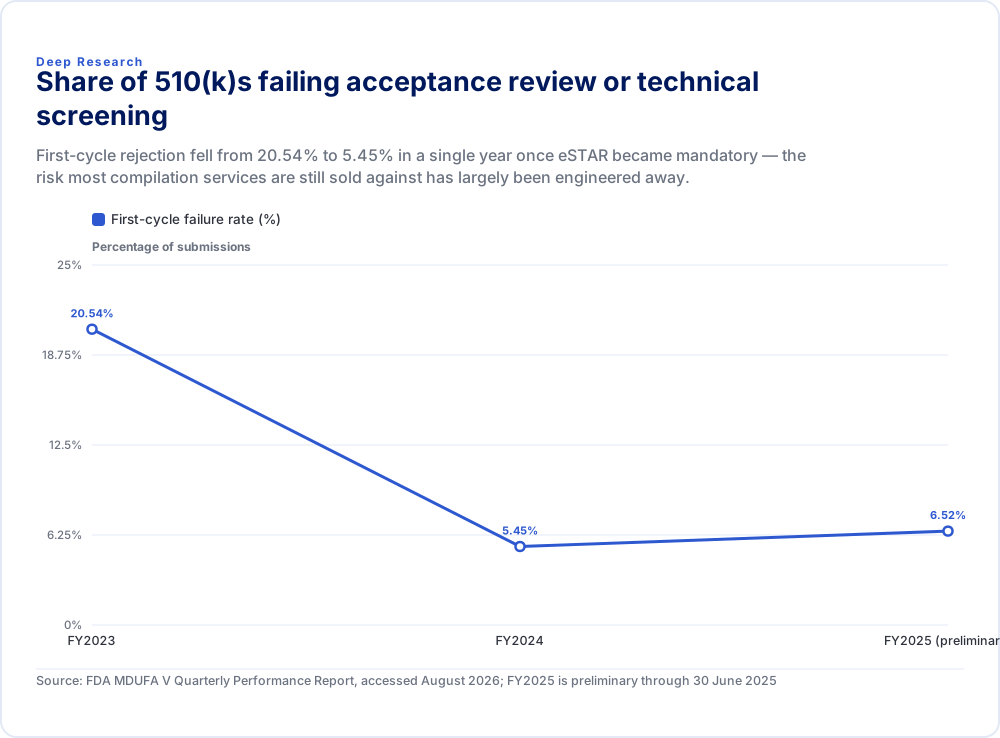
The risk most compilation services are sold against has already been engineered away. eSTAR has been mandatory for 510(k)s since 1 October 2023, and FDA states that "given that a properly prepared electronic submission should represent a complete submission, eSTAR submissions are not anticipated to undergo a Refuse to Accept (RTA) process" 1011. The published first-cycle failure rate fell from 20.54% in FY2023 to 5.45% in FY2024 and 6.52% in FY2025 12. Meanwhile FDA's own performance data records average FDA days to decision of 74.8 (FY2023) and 74.4 (FY2024) against average industry days of 66.2 and 66.4, across 1.67 average review cycles 12. Roughly 47% of elapsed time is the sponsor's own response time. You are not buying completeness insurance. You are buying the ability to answer an Additional Information request well and fast.
One more correction matters more than any price benchmark in this paper. FDA's January 2025 draft credibility guidance is expressly about AI supporting regulatory decision-making for drug and biological products, not medical devices 13. It excludes drafting and writing from its own scope when used only for operational efficiency, but that sentence is neither a device-specific safe harbor nor an FDA endorsement of AI-written submissions. For a device dossier, the defensible rule is simpler: keep a human accountable for every assertion, preserve controlled source records, validate every cross-reference, and discuss model-derived evidence with FDA when its regulatory treatment is unclear.
This paper is a buyer's workpaper. It maps what a technical file actually contains under each regime, tells you exactly what is reusable between them and what is not, publishes a real price list including the lines that make outsourcing look expensive, and gives you a break-even model you can run on your own numbers. It is not a market-access hub for a product class; adjacent Pure Global Deep Research covers coronary stents, surgical robots, IVDs, orthopedic implants and the ISO 10993-1:2025 transition, and the companion piece on what national registers actually contain asks the same kind of question about public data related Pure Global researchrelated Pure Global researchrelated Pure Global researchrelated Pure Global researchrelated Pure Global researchrelated Pure Global research. If your device is AI-enabled, note that FDA's device-side AI guidance is a separate document from the AI-in-submissions guidance discussed later, and the two are routinely conflated 14.
Why "technical file compilation cost" has no single answer
Takeaway: the phrase describes at least four different jobs that share a name. Until a quote states who writes, who closes gaps, and who answers the reviewer, comparing two prices is comparing two nouns you have not defined.
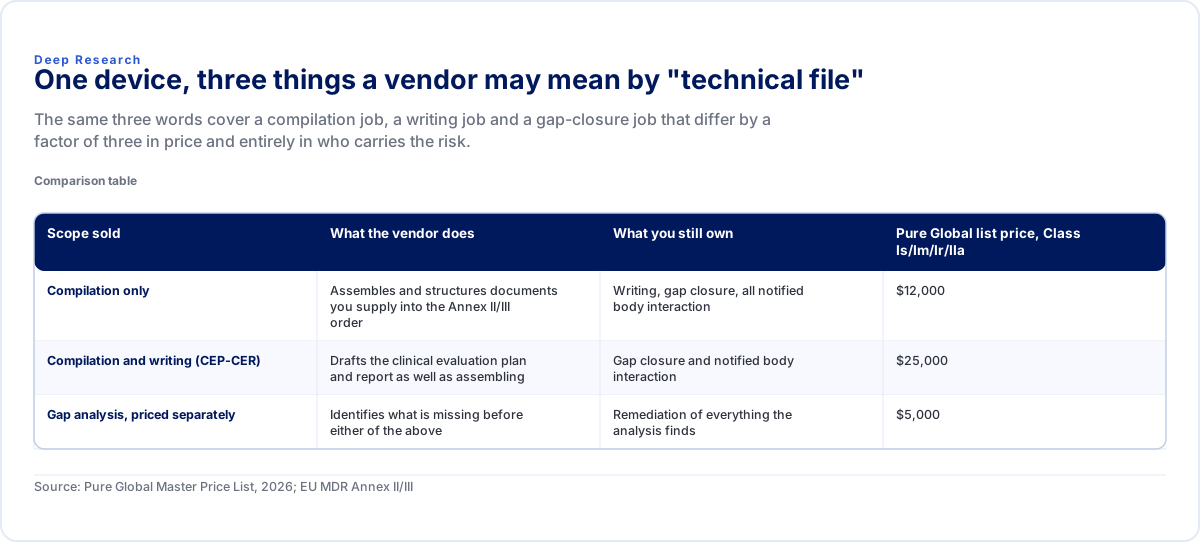
| Scope sold | What the vendor does | What you still own | Pure Global list price, Class Is/Im/Ir/IIa |
|---|---|---|---|
| Compilation only | Assembles and structures documents you supply into the Annex II/III order | Writing, gap closure, all notified body interaction | $12,000 |
| Compilation and writing (CEP-CER) | Drafts the clinical evaluation plan and report as well as assembling | Gap closure and notified body interaction | $25,000 |
| Gap analysis, priced separately | Identifies what is missing before either of the above | Remediation of everything the analysis finds | $5,000 |
Source: Pure Global Master Price List, 2026; EU MDR Annex II/III
Start with the concrete case. A Class IIa device, one device family, EU MDR, no clinical investigation. Here are three real line items from one published price list — ours — for what a buyer would describe with the same four words.
| Published line item | Class Is/Im/Ir/IIa fee | What the note says |
|---|---|---|
| Technical Documentation Compilation EU MDR | $12,000 | "This service does not include writing of documents or gap closure or NB interaction." |
| CEP-CER Compilation EU MDR | $18,000 | "You must consult with an MDR expert to confirm service scope and pricing." |
| CEP-CER Compilation & Writing EU MDR | $25,000 | Same confirmation note; writing included. |
Pure Global Master Price List, EU sheet, version 1.2, last updated 2 April 2026; also published in summary on the public pricing page Pure Global pricingPure Global pricing.
The spread from $12,000 to $25,000 is not a discount structure. It is the difference between assembling documents that already exist, producing the clinical argument, and producing the clinical argument in finished prose that a notified body will read. A manufacturer who has never compiled an MDR file does not know which of those three they need, because the thing that determines it — how much of the evidence already exists in adequate form — is exactly what they have not yet assessed.
That is the structural reason the internet's answer to this question is a range with no scope attached. Search the phrase and you will be told $10,000 to $50,000 by firms that publish no line items at all. In our pooled AI-answer telemetry, the consultancy domains cited most often on these questions are emergobyul.com (62 answers), medenvoyglobal.com (30), freyrsolutions.com (20), qservegroup.com (18) and mcra.com (17) 1516171819. Pure Global analysis of 366 non-empty AI answers across three client exports, 29 August 2026. The range they collectively produce is not wrong. It is unfalsifiable, which is worse.
There is a second reason, and it is now a matter of EU law. The Commission looked at the notified-body side of the same problem and concluded that quoting practice is so inconsistent that manufacturers cannot plan. Implementing Regulation (EU) 2026/977 says so in terms 1. Its remedy is disclosure: from 30 April each year, beginning with reports due under Article 4(4) which applies from 1 January 2028, every notified body must publish an annual report on its website giving the median duration of conformity assessment activities from application to certification, in days, and the median total cost of completed conformity assessment activities, in euro — where total cost is defined as "the sum of all the fees applied by a notified body to a manufacturer for the activities performed during the timeline including any administrative charges" 1.
Read that carefully, because of what it implies about the difference between two things that get conflated. No notified body publishes its own median fee today, which is precisely why the Commission had to legislate. What does exist is survey evidence from the paying side, and the distinction matters: a manufacturer survey tells you what buyers report spending, with self-selection and recall error attached; a notified body's own published median will tell you what a specific seller charges, comparably, against a defined scope. The first is useful for budgeting. Only the second lets you shop. That second thing arrives in 2028.
What the buyer-side surveys actually say
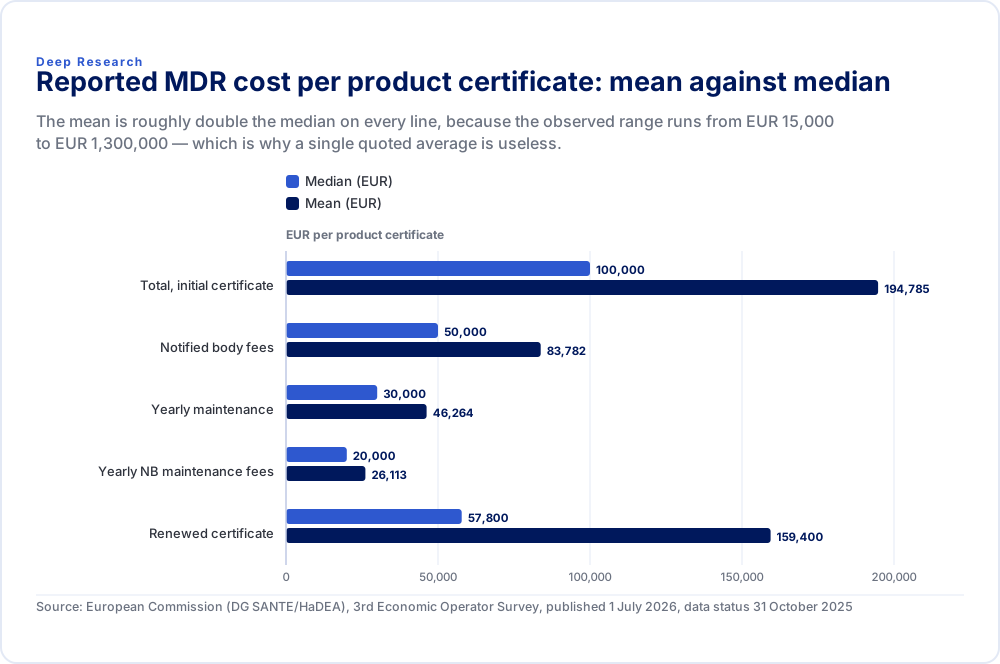
| Median (EUR) | Mean (EUR) | |
|---|---|---|
| Total, initial certificate | 100,000 | 194,785 |
| Notified body fees | 50,000 | 83,782 |
| Yearly maintenance | 30,000 | 46,264 |
| Yearly NB maintenance fees | 20,000 | 26,113 |
| Renewed certificate | 57,800 | 159,400 |
Source: European Commission (DG SANTE/HaDEA), 3rd Economic Operator Survey, published 1 July 2026, data status 31 October 2025
Three published surveys carry usable figures. All three are self-reported and none is a regulator-published price, so we give them with their sample sizes, dates and dispersion rather than as a benchmark.
| Metric (MDR, per product certificate) | Mean | Median |
|---|---|---|
| Total cost for an initial certificate | €194,785 | €100,000 |
| Notified body fees per certificate | €83,782 | €50,000 |
| Yearly maintenance cost per certificate | €46,264 | €30,000 |
| Yearly notified body maintenance fees | €26,113 | €20,000 |
| Cost of one renewed certificate | €159,400 | €57,800 |
European Commission 3rd Economic Operator Survey, published 1 July 2026, data status 31 October 2025; 152 medical device manufacturer responses, with n=46 for the initial-certificate cost item and an observed range of €15,000–€1,300,000. Commissioned by DG SANTE via HaDEA 23.
The same survey prices the clinical work separately: drawing up the clinical evaluation for the last single device certified ranged from roughly €10,000 for a Class I device to €50,000 for a Class III, with an observed span of €1,000 to €86,000 2. Set that against our own published CEP-CER compilation-and-writing fee of $25,000 for Class Is/Im/Ir/IIa Pure Global pricing: the outsourced price sits inside the reported self-performed range, which is the honest way to read a price list against a market.
MedTech Europe's 2024 survey, published January 2025, adds the composition of the spend and it is the single most decision-relevant number in this section. Of total manufacturer costs to obtain and maintain certification in the first year: 90% personnel costs to complete QMS and technical documentation work, 7% notified body fees, and 3% yearly regulatory maintenance per device 20. The same survey reports average notified body fees of €136,981 for MDR QMS assessment and €176,202 for MDR technical documentation assessment, and finds that 70% of device manufacturers report clinical evaluation cost increases of 100% or more versus the Directives 20.
Hold those two survey results next to each other, because they appear to disagree and the disagreement is instructive. The Commission survey puts median notified body fees at €50,000 per certificate; MedTech Europe reports averages of €137,000 and €176,000 for QMS and technical documentation assessment. They are measuring different units — per certificate versus per assessment activity, median versus mean, different samples and dates. Neither is wrong and neither is a price you can plan against. That is the entire argument for Implementing Regulation (EU) 2026/977 in two lines.
The 90/7/3 split is the finding a buyer should act on. If nine tenths of first-year cost is personnel time on QMS and technical documentation, then the notified body fee is not the lever — the lever is how many hours the documentation takes and who spends them. Every argument in this paper about scope, reuse and gap closure is an argument about that 90%.
The same Regulation caps the phases of assessment, which is genuinely new planning information: 30 days for application review and contract signature, 120 days for quality management system auditing, 90 days for product verification, 20 days for decision and certification, with QMS audit and product verification "conducted in parallel when carried out in accordance with Annex IX" 1. Interruptions are capped at one for the application phase and four each for QMS auditing and product verification 1. And in a provision that matters if you have ever been told a delay was your fault, "Expiry of the maximum timelines … shall not be sufficient reason for the notified body to refuse issuing a certificate" 1. These apply from 25 February 2027 1.
So the honest framing of the buyer's problem in 2026 is this. There is no market price, because the market has not been made to disclose one. There is a scope ambiguity that vendors have no incentive to resolve. And there is a genuine engineering question underneath — how much of your evidence already exists in a form a reviewer will accept — that neither party can answer until someone does the gap analysis. Everything that follows is an attempt to give you the tools to price that yourself.
What a technical file actually contains
Takeaway: the MDR file is three annexes, not one, and it includes documents that must keep updating after you ship. The 510(k) is a 23-heading interactive form that hides sections you do not need. They are not two versions of the same object.
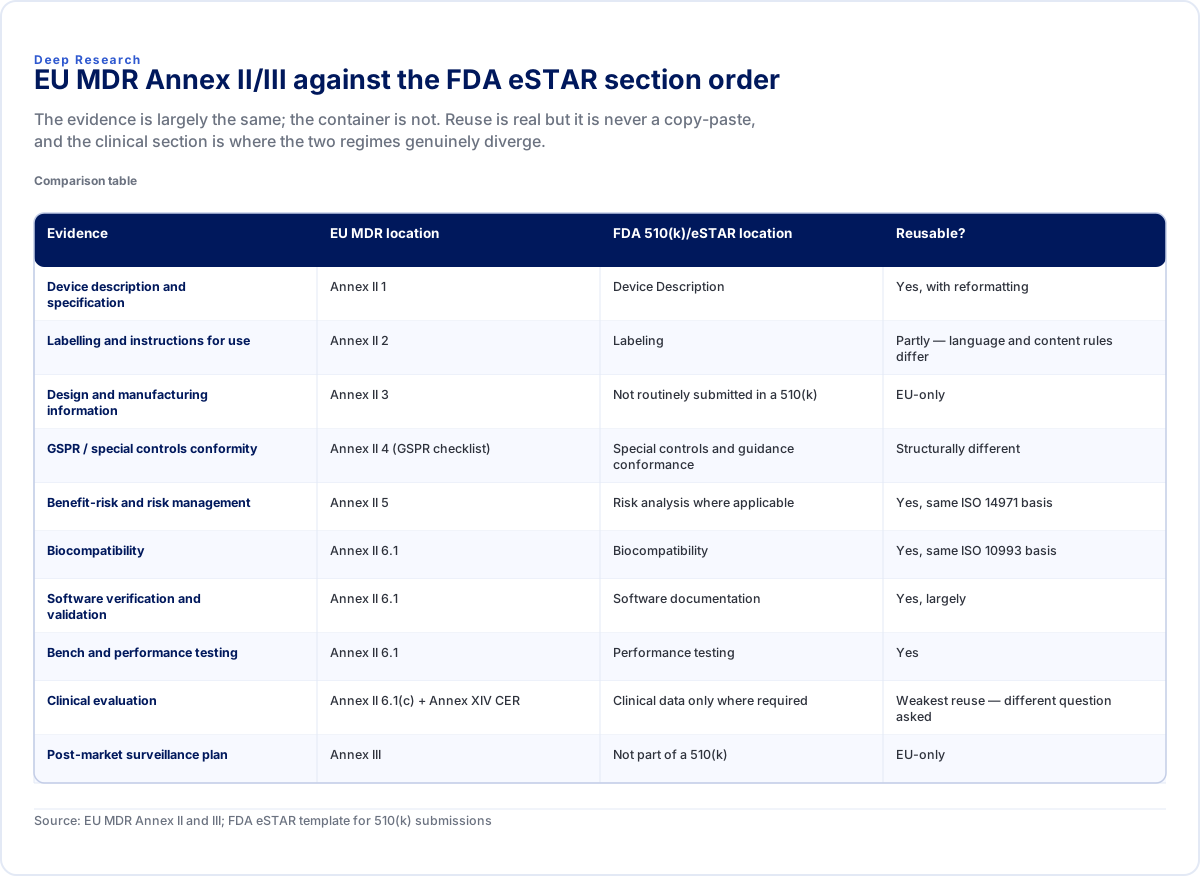
| Evidence | EU MDR location | FDA 510(k)/eSTAR location | Reusable? |
|---|---|---|---|
| Device description and specification | Annex II 1 | Device Description | Yes, with reformatting |
| Labelling and instructions for use | Annex II 2 | Labeling | Partly — language and content rules differ |
| Design and manufacturing information | Annex II 3 | Not routinely submitted in a 510(k) | EU-only |
| GSPR / special controls conformity | Annex II 4 (GSPR checklist) | Special controls and guidance conformance | Structurally different |
| Benefit-risk and risk management | Annex II 5 | Risk analysis where applicable | Yes, same ISO 14971 basis |
| Biocompatibility | Annex II 6.1 | Biocompatibility | Yes, same ISO 10993 basis |
| Software verification and validation | Annex II 6.1 | Software documentation | Yes, largely |
| Bench and performance testing | Annex II 6.1 | Performance testing | Yes |
| Clinical evaluation | Annex II 6.1(c) + Annex XIV CER | Clinical data only where required | Weakest reuse — different question asked |
| Post-market surveillance plan | Annex III | Not part of a 510(k) | EU-only |
Source: EU MDR Annex II and III; FDA eSTAR template for 510(k) submissions
Most cost confusion resolves the moment you look at the two content models side by side. They are not similar.
The EU MDR side: three annexes and a lifecycle obligation
The MDR and IVDR framework, and the Commission's own orientation material for it, sit on the DG SANTE medical devices pages 21. MDR Annex II opens with a formatting requirement most people skip, and it is load-bearing for cost: the documentation "shall be presented in a clear, organised, readily searchable and unambiguous manner" 22. That is not a style preference. It is why "compilation" is a real service with real hours in it.
Annex II has six top-level headings 22:
- Device description and specification, including variants and accessories — with 1.1 device description and specification, and 1.2 reference to previous and similar generations of the device
- Information to be supplied by the manufacturer
- Design and manufacturing information
- General safety and performance requirements
- Benefit-risk analysis and risk management
- Product verification and validation — with 6.1 pre-clinical and clinical data, and 6.2 additional information required in specific cases
Section 4 is stricter than most checklists imply, and it is where hours disappear. It requires "(a) the general safety and performance requirements that apply to the device and an explanation as to why others do not apply; (b) the method or methods used to demonstrate conformity with each applicable general safety and performance requirement; (c) the harmonised standards, CS or other solutions applied; and (d) the precise identity of the controlled documents offering evidence of conformity with each harmonised standard, CS or other method applied", incorporating "a cross-reference to the location of such evidence within the full technical documentation" 22. Note the words each and precise identity. A GSPR checklist that says "see risk file" is not conformant, and rebuilding one that is, on a legacy file, is a multi-week job that no compilation quote covers unless it says so.
Annex II §6.1(b) enumerates the pre-clinical evidence: "the biocompatibility of the device including the identification of all materials in direct or indirect contact with the patient or user; physical, chemical and microbiological characterisation; electrical safety and electromagnetic compatibility; software verification and validation …; stability, including shelf life; and performance and safety" 22. It also contains an explicit permission to reuse — "Where no new testing has been undertaken, the documentation shall incorporate a rationale for that decision. An example of such a rationale would be that biocompatibility testing on identical materials was conducted when those materials were incorporated in a previous version of the device that has been legally placed on the market" 22. That sentence is worth money. It is the legal basis for not repeating a test you have already paid for, provided you write the rationale.
Annex III is a separate annex and a separate deliverable. It contains only two numbered items: the post-market surveillance plan drawn up under Article 84, and "the PSUR referred to in Article 86 and the post-market surveillance report referred to in Article 85" 22. The PMS plan must specify the collection of "information concerning serious incidents, including information from PSURs, and field safety corrective actions; records referring to non-serious incidents and data on any undesirable side-effects; information from trend reporting; relevant specialist or technical literature, databases and/or registers; information, including feedbacks and complaints, provided by users, distributors and importers; and publicly available information about similar medical devices" 22. It closes by requiring "a PMCF plan as referred to in Part B of Annex XIV, or a justification as to why a PMCF is not applicable" 22.
Annex XIV is the third. Part A (sections 1–4) is clinical evaluation: a clinical evaluation plan with eight mandatory minimum contents, a systematic scientific literature review to "identify available clinical data relevant to the device and its intended purpose and any gaps in clinical evidence", appraisal, generation of new data where needed, analysis, and a clinical evaluation report 22. Part B (sections 5–8) is post-market clinical follow-up: the PMCF plan with its objectives (a)–(e) and minimum contents (a)–(h), the PMCF evaluation report, and the loop back into clinical evaluation and risk management 22.
Annex XIV §2 supplies the proportionality rule that determines whether your file is a $12,000 job or a $40,000 one: "The clinical evaluation shall be thorough and objective, and take into account both favourable and unfavourable data. Its depth and extent shall be proportionate and appropriate to the nature, classification, intended purpose and risks of the device in question, as well as to the manufacturer's claims in respect of the device" 22. Note the last clause. Your own marketing claims drive your clinical evidence burden. Trimming an unsupportable claim is often the cheapest gap-closure action available, and it costs nothing but an argument with the commercial team.
Finally, the obligation does not end at certification. Article 61(11) requires that "The clinical evaluation and its documentation shall be updated throughout the life cycle of the device concerned" 22. An MDR technical file is a subscription, not a purchase. Any cost model that prices only the first compilation is pricing the down payment.
The FDA side: 23 headings in an interactive form
Since 1 October 2023, 510(k)s must be submitted through eSTAR — FDA's guidance landing page states that "As of October 1, 2023, FDA will require that 510(k) electronic submissions be provided as described in this guidance" 101123, and the notice of availability was published in the Federal Register on 22 September 2022 24. This sits inside the wider 510(k) programme documentation, which is still the right starting point for anyone choosing between Traditional, Special and Abbreviated routes 2526. The legal basis is section 745A(b) of the FD&C Act as amended by section 207 of FDARA, and the guidance is explicit that "Insofar as this guidance provides 'standards,' 'timetable,' or 'criteria for waivers' and 'exemptions' pursuant to section 745A(b) of the FD&C Act, it has binding effect" 11. FDA also closed the escape hatch: "At this time, FDA has not identified any particular circumstances appropriate for a waiver of the 510(k) electronic submission requirements and does not intend to grant requests for waiver" 11. Current template versions are nIVD eSTAR 7.0 and IVD eSTAR 7.0 10.
Table 1 of the guidance gives the authoritative content model — 23 "Information Requested" headings in document order 11:
Submission Type; Cover Letter / Letters of Reference; Applicant Information; Pre-Submission Correspondence & Previous Regulator Interaction; Consensus Standards; Device Description; Proposed Indications for Use (Form FDA 3881); Classification; Predicates and Substantial Equivalence; Design/Special Controls, Risks to Health, and Mitigation Measures; Labeling; Reprocessing; Sterility; Shelf Life; Biocompatibility; Software/Firmware; Cybersecurity/Interoperability; Electromagnetic Compatibility (EMC), Electrical, Mechanical, Wireless and Thermal Safety; Performance Testing; References; Administrative Documentation; and the Amendment/Additional Information response.
Two practical notes. First, you will never see all 23: "eSTAR is an interactive PDF form … Only relevant sections and requests will be displayed based on the applicant's answers; therefore, you will not be able to display all possible questions in an eSTAR" 10. This is why scoping a 510(k) by page count is meaningless and why an experienced preparer's first hour is worth more than their tenth. Second, three artefacts that older checklists treat as separate deliverables are now built in: "You do not need to provide an 'Indications for Use' page (Form FDA 3881), the 'Premarket Review Submission Cover Sheet' (Form FDA 3514), or a 'Declaration of Conformity' (if applicable) with your eSTAR since all are built into the eSTAR template" 10.
A warning about a page you will find in search results. FDA's "Content of a 510(k)" page lists a different, older element set — user fee cover sheet, cover sheet form, table of contents, RTA checklist, indications-for-use statement, 510(k) summary or statement, truthful and accurate statement, proposed labeling, specifications, substantial equivalence comparison, performance data. That page's own "Content current as of" date is 26 April 2019 27. It predates mandatory eSTAR by four years. Do not scope a 2026 submission against it; several consultancy checklists still do.
The structural difference, stated plainly
| Dimension | FDA 510(k) | EU MDR technical file |
|---|---|---|
| Container | Interactive eSTAR PDF, 23 possible headings, sections shown conditionally 1011 | Three annexes: Annex II (6 headings), Annex III (2 items), Annex XIV (Parts A and B) 22 |
| Legal test | Substantial equivalence to a predicate, 21 CFR 807.100(b) 28 | Conformity with GSPRs and an acceptable benefit-risk ratio, MDR Article 61(1) 22 |
| Clinical data | Conditional — "if deemed necessary by the Commissioner"; FDA states clinical data are not needed for most cleared devices 2827 | Required by default; omission is an Article 61(10) exception requiring documented justification 22 |
| Post-market documents in the file | None equivalent | PMS plan, PSUR, PMS report (Annex III); PMCF plan and PMCF evaluation report (Annex XIV Part B) 22 |
| Lifecycle obligation | One-time premarket demonstration | "updated throughout the life cycle of the device", Article 61(11) 22 |
| Third-party route | Voluntary 510(k) Third Party Review Program; no FDA user fee where used 2930 | Mandatory notified body for everything above Class I non-sterile, non-measuring, non-reusable-surgical |
That last row is the one that most often surprises a US-first manufacturer. In the US, a third party is an optional accelerator you pay instead of FDA — "The sole payment under the program is between the 510(k) submitter and the 3P510k Review Organization; there is no separate payment (i.e., user fee) to the FDA", and roughly half of 510(k)s FDA receives are eligible 29. In the EU, the third party is compulsory, its queue is not yours to manage, and until 2028 it does not have to tell you what it charges 1.
What is genuinely reusable between a 510(k) and an MDR file
Takeaway: the non-clinical evidence travels. The clinical argument does not, and neither do two of the six standards most people assume are common ground. IEC 62366-1 and IEC 62304 appear nowhere on the current MDR harmonised standards list.
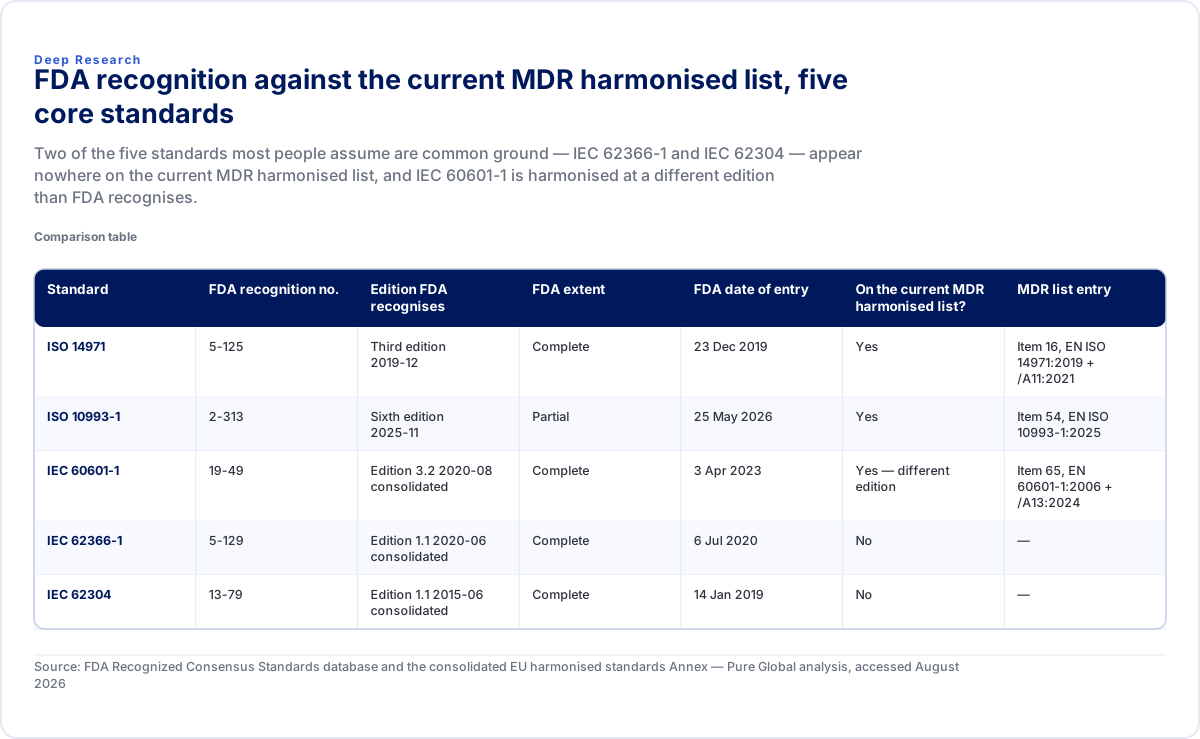
| Standard | FDA recognition no. | Edition FDA recognises | FDA extent | FDA date of entry | On the current MDR harmonised list? | MDR list entry |
|---|---|---|---|---|---|---|
| ISO 14971 | 5-125 | Third edition 2019-12 | Complete | 23 Dec 2019 | Yes | Item 16, EN ISO 14971:2019 + /A11:2021 |
| ISO 10993-1 | 2-313 | Sixth edition 2025-11 | Partial | 25 May 2026 | Yes | Item 54, EN ISO 10993-1:2025 |
| IEC 60601-1 | 19-49 | Edition 3.2 2020-08 consolidated | Complete | 3 Apr 2023 | Yes — different edition | Item 65, EN 60601-1:2006 + /A13:2024 |
| IEC 62366-1 | 5-129 | Edition 1.1 2020-06 consolidated | Complete | 6 Jul 2020 | No | — |
| IEC 62304 | 13-79 | Edition 1.1 2015-06 consolidated | Complete | 14 Jan 2019 | No | — |
Source: FDA Recognized Consensus Standards database and the consolidated EU harmonised standards Annex — Pure Global analysis, accessed August 2026
This is the section that decides whether a second-market file is a 40% job or a 90% job, and it is almost always answered by assertion rather than by checking. So we checked. Every FDA entry below was read from FDA's Recognized Consensus Standards database; every EU entry was read from the consolidated Annex to Commission Implementing Decision (EU) 2021/1182, consolidated version of 17 June 2026, whose most recent amending act is Commission Implementing Decision (EU) 2026/1231 of 11 June 2026 313233.
| Standard | FDA recognition no. | Edition FDA recognises | FDA extent | FDA date of entry | On the current MDR harmonised list? | MDR list entry |
|---|---|---|---|---|---|---|
| ISO 14971 | 5-125 | Third edition 2019-12 | Complete | 23 Dec 2019 | Yes | Item 16, EN ISO 14971:2019 + /A11:2021 |
| ISO 10993-1 | 2-313 | Sixth edition 2025-11 | Partial | 25 May 2026 | Yes | Item 54, EN ISO 10993-1:2025 |
| IEC 60601-1 | 19-49 | Edition 3.2 2020-08 consolidated | Complete | 3 Apr 2023 | Yes — different edition | Item 65, EN 60601-1:2006 + /A13:2024 |
| IEC 62366-1 | 5-129 | Edition 1.1 2020-06 consolidated | Complete | 6 Jul 2020 | No | — |
| IEC 62304 | 13-79 | Edition 1.1 2015-06 consolidated | Complete | 14 Jan 2019 | No | — |
FDA recognition records for ISO 14971 34, ISO 10993-1 35, IEC 60601-1 36, IEC 62366-1 37 and IEC 62304 38; the prior ISO 10993-1:2018 recognition remains listed as 2-258 39. EU entries from the consolidated harmonised standards Annex 31.
Four consequences follow, in descending order of how much money they move.
Risk management is the one clean reuse. ISO 14971:2019 is recognised in full by FDA and harmonised in the EU on the same base edition. The EU adds the /A11:2021 amendment, which is the Z-annex mapping the standard to MDR requirements and has no FDA counterpart 3134. Practically: your risk management file travels, and what you add for the EU is a mapping document, not a new hazard analysis. This is the strongest genuine reuse case of the six.
Usability and software lifecycle evidence does not carry a presumption of conformity in the EU. We searched the full consolidated Annex for "62366" and for "62304" and found no entry for either 31. This does not mean the evidence is worthless — it means it reaches MDR through Annex II §4(c) as an "other solution applied", where the manufacturer bears the burden of demonstrating that the method demonstrates conformity, rather than through the presumption a harmonised standard confers 22. Budget the difference as writing, not as testing: the tests are done; the argument connecting them to the GSPRs is not.
Electrical safety reports travel but their citations do not. FDA recognises IEC 60601-1 at Edition 3.2 (2020), with a caveat printed on the record itself: "This standard is recognized with relevant US national differences applied" 36. The MDR harmonised list still carries EN 60601-1:2006 with amendment A13:2024 31. FDA separately recognises the AAMI national adoption ES60601-1 under recognition 19-46 36. The physical test data are largely the same; the declaration of conformity, the national-differences annexes and the standard citation in your GSPR table are not interchangeable. A test house will usually issue against both on request, and asking for that at the point of testing is far cheaper than asking for it after.
Biocompatibility is the trap, because it looks aligned and is not. ISO 10993-1:2025 is on both lists, which reads as convergence. But FDA's extent of recognition for 2-313 is Partial 35. A bare declaration of conformity to ISO 10993-1:2025 is therefore not sufficient for a 510(k); the unrecognised provisions must be addressed separately. The clause-level detail sits in FDA's Supplementary Information Sheet for that recognition, and we deliberately do not restate the specific excluded clauses or any transition date here — several secondary sources circulate a clause list and a 2029 cutoff that the recognition record itself does not state. Read the Supplementary Information Sheet for your own device before you rely on it. Our separate guide to the ISO 10993-1:2025 transition covers the substance of the revision related Pure Global research.
Why a substantial equivalence argument is not a clinical evaluation report
This is the single most expensive misconception in the build-vs-buy decision, because it makes a European file look like a formatting exercise.
The 510(k) test is comparative and predicate-anchored. 21 CFR 807.100(b) makes FDA's determination turn on whether the device "has the same intended use as the predicate device" and either the same technological characteristics, or different characteristics where "the data submitted establishes that the device is substantially equivalent to the predicate device and contains information, including clinical data if deemed necessary by the Commissioner, that demonstrates that the device is as safe and as effective as a legally marketed device" and "does not raise different questions of safety and effectiveness than the predicate device" 28. Two features matter: clinical data are conditional, and the benchmark is another device.
The MDR test is absolute and evidence-anchored. Article 61(1) requires that confirmation of conformity with the GSPRs and "the evaluation of the undesirable side-effects and of the acceptability of the benefit-risk-ratio referred to in Sections 1 and 8 of Annex I, shall be based on clinical data providing sufficient clinical evidence" 22. There is no predicate. The manufacturer must "specify and justify the level of clinical evidence necessary to demonstrate conformity" itself 22. And Article 61(3)(c) adds a requirement with no 510(k) analogue at all: "a consideration of currently available alternative treatment options for that purpose, if any" 22.
The MDR equivalence route is not the predicate route. Where a 510(k) compares on intended use and technological characteristics, Annex XIV §3 requires equivalence across technical, biological and clinical characteristics, "similar to the extent that there would be no clinically significant difference in the safety and clinical performance of the device", on "proper scientific justification" 22. Then it adds the condition that kills most reuse attempts: "It shall be clearly demonstrated that manufacturers have sufficient levels of access to the data relating to devices with which they are claiming equivalence in order to justify their claims of equivalence" 22. A predicate cited from a public 510(k) summary cannot satisfy that. You do not have access to the predicate manufacturer's data, and saying so in a CER ends the equivalence argument.
Omitting clinical data is handled differently in each system. Under 510(k), absence of clinical data is the norm and needs no special justification 27. Under MDR it is an exception under Article 61(10), which requires "adequate justification for any such exception … based on the results of the manufacturer's risk management and on consideration of the specifics of the interaction between the device and the human body, the clinical performance intended and the claims of the manufacturer", substantiated in the Annex II documentation, explaining why "a demonstration of conformity … based on the results of non-clinical testing methods alone, including performance evaluation, bench testing and pre-clinical evaluation" is adequate 22. It is a justified exception, not a default route. Notified bodies assess it in a dedicated section of MDCG 2020-13, "Section J: Where demonstration of conformity based on clinical data is not deemed appropriate (Article 61(10))" 40.
Two MDCG documents are worth having open while you scope this work, with their status understood. MDCG 2020-6 supplies the working definition of sufficient clinical evidence — "the present result of the qualified assessment which has reached the conclusion that the device is safe and achieves the intended benefits" — and states its own status: "This guidance document is not legally binding … it should therefore be recognised as best practice" 41. MDCG 2020-13 is the notified body's assessment template, not a manufacturer's CER template; reading it tells you how your CER will be marked, which is more useful than most CER templates 40. Both sit on the Commission's MDCG guidance index 42. Team-NB's April 2026 position paper on technical documentation is the notified-body trade association's view of the same question and is worth reading alongside them, with the same non-binding status 43.
The honest reuse estimate
| Dossier element | Reusable between 510(k) and MDR? | What it costs to convert |
|---|---|---|
| Risk management file | Largely yes | Add the EN ISO 14971:2019/A11:2021 Z-annex mapping |
| Biocompatibility testing | Yes, data | Re-argue against ISO 10993-1:2025; check FDA's partial recognition separately |
| Electrical safety and EMC reports | Yes, data | Re-issue or re-cite against the EU edition; national-differences annexes differ |
| Software V&V | Yes, data | No presumption of conformity in the EU; write the Annex II §4(c) argument |
| Usability engineering file | Yes, data | Same — no harmonised standard to lean on |
| Sterility, shelf life, stability | Yes | Usually the cleanest transfer of all |
| GSPR / special controls conformity table | No | Built from scratch, per requirement, with document-level cross-references |
| Clinical argument | No | Different legal test, different structure, no predicate; build twice |
| PMS plan, PSUR, PMCF plan and report | No US equivalent | Net new, and recurring |
If you take one number from this section, take this one: the reusable layer is the non-clinical evidence base, which is also the expensive-to-generate layer. The non-reusable layer is documentation work. That is good news for a manufacturer with a mature test file and bad news for anyone who assumed a European file was a translation job.
The three routes, defined precisely
Takeaway: the routes differ on who holds the pen, who closes the gaps, and who talks to the reviewer. Those three questions, not the hourly rate, determine what you are buying.
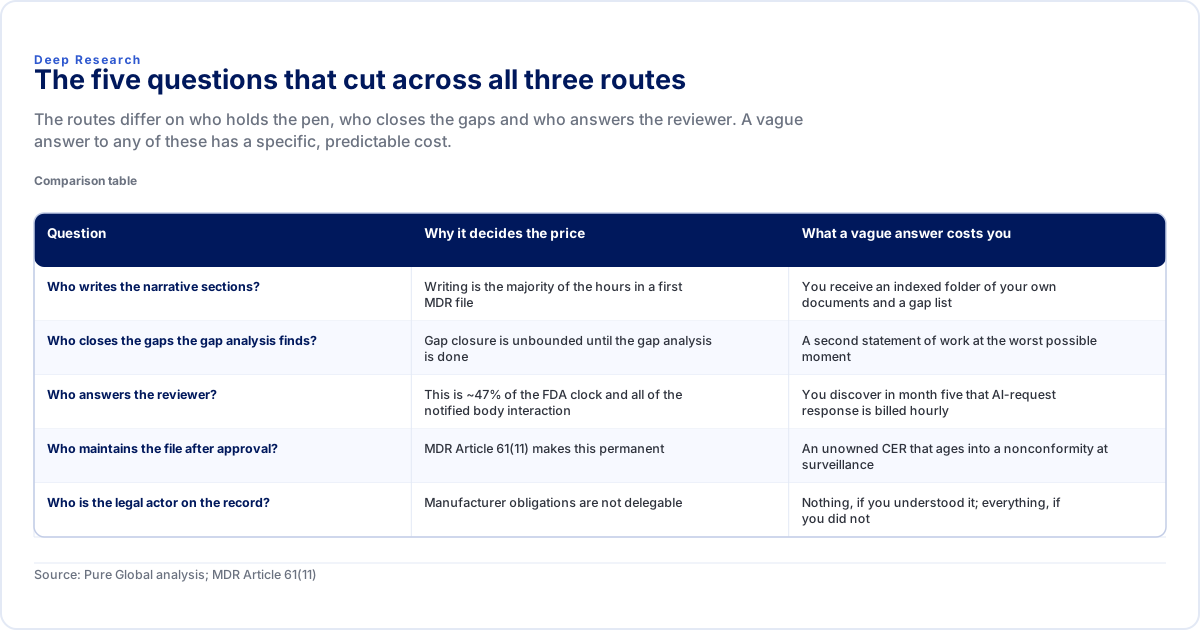
| Question | Why it decides the price | What a vague answer costs you |
|---|---|---|
| Who writes the narrative sections? | Writing is the majority of the hours in a first MDR file | You receive an indexed folder of your own documents and a gap list |
| Who closes the gaps the gap analysis finds? | Gap closure is unbounded until the gap analysis is done | A second statement of work at the worst possible moment |
| Who answers the reviewer? | This is ~47% of the FDA clock and all of the notified body interaction | You discover in month five that AI-request response is billed hourly |
| Who maintains the file after approval? | MDR Article 61(11) makes this permanent | An unowned CER that ages into a nonconformity at surveillance |
| Who is the legal actor on the record? | Manufacturer obligations are not delegable | Nothing, if you understood it; everything, if you did not |
Source: Pure Global analysis; MDR Article 61(11)
"In-house versus consultant" is the wrong axis, because both ends of it hide the same ambiguity about scope. Here is a definition set that survives contact with a quote.
Route A — In-house. Your own staff plan, write, close gaps and correspond with the reviewer. You buy nothing but testing and government fees. The capability you need is not "regulatory knowledge" in the abstract; it is having seen a reviewer's questions before. The economics are dominated by utilisation, which is where the 56.6% single-filer finding lands.
Route B — AI-assisted in-house. Your own staff hold the pen, with generative tooling doing first drafts, gap listing, cross-referencing, standards mapping and consistency checking. You still own the review burden and the accountability. This is the route that has changed most in eighteen months and is worst understood, so it gets its own section below.
Route C — Regulatory consultant. An external firm performs some defined subset of the work. The critical variable is which subset. In our own price list the subsets are named explicitly, and one of them says in the note that it excludes writing, gap closure and notified-body interaction Pure Global pricing. Most quotes in this market do not say that. Ask.
The distinction that actually matters cuts across all three:
| Question | Why it decides the price | What a vague answer costs you |
|---|---|---|
| Who writes the narrative sections? | Writing is the majority of the hours in a first MDR file | You receive an indexed folder of your own documents and a gap list |
| Who closes the gaps the gap analysis finds? | Gap closure is unbounded until the gap analysis is done | A second statement of work at the worst possible moment |
| Who answers the reviewer? | This is ~47% of the FDA clock and all of the NB interaction | You discover in month five that AI-request response is billed hourly |
| Who maintains the file after approval? | MDR Article 61(11) makes this permanent 22 | An unowned CER that ages into a nonconformity at surveillance |
| Who is the legal actor on the record? | Manufacturer obligations are not delegable | Nothing, if you understood it; everything, if you did not |
That last row deserves emphasis because it is the one thing no route changes. A consultant can hold the pen. A consultant cannot hold the obligation. Under MDR the manufacturer remains the manufacturer, and under the US regime the foreign establishment remains the establishment — which brings us to the cost stack.
The cost stack, line by line
Takeaway: for the 50.7% of 510(k) clearances that go to applicants outside the US, "compilation cost" is a minority of total landed regulatory cost. The lines that get excluded from quotes are the ones that recur annually.
| Share of clearances (%) | |
|---|---|
| United States | 49.3% |
| China | 16.4% |
| Korea | 5.5% |
| Germany | 3.3% |
| Israel | 2.7% |
| Japan | 2.1% |
| France | 2% |
| Switzerland | 2% |
| United Kingdom | 1.8% |
| Italy | 1.7% |
| Taiwan | 1.7% |
| Canada | 1.6% |
Source: FDA 510(k) Premarket Notification database — Pure Global analysis, accessed August 2026
In the 2020–2025 cohort, applicant country breaks down as follows. Pure Global analysis of the FDA 510(k) export, snapshot 24 August 2026 4.
| Applicant country | Clearances 2020–2025 | Share |
|---|---|---|
| United States | 9,304 | 49.3% |
| China | 3,092 | 16.4% |
| Korea | 1,044 | 5.5% |
| Germany | 630 | 3.3% |
| Israel | 509 | 2.7% |
| Japan | 390 | 2.1% |
| France | 382 | 2.0% |
| Switzerland | 371 | 2.0% |
| United Kingdom | 345 | 1.8% |
| Italy | 324 | 1.7% |
| Taiwan | 324 | 1.7% |
| Canada | 304 | 1.6% |
The cohort is overwhelmingly Class II — 17,653 of 18,855 records — and overwhelmingly Traditional rather than Special or Abbreviated: 15,502 Traditional, 2,816 Special, 291 Abbreviated, 195 Direct 4. That mix matters for cost, because a Special 510(k) for your own modification is a fundamentally cheaper object than a Traditional against someone else's predicate, and a quote that does not ask which one you are filing is not a quote.
Here is the full stack a foreign manufacturer actually pays for a US Class II entry, with the government lines separated from the professional lines because they behave differently.
| Line | FY2026 | FY2027 | Recurs? | Notes |
|---|---|---|---|---|
| MDUFA 510(k) review fee, standard | $26,067 | $28,653 | Per submission | Statutorily 4.5% of the standard PMA fee 7 |
| MDUFA 510(k) review fee, small business | $6,517 | $7,163 | Per submission | 25% of standard; must be granted before filing 79 |
| Annual establishment registration | $11,423 | $13,785 | Annually | No small-business reduction 78 |
| De Novo, standard / small business | $173,782 / $43,446 | $191,020 / $47,755 | Per request | If no predicate exists 67 |
| PMA, standard / small business | $579,272 / $144,818 | $636,732 / $159,183 | Per application | 67 |
| US Agent | — | — | Annually | Required for every foreign establishment, 21 CFR 807.40 44 |
| 510(k) compilation and submission | — | — | Per submission | Professional fee; scope varies enormously |
| Testing (biocompatibility, electrical, EMC, software) | — | — | Per device | Usually the largest single line for a novel device |
| Translation and English-language authoring | — | — | Per submission | Excluded from most compilation quotes |
Federal Register notices for FY2026 and FY2027 rates 67; FDA's fee page carries both 8.
Three lines in that table are worth arguing about before you argue about anyone's day rate.
Small-business determination. In FY2027 the gap between the standard and small-business 510(k) fee is $21,490 7. The determination is an application, it must be granted before the submission, and "the small business status expires on September 30 of the fiscal year in which it is granted. A new MDUFA Small Business Request must be submitted and approved each fiscal year" 9. Three details decide whether you actually get it. The threshold is gross receipts or sales of no more than $100 million including affiliates for the most recent tax year; a tighter threshold of $30 million or less additionally qualifies a firm for a full waiver of the fee on its first premarket application or premarket report; and the supporting materials should be filed at least 60 days before the submission they are meant to cover 69. We have watched companies negotiate three thousand dollars off a compilation fee while missing all three. If you file in September and again in October, you need two determinations.
Establishment registration has no small-business rate, but there is now a hardship waiver. The FY2027 notice is explicit in its arithmetic: "After increasing establishment registration fees only, this yields fees of $636,732 (premarket application) and $13,785 (establishment registration)" — and unlike submission fees, there is no small-business tier 7. What was introduced for FY2026 is different and much narrower: FDA "may, but is not required to" waive the annual establishment registration fee, excluding the initial registration, where the establishment is a small business and payment represents a financial hardship — and for this waiver alone "small business" means gross receipts or sales of $1,000,000 or less, including affiliates 6. That is a hundredfold tighter than the application-fee threshold, and it is discretionary. Plan on paying the fee; treat the waiver as an exception worth asking about only if you are genuinely at that scale.
US Agent is a legal role, not an admin service. 21 CFR 807.40 requires each foreign establishment to designate exactly one US Agent who "shall reside or maintain a place of business in the United States" 44. The duties are specific: "Upon request from FDA, the United States agent shall assist FDA in communications with the foreign establishment, respond to questions concerning the foreign establishment's products that are imported or offered for import into the United States, and assist FDA in scheduling inspections of the foreign establishment" 44. And the substitution clause is the part people miss: "If the agency is unable to contact the foreign establishment directly or expeditiously, FDA may provide information or documents to the United States agent, and such an action shall be considered to be equivalent to providing the same information or documents to the foreign establishment" 44. Service on your agent is service on you. Changes must be reported within 10 business days 44. Registration and listing obligations sit in 21 CFR Part 807 4546.
On the EU side the equivalent recurring lines are the authorised representative, EUDAMED actor and device registration, notified body fees and surveillance audits, and the PMS/PMCF documents that must keep being produced. The notified body line is the one nobody can benchmark, for the reason set out above 1.
A real price list, published
Takeaway: here are our own numbers, including the ones that make outsourcing look expensive and the one whose note says it excludes writing. A calibration point is more useful than a range, and a calibration point with its exclusions printed is more useful still.
| Service | Class I non-sterile | Class Is/Im/Ir/IIa | Class IIb / III |
|---|---|---|---|
| Technical Documentation Compilation EU MDR | $8,000 | $12,000 | $15,000 |
| CEP-CER Compilation EU MDR | $10,000 | $18,000 | $22,000 |
| CEP-CER Compilation & Writing EU MDR | $15,000 | $25,000 | $30,000 |
| Gap Analysis EU MDR | $5,000 | $5,000 | $5,000 |
| Classification Assessment EU MDR | $2,000 | $2,000 | $2,000 |
| 510(k) Compilation and Submission US | $15,000-$20,000 | $15,000-$20,000 | $15,000-$20,000 |
Source: Pure Global Master Price List, 2026
We publish a price list. It is one vendor's list price, not a market benchmark, and it should be read as a calibrated reference point rather than as evidence about anyone else's fees. Figures below are from the Pure Global Master Price List — EU sheet version 1.2, last updated 2 April 2026; USA sheet version 1.1, last updated 12 January 2026 — with the public pricing page as the customer-facing equivalent Pure Global pricingPure Global pricingPure Global market guidePure Global market guide.
European Union — MDR
| Service | Class I non-sterile | Class Is/Im/Ir/IIa | Class IIb / III |
|---|---|---|---|
| Technical Documentation Compilation EU MDR | $8,000 | $12,000 | $15,000 |
| CEP-CER Compilation EU MDR | $10,000 | $18,000 | $22,000 |
| CEP-CER Compilation & Writing EU MDR | $15,000 | $25,000 | $30,000 |
Every Technical Documentation Compilation line carries the note: "This service does not include writing of documents or gap closure or NB interaction." Every CEP-CER line carries: "You must consult with an MDR expert to confirm service scope and pricing." All EU consultancy lines carry a further condition: "when using China based MDR experts, the listed fee is 50% lower" Pure Global pricing.
European Union — supporting services
| Service | Fee | Unit |
|---|---|---|
| Classification Assessment EU MDR | $2,000 | Per device or device family |
| Strategic Status Assessment EU MDR | $2,500 | Per product portfolio, limited to 3 devices |
| Gap Analysis EU MDR | $5,000 | Per device or device family |
| Regulatory Pathway EU MDR | $5,000 | Per device or device family |
| QMS support EU MDR/IVDR | $3,500 | Implementation service, 8 hours, plus 4×2h training modules |
| MDR Training | $2,000 | Per day |
| EU Authorized Representative, 1 device group | $2,000 | Annual |
| EU Authorized Representative, 5 device groups | $4,000 | Annual |
The AR line includes document review, free sale certificate requests and EUDAMED support, and carries the list's standard commercial terms: "A three-year contract is required; early termination is possible with 50% payoff of the remaining contract value; for annual contracts the first year fee is increased by 50%" Pure Global pricing. We reproduce that condition rather than dropping it, because a $2,000 annual line under a three-year commitment is a $6,000 decision, and an annual-term version of it is $3,000 in year one.
United States
| Service | Fee | Unit |
|---|---|---|
| 510(k) Compilation and Submission US | $15,000–$20,000 | Per submission |
| US Agent | $1,000 | Annual |
| FDA 510(k) review fee, standard (government) | $26,067 (FY2026) | Per submission |
| FDA 510(k) review fee, small business (government) | $6,517 (FY2026) | Per submission |
The 510(k) line carries "You must consult with an expert to confirm service scope and pricing." The US Agent line includes "Support with annual FDA fee processing, establishment registration, and official correspondent services" Pure Global pricingPure Global market guide.
Read the US block and the EU block together and one number should stop you. For a US Class II submission, the professional fee ($15,000–$20,000) and the government fee ($26,067, or $6,517 with small-business status) are the same order of magnitude — and if you qualify as a small business, the professional fee is two to three times the government fee. For an EU Class IIa file, the professional fee for compilation and writing ($25,000) sits alongside a notified body fee that nobody can quote you a median for 1. The US decision is arithmetic. The EU decision has an unpriced term in it, and pretending otherwise is how schedules break.
Canada, for contrast, shows how much class drives price within a single market: Class I $3,000; Class II $8,000–$10,000; Class III $12,000–$15,000; Class IV $20,000–$25,000 — every line marked "Compilation only" Pure Global pricing. Same market, same vendor, same word, a factor of eight across risk class.
A worked multi-market example
Compilation is a one-time cost. In-country representation is the recurring one, and it is the line most often missed in a market-entry model because it does not appear until after the file is done. Here is what one Class IIa device costs to keep on four markets for a year, at list, using the same price list Pure Global pricing:
| Market | Role | Scope | Annual fee |
|---|---|---|---|
| United States | US Agent | 1 establishment | $1,000 |
| European Union | EU Authorized Representative | 1 device group | $2,000 |
| Australia | Australian Sponsor | 1 registration, MD & IVD all classes | $2,000 |
| Brazil | Brazil Registration Holder | 1 notification, Class I/II | $2,000 |
| Total | One device, four markets | $7,000 / year |
If the same device is Class III or IV in Brazil, the Brazilian line becomes $3,000 and the total is $8,000 per year Pure Global pricing. Every one of these lines is flat and "everything included" in a specific sense worth reading: the Australian and Brazilian fees cover preparation and submission of the registration on a CE-marking reference approval, modifications, renewals and correspondence with authorities; the Brazilian line adds required translation, letters of importation and UDI submissions Pure Global pricing. They are not hourly.
A higher-risk four-market illustration produces a different but equally auditable total: $9,000 per year for a US Agent ($1,000), EU Authorized Representative ($2,000), Singapore registrant for one Class C/D registration ($3,000), and Brazil Registration Holder for one Class III/IV registration ($3,000) Pure Global pricing. This is not a universal global-access budget. It is a transparent basket that a buyer can replace line by line, and it shows why device class and country selection must be stated beside any representation-cost headline.
Two conditions belong with that total rather than in a footnote. All in-country representation lines require a three-year contract, with early termination at 50% of the remaining contract value; and an annual-term version carries a 50% first-year uplift Pure Global pricing. So $7,000 per year on a three-year term is a $21,000 commitment, and the same four markets bought one year at a time cost $10,500 in year one. A reader comparing our number against an hourly consultancy quote should compare the three-year figure, because that is the commitment being made.
The reason this table belongs in a report about compilation cost is the sequencing point made at the top: representation fees start when the file lands, not when it is written. A build-versus-buy model that stops at the compilation fee has priced the project and missed the programme.
The break-even model
Takeaway: the in-house question is not "can we do this cheaper". It is "what part of this workload exists whether or not we submit anything". Split the two and the arithmetic usually answers itself.
Every build-versus-buy model we have seen makes the same error: it divides one person's salary by one submission and declares outsourcing expensive or cheap. That comparison is wrong in both directions, because a regulatory function does two structurally different jobs.
Job one is retained capability. Post-market surveillance, PSUR production, vigilance decisions, complaint handling, change control assessment, EUDAMED and registration maintenance, standards monitoring, and the annual small-business determination. This work exists whether or not you file anything. MDR makes it explicit — Annex III requires a PMS plan, PSURs and PMS reports as part of the technical documentation, and Article 61(11) requires the clinical evaluation to be "updated throughout the life cycle of the device" 22. You cannot outsource this away; you can only decide who executes it.
Job two is project work. Compiling and writing a specific dossier for a specific submission. This is lumpy, and its frequency is the thing the 510(k) data speaks to directly.
| Applicants | |
|---|---|
| Exactly 1 clearance | 3,907 |
| 2 or more | 2,990 |
| 3 or more | 1,752 |
| 5 or more | 860 |
| 10 or more | 287 |
Source: FDA 510(k) Premarket Notification database — Pure Global analysis, accessed August 2026
| Filers with at least N clearances, 2020–2025 | Applicants | Share of 6,897 |
|---|---|---|
| ≥ 1 | 6,897 | 100% |
| ≥ 2 | 2,990 | 43.4% |
| ≥ 3 | 1,752 | 25.4% |
| ≥ 5 | 860 | 12.5% |
| ≥ 10 | 287 | 4.2% |
Pure Global analysis of the FDA 510(k) database, snapshot 24 August 2026 4. Applicants with exactly one clearance number 3,907 — 56.6% of applicants, accounting for 20.7% of all clearances in the window 4.
Two readings of that table matter. First, more than half of all US device filers face this decision once every six years, which is far too infrequent to build and retain project capability. Second, the market is not concentrated — the twenty largest filers hold only 7.5% of clearances, and the largest single filer in the window, Siemens Medical Solutions, has 154 4. There is no dominant-scale effect to imitate. Most of your peers are in the same position you are.
The arithmetic, with your numbers
Do not use our salary assumptions. Use yours. The model has four inputs and one output.
- L = fully loaded annual cost of one regulatory FTE, including employer taxes, benefits, tooling, training and management overhead
- H = productive hours per year for that person (industry planning assumptions commonly sit between 1,600 and 1,800 after leave, training and non-project time)
- P = project hours for the dossier in question
- F = the consultant fee for the same defined scope
Loaded hourly rate = L ÷ H. Marginal in-house project cost = P × (L ÷ H). Compare with F.
Worked illustratively, and only illustratively, at L = $162,000 and H = 1,700, the loaded rate is roughly $95 per hour. We assert nothing about what a regulatory specialist costs in your market; substitute your own figure and the structure of the answer does not change.
| Dossier | Illustrative project hours P | Marginal in-house cost at $95/h | Published fee F for a defined scope | Which wins at the margin |
|---|---|---|---|---|
| Traditional 510(k), Class II, mature test file | 150–300 | $14,250–$28,500 | $15,000–$20,000 | Roughly parity |
| Special 510(k), own modification | 40–90 | $3,800–$8,550 | Below list; scope-dependent | In-house, usually |
| First EU MDR Class IIa file, MDD legacy base | 400–700 | $38,000–$66,500 | $25,000 compilation and writing | Consultant, usually |
| Second file, same device family | 120–250 | $11,400–$23,750 | Scope-dependent | In-house, usually |
| CER refresh under Article 61(11) | 60–150 annually | $5,700–$14,250 | Scope-dependent | In-house, if capability retained |
The project-hour ranges are planning inputs, not measurements. We do not publish them as findings and no source is claimed for them; they are there so you can replace them with your own historical actuals, which is the only version of this table that should influence a decision. Published fees are from the price list cited above Pure Global pricing.
The pattern the table reveals is more useful than any individual cell. For a 510(k) the two routes are close enough that price is not the deciding factor — speed, reviewer experience and opportunity cost decide it. For a first MDR file the consultant usually wins, because the learning curve is paid once by a firm that has climbed it and repeatedly by a team that has not. For every subsequent file the in-house route wins, provided the capability was retained. That is an argument for a hybrid: buy the first file and require knowledge transfer as a contract deliverable, then run the second in-house.
The three costs the model above still omits
Opportunity cost. If your one regulatory person spends 600 hours on an MDR file, the PMS backlog grows for four months. In a surveillance audit that backlog is the finding, not the file.
The cost of being wrong about scope. A compilation service that excludes gap closure produces a gap list. If the gap list is long, you have paid for a diagnosis and still own the treatment, and you own it at the point in the schedule where you have least room.
The recertification and renewal tail. MDR certificates expire. Registrations renew. Small-business status expires every 30 September 9. None of that appears in a compilation quote.
What AI actually changes, and what it does not
Takeaway: the cited FDA credibility framework is a draft for drug and biological products. Its drafting exclusion describes the boundary of that document; it does not make device-submission authoring "unregulated" or automatically place device evidence inside the document's seven steps.
Ask a vendor whether AI-assisted regulatory writing creates a documentation burden with FDA and you will get one of two confident answers. Both are usually wrong, because both fail to distinguish the two things AI can do in a dossier.
FDA's draft guidance Considerations for the Use of Artificial Intelligence To Support Regulatory Decision-Making for Drug and Biological Products was issued on 6 January 2025 under docket FDA-2024-D-4689 and, as at 29 August 2026, remains a draft 134748. Its seven-step, risk-based credibility framework is therefore relevant background for drug and biologic submissions—not a device rule that this report can transplant by analogy.
And then it draws the line, in a sentence that deserves to be quoted rather than paraphrased:
"This guidance does not address the use of AI models (1) in drug discovery or (2) when used for operational efficiencies (e.g., internal workflows, resource allocation, drafting/writing a regulatory submission) that do not impact patient safety, drug quality, or the reliability of results from a nonclinical or clinical study." 13
Read that sentence narrowly. It confirms that the drug-and-biologic draft itself does not address operational drafting that leaves patient safety, product quality and study-result reliability unaffected. It does not say that AI authoring is unregulated, waive the truthful-and-accurate statement, displace design or document controls, or prescribe what a device sponsor must submit. We found no cited FDA document in this report that creates a special credibility dossier merely because a language model helped draft ordinary device-submission prose.
The inverse cannot be stated as an automatic rule either. If a model generates or substitutes for evidence—a predicted biocompatibility result, synthetic control, imputed performance value or model-derived endpoint—the sponsor must identify the applicable device pathway, explain the model's role and validate the resulting evidence. The seven-step framework may be a useful discussion aid, but the cited guidance does not make it binding on device submissions. Early FDA engagement is the safe choice when model output could affect safety, effectiveness or the reliability of evidence 1314.
There is a separate, device-specific draft guidance, Artificial Intelligence-Enabled Device Software Functions: Lifecycle Management and Marketing Submission Recommendations, dated 7 January 2025 and also still in draft 49. That one is about AI in your device, not AI in your writing process. Conflating the two is the most common error in this conversation, and it is usually made by someone selling something.
What that means operationally
| Task | Does AI help? | Review burden it creates | What the cited FDA materials establish |
|---|---|---|---|
| First-draft device description, intended purpose, classification rationale | Substantially | Low — factual check against the design file | No device-specific AI burden identified here; normal accountability remains |
| GSPR / special-controls cross-referencing | Substantially | Medium — every cross-reference must resolve to a controlled document, per Annex II §4(d) 22 | The drug/biologic draft does not govern this task |
| Literature-search screening and appraisal tabulation | Yes, with human adjudication | High — Annex XIV requires a systematic review 22 | Preserve the search, exclusions and human decisions |
| Standards gap mapping across jurisdictions | Yes | Medium — verify every recognition and harmonisation claim against the primary register 3150 | No substitution for primary-register checks |
| Consistency checking across a 400-page dossier | Yes | Low | Human approval and document control remain |
| Drafting a clinical-evaluation conclusion | Only as a draft | Very high | Manufacturer owns the judgement and evidence trail |
| Generating or imputing performance or safety data | Potentially | Very high | Pathway-specific assessment and early FDA engagement; no automatic device rule can be inferred from 13 |
The row that should change behaviour is the standards row. We built the crosswalk in this paper by reading five FDA recognition records and searching the consolidated EU harmonised standards Annex 313435363738. A language model asked the same question will confidently tell you IEC 62304 is harmonised under MDR. It is not on the current list 31. That error, uncaught, produces a GSPR table claiming a presumption of conformity that does not exist — which is exactly the kind of thing a notified body finds.
So the honest summary of what AI changes: it compresses the drafting and cross-referencing layer, which is a large share of hours and a small share of risk. It does not compress the judgement layer, and it slightly increases the verification layer, because plausible-sounding regulatory claims now arrive faster than they used to. The accountability does not move at all. Under MDR the manufacturer signs the declaration of conformity; under the US regime the submitter signs the truthful and accurate statement. No tool changes who is on the document.
Where the clock actually goes
Takeaway: eSTAR cut first-cycle rejection from 20.54% to about 6%. Sponsor response time is now roughly 47% of total elapsed time. You are buying the ability to answer questions, not the ability to fill in forms.
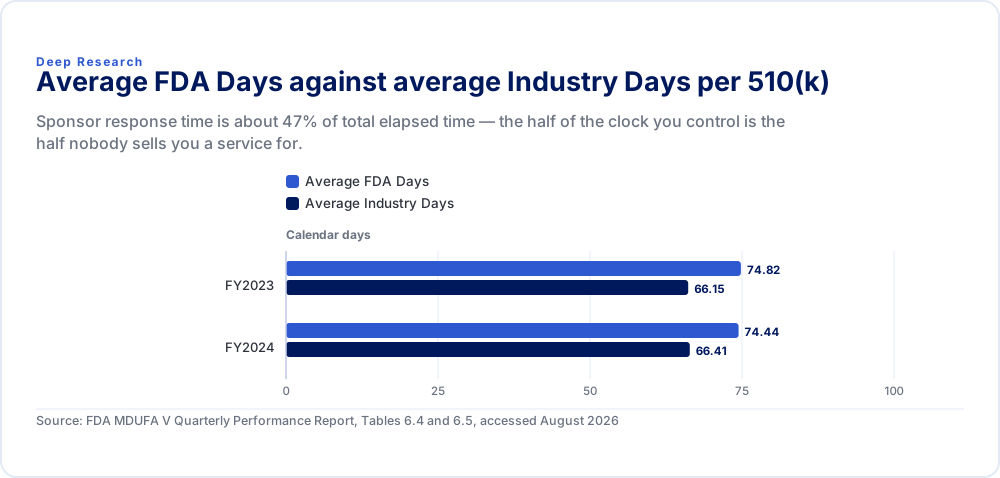
| Average FDA Days | Average Industry Days | |
|---|---|---|
| FY2023 | 74.82 | 66.15 |
| FY2024 | 74.44 | 66.41 |
Source: FDA MDUFA V Quarterly Performance Report, Tables 6.4 and 6.5, accessed August 2026
Most compilation services are still sold against the fear of a Refuse to Accept designation. That fear was rational in 2019 and is largely obsolete now, and the change is measurable.
The RTA process itself has not gone away. Under the current policy — Refuse to Accept Policy for 510(k)s, issued 21 April 2022, superseding the September 2019 version — "The acceptance review occurs prior to the substantive review and should be conducted and completed within 15 calendar days of FDA receiving the 510(k) notification" 5152. If it fails, FDA notifies the submitter and provides the completed checklist showing which items caused it 51. Two mitigating facts are worth knowing: "A new submission and new user fee are not necessary", and you have 180 days to respond before the submission is deemed withdrawn 51. The cost of an RTA is schedule, not fee — the review clock does not start until the submission is accepted 51.
But eSTAR changed the probability. FDA states plainly: "After the FDA receives an eSTAR submission, given that a properly prepared electronic submission should represent a complete submission, eSTAR submissions are not anticipated to undergo a Refuse to Accept (RTA) process. However, the FDA intends to employ a virus scanning and technical screening process for eSTAR" — and a failed technical screening can hold the submission for up to 180 days 10.
The published outcome is in FDA's quarterly MDUFA performance data. Table 6.1, "CDRH – 510(k) Acceptance Review Decision", reports the rate of submissions not accepted for review or failing technical screening on the first cycle 12:
| Fiscal year | Submissions received | Not accepted or failed technical screening, first cycle |
|---|---|---|
| FY 2023 | 3,858 | 20.54% |
| FY 2024 | 3,557 | 5.45% |
| FY 2025 (through 30 June 2025, preliminary) | 2,743 | 6.52% |
That metric combines RTA designations and technical-screening failures, and the FY2025 figure is a partial-year, preliminary number as of 30 June 2025 12.
| First-cycle failure rate (%) | |
|---|---|
| FY2023 | 20.54% |
| FY2024 | 5.45% |
| FY2025 (preliminary) | 6.52% |
Source: FDA MDUFA V Quarterly Performance Report, accessed August 2026; FY2025 is preliminary through 30 June 2025
Now look at where the time actually sits. From the same quarterly report, Tables 6.4 and 6.5 12:
| Metric | FY 2023 | FY 2024 | FY 2025 (partial) |
|---|---|---|---|
| 510(k)s with a MDUFA V decision within 90 FDA Days | 99.32% | 98.76% | 98.71% |
| Average FDA Days to decision | 74.82 | 74.44 | 64.32 |
| Average Industry Days | 66.15 | 66.41 | — |
| Average review cycles | 1.67 | 1.68 | — |
FDA is meeting its decision goal — the MDUFA V commitment is "FDA will issue a MDUFA decision for 95% of 510(k) submissions within 90 FDA Days" — with room to spare 53. The shared outcome goal is different: Total Time to Decision, which counts calendar days including your response time, was 127 days and met in FY2023, then 139 days and missed in FY2024, against goals of 128 and 124 respectively 54. FY2025 is not yet computable because "A 510(k) cohort is considered closed when 99 percent of submissions in the MDUFA cohort have reached a decision" 54. The FY2026 and FY2027 TTD goal is 112 calendar days, potentially adjusted to 108 53.
Set the two rows against each other. Average FDA days 74.4; average industry days 66.4. The sponsor holds the file for roughly 47% of elapsed time, across 1.67 cycles. The submission is going back and forth once more than half the time, and when it does, the response time is yours.
There is one more provision worth knowing about because it is a free escalation you may not have been told you have: "For all 510(k) submissions that do not reach a MDUFA decision within 100 FDA Days, FDA will provide written feedback to the applicant to be discussed in a meeting or teleconference, including all outstanding issues with the application preventing FDA from reaching a decision" 53.
The buying implication is direct and it contradicts how most of this market is sold. Paying a premium for completeness insurance buys down a 5–6% risk that eSTAR already engineered away. Paying for the capability to write a fast, complete, technically credible Additional Information response addresses roughly half the calendar. When you compare quotes, the question that separates them is not "is compilation included" but "is AI-request response included, and at what rate".
The notified-body capacity constraint
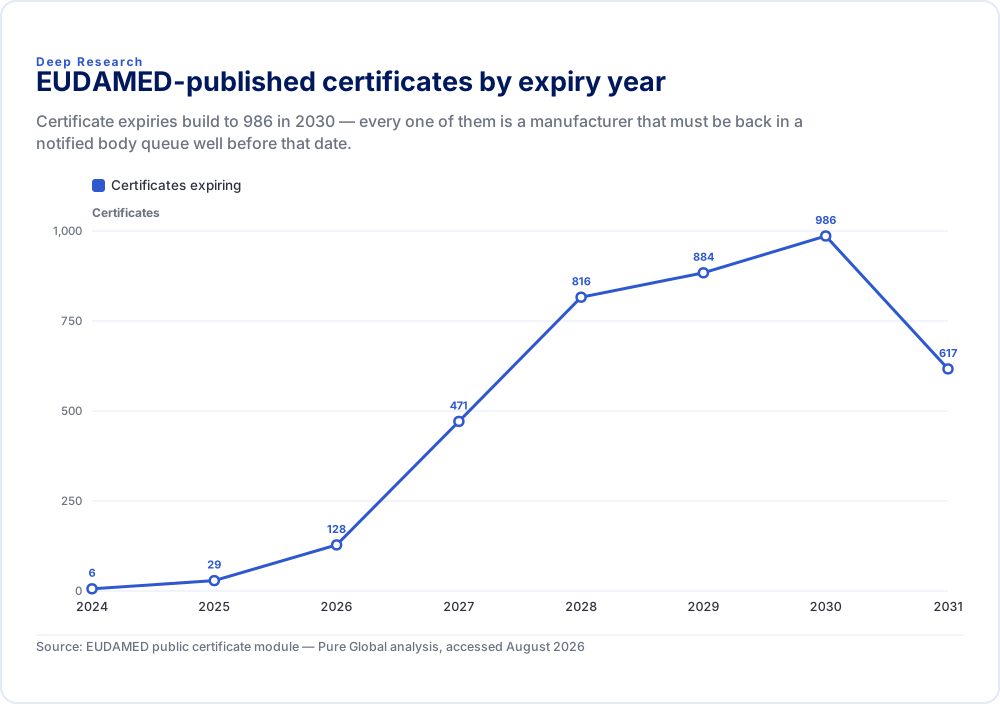
Takeaway: 52 designated bodies, 32,898 applications, 18,010 certificates, and a public register whose expiry dates cluster hard in 2028–2030. Book the slot against a date, not against file readiness.
| Certificates expiring | |
|---|---|
| 2024 | 6 |
| 2025 | 29 |
| 2026 | 128 |
| 2027 | 471 |
| 2028 | 816 |
| 2029 | 884 |
| 2030 | 986 |
| 2031 | 617 |
Source: EUDAMED public certificate module — Pure Global analysis, accessed August 2026
On the US side the constraint is your own response time. On the EU side it is someone else's queue, and the numbers are now public enough to plan against.
How many bodies. As at 28 February 2026 there were 52 notified bodies designated under MDR and 19 under IVDR, per the Commission-commissioned 20th Notified Body survey reported in the study "Supporting the monitoring of the availability of medical devices on the EU market", conducted for DG SANTE via HaDEA by Gesundheit Österreich GmbH with Areté 55. The two counts must not be summed, because bodies can hold both designations. We give the figure with its cutoff date deliberately: NANDO now sits inside the Commission's Single Market Compliance Space, which is a client-rendered application, and we were not able to extract a live designation count from the register itself 56.
How much work is in the system. The same survey records, as at 28 February 2026, 32,898 MDR applications filed and 18,010 MDR certificates issued 55.
How long it takes. This is where most published figures are wrong, and the correction is worth more than the number. The Commission does not publish a median time from application to certificate. It publishes banded distributions across notified bodies, measured from a later starting point. For MDR QMS certificates, "62% of NBs: 13-18 months to issue a new QMS certificate" and "30% of NBs: 6-12 months". For MDR QMS+PRODUCT certificates, "51% of NBs: 13-18 months" and "31% of NBs: 19-24 months" 55. Critically, the indicator "shows the time to reach a new certificate (from written agreement … to issuance)" — it does not start at application 55. The earlier stage is measured separately: "In the majority of the cases (65%), it takes less than 2 months from an application lodged to a written agreement signed" 55.
So a defensible planning statement is: for a majority of bodies, expect under two months from application to written agreement, then 13–18 months from written agreement to a new QMS certificate, and longer where product verification is bundled. A single official median from application to certificate does not exist, and from 2028 it will, because Implementing Regulation (EU) 2026/977 will require every body to publish one 1.
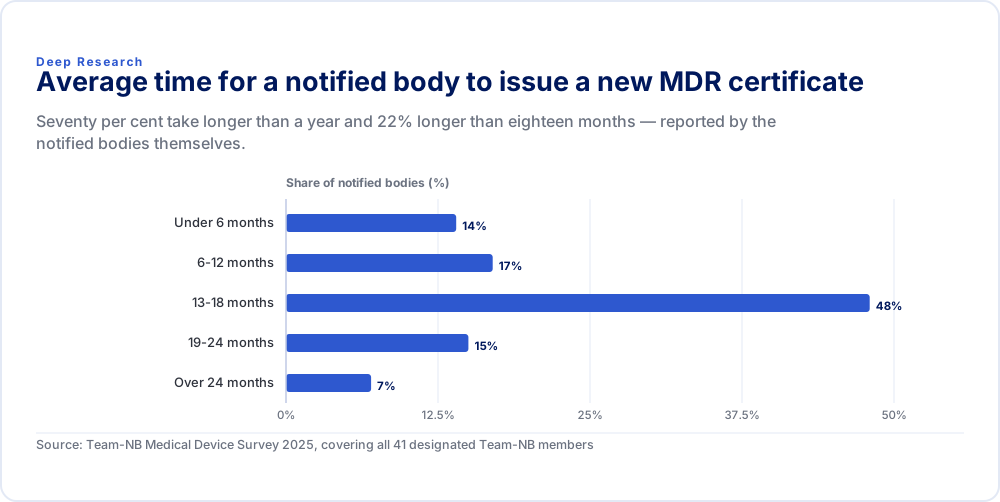
The notified bodies' own trade association reports the same shape from the other side of the table. Team-NB's Medical Device Survey 2025, covering all 41 of its designated members — 79% of the MDR-designated population — gives the distribution of average time to issue a new MDR certificate as: under 6 months 14%, 6–12 months 17%, 13–18 months 48%, 19–24 months 15%, over 24 months 7% 57. Seventy per cent take longer than a year, and 22% take longer than eighteen months.
| Share of notified bodies (%) | |
|---|---|
| Under 6 months | 14% |
| 6-12 months | 17% |
| 13-18 months | 48% |
| 19-24 months | 15% |
| Over 24 months | 7% |
Source: Team-NB Medical Device Survey 2025, covering all 41 designated Team-NB members
Two further figures from that survey change how you should choose a body. Its 41 members issued 17,260 certificates by end-2025, but the distribution is extreme: two bodies issued more than 1,000 each, six issued 300–1,000, and 33 of 41 issued fewer than 300. The average is 347; the median is 68 57. Most designated notified bodies are small. Picking one because it appears in NANDO under your product code tells you nothing about whether it has the throughput to take you. Team-NB also reports the first headcount decline in over a decade — 8% fewer internal conformity assessment staff and 21% fewer subcontractors 57 — which is the supply side of the 2028–2030 expiry wave moving the wrong way.
And here is the finding that connects capacity back to file quality. In the Commission's February 2026 survey wave, the two leading stated reasons for refusing an application were "outside the scope of designation" at 30% and "applications not complete" at 25% 55. Cumulative refusals have climbed steadily: 232 in October 2022, 650 in February 2025, 918 in October 2025, 989 by February 2026 55. A quarter of refusals are a documentation problem, not a technical one. That is the EU counterpart to the FDA acceptance-review statistic — except that on the EU side it has not been engineered away by a mandatory template, and it costs you a queue position rather than 15 days.
When the queue gets worse. Our own analysis of the public EUDAMED certificate export (snapshot 25 July 2026) contains 3,937 latest-version certificate records held by 2,799 actors and issued by 49 notified bodies. Pure Global analysis 58.
| Expiry year | Certificates in the public export |
|---|---|
| 2024 | 6 |
| 2025 | 29 |
| 2026 | 128 |
| 2027 | 471 |
| 2028 | 816 |
| 2029 | 884 |
| 2030 | 986 |
| 2031 | 617 |
Read that as a shape, not a census — the reasons are in the methodology section below. The shape is unambiguous: recertification demand roughly doubles from 2027 to 2028 and keeps climbing to 2030. Recertification competes for the same reviewers and the same audit weeks as first-time MDR certification. If your plan is "we will approach a notified body when the file is ready", your plan contains an assumption about someone else's 2029 capacity.
Concentration makes it worse. In the same export, five notified bodies account for 46.8% of certificates. NB 0197 alone holds 16.4% and NB 0123 holds 13.0% 58. NANDO identifies 0197 as TÜV Rheinland LGA Products GmbH and 0123 as TÜV SÜD Product Service GmbH 5960. The export does not carry notified body names, so any other number in our data should be looked up in NANDO before you act on it 56.
And the holder side is fragmented. Of 2,799 certificate holders in the export, 2,212 — 79.0% — hold exactly one certificate 58. The country prefix of the holder's SRN shows China at 19.0%, Italy 13.0%, Germany 12.7%, the United States 7.1%, Korea 4.0% and Türkiye 3.9% 58. That distribution mirrors the 510(k) applicant mix in shape: a long tail of single-certificate manufacturers negotiating with a concentrated set of assessors. It is the structural reason a small manufacturer has no pricing power in this transaction, and the reason the Commission legislated for disclosure instead.
What the new Regulation gives you. From 25 February 2027, the phase caps apply: 30 days for application review and contract signature, 120 days for QMS auditing, 90 days for product verification, 20 days for decision and certification, with QMS audit and product verification run in parallel under Annex IX, and interruptions capped at one, four and four respectively 1. From 2028, published median cost and median duration per body 161. Until then, the only leverage available is to apply early, to have a complete file at the written-agreement stage, and to treat the interruption cap as a negotiating anchor once it applies.
One EUDAMED date correction, because it changes what absence means. Commission Decision (EU) 2025/2371 of 26 November 2025, published 27 November 2025, confirmed the functionality of four electronic systems, triggering the six-month transition set by Regulation (EU) 2024/1860 6263. The Commission states: "As of 28 May 2026, the following 4 modules of EUDAMED became mandatory to use: Actor registration; UDI/Device registration; Notified Bodies & Certificates; Market Surveillance" 6465. Vigilance and post-market surveillance, and clinical investigations and performance studies, remain under development with no date, and the Commission has said "There will be no time for voluntary use for these two modules before they become mandatory" 64. Legacy certificate upload runs on a longer clock: under amended MDR Article 123(3)(ea), notified bodies have 18 months from the notice, and need only enter "the latest relevant certificate" for legacy devices 63. That is why the public certificate register is mandatory and still incomplete, and why our 3,937 records are a floor, not a population.
The quote-normalisation checklist
Takeaway: twelve questions turn three incomparable quotes into three prices for one deliverable. Send them verbatim. The pattern of what a vendor will and will not put in writing is itself the answer.
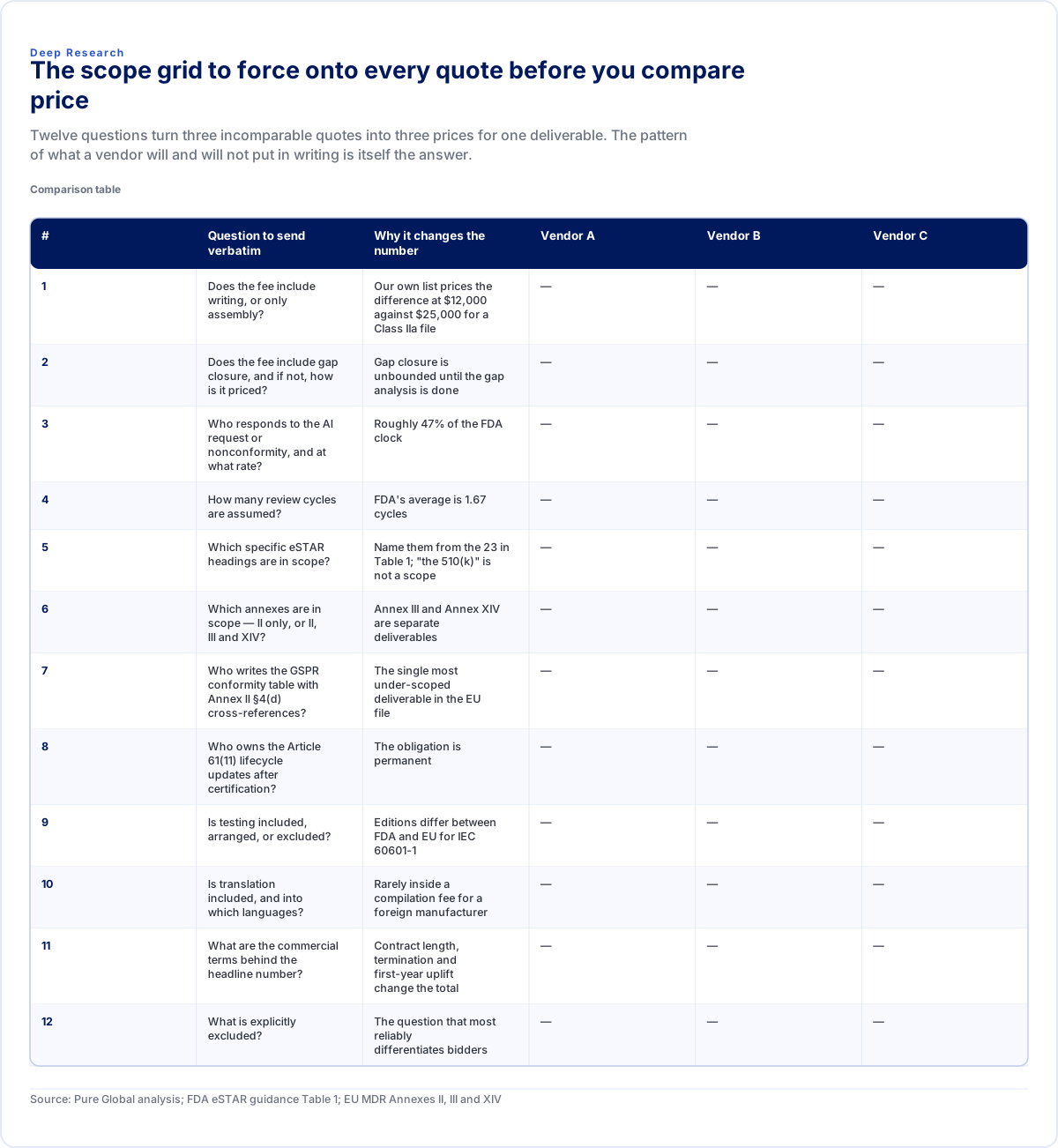
| # | Question to send verbatim | Why it changes the number | Vendor A | Vendor B | Vendor C |
|---|---|---|---|---|---|
| 1 | Does the fee include writing, or only assembly? | Our own list prices the difference at $12,000 against $25,000 for a Class IIa file | — | — | — |
| 2 | Does the fee include gap closure, and if not, how is it priced? | Gap closure is unbounded until the gap analysis is done | — | — | — |
| 3 | Who responds to the AI request or nonconformity, and at what rate? | Roughly 47% of the FDA clock | — | — | — |
| 4 | How many review cycles are assumed? | FDA's average is 1.67 cycles | — | — | — |
| 5 | Which specific eSTAR headings are in scope? | Name them from the 23 in Table 1; "the 510(k)" is not a scope | — | — | — |
| 6 | Which annexes are in scope — II only, or II, III and XIV? | Annex III and Annex XIV are separate deliverables | — | — | — |
| 7 | Who writes the GSPR conformity table with Annex II §4(d) cross-references? | The single most under-scoped deliverable in the EU file | — | — | — |
| 8 | Who owns the Article 61(11) lifecycle updates after certification? | The obligation is permanent | — | — | — |
| 9 | Is testing included, arranged, or excluded? | Editions differ between FDA and EU for IEC 60601-1 | — | — | — |
| 10 | Is translation included, and into which languages? | Rarely inside a compilation fee for a foreign manufacturer | — | — | — |
| 11 | What are the commercial terms behind the headline number? | Contract length, termination and first-year uplift change the total | — | — | — |
| 12 | What is explicitly excluded? | The question that most reliably differentiates bidders | — | — | — |
Source: Pure Global analysis; FDA eSTAR guidance Table 1; EU MDR Annexes II, III and XIV
Send these to every bidder, including your own internal team, and require written answers before you compare numbers.
1. Does the fee include writing, or only assembly? Our own list distinguishes them explicitly and prices the difference at $12,000 versus $25,000 for a Class IIa file Pure Global pricing. If a quote does not distinguish them, it has not been scoped.
2. Does the fee include gap closure, and if not, how is gap closure priced? Gap closure is unbounded until the gap analysis is done. The only honest structures are a separate gap analysis first, or an hourly rate with a not-to-exceed.
3. Who responds to the FDA Additional Information request or the notified body nonconformity, and at what rate? This is roughly 47% of the FDA clock 12. If it is out of scope, the quote covers the easy half.
4. How many review cycles are assumed? FDA's average is 1.67 12. A fixed fee assuming one cycle is a fixed fee for something that happens less than half the time.
5. Which specific eSTAR headings are in scope? Name them from the 23 in Table 1 of the guidance 11. "The 510(k)" is not a scope.
6. Which annexes are in scope — II only, or II, III and XIV? Annex III (PMS plan, PSUR, PMS report) and Annex XIV (CEP, CER, PMCF plan, PMCF report) are separate deliverables from Annex II 22. Many "technical file" quotes cover Annex II alone.
7. Who writes the GSPR conformity table, with the document-level cross-references Annex II §4(d) requires? 22 This is the single most under-scoped deliverable in the EU file.
8. Who owns the Article 61(11) lifecycle updates after certification? 22 If the answer is "you", say so in the plan and staff it.
9. Is testing included, arranged, or excluded? And if arranged, are reports issued against both the FDA-recognised edition and the EU-harmonised edition where they differ, as they do for IEC 60601-1 3136?
10. Is translation included, and into which languages? For a foreign manufacturer, English-language authoring of a technical narrative is a real cost line and is rarely in a compilation fee.
11. What are the commercial terms behind the headline number? Our own AR line requires a three-year contract, prices early termination at 50% of the remaining value, and uplifts the first year by 50% on annual terms Pure Global pricing. Terms like that are normal in this market and change the effective price materially.
12. What is explicitly excluded? Ask for the exclusion list in writing. A vendor who publishes exclusions is easier to work with than one who does not, and this is the question that most reliably differentiates bidders.
Three supplementary questions for the US route specifically. Have you applied for small-business determination for the correct fiscal year 9? Is your device eligible for the 510(k) Third Party Review Program, where there is no FDA user fee and roughly half of submissions qualify 293066? And is your US Agent designation current, given the 10-business-day change-reporting rule 44?
RACI for each route
Takeaway: the accountable party never changes. Only the responsible party moves. Any proposal that appears to move accountability is describing something that cannot be sold.
| Activity | In-house | AI-assisted in-house | Consultant |
|---|---|---|---|
| Regulatory strategy and pathway | R/A: RA lead | R/A: RA lead | R: consultant · A: manufacturer |
| Classification and predicate or equivalence selection | R/A: RA lead | R: RA lead (AI-assisted shortlist) · A: RA lead | R: consultant · A: manufacturer |
| Gap analysis | R/A: RA lead | R: AI-assisted · A: RA lead | R: consultant · A: manufacturer |
| Document assembly and indexing | R/A: RA lead | R: AI · A: RA lead | R: consultant · A: manufacturer |
| Narrative writing | R/A: RA lead | R: AI first draft · A: RA lead | R: consultant · A: manufacturer |
| GSPR / special controls conformity table | R/A: RA lead | R: AI-assisted mapping · A: RA lead | R: consultant · A: manufacturer · C: design owner |
| Clinical evaluation appraisal and conclusion | R/A: clinical lead | R/A: clinical lead — not delegable to a model | R: medical writer · A: manufacturer |
| Gap closure (testing, design change, claim reduction) | R/A: engineering · C: RA | Same | R: manufacturer · C: consultant |
| Submission and reviewer correspondence | R/A: RA lead | R/A: RA lead | R: consultant · A: manufacturer |
| Declaration of conformity / truthful and accurate statement | A: manufacturer | A: manufacturer | A: manufacturer |
| PMS, PSUR, PMCF and Article 61(11) updates | R/A: RA lead | R: AI-assisted · A: RA lead | R: consultant if contracted · A: manufacturer |
| US Agent duties under 21 CFR 807.40 | R: designated agent · A: foreign establishment | Same | Same 44 |
The bottom three rows are the ones to read twice. The signature is always yours. The lifecycle obligation is always yours. And FDA's service on your US Agent is "considered to be equivalent to providing the same information or documents to the foreign establishment" 44 — which means the agent you chose on price is the address at which your regulatory correspondence is legally delivered.
Frequently asked questions
How much does a technical file cost? There is no answer to that question as asked, and anyone who gives you one has substituted a different question. Ask instead: how much does this scope cost, for this class, with writing and gap closure and reviewer correspondence either in or out. Our own published list for EU MDR Class IIa runs $12,000 for compilation without writing, $18,000 for CEP-CER compilation, and $25,000 for compilation and writing Pure Global pricingPure Global pricing.
What does a 510(k) cost in total in 2026? Government fee plus professional fee plus testing. The FY2026 MDUFA standard 510(k) fee is $26,067 and the small-business fee is $6,517; in FY2027 they rise to $28,653 and $7,163 678. Add the annual establishment registration fee of $11,423 (FY2026) or $13,785 (FY2027), which has no small-business reduction 78. Our published compilation and submission fee is $15,000–$20,000 Pure Global pricing. Testing is usually the largest and most variable line and is device-specific.
Can I reuse my 510(k) for the EU? Partly. The non-clinical evidence base largely travels — biocompatibility data, electrical safety and EMC reports, software V&V, sterility, shelf life, risk management. The clinical argument does not, because the two legal tests are different: 21 CFR 807.100(b) is a comparison against a predicate with clinical data only "if deemed necessary", while MDR Article 61(1) requires "sufficient clinical evidence" for an absolute benefit-risk determination and Article 61(3)(c) additionally requires consideration of alternative treatment options 2228. And the GSPR conformity table, the PMS documents and the PMCF plan have no US equivalent 22.
Is the MDR equivalence route the same as a 510(k) predicate? No, and assuming so is expensive. Annex XIV §3 requires equivalence across technical, biological and clinical characteristics, and adds that "It shall be clearly demonstrated that manufacturers have sufficient levels of access to the data relating to devices with which they are claiming equivalence" 22. A predicate cited from a public 510(k) summary cannot satisfy the data-access condition.
Is IEC 62304 harmonised under MDR? No. We searched the consolidated Annex to Implementing Decision (EU) 2021/1182 as amended to 17 June 2026 and found no entry for 62304, and none for 62366-1 either 3132. Both are recognised by FDA in full 3738. Software lifecycle and usability evidence therefore reaches MDR as an "other solution applied" under Annex II §4(c), with no presumption of conformity 22.
Does using AI to draft my submission create a documentation burden with FDA? No special device-submission burden is established by the source cited here for ordinary drafting. FDA's draft says it does not address operational drafting, but the document covers drug and biological products—not devices—and remains a draft 1347. Keep human approval, traceability and document controls. If model output affects evidence, ask FDA how the device pathway treats it instead of assuming the drug/biologic seven-step framework automatically applies 14.
What is the average time to get a 510(k) cleared? FDA's own averages for FY2024 are 74.44 FDA Days and 66.41 Industry Days across 1.68 review cycles 12. The shared Total Time to Decision outcome — which counts both — was 127 calendar days in FY2023 and 139 in FY2024 54. The FY2026 and FY2027 goal is 112 calendar days 53.
What is the median cost and duration of a notified body assessment? No notified body publishes its own median, which is why the Commission legislated for it; the first published medians arrive in 2028 under Implementing Regulation (EU) 2026/977 161. What exists today is buyer-side survey evidence. The Commission's 3rd Economic Operator Survey reports a median €50,000 in notified body fees per MDR product certificate and a median €100,000 total cost for an initial certificate, on 152 manufacturer responses with data status 31 October 2025 and an observed range of €15,000–€1,300,000 2. MedTech Europe reports average notified body fees of €136,981 for MDR QMS assessment and €176,202 for technical documentation assessment on a different unit and sample 20. Use these for budgeting, not for comparing one body against another. On duration, 70% of new MDR certificates take longer than 12 months and 22% longer than 18 months 57.
How long does MDR certification take? For a majority of bodies: under two months from application to written agreement (65% of cases), then 13–18 months from written agreement to a new QMS certificate (62% of bodies), longer where product verification is bundled (51% of bodies at 13–18 months, 31% at 19–24 months) 55. From 25 February 2027, phase caps of 30/120/90/20 days apply under Implementing Regulation (EU) 2026/977 1.
Should we hire a regulatory person or use a consultant? Split the workload first. Retained capability — PMS, PSUR, vigilance, change control, registrations — exists whether or not you submit, and cannot be outsourced away. Project work is lumpy, and 56.6% of US 510(k) applicants filed exactly once in six years 4. The common answer for a first-time filer is a hybrid: buy the first dossier with knowledge transfer as a contract deliverable, retain the maintenance capability, run the second dossier in-house.
Do I need a US Agent, and what do they actually do? Every foreign establishment required to register must designate exactly one US Agent who resides or maintains a place of business in the United States 44. The agent assists FDA with communications, answers questions about imported products, and helps schedule inspections — and if FDA cannot reach you expeditiously, delivery to the agent counts as delivery to you 44. Changes must be reported within 10 business days 44.
Is EUDAMED mandatory now? Four modules are: Actor registration, UDI/Device registration, Notified Bodies & Certificates, and Market Surveillance, all mandatory since 28 May 2026 64. Vigilance and post-market surveillance, and clinical investigations and performance studies, remain in development with no date 64. Legacy certificate upload by notified bodies runs on an 18-month clock from the 27 November 2025 notice under amended MDR Article 123(3)(ea) 6263.
Why is your price list public? Because a range with no scope is not information, and because the exclusions are the useful part. The line that says "This service does not include writing of documents or gap closure or NB interaction" tells a buyer more than the number next to it Pure Global pricingPure Global pricing.
Methodology and limitations
Takeaway: two computed datasets, one internal price list, and a large body of primary regulatory text. Here is exactly what each can and cannot support, and the four numbers we deliberately do not give you.
Datasets and snapshots. The 510(k) analysis uses the FDA 510(k) premarket notification export, snapshot 24 August 2026, containing 175,559 decision records 45. The certificate analysis uses the public EUDAMED certificate search export, snapshot 24 August 2026 wrapping an inner cut of 25 July 2026, containing 3,937 rows 5865. Both were computed by Pure Global; the scripts and full outputs are retained in the working record for this report.
Applicant normalisation, and why the concentration figure is an upper bound. Applicant strings were upper-cased, punctuation stripped, and a fixed list of legal-form and geography tokens removed (INC, LLC, LTD, LIMITED, CORP, CORPORATION, CO, COMPANY, GMBH, SA, SAS, SPA, BV, AG, PLC, PTY, KK, SRL, AB, AS, OY, APS, PTE, SDN BHD, LP, LLP, GROUP, USA, US, HOLDING(S)). This merges "Medline Industries, Inc." with "Medline Industries, LP". It does not merge unrelated spellings, subsidiaries trading under different names, or corporate groups. The 56.6% single-filer figure is therefore an upper-bound estimate: true corporate-group concentration is higher and the single-filer share is somewhat lower. We state this rather than presenting the figure as exact.
Window. 2020-01-01 to 2025-12-31 by decision date. 2026 is partial in the snapshot — 1,764 records — and including it would understate the final year.
Applicant country is populated for the modern window but blank on most pre-2000 records, so all percentages are computed on the 2020–2025 window only.
EUDAMED export constraints. All 3,937 rows are latest-version records covering 3,841 distinct certificate numbers; the difference is amendments and reissues under the same number. Two columns are empty on every row in this export: applicableLegislation and certificateType. No MDR-versus-IVDR split is inferred from this data, and none should be. Notified body names are also absent, which is why we name only NB 0197 and NB 0123, and only against external identification 565960.
The certificate register is mandatory but still filling. An earlier version of our working record described the certificate module as not yet mandatory. That was wrong and is corrected here. The module became mandatory on 28 May 2026, before our inner snapshot date 64. But under amended MDR Article 123(3)(ea), notified bodies have 18 months from the 27 November 2025 notice to upload legacy certificates and need only upload the latest relevant one 6263. Against a Commission-reported population of 18,010 MDR certificates issued as at 28 February 2026 55, our 3,937 records are a lower bound. Everything drawn from this lane is framed as "in the public register as it stood on 25 July 2026", and the expiry-year distribution is presented as a shape, not a count.
The price list is one vendor's list price. It is used as a transparent, dated calibration point and is labelled as such throughout. It is not a market benchmark. We do not publish, estimate or imply any competitor's fees. All figures are reproduced exactly as listed, with sheet version and last-updated date, and with the list's own conditions preserved rather than dropped Pure Global pricingPure Global pricing.
No salary figure is asserted as fact. The break-even model takes fully loaded cost and productive hours as reader-supplied inputs. The illustrative values used to demonstrate the arithmetic are labelled illustrative, and the project-hour ranges are planning inputs with no source claimed. The structure of the conclusion is invariant to the values chosen; the specific cells are not.
EU legal text retrieval. Direct requests to eur-lex.europa.eu redirected to the Official Journal landing page during our verification session. All MDR, Regulation and Decision text quoted here was read from the EU Publications Office CELEX service, which serves the same official text; canonical EUR-Lex and ELI identifiers are given alongside each entry in the source list 2267. This is a retrieval-method note, not a doubt about the text.
What we treat as survey evidence rather than as price, and what we withhold entirely
Survey evidence, labelled as such. Every euro figure in the EU sections comes from a self-reported manufacturer survey, not from a regulator-published price or a notified body's own tariff. The Commission's 3rd Economic Operator Survey (152 responses, n=46 on the initial-certificate cost item, data status 31 October 2025) and MedTech Europe's 2024 survey (published January 2025) are cited with their sample sizes, dates and dispersion attached, and the two are shown to disagree because they measure different units 220. Team-NB's 2025 survey covers 41 of 52 MDR-designated bodies, so its throughput and duration distributions describe 79% of the market rather than all of it 57. None of these is a benchmark you can hold a specific notified body to. That instrument does not exist until 2028 1.
One arithmetic caveat on the Team-NB figures: the cumulative MDR and IVDR certificate counts in that survey do not sum cleanly to its 17,260 headline, which appears to include legacy Directive certificates. We cite the distribution and the timing bands, which are internally consistent, rather than the headline total.
Three numbers we deliberately do not give you. These circulate widely and have no source we could verify. Stating them would make this paper more quotable and less true.
- A median MDR duration from application to certificate. The Commission publishes banded percentages across notified bodies measured from written agreement, and Team-NB publishes bands for time to a new certificate; neither is a median from application 5557. No body is obliged to publish one until 2028 1.
- A live NANDO count of MDR-designated notified bodies. The Single Market Compliance Space is client-rendered and we could not extract a count from the register. We use 52, with its February 2026 cutoff attached 5556.
- Clause-level detail of FDA's partial recognition of ISO 10993-1:2025, including the widely repeated 2029 transition date. The recognition record confirms extent "Partial" and nothing more 35. Read the Supplementary Information Sheet for your device.
We also decline to use one figure that appears in almost every article on this subject: the "$31 million average cost of a 510(k) product" from the 2010 Makower/Stanford study. It is sixteen years old, industry-sponsored rather than regulator-published, drawn from a self-selected sample the authors themselves describe as skewed toward companies needing clinical data, and — decisively — it measures whole-programme concept-to-clearance cost, not dossier compilation. Quoting it in a paper about technical file cost would mislead a reader by an order of magnitude.
We also note two forward-looking gaps. FY2028 MDUFA rates do not exist; FDA has noticed a public meeting on MDUFA reauthorisation but no rates are published beyond FY2027 68. And the most recent MDUFA quarterly performance PDF we could obtain covers actions through 30 June 2025, so every RTA-rate and elapsed-time figure here is labelled to that date or to the 30 September 2025 annual report 1254. FDA's FDA-TRACK dashboard footnotes preliminary performance to a later date, but we could not obtain the corresponding published PDF and do not quote from the dashboard 69.
Conclusion
The question "what does technical file compilation cost" has no answer because it has no object. Three things fix that, and all three are within a buyer's control today.
Define the deliverable before you compare prices. Writing, gap closure and reviewer correspondence are three separable scopes, and the gap between the cheapest and the most complete version of "compilation" for a single Class IIa device is $12,000 to $25,000 on our own published list Pure Global pricing. Twelve written questions convert three incomparable quotes into three prices for one thing.
Buy the capability that matches where the risk actually sits. eSTAR has driven first-cycle rejection from 20.54% to about 6% 12. Meanwhile the sponsor holds the file for roughly 47% of elapsed FDA time across 1.67 review cycles 12. Completeness is close to solved; response quality is not. On the EU side the binding constraint is neither your budget nor your file — it is a queue at 52 designated bodies, five of which hold 46.8% of the certificates in the public register, facing a recertification wave that roughly doubles from 2027 to 2028 5558.
Split retained capability from project work, then do the arithmetic with your own numbers. With 56.6% of US filers submitting once in six years, the in-house build rarely wins on project cost alone 4 — but the maintenance workload that MDR Article 61(11) and Annex III create cannot be outsourced away in any case 22. The hybrid that usually survives contact with reality is: buy the first dossier with knowledge transfer written into the statement of work, retain the maintenance capability, run the second one yourself.
One closing note on what has genuinely changed in the last year. FDA's drug-and-biologic draft confirms that operational drafting is outside that document's scope, but it does not establish a device safe harbor; device sponsors should budget for human verification and evidence traceability, not a made-up automatic seven-step filing package 1314. The European Commission, by contrast, has conceded in a binding Regulation that manufacturers "are not provided with a reliable estimation of the overall requested services and costs"—and has set a date by which that must stop 1.
Note precisely what is and is not missing. Buyer-side cost evidence exists and is decent: a median €100,000 for an initial MDR certificate, of which a median €50,000 is notified body fees, with 90% of first-year cost being personnel time on QMS and technical documentation rather than fees at all 220. What does not exist is a comparable, seller-published price — the thing you would need to choose between two notified bodies on cost. That arrives in 2028. Until then, budget from the survey medians, understand that they carry a €15,000-to-€1,300,000 spread behind them, and spend your negotiating effort on the 90% you control rather than the 7% you do not.
Pure Global publishes its price list, including its exclusions Pure Global pricing. No approval or timeline is guaranteed, and all fees are subject to the conditions stated on the list.
References
- European Commission, Commission Implementing Regulation (EU) 2026/977 of 4 May 2026 laying down certain uniform quality management and procedural requirements for the conformity assessment activities carried out by a notified body designated under Regulations (EU) 2017/745 and (EU) 2017/746 — OJ L, 5 May 2026; quotation practice recital; phase caps of 30/120/90/20 days; annual median cost and duration reporting under Article 4(4); applies from 25 February 2027, Article 4(4) from 1 January 2028. publications.europa.eu ↩ ↩ ↩ ↩ ↩ ↩ ↩ ↩ ↩ ↩ ↩ ↩ ↩ ↩ ↩ ↩ ↩ ↩ ↩
- European Commission (DG SANTE / HaDEA), Gesundheit Österreich GmbH, 3rd Economic Operator Survey — Study supporting the monitoring of the availability of medical devices on the EU market, published 1 July 2026, data status 31 October 2025 — 152 medical device manufacturer responses; median €100,000 total cost for an initial MDR certificate (mean €194,785; n=46; range €15,000–€1,300,000); median €50,000 notified body fees per certificate; median €30,000 yearly maintenance; median €57,800 per renewed certificate; clinical evaluation cost roughly €10,000 (Class I) to €50,000 (Class III), range €1,000–€86,000; 48% of respondents withdrew at least one product from the EU market since 2021, 63% of those citing cost of re-approval. Self-reported survey data, not a regulator-published price. ppri.goeg.at ↩ ↩ ↩ ↩ ↩ ↩ ↩
- European Commission, Study supporting the monitoring of the availability of medical devices on the EU market — Commission landing page for the notified body and economic operator survey series cited at sources 65 and 4. health.ec.europa.eu ↩ ↩
- U.S. Food and Drug Administration, 510(k) Premarket Notification database — Pure Global analysis of the 24 August 2026 export (175,559 records; 18,855 clearances and 6,897 normalised applicants in the 2020–2025 window). accessdata.fda.gov ↩ ↩ ↩ ↩ ↩ ↩ ↩ ↩ ↩ ↩
- U.S. Food and Drug Administration, Downloadable 510(k) files — source of the bulk export analysed. fda.gov ↩ ↩
- Federal Register, Medical Device User Fee Rates for Fiscal Year 2026, 30 July 2025 — FY2026 rates: 510(k) $26,067 / $6,517; De Novo $173,782 / $43,446; PMA $579,272 / $144,818. federalregister.gov ↩ ↩ ↩ ↩ ↩ ↩ ↩
- Federal Register, Medical Device User Fee Rates for Fiscal Year 2027, 91 FR 48134, 31 July 2026 — FY2027 rates: 510(k) $28,653 / $7,163; De Novo $191,020 / $47,755; PMA $636,732 / $159,183; establishment registration $13,785 with no small-business reduction; 510(k) fee is 4.5% of the standard fee; small business fee is 25% of standard. federalregister.gov ↩ ↩ ↩ ↩ ↩ ↩ ↩ ↩ ↩ ↩ ↩ ↩
- U.S. Food and Drug Administration, Medical Device User Fee Amendments (MDUFA) fees — FY2026 and FY2027 fee tables; establishment registration $11,423 (FY2026) and $13,785 (FY2027); no user fee for 510(k)s submitted on behalf of an FDA-accredited third-party reviewer. fda.gov ↩ ↩ ↩ ↩ ↩ ↩
- U.S. Food and Drug Administration, Reduced or Waived Medical Device User Fees: Small Business Determination (SBD) Program — small business status expires 30 September of the fiscal year in which it is granted; a new request must be approved each fiscal year. fda.gov ↩ ↩ ↩ ↩ ↩ ↩
- U.S. Food and Drug Administration, eSTAR Program — mandatory use for 510(k) and De Novo; nIVD and IVD eSTAR version 7.0; conditional display of sections; forms FDA 3881 and 3514 built in; eSTAR submissions "not anticipated to undergo a Refuse to Accept (RTA) process"; technical screening hold up to 180 days. FDA content current as of 3 August 2026. fda.gov ↩ ↩ ↩ ↩ ↩ ↩ ↩
- U.S. Food and Drug Administration, Electronic Submission Template for Medical Device 510(k) Submissions — Guidance for Industry and FDA Staff — issued 2 October 2023, originally 22 September 2022; docket FDA-2021-D-0872; Table 1 content model (23 headings); section 745A(b) FD&C Act basis; binding effect statement; no waivers anticipated; effective 1 October 2023. fda.gov ↩ ↩ ↩ ↩ ↩ ↩ ↩
- U.S. Food and Drug Administration, Quarterly Update on Medical Device Performance Goals — MDUFA V CDRH Performance Data, actions through 30 June 2025 — Table 6.1 first-cycle not-accepted/failed-technical-screening rate (20.54% FY2023; 5.45% FY2024; 6.52% FY2025 preliminary); Tables 6.4 and 6.5 FDA Days, Industry Days and review cycles. fda.gov ↩ ↩ ↩ ↩ ↩ ↩ ↩ ↩ ↩ ↩ ↩
- U.S. Food and Drug Administration, Considerations for the Use of Artificial Intelligence To Support Regulatory Decision-Making for Drug and Biological Products — Draft Guidance — seven-step credibility assessment framework; definition of credibility; explicit scope exclusion of "drafting/writing a regulatory submission"; encouragement to engage early on scope. fda.gov ↩ ↩ ↩ ↩ ↩ ↩ ↩
- U.S. Food and Drug Administration, Artificial Intelligence-Enabled Medical Devices — device-side AI, distinct from the use of AI in preparing a regulatory submission. fda.gov ↩ ↩ ↩ ↩
- Emergo by UL, Emergo by UL — most-cited consultancy domain in our pooled AI-answer set (62 of 366 non-empty answers). Cited as an observed AI citation pattern; no fee data attributed. emergobyul.com ↩
- MedEnvoy Global, MedEnvoy Global — 30 of 366 answers. medenvoyglobal.com ↩
- Freyr Solutions, Freyr Solutions — 20 of 366 answers. freyrsolutions.com ↩
- Qserve Group, Qserve Group — 18 of 366 answers. qservegroup.com ↩
- MCRA, MCRA — 17 of 366 answers. mcra.com ↩
- MedTech Europe, IVDR & MDR Survey Results 2024, fieldwork 5 April – 3 May 2024, published January 2025 — first-year certification cost composition of 90% personnel / 7% notified body fees / 3% yearly regulatory maintenance; average notified body fees of €136,981 for MDR QMS assessment and €176,202 for MDR technical documentation assessment; 70% of device manufacturers reporting clinical evaluation cost increases of 100% or more versus the Directives. Industry association survey, self-reported. medtecheurope.org ↩ ↩ ↩ ↩ ↩
- European Commission, Medical devices — new regulations — MDR and IVDR framework landing page. health.ec.europa.eu ↩
- European Union, Regulation (EU) 2017/745 on medical devices (MDR), consolidated text of 9 July 2024 — Annex II (six headings; §4 GSPR cross-referencing; §6.1 pre-clinical and clinical data; reuse rationale); Annex III (PMS plan, PSUR, PMS report); Annex XIV Parts A and B (clinical evaluation, equivalence, PMCF); Article 61(1), 61(3)(c), 61(10), 61(11); Article 123(3) as amended. publications.europa.eu ↩ ↩ ↩ ↩ ↩ ↩ ↩ ↩ ↩ ↩ ↩ ↩ ↩ ↩ ↩ ↩ ↩ ↩ ↩ ↩ ↩ ↩ ↩ ↩ ↩ ↩ ↩ ↩ ↩ ↩ ↩ ↩ ↩ ↩ ↩ ↩ ↩
- U.S. Food and Drug Administration, Electronic Submission Template for Medical Device 510(k) Submissions — guidance landing page — states that as of 1 October 2023 FDA requires 510(k) electronic submissions as described in the guidance. fda.gov ↩
- Federal Register, Electronic Submission Template for Medical Device 510(k) Submissions; Guidance for Industry and Food and Drug Administration Staff; Availability, 22 September 2022 — notice of availability for the guidance cited at source 13. federalregister.gov ↩
- U.S. Food and Drug Administration, How to Prepare a Traditional 510(k) — submission preparation guidance. fda.gov ↩
- U.S. Food and Drug Administration, Premarket Notification 510(k) — programme overview and submission types. fda.gov ↩
- U.S. Food and Drug Administration, Content of a 510(k) — older element set; FDA content current as of 26 April 2019, predating mandatory eSTAR; also states clinical data are not needed for most devices cleared through 510(k). fda.gov ↩ ↩ ↩
- U.S. Government, 21 CFR 807.100 — FDA action on a premarket notification — substantial equivalence criteria at 807.100(b). ecfr.gov ↩ ↩ ↩ ↩
- U.S. Food and Drug Administration, 510(k) Third Party Review Program — voluntary alternative review; approximately half of 510(k)s eligible; no separate FDA user fee where used; formerly the Accredited Persons Program under section 523 FD&C Act. fda.gov ↩ ↩ ↩
- U.S. Food and Drug Administration, Current List of FDA-Recognized 510(k) Third Party Review Organizations — database updated 24 August 2026; eligible product codes by organisation. accessdata.fda.gov ↩ ↩
- European Commission, Commission Implementing Decision (EU) 2021/1182 on harmonised standards for medical devices, consolidated text of 17 June 2026 — Annex items 16 (EN ISO 14971:2019 + /A11:2021), 54 (EN ISO 10993-1:2025) and 65 (EN 60601-1:2006 + /A13:2024); searched for "62366" and "62304" with no entry found. publications.europa.eu ↩ ↩ ↩ ↩ ↩ ↩ ↩ ↩ ↩ ↩
- European Union, Commission Implementing Decision (EU) 2026/1231 of 11 June 2026 — most recent act amending the harmonised standards list consolidated above. eur-lex.europa.eu ↩ ↩
- European Commission, Harmonised standards — Medical devices — landing page for the MDR and IVDR harmonised standards lists. single-market-economy.ec.europa.eu ↩
- U.S. Food and Drug Administration, Recognized Consensus Standards — Recognition No. 5-125, ISO 14971 Third edition 2019-12 — extent of recognition Complete; date of entry 23 December 2019. accessdata.fda.gov ↩ ↩ ↩
- U.S. Food and Drug Administration, Recognized Consensus Standards — Recognition No. 2-313, ISO 10993-1 Sixth edition 2025-11 — extent of recognition Partial; date of entry 25 May 2026. accessdata.fda.gov ↩ ↩ ↩ ↩
- U.S. Food and Drug Administration, Recognized Consensus Standards — Recognition No. 19-49, IEC 60601-1 Edition 3.2 2020-08 consolidated — extent Complete; date of entry 3 April 2023; recognised with relevant US national differences applied; related AAMI adoption at recognition 19-46. accessdata.fda.gov ↩ ↩ ↩ ↩ ↩
- U.S. Food and Drug Administration, Recognized Consensus Standards — Recognition No. 5-129, IEC 62366-1 Edition 1.1 2020-06 consolidated — extent Complete; date of entry 6 July 2020. accessdata.fda.gov ↩ ↩ ↩
- U.S. Food and Drug Administration, Recognized Consensus Standards — Recognition No. 13-79, IEC 62304 Edition 1.1 2015-06 consolidated — extent Complete; date of entry 14 January 2019. accessdata.fda.gov ↩ ↩ ↩
- U.S. Food and Drug Administration, Recognized Consensus Standards — Recognition No. 2-258, ISO 10993-1 Fifth edition 2018-08 — extent Partial; date of entry 14 January 2019. accessdata.fda.gov ↩
- Medical Device Coordination Group, MDCG 2020-13 — Clinical evaluation assessment report template, July 2020 — notified body assessment template, including Section J on Article 61(10); non-binding status disclaimer. health.ec.europa.eu ↩ ↩
- Medical Device Coordination Group, MDCG 2020-6 — Clinical evidence needed for medical devices previously CE marked under Directives 93/42/EEC or 90/385/EEC, April 2020 — working definition of sufficient clinical evidence; non-binding best-practice status. health.ec.europa.eu ↩
- European Commission, Guidance — MDCG endorsed documents and other guidance — index of current MDCG guidance; documents are not legally binding. health.ec.europa.eu ↩
- Team-NB, Position Paper — Best Practice Guidance on Technical Documentation under EU MDR 2017/745, V4, 21 April 2026 — notified body association position paper; not a fee or duration survey. team-nb.org ↩
- U.S. Government, 21 CFR 807.40 — Establishment registration and device listing for foreign establishments importing or offering for import devices into the United States — one US Agent; residence or place of business in the US; duties; equivalence of delivery to the agent; 10-business-day change reporting. Title 21 up to date as of 27 August 2026. ecfr.gov ↩ ↩ ↩ ↩ ↩ ↩ ↩ ↩ ↩ ↩ ↩
- U.S. Food and Drug Administration, Device Registration and Listing — 21 CFR Part 807 obligations. fda.gov ↩
- U.S. Government, 21 CFR Part 807 — Establishment Registration and Device Listing for Manufacturers and Initial Importers of Devices. ecfr.gov ↩
- U.S. Food and Drug Administration, Considerations for the Use of Artificial Intelligence To Support Regulatory Decision-Making for Drug and Biological Products — guidance landing page, dated 6 January 2025, docket FDA-2024-D-4689; still designated Draft as at 29 August 2026. fda.gov ↩ ↩
- U.S. Government Publishing Office, Federal Register notice of availability, 7 January 2025 — publication of the AI draft guidance. govinfo.gov ↩
- U.S. Food and Drug Administration, Artificial Intelligence-Enabled Device Software Functions: Lifecycle Management and Marketing Submission Recommendations — Draft Guidance, 7 January 2025 — AI in the device, distinct from AI in the authoring process; still Draft as at 29 August 2026. fda.gov ↩
- U.S. Food and Drug Administration, Recognized Consensus Standards database — search interface for recognition numbers, editions and extent of recognition. accessdata.fda.gov ↩
- U.S. Food and Drug Administration, Refuse to Accept Policy for 510(k)s — Guidance for Industry and FDA Staff — issued 21 April 2022, originally 20 May 1994, superseding the 13 September 2019 version; docket FDA-2012-D-0523; 15-calendar-day acceptance review; no new user fee on RTA response; 180-day deadline; review clock does not start until acceptance. fda.gov ↩ ↩ ↩ ↩
- U.S. Food and Drug Administration, Refuse to Accept Policy for 510(k)s — guidance landing page dated 21 April 2022. fda.gov ↩
- U.S. Food and Drug Administration, MDUFA Performance Goals and Procedures, Fiscal Years 2023 through 2027 (MDUFA V Commitment Letter) — 95% of 510(k)s within 90 FDA Days; written feedback obligation at 100 FDA Days; shared outcome Total Time to Decision goals of 128/124/112/112/112 calendar days, with conditional adjustment to 108 for FY2026–FY2027. fda.gov ↩ ↩ ↩ ↩
- U.S. Food and Drug Administration, FY2025 MDUFA Performance Report to Congress — 510(k) Total Time to Decision 127 days (FY2023, met) and 139 days (FY2024, missed); cohort-closure rule at 99% of submissions decided; FY2023 combined goal missed on the PMA TTD component. fda.gov ↩ ↩ ↩ ↩
- European Commission (DG SANTE / HaDEA), Gesundheit Österreich GmbH with Areté, Study supporting the monitoring of the availability of medical devices on the EU market — 20th Notified Body survey — survey conducted March 2026, data cutoff 28 February 2026; 52 notified bodies designated under MDR and 19 under IVDR; 32,898 MDR applications and 18,010 MDR certificates; QMS certificate duration bands measured from written agreement to issuance; 65% of applications reach written agreement in under 2 months. health.ec.europa.eu ↩ ↩ ↩ ↩ ↩ ↩ ↩ ↩ ↩ ↩ ↩ ↩
- European Commission, NANDO — Single Market Compliance Space, notified bodies — official register of notified bodies by identification number and scope; client-rendered application from which a designation count could not be extracted programmatically. webgate.ec.europa.eu ↩ ↩ ↩ ↩
- Team-NB, Medical Device Survey 2025, published May 2025 — all 41 designated Team-NB members, 79% of the MDR-designated population; 17,260 certificates issued by end-2025; 33 of 41 bodies issued fewer than 300 (mean 347, median 68); average time to a new MDR certificate under 6 months 14%, 6–12 months 17%, 13–18 months 48%, 19–24 months 15%, over 24 months 7%; internal conformity assessment staff down 8% and subcontractors down 21%. Notified body association survey, self-reported. team-nb.org ↩ ↩ ↩ ↩ ↩ ↩
- European Commission, EUDAMED public certificate search — Pure Global analysis of the 25 July 2026 public export (3,937 latest-version rows; 3,841 distinct certificate numbers; 2,799 actors; 49 notified bodies; top five bodies 46.8% of records; 79.0% of holders with one certificate). ec.europa.eu ↩ ↩ ↩ ↩ ↩ ↩
- TÜV Rheinland, TÜV Rheinland: Notified Body for the New Medical Device Regulation — TÜV Rheinland LGA Products GmbH designated under MDR; NANDO identification number 0197. insights.tuv.com ↩ ↩
- Zentralstelle der Länder für Gesundheitsschutz bei Arzneimitteln und Medizinprodukten (ZLG), Scope of designation and notification of a conformity assessment body — Regulation (EU) 2017/745: TÜV SÜD Product Service GmbH — Kennnummer 0123; MDR designation scope, excluding Articles 16 and 17 activities. zlg.de ↩ ↩
- European Union, Commission Implementing Regulation (EU) 2026/977 — ELI — canonical identifier for the Regulation cited at source 3. data.europa.eu ↩ ↩
- European Union, Commission Decision (EU) 2025/2371 of 26 November 2025 — Article 34(3) notice confirming functionality of the actor registration, UDI/device registration, notified bodies and certificates, and market surveillance electronic systems; published 27 November 2025; triggers the transition periods. eur-lex.europa.eu ↩ ↩ ↩
- European Union, Regulation (EU) 2024/1860 amending Regulations (EU) 2017/745 and (EU) 2017/746 as regards a gradual roll-out of Eudamed, the obligation to inform in case of interruption or discontinuation of supply, and transitional provisions for certain in vitro diagnostic medical devices — MDR Article 123(3)(d), (e) and (ea) as amended; 6-, 12- and 18-month periods measured from the Article 34(3) notice; legacy certificates limited to the latest relevant certificate. publications.europa.eu ↩ ↩ ↩ ↩
- European Commission, EUDAMED overview — four modules mandatory as of 28 May 2026; vigilance/PMS and clinical investigations under development with no voluntary-use period. health.ec.europa.eu ↩ ↩ ↩ ↩ ↩
- European Commission, UDI/Device registration in EUDAMED — module scope and registration obligations. health.ec.europa.eu ↩ ↩
- U.S. Food and Drug Administration, 510(k) Third Party Performance Metrics and Accreditation Status — MDUFA V commitment to publish per-organisation performance; accreditation withdrawals. fda.gov ↩
- European Union, Regulation (EU) 2017/745 — ELI — canonical identifier for the MDR text cited at source 30. eur-lex.europa.eu ↩
- Federal Register, Medical Device User Fee Amendments; Public Meeting; Request for Comments, 8 July 2026 — MDUFA reauthorisation process; no rates published beyond FY2027. federalregister.gov ↩
- U.S. Food and Drug Administration, FDA-TRACK: MDUFA quarterly performance dashboards — 510(k) — dashboard footnoting preliminary performance; the corresponding PDF beyond 30 June 2025 was not retrievable at the time of writing. fda.gov ↩
 Market · Jul 24, 2026FDA US Medical Device RegistrationMarket · Jul 24, 2026EU Medical Device Classification & Regulation (MDR/IVDR)Case Study · Aug 11, 2026Basic UDI-DI Grouping for Contrast DevicesCase Study · Aug 11, 2026Class III Dermal Fillers Under the EU MDRRegulatory Update · Oct 11, 2026EU First Device JCA SelectionRegulatory Update · Sep 17, 2026FDA Buffy Coat System GuidanceRegulatory Update · Sep 14, 2026COMBINE: Combined-Study Safety ReportingRegulatory Update · Sep 14, 2026MDCG Rule 7: IVD Quality ControlsVideo · Sep 11, 2026ISO 15223-1: What Device Labels Need to SayVideo · Mar 12, 2026How to Register a Medical Device with the US FDA
EUDAMED Registration Deadlines for Devices and Certificates in 2026
Separate mandatory use, device-registration backlog and certificate deadlines before judging an EUDAMED record or planning the next submission.
China GMP inspections: outsourcing registrants from November 2026
Prepare for 1 November 2026 with a verified comparison of the registrant’s and manufacturer’s minimum inspection chapters, graded requirements and release responsibilities.
QMSR Warning Letters 2026: The ISO 13485 Records FDA Named
Four posted FDA warning letters cite ISO 13485:2016 Clause 7.1 and name the missing records. Pull those first, then management-review and audit reports.
Let's Talk,
Anywhere You Are.
Whether looking for more information or ready to partner with us, we're here to guide you through every step of the regulatory process.
Contact us