How a Single-Use Endoscopy Platform Became Six ANVISA Notifications
The manufacturer arrived with one platform, one intended-purpose sentence and a plan for a single Brazilian filing. How ANVISA grouping rules decomposed the catalog into six Class II notifications, and what keeps them consistent.
This anonymized case study is built around a real Pure Global registration outcome. Client identity is withheld, and project details have been generalized or reconstructed to illustrate realistic regulatory challenges and solutions. It is not a literal account of one client's private history. Regulatory and pricing information is dated and sourced separately.
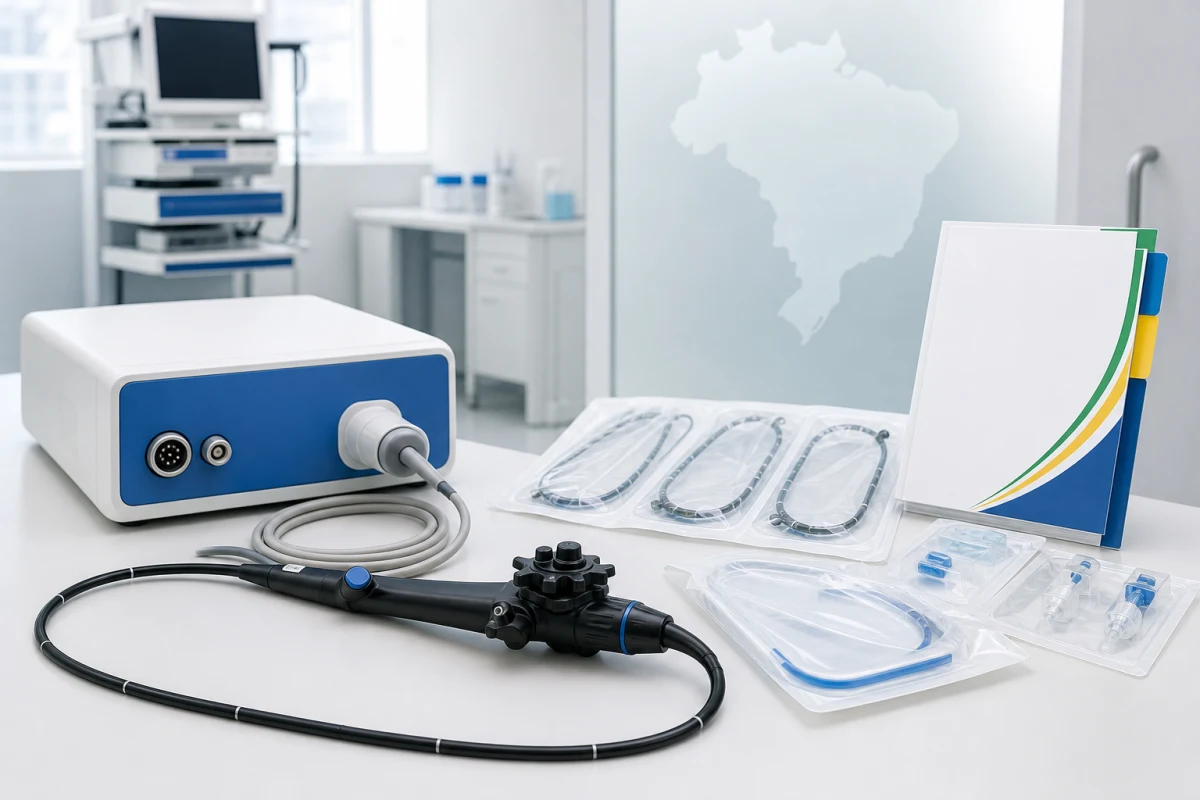
A single-use endoscopy platform is bought as one system and registered as several devices. Closing that gap was the whole project. The platform now stands in Brazil as six Class II notifications, all in force, all held by our Brazilian entity: the specialty scope lines, the imaging and processing unit they share, and one sterile procedural accessory.
The plan that arrived: one platform, one filing
The manufacturer makes sterile single-use digital scopes — upper urinary tract, bladder, uterine cavity, airway — plus the reusable unit that powers, drives and displays all of them, and a sterile accessory used in the urology procedures. Hospitals buy the system, not the scope, and the regulatory plan matched that commercial story: one Brazilian filing for the platform, perhaps a second for the accessory, one translated manual, one label family. Internally it was one product line with one intended-purpose sentence and one master technical file. We were asked how quickly it could publish. The first answer was that the object they wanted to file did not exist in Brazil.
RDC 751/2022 does allow grouped filings: ANVISA grants notification or registration for families, systems and kits as well as for single devices. But the sole paragraph of Article 3 sends the grouping rules out to separate regulations, and the definitions are far narrower than a catalog. A sistema is a set of compatible devices interacting exclusively to fulfil one intended purpose declared by the manufacturer; the health-materials grouping rule tightens that to components of exclusive use among themselves serving a single specific function. A processing unit running four scope lines across three specialties fails both readings — the components are not exclusive to each other, and there is no single intended purpose to name on the form.
Two grouping rulebooks, and neither starts from your catalog
Brazil does not run one grouping standard. Products regularized as equipment follow RDC 542/2021; health-use materials follow RDC 556/2021, with category-specific criteria in IN 101/2021. The criteria are not identical, and the materials rule bans notifying a family of kits or systems outright — a prohibition the equipment rule does not carry. A platform mixing durable equipment with sterile disposables has to answer that question object by object before anything else can be decided.
Endoscopy made it harder in a quiet way. IN 101/2021 publishes specific family criteria for catheters, syringes, infusion sets and a long list of other categories, but nothing for endoscopes; anything uncovered falls back to the general rules. With no category template to copy, we built the map from those criteria and the classification rules, one item at a time.
Where the family lines actually fell
The manufacturer's instinct was to group by engineering: same sensor, same illumination, same working-channel architecture, one family. Brazil does not group on technology alone. Under RDC 556/2021 a family requires the same manufacturer, principle of operation, mechanism of action, indication of use, contraindications, adverse effects, warnings, storage conditions and risk class, plus similar raw materials and manufacturing technology — and sterile products may not share a family with non-sterile ones, nor single-use products with reprocessable ones. RDC 542/2021 makes the same pairing on the equipment side: similar technology and similar indication and purpose as stated by the manufacturer.
Indication is what split the platform. A ureteroscope and a cystoscope can be near-identical instruments and still be two records, because they enter different anatomy for different clinical purposes and carry different warnings; the hysteroscope and the airway scope sit further apart again. What did group was scale: dimensional variation counts as commercial models within a family, so each scope line's lengths and diameters travel inside one record instead of multiplying it, and the classification and grouping rules reward drawing that boundary precisely. Grouping is not a discount either — ANVISA's equipment manual notes that a family notification is charged the same fee as a single-device notification. What it buys is fewer files to keep alive.
Four intended purposes instead of one
The master manual described the platform in a single line, for endoscopic visualization of the human body. That sentence had to go before anything could be classified, because in Brazil intended purpose is the input to the classification rules, not a marketing preamble. Rule 5 places non-surgically-invasive devices applied to body orifices in Class II for short-term use — but drops to Class I where use goes no further than the oral cavity, ear canal or nasal cavity, and returns to Class II when the device connects to an active device of Class II or above. Where a device is not intended exclusively or mainly for one part of the body, Article 8 classifies it on its most critical use. A catch-all sentence does not simplify that arithmetic; it forfeits control of it.
So we wrote intended purposes per record, against the anatomy each scope actually enters, with the target patient population, use environment and operator type ANVISA's dossier guidance expects. Two constraints made the care worthwhile. Every communication and advertisement must agree strictly with the information the holder submitted, so the sales language had to fit inside the records rather than the reverse. And there is no filing broadly and tightening later, or filing narrowly and quietly broadening: changing or adding an approved indication is a petition of its own, with evidence expected for the new indication.
Naming worked the same way. A record's technical name comes from ANVISA's coded table rather than the manufacturer's brand, and a family notification carries one commercial name with its models beneath it — a second reason four specialty brands were never going to share a record.
The accessory that could not hide inside a scope record
The accessory was expected to ride along inside the scope filing. Accessories are classified on their own account, separately from the device they are used with, and the only exemption from separate regularization covers accessories produced exclusively to integrate that same manufacturer's already-regularized devices and documented inside those dossiers. ANVISA's published questions and answers on RDC 751/2022 set out when an accessory needs its own record: when it is made by someone other than the manufacturer of the equipment it serves, when it is a non-active product that would be regulated by another ANVISA area, or when its risk class is higher than the equipment's. The equipment manual adds a firm line that anything adding a new function is not an accessory at all, because a new function changes the device's intended purpose.
The item is a sterile single-use device with its own clinical job, sold separately and used in a procedure rather than exclusively with one scope. Every test pointed the same way, and the accessory boundary is what turned five records into six.
One evidence base, six files that had to agree
A notification does not carry the technical file into ANVISA. The dossier stays with the holder, may be assembled by reference from the quality system, and can be called in at any time. Convenient, until you notice that each record still needs a complete file: device description with the accessories intended to integrate it, indication and purpose, precautions, label and manual models, the manufacturing flow with each site named, and safety and performance evidence against the applicable standards.
Most of that content genuinely is shared — electrical safety and electromagnetic compatibility for the processing unit, biocompatibility of common patient-contact materials, sterilization validation, imaging performance. Reuse was right; uncontrolled copying was not, because six copies drift the moment one changes. We held the shared evidence once, bound record-specific content only where it applied, and used the comparative model table that must accompany a family filing as the place where differences are stated deliberately rather than discovered later.
Compatibility had to be repeated on purpose. Instructions for use must describe a device well enough to identify what it may safely be combined with, and a part compatible with several pieces of equipment from the same manufacturer has to be declared in each compatible record. The scope-to-unit matrix appears in every file in the family, and every copy has to say the same thing.
Portuguese labeling, and a public shelf to keep tidy
Labels and instructions for use must be written in Portuguese, and translation was the smallest part of it. Each Brazilian label carries the legal manufacturer, the company name and address of the notification holder, the qualified technical responsible, sterility and single-use markings, and the ANVISA notification number — which does not exist until the record publishes, so artwork has to be built to receive it. Equipment carries an additional indelible plate with its ANVISA number. A family may run one collective manual covering all its models, provided it sets out their similarities and differences in a comparative table.
Then the file goes on a public shelf. Instructions for use are uploaded by the holder to ANVISA's documentary repository within thirty days of publication, appear immediately without documentary analysis, stay public only in their newest version, and are attested by the holder as consistent with the regularized product. Content that does not match is a sanctionable offence and can lead to suspension until corrected. Six manuals, one holder, one public shelf: any disagreement between them is visible to anyone who looks. We ran the family from a single Brazilian terminology base and one label template, so consistency was structural rather than a matter of proofreading, with the labeling and IFU rules as the specification.
Six notifications in force, and a change-control problem to run
Class I and II notifications do not expire and are exempt from revalidation. That is genuinely lighter, and it removes the one calendar event that forces a company to re-read its own file. Change control has to supply that discipline instead, six times over.
Alteration petitions for Class I and II devices run under the immediate-implementation regime: they take effect on filing, publish within thirty days, and pass through without documentary analysis. ANVISA may audit them at any time and may suspend marketing, importation or use where an inconsistency justifies the measure. Non-reportable changes never reach the agency and must be controlled inside the holder's quality system and folded into later petitions. One revision to the shared imaging chain touches every scope record, and a change correct in one record and missing from five is exactly what that regime discovers late rather than early.
Two family-scale duties sit on top. Class II devices must carry UDI from 10 January 2027, and UDI granularity is per model, not per record: one UDI-DI for each device model, transmitted to Brazil's national database by the holder and required to match the approved product information. The grouping work that compressed the catalog into six records does not compress UDI. And post-market surveillance and vigilance runs through the holder, which makes the holder question a lifecycle decision rather than a filing convenience; the reasoning behind ours is set out in our in-country representation model.
What we would tell another endoscopy platform
Decompose the catalog before committing to a calendar, against the grouping criteria rather than the product brochure. Expect indication of use, not technology, to draw the family lines, and the accessory boundary to add a record rather than remove one. Write the intended purposes at record level early: they set the class, bound the marketing and are expensive to widen later. Then build the files so shared parts are shared once and different parts differ on purpose, because for the rest of the product's life every change has to land in all of them.
A platform on the notification route and a single high-risk device going through full registration are different projects; our Class IV coronary balloon case covers the other end of the ANVISA spectrum. For the whole framework, start with the Brazil market page, or talk to our team about how your catalog would decompose.
 Case Study · Aug 11, 2026Basic UDI-DI Grouping for Contrast DevicesRegulatory Update · Oct 1, 2026WHO Medical Device Prequalification ExpansionBlog · Oct 14, 2026FDA Cleared vs Approved vs GrantedBlog · Oct 14, 2026FDA Medical Device Classification GuideBlog · Aug 31, 2026Technical File Compilation Cost: Build, Buy, or Hybrid?Blog · Aug 24, 2026Medical Device Registration Verification 2026Case Study · Aug 11, 2026One Balloon-Catheter Line, Two ANVISA RoutesRegulatory Update · Oct 17, 2026FDA Toxicology 510(k) ExemptionsRegulatory Update · Oct 17, 2026MHRA DORS Annual FeesRegulatory Update · Oct 17, 2026TFDA Clinical Trial E-Submissions
Bring your endoscopy platform to Brazil
From catalog decomposition and family mapping to Portuguese labeling and the Brazil Registration Holder role, we run the program this case study describes.

Catalog decomposition and family mapping under RDC 751/2022, 542/2021 and 556/2021
Record-level intended purpose, technical files and compatibility declarations
Brazilian Portuguese labeling, collective IFU and repository uploads
We act as your Brazil Registration Holder and run change control across the family
Frequently asked questions
Rarely. ANVISA does grant notification for families, systems and kits, but grouping follows separate rules — RDC 542/2021 for products regularized as equipment, RDC 556/2021 with IN 101/2021 for health-use materials — and the definitions are narrow. A system means components of exclusive use among themselves serving a single specific function, which a processing unit shared across several specialties does not satisfy. In this case the commercial platform resolved into six Class II notifications: the specialty scope families, the shared imaging and processing unit, and one procedural accessory.
The general grouping criteria, not the shared engineering. Products in one family must have the same manufacturer, principle of operation, mechanism of action, indication of use, contraindications, adverse effects, warnings, storage conditions and risk class, plus similar raw materials and manufacturing technology; sterile products cannot share a family with non-sterile ones, nor single-use products with reprocessable ones. Indication of use is usually the splitter: two scopes can be near-identical instruments and still need separate records. Dimensional variants are commercial models and do group inside one record.
Often yes. Accessories are classified on their own account, separately from the device they are used with, and the exemption from separate regularization is narrow: it covers accessories produced exclusively to integrate that same manufacturer’s already-regularized devices and documented inside those dossiers. ANVISA’s questions and answers on RDC 751/2022 require an own record where the accessory is made by another manufacturer, where a non-active product would be regulated by another ANVISA area, or where its risk class exceeds the equipment’s. Anything that adds a new function is not an accessory at all.
Class I and II notifications do not expire and are exempt from revalidation, so nothing on the calendar forces a review of the file. Alteration petitions for these classes run under the immediate-implementation regime: they take effect on filing and publish within thirty days without documentary analysis, and ANVISA may audit them at any time and suspend marketing, importation or use where an inconsistency justifies it. One change to a shared platform component therefore has to land in every affected record, with the instructions for use re-uploaded and UDI data kept correct per device model.
Single Process,
Multiple Markets
When you partner with Pure Global, a single registration process opens doors to multiple countries. Our global subsidiaries make this streamlined path possible.











Let's Talk,
Anywhere You Are.
Whether looking for more information or ready to partner with us, we're here to guide you through every step of the regulatory process.
Contact us