Device Classification and Clinical Evidence Across Four Markets in 2026
Assess device classification and clinical-data pathways across Japan, Vietnam, the US and EU, with dated registration and cost evidence.
TL;DR
A domestic risk class or an existing approval is an input to the next market's assessment, rather than a portable authorization. The consequential questions are the intended purpose, applicable rule, evidence gap, local applicant and administrative route.
Japan's published FY2017–FY2025 improved-device lists contain 2,051 records without attached clinical study results and 442 with clinical data. Those are approved-list records, including new approvals and partial changes, not a probability that a proposed device can avoid a trial 1.
The retained Vietnam classification extract contains 179,902 outcomes, with 10.28% labeled revoked. Its status field records no reason or requester, so a specific under-classification allegation requires the actual decision and supporting record. US product-code exemptions likewise require their conditions checked; EU MDR classification depends on intended purpose and applicable Annex VIII rules 2 3 4 5.
For current EU operations, distinguish mandatory module use from the backlog deadlines: May 28, 2026; November 28, 2026 for the relevant earlier-placed devices; and May 28, 2027 for pre-existing certificates. Keep government fees, representation and evidence-preparation costs in separate budget lines 6 7 8.
Japan PMDA Non-Clinical Premarket Pathways: When an Improved Device Qualifies for Approval Without Clinical Data
Japan's review category, risk class and approval type answer different questions. A foreign clearance can help identify relevant evidence, while the proposed intended purpose and technological differences determine which questions the Japanese assessment must resolve. PMDA publishes improved-device approvals both with and without attached clinical study results; the comparison below keeps both categories visible 1 9 10.
Statutory architecture and the scope of clinical-data criteria
Japan's PMD Act distinguishes three statutory control categories across four risk classes: General Medical Devices correspond to Class I; Controlled Medical Devices to Class II; and Specially Controlled Medical Devices encompass Classes III and IV. Class IV is the higher risk tier within that last category. Market-entry assessment requires the device's designation, applicable certification standards and approval category, rather than risk class alone 11:
- Marketing Notification (Todokede, Class I): General medical devices do not undergo technical review. A licensed Marketing Authorization Holder (MAH) submits the notification under Articles 23-2-12–13. Article 23-2-17 foreign-special approval and its DMAH mechanism are a separate route 11.
- Registered Certification Body Third-Party Certification (Ninsho, PMD Act Article 23-2-23): Certification can cover designated Class II and eligible designated Class III devices meeting the applicable ministerial certification standards. Private Registered Certification Bodies (RCBs) assess eligible devices; an existing JIS alone establishes no certification eligibility. If a device deviates from the scope or technical parameters of an applicable certification standard, it is disqualified from third-party Ninsho and must be submitted to PMDA for Minister's Marketing Approval (Shonin) under PMD Act Article 23-2-5 11.
- PMDA Minister's Approval (Shonin, PMD Act Article 23-2-5): Devices subject to direct regulatory review by PMDA are divided into four premarket review categories, with categories explained by PMDA and the clinical-data scope notice 9 10:
- Track A — New Medical Devices (Shin Iryokiki): Devices featuring a distinctly novel structure, principle of operation, indication, or clinical performance without precedent in Japan. These submissions typically require prospective clinical investigation data, with the relevance of overseas evidence assessed for the device and population 9 10.
- Track B — Improved Medical Devices With Clinical Data (Kaizen Iryokiki [Rinsho Ari]): Devices that modify an existing device's clinical performance, intended use, or anatomical site in a manner that cannot be fully substantiated through bench testing or animal models alone, necessitating human clinical evaluation 9 10.
- Track C — Improved Medical Devices Without Clinical Data (Kaizen Iryokiki [Rinsho Nashi]): Devices that differ from established predicates in technical design, materials, geometry, software algorithms, or workflow, but whose clinical safety and performance differences can be comprehensively verified using non-clinical testing (such as mechanical fatigue, ISO 10993 biocompatibility, IEC 60601/62304 electrical and software safety, preclinical animal performance, or analytical concordance) within the applicable review category and general clinical-data scope criteria 10 9.
- Track D — Generic Medical Devices (Kohatsu Iryokiki): Direct equivalent devices (Jisshitsu-teki ni Doto) that match an already-approved Japanese predicate in intended use, structural design, materials, and specifications, assessed against the applicable equivalence criteria 1 9.
Notification 1117-1 of November 17, 2017 addresses specified pre-/post-market approaches to avoiding new clinical trials and references the August 4, 2008 clinical-data scope notice 0804001. Read it within that scope alongside PMDA’s review-category explanation and general clinical-data criteria. It is distinct from the existence of the improved-without-clinical-data review category 9 10 12.
The approved-list denominator, with clinical and non-clinical categories kept visible
The retained nine-year workbooks list 2,051 improved-device records without clinical data and 6,777 generic-device records. Within the former, 1,383 are new approvals and 668 partial changes. The generic category contains 2,428 new approvals and 4,349 partial changes. The distinction is useful: counting every partial change as a new market entry would substantially alter the question being answered 1.
For comparison, the official improved-with-clinical lists were retrieved and counted separately. Their nine-year total is 442 listed items: 308 new approvals and 134 partial changes. The table shows the annual counts for both improved categories. 1.
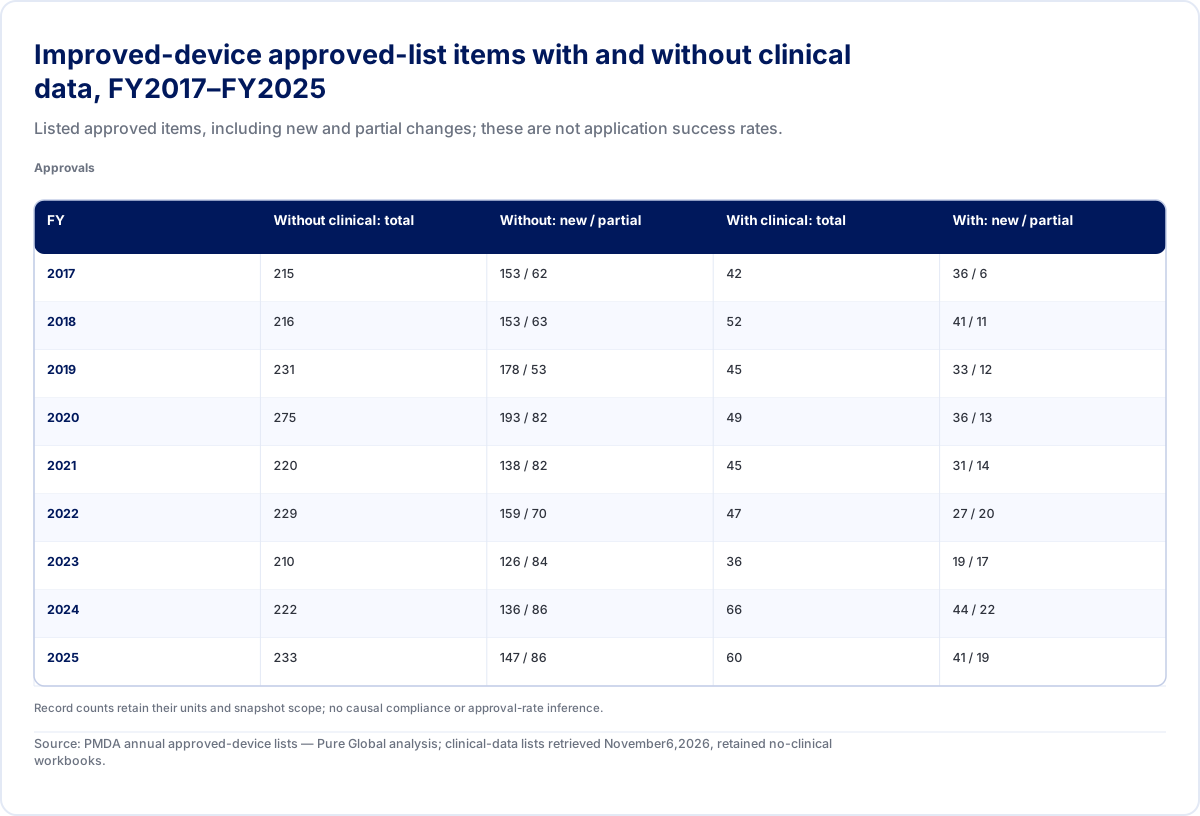
| FY | Without clinical: total | Without: new / partial | With clinical: total | With: new / partial |
|---|---|---|---|---|
| 2017 | 215 | 153 / 62 | 42 | 36 / 6 |
| 2018 | 216 | 153 / 63 | 52 | 41 / 11 |
| 2019 | 231 | 178 / 53 | 45 | 33 / 12 |
| 2020 | 275 | 193 / 82 | 49 | 36 / 13 |
| 2021 | 220 | 138 / 82 | 45 | 31 / 14 |
| 2022 | 229 | 159 / 70 | 47 | 27 / 20 |
| 2023 | 210 | 126 / 84 | 36 | 19 / 17 |
| 2024 | 222 | 136 / 86 | 66 | 44 / 22 |
| 2025 | 233 | 147 / 86 | 60 | 41 / 19 |
Record counts retain their units and snapshot scope; no causal compliance or approval-rate inference.
Source: PMDA annual approved-device lists — Pure Global analysis; clinical-data lists retrieved November6,2026, retained no-clinical workbooks.
These lists describe approved items under their published categories. They exclude the denominator of rejected, withdrawn or otherwise unapproved applications, and may include multiple trade names approved together. A ratio between the categories therefore measures listed approval activity. An applicant with different technology, intended use or unresolved performance questions needs a device-specific evidence assessment.
A new product approval in this table is also distinct from the category “New Medical Device.” The former is an approval type within a review category; the latter is a Japanese review category. That distinction helps a regulatory team avoid reading the substantial share of new improved-device approvals as proof that an entirely novel clinical claim requires no clinical evidence 1 9 10.
The nine-year comparison records 83 fiscal-year/approval-number overlap observations between generic and improved-without-clinical lists. A number can recur across years, so 83 is not a count of distinct licenses. In FY2025, the 449 new-approval rows across those two lists have no duplicated approval number. These observations concern the retained lists and their approval types. The reasons for each shared license number would require reading the corresponding changes rather than assigning a causal explanation from the overlap alone 1.
For a proposed Japanese application, the useful next step is to identify the intended difference from the relevant approved device and the evidence that resolves that difference. Mechanical performance, material safety, software behavior and clinical performance are different questions. A favorable result in one domain leaves the remaining relevant questions to be assessed under the applicable framework. The published lists help locate precedents; the notification and review guidance define the evidentiary assessment 9 10.
What the FY2025 category list adds
The retained improved-without-clinical workbook contains 233 FY2025 approvals, split into 147 new and 86 partial changes. Its named generic-device categories show the range of technical changes reviewed within that category. The chart reports those listed category counts 1.
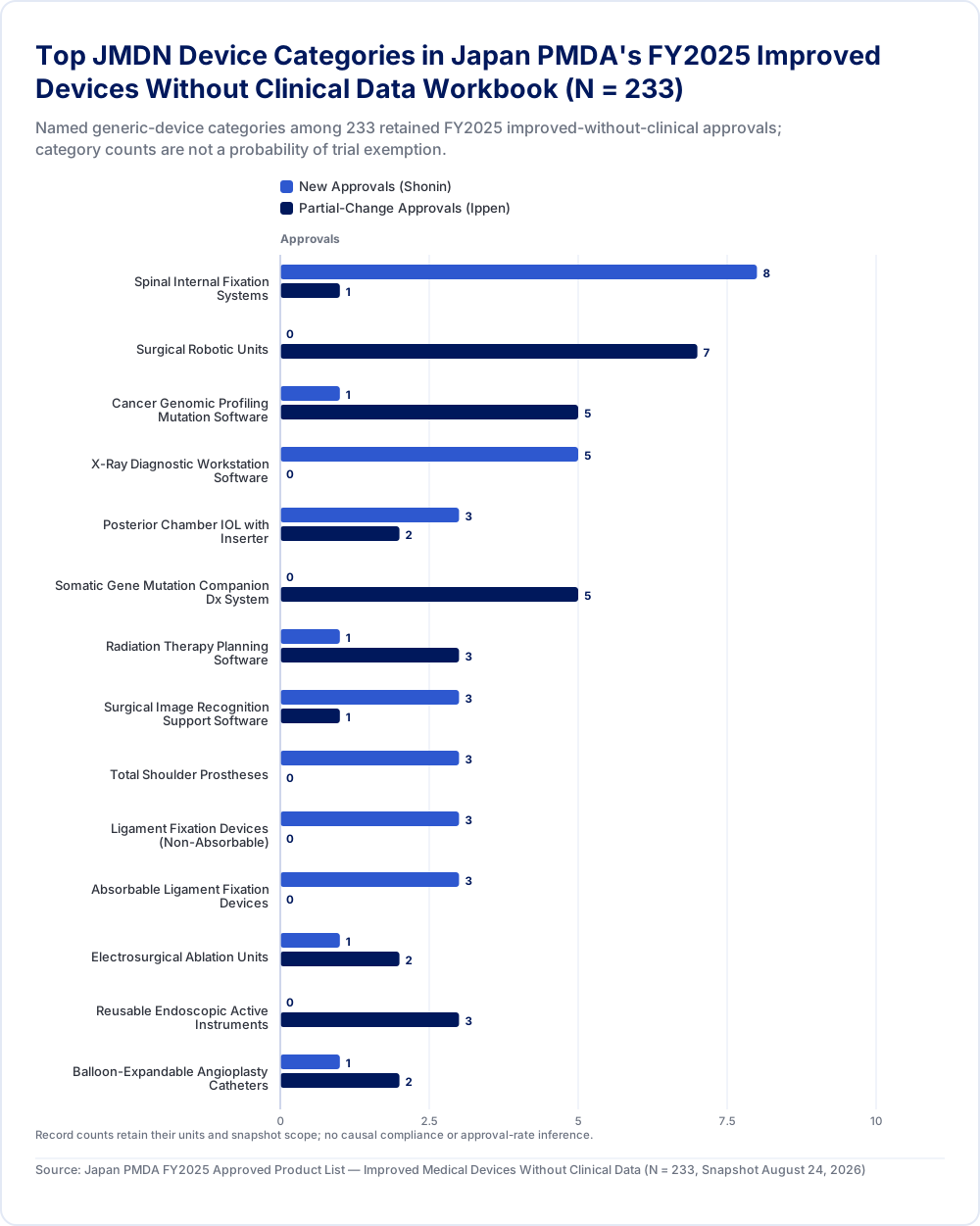
| New Approvals (Shonin) | Partial-Change Approvals (Ippen) | |
|---|---|---|
| Spinal Internal Fixation Systems | 8 | 1 |
| Surgical Robotic Units | 0 | 7 |
| Cancer Genomic Profiling Mutation Software | 1 | 5 |
| X-Ray Diagnostic Workstation Software | 5 | 0 |
| Posterior Chamber IOL with Inserter | 3 | 2 |
| Somatic Gene Mutation Companion Dx System | 0 | 5 |
| Radiation Therapy Planning Software | 1 | 3 |
| Surgical Image Recognition Support Software | 3 | 1 |
| Total Shoulder Prostheses | 3 | 0 |
| Ligament Fixation Devices (Non-Absorbable) | 3 | 0 |
| Absorbable Ligament Fixation Devices | 3 | 0 |
| Electrosurgical Ablation Units | 1 | 2 |
| Reusable Endoscopic Active Instruments | 0 | 3 |
| Balloon-Expandable Angioplasty Catheters | 1 | 2 |
Record counts retain their units and snapshot scope; no causal compliance or approval-rate inference.
Source: Japan PMDA FY2025 Approved Product List — Improved Medical Devices Without Clinical Data (N = 233, Snapshot August 24, 2026)
The separate remanufactured single-use-device evidence needs an equally bounded description. Sixteen entries appear in the four retained workbooks, with three FY2025 partial changes. The official index covers FY2019–FY2026 and explicitly lists FY2024/FY2026 as having no approved items. The statement about those sixteen retained entries does not establish every remanufactured approval across all published years. Review periods in an individual list are observations for those entries, distinct from a guaranteed clock for a future application 1.
A device team can use the list's generic name, approval type, company and year to locate a relevant precedent. It should then compare intended use and changes in the actual evidence package. The absence of a matching generic name in this selected list can also reflect the limits of the selected review category; the ministerial-approval lists are separate from the notification and certification routes 10 11.
Vietnam IMDA Classification Audits: Regulatory Mechanics and Cohort Evidence
In Vietnam, risk classification under ASEAN Medical Device Directive (AMDD) criteria constitutes one determinant of the applicable declaration or registration route 2 13 14 15.
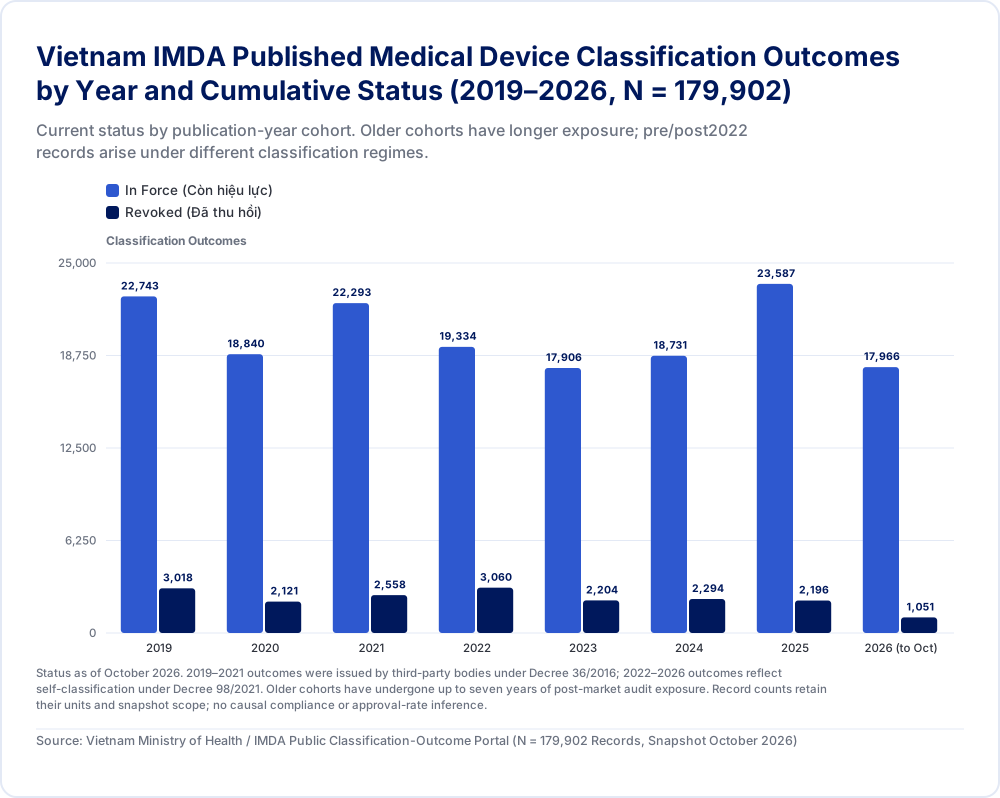
| In Force (Còn hiệu lực) | Revoked (Đã thu hồi) | |
|---|---|---|
| 2019 | 22,743 | 3,018 |
| 2020 | 18,840 | 2,121 |
| 2021 | 22,293 | 2,558 |
| 2022 | 19,334 | 3,060 |
| 2023 | 17,906 | 2,204 |
| 2024 | 18,731 | 2,294 |
| 2025 | 23,587 | 2,196 |
| 2026 (to Oct) | 17,966 | 1,051 |
Status as of October 2026. 2019–2021 outcomes were issued by third-party bodies under Decree 36/2016; 2022–2026 outcomes reflect self-classification under Decree 98/2021. Older cohorts have undergone up to seven years of post-market audit exposure. Record counts retain their units and snapshot scope; no causal compliance or approval-rate inference.
Source: Vietnam Ministry of Health / IMDA Public Classification-Outcome Portal (N = 179,902 Records, Snapshot October 2026)
Statutory Framework Under Decree 98/2021/ND-CP and Circular 05/2022/TT-BYT
Vietnam's medical device regulatory system is anchored by Decree No. 98/2021/ND-CP (effective 1 January 2022) 13, as amended by Decree No. 07/2023/ND-CP (effective 3 March 2023) 14, Decree No. 96/2023/ND-CP, and Decree No. 04/2025/ND-CP (effective 1 January 2025, consolidated as 08/VBHN-BYT on 6 March 2026) 15. Technical classification rules are promulgated under Circular No. 05/2022/TT-BYT 16, amended by Circular No. 24/2026/TT-BYT (issued 30 June 2026, effective 1 July 2026, consolidated as 12/2026/VBHN-TT-BYT on 10 July 2026) 17. Circular 24/2026/TT-BYT updated the inspection roadmap in Article 8, while leaving the classification rules in Appendix I completely unchanged as of 1 July 2026 16 17.
The operational mechanics of this framework establish distinct pathways by risk tier 13 14 15 16:
- Classification and Registrant Responsibilities: Under Decree 98/2021/ND-CP Article 5(6), medical devices must be classified into Class A (low risk), Class B (low-moderate risk), Class C (moderate-high risk), or Class D (high risk) by the declaring or registering establishment itself. Under Article 25(1), the entity eligible to act as the Marketing Authorization Holder (CSDKLH) includes Vietnamese enterprises, cooperatives and household businesses owning the device; those Vietnamese establishments authorised by the owner; and the qualifying resident representative office of a foreign trader that owns or is authorised by the owner. Apply Article 25’s ownership/authorisation and warranty arrangements to the actual applicant 13.
- Class A and B declarations (PCBA/PCBB): The local declaring establishment submits the applicable dossier to the provincial authority through the relevant process. Product declarations and establishment trading-eligibility declarations are different procedures and units. Plan the actual dossier, responsible establishment and publication requirements under the current decree 13.
- Class C/D registration: Assess the actual route and dossier. Article 29(2)(a) sets the relevant reference eligibility using a CFS or marketing authorisation from the stated authorities; Article 30 addresses the dossier. Verify the exact product, document issuer and conditions rather than infer eligibility from a brand or generic foreign clearance 13.
- Revocation ground and device disposition: Article 6(1) distinguishes incorrect classification that lowers the risk tier from a forged classification result. The Ministry issues the revocation and removes the result from the portal; dependent circulation numbers are reviewed for revocation. Article 7 then distinguishes pending applications, uncleared imports, cleared-but-unsold units and units already sold to healthcare facilities. Applicable actions include stopping the application or customs process, stopping circulation and recalling unsold units. For units already sold, the holder must report quantities to the issuing authority and notify the facilities in writing. Article 7(4)(b) permits continued facility use specifically for incorrectly risk-classified devices without potential harm to patient health, with the holder required to complete the facility circulation dossier after obtaining a new circulation number. Under 7(4)(c), potentially harmful misclassified devices must cease use and the holder must remedy the consequences for facility operations. An unknown revocation ground or a forged result establishes no automatic continued-use exception 13.
Empirical Audit of 179,902 Published Classification Outcomes (2019–2026)
The retained public classification-outcome extract on the IMDA portal (vimda.moh.gov.vn, October 2026 snapshot) encompasses 179,902 published records. Normalizing Vietnamese classification strings yields the following baseline distribution 2:
- Class B: 78,198 outcomes (43.47%)
- Class A: 50,468 outcomes (28.05%)
- Class C: 36,647 outcomes (20.37%)
- Class D: 14,571 outcomes (8.10%)
- Unmapped or multi-component entries: 18 outcomes (0.01%)
Class A and Class B outcomes represent 71.52% of all published classifications (128,666 records) 2.
Across the entire database, 161,400 outcomes (89.72%) are listed as In Force (Còn hiệu lực), while 18,502 outcomes (10.28%) are listed as Revoked (Đã thu hồi) 2. Direct PDF links to administrative decisions are attached to 17,105 of the revoked records (92.45%) 2. Crucially, examining revocation rates across risk tiers reveals near-uniform distribution across all four classes 2:
- Class B: 8,781 revocations out of 78,198 outcomes (11.23%)
- Class D: 1,613 revocations out of 14,571 outcomes (11.07%)
- Class A: 4,814 revocations out of 50,468 outcomes (9.54%)
- Class C: 3,282 revocations out of 36,647 outcomes (8.96%)
- Unmapped / Multi-class: 12 revocations out of 18 outcomes (66.67%)
Together, Class A and Class B account for 73.48% of all revocations (13,595 of 18,502), a proportion that directly mirrors their 71.52% share of total filings 2.
Records published between 2019 and 2021 (71,573 outcomes, or 39.78% of the registry) were classified by third-party certification bodies under the previous Decree No. 36/2016/ND-CP framework 2. From 2022 onward, classifications were performed by declarants and registrants themselves under Decree 98/2021/ND-CP 13. Older cohorts have had more time for their status to change. The following are cumulative shares by publication year at the snapshot, not revocations occurring in that year: 2019 outcomes show 3,018 revocations out of 25,761 (11.72%); 2020 outcomes show 2,121 of 20,961 (10.12%); 2021 outcomes show 2,558 of 24,851 (10.29%); and 2022 outcomes show 3,060 of 22,394 (13.66%) 2. In contrast, more recent cohorts exhibit lower cumulative revocation rates: 2023 at 10.96% (2,204 of 20,110), 2024 at 10.91% (2,294 of 21,025), 2025 at 8.52% (2,196 of 25,783), and 2026 through October at 5.53% (1,051 of 19,017) 2.
The status field identifies neither a revocation ground nor the requester. It therefore supports a status description, without ranking named organizations as disciplined or high-risk intermediaries. The 2019–2021 records also arose under the earlier third-party classification regime, while the current framework places classification with the declarant or registrant. Both regime and exposure time matter before comparing organizations or years 2 13.
Keyword cohorts are exploratory slices, not verified classification decisions
The original analysis used five case-insensitive keyword patterns against device names. They return 375 wound-related query matches, 381 orthopedic matches, 164 cardiovascular matches, 12,592 IVD-related matches and 1,766 imaging matches. The labels are shorthand for search expressions; the queries can overlap. Adding them does not produce a distinct device population 2.
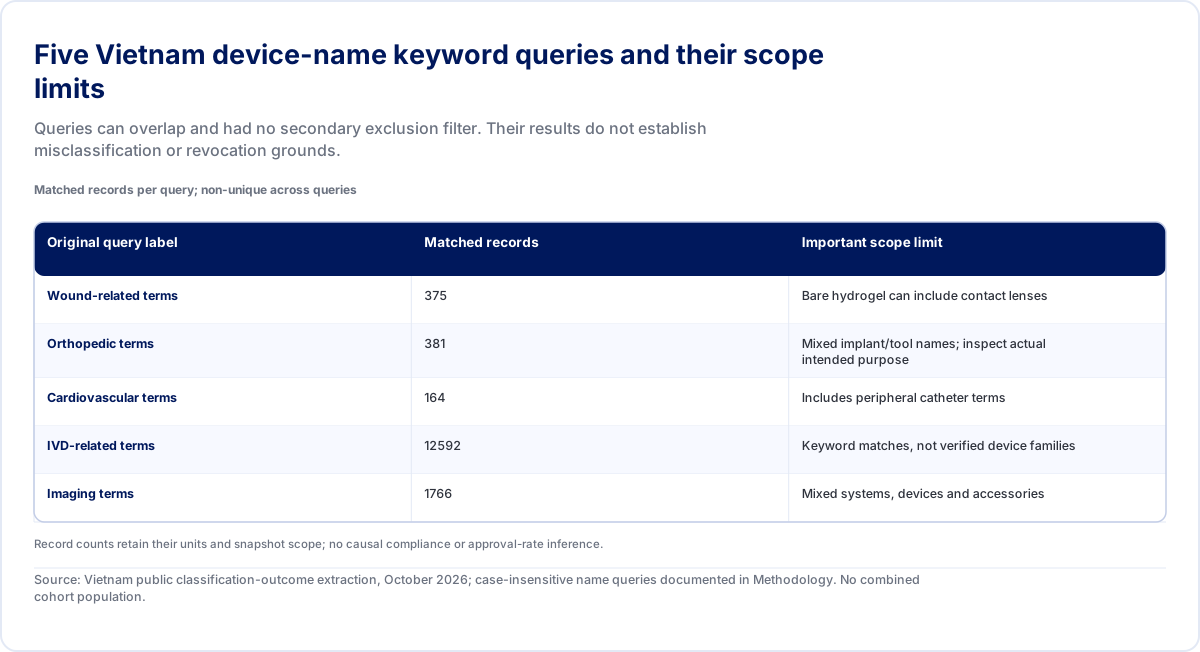
| Original query label | Matched records | Important scope limit |
|---|---|---|
| Wound-related terms | 375 | Bare hydrogel can include contact lenses |
| Orthopedic terms | 381 | Mixed implant/tool names; inspect actual intended purpose |
| Cardiovascular terms | 164 | Includes peripheral catheter terms |
| IVD-related terms | 12592 | Keyword matches, not verified device families |
| Imaging terms | 1766 | Mixed systems, devices and accessories |
Record counts retain their units and snapshot scope; no causal compliance or approval-rate inference.
Source: Vietnam public classification-outcome extraction, October 2026; case-insensitive name queries documented in Methodology. No combined cohort population.
The wound expression includes the bare word “hydrogel,” so it can capture silicone-hydrogel contact lenses. The cardiovascular expression includes peripheral vascular catheter terms. No secondary manual exclusion was performed in the retained analysis. The visual keeps the broad query definitions and limits visible.
Within the wound-keyword results, 143 records are Class A, 111 B, 70 C and 51 D. Forty-two have revoked status. Those figures describe the query output. The individual record and governing decision are needed to assess classification correctness, revocation grounds and the applicable rule. The current classification file, intended purpose and any linked administrative decision are the next evidence to examine 2 16.
The useful operational lesson is a verification task: search terms locate possible precedents, then a reviewer checks the actual product and governing rule. The cohort is a navigation aid. A boundary that appears in a group percentage must be verified against individual intended purposes before it informs a registration strategy.
US FDA Product Classification vs. EU MDR Annex VIII Up-Classification and Mandatory EUDAMED Deadlines
The following comparison covers EU MDR devices. IVD classification and performance evaluation require a separate IVDR assessment 18. For the US device assessment, verify the product code and its exemption conditions. For the EU assessment, apply the MDR classification rules to invasiveness, intended purpose and mechanism of action 19 20 4 5.
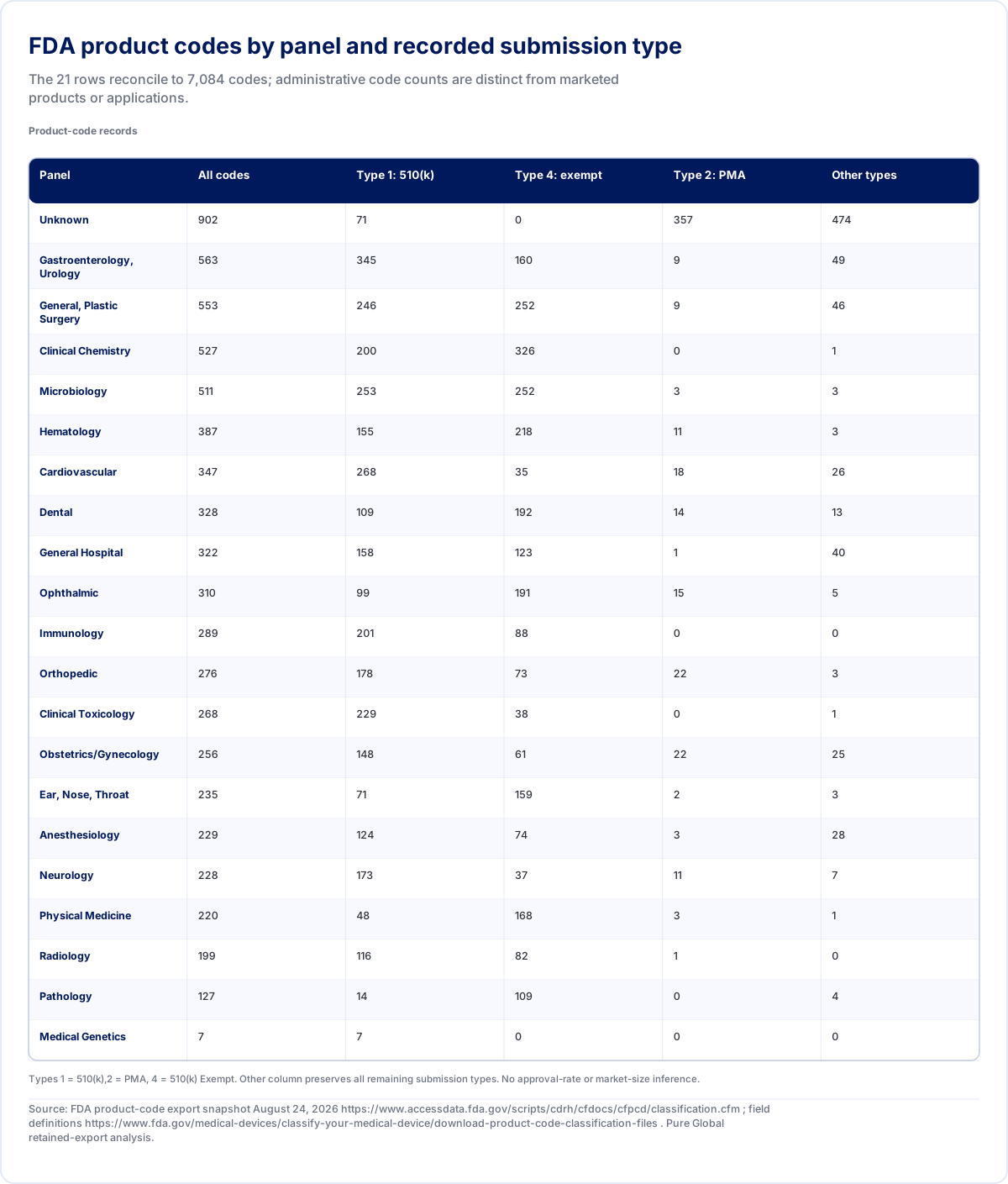
| Panel | All codes | Type 1: 510(k) | Type 4: exempt | Type 2: PMA | Other types |
|---|---|---|---|---|---|
| Unknown | 902 | 71 | 0 | 357 | 474 |
| Gastroenterology, Urology | 563 | 345 | 160 | 9 | 49 |
| General, Plastic Surgery | 553 | 246 | 252 | 9 | 46 |
| Clinical Chemistry | 527 | 200 | 326 | 0 | 1 |
| Microbiology | 511 | 253 | 252 | 3 | 3 |
| Hematology | 387 | 155 | 218 | 11 | 3 |
| Cardiovascular | 347 | 268 | 35 | 18 | 26 |
| Dental | 328 | 109 | 192 | 14 | 13 |
| General Hospital | 322 | 158 | 123 | 1 | 40 |
| Ophthalmic | 310 | 99 | 191 | 15 | 5 |
| Immunology | 289 | 201 | 88 | 0 | 0 |
| Orthopedic | 276 | 178 | 73 | 22 | 3 |
| Clinical Toxicology | 268 | 229 | 38 | 0 | 1 |
| Obstetrics/Gynecology | 256 | 148 | 61 | 22 | 25 |
| Ear, Nose, Throat | 235 | 71 | 159 | 2 | 3 |
| Anesthesiology | 229 | 124 | 74 | 3 | 28 |
| Neurology | 228 | 173 | 37 | 11 | 7 |
| Physical Medicine | 220 | 48 | 168 | 3 | 1 |
| Radiology | 199 | 116 | 82 | 1 | 0 |
| Pathology | 127 | 14 | 109 | 0 | 4 |
| Medical Genetics | 7 | 7 | 0 | 0 | 0 |
Types 1 = 510(k),2 = PMA, 4 = 510(k) Exempt. Other column preserves all remaining submission types. No approval-rate or market-size inference.
Source: FDA product-code export snapshot August 24, 2026 https://www.accessdata.fda.gov/scripts/cdrh/cfdocs/cfpcd/classification.cfm ; field definitions https://www.fda.gov/medical-devices/classify-your-medical-device/download-product-code-classification-files . Pure Global retained-export analysis.
US FDA Premarket Classification Architecture Across 20 Specialty Panels
An audit of the 7,084 retained medical-device product codes in the FDA database demonstrates that 2,638 codes (37.24%) are exempt from premarket notification under FD&C Act Sections 510(l) and 510(m) (Submission Type 4) 19 3. An additional 306 codes (4.32%) have Submission Type 7, which FDA defines as Enforcement Discretion; that field alone does not identify every record as a convenience kit 19 21.
Cross-tabulating statutory class and submission type illustrates this distribution 19:
- Class I Product Codes (2,401 codes, 33.89% of catalog): 2,154 codes (89.71% of Class I) are 510(k)-exempt; 155 codes (6.46%) are reserved Class I codes requiring a 510(k); 91 codes (3.79%) have Enforcement Discretion; and 1 has Contact ODE, calling for clarification with FDA rather than naming a review pathway 19.
- Class II Product Codes (3,632 codes, 51.27% of catalog): 2,992 codes (82.38% of Class II) require a 510(k); 484 codes (13.33%) are 510(k)-exempt; 155 codes (4.27%) have Enforcement Discretion; and 1 has Contact ODE 19.
- Class III (531 codes, 7.50%), Unclassified (86 codes, 1.21%), Not Classified (383 codes, 5.41%), and Humanitarian Device Exemptions (51 codes, 0.72%): Among Class III codes, 500 (94.16%) require a Premarket Approval (PMA, Submission Type 2) 19. Crucially, 66 of the 86 unclassified codes (76.74%) require a 510(k), including major commercial wound care codes such as FRO (Dressing, Wound, Drug), KGN (Wound Dressing With Animal-Derived Material), and QSY (Hemostatic Wound Dressing) 19 20.
Premarket notification exemption rates vary widely across CDRH's 20 named specialty panels (which encompass 6,182 codes, alongside 902 product codes unassigned to a named panel) 19. Exemption shares reach 85.83% in Pathology (109 of 127 codes), 76.36% in Physical Medicine (168 of 220), 67.66% in Ear, Nose, and Throat (159 of 235), 61.86% in Clinical Chemistry (326 of 527), 61.61% in Ophthalmic (191 of 310), 58.54% in Dental (192 of 328), 56.33% in Hematology (218 of 387), 49.32% in Microbiology (252 of 511), and 45.57% in General & Plastic Surgery (252 of 553) 19. In contrast, exemption rates drop to 28.42% in Gastroenterology & Urology (160 of 563), 26.45% in Orthopedic (73 of 276), 23.83% in Obstetrics/Gynecology (61 of 256), 16.23% in Neurology (37 of 228), 14.18% in Clinical Toxicology (38 of 268), and 10.09% in Cardiovascular (35 of 347) 19.
A conditional intended-purpose crosswalk
MDCG 2021-24 Rev.1 warns that dressing classification cannot be determined a priori from the material or type alone. The following are illustrative rule patterns, not binding classifications assigned to every device sharing a US product code. Obtain the exact intended purpose, composition and action before applying the rule 5.
| Proposed intended-purpose pattern | US question | EU question | Evidence needed before deciding |
|---|---|---|---|
| Dressing used as a mechanical barrier or to absorb exudate | Verify the exact product code and exemption conditions under Part 878. | Apply Rule 4's relevant intended-purpose branch; sterile supply has its own notified-body scope. | Intended use, wound type, performance and sterile status. |
| Dressing managing the wound microenvironment | A US exemption, where applicable, still has its stated limits. | Rule 4 can lead to Class IIa; the secondary-intention dermis-breach branch leads to IIb. | Labeled wound purpose and claimed action. |
| Product incorporating a potentially medicinal ancillary substance | Verify classification and jurisdiction for the actual product. | Determine whether the substance meets Rule 14's medicinal-substance conditions. | Composition, principal/ancillary action and relevant characterization. |
| Device made using nonviable animal tissues/derivatives | Read the US classification and evidence requirements for that device. | Assess Rule 18, including its stated scope and exceptions. | Tissue origin, contact and use conditions; any other applicable instrument. |
| Active suction pump | Verify the pump's US classification, independently of dressing codes. | Consider Rule 12 and whether the potentially hazardous conditions alter the class. | Intended application, energy and risk context. |
The table's analysis derives from MDR Annex VIII and MDCG's explanations. It deliberately leaves substance, absorption and anatomical questions open where the product evidence is missing. A gel, a hemostatic sponge and a suction pump should not be assigned a definitive EU class merely from their names 20 4 5.
Vietnam needs its own Appendix I assessment under Circular 05/2022 as amended, rather than a substitution of the EU class letter or number. Its result then informs the current declaration/registration route and local applicant requirements. Teams preparing a submission can consult Pure Global's Vietnam regulatory glossary as an explanatory aid alongside the primary legal text 16 17.
Key Structural Divergences Between US 510(k) Clearances and EU MDR Conformity Assessment
Translating US regulatory documentation into compliant EU MDR technical documentation reveals three recurring structural traps 20 4 5 22:
- Rule 4 and rule precedence: The intended function determines the relevant wound-dressing branch, subject to the strictest applicable rule. The microenvironment branch is IIa; IIb applies where the device is principally intended for wounds breaching the dermis that can only heal by secondary intention. Assess the precise claim and other applicable rules before assigning a class. US exemption status still needs its own limitations assessment 20 4 5.
- Substances and tissue origin: Rule 14 depends on incorporation of a substance that would be a medicinal product if used separately and whose action is ancillary. Rule 18 depends on the animal/human tissue/cell or derivative origin, non-viability and the stated intact-skin exception for the animal-origin branch. A material name such as collagen or ECM alone leaves those inputs unresolved. Regulation 722/2012 Article 1 covers the specified non-viable tissues/derivatives from bovine, ovine, caprine, deer, elk, mink and cats; its exclusions include no human-body contact or intact-skin-only contact and specified processed tallow derivatives. Assess that separate TSE scope 4 5 23.
- Equivalence and investigation exemptions: Technical, biological and clinical equivalence is distinct from exemption from mandatory investigation. Article 61(4)–(6) addresses implantable and Class III devices. Under 61(4), modification of the same manufacturer's marketed device requires demonstrated Annex XIV equivalence endorsed by the notified body, sufficient clinical evaluation of the marketed device, and an appropriate PMCF plan including post-market studies. Under 61(5), reliance on another manufacturer's device additionally requires the specified contract giving full ongoing technical-documentation access, an MDR-compliant comparator clinical evaluation, and clear evidence to the notified body. Applicable 61(4) requirements, including equivalence endorsement, sufficient clinical data and PMCF studies, still apply; a contract alone establishes no exemption. Paragraph 61(6) provides independent cases for eligible Directive-marketed devices and the listed technologies, subject to sufficient clinical data and applicable common specifications; do not import 61(5)'s contract requirement into those cases. For other devices, investigation needs depend on clinical-evaluation objectives and whether existing evidence meets them. Establish sufficient access under Annex XIV for any equivalence claim. MDCG 2023-7 explains these separate assessments 4 22 24.
Mandatory EUDAMED dates and certificate uploads
Compounding Annex VIII classification changes, the European Union's transition to mandatory EUDAMED registration took legal effect under Regulation (EU) 2024/1860 (adopted 13 June 2024) 6 and Commission Decision (EU) 2025/2371 (published in the Official Journal of the European Union on 27 November 2025) 7 8.
| EUDAMED / EU MDR Regulatory Obligation | Legal Basis (Regulation (EU) 2024/1860 & Decision 2025/2371) | Effective Date | Compliance Deadline | Operational Scope and Requirements |
|---|---|---|---|---|
| 1. Mandatory Use of First Four EUDAMED Modules | MDR Art. 34(3) & Art. 123(3)(d); Decision (EU) 2025/2371 | 28 May 2026 | Active Now (Since 28 May 2026) | Actor registration applies to the relevant economic operators; manufacturers/SPP producers register eligible Regulation devices/SPPs before first placement under a UDI-DI on/after May 28, 2026. Custom-made, investigational and performance-study devices are excluded from UDI/DEV. NBs use NB/CRF; competent authorities manage market surveillance. Vigilance/CI modules have separate implementation. 6 7 8 |
| 2. Device Registration Window for Earlier-Placed Devices with Continuing Placements | MDR Art. 123(3)(e); Commission Roll-Out Q&A (eudamed-qa_en.pdf) | 28 May 2026 | 28 November 2026 (12 months from OJEU notice) | Earlier-placed eligible Regulation/legacy devices or SPPs with continuing placements: register by November 28, 2026. Legacy same-device exception uses Q8 identity/shared-characteristics test; a change needing a new UDI-DI defeats that identity. Discontinued placements retain the later Q14 trigger when a reportable PMSV action must use the vigilance module, including legacy-specific actions. 6 8 |
| 3. Notified Body Certificate Upload Backlog | MDR Art. 123(3)(ea); Commission Roll-Out Q&A (eudamed-qa_en.pdf) | 28 May 2026 | 28 May 2027 (18 months from OJEU notice) | NBs register relevant earlier MDR/IVDR certificate information by May 28, 2027 only for Regulation devices registered or requiring registration in UDI/DEV; latest certificate version and applicable latest decision. New certificates/updates after mandatory use follow the current module duties. 6 8 |
Interpreting the 3,937 certificates recorded in EUDAMED as of 25 July 2026 requires understanding that this module operated voluntarily until 28 May 2026, and notified bodies have until 28 May 2027 to finish uploading pre-existing certificates 6 7 25. By comparison, Team-NB's 2025 survey reports that its 41 member notified bodies had issued 13,953 MDR certificates by the end of 2025 26. The 3,937 certificates in EUDAMED are a public-module snapshot with incomplete backfilling rather than the total universe of active European certifications 25 26.
Commercial Budgeting and Review Timelines Across Four Jurisdictions
Budgeting for global regulatory market access requires disaggregating costs into three distinct layers: (1) statutory government evaluation fees and user charges, (2) annual in-country legal representation, and (3) one-time technical dossier preparation and clinical evaluation writing 10 27 28 Commercial Services and Regulatory Pricing Schedule 2026–2027 International Medical Device & IVD Regulatory Platform and In-Country Representation.
Keep statutory and commercial budget lines separate
For FDA FY2027, effective October 1, 2026 through September 30, 2027, the published standard 510(k) fee is $28,653 and the small-business fee is $7,163. The annual establishment registration fee is $13,785. FDA may grant a registration-fee waiver, excluding initial registration, to qualifying small businesses demonstrating financial hardship. Qualification and timing are governed by the actual SBD program; the existence of a reduced fee should not be treated as automatic eligibility 28 29.
Vietnam's Circular 59/2023 fee schedule gives VND 1,000,000 for Class A declaration, VND 3,000,000 for Class B and VND 6,000,000 for new Class C/D registration. The temporary 50% reduction under Circular 64/2025 runs through December 31, 2026, giving VND 500,000, VND 1,500,000 and VND 3,000,000 respectively. A 2027 budget needs the then-applicable schedule checked rather than assume that a temporary reduction continues 27 30.
Pure Global’s current price page states a three-year contract, early termination at 50% of remaining contract value and a one-year option with a 50% higher first-year fee. Its US/EU packages exclude dossier compilation; Vietnam includes it. The following scoped comparison combines current public terms with the identified company-supplied Master Price List workbook. Workbook compilation figures require expert confirmation and a device-specific quote Commercial Services and Regulatory Pricing Schedule 2026–2027 (Pure Global. Master Price List, company-supplied commercial workbook, USA/EU version 1.1, January 12, 2026; Vietnam April 15, 2026. Commercial preparation scope/figures require expert quote confirmation. Current government charges use the separately cited official 2026–2027 sources.).
| Market / assumed scope | Government or third-party charges | Recurring representation | One-time preparation |
|---|---|---|---|
| US, one 510(k) device | FY2027 standard 510(k) $28,653; annual establishment $13,785 where applicable | From $1,000/year | Workbook USA: 510(k) compilation/submission $15,000–$20,000 per submission; expert quote required |
| EU, one MDR device group | NB/testing charges quoted separately; no general EUDAMED registration government fee in this package | From $2,000/year; five groups $4,000 | Workbook EU: IIa technical-documentation compilation $12,000 per device/family; excludes writing, gap closure, NB interaction; expert quote required |
| Vietnam, one registration | 2026 reduced A/B/C–D charges VND 500,000/1,500,000/3,000,000 | From $2,000/year | Dossier preparation included within assessed package; additional scope requires quote |
| Japan | Route-specific authority/RCB charges: quote/current schedule required | Custom scope and quote required | Preparation/translation/consultations: quote required |
Hypothetical US subtotal: assume one standard-fee 510(k), one establishment owing the FY2027 annual fee, first-year US representation at the three-year-contract starting rate and the quoted workbook compilation range. These named lines total $58,438–$63,438 ($28,653+$13,785+$1,000+$15,000–$20,000). This excludes testing, studies, extra translations, Q-Sub/post-submission work and other unpriced scope. It is a partial first-year budget, not an all-in market-entry cost. A one-year service agreement changes the representation line to $1,500 under the published 50% uplift; confirm the actual contract and quote Commercial Services and Regulatory Pricing Schedule 2026–2027 28 (Pure Global. Master Price List, company-supplied commercial workbook, USA/EU version 1.1, January 12, 2026; Vietnam April 15, 2026. Commercial preparation scope/figures require expert quote confirmation. Current government charges use the separately cited official 2026–2027 sources.).
The company-supplied Market Timelines 2026 workbook is a commercial planning source, not a statute or a statistical record of completed projects. Its Vietnam sheet gives planning estimates of 1–2 weeks for the two notification rows and 4–5 months in the “Realistic” column for the registration rows; it separately lists 12–18+ months without a reference-country approval. Use the applicable legal eligibility and actual dossier to assess the reference route; these estimates guarantee no outcome (Pure Global. Market Timelines 2026 — Pure Markets, company-supplied planning workbook, Vietnam/Japan/EU/US sheets. Commercial planning estimates, not statutory deadlines.).
For Japan, the review category and the relevant PMDA guidance periods belong in the plan, with applicant response time, consultations and evidence preparation tracked separately. For the EU, notified-body assessment is also distinct from preparing the manufacturer's technical file. Team-NB's survey reports time bands and incomplete-submission experience, not a guaranteed completion date for the particular product 10 26 31.
Sequence the budget around evidence dependencies
The subtotal’s unpriced lines should drive the next evidence review. For a device lacking suitable clinical evidence, an attractive representation quote leaves a study or evaluation question unresolved. For a device with a complete source dossier, the target-market rule and specific scope can still require adaptation. Assign the deliverable, owner and acceptance basis before adding it to the budget. This is Pure Global’s editorial planning approach.
Keep approval-review time, applicant preparation and responses, testing and commercial onboarding separate. Japan’s review-category targets and a company’s planning ranges describe different intervals. An EU notified-body quotation should identify which assessment and review rounds it covers. A Vietnam reliance plan needs both the legal eligibility decision and the actual dossier. Record what can begin now and which work depends on a classification, evidence or authority decision 10 13 26 (Pure Global. Market Timelines 2026 — Pure Markets, company-supplied planning workbook, Vietnam/Japan/EU/US sheets. Commercial planning estimates, not statutory deadlines.).
A proposed four-step decision record
The following workflow is Pure Global’s editorial recommendation. Its EU device classification and clinical-evidence comparison concerns MDR devices; an IVD requires separate IVDR classification and performance evaluation 18.
- Define the product and claim. Record intended purpose, user, population, anatomical contact, composition, duration and mechanism. Preserve the label/IFU version reviewed. A class conclusion needs these inputs, not merely a material name or a foreign product code 4 5.
- Identify the target framework and route. Record the rule and its conditions, responsible applicant and evidence category. For Japan, keep the review category and approval type separate; for Vietnam, identify the applicable current legal regime and declaration/registration route 9 10 13 16.
- Test the evidence gap. Locate the relevant precedent, then compare its claim, technology and supporting information with the proposed device. Treat registry status as a pointer to the record, not a substitute for the technical or clinical assessment. Keep the source of an equivalence argument clear 5 22.
- Record the schedule and budget basis. Separate legal effective dates, registration backlog deadlines, review guidance and commercial estimates. For relevant earlier-placed EU devices, the November 28, 2026 registration deadline is a current operational dependency. Government fees and representation/dossier charges each need their own scope and period 6 7 8 Commercial Services and Regulatory Pricing Schedule 2026–2027.
The resulting record should make an unresolved question easy to find: which fact could change the classification or route, what evidence is needed and who owns the next decision. Teams can contact Pure Global to discuss that review and request a scope-specific quote. Company services support the assessment; the regulator or applicable conformity-assessment process retains its decision-making role International Medical Device & IVD Regulatory Platform and In-Country Representation.
Methodology and limits
The PMDA no-clinical and generic counts come from the retained FY2017–FY2025 workbooks. The with-clinical lists were retrieved on November 6, 2026: FY2017–FY2020 PDF approval-type counts reconcile between isolated text tokens and independent table-cell extraction on every page; FY2021–FY2025 workbooks were counted from the approval-type column. The published lists may include simultaneous multiple trade names. These are listed approved items, distinct from submitted applications, unique technologies and success probabilities 1.
Vietnam counts refer to the retained public outcome extract. The current status is attached to publication-year cohorts, with differing observation time and a change from third-party classification to declarant/registrant classification in 2022. Status carries no revocation reason or requester. The retained classification outcomes are the unit here 2 13.
The five original cohort expressions are case-insensitive name searches, with no post-query exclusion filter. Their terms are disclosed below. A record can match more than one expression. Class distributions therefore describe those query results, without establishing that any entry was legally classified correctly or incorrectly.
wound_dressings_topical: băng vết thương|gạc vết thương|wound dressing|hydrocolloid|hydrogel|alginate|foam dressing|băng gạc|collagen dressing|silver dressing
orthopedic_implants_fixation: vít xương|nẹp xương|khớp nhân tạo|bone screw|bone plate|hip prosthesis|knee prosthesis|spinal cage|intramedullary nail
cardiovascular_stents_catheters: stent mạch vành|stent động mạch|coronary stent|guiding catheter|balloon catheter|ống thông tim|ống thông mạch
ivd_reagents_analyzers: bộ xét nghiệm ivd|chất chuẩn|chất kiểm chứng|máy phân tích huyết học|máy xét nghiệm miễn dịch|ivd|immunoassay|calibrator
diagnostic_ultrasound_imaging: máy siêu âm|đầu dò siêu âm|ultrasound system|máy chụp cắt lớp|ct scanner|mri system|máy x-quang
FDA figures refer to product codes and their administrative fields, not marketed SKUs, application volumes or clinical outcomes. Twenty named panels cover 6,182 codes; 902 have no assigned panel in the retained export. The visual displays all 20 named panels and the unassigned 902 codes, with residual submission types explicit 19.
EUDAMED certificate uploads are incomplete during the transition; total issuance and expiry analysis need complete corresponding datasets. Team-NB's issued-certificate and survey-response measures have their own populations. The conditional rule crosswalk is editorial interpretation of the stated intended-purpose patterns; a real product needs its own assessment 4 5 25 26.
Conclusion
The practical unit of cross-market planning is the product's intended purpose and evidence, evaluated under the destination's framework. Use published approvals and registry outcomes to locate precedents and questions. Preserve the difference between a listed record, an administrative route and the evidence supporting a new claim.
A useful decision package then identifies the applicable rule, remaining evidence, local role, deadline and scoped budget. Japan's clinical-data categories, Vietnam's publication/status history and the US/EU rule comparison each contribute a different part. Keeping those boundaries visible gives the team a reviewable basis for its next submission decision.
References
- Japan Pharmaceuticals and Medical Devices Agency (PMDA). Lists of Approved Medical Devices (FY2017–FY2025): Improved Medical Devices With and Without Clinical Data, Generic Medical Devices, and Remanufactured Single-Use Medical Devices, official PMDA approval lists; retained non-clinical workbooks plus clinical-data lists retrieved November 6, 2026. — Lists of Approved Medical Devices (FY2017–FY2025): Improved Medical Devices With and Without Clinical Data, Generic Medical Devices, and Remanufactured Single-Use Medical Devices pmda.go.jp ↩ ↩ ↩ ↩ ↩ ↩ ↩ ↩ ↩ ↩
- Vietnam Ministry of Health (MoH) — Infrastructure and Medical Device Administration (IMDA). Public Portal of Medical Device Classification Outcomes (Công khai phân loại trang thiết bị y tế, N = 179,902 published classification records), official outcome registry (verified snapshot October 2026). — Public Portal of Medical Device Classification Outcomes (Công khai phân loại trang thiết bị y tế, N = 179,902 published classification records) vimda.moh.gov.vn ↩ ↩ ↩ ↩ ↩ ↩ ↩ ↩ ↩ ↩ ↩ ↩ ↩ ↩ ↩
- U.S. Food and Drug Administration (FDA). Medical Device Exemptions 510(k) and GMP Requirements (FD&C Act Sections 510(l) and 510(m)), Class I and Class II premarket notification exemption rules. — Medical Device Exemptions 510(k) and GMP Requirements (FD&C Act Sections 510(l) and 510(m)) fda.gov ↩ ↩
- European Parliament and Council of the European Union. Regulation (EU) 2017/745 of 5 April 2017 on Medical Devices (EU MDR), Consolidated Version through July 9, 2024: Articles 22, 51, 61, and Annex VIII (Rules 1–22), Official Journal of the European Union. — Regulation (EU) 2017/745 of 5 April 2017 on Medical Devices (EU MDR), Consolidated Version through July 9, 2024: Articles 22, 51, 61, and Annex VIII (Rules 1–22) eur-lex.europa.eu ↩ ↩ ↩ ↩ ↩ ↩ ↩ ↩ ↩
- Medical Device Coordination Group (MDCG). MDCG 2021-24 Rev.1: Guidance on Classification of Medical Devices under Regulation (EU) 2017/745 (April 2026), European Commission DG SANTE. — MDCG 2021-24 Rev.1: Guidance on Classification of Medical Devices under Regulation (EU) 2017/745 (April 2026) health.ec.europa.eu ↩ ↩ ↩ ↩ ↩ ↩ ↩ ↩ ↩ ↩
- European Parliament and Council of the European Union. Regulation (EU) 2024/1860 of 13 June 2024 Amending Regulations (EU) 2017/745 and (EU) 2017/746 as Regards a Gradual Roll-Out of EUDAMED, Article 10a Prior Notice, and Transitional Provisions, Official Journal of the European Union. — Regulation (EU) 2024/1860 of 13 June 2024 Amending Regulations (EU) 2017/745 and (EU) 2017/746 as Regards a Gradual Roll-Out of EUDAMED, Article 10a Prior Notice, and Transitional Provisions eur-lex.europa.eu ↩ ↩ ↩ ↩ ↩ ↩ ↩
- European Commission. Transition Timeline: Devices and Certificates Registration under Regulation (EU) 2024/1860 (md_eudamed_tp-cert-devices_en.pdf), Directorate-General for Health and Food Safety. — Transition Timeline: Devices and Certificates Registration under Regulation (EU) 2024/1860 (md_eudamed_tp-cert-devices_en.pdf) health.ec.europa.eu ↩ ↩ ↩ ↩ ↩
- European Commission. Gradual Roll-Out of EUDAMED: Questions & Answers (eudamed-qa_en.pdf, Rev. November 2025), European Commission DG SANTE. — Gradual Roll-Out of EUDAMED: Questions & Answers (eudamed-qa_en.pdf, Rev. November 2025) health.ec.europa.eu ↩ ↩ ↩ ↩ ↩ ↩
- Japan Ministry of Health, Labour and Welfare (MHLW) and PMDA. PSEHB/MDED and PSEHB/PSD Notification No.1117-1 (November 17, 2017): clinical study result documents, PMDA English Regulatory Information Portal. — PSEHB/MDED and PSEHB/PSD Notification No.1117-1 (November 17, 2017): clinical study result documents pmda.go.jp ↩ ↩ ↩ ↩ ↩ ↩ ↩ ↩ ↩ ↩
- Japan Pharmaceuticals and Medical Devices Agency (PMDA). About Medical Device Reviews, Shonin Approval Categories, and Guideline Review Periods (承認について 大臣承認), statutory review categories and applicant guideline timelines. — About Medical Device Reviews, Shonin Approval Categories, and Guideline Review Periods (承認について 大臣承認) pmda.go.jp ↩ ↩ ↩ ↩ ↩ ↩ ↩ ↩ ↩ ↩ ↩ ↩ ↩
- Government of Japan (e-Gov). Act on Securing Quality, Efficacy and Safety of Products Including Pharmaceuticals and Medical Devices (PMD Act, Act No. 145 of 1960, Articles 23-2-5, 23-2-17, and 23-2-23), official Japanese law text. — Act on Securing Quality, Efficacy and Safety of Products Including Pharmaceuticals and Medical Devices (PMD Act, Act No. 145 of 1960, Articles 23-2-5, 23-2-17, and 23-2-23) laws.e-gov.go.jp ↩ ↩ ↩ ↩
- PMDA. Notification 1117-1, November 17, 2017: specified clinical-trial-data approaches. — Notification 1117-1, November 17, 2017: specified clinical-trial-data approaches pmda.go.jp ↩
- Government of Vietnam. Decree No. 98/2021/ND-CP on the Management of Medical Devices (Issued November 8, 2021; Effective January 1, 2022), national legal framework for Class A/B notifications, Class C/D marketing authorizations, and registrant responsibilities. — Decree No. 98/2021/ND-CP on the Management of Medical Devices (Issued November 8, 2021; Effective January 1, 2022) vanban.chinhphu.vn ↩ ↩ ↩ ↩ ↩ ↩ ↩ ↩ ↩ ↩ ↩ ↩
- Government of Vietnam. Decree No. 07/2023/ND-CP Amending and Supplementing a Number of Articles of Decree No. 98/2021/ND-CP on Medical Device Management (Issued and Effective March 3, 2023), post-market classification audit provisions and reference-country reliance rules. — Decree No. 07/2023/ND-CP Amending and Supplementing a Number of Articles of Decree No. 98/2021/ND-CP on Medical Device Management (Issued and Effective March 3, 2023) vanban.chinhphu.vn ↩ ↩ ↩
- Government of Vietnam. Decree No. 04/2025/ND-CP Amending and Supplementing Decree No. 98/2021/ND-CP (Consolidated as 08/VBHN-BYT, March 6, 2026), consolidated legal provisions on medical device management. — Decree No. 04/2025/ND-CP Amending and Supplementing Decree No. 98/2021/ND-CP (Consolidated as 08/VBHN-BYT, March 6, 2026) datafiles.chinhphu.vn ↩ ↩ ↩
- Vietnam Ministry of Health (MoH). Circular No. 05/2022/TT-BYT Elaborating the Implementation of Decree No. 98/2021/ND-CP (August 1, 2022, Consolidated as 12/2026/VBHN-TT-BYT, July 10, 2026), Appendix I Medical Device Classification Rules (16 Non-IVD Rules and 7 IVD Rules). — Circular No. 05/2022/TT-BYT Elaborating the Implementation of Decree No. 98/2021/ND-CP (August 1, 2022, Consolidated as 12/2026/VBHN-TT-BYT, July 10, 2026) vbpl.vn ↩ ↩ ↩ ↩ ↩ ↩
- Vietnam Ministry of Health (MoH). Circular No. 24/2026/TT-BYT Amending and Supplementing Article 8 of Circular No. 05/2022/TT-BYT (Issued June 30, 2026; Effective July 1, 2026), ministerial update regarding medical device inspection roadmaps. — Circular No. 24/2026/TT-BYT Amending and Supplementing Article 8 of Circular No. 05/2022/TT-BYT (Issued June 30, 2026; Effective July 1, 2026) vanban.chinhphu.vn ↩ ↩ ↩
- MDCG. 2020-16 Rev.5: IVD classification guidance. — 2020-16 Rev.5: IVD classification guidance health.ec.europa.eu ↩ ↩
- U.S. Food and Drug Administration (FDA). Product Classification Database (7,084 Product Codes across 20 Named Panels and Unassigned Records), CDRH/CBER product classification export (verified snapshot August 24, 2026). — Product Classification Database (7,084 Product Codes across 20 Named Panels and Unassigned Records) accessdata.fda.gov ↩ ↩ ↩ ↩ ↩ ↩ ↩ ↩ ↩ ↩ ↩ ↩
- U.S. Food and Drug Administration (FDA) and Office of the Federal Register (eCFR). 21 CFR Part 878 — General and Plastic Surgery Devices (Sections 878.9, 878.4014, 878.4015, 878.4018, 878.4020, 878.4022, 878.4025, 878.4452, and 878.4780), statutory classification and limitations of 510(k) exemptions. — 21 CFR Part 878 — General and Plastic Surgery Devices (Sections 878.9, 878.4014, 878.4015, 878.4018, 878.4020, 878.4022, 878.4025, 878.4452, and 878.4780) ecfr.gov ↩ ↩ ↩ ↩ ↩
- FDA. Product-code classification export and Submission Type ID definitions. — Product-code classification export and Submission Type ID definitions fda.gov ↩
- Medical Device Coordination Group (MDCG). MDCG2020-6: Clinical Evidence Needed for Medical Devices Previously CE Marked, European Commission DG SANTE. — MDCG2020-6: Clinical Evidence Needed for Medical Devices Previously CE Marked health.ec.europa.eu ↩ ↩ ↩
- EU. Regulation 722/2012, Article 1: animal-origin/TSE scope. — Regulation 722/2012, Article 1: animal-origin/TSE scope eur-lex.europa.eu ↩
- MDCG. 2023-7: clinical investigation exemptions under MDR Article 61. — 2023-7: clinical investigation exemptions under MDR Article 61 health.ec.europa.eu ↩
- European Commission. EUDAMED Public Search Portal — Certificates Module (N = 3,937 Registered Certificates across 49 Notified Body SRNs), verified snapshot July 25, 2026. — EUDAMED Public Search Portal — Certificates Module (N = 3,937 Registered Certificates across 49 Notified Body SRNs) ec.europa.eu ↩ ↩ ↩
- European Association of Medical Devices Notified Bodies (Team-NB). Team-NB Medical Device Survey 2025 (Published May 2026), survey of 41 member notified bodies covering 13,953 issued MDR certificates and technical documentation completeness bands. — Team-NB Medical Device Survey 2025 (Published May 2026) team-nb.org ↩ ↩ ↩ ↩ ↩
- Vietnam Ministry of Finance (MoF). Circular No. 59/2023/TT-BTC (Medical Device Evaluation Fees), statutory fees for Class A/B notifications and Class C/D marketing authorizations. — Circular No. 59/2023/TT-BTC (Medical Device Evaluation Fees) vanban.chinhphu.vn ↩ ↩
- U.S. Food and Drug Administration (FDA). Medical Device User Fee Amendments (MDUFA V) FY2027 User Fee Rates, statutory user fee schedule effective October 1, 2026 through September 30, 2027 ($13,785 establishment registration; $28,653 standard 510(k); $7,163 small business 510(k)). — Medical Device User Fee Amendments (MDUFA V) FY2027 User Fee Rates fda.gov ↩ ↩ ↩
- U.S. FDA. Reduced or waived medical-device user fees: Small Business Determination Program, FY2027. — Reduced or waived medical-device user fees: Small Business Determination Program fda.gov ↩
- Vietnam Ministry of Finance. Circular64/2025/TT-BTC: temporary fee reductions, June 30, 2025. — Circular64/2025/TT-BTC: temporary fee reductions vanban.chinhphu.vn ↩
- European Association of Medical Devices Notified Bodies (Team-NB). Best Practice Guidance for the Submission of Technical Documentation under Annex II and III of Medical Device Regulation (EU) 2017/745, Version 4 (Adopted April 21, 2026), position paper establishing notified body pre-assessment criteria. — Best Practice Guidance for the Submission of Technical Documentation under Annex II and III of Medical Device Regulation (EU) 2017/745, Version 4 (Adopted April 21, 2026) team-nb.org ↩
 Market · Oct 15, 2026FDA US Medical Device RegistrationMarket · Oct 15, 2026EU Medical Device Classification & Regulation (MDR/IVDR)Market · Oct 15, 2026PMDA Japan Medical Device Registration & ApprovalCase Study · Aug 11, 2026Basic UDI-DI Grouping for Contrast DevicesCase Study · Aug 11, 2026Class III Dermal Fillers Under the EU MDRRegulatory Update · Nov 6, 2026Orphan IVD clinical evidenceRegulatory Update · Nov 1, 2026EUDAMED SSCP/SSP Upload TransitionRegulatory Update · Oct 17, 2026FDA Toxicology 510(k) ExemptionsRegulatory Update · Oct 11, 2026EU First Device JCA SelectionVideo · Oct 16, 2026FDA Small Business Determination

Device Change Control: A Five-Market Release Plan for 2026
Classify device changes in five markets, identify local release conditions, and separate annual representation fees from government charges.
FDA 510(k) Pathway Selection: Evidence, Review Clocks and Costs in 2026
A data-backed guide to Traditional, Special, Abbreviated and third-party 510(k) decisions, with clear limits on what historical clearance times can predict.

Team-NB MDR Documentation: Submission Completeness Checks (2026)
Interpret Team-NB’s notified-body completeness survey correctly and turn MDR technical-documentation guidance into a scoped evidence and submission check.
Let's Talk,
Anywhere You Are.
Whether looking for more information or ready to partner with us, we're here to guide you through every step of the regulatory process.
Contact us