Orthopedic Implant Global Market Access 2026: One Implant, Seven Risk Classes — Registration Pathways, Timelines, Fees, and the Two Forces Reshaping Entry
The same orthopedic implant can be Class II in the United States and Class III across the European Union, China, Japan and Australia. This report compares pathways, realistic timelines, government fees, reliance limits and mandatory in-country-representative costs across seven major markets.
The neutral, priced, cross-border map for getting a joint-replacement, spine, or trauma implant into the world's biggest markets.
TL;DR
A total knee replacement is the same object in every operating room on earth. It is not the same object to a regulator. In the United States it clears as a Class II device on a predicate; cross the Atlantic and the identical implant is Class III — the highest risk tier, routed through a notified body and an EU expert panel; land it in China and it is Class III again, but now it needs a local type-test in a government lab and, usually, a local clinical trial. One implant, and the regulatory burden triples or quadruples depending on the flag over the customs post. That asymmetry — not the engineering — is what actually governs an orthopedic maker's global rollout, and it is almost never mapped in one place.
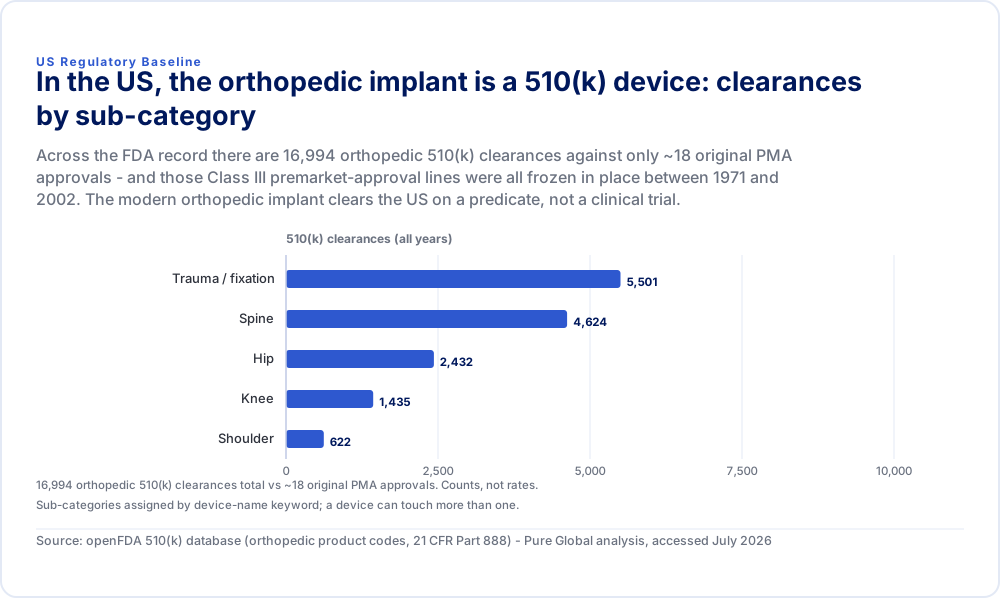
- In the US, the modern orthopedic implant is a 510(k) device, not a PMA device. Across the FDA record there are 16,994 orthopedic 510(k) clearances against just ~18 original PMA approvals — and every one of those Class III premarket-approval lines was frozen in place between 1971 and 2002 1. The US is the low-classification anchor.
- Almost everywhere else, the same implant is top-tier risk. In China's NMPA registry 93.8% of orthopedic registrations are Class III 2; in Brazil's ANVISA about 51% are Class III or IV 3; in Korea about 53% are Grade 3 or 4 4; under EU MDR Rule 8 a joint replacement is Class III by definition 5.
- China's volume-based procurement has repriced the whole category. The September 2021 national joint tender cut artificial-hip and -knee prices by an average of ~82% (a hip from 35,000 to about 7,000 RMB) 6; spinal implants followed at ~80% in 2022 and sports-medicine at ~70% in 2023 7.
- Europe's Class III queue is the binding constraint on timing. As of the European Commission's March-2026 notified-body survey, 33,175 MDR applications had produced only 17,549 certificates (52.9%), across roughly 51 notified bodies — down from about 96 under the old directive 8.
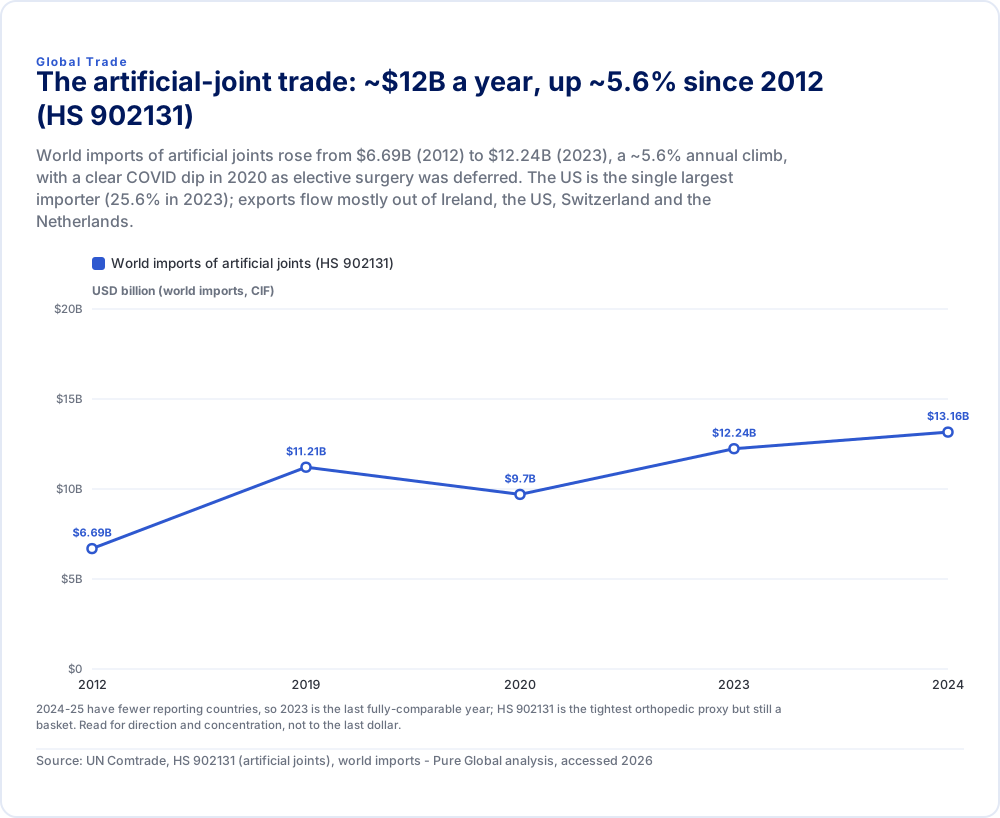
- The world trades ~$12 billion in artificial joints a year, and it flows through a handful of hubs. UN Comtrade puts HS-902131 world imports at $12.24 billion in 2023, up ~5.6% a year since 2012, exported mostly out of Ireland, the US, Switzerland and the Netherlands, and imported first of all by the US 9.
- Every market forces a foreign maker to work through a legally-mandated local representative — US Agent, EU Authorised Representative, China legal agent, Korea License Holder, Brazil Registration Holder, Japan MAH, Australian Sponsor — and in the EU and Brazil that entity carries legal liability, not just paperwork 10.
The through-line of this report is a single sentence a regulatory-affairs lead can take to a board: an orthopedic implant is registered market by market, on a different risk class each time, always through a local entity, and in 2026 timing and price are set less by the device than by two policy forces — Chinese procurement and European backlog. The neutral map is below; the pricing is explicit, including ours.
What an orthopedic implant is (as a regulated object)
The takeaway first: to a regulator an "orthopedic implant" is not one thing but a fork — and which branch a device lands on decides everything downstream. The fork turns on how permanently and how critically the device load-bears inside the body.
Set the clinical taxonomy against the regulatory one. Clinically, orthopedic implants split into three big families: joint reconstruction (total and partial hip, knee, shoulder, ankle), spine (fusion cages, pedicle-screw fixation, disc replacement), and trauma fixation (plates, screws, intramedullary nails). In the US FDA record those families size up in exactly that order — across all years there are 5,501 trauma/fixation 510(k) clearances, 4,624 spine, 2,432 hip, 1,435 knee and 622 shoulder 1. Trauma is the highest-volume, lowest-drama category; joint reconstruction is where the value and the regulatory scrutiny concentrate.
The regulatory fork is risk class, and it is not intuitive. The FDA's orthopedic panel — everything under 21 CFR Part 888 — spans 273 product codes, of which 183 are Class II, 68 Class I, and only 22 Class III 11. A standard cemented or uncemented total knee sits in Class II; the FDA affirmatively down-classified the uncemented patellofemorotibial and unicompartmental knee prostheses into Class II with special controls 12. The Class III minority is a specific, higher-hazard set: alternative-bearing total hips, mobile-bearing total knees, total ankle and total disc replacements, and — the cautionary tale — metal-on-metal total hips, which the FDA pushed up into Class III in a February 2016 final order after the metallosis failures, effectively ending their US market 12.
| US FDA orthopedic 510(k) clearances | |
|---|---|
| Trauma / fixation | 5,501 |
| Spine | 4,624 |
| Hip | 2,432 |
| Knee | 1,435 |
| Shoulder | 622 |
16,994 orthopedic 510(k) clearances total vs ~18 original PMA approvals. Counts, not rates.
Sub-categories assigned by device-name keyword; a device can touch more than one.
Source: openFDA 510(k) database (orthopedic product codes, 21 CFR Part 888) - Pure Global analysis, accessed July 2026
That MoM episode is worth holding onto, because it is the exception that proves the rule the rest of this report documents: in the US, an orthopedic implant is a Class II, 510(k) device unless a specific safety history has forced it up. The predicate system — clear your device by showing it is substantially equivalent to one already on the market — is the American default for joints, spine and trauma alike. It is fast, it is cheap relative to a clinical-trial pathway, and, as the next sections show, it is almost unique to the United States.
How big, and where it is sold, made, traded, and approved
The takeaway first: the orthopedic-implant market is large, aging-driven, and consolidated — roughly a $50-billion device market riding a $12-billion-a-year artificial-joint trade, dominated by the same six companies in every country, and shifting toward local manufacture in China.
The market: a range, not a number
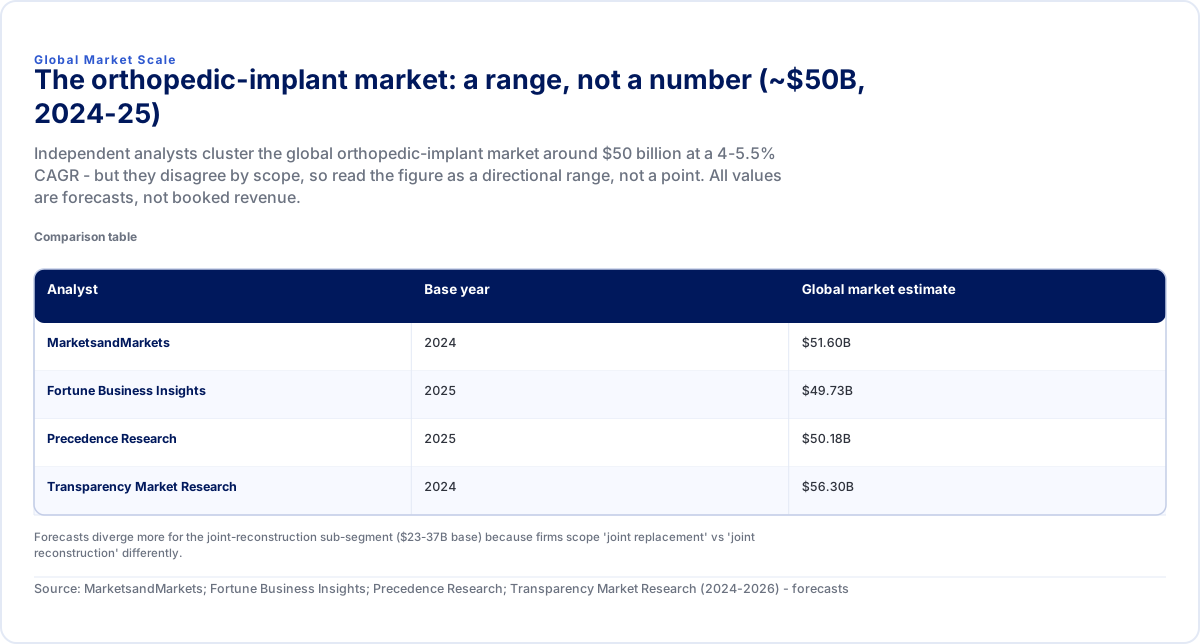
Independent analysts cluster the global orthopedic-implant market around $50 billion in 2024–2025, growing at a 4–5.5% CAGR: MarketsandMarkets sizes orthopedic devices at $51.6 billion (2024) rising to $68.5 billion (2030); Fortune Business Insights puts implants at $49.73 billion (2025) to $80.44 billion (2034); Precedence at $50.18 billion to $80.14 billion; Transparency Market Research at $56.3 billion to $87.6 billion 13. These are forecasts, not booked revenue, and the joint-reconstruction sub-segment estimates diverge more widely ($23–37 billion base) because firms scope "joint replacement" versus "joint reconstruction" differently — treat the ~$50-billion whole-market figure as a directional range, not a point 13.
| Analyst | Base year | Global market estimate |
|---|---|---|
| MarketsandMarkets | 2024 | $51.60B |
| Fortune Business Insights | 2025 | $49.73B |
| Precedence Research | 2025 | $50.18B |
| Transparency Market Research | 2024 | $56.30B |
Forecasts diverge more for the joint-reconstruction sub-segment ($23-37B base) because firms scope 'joint replacement' vs 'joint reconstruction' differently.
Source: MarketsandMarkets; Fortune Business Insights; Precedence Research; Transparency Market Research (2024-2026) - forecasts
The demand under those numbers is demographic and durable. A 2025 peer-reviewed systematic review projects total-knee-arthroplasty volumes rising at least 130% and total-hip volumes 121% to over 200% by 2050; the AAOS has warned that US surgeons will need to double their joint-arthroplasty caseload to keep up 14. The OECD records hip and knee replacement rates rising in nearly every member country over the past decade, averaging 198 hip and 156 knee replacements per 100,000 people, driven by ageing and obesity 14. This is a market whose base grows on autopilot.
The trade map: ~$12 billion a year, through a few hubs
Trade data turns the abstraction into flows. In UN Comtrade, the cleanest orthopedic proxy — HS 902131, artificial joints — shows world imports rising from $6.69 billion (2012) to $12.24 billion (2023) and about $13.16 billion (2024), a ~5.6% annual climb, with a clear COVID dip in 2020 as elective surgery was deferred 9. The export side is even more telling about where implants are actually made: in 2023 the top exporters were Ireland (17.8%), the United States (14.3%), Switzerland (12.1%), the Netherlands (10.5%), Germany (10.0%), the UK (9.4%) and Belgium (7.2%) — the manufacturing-and-distribution hubs of the multinational orthopedic industry — while China accounted for just 3.5% 9. On the import side the United States is the world's single largest buyer at 25.6% 9.
| World imports of artificial joints (HS 902131) | |
|---|---|
| 2012 | $6.69B |
| 2019 | $11.21B |
| 2020 | $9.7B |
| 2023 | $12.24B |
| 2024 | $13.16B |
2024-25 have fewer reporting countries, so 2023 is the last fully-comparable year; HS 902131 is the tightest orthopedic proxy but still a basket. Read for direction and concentration, not to the last dollar.
Source: UN Comtrade, HS 902131 (artificial joints), world imports - Pure Global analysis, accessed 2026
One honesty note travels with the trade series: HS 902131 is the tightest available proxy but still a broad basket, the adjacent code 902139 ("other artificial body parts") includes non-orthopedic prosthetics and should be read only as an upper bound, and 2024–2025 have fewer reporting countries, so 2023 is the last fully-comparable year 9. Read the trade data for direction and concentration, not to the last dollar.
Where it is approved — and by whom, everywhere
The registration records across regulators tell one consistent story about the competitive wall. The same six companies top every market's leaderboard — Zimmer Biomet, Johnson & Johnson (DePuy Synthes), Stryker, Smith & Nephew, Medtronic and Medacta appear as the leading FDA 510(k) applicants, the leading NMPA registrants, the leading TGA sponsors and the leading PMDA approval-holders, simultaneously 1 2 15 16. A new entrant is not registering into an open field; it is registering into a market where incumbents already hold thousands of clearances apiece — Biomet alone has 385 US orthopedic 510(k)s, Smith & Nephew 370, Zimmer 332 1.
China is the exception worth flagging for any market-access plan. In the NMPA registry, domestic orthopedic registrations (3,920) now outnumber imported ones (1,993), and the gap is widening — in 2024 there were 446 domestic orthopedic registrations against just 46 imports 2. Localization is not a talking point in China; it is visible in the registration flow, and it interacts directly with the procurement policy in §6.
The safety record, read honestly
The takeaway first: the orthopedic adverse-event record is enormous but must be read as reporting volume, not risk rate — and the most useful signal in it is that design, not manufacturing, is the leading recall cause, which is exactly what a registration dossier is built to interrogate.
The scale is real. The FDA's MAUDE database holds 1,196,697 orthopedic adverse-event records from 2008 to 2026, running 65,000–95,000 a year lately, with a mix of 64.5% injury, 34.4% malfunction and 0.2% death (2,475 deaths) 17. Knee code JWH alone carries 148,716 reports; hip code KWA carries 138,409 17. But MAUDE is passive, unverified and duplicative, and its volume tracks the size of the installed base and the intensity of reporting, not an incidence rate — a device implanted in millions of patients generates more reports than one implanted in thousands, with no bearing on which is safer. We report it as scale and mix, never as a rate.
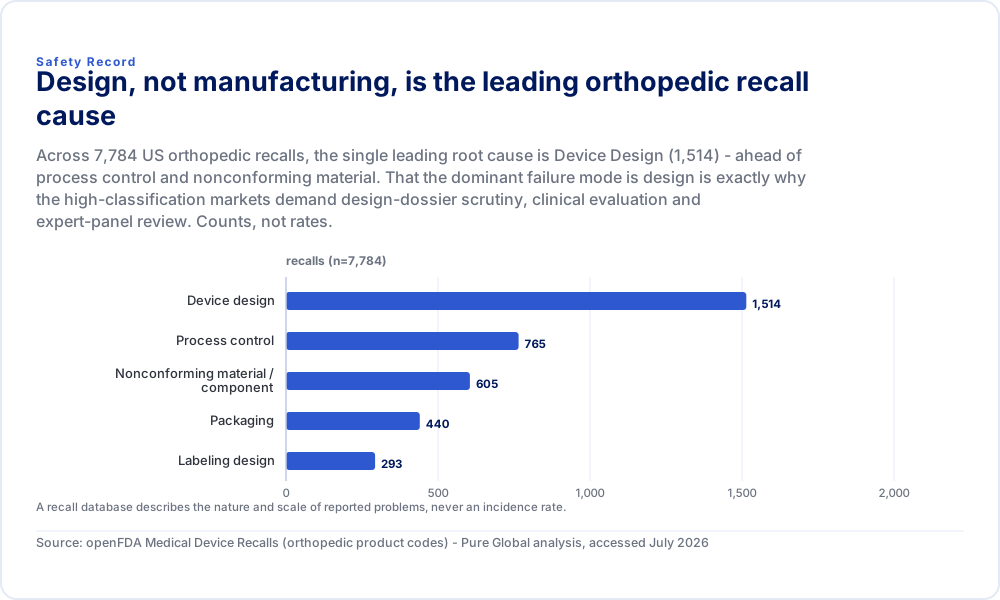
The recall record is where a market-access reader should actually look, because it names causes. Across 7,784 orthopedic recalls, the single leading root cause is "Device Design" (1,514 recalls), ahead of process control (765) and nonconforming material or component (605) 18. That ordering is notable for implants: the dominant failure mode being design, not manufacturing, is precisely why the high-classification markets in §4 demand design-dossier scrutiny, clinical evaluation and expert-panel review — and why the US predicate route, which can clear a new design on equivalence to an old one, draws the criticism it does.
| Orthopedic recalls by root cause | |
|---|---|
| Device design | 1,514 |
| Process control | 765 |
| Nonconforming material / component | 605 |
| Packaging | 440 |
| Labeling design | 293 |
A recall database describes the nature and scale of reported problems, never an incidence rate.
Source: openFDA Medical Device Recalls (orthopedic product codes) - Pure Global analysis, accessed July 2026
One more structural fact shapes how a new entrant must build its evidence: orthopedic clinical evidence is only lightly industry-funded. Of 5,680 orthopedic-implant trials on ClinicalTrials.gov, just ~19.6% are industry-sponsored — falling to about 16% in 2020–2024 — with the rest run by hospitals and academic groups 19. A manufacturer entering a market that demands local clinical data (China, often Japan and Korea) cannot assume a ready-made industry trial exists to lean on; the evidence base it needs is frequently investigator-led and not built to its dossier.
One implant, seven risk classes: the regulatory map
The takeaway first: the same total knee replacement is classified — and therefore routed, evidenced, timed and priced — completely differently in each major market. Below is the divergence in one table, then market by market. The universal that survives every difference: no market lets a foreign maker register alone.
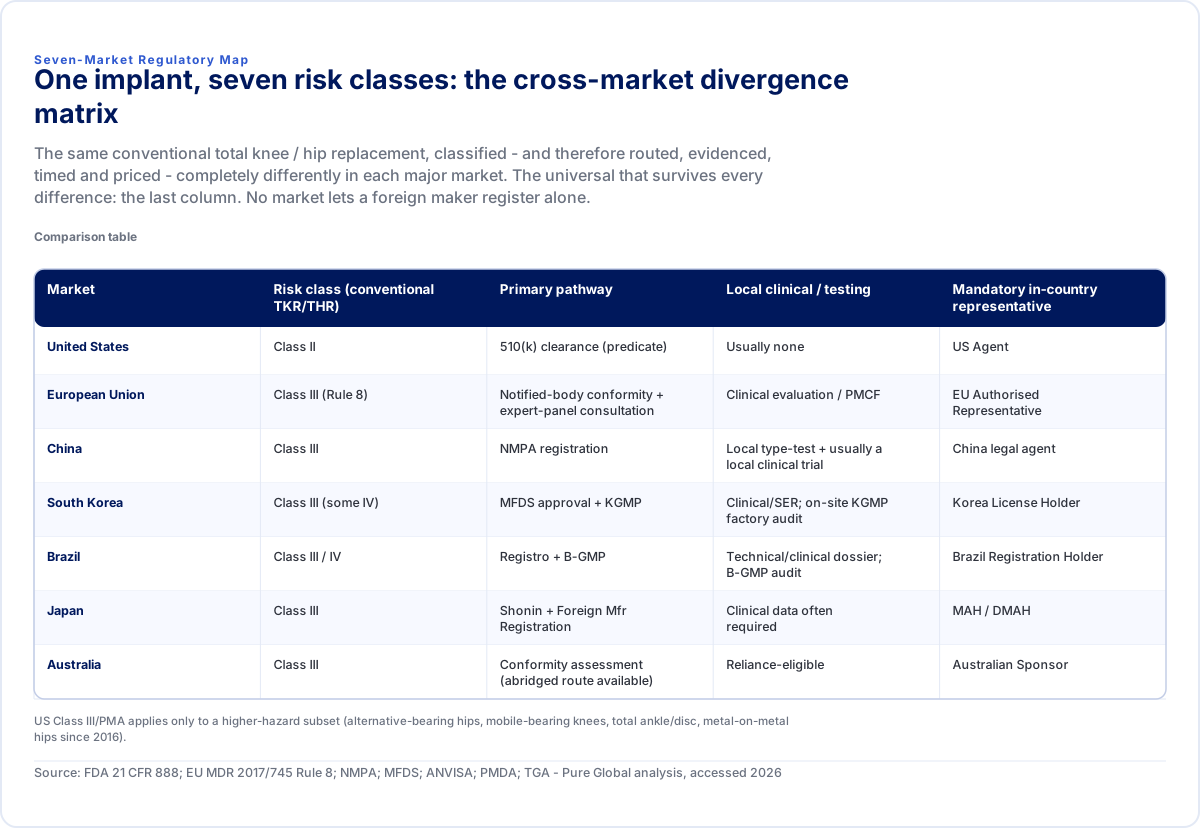
| Market | Risk class (conventional TKR/THR) | Primary pathway | Local clinical / testing | Mandatory in-country representative |
|---|---|---|---|---|
| United States | Class II | 510(k) clearance (predicate) | Usually none | US Agent |
| European Union | Class III (Rule 8) | Notified-body conformity + expert-panel consultation | Clinical evaluation / PMCF | EU Authorised Representative |
| China | Class III | NMPA registration | Local type-test + usually a local clinical trial | China legal agent |
| South Korea | Class III (some IV) | MFDS approval + KGMP | Clinical/SER; on-site KGMP factory audit | Korea License Holder |
| Brazil | Class III / IV | Registro + B-GMP | Technical/clinical dossier; B-GMP audit | Brazil Registration Holder |
| Japan | Class III | Shonin + Foreign Mfr Registration | Clinical data often required | MAH / DMAH |
| Australia | Class III | Conformity assessment (abridged route available) | Reliance-eligible | Australian Sponsor |
US Class III/PMA applies only to a higher-hazard subset (alternative-bearing hips, mobile-bearing knees, total ankle/disc, metal-on-metal hips since 2016).
Source: FDA 21 CFR 888; EU MDR 2017/745 Rule 8; NMPA; MFDS; ANVISA; PMDA; TGA - Pure Global analysis, accessed 2026
United States — the Class II anchor
The US is the outlier that makes the divergence visible. A conventional total knee or hip is Class II, cleared through the 510(k) predicate route in roughly six months of review, generally on bench and equivalence data rather than a new clinical trial 1 20. Only the specific higher-hazard subset — alternative-bearing hips, mobile-bearing knees, total ankle and disc, and metal-on-metal hips since 2016 — is pushed into Class III PMA, a pathway that historically ran about 27 months of review and years end-to-end 12. Every foreign manufacturer still needs a US Agent, US-resident, one per establishment, before any registration completes 10.
European Union — the same implant, three classes higher
Cross into the EU and the identical knee is Class III under MDR Rule 8, which classifies total or partial joint replacements at the top tier by definition (ancillary screws, plates and instruments excepted) 5. Class III implantables do not merely go through a notified body; they trigger the clinical-evaluation-consultation procedure, where the clinical evaluation report is submitted to an EU expert panel for scrutiny (MDR Article 54, Annex IX) 5. The manufacturer must hold a clinical evaluation and post-market clinical follow-up, and appoint an EU Authorised Representative who is jointly and severally liable for a defective device alongside the maker 10. This is the sharpest single up-classification in the report: Class II in Washington, Class III with panel review in Brussels, for one unchanged device.
China — Class III, and the local trial is the wall
China classifies orthopedic implants as Class III, confirmed hard by the registry itself: 93.8% of orthopedic NMPA registrations are Class III 2. Two local requirements make China the highest-effort major market. First, a type-test — physical samples tested at a designated Chinese government laboratory, a distinct 6–9-month step no foreign data can replace 2. Second, a local clinical trial is usually required for high-risk implants, pushing realistic timelines to four to five years end-to-end 20. A China-based legal agent is mandatory to hold the certificate and communicate with the NMPA 10. And, as §2 showed, the registration flow is localizing — a strategic fact that §6's procurement policy sharpens into a warning.
South Korea — Grade 3/4, and the factory audit comes first
Korea places orthopedic implants at Class III, with the highest-risk implants at Class IV — in the MFDS permit record about 53% of orthopedic devices sit at Grade 3 or 4 4. The distinctive gate is KGMP: a Korea Good Manufacturing Practice certificate that requires an on-site audit of the foreign manufacturing facility, is valid three years, and must be obtained before product registration, not alongside it 4. A Korea License Holder legally holds the device license on the foreign maker's behalf 10. Class III review runs roughly 6–12 months, Class IV up to 12–16, on top of the KGMP timeline 20.
Brazil — Class III/IV, and B-GMP is a hard gate
Brazil routes Class III and IV devices — where about 51% of orthopedic registrations sit — through the Registro pathway, and layers on a requirement that catches many first-time entrants: Brazilian Good Manufacturing Practice (B-GMP) certification, which the application will not clear without 3. B-GMP can be obtained in about two months if the manufacturer already holds an MDSAP certificate, but 6–18+ months if it requires a physical ANVISA inspection 20. Only a Brazilian entity can act as the Registration Holder — a foreign maker cannot hold its own registro 10.
Japan — Class III, on the "generic" track
Japan treats orthopedic implants as Class III "specially controlled" devices, approved by shonin through PMDA review and MHLW, with a Foreign Manufacturer Registration and a Marketing Authorization Holder (MAH) or its distributor equivalent (DMAH) mandatory regardless of class 16 10. The nuance that matters commercially: Japan's orthopedic route runs overwhelmingly through the 後発 "generic" / no-clinical pathway — of the approvals in the PMDA record, 728 came via the generic route and 359 via "improved, no clinical," a substantial-equivalence analog to the US 510(k) 16. Shonin timelines run 18–36 months 20. Japan is high-classification but not always high-clinical-burden — a distinction worth exploiting in sequencing.
Australia — Class III, but reliance-friendly
Australia classes joint replacements as Class III and requires an Australian Sponsor, but it is one of the few high-classification markets that will lean on a foreign approval: the TGA offers an abridged conformity-assessment route for devices already approved by the US FDA, EU notified bodies, Health Canada or Japan's PMDA 15 21. It belongs in the reliance discussion in §7.
The one universal
Read down the last column of the matrix and the pattern is absolute: no major market lets a foreign orthopedic-implant maker register on its own. Every one requires a local representative, holder or sponsor — and in the EU and Brazil that role carries legal liability, not just administrative duty 10. Reliance can shrink the evidence and audit burden (§7); it never removes this requirement. It is the one line item on every rollout, in every market, and it is the line item §5 prices.
What it costs and how long it takes
The takeaway first: the government fee is almost never the real cost — the real cost is time, evidence, and the recurring in-country-representation fee, and the last of those is the one competitors quote hourly and bury. Here is the whole stack, including our own fees, in the open.
Time is the number that actually hurts
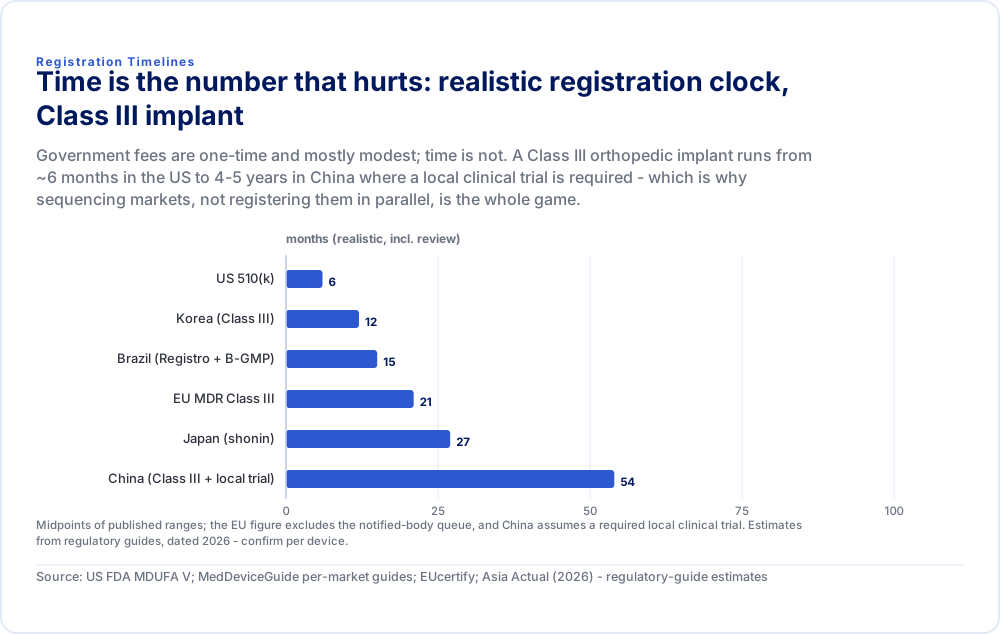
Government fees are one-time and, outside the US, mostly modest. Time is not. A realistic registration clock for a Class III orthopedic implant runs roughly: US 510(k) ~6 months (PMA ~285 days of review, far longer end-to-end); EU MDR Class III 18–24 months, up to 30 for novel devices, before you even count the notified-body queue in §6; China 4–5 years when a local clinical trial is required; Korea 6–16 months plus the KGMP audit; Brazil 12–15 months plus B-GMP; Japan 18–36 months 20 20. Sequencing across markets is therefore not optional — it is the difference between revenue in 2027 and revenue in 2031.
| Registration timeline (months, midpoint) | |
|---|---|
| US 510(k) | 6 |
| Korea (Class III) | 12 |
| Brazil (Registro + B-GMP) | 15 |
| EU MDR Class III | 21 |
| Japan (shonin) | 27 |
| China (Class III + local trial) | 54 |
Midpoints of published ranges; the EU figure excludes the notified-body queue, and China assumes a required local clinical trial. Estimates from regulatory guides, dated 2026 - confirm per device.
Source: US FDA MDUFA V; MedDeviceGuide per-market guides; EUcertify; Asia Actual (2026) - regulatory-guide estimates
Government fees, for context — the small number
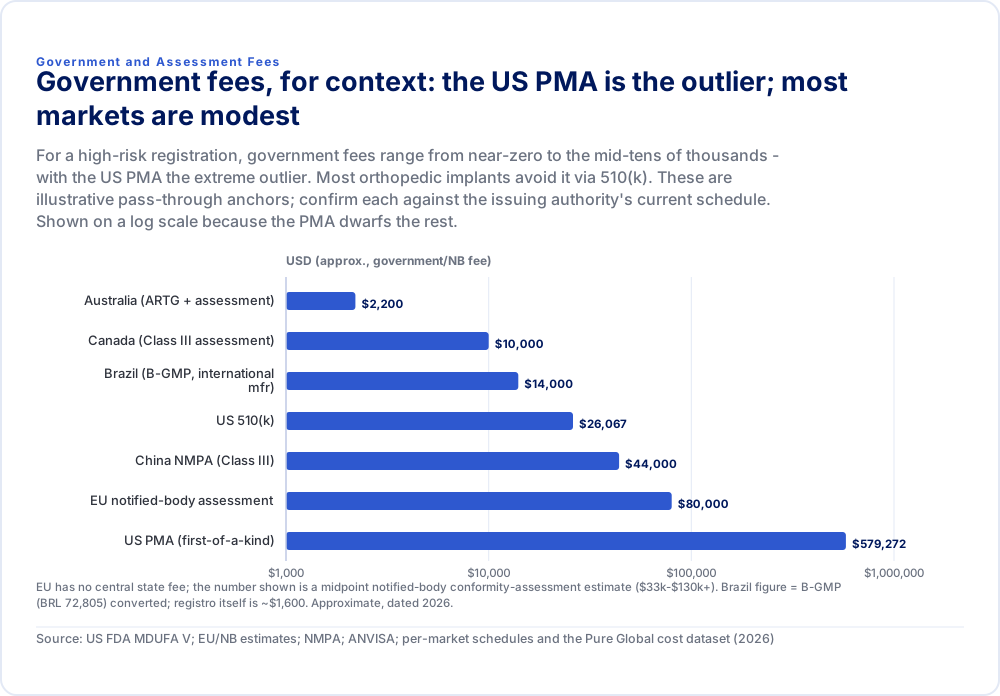
For a high-risk registration, government fees range from near-zero to the mid-tens of thousands, with the US the extreme outlier: a first-of-a-kind US PMA carries a $579,272 fee (though most orthopedic implants avoid it via 510(k), at $26,067, or $6,517 for a small business), plus an $11,423 annual establishment fee 1 7. The EU charges no central state fee — the cost there is the notified-body conformity assessment, commonly $33,000–$130,000 and up 7. China's NMPA registration fee is about RMB 308,800 (~$44,000), on top of local type-testing and the trial itself 7. Brazil's Registro runs about BRL 8,510, but B-GMP certification for an international manufacturer is BRL 72,805 per certificate — the real number 3 7. Australia, Canada and Korea sit in the low thousands to low tens of thousands 7. These are illustrative pass-through anchors; confirm the current figure against each authority's own schedule.
| Government / notified-body fee (approx. USD) | |
|---|---|
| Australia (ARTG + assessment) | $2,200 |
| Canada (Class III assessment) | $10,000 |
| Brazil (B-GMP, international mfr) | $14,000 |
| US 510(k) | $26,067 |
| China NMPA (Class III) | $44,000 |
| EU notified-body assessment | $80,000 |
| US PMA (first-of-a-kind) | $579,272 |
EU has no central state fee; the number shown is a midpoint notified-body conformity-assessment estimate ($33k-$130k+). Brazil figure = B-GMP (BRL 72,805) converted; registro itself is ~$1,600. Approximate, dated 2026.
Source: US FDA MDUFA V; EU/NB estimates; NMPA; ANVISA; per-market schedules and the Pure Global cost dataset (2026)
The Pure Global flat-fee model
Every market forces a legally-mandated in-country representative — and that recurring fee, not the government fee, is where the real cost and the real opacity live. A foreign manufacturer cannot hold an orthopedic-implant registration in the US, EU, China, Korea, Brazil or Japan without a designated local role (§4). The only open question is whether the fee for that role is flat and disclosed, or variable and buried.
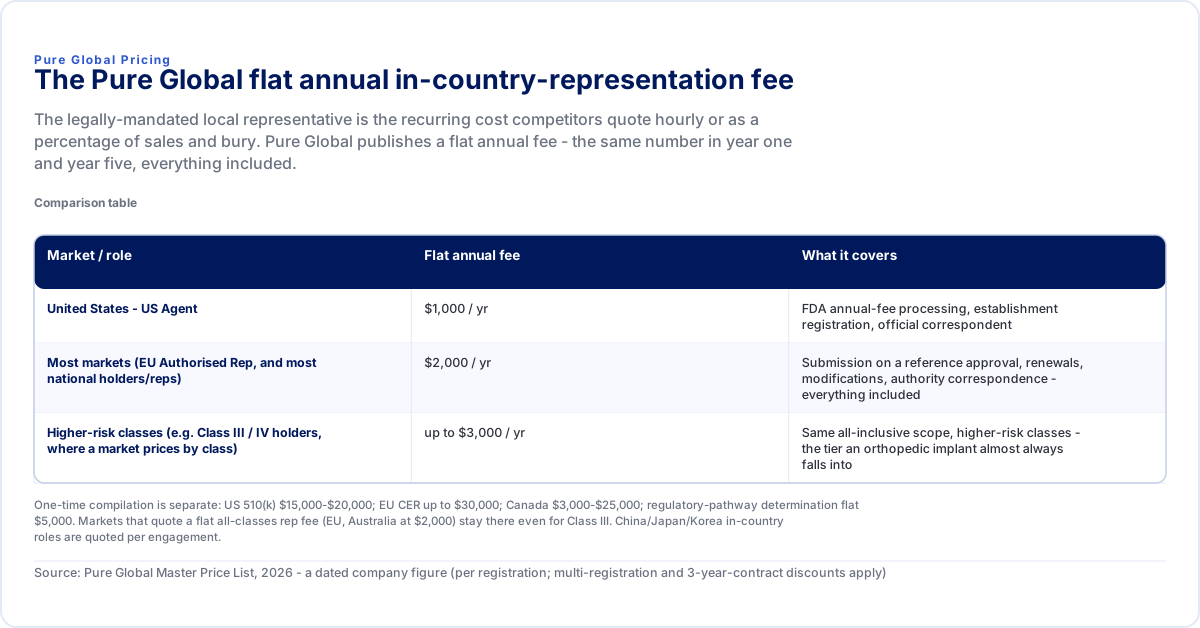
Where competitors bill this legally-required role hourly or as a percentage of sales, Pure Global publishes a flat annual fee: US Agent $1,000; most markets $2,000; up to $3,000 for the higher-risk classes an orthopedic implant almost always falls into (Pure Global Master Price List, 2026 — a dated company figure) Source. "Everything included" means preparation and submission of the registration on a reference approval (for example a CE mark), renewals, modifications, and all correspondence with the authority — the same number in year one and year five.
| Market / role | Flat annual fee | What it covers |
|---|---|---|
| United States - US Agent | $1,000 / yr | FDA annual-fee processing, establishment registration, official correspondent |
| Most markets (EU Authorised Rep, and most national holders/reps) | $2,000 / yr | Submission on a reference approval, renewals, modifications, authority correspondence - everything included |
| Higher-risk classes (e.g. Class III / IV holders, where a market prices by class) | up to $3,000 / yr | Same all-inclusive scope, higher-risk classes - the tier an orthopedic implant almost always falls into |
One-time compilation is separate: US 510(k) $15,000-$20,000; EU CER up to $30,000; Canada $3,000-$25,000; regulatory-pathway determination flat $5,000. Markets that quote a flat all-classes rep fee (EU, Australia at $2,000) stay there even for Class III. China/Japan/Korea in-country roles are quoted per engagement.
Source: Pure Global Master Price List, 2026 - a dated company figure (per registration; multi-registration and 3-year-contract discounts apply)
The heavy one-time lifting is priced separately, as a project fee charged once: US 510(k) compilation $15,000–$20,000; EU clinical-evaluation-report writing up to $30,000 by device class; Canadian registration compilation $3,000–$25,000 across Class I to IV; and a flat $5,000 regulatory-pathway determination to fix the correct route before any file is built Source. Pure Global says its in-house AI tooling cuts dossier-compilation time by more than half — a company claim from its 2026 announcements, offered as a claim, not an independently verified outcome Source.
Two honesty notes specific to orthopedics. First, the "up to $3,000" higher-risk tier applies where a market prices by class (Brazil Class III/IV, for example); markets that quote a flat all-classes fee — the EU Authorised Representative and the Australian Sponsor at $2,000 — stay at that figure even for a Class III implant Source. Second, China, Japan and Korea in-country roles are quoted per engagement; where a market is not on the published flat-fee list, treat the $3,000 higher-risk figure as an anchor and confirm the current quote.
Worked example: one implant, four markets
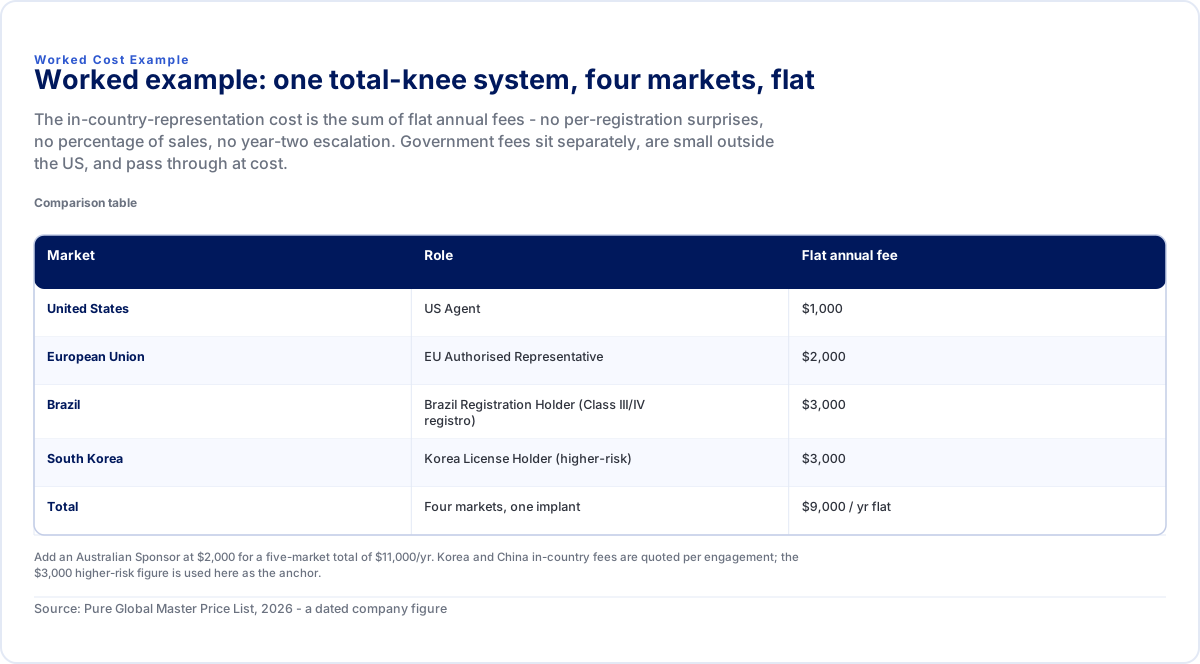
Consider a single total-knee system launching across four markets. The in-country-representation cost is the sum of four flat annual fees: US Agent $1,000, EU Authorised Representative $2,000, Brazil Registration Holder $3,000 (a Class III/IV registro), and Korea License Holder $3,000. The arithmetic is exact — $1,000 + $2,000 + $3,000 + $3,000 = $9,000 per year, flat Source. Add an Australian Sponsor at $2,000 and five markets run $11,000 per year Source. There are no per-registration surprises, no percentage of sales, and no year-two escalation; the government fees sit separately, are small outside the US, and pass through at cost.
| Market | Role | Flat annual fee |
|---|---|---|
| United States | US Agent | $1,000 |
| European Union | EU Authorised Representative | $2,000 |
| Brazil | Brazil Registration Holder (Class III/IV registro) | $3,000 |
| South Korea | Korea License Holder (higher-risk) | $3,000 |
| Total | Four markets, one implant | $9,000 / yr flat |
Add an Australian Sponsor at $2,000 for a five-market total of $11,000/yr. Korea and China in-country fees are quoted per engagement; the $3,000 higher-risk figure is used here as the anchor.
Source: Pure Global Master Price List, 2026 - a dated company figure
The two forces reshaping entry in 2026
The takeaway first: two policy forces — not any device change — now set the price and the timing of orthopedic market entry. China's volume-based procurement has cut implant prices 70–84%, resetting the economics of the world's second-largest market; the EU's notified-body backlog has made the Class III certificate a scheduling problem, not just a technical one.
China VBP: the price gate
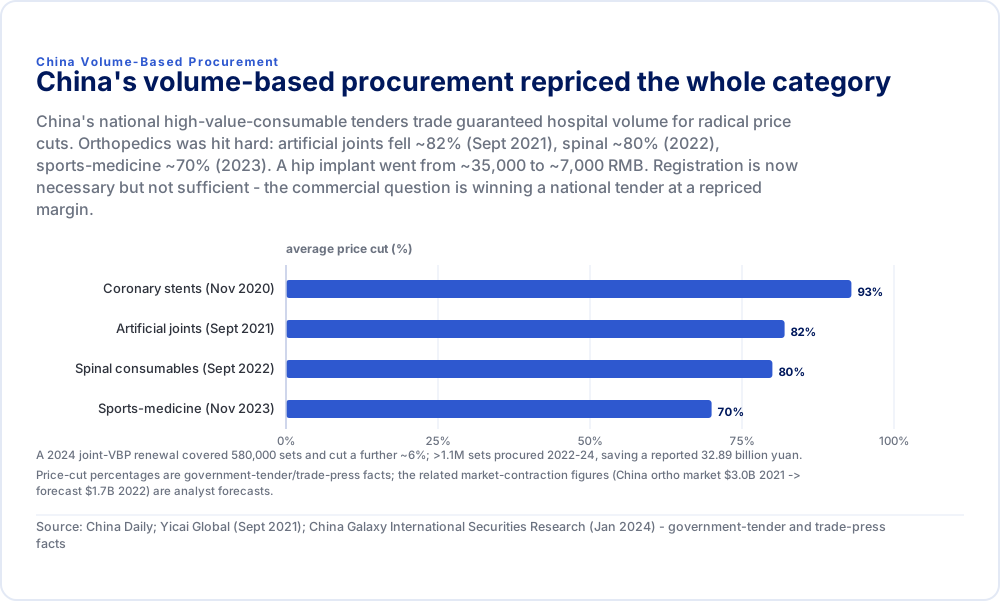
Since 2020 China has run its high-value medical-consumable market through volume-based procurement (集中带量采购, VBP) — centralized national tenders that trade guaranteed hospital volume for radical price cuts. Orthopedics was the second category in: the September 2021 national artificial-joint tender cut average hip and knee prices by ~82%, taking a hip implant from about 35,000 to about 7,000 RMB and a knee from about 32,000 to about 5,000 RMB, with 44 of 48 bidders selected to supply a target of 540,000 joints — roughly 90% of national demand 6. Spinal implants followed in September 2022 at an average ~80% cut, and sports-medicine consumables in November 2023 at ~70% 7. A 2024 renewal expanded the joint program to 580,000 sets across 6,000+ hospitals and cut a further ~6%; over 2022–2024 more than 1.1 million joint sets were procured, more than 90% of national use, saving a reported 32.89 billion yuan 22.
| Average price cut in national VBP tender | |
|---|---|
| Coronary stents (Nov 2020) | 93% |
| Artificial joints (Sept 2021) | 82% |
| Spinal consumables (Sept 2022) | 80% |
| Sports-medicine (Nov 2023) | 70% |
A 2024 joint-VBP renewal covered 580,000 sets and cut a further ~6%; >1.1M sets procured 2022-24, saving a reported 32.89 billion yuan.
Price-cut percentages are government-tender/trade-press facts; the related market-contraction figures (China ortho market $3.0B 2021 -> forecast $1.7B 2022) are analyst forecasts.
Source: China Daily; Yicai Global (Sept 2021); China Galaxy International Securities Research (Jan 2024) - government-tender and trade-press facts
For a market-access plan, VBP is decisive and double-edged. It compresses per-unit margin toward commodity levels — analysts estimate VBP reduced the value of China's orthopedic market by nearly half, from about $3.0 billion (2021) to a forecast $1.7 billion (2022), and it has driven multinationals to retrench (Medtronic stated 80% of its portfolio could be affected; ZimVie announced the removal of its spine business from China in 2023) 23. But it also guarantees volume to the winners and, combined with the localization visible in the registration data (§2), rewards a low-cost, locally-manufactured or locally-partnered supply model. The strategic question China now poses is not "can I register?" but "can I register and win a tender at a repriced margin?" — and the answer shapes whether China belongs early or late in a rollout. (These market-size and contraction figures are analyst forecasts; the price-cut percentages are government-tender and trade-press facts.)
EU MDR: the timing gate
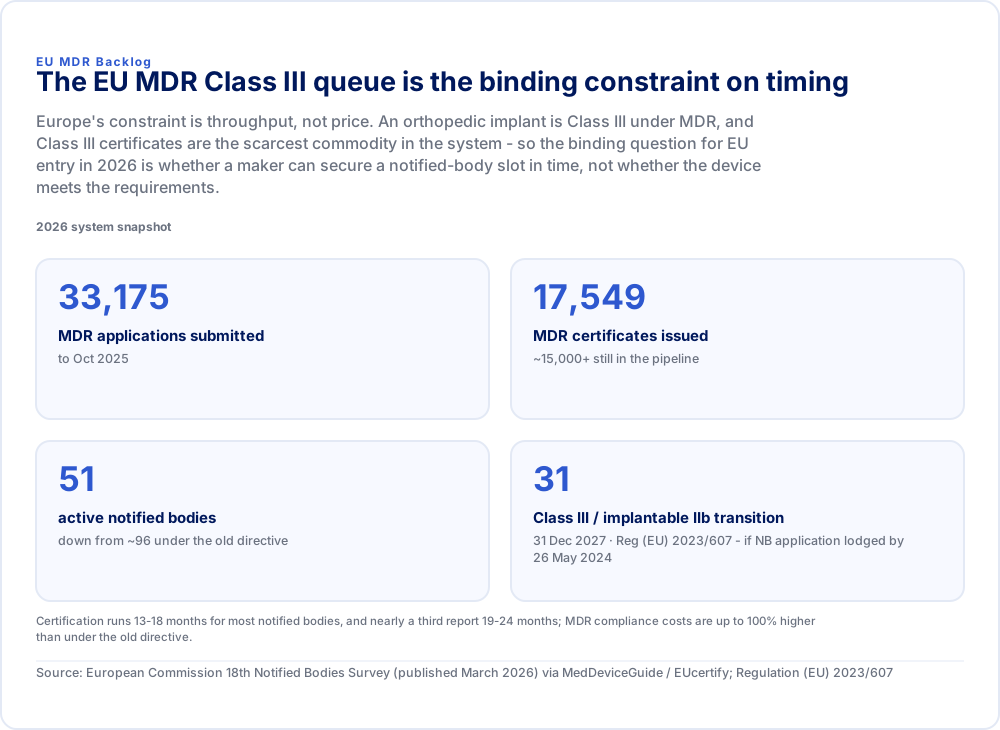
Europe's constraint is not price but throughput. Under the MDR, an orthopedic implant is Class III (§4), and Class III certificates have become the scarcest commodity in the system. The European Commission's 18th notified-body survey (published March 2026) recorded 33,175 MDR applications but only 17,549 certificates issued — 52.9% — with an estimated 15,000+ still in the pipeline, handled by roughly 51 notified bodies, down from about 96 under the previous directive 8. Certification now takes 13–18 months for most notified bodies, and nearly a third report 19–24 months, with MDR compliance costs up to 100% higher than under the old regime 24.
EU MDR BacklogThe EU MDR Class III queue is the binding constraint on timingEurope's constraint is throughput, not price. An orthopedic implant is Class III under MDR, and Class III certificates are the scarcest commodity in the system - so the binding question for EU entry in 2026 is whether a maker can secure a notified-body slot in time, not whether the device meets the requirements.2026 system snapshot
- MDR applications submitted
- 33,175to Oct 2025
- MDR certificates issued
- 17,549~15,000+ still in the pipeline
- active notified bodies
- 51down from ~96 under the old directive
- Class III / implantable IIb transition
- 3131 Dec 2027 · Reg (EU) 2023/607 - if NB application lodged by 26 May 2024
Certification runs 13-18 months for most notified bodies, and nearly a third report 19-24 months; MDR compliance costs are up to 100% higher than under the old directive.
Source: European Commission 18th Notified Bodies Survey (published March 2026) via MedDeviceGuide / EUcertify; Regulation (EU) 2023/607
Brussels' relief valve is Regulation (EU) 2023/607, which extended the transition for Class III and implantable Class IIb devices to 31 December 2027 (other classes to 2028), conditional on a manufacturer having lodged a notified-body application by 26 May 2024 and signed a written agreement by 26 September 2024, and it deleted the old "sell-off" deadline 25. For an orthopedic maker the implication is concrete: the binding constraint on European entry in 2026 is not whether the device meets Class III requirements but whether it can secure a notified-body slot in time — a scheduling and documentation problem that rewards early, complete, correctly-routed filing over technical merit alone.
Reliance: the lever, and its two hard limits
The takeaway first: an FDA clearance or a CE mark can meaningfully accelerate entry into several markets — but reliance is uneven, it never erases the divergent classification, and it never removes the local representative.
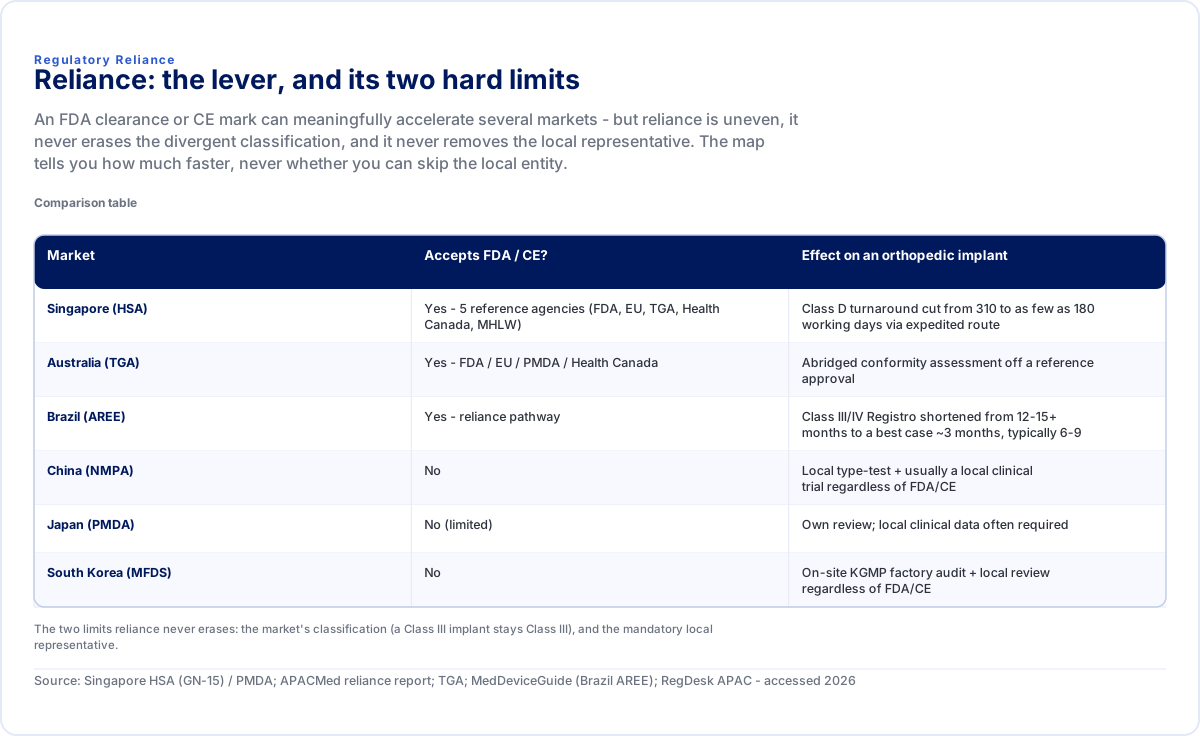
Reliance is the single most powerful tool for sequencing an orthopedic rollout, and it is real. Singapore's HSA leverages approvals from five reference agencies (US FDA, EU, Australia's TGA, Health Canada, Japan's MHLW), cutting a Class D device's turnaround from 310 to as few as 180 working days via the expedited route 21. Australia offers abridged conformity assessment off an FDA, EU, PMDA or Health Canada approval 15 21. Brazil's AREE reliance pathway can shorten a Class III/IV Registro from 12–15+ months to a best case of about three months, typically six to nine 21.
| Market | Accepts FDA / CE? | Effect on an orthopedic implant |
|---|---|---|
| Singapore (HSA) | Yes - 5 reference agencies (FDA, EU, TGA, Health Canada, MHLW) | Class D turnaround cut from 310 to as few as 180 working days via expedited route |
| Australia (TGA) | Yes - FDA / EU / PMDA / Health Canada | Abridged conformity assessment off a reference approval |
| Brazil (AREE) | Yes - reliance pathway | Class III/IV Registro shortened from 12-15+ months to a best case ~3 months, typically 6-9 |
| China (NMPA) | No | Local type-test + usually a local clinical trial regardless of FDA/CE |
| Japan (PMDA) | No (limited) | Own review; local clinical data often required |
| South Korea (MFDS) | No | On-site KGMP factory audit + local review regardless of FDA/CE |
The two limits reliance never erases: the market's classification (a Class III implant stays Class III), and the mandatory local representative.
Source: Singapore HSA (GN-15) / PMDA; APACMed reliance report; TGA; MedDeviceGuide (Brazil AREE); RegDesk APAC - accessed 2026
The limits are as important as the lever, and honesty about them is what separates a plan from a brochure. China, Japan and Korea do not grant product-approval reliance for orthopedic implants — China requires local type-testing and usually a local trial, Korea requires an on-site KGMP factory audit, and Japan requires its own review and often local clinical data; a foreign approval eases none of these 26 2 4 16. And even where reliance works, it touches only the evidence and audit burden — it never changes the market's classification (a CE-marked Class III implant is still Class III everywhere it is Class III) and it never removes the local representative (§4). The reliance map tells you how much faster, never whether you can skip the local entity.
The market-access playbook
The takeaway first: an orthopedic implant is registered market by market, on a different risk class each time, always through a local entity — so the winning approach sequences markets by classification, reliance and timing rather than treating "global registration" as one project.
- Fix the classification per market before anything else. The same knee is Class II in the US and Class III in the EU, China, Korea, Brazil, Japan and Australia — so the pathway, evidence and fee are set market by market. A flat $5,000 regulatory-pathway determination up front prevents the expensive error of building one dossier and assuming it travels Source.
- Anchor on your strongest approval, then map reliance. An FDA clearance or CE mark is the reliance currency for Singapore, Australia and Brazil's AREE — sequence those reliance-friendly markets to follow your anchor, and treat China, Japan and Korea as independent, local-data projects 21 26.
- Start the long poles first. China (4–5 years with a local trial) and the EU (18–24 months plus a notified-body queue) are the binding timelines; if they are in the plan, they start first, not last 20 8.
- Budget for the audits, not just the fees. Korea's on-site KGMP audit and Brazil's B-GMP certificate are gating, sequential and time-consuming — an MDSAP certificate can collapse Brazil's B-GMP from 18 months to two 4 20.
- Price China as a tender market, not just a registration market. Registration is necessary but not sufficient; VBP means the commercial question is winning a national tender at a repriced margin, which favors local manufacture or partnership 6 23.
- Appoint the local representative deliberately in every market. It is legally mandatory everywhere, it carries legal liability in the EU and Brazil, and it is a recurring cost — so a single accountable partner across markets beats seven separate relationships 10.
A typical multi-market orthopedic rollout therefore runs on two clocks at once: the reliance-friendly markets (US, then Australia/Singapore/Brazil via reliance) can be live inside a year to two of the anchor approval, while the local-data markets (EU on the notified-body queue, China on its trial, Japan and Korea on their audits) run in parallel on multi-year timelines — with a local representative standing behind the registration in each.
This is the work Pure Global is built to do: acting as the legally-mandated in-country representative across 15+ direct and 30+ partner markets, on a flat annual fee from USD $2,000; determining the correct pathway per market; and compiling and submitting the dossier — with AI-assisted preparation the company says cuts compilation time by more than half (a dated company claim) — so an orthopedic manufacturer runs one relationship instead of standing up a local entity in every country Source Source.
Conclusion: four takeaways
One implant, seven risk classes. A conventional total knee is Class II and 510(k) in the United States, Class III with expert-panel review in the EU, and Class III with mandatory local testing and usually a local trial in China — and Class III or IV in Korea, Brazil, Japan and Australia. The device does not change; the regulatory burden triples market to market. That asymmetry, not the engineering, governs the rollout.
The US is the low-classification anchor; everywhere else is the high-risk tier. The FDA record — 16,994 orthopedic 510(k)s against ~18 legacy PMAs — is unique. NMPA at 93.8% Class III, ANVISA and MFDS above 50% high-risk, and MDR Rule 8 are the global norm the US departs from.
In 2026 two policy forces, not any device change, set price and timing. China's volume-based procurement cut implant prices 70–84% and reset the economics of entry; the EU's notified-body backlog — 33,175 applications, 17,549 certificates, ~51 bodies — made the Class III certificate a scheduling problem. A rollout planned without both is planned against the wrong constraints.
Every market requires a local entity — that is the one constant, and it is where sequencing and cost concentrate. Reliance can accelerate several markets; it never erases the classification and never removes the local representative. The orthopedic maker that treats global registration as one project loses; the one that sequences by classification, reliance and timing — behind a single accountable in-country partner — wins.
Talk to us
Pure Global acts as the legally-mandated in-country representative and runs the full registration lifecycle for orthopedic-implant manufacturers across 15+ direct and 30+ partner markets, on a published flat annual fee. If you are sequencing a joint-replacement, spine or trauma portfolio across the US, EU, China, Korea, Brazil, Japan and beyond — and want the classification, timeline, fee and reliance map for your specific device before you commit — Talk to Pure Global.
References
- openFDA — 510(k) and PMA databases (orthopedic product codes, 21 CFR Part 888) — Pure Global analysis, accessed July 2026. open.fda.gov ↩ ↩ ↩ ↩ ↩ ↩
- China NMPA — device registration database (orthopedic registrations; class + domestic/import split) — Pure Global analysis, crawled June–July 2026. nmpa.gov.cn ↩ ↩ ↩ ↩ ↩ ↩
- Brazil ANVISA — medical-device registrations (orthopedic class III/IV; country of manufacture) — Pure Global analysis, July 2026; Global Regulatory Partners, Medical Device Registration in Brazil (B-GMP, RDC 665/2022). gov.br ↩ ↩ ↩
- South Korea MFDS — device permits (orthopedic Grade 3/4) — Pure Global analysis, June 2026; Maven RS, Korea MFDS Registration Guide (KLH/KGMP, 2026); Global Regulatory Partners. mfds.go.kr ↩ ↩ ↩ ↩ ↩
- Regulation (EU) 2017/745 (MDR), Annex VIII Rule 8 (joint replacements = Class III); MDCG 2021-24 (Article 54 clinical-evaluation-consultation / expert panel). medical-device-regulation.eu ↩ ↩ ↩
- China Daily and Yicai Global — national artificial-joint volume-based-procurement tender (average ~82% price cut), 15 September 2021. chinadaily.com.cn ↩ ↩ ↩
- China Galaxy International Securities Research — high-value-consumable VBP rounds (stents 93% / joints 82% / spinal 80% / sports-med 70%), 3 January 2024; per-market government-fee anchors from the regulatory guides in [11] and the Pure Global cost dataset [27]. researchportal.chinastock.com.hk ↩ ↩ ↩ ↩ ↩ ↩ ↩
- European Commission — 18th Notified Bodies Survey on MDR/IVDR certifications (published March 2026; 33,175 applications / 17,549 certificates; ~51 notified bodies) via MedDeviceGuide and EUcertify; Mantra Systems (notified-body count). health.ec.europa.eu ↩ ↩ ↩
- UN Comtrade — HS 902131 (artificial joints), 902110 (orthopaedic/fracture appliances), 902139 (other artificial body parts), annual 2012–2024 — Pure Global analysis, accessed 2026. comtradeplus.un.org ↩ ↩ ↩ ↩ ↩
- 21 CFR 807.40 (US Agent); Regulation (EU) 2017/745 Article 11 (EU Authorised Representative, joint liability); GOV.UK (UK Responsible Person); Emergo by UL (China legal agent); Artixio / OMC Medical (Korea License Holder); Rimsys (Brazil Registration Holder); ElendiLabs (Japan MAH/DMAH); Health Canada GUI-0016 (MDEL). ecfr.gov ↩ ↩ ↩ ↩ ↩ ↩ ↩ ↩ ↩
- U.S. FDA — Product Classification database (21 CFR Part 888, orthopedic panel) — Pure Global analysis, accessed July 2026. accessdata.fda.gov ↩
- U.S. FDA — Metal-on-Metal Hip Implants: FDA Activities (2016 final order) and knee-prosthesis reclassification guidance; Clinical Orthopaedics and Related Research, PMC4773325 (2016). fda.gov ↩ ↩ ↩
- MarketsandMarkets; Fortune Business Insights; Precedence Research; Transparency Market Research; Fact.MR — orthopedic-implant / joint-reconstruction market estimates (forecasts; analyst spread), 2024–2026. fortunebusinessinsights.com ↩ ↩
- Stubnya B. et al., systematic review of arthroplasty projections to 2050, PMC12653837 (2025); AAOS 2023 Annual Meeting (surgeon-supply projection); OECD, Health at a Glance 2025 (hip/knee replacement rates). pmc.ncbi.nlm.nih.gov ↩ ↩
- Australia TGA — ARTG (orthopedic entries; sponsors; abridged review) — Pure Global analysis, July 2026. tga.gov.au ↩ ↩ ↩
- Japan PMDA — fiscal-year approval lists FY2017–FY2025 (orthopedic generic / improved-no-clinical) — Pure Global analysis, July 2026; MasterControl, Japan PMDA Regulations ; ElendiLabs PMDA guide. pmda.go.jp ↩ ↩ ↩ ↩
- openFDA — MAUDE adverse-event database (orthopedic product codes, 2008–2026) — Pure Global analysis, accessed July 2026. accessdata.fda.gov ↩ ↩
- openFDA — Medical Device Recalls (orthopedic product codes) — Pure Global analysis, accessed July 2026. accessdata.fda.gov ↩
- ClinicalTrials.gov — orthopedic-implant trial corpus (industry- vs investigator-sponsored) — Pure Global analysis, July 2026. clinicaltrials.gov ↩
- MedDeviceGuide per-market registration guides (China, Brazil, Japan, Korea, 2026); EUcertify Notified-Body capacity tracker; Asia Actual (Japan) — realistic Class III timelines. meddeviceguide.com ↩ ↩ ↩ ↩ ↩ ↩ ↩ ↩ ↩
- Singapore HSA (GN-15 reliance / five reference agencies) via PMDA and APACMed reliance report; TGA abridged review; MedDeviceGuide (Brazil AREE reliance). hsa.gov.sg ↩ ↩ ↩ ↩ ↩
- Xinhua — 2024 national artificial-joint VBP renewal (580,000 sets; further ~6% cut; 1.1M sets 2022–24), 23 May 2024. english.news.cn ↩
- GlobalData via Orthopedic Design & Technology (China orthopedic-market contraction forecast — analyst claim); MD+DI and ZS Associates (Medtronic/ZimVie VBP impact — company/analyst claims), 2022–2023. odtmag.com ↩ ↩
- MedTech Europe — 2024 MDR & IVDR Survey (compliance cost up to +100%; certification 13–24 months) via Veranex. medtecheurope.org ↩
- Regulation (EU) 2023/607 (MDR transition extensions to 31 Dec 2027 for Class III / implantable Class IIb); European Commission Q&A; Emergo by UL. eur-lex.europa.eu ↩
- RegDesk — Medical Device Registration in APAC (markets requiring local data: China, Japan, Korea), 2026. regdesk.co ↩ ↩
 Market · Oct 15, 2026FDA US Medical Device RegistrationMarket · Oct 15, 2026EU Medical Device Classification & Regulation (MDR/IVDR)Market · Oct 15, 2026NMPA China Medical Device Registration & ApprovalCase Study · Aug 11, 2026Basic UDI-DI Grouping for Contrast DevicesCase Study · Aug 11, 2026Class III Dermal Fillers Under the EU MDRDevice Type · Oct 14, 2026Orthopedic Implants: FDA, EU MDR & Global RegistrationRegulatory Update · Oct 17, 2026FDA Toxicology 510(k) ExemptionsRegulatory Update · Oct 17, 2026TGA Digital ScribesRegulatory Update · Oct 11, 2026EU First Device JCA SelectionRegulatory Update · Oct 1, 2026ANVISA–Hong Kong DH Cooperation MoU
Team-NB MDR Documentation: Submission Completeness Checks (2026)
Interpret Team-NB’s notified-body completeness survey correctly and turn MDR technical-documentation guidance into a scoped evidence and submission check.
21 CFR Part 820 to ISO 13485: The QMSR Crosswalk
QMSR cut 21 CFR Part 820 from 31 sections to six and made ISO 13485:2016 the rule. This crosswalk maps every old section to its ISO 13485 clause, marks which mappings FDA stated, lists the FDA-only requirements and shows where a decade of 483 citations now lands.
FDA Cleared vs Approved vs Granted: 510(k), PMA and De Novo
In 2025 FDA cleared 3,198 devices through 510(k), granted 27 De Novo requests and approved 38 original PMAs. This guide explains what each word means legally, how long each route takes, what it costs in FY2027 and how to describe your device's status without misbranding it.
Let's Talk,
Anywhere You Are.
Whether looking for more information or ready to partner with us, we're here to guide you through every step of the regulatory process.
Contact us