Medical Device Registration Verification 2026: What 15 National Public Data Files Actually Contain
A public register is not a market map. This workpaper names what one row means, which identity fields are filled, and where verification still needs in-country evidence.
TL;DR
A public medical-device register is not a market map. Across the August 2026 public files an RA lead can actually download, row counts, class fill and manufacturer-country completeness are not comparable until the grain of one row is named. Treating an HSA product listing, an ANMAT procedure bulletin, a COFEPRIS issuance list and an ARCSA catalog line as the same unit produces a false “registered everywhere / registered nowhere” decision.
Three computed facts fix the scale of that error.
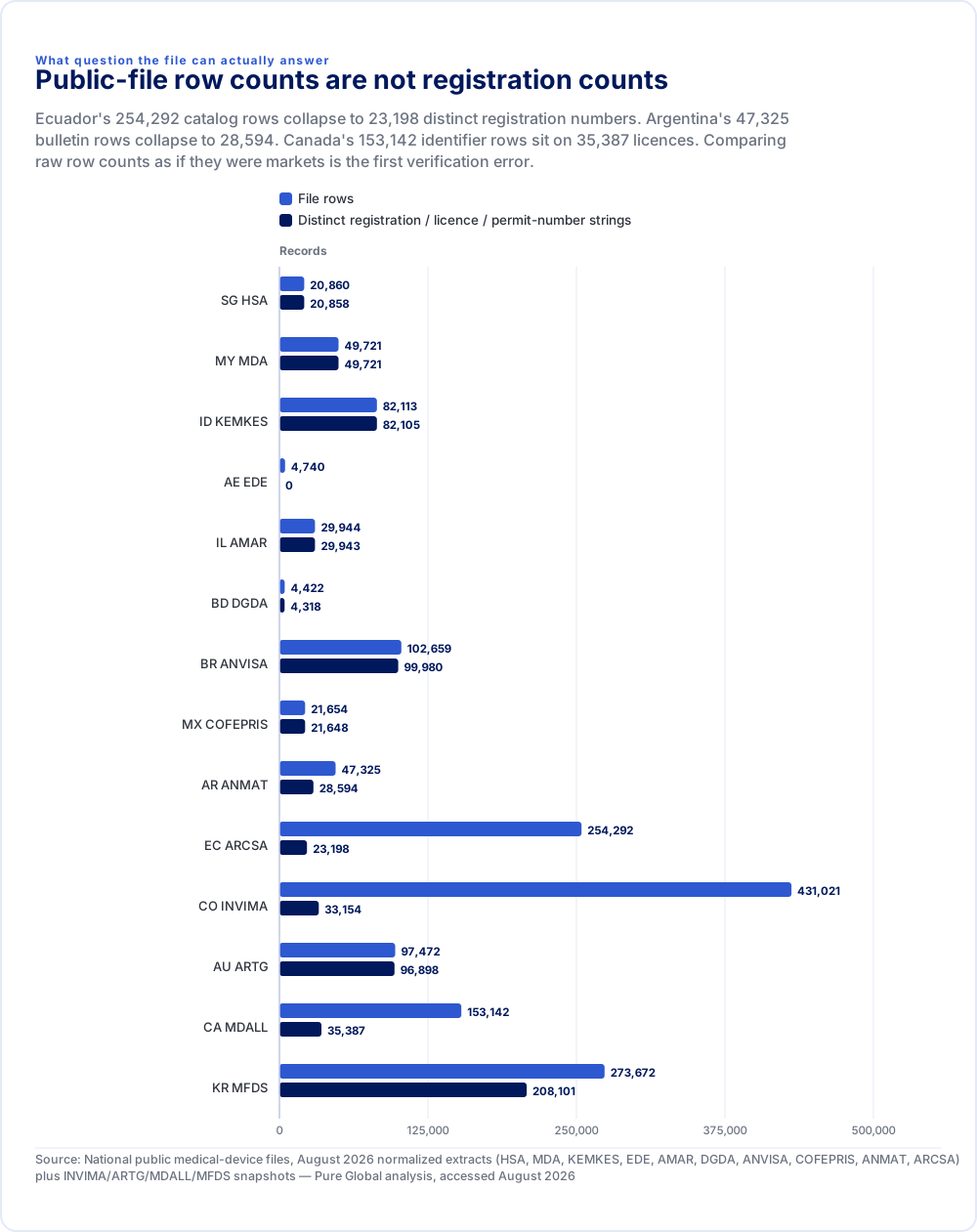
Ecuador’s ARCSA catastro holds 254,292 rows and only 23,198 distinct registration numbers — about 11 catalog items per certificate. Argentina’s ANMAT Helena bulletin holds 47,325 rows and 28,594 distinct registration numbers. Canada’s MDALL active listing holds 153,142 device-identifier rows on 35,387 licences. Rank those files by raw rows and Ecuador looks like a giant device market. Rank them by certificates and it is a mid-size register with a fat catalog. The file did not change. The unit did. Authority files — Pure Global analysis, accessed August 2026.
Singapore’s SMDR extract in this snapshot is 20,860 rows and 20,858 registration numbers, all Class B 11,968 / C 6,296 / D 2,596. There is no Class A in that file. HSA’s own Infosearch portal splits SMDR from a separate Class A Medical Device Database; GN-15 still treats Class A as a product-notification object, not an SMDR registration 1234. A missing Class A name in SMDR is not “unregistered.” It may be on the other database.
The United Arab Emirates EDE device subset in this snapshot is 4,740 rows with zero registration numbers. Identity is a source-record key. You cannot verify “reg no. X” against this export. Manufacturer name is filled on 4,737 of 4,740 rows across 879 unique manufacturers, and this projection labels all 4,740 rows active. Completeness of a name is not completeness of an identity field. Authority file — Pure Global analysis, accessed August 2026.
Two files people treat as “the register” are not national product listings at all. FDA’s 22 July 2026 510(k) export holds 175,559 decision records. EUDAMED’s 25 July 2026 public device-model file holds 2,926,029 rows; authorised-representative name is filled on 1,419,952 (48.5%). A 510(k) number is a marketing-authorization decision. An EUDAMED model without a visible AR name is a fill limitation of the public extract, not proof that no AR exists 567.
Counts are records, not installed base. A missing name match is not an illegal product. This paper is a verification workpaper: what is a row? It is not another product-category market-access hub. Adjacent Pure Global Deep Research pieces map coronary stents, surgical robots, IVDs, orthopedic implants and the ISO 10993-1:2025 transition. Those papers ask how a device class travels. This one asks whether the CSV in your downloads folder can answer the question you think it can.
IMDRF’s inherited GHTF language still separates registration of parties from listing of devices 8. Most of the files below mix those jobs, add a third (procedure events) and a fourth (catalog lines under one certificate). The rest of this guide names the grain, maps which identity fields are actually filled, and prices the in-country work that remains when the row is missing, expired, or the wrong object. Representation fees are published and flat. No approval or timeline is guaranteed.
What question the file can actually answer
Takeaway: 20,860 Singapore rows and 254,292 Ecuador rows are not two sizes of the same object. Until you name the grain — product listing, procedure bulletin, issuance list, or catalog item — a row count is a file-size statistic, not a registration census.
| File rows | Distinct registration / licence / permit-number strings | |
|---|---|---|
| SG HSA | 20,860 | 20,858 |
| MY MDA | 49,721 | 49,721 |
| ID KEMKES | 82,113 | 82,105 |
| AE EDE | 4,740 | 0 |
| IL AMAR | 29,944 | 29,943 |
| BD DGDA | 4,422 | 4,318 |
| BR ANVISA | 102,659 | 99,980 |
| MX COFEPRIS | 21,654 | 21,648 |
| AR ANMAT | 47,325 | 28,594 |
| EC ARCSA | 254,292 | 23,198 |
| CO INVIMA | 431,021 | 33,154 |
| AU ARTG | 97,472 | 96,898 |
| CA MDALL | 153,142 | 35,387 |
| KR MFDS | 273,672 | 208,101 |
Source: National public medical-device files, August 2026 normalized extracts (HSA, MDA, KEMKES, EDE, AMAR, DGDA, ANVISA, COFEPRIS, ANMAT, ARCSA) plus INVIMA/ARTG/MDALL/MFDS snapshots — Pure Global analysis, accessed August 2026
The first verification error is ranking markets by CSV length. The August 2026 normalized extracts of ten national files, plus Colombia, Australia, Canada and Korea snapshots, produce this identity table. Distinct identity is the registration number where the file has one; for Canada it is the licence; for the UAE it is empty.
| Authority file | Rows | Distinct registration / licence numbers | Rows per distinct identity | Grain in this snapshot |
|---|---|---|---|---|
| SG HSA SMDR (B/C/D) | 20,860 | 20,858 | 1.00 | Product listing. Class A is a separate HSA database. |
| MY MDA | 49,721 | 49,721 | 1.00 | Product listing. Holder filled; manufacturer name not in this projection. |
| ID KEMKES | 82,113 | 82,105 | 1.00 | Product listing (AKD + AKL). |
| AE EDE (device subset) | 4,740 | 0 | — | Directory row. Identity is a source-record key, not a registration number. |
| IL AMAR | 29,944 | 29,943 | 1.00 | Product listing. |
| BD DGDA | 4,422 | 4,318 | 1.02 | Product listing parsed from official PDF lists. |
| BR ANVISA | 102,659 | 99,980 | 1.03 | Product listing. |
| MX COFEPRIS | 21,654 | 21,648 | 1.00 | Issuance list, not a live all-history register. |
| AR ANMAT Helena | 47,325 | 28,594 | 1.66 | Procedure-bulletin row, not a collapsed product. |
| EC ARCSA | 254,292 | 23,198 | 10.96 | Catalog item under a sanitary registration. |
| CO INVIMA | 431,021 | 33,154 | 13.00 | Sanitary-registration row, including non-device groups. |
| AU ARTG | 97,472 | 96,898 (ARTG IDs) | 1.01 | Therapeutic-goods register. Filter before calling it a device file. |
| CA MDALL | 153,142 | 35,387 licences | 4.33 | Active device-identifier rows, not collapsed licences. |
| KR MFDS | 273,672 | 208,101 (permit strings) | 1.32 | Product-grade file; DOCID is a row key, not a permit number. |
Authority files — Pure Global analysis, accessed August 2026. Official landings for the files themselves: HSA / data.gov.sg 12; MDA 910; KEMKES Infoalkes 1112; EDE 1314; Israel Medical Equipment Division (AMAR) 15; DGDA 16; ANVISA 1718; COFEPRIS 19; ANMAT Helena 2021; INVIMA 2223; ARCSA 2425; TGA ARTG 2627; Health Canada MDALL 2829; MFDS 30; PMDA 31.
| Grain | Example file | Rows in this snapshot | What a row is |
|---|---|---|---|
| Product listing | HSA SMDR (B/C/D); MDA; KEMKES; AMAR; DGDA; ANVISA | 4k–103k | One listed device / registration, with local exceptions (HSA has no Class A in this file) |
| Procedure-bulletin row | Argentina's ANMAT Helena database | 47,325 rows / 28,594 unique reg nos | A process event, not a collapsed product catalogue |
| Issuance list | COFEPRIS annual lists | 21,654 | What was issued in the published lists — not a live all-history register |
| Catalog item under a certificate | ARCSA catastro; INVIMA sanitary rows; MDALL device IDs | 153k–431k | A line item, identifier or mixed sanitary group — not one certificate = one row |
Source: Same national public-file extracts — Pure Global analysis, accessed August 2026
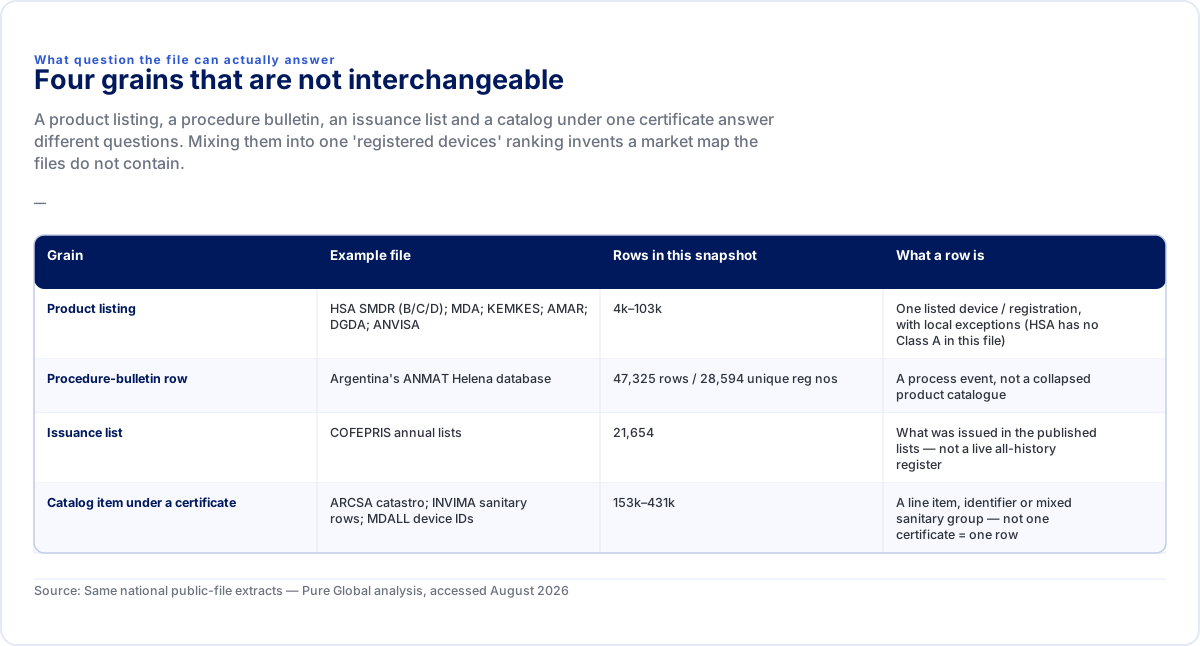
Four grains in that table are not interchangeable.
Product listing. Singapore SMDR, Malaysia MDA, Indonesia KEMKES, Israel AMAR, Bangladesh DGDA and Brazil ANVISA sit closest to “one row ≈ one listed device / registration,” with local exceptions. SMDR’s exception is structural: Class A lives elsewhere 24. MDA’s exception is a missing manufacturer-name column in this projection, not a missing legal manufacturer. KEMKES is a product listing with manufacturer country filled on 82,108 of 82,113 rows — the rare file that can answer “where was this made?” without a second join.
Procedure-bulletin row. ANMAT Helena is an electronic procedure system for medical products, including IVDs 2021. In this snapshot every row has a process number (47,325 process fills; 47,286 distinct process numbers) and a holder name (1,338 unique holders). Registration numbers collapse to 28,594. Class, manufacturer name and status are empty. A Helena row is a process event. Collapsing it into “47,325 registered devices in Argentina” invents a catalogue the bulletin does not contain. The ratio is 1.66 rows per distinct registration number. Two process rows can share a registration number because two procedures happened.
Issuance list. COFEPRIS publishes chronological lists of sanitary registrations of medical devices, with year folders on the official page 19. This snapshot holds 21,654 issuance-list rows and 21,648 registration numbers. Class is filled on 21,642 rows (I 9,920 / II 8,051 / III 3,671). Holder is filled; manufacturer name is not in this projection. An issuance list answers “what did the authority publish as issued in these lists?” It does not answer “what is valid in Mexico tomorrow?” Older stock that was never re-published in the annual packs is invisible. Using 21,654 as the historical stock of valid Mexican registrations under-counts on purpose, because the file was never that object.
Catalog item under a certificate. ARCSA’s catastro workbooks are the clearest inflation. 254,292 catalog rows sit under 23,198 registration numbers and 24,891 process numbers. Status is fully mapped: active 228,202; expired 25,577; cancelled 507; suspended 6. Holder is filled on every row (2,258 unique holders). Manufacturer name and class are empty. The official cut of the workbook is April 2026, captured in August 2026 — do not label the rows as August registrations. A single sanitary registration can carry many catalog lines: a generator, a fiber, a kit, a spare, a Spanish-language variant. Keyword “laser” hits in this extract illustrate the grain without classifying anything: several catalog lines share registration 2315-DME-0117 (ClosureFast catheter lengths), 14167-DME-0223 (FOX diode variants), DM801013 (holmium fibers). That is one certificate fan-out, not 11 separate Ecuadorian markets.
Canada and Colombia belong in the same grain family even though they are not in the ten-file v2 set. MDALL’s 153,142 active device-identifier rows collapse to 35,387 licences and 144,924 device IDs — 4.33 identifier rows per licence. INVIMA’s 431,021 sanitary rows collapse to 33,154 REGISTRO_SANITARIO values — 13.00 rows per registro. INVIMA’s own open-data title is sanitary registrations of medical devices and other groups 23. A raw INVIMA dump used as a device census is already the wrong object.
The near-1.00 ratios are the easy files, and they still lie if you skip the sister database. SMDR’s 20,860 / 20,858 is a clean product listing of B/C/D only. MDA’s 49,721 / 49,721 is a clean product listing that cannot tell you class or manufacturer name from this projection. EDE’s 4,740 / 0 is a clean directory that cannot tell you a registration number at all.
HSA’s public documentation is unusually honest about the split. The data.gov.sg SMDR csv states that SMDR is the official repository of registered medical devices with risk classification Class B, C or D, and that SMDR is also searchable on Infosearch 12. The same Infosearch page lists a Class A Medical Device Database as a separate object. GN-15 Revision 13 (March 2026) is the current product-registration guidance; the overview page says Class A devices are exempted from product registration and instead require a product-notification application in SHARE 3432. HSA also publishes a distinct Class A csv on data.gov.sg, covering March 2004 to April 2026, last updated 8 June 2026 — a different published object from the 20,860-row SMDR listing 33. If your verification playbook is “download SMDR, Ctrl-F the trade name,” you have built a Class B/C/D playbook and called it Singapore.
Malaysia’s public search is the Medical Device Authority Register / Malaysia Medical Device Register, sitting under the Medical Device Act 2012 (Act 737): no medical device shall be imported, exported or placed on the market unless registered 91034. The public search warns that a device that does not appear may be unregistered, expired, suspended or cancelled. That warning is about search recall, not about column completeness. In this snapshot every MDA row has a registration number, a holder name (2,385 unique holders), an issued-on date and an expiry date. Class fill is 0. Manufacturer-name fill is 0. The file can answer “is this registration number on the public list, who holds it, and when does it expire?” It cannot answer “what class is it?” or “who manufactured it?” from this projection. Those are still MDA questions. They are not this CSV’s questions.
Indonesia’s Infoalkes / Regalkes stack is the public face of Kemenkes marketing authorizations. AKD numbers mark locally manufactured devices; AKL numbers mark imports 111235. The extract is 82,113 rows and 82,105 registration numbers — eight spare rows, not an Ecuador-scale fan-out. Class is filled on 82,112 rows. Manufacturer country is filled on 82,108. That is the file in this set that can support an origin table without apology.
Bangladesh is the small PDF-derived listing: 4,422 rows, 4,318 distinct registration numbers, class filled on 4,415. DGDA publishes registered-device lists from the Directorate’s site 16. A 104-row gap between rows and unique registration numbers is duplication and parse residue in a PDF-origin file, not a catalog grain. Treat DGDA as a product listing with a short identity-cleaning step, not as ARCSA.
Israel AMAR is a product listing of 29,944 rows and 29,943 registration numbers. The Ministry’s Medical Equipment Division registers devices, issues import permits and publishes a registry of medical supplies 15. Manufacturer country is filled on 29,624 rows. Holder count is 732; unique manufacturer names are 10,131. That gap is the story: the legal face on the Israeli row is often a local registration holder, not the foreign factory. Searching the manufacturer’s US 510(k) applicant string in AMAR is the wrong key.
Brazil’s ANVISA export is the large product listing: 102,659 rows, 99,980 distinct registration numbers (1.03 rows per number). Class is filled on every row. Manufacturer country is filled on 102,525. Consultas and the open-data portal are the public doors 17183637. RDC 751/2022 is the classification-and-regularization rule: Class I/II notificação, Class III/IV registro 3817. The register can tell you the class. It can only sometimes tell you the expiry: 17,314 rows have an expiry date (16.9%). An absent expiry is not perpetual validity. It is a sparse field.
Read the grain table as a question filter, not as a ranking.
- “Is this registration number on the public product list?” — SMDR (B/C/D), MDA, KEMKES, AMAR, DGDA, ANVISA, with the Class A caveat in Singapore.
- “Did this procedure happen?” — ANMAT Helena.
- “Was this issued in the published annual lists?” — COFEPRIS.
- “What SKUs sit under this certificate?” — ARCSA; also INVIMA sanitary rows and MDALL identifiers.
- “What is the registration number?” — not EDE, in this export.
If the question and the grain do not match, stop. A bigger CSV will not fix a unit error. The next section asks a different question: even when the grain is right, which columns are actually filled.
The completeness map
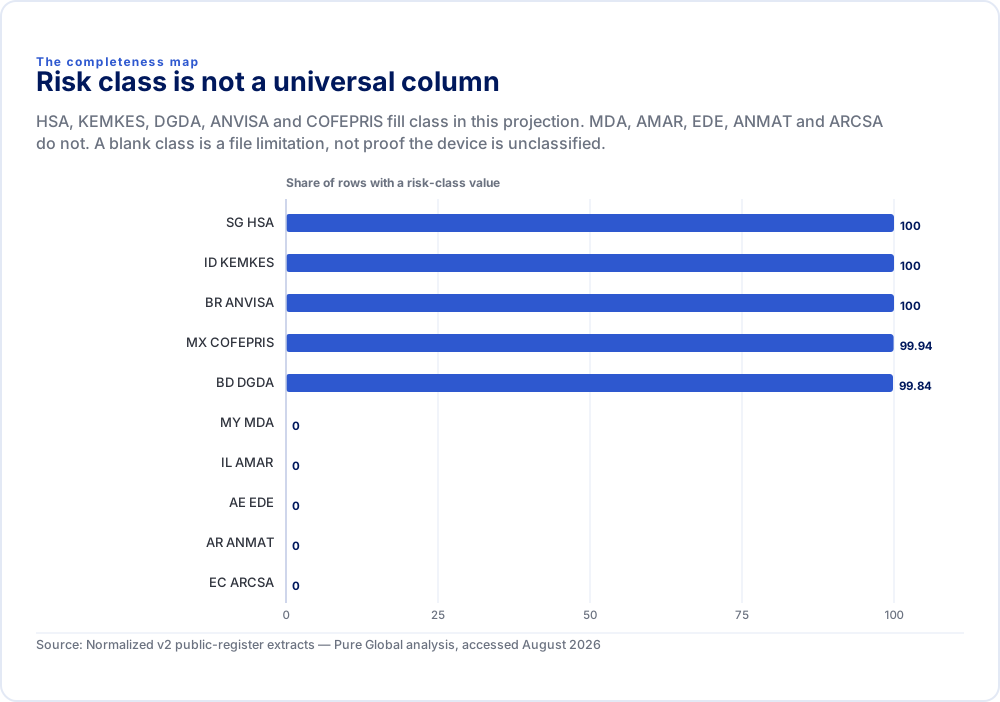
Takeaway: class is filled in five of the ten v2 files and empty in the other five. Manufacturer country is a usable column in Indonesia, Brazil and Israel, and empty in Singapore, Malaysia, UAE, Bangladesh, Mexico, Argentina and Ecuador in this projection. Singapore’s missing Class A and the UAE’s missing registration number are the two completeness failures that most often get misread as “not registered.”
| Class fill rate (%) | |
|---|---|
| SG HSA | 100 |
| ID KEMKES | 100 |
| BR ANVISA | 100 |
| MX COFEPRIS | 99.94 |
| BD DGDA | 99.84 |
| MY MDA | 0 |
| IL AMAR | 0 |
| AE EDE | 0 |
| AR ANMAT | 0 |
| EC ARCSA | 0 |
Source: Normalized v2 public-register extracts — Pure Global analysis, accessed August 2026
Class is not a universal column
| File | Rows | Class filled | Fill rate | Mix in this snapshot |
|---|---|---|---|---|
| SG HSA SMDR | 20,860 | 20,860 | 100% | B 11,968 / C 6,296 / D 2,596. No Class A. |
| ID KEMKES | 82,113 | 82,112 | 99.999% | A 25,440 / B 37,146 / C 16,907 / D 2,619 |
| BR ANVISA | 102,659 | 102,659 | 100% | I 37,381 / II 47,964 / III 11,323 / IV 5,991 |
| MX COFEPRIS | 21,654 | 21,642 | 99.94% | I 9,920 / II 8,051 / III 3,671 |
| BD DGDA | 4,422 | 4,415 | 99.84% | A 1,331 / B 1,209 / C 1,454 / D 421 |
| MY MDA | 49,721 | 0 | 0% | Empty in this projection |
| IL AMAR | 29,944 | 0 | 0% | Empty in this projection |
| AE EDE | 4,740 | 0 | 0% | Empty in this projection |
| AR ANMAT | 47,325 | 0 | 0% | Empty in this projection |
| EC ARCSA | 254,292 | 0 | 0% | Empty in this projection |
Authority files — Pure Global analysis, accessed August 2026.
HSA, KEMKES, DGDA, ANVISA and COFEPRIS fill class. MDA, AMAR, EDE, ANMAT and ARCSA do not in this projection. A blank class is a file limitation. It is not proof the device is unclassified in that jurisdiction.
Singapore’s 100% class fill is the trap inside a complete column. 20,860 = 11,968 + 6,296 + 2,596. Class B is 57.4% of SMDR rows, Class C 30.2%, Class D 12.4%. Those shares describe the SMDR object, not the Singapore market. HSA’s public risk table still has four classes: A (bandages, wheelchairs, surgical masks) through D (pacemakers, heart stents, breast implants) 39. GN-13 remains the classification guidance on HSA’s guidance index 5. Class A devices are not “too unimportant to list.” They are listed on a different public object: Infosearch’s Class A Medical Device Database, the Class A csv on data.gov.sg, and SHARE product-notification records 243332. HSA’s 2018 legislative note already said importers and manufacturers must list Class A devices on the public Class A database even where sterile Class A devices were taken off the registration track 40. If a hospital procurement team searches only SMDR, they will “fail” every Class A SKU.
Indonesia’s class mix is a four-rung ladder with a thin top: Class A 25,440 (31.0%), B 37,146 (45.2%), C 16,907 (20.6%), D 2,619 (3.2%). Class D is 2,619 of 82,113 — a real high-risk tail, not a rounding error, and not a ranking of “the Indonesian market.” Bangladesh, parsed from DGDA PDF lists, has a more even A/B/C spread and a small D tail: A 1,331, B 1,209, C 1,454, D 421. Brazil’s mix is I 37,381 (36.4%), II 47,964 (46.7%), III 11,323 (11.0%), IV 5,991 (5.8%). Mexico’s issuance lists, which have no Class IV in this scheme, are I 9,920 (45.8% of class-filled rows), II 8,051 (37.2%), III 3,671 (17.0%). Those percentages describe issued rows in the published lists, not the live stock of valid registrations.
| ANVISA class | |
|---|---|
| I | 37,381 |
| II | 47,964 |
| III | 11,323 |
| IV | 5,991 |
Source: ANVISA public medical-device export — Pure Global analysis, accessed August 2026
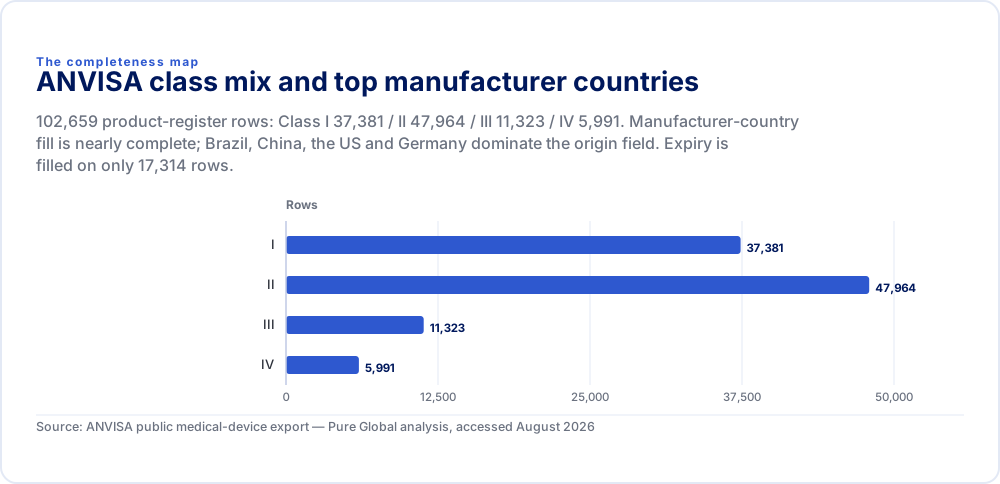
ANVISA is the completeness showcase and the expiry warning in the same file. Class is 100% filled. Manufacturer country is filled on 102,525 of 102,659 rows (99.9%). Status maps to active on 85,345 rows (83.1%). Expiry is filled on 17,314 (16.9%). The origin field is dominated by Brazil 32,038, China 20,641, the United States 15,983 and Germany 8,534, then Italy 2,456, India 2,187, France 2,062, Korea 2,004, the United Kingdom 1,869, Switzerland 1,707. That is an origin census of rows, not of companies and not of units sold. Unique manufacturers in the Brazil extract are 10,768; unique holders are 4,183. The legal face of the Brazilian row is often the Brazil Registration Holder, not the factory string from a 510(k) applicant field.
Manufacturer country and manufacturer name
Manufacturer country and manufacturer name are different columns. Several files have one and not the other.
| File | Manufacturer name filled | Unique manufacturers | Manufacturer country filled | Top countries (this projection) |
|---|---|---|---|---|
| ID KEMKES | 82,108 | 9,188 | 82,108 | CN 23,804; ID 19,696; US 6,686; DE 6,514 |
| BR ANVISA | 102,520 | 10,768 | 102,525 | BR 32,038; CN 20,641; US 15,983; DE 8,534 |
| IL AMAR | 29,890 | 10,131 | 29,624 | US 8,294; DE 4,002; CN 3,813; IL 2,428 |
| AE EDE | 4,737 | 879 | 0 | Country empty; name almost complete |
| BD DGDA | 4,421 | 1,595 | 0 | Name filled; country empty |
| SG HSA | 0 | 0 | 0 | Product owner filled on 20,860; manufacturer name not in this v2 projection |
| MY MDA | 0 | 0 | 0 | Holder filled on 49,721 |
| MX COFEPRIS | 0 | 0 | 0 | Holder filled on 21,647 |
| AR ANMAT | 0 | 0 | 0 | Holder filled on 47,325 |
| EC ARCSA | 0 | 0 | 0 | Holder filled on 254,292 |
Authority files — Pure Global analysis, accessed August 2026.
Indonesia’s origin mix is the ASEAN file that can actually be cut by country. China 23,804 (29.0% of country-filled rows), Indonesia 19,696 (24.0%), the United States 6,686 (8.1%), Germany 6,514 (7.9%), then Korea 3,553, Japan 2,424, India 2,041, Italy 1,875, France 1,359, Taiwan 1,339. Unique manufacturers 9,188; unique holders 3,488. An AKL row is an import authorization sitting with an Indonesian holder. Searching the US applicant name here will under-match even when the device is on the list.
Israel inverts the usual “local manufacturing” expectation. The United States 8,294, Germany 4,002 and China 3,813 outrun Israel 2,428 on manufacturer country. Italy 1,564, the United Kingdom 1,220, France 1,088 and Switzerland 989 follow. The holder column is the local bottleneck: 732 unique holders for 10,131 manufacturer names. AMAR is a reliance-heavy register in practice; the public row still names an Israeli registration holder. Completeness of manufacturer country (29,624 / 29,944, 98.9%) does not make the holder column optional.
The UAE is the opposite completeness profile: manufacturer name on 4,737 / 4,740, manufacturer country empty, registration number empty. EDE is the federal authority for medical and pharmaceutical products; the public drug directory is the searchable face of registered products 1314. The device subset we analysed is a directory of product name, manufacturer, status and issued-on date. This projection labels all 4,740 rows active. Issued-on is filled on every row. That is a useful directory if your question is “does this product name appear, under which manufacturer, as active?” It is a dead end if your question is “what is the registration number?” Do not invent one from the source-record key and put it in a certificate tracker.
Singapore SMDR fills product owner on 20,860 / 20,860 and registrant / holder on 20,860 / 20,860, across 865 unique holders. Manufacturer name is not in this v2 projection. That is not “Singapore hid the factory.” It is a projection that keeps the legal faces HSA publishes on SMDR — product owner and registrant — and does not pretend a missing manufacturer-name field is a missing factory. GN-15 and the SHARE medical-device service still require a Singapore registrant for Class B/C/D registrations 3432. The 865 holders are the local layer. Siemens Healthcare, Johnson & Johnson International (Singapore), Abbott Laboratories (Singapore) and Medtronic International appear as high-frequency registrants on the public data.gov.sg explorer 1. Those are registrant strings, not a market-share table.
Malaysia, Mexico, Argentina and Ecuador fill the holder and skip the manufacturer. Unique holders: MDA 2,385, COFEPRIS 3,482, ANMAT 1,338, ARCSA 2,258. If the verification task is “who is legally on the row in-country?”, these files can answer. If the task is “match our legal manufacturer to the register,” they cannot, from this projection. Name-matching across scripts and languages is not legal identity in any case. Hebrew holder strings in AMAR, Spanish holder strings in ANMAT and ARCSA, and Bahasa product names in Infoalkes will break a naive English exact match even when the row exists.
Status and expiry
Status and expiry are the columns teams use to decide “still valid.” They are also the columns most often empty, sparse, or defined at the wrong grain.
| File | Status mapped in this snapshot | Expiry filled | What that supports |
|---|---|---|---|
| AE EDE | active 4,740 (100% of rows) | 0 | A directory of currently tagged-active products, no expiry column here |
| BR ANVISA | active 85,345 (83.1%) | 17,314 (16.9%) | Active is majority; expiry is sparse |
| EC ARCSA | active 228,202; expired 25,577; cancelled 507; suspended 6 | 253,860 | Status and expiry exist — at catalog-item grain |
| MY MDA | not mapped | 49,721 (100%) | Expiry exists; class does not |
| IL AMAR | not mapped | 29,944 (100%) | Expiry exists; class does not |
| ID KEMKES | not mapped | 82,113 (100%) | Issued-on and expiry both complete |
| SG HSA | not mapped | 0 | Issued-on complete; no expiry column here |
| AR ANMAT | not mapped | 0 | Procedure event, not a validity register |
| MX COFEPRIS | not mapped | 0 | Issuance list; issued-on on 20,069 rows |
| BD DGDA | not mapped | 0 | Issued-on on 4,405 rows |
| CO INVIMA | Vigente 295,296; Vencido 102,065; plus other estados | n/a (estado field) | Status exists — at sanitary-row grain, not devices-only |
Authority files — Pure Global analysis, accessed August 2026.
MDA and KEMKES are the unglamorous completeness wins: every row has an expiry date. If the question is “when does this Malaysian or Indonesian registration number expire?”, those files can answer. If the question is “what class is this Malaysian device?”, MDA cannot, here.
ANVISA’s 17,314 expiry fills against 102,659 rows is the number that should sit on a sticky note. 83.1% of rows map to active, which looks like a live register. 16.9% have an expiry date, which is not how a live register’s validity column is supposed to look if you expected every row to carry a clock. RDC 751 still distinguishes notification from registro 38. The export does not turn a blank expiry into a perpetual certificate. Confirm validity in Consultas or the current certificate, not by inferring immortality from a null 18.
ARCSA’s status mix is complete and easy to misuse. 228,202 active catalog items are 89.7% of rows. 25,577 expired items are 10.1%. Cancelled 507 and suspended 6 are the thin tail. Because the grain is a catalog item, “89.7% active” is not “89.7% of Ecuadorian certificates are active.” The same registration number can contribute active and expired lines if the workbook keeps history at SKU level. Expired 25,577 catalog lines are not 25,577 dead companies.
INVIMA’s estado mix is larger and more honest about being a sanitary file rather than a shop window. Of 431,021 rows: Vigente 295,296 (68.5%), Vencido 102,065 (23.7%), Pérdida de fuerza ejecutoria 11,554, Cancelado 11,056, Negado 2,855, En estudio 2,727, En trámite de renovación 2,455, Suspendido 1,263, plus smaller buckets (abandono, desistido, no aplica, revocado). A Vencido row is a record of an expired sanitary registration line, not a device that “failed INVIMA.” Counting only Vigente still leaves you with 295,296 rows and only 33,154 distinct registro numbers. Status filters do not collapse grain.
Singapore SMDR in this projection has issued-on on every row and no expiry column. HSA registrations remain listings on SMDR until cancelled or changed; validity is not a simple “expires on” cell in this extract. Do not read a missing expiry as “Singapore never expires devices.” Read it as “this file does not carry that field.” Change notification and cancellation are separate HSA procedures 532.
Identity fields that are filled instead
When manufacturer name is empty, something else is usually full. That something else is often the field you should have been joining on.
| File | Unique holders | Unique manufacturers | Unique registration numbers | Other identity |
|---|---|---|---|---|
| SG HSA | 865 | 0 | 20,858 | Product owner filled 20,860 |
| MY MDA | 2,385 | 0 | 49,721 | — |
| ID KEMKES | 3,488 | 9,188 | 82,105 | — |
| AE EDE | 0 | 879 | 0 | source-record keys 4,740 |
| IL AMAR | 732 | 10,131 | 29,943 | — |
| BD DGDA | 1,069 | 1,595 | 4,318 | — |
| BR ANVISA | 4,183 | 10,768 | 99,980 | process numbers 99,980 |
| MX COFEPRIS | 3,482 | 0 | 21,648 | — |
| AR ANMAT | 1,338 | 0 | 28,594 | process numbers 47,286 |
| EC ARCSA | 2,258 | 0 | 23,198 | process numbers 24,891 |
Authority files — Pure Global analysis, accessed August 2026.
Argentina is the process-number file. 47,286 distinct process numbers against 28,594 registration numbers is the bulletin. Ecuador is the catalog-plus-process file: 24,891 process numbers, 23,198 registration numbers, 254,292 rows. Brazil’s process number matches the registration-number count at 99,980 — a product listing that happens to carry both labels, not a Helena-style event log.
Two completeness failures deserve to be restated in operational language.
Singapore missing Class A. Searching SMDR for a Class A device and finding nothing is consistent with a correctly regulated Class A notification that lives on the Class A database 2433. It is also consistent with a device that was never notified. The SMDR miss does not distinguish those cases. Open Infosearch’s Class A object, or the Class A csv, before you write “unregistered in Singapore.”
UAE missing registration number. Searching the EDE device subset for a registration number will always miss, because the field is empty on all 4,740 rows. Search product name and manufacturer instead, then confirm the current EDE marketing-authorization record through the authority’s service — the directory is not the certificate 1314.
Keyword hits are not a third completeness column. Laser-regex hits in SMDR were 103; ultrasound-string hits 701. Malaysia 49 laser / 558 ultrasound. Indonesia 69 / 1,647. Israel 88 / 414. Ecuador 43 / 625. Those counts are a reminder that string search across product names is not classification. SMDR’s 103 laser hits include generators, fibers, aesthetic platforms and at least one collagen matrix whose name matched the regex. EUDAMED’s 770 laser and 3,028 ultrasound hits across 2.9 million names are the same warning at a larger scale. Do not turn a regex into a product-code census.
The two files people confuse with registers
Takeaway: a US 510(k) row is a marketing-authorization decision. An EUDAMED row is a device model in a 2.9-million-row UDI file, with authorised-representative name filled on only 48.5% of models. Neither file is a live national product register in the SMDR/MDA/ANVISA sense, and neither proves foreign listing.
FDA 510(k): 175,559 decisions, not a live listing
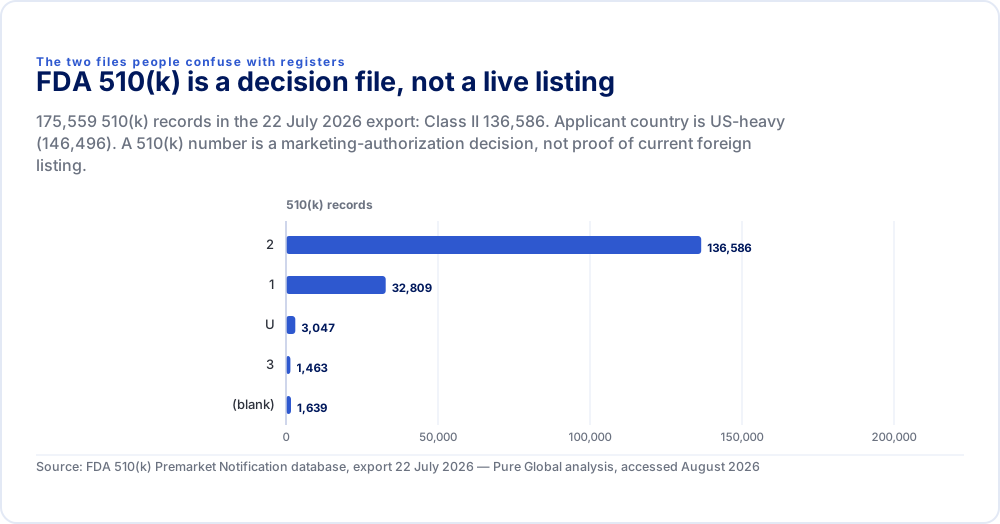
| Device class in 510(k) file | |
|---|---|
| 2 | 136,586 |
| 1 | 32,809 |
| U | 3,047 |
| 3 | 1,463 |
| (blank) | 1,639 |
Source: FDA 510(k) Premarket Notification database, export 22 July 2026 — Pure Global analysis, accessed August 2026
FDA’s 510(k) Premarket Notification database is a search-and-download of clearance decisions 4142. The 22 July 2026 export holds 175,559 records. Unique normalized applicants: 31,763. Device class 2: 136,586 (77.8%). Class 1: 32,809. Unclassified (U): 3,047. Class 3: 1,463. Blank class: 1,639. Applicant country is US-heavy: United States 146,496 (83.4%), China 5,589, Germany 2,451, Canada 2,235, Korea 2,025, Taiwan 1,918, United Kingdom 1,866, Israel 1,668, Malaysia 1,326, Japan 1,242. Authority file — Pure Global analysis, accessed August 2026.
Decision years 2023–2026 in this export: 3,346 / 3,129 / 3,225 / 1,764. 2026 is a partial year through 22 July, not a collapse of the 510(k) programme. Rows in 2023–2026 total 11,464, from 4,797 unique normalized applicants in that window. The long file is a history of decisions. It includes devices later withdrawn, devices never launched, and devices whose current listing lives in a different FDA object.
That different object is establishment registration and device listing under 21 CFR Part 807 434445. The 22 July 2026 registration-and-listing export holds 419,651 establishment-type rows. Top types: Manufacture 118,319; contract manufacturer 68,878; contract sterilizer 39,376; export-only (no other operation) 36,567; specification developer 31,872; repack or relabel 30,711; complaint-file establishment 19,040. Combined-type rows exist (manufacture plus complaint file, export-only plus manufacture). There is no establishment type named “independent servicer.” Registration tells FDA where establishments are and which devices they handle. Listing is not a 510(k). A 510(k) is not a listing. Confusing the two is how a team “finds” a predicate in the 510(k) database and concludes the device is currently offered for sale in the United States by that applicant.
PMA is the third US object in the same download cluster: 56,765 PMA rows in the 22 July 2026 export 4647. Classification codes: 7,084 in the same day’s classification export 48. A product code is a classification key, not a register row. Keyword “laser” inside the classification file hits codes that include surgical lasers and CD players, lidar, and veterinary lasers — another reminder that a string is not a class.
MDUFA FY2026 prices the decision, not the listing. The standard 510(k) fee is $26,067 (small business $6,517). Establishment registration is $11,423 per year. A PMA is $579,272 standard 4950. Those fees are the US government clock. They do not buy a Singapore SMDR row, an ANVISA cadastro, or an EUDAMED AR appointment.
A 510(k) therefore answers: “did FDA find this device substantially equivalent, on this decision date, under this product code, for this applicant?” It does not answer: “may I sell this in Malaysia next quarter?” IMDRF/GHTF language keeps registration of establishments and listing of devices as distinct from premarket review 8. FDA’s own 510(k) and PMA explainers say the same in US vocabulary 5152. Carrying a K-number into an HSA search is evidence for an abridged evaluation route under GN-15, when the conditions are met — not a substitute for the Singapore listing 34.
EUDAMED: 2,926,029 models, AR name on 48.5%
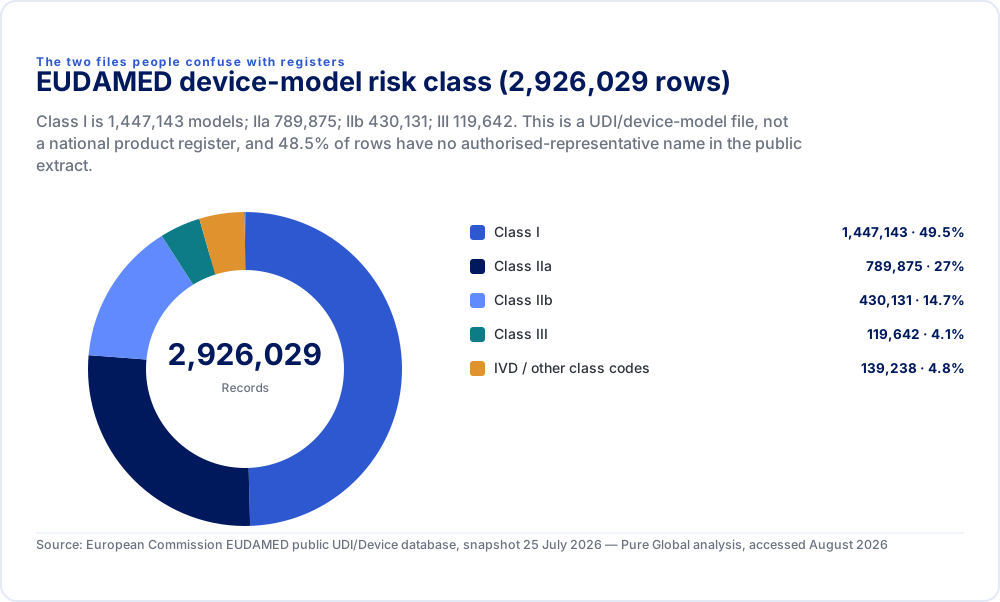
| Count | |
|---|---|
| Class I | 1,447,143 |
| Class IIa | 789,875 |
| Class IIb | 430,131 |
| Class III | 119,642 |
| IVD / other class codes | 139,238 |
Source: European Commission EUDAMED public UDI/Device database, snapshot 25 July 2026 — Pure Global analysis, accessed August 2026
EUDAMED is the European database on medical devices established by MDR 2017/745 and IVDR 2017/746 753546. The public UDI/Device module is a model file. The 25 July 2026 snapshot holds 2,926,029 unique rows, matching the upstream total. UDI/device registration in the module became mandatory on 28 May 2026; this snapshot is an early mandatory-era extract, not a finished inventory of every device on the Union market 5553.
Risk-class codes as stored:
| Class code (as stored) | Rows |
|---|---|
| Class I | 1,447,143 |
| Class IIa | 789,875 |
| Class IIb | 430,131 |
| Class III | 119,642 |
| IVD general | 57,046 |
| Class A (IVD-style code) | 55,926 |
| Class B | 13,874 |
| Class C | 8,141 |
| IVD Annex II list B | 1,755 |
| IVD self-testing | 1,664 |
| IVD Annex II list A | 441 |
| AIMDD | 275 |
| Class D | 116 |
Class I is 49.5% of the file; IIa 27.0%; IIb 14.7%; III 4.1%. IVD and residual class codes make up the rest (139,238 in the chart’s residual bucket). This is a Union model mix, not a ranking of national registers. Comparing “EUDAMED 2.9 million” with “SMDR 20,860” without naming grain is the same error as comparing ARCSA with SMDR.
Device-model status: on-the-market 2,868,528 (98.0%); no-longer-on-the-market 32,130; not intended for EU market 25,371. Manufacturer name is filled on 2,926,029 — 100%. Authorised-representative name is filled on 1,419,952 — 48.5%. Authority file — Pure Global analysis, accessed August 2026.
The AR fill rate is the number that gets abused in due-diligence decks. MDR requires an authorised representative when the manufacturer is not established in the Union 6. A public extract with AR name blank on 1,506,077 models does not prove those models have no AR. It proves this public field is incomplete. Possible reasons include EU-established manufacturers (no AR required), module timing around the May 2026 mandate, actor-module linkage that does not project into this name field, and genuine gaps. The extract cannot tell those apart. Treat 48.5% as a fill rate, not as a census of appointed representatives.
EUDAMED also does not replace a UK MHRA registration, a Swiss representative, or a national product register in Singapore or Brazil. MHRA still requires registration before placing devices on the Great Britain market; registration with MHRA is not accreditation or endorsement 5657. An EUDAMED on-the-market flag is not an MHRA DORS record.
Ultrasound-string hits 3,028 and laser-regex hits 770 in this 2.9-million-name file are recorded only as a negative control. Keyword search is not EMDN classification and not a product-code map.
The operational join from this section is narrow. If you hold a 510(k) or an EU certificate and you are staring at a foreign CSV:
- The 510(k) or EUDAMED row is reference evidence, not the foreign listing.
- The foreign file may not even be a listing (Helena, COFEPRIS lists, ARCSA catastro, EDE directory).
- EUDAMED AR-name blank is not “we can skip the AR.”
- FDA listing under Part 807 is the US live-establishment object; 510(k) is the decision object 4344.
WHO’s Global Model Regulatory Framework still points regulators at GHTF/IMDRF definitions of registration and listing as the vocabulary for this distinction 588. The next section adds four national files that fail the same test in different ways.
Four extra national files
Takeaway: ARTG is a therapeutic-goods register until you filter it (61,995 medical-device rows of 97,472). MDALL is an identifier file (153,142 rows on 35,387 licences). MFDS is a graded product file with a large withdrawn tail. Japan’s PMDA public crawl in this snapshot is mostly 添付文書 (package inserts / IFUs), not a registration register.
Australia ARTG: filter medicines out before you call it a device register
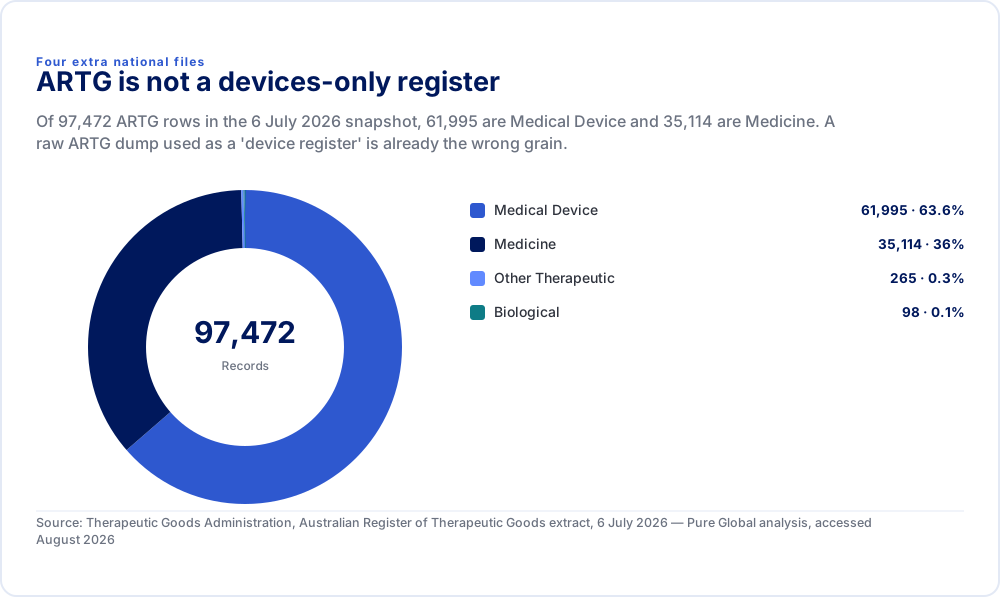
| Count | |
|---|---|
| Medical Device | 61,995 |
| Medicine | 35,114 |
| Other Therapeutic | 265 |
| Biological | 98 |
Source: Therapeutic Goods Administration, Australian Register of Therapeutic Goods extract, 6 July 2026 — Pure Global analysis, accessed August 2026
The Australian Register of Therapeutic Goods is the public database of therapeutic goods that can be legally supplied in Australia 262759. The 6 July 2026 snapshot holds 97,472 rows and 96,898 distinct artg_id values, or 1.01 rows per ARTG ID. Therapeutic type: Medical Device 61,995 (63.6%), Medicine 35,114 (36.0%), Other Therapeutic 265, Biological 98. A raw ARTG dump used as a “device register” is already 35,114 medicines plus biologicals and other goods. Authority file — Pure Global analysis, accessed August 2026.
ARTG category is a second grain inside the same file: Included 56,626; Registered 20,241; Listed 11,913; Listed (Export Only) 2,913; Included – IVD 2,881; Included (Export Only) 2,505; plus smaller disinfectant and provisional buckets. “Included” medical devices and “registered” medicines are not the same regulatory object. TGA’s search guidance is explicit that you can search medicines and devices in one box 27. That convenience is why unfiltered dumps mislead.
A foreign manufacturer places devices through an Australian Sponsor. The ARTG public summary names the sponsor, not necessarily the US 510(k) applicant. Sponsor is the identity field for verification; ARTG ID is the listing key. Export-only inclusions are not an Australian commercial listing. Counting 97,472 as “Australian device registrations” inflates the device stock by every medicine, biological, disinfectant and export-only row in the extract.
Laser-string hits 63 and ultrasound-string hits 874 in this snapshot are, again, name filters. They do not classify the 61,995 device rows.
Canada MDALL: 4.33 identifier rows per licence
Health Canada’s Medical Devices Active Licence Listing is the public query of Class II–IV licensed devices 2829. Class I devices do not require a medical device licence; they sit under establishment licensing instead 2860. The 6 July 2026 active-device extract holds 153,142 rows, 35,387 distinct licences, 144,924 device IDs. Trade name is filled on every row. End-date fill is 0 in this extract — an active listing snapshot, not a history of cancelled licences. Authority file — Pure Global analysis, accessed August 2026.
153,142 / 35,387 = 4.33 identifier rows per licence. A licence is the Health Canada object a manufacturer holds. A device identifier (often a catalogue number) is the SKU-level key. Searching MDALL by identifier and reporting “153,000 Canadian licences” is the ARCSA error in English. Searching by licence number and expecting one trade name will miss the other identifiers on the same licence.
MDALL is also not a Canadian authorised-representative register. Health Canada’s structure is manufacturer licensing (MDL for Class II–IV) plus importer/distributor establishment licensing (MDEL). The MDEL listing is a different public object: it names establishments and activities, not the catalogue of licensed devices 6162. Pure Global does not publish a “Canadian representative” appointment line; Canada is priced as compilation, not as a named local-representative role. That is a service-map fact, not a claim that Canada has no importer duties.
Korea MFDS: grades plus a withdrawn tail
MFDS classifies devices in four grades and publishes product and approval-process information in English 3063. The 5 June 2026 extract holds 273,672 rows, 208,101 distinct non-empty permit-number strings and 214,690 item sequences. The 273,672 unique DOCIDs are source-row keys, not evidence of 273,672 distinct permits; the file averages 1.32 rows per permit string. Grade filled on 272,966: grade 1 160,381 (58.8% of graded rows), 2 77,538 (28.4%), 3 25,868 (9.5%), 4 9,179 (3.4%). Authority file — Pure Global analysis, accessed August 2026.
Item state is the column that stops a naive “273,672 registered devices in Korea” slide:
| Item state (as stored) | Rows |
|---|---|
| 정상 (normal / active) | 136,487 |
| 취하 (withdrawn) | 111,992 |
| 만료(유효기간) (expired) | 9,480 |
| 취소 (cancelled) | 8,945 |
| 양도 (transferred) | 6,768 |
Cancel flag: Y 137,185 / N 136,487. Active-looking “정상” is 49.9% of rows, not the whole file. Withdrawn 111,992 is 40.9%. A dump that does not filter item state will almost double the live stock. Grade 1 is the bulk of the file because low-risk products dominate any unfiltered product list — the same shape as EUDAMED Class I and ANVISA Class I/II, and still not a market-size number.
Laser hits 29 and ultrasound hits 2,995 in this extract follow the same keyword warning. Ultrasound-string density is high because the Korean product-name field is long and descriptive; it is not a count of diagnostic scanners.
Japan PMDA: an IFU crawl is not a register
PMDA’s English portal points to Japanese-language search systems for package inserts, review reports and safety information 3164. Electronic package-insert posting on the PMDA system has been required for medical devices and IVDs 65. The non-drug public crawl summarised for this snapshot held 269,816 manifest rows, of which 257,679 were tagged medical_device and 249,245 of those were 添付文書 — package inserts / instructions for use.
That is a document crawl, not a shonin/ninsho registration register. Using “~257k Japanese medical-device documents” as “how many devices are registered in Japan” is a grain error on the same order as using ARCSA’s 254,292 catalog lines as 254,292 certificates. Japan’s actual marketing-authorization objects remain Class I notification, Class II/III certification, and Class III/IV approval, with a licensed MAH or DMAH for foreign manufacturers 66. Pure Global does not publish a Japan MAH fee in the Master Price List; that engagement is quote-on-request Pure Global pricingPure Global US market page. Do not invent a fee, and do not invent a registration census from an IFU folder.
INVIMA, again, as a sanitary overlay — not a fourth extra of the same kind
Colombia was already in the grain table. It belongs next to ARTG as a mixed sanitary file. Nivel de riesgo is filled on 422,457 of 431,021 rows (98.0%): I 153,126, IIa 134,376, II 46,530, IIb 34,137, III 54,164, plus a 124-row IIA variant. Holder country (país titular) is filled on every row: Colombia 278,961, United States 73,902, Germany 14,444, China 8,812, Spain 8,736. Those are sanitary-row origins, including non-device groups. Filter product group before you brief a device launch.
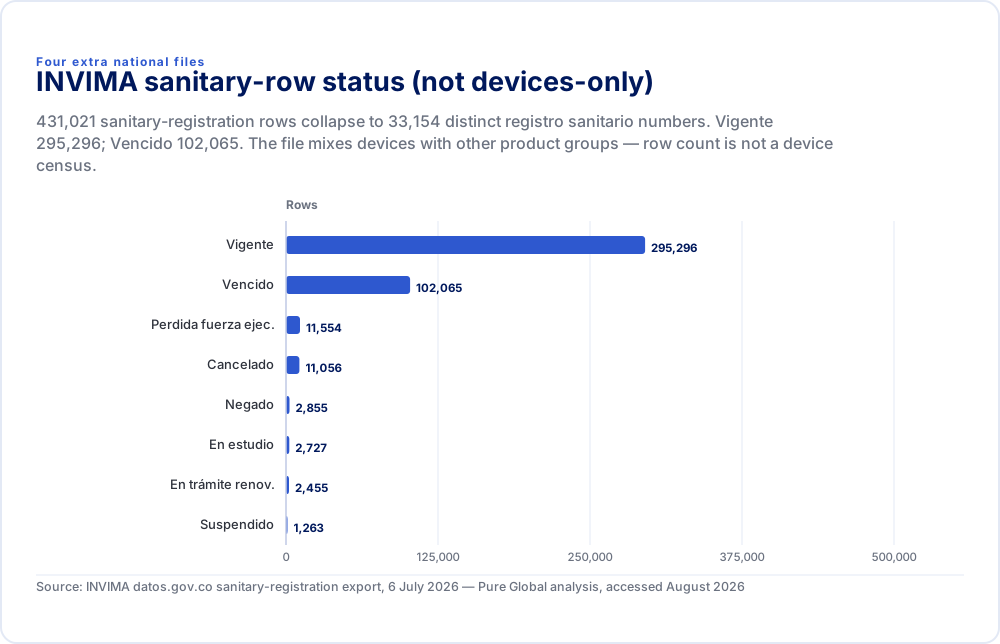
| Estado | |
|---|---|
| Vigente | 295,296 |
| Vencido | 102,065 |
| Perdida fuerza ejec. | 11,554 |
| Cancelado | 11,056 |
| Negado | 2,855 |
| En estudio | 2,727 |
| En trámite renov. | 2,455 |
| Suspendido | 1,263 |
Source: INVIMA datos.gov.co sanitary-registration export, 6 July 2026 — Pure Global analysis, accessed August 2026
Vigente 295,296 versus Vencido 102,065 is the status conversation procurement actually has. A Vencido sanitary row is not a current licence. It is also not proof the product was never authorised. Keep the distinct registro count (33,154) in the same sentence as the row count (431,021) or you will brief the wrong altitude.
A verification sequence
Takeaway: pick the grain, lock the identity field the file actually fills, check status and expiry at that grain, then decide whether in-country representation is still the missing layer. A US 510(k) or EU certificate is reference evidence. It is not the foreign row.
A workable sequence, derived from the files above rather than from a generic RA checklist:
1. Write the question in one sentence that names the unit. “Is registration number DE0502179 on SMDR as Class C?” is a question SMDR can answer. “How many devices are registered in Ecuador?” is not a question the catastro can answer until you say certificates (23,198) or catalog lines (254,292). “Is this Class A listed in Singapore?” is an Infosearch Class A question, not an SMDR question 24.
2. Identify the grain of the file you actually downloaded. Product listing (SMDR B/C/D, MDA, KEMKES, AMAR, DGDA, ANVISA). Procedure bulletin (Helena). Issuance list (COFEPRIS). Catalog / identifier / mixed sanitary (ARCSA, MDALL, INVIMA). Directory without registration numbers (EDE). Decision file (510(k), PMA). Model file (EUDAMED). Document crawl (PMDA IFUs). Therapeutic-goods mix (ARTG). If the grain is wrong, do not proceed to a name search. You will get a precise answer to a different question.
3. Lock the identity field the file fills. Registration number where it exists (SMDR, MDA, KEMKES, AMAR, DGDA, ANVISA, COFEPRIS lists). Process number for Helena events. Source-record key plus product name plus manufacturer for EDE. Licence number and device identifier for MDALL. REGISTRO_SANITARIO for INVIMA, not row number. ARTG ID after filtering therapeutic type to Medical Device. Do not lock on manufacturer legal name in SMDR, MDA, COFEPRIS, ANMAT or ARCSA in this projection — the column is empty. Do not lock on registration number in EDE — the column is empty.
4. Only then search names, and treat names as clues. Holder strings, product-owner strings, Hebrew/Spanish/Bahasa trade names, and 510(k) applicant strings are different alphabets of the same commercial story. Israel’s 732 holders versus 10,131 manufacturers is the quantitative version of that warning. A miss on an English manufacturer name in AMAR or ANMAT is not a finding of non-registration.
5. Read class, status and expiry as file-specific. Class empty in MDA/AMAR/EDE/Helena/ARCSA means “not in this projection,” not “unclassified.” Expiry empty in ANVISA on 85,345 active-mapped rows that lack an expiry date means “field sparse,” not “valid forever.” ARCSA status is catalog-item status. INVIMA estado is sanitary-row estado. MFDS item state must be filtered to 정상 before you brief a live stock. SMDR has no Class A and no expiry column here.
6. Open the sister object when the architecture has one. Singapore: SMDR and Class A database and dealer’s licence database on Infosearch 2. The April 2026 SMDR csv also has an xlsx twin on data.gov.sg — same listing family, different packaging 67. Malaysia: MMDR and MDAR 1068. Indonesia: Infoalkes search and the Farmalkes service index that still points at Info Alkes & PKRT 1269. Argentina: Helena and the ANMAT agency landing 2170. Mexico: the annual lists and the COFEPRIS home visor 1971. Brazil: Consultas and the produtos-para-a-saúde entry on consulta a registro 1872. Canada: MDALL and MDEL 2961. United States: 510(k) or PMA and registration/listing 4145. EU: EUDAMED device module and actor module; AR name fill 48.5% is not the actor census 753. Japan: do not use an IFU crawl as the sister of shonin.
7. Confirm the official cut date. ARCSA’s workbook is an April 2026 official cut captured in August 2026. ARTG, MDALL and INVIMA snapshots used here are 6 July 2026. MFDS is 5 June 2026. EUDAMED is 25 July 2026. FDA exports are 22 July 2026. SMDR’s public csv is the April 2026 listing 1. A July search on a live portal can disagree with an April dump without either being “wrong.”
8. Decide what remaining work is legal, not what remaining work is a Ctrl-F miss. If the row is the right grain, the identity matches, and status is current, you still may need a named local role: US Agent, EU AR, UKRP, Australian Sponsor, Singapore Registrant, Brazil Registration Holder, Mexican registration holder, Israeli IRH, Malaysian AR, Indonesian licence holder. Canada still needs MDL/MDEL allocation even without a Pure Global “Canadian representative” line 62Pure Global pricing. Japan still needs a MAH. A found row does not appoint those roles. A missing row does not tell you which role to appoint until you know whether the miss was grain, class-split, or a genuine gap.
9. Keep 510(k) and EUDAMED in a reference folder, not in the foreign-listing column. GN-15 abridged/expedited routes can use reference-agency approvals 34. ANVISA’s RDC 751/2022 internalizes Mercosur GMC 25/2021 and still requires a Brazilian regularization file 3873. IMDRF remains the vocabulary layer — registration of parties versus listing of devices — and FDA publishes its own IMDRF page as a US reading of that forum 874. The Commission’s EUDAMED hub is the Union IT system, not a national product register 75. FDA’s IMDRF explainer is the US door into the same definitions 76. INVIMA’s institutional site and Ecuador’s Ministry of Public Health ARCSA index are the parent landings for those sanitary files 7778. Reliance shortens evaluation when the conditions are met. It does not write the foreign row by itself.
This sequence is a verification playbook. It is not a promise that a given dossier will be accepted on a given clock.
What it costs when the row is the wrong object
Takeaway: government fees are the smaller published number. The expensive mistake is compiling the wrong file — a 510(k) mental model for a listing market, an SMDR search for a Class A device, an ARCSA row count as a certificate census — and then discovering the local role was never appointed. Pure Global’s published representation fees are identical to the other Deep Research reports: they track market and risk class, not device type.
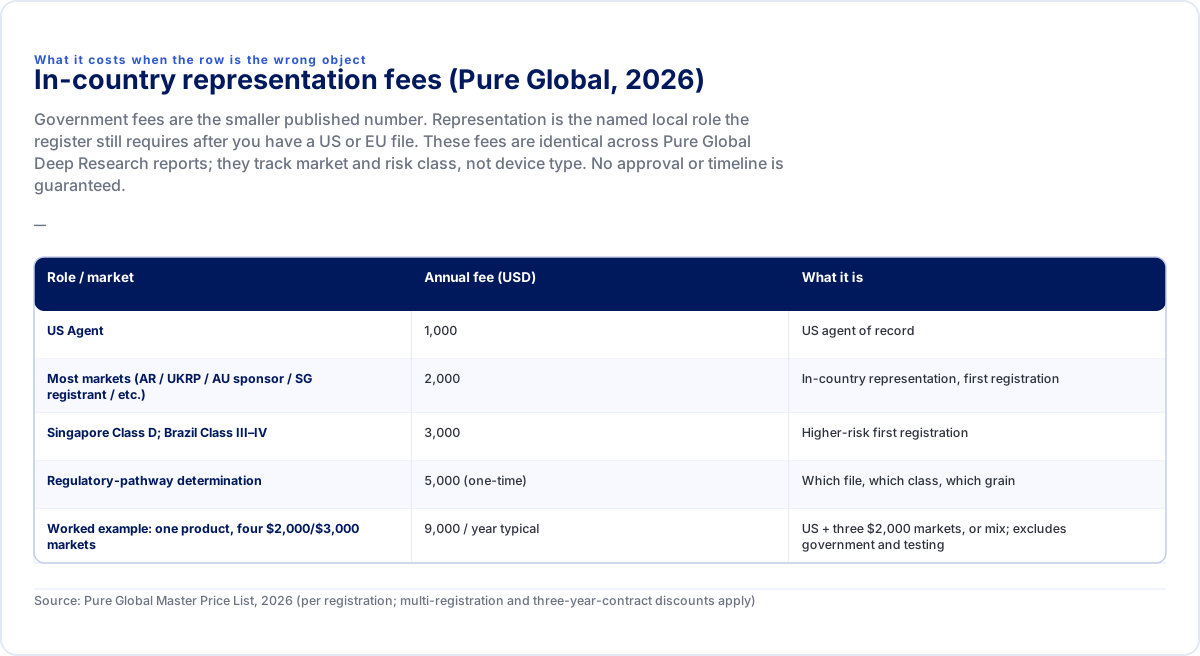
| Role / market | Annual fee (USD) | What it is |
|---|---|---|
| US Agent | 1,000 | US agent of record |
| Most markets (AR / UKRP / AU sponsor / SG registrant / etc.) | 2,000 | In-country representation, first registration |
| Singapore Class D; Brazil Class III–IV | 3,000 | Higher-risk first registration |
| Regulatory-pathway determination | 5,000 (one-time) | Which file, which class, which grain |
| Worked example: one product, four $2,000/$3,000 markets | 9,000 / year typical | US + three $2,000 markets, or mix; excludes government and testing |
Source: Pure Global Master Price List, 2026 (per registration; multi-registration and three-year-contract discounts apply)
Government fees are context, not the programme
FY2026 FDA user fees are the US context: 510(k) $26,067 standard / $6,517 small business; establishment registration $11,423; PMA $579,272 standard 49. MHRA’s Great Britain registration fee from 1 April 2026 is GBP 300 per year per level-2 GMDN category 56. Those numbers buy a decision or a national registration entry in that system. They do not buy a Brazilian registro, a Singapore Class D listing, or an Israeli AMAR certificate.
The register-verification error has a fee shape. If you treat a 510(k) as global listing, you budget a US decision and under-budget every local role. If you treat SMDR as all of Singapore, you may skip Class A notification and still be unlisted on the database hospitals actually search for low-risk SKUs 433. If you treat COFEPRIS annual lists as the live stock, you may conclude a 2018 registration is dead because it did not reappear in the 2024–2026 packs 19. Each of those is a dossier and a calendar, not a Ctrl-F.
Pure Global in-country representation (Master Price List, 2026)
| Role / market | Annual fee (USD) | What it is |
|---|---|---|
| US Agent | 1,000 | US agent of record |
| Most markets (EU AR, UKRP, Australian Sponsor, Singapore Registrant, and equivalents) | 2,000 | In-country representation, first registration |
| Singapore Class D; Brazil Class III–IV | 3,000 | Higher-risk first registration |
| Regulatory-pathway determination | 5,000 (one-time) | Which file, which class, which grain |
| Worked example: one product, four markets | 9,000 / year typical | US Agent + three $2,000 markets, or a $1,000/$2,000/$3,000 mix; excludes government and testing |
Source: Pure Global Master Price List, 2026 (per registration; multi-registration and three-year-contract discounts apply) Pure Global pricingPure Global US market page.
The $2,000 / $3,000 annual line is the bundled local role: submission on a reference approval where that is the agreed scope, renewals, modifications, and authority correspondence. It does not include government fees, notified-body fees, testing, clinical investigations, or translations from languages other than English. It does not guarantee approval or a timeline.
Canada has no Pure Global “Canadian representative” line in this published map. Health Canada’s manufacturer/importer structure is MDL plus MDEL, not an EU-style AR appointment 6261. Pure Global prices Canada compilation in a range of $3,000–$25,000, not an annual representative appointment Pure Global pricing.
Japan MAH is not in the published price list. Quote on request Pure Global pricing66.
One-time compilation ranges (same numbers as the other reports)
| Work | Typical published range (USD) |
|---|---|
| Regulatory-pathway determination | 5,000 flat |
| US 510(k) compilation | 15,000–20,000 |
| EU clinical evaluation report (CER), by class | up to 30,000 |
| Canada compilation | 3,000–25,000 |
Source: Pure Global Master Price List, 2026 Pure Global pricingPure Global US market page. Compilation is a dossier project. Representation is the named local role that remains after the dossier exists. Mixing the two invoices is how a spreadsheet shows “we already paid for Brazil” when the payment was a US 510(k) compile.
Worked four-market example: $9,000 per year
One product, four markets, representation only:
- United States, US Agent: $1,000
- Australia, Sponsor: $2,000
- Singapore, Class B or C Registrant: $2,000
- Malaysia, Authorised Representative: $2,000
- Total: $7,000 / year
Swap Singapore to Class D ($3,000) and replace Malaysia with Brazil Class III–IV ($3,000), keep US Agent ($1,000) and Australia ($2,000): $9,000 / year. That is the worked example used across Pure Global Deep Research reports — one product, four markets, $9,000 / year typical for a $1,000 + $2,000 + $3,000 + $3,000 mix, or US plus three $2,000 markets at $7,000. The published slide uses $9,000 / year as the four-market planning number Pure Global pricing.
Add the pathway-determination $5,000 once, at the front, if the grain is genuinely unclear — SMDR versus Class A, COFEPRIS list versus live stock, ARCSA catalog versus certificate, 510(k) versus listing, EUDAMED model versus national file. That $5,000 is cheap against a $15,000–$20,000 510(k) compile spent on a device that needed a PMA, or against a Brazil Class IV registro treated as a notification, or against a Singapore Class D file built as if Class A notification were enough.
None of these figures is a quote for a specific SKU. Multi-registration and three-year-contract discounts apply. Government, laboratory, notified-body, MAH and clinical costs sit outside the table. No approval or timeline is guaranteed.
Frequently asked questions
Why is my Class A device missing from the Singapore SMDR csv?
Because SMDR in the public April 2026 listing is Class B, C and D. This snapshot is 20,860 rows: B 11,968, C 6,296, D 2,596, and zero Class A 1. Class A devices are exempted from product registration and are notified, then listed on HSA’s separate Class A Medical Device Database (Infosearch and a distinct data.gov.sg csv) 2433. A miss in SMDR is the expected result for a correctly notified Class A device. Confirm on the Class A object before you treat the miss as non-registration.
I have a US 510(k). Why am I not on HSA SMDR?
A 510(k) is a US substantial-equivalence decision (175,559 records in the 22 July 2026 export), not a Singapore listing 4151. GN-15 can use FDA as a reference-agency approval for abridged or expedited evaluation when the conditions are met, including sameness of labelled use 34. You still need a Singapore Registrant, a SHARE application, and — for Class A — a notification rather than an SMDR registration. Implantable devices in contact with the central circulatory system, and devices with a registrable drug in a secondary role, are excluded from expedited Class D 4. Reference evidence shortens evaluation. It does not write the SMDR row.
Ecuador has 254,292 rows. Is that 254,292 registered devices?
No. The ARCSA catastro snapshot is 254,292 catalog items under 23,198 distinct registration numbers and 24,891 process numbers — about 11 lines per certificate 2425. Status (active 228,202, expired 25,577, cancelled 507, suspended 6) is at catalog grain. The official cut is April 2026. Do not brief “254,000 Ecuadorian registrations” and do not label the extract as August 2026 issuances.
COFEPRIS published 21,654 rows. Is that every valid Mexican registration?
No. The file is an issuance list compiled from COFEPRIS’s published annual packs, not a live all-history register 19. Class I 9,920 / II 8,051 / III 3,671 describes issued rows in those lists. Manufacturer name is not in this projection. A registration issued in an earlier year and not re-published in the packs you downloaded can still be the live object. Confirm on the current COFEPRIS visor or the sanitary-registration document, not only on the annual list.
INVIMA shows more than 100,000 Vencido rows. Are those illegal products?
No. The 6 July 2026 sanitary export holds 431,021 rows and 33,154 distinct REGISTRO_SANITARIO numbers. Vencido 102,065 is an estado value on sanitary rows, including non-device groups 2223. An expired sanitary row is a historical record. It is not a count of products being sold illegally, and it is not a device-only census. Filter product group, collapse to registro, then read estado.
EUDAMED has no authorised-representative name on my model. Do I not need an AR?
Not on the strength of this extract. AR name is filled on 1,419,952 of 2,926,029 models (48.5%) 753. Manufacturer name is filled on 100%. MDR still requires an AR when the manufacturer is not established in the Union 6. A blank public name field is a fill limitation. It is not a legal opinion that no AR exists and not permission to skip the appointment.
ANMAT Helena has 47,325 rows. Why do you say 28,594 registrations?
Helena is a procedure bulletin. This snapshot has 47,325 rows, 47,286 distinct process numbers, 28,594 distinct registration numbers, and 1,338 holders. Class, manufacturer and status are empty 2021. Two procedures can share one registration number. Use process number for “what event happened?” Use registration number, after collapsing, for “how many certificates appear in the bulletin?” Do not use 47,325 as a product catalogue.
Does a found row mean I can sell, and does a missed name mean the product is illegal?
No and no. A found row is a record in a public file of a stated grain and date. It is not installed base, not a customs instruction, and not a substitute for the local role the jurisdiction requires. A missed name match across scripts, holder-versus-manufacturer columns, or sister databases (SMDR vs Class A; 510(k) vs listing; IFU vs shonin) is a search failure until proven otherwise. Counts are records. Missing name is not illegal product.
Methodology and limitations
Takeaway: this is a grain-and-completeness study of public files an RA lead can download in August 2026, plus FDA and EUDAMED contrast files. Filters have edges. We report them rather than smoothing them.
- Ten national medical-device public files (August 2026 normalized extracts): Singapore HSA SMDR, Malaysia MDA, Indonesia KEMKES, UAE EDE device subset, Israel AMAR, Bangladesh DGDA PDF lists, Brazil ANVISA, Mexico COFEPRIS issuance lists, Argentina ANMAT Helena, Ecuador ARCSA catastro. Computed 22 August 2026. Row counts, distinct identity fields, class/status/country fill and holder/manufacturer uniques as tabulated above. Authority files — Pure Global analysis, accessed August 2026. Official landings cited in Sources.
- Singapore Class A is documented from HSA Infosearch, GN-15, the registration overview and the separate Class A dataset page. It is not counted inside the 20,860-row SMDR extract 23433.
- Colombia INVIMA: 6 July 2026 sanitary-registration export from datos.gov.co, 431,021 rows 23. Used as the Colombia snapshot. The file includes non-device sanitary groups.
- Australia ARTG: 6 July 2026 snapshot, 97,472 rows, therapeutic-type split as tabulated 26.
- Canada MDALL: 6 July 2026 active device-identifier extract, 153,142 rows 29.
- Korea MFDS: 5 June 2026 extract, 273,672 rows, grade and item state as tabulated 30.
- Japan PMDA: 7 June 2026 public-document crawl summary. Medical_device documents 257,679, of which 249,245 添付文書. Negative control: not a registration register 6465.
- FDA: 510(k), PMA, classification and registration-and-listing exports dated 22 July 2026 41464845. 510(k) 2026 decision-year count is partial through that export date.
- EUDAMED: public UDI/Device dump, snapshot 25 July 2026, 2,926,029 rows 7. AR-name fill 1,419,952. Ultrasound/laser string hits are keyword controls, not classifications.
- Duplicate lineage: older dumps of the same ten authorities were inspected and not counted as extra lanes. They are the same official files at older stamps.
- Fees: FDA MDUFA FY2026 page; MHRA registration guidance; Pure Global Master Price List 2026 4956Pure Global pricing. Fees drift. Re-verify at the time of a live engagement. This paper does not guarantee fees, approvals or timelines.
- Name matching across scripts and languages is not legal identity. Holder versus manufacturer is a structural split in AMAR, ANVISA, KEMKES and others.
- COFEPRIS issuance lists under-count historical valid stock by construction 19.
- ARCSA grain inflates row counts; the official cut is April 2026.
- INVIMA is not devices-only.
- EUDAMED AR fill is not a census of appointed representatives.
- Counts are not rates, shares, forecasts or installed base. Applicant and holder names are identifiers in a regulatory file, not endorsements.
Conclusion
Four takeaways survive the downloads.
Name the grain before you count. Ecuador’s 254,292 catalog rows and 23,198 certificates are one file. Argentina’s 47,325 bulletin rows and 28,594 registrations are one file. Canada’s 153,142 identifiers and 35,387 licences are one file. Row rankings are file-size statistics.
Completeness is local. SMDR is a complete Class B/C/D listing and an empty Class A listing. EDE is a complete active directory and an empty registration-number file. MDA can tell you expiry and holder for 49,721 rows and cannot tell you class. ANVISA can tell you class for 102,659 rows and expiry for 17,314. A blank cell is a file limitation until proven otherwise.
510(k) and EUDAMED are the wrong kind of famous. 175,559 510(k) decisions and 2,926,029 EUDAMED models are real public objects. They are not SMDR, not MDA, not ANVISA, and not a substitute for the local row. EUDAMED AR name on 48.5% of models is a fill rate.
The remaining work is still a named local role plus, when needed, a compilation. Finding the row does not appoint a US Agent, EU AR, Singapore Registrant or Brazil holder. Missing the row does not mean the product is illegal until grain, sister databases and name fields have been exhausted. Representation at published flat fees — US Agent $1,000, most markets $2,000, Singapore Class D and Brazil III–IV $3,000, four-market example $9,000 / year — is the layer the CSV cannot replace Pure Global pricing. Pathway determination at $5,000 is the cheap way to freeze the object. Japan MAH remains quote-on-request. Canada remains compilation, not a representative line. No approval or timeline is guaranteed.
Pure Global runs global registration programmes — pathway determination, dossier compilation, and in-country representation as US Agent, EU Authorised Representative, UK Responsible Person, Australian Sponsor, Singapore Registrant, Brazil Registration Holder and equivalents — at the flat, published fees above. If the question you are actually asking is “what is this row?”, start there. The category hubs for coronary stents Pure Global source, surgical robots Pure Global source, ISO 10993-1:2025 Pure Global source, IVDs Pure Global source and orthopedic implants Pure Global source answer a different question, with a different object, on purpose.
References
- Health Sciences Authority / data.gov.sg, Listing of Registered Medical Devices - Apr 2026 (csv), last updated 8 June 2026 — SMDR public extract; explorer mix Class B / C / D (no Class A). Pure Global analysis of the normalized snapshot, accessed August 2026. data.gov.sg ↩ ↩ ↩ ↩ ↩ ↩
- Health Sciences Authority, Infosearch, last updated 30 June 2026 — separate searches for Singapore Medical Device Register (SMDR), Class A Medical Device Database, and Dealer’s Licence Database. hsa.gov.sg ↩ ↩ ↩ ↩ ↩ ↩ ↩ ↩ ↩ ↩
- Health Sciences Authority, Guidance documents for medical devices — official index for the current GN-15 product-registration guidance, accessed August 2026. hsa.gov.sg ↩ ↩ ↩ ↩ ↩ ↩ ↩
- Health Sciences Authority, Registration overview of medical devices — Class A exempted from product registration (SHARE notification); Class B/C/D registration routes; reference agencies; exclusions from expedited Class D. hsa.gov.sg ↩ ↩ ↩ ↩ ↩ ↩ ↩ ↩ ↩ ↩ ↩ ↩ ↩ ↩
- Health Sciences Authority, Guidance documents for medical devices — index including GN-13 (risk classification), GN-15, GN-21, GN-22 (Class A dealers), GN-24, GN-25. hsa.gov.sg ↩ ↩ ↩
- European Union, Regulation (EU) 2017/745 (MDR) — authorised representative (Article 11); EUDAMED (Articles 33–34); UDI (Article 27). eur-lex.europa.eu ↩ ↩ ↩ ↩
- European Commission, EUDAMED public site — Pure Global analysis of the 25 July 2026 public UDI/Device extract (2,926,029 rows; AR name filled 1,419,952). ec.europa.eu ↩ ↩ ↩ ↩ ↩
- IMDRF / GHTF Study Group 1, GHTF/SG1/N065:2010 Registration of Manufacturers and other Parties and Listing of Medical Devices, 2010 — registration of parties versus listing of devices. imdrf.org ↩ ↩ ↩ ↩
- Medical Device Authority (Malaysia), Medical Device Registration Information — Section 5(1) of the Medical Device Act 2012 (Act 737). portal.mda.gov.my ↩ ↩
- Medical Device Authority (Malaysia), Malaysia Medical Device Register (MMDR) public search — registered-device search; a miss may mean unregistered, expired, suspended or cancelled. mmdr.mda.gov.my ↩ ↩ ↩
- Ministry of Health of Indonesia, e-Info Alkes PKRT — official public information on registered medical devices and household health supplies. infoalkes.kemkes.go.id ↩ ↩
- Ministry of Health of Indonesia, e-Info Alkes search — public search by marketing-authorization number, product name, registrant and manufacturer. infoalkes.kemkes.go.id ↩ ↩ ↩
- Emirates Drug Establishment, Home — federal authority for pharmaceuticals and medical devices. ede.gov.ae ↩ ↩ ↩
- Emirates Drug Establishment, Drug Directory — public directory of registered products. Device-subset completeness as analysed: 4,740 rows, 0 registration numbers. ede.gov.ae ↩ ↩ ↩
- Israel Ministry of Health, Medical Equipment Division — AMAR: registration of medical devices, import permits, registry of medical supplies. gov.il ↩ ↩
- Directorate General of Drug Administration (Bangladesh), DGDA — official portal, including registered medical-device lists for import. dgda.gov.bd ↩ ↩
- ANVISA, Medical devices — notification (Class I/II) and marketing authorization (Class III/IV) under RDC 751/2022. gov.br ↩ ↩ ↩
- ANVISA, Consultas — public consultation of product registrations. consultas.anvisa.gov.br ↩ ↩ ↩ ↩
- COFEPRIS, Listados de Registros de Dispositivos Médicos — annual issuance lists (2022–2026 folders), not a live all-history register. gob.mx ↩ ↩ ↩ ↩ ↩ ↩
- ANMAT, Productos Médicos — Sistema HELENA for electronic medical-product procedures, including IVDs. argentina.gob.ar ↩ ↩ ↩
- ANMAT, Sistema Helena — electronic procedure system. helena.anmat.gob.ar ↩ ↩ ↩ ↩
- INVIMA, Consulta Registros Sanitarios — official validity/status consultation. invima.gov.co ↩ ↩
- INVIMA / datos.gov.co, Registros sanitarios de dispositivos médicos y otros — open sanitary-registration export; 6 July 2026 snapshot analysed (431,021 rows; 33,154 distinct registro numbers). datos.gov.co ↩ ↩ ↩ ↩
- Government of Ecuador / ARCSA, Inscripción de Registro Sanitario de Dispositivos Médicos — sanitary registration; five-year certificate term as stated on the trámite page. gob.ec ↩ ↩
- ARCSA, Agencia Nacional de Regulación, Control y Vigilancia Sanitaria — Base de Datos y Registros Emitidos, including device catastro workbooks. Snapshot: April 2026 official cut, captured August 2026. controlsanitario.gob.ec ↩ ↩
- Therapeutic Goods Administration, About the Australian Register of Therapeutic Goods (ARTG). tga.gov.au ↩ ↩ ↩
- Therapeutic Goods Administration, Searching the ARTG — medicines and medical devices in one search. tga.gov.au ↩ ↩ ↩
- Health Canada, Medical Devices Active Licence Listing (MDALL) — Class II–IV licences; Class I via establishment licensing. canada.ca ↩ ↩ ↩
- Health Canada, MDALL search — active and archived licence search. Pure Global analysis of the 6 July 2026 active-device extract (153,142 identifier rows; 35,387 licences). health-products.canada.ca ↩ ↩ ↩ ↩
- Ministry of Food and Drug Safety (Korea), Medical Devices — Products. mfds.go.kr ↩ ↩ ↩
- Pharmaceuticals and Medical Devices Agency (Japan), PMDA English home. pmda.go.jp ↩ ↩
- Health Sciences Authority, SHARE (Medical Device) — product registration, change notification, Class A product notification; links to SMDR and Class A database. hsa.gov.sg ↩ ↩ ↩ ↩
- Health Sciences Authority / data.gov.sg, Class A Medical Devices (csv), last updated 8 June 2026 — separate Class A object (March 2004–April 2026), not the SMDR B/C/D listing. data.gov.sg ↩ ↩ ↩ ↩ ↩ ↩
- Medical Device Authority (Malaysia), Official portal — e-services including Medical Device Authority Register (MDAR) and MeDC@St 2.0+. portal.mda.gov.my ↩
- Ministry of Health of Indonesia, Regalkes — Registrasi Alat Kesehatan — online marketing-authorization applications (AKD/AKL). regalkes.kemkes.go.id ↩
- ANVISA, Dados Abertos — open-data landing. gov.br ↩
- ANVISA, dados.anvisa.gov.br — downloadable open files, including medical-device analysis queues. dados.anvisa.gov.br ↩
- ANVISA, Resolução RDC nº 751/2022 — Article 6 (Class I/II notificação) and Article 7 (Class III/IV registro); in force 1 March 2023. anvisalegis.datalegis.net ↩ ↩ ↩
- Health Sciences Authority, How medical devices are regulated by HSA — four-class table (A–D) with examples. hsa.gov.sg ↩
- Health Sciences Authority, HSA Enhances Legislation for Faster Access to Medical Devices — Class A listing on the public Class A database. hsa.gov.sg ↩
- U.S. Food and Drug Administration, 510(k) Premarket Notification database — Pure Global analysis of the 22 July 2026 export (175,559 records). accessdata.fda.gov ↩ ↩ ↩ ↩
- U.S. Food and Drug Administration, Downloadable 510(k) files. fda.gov ↩
- U.S. Food and Drug Administration, Device Registration and Listing — 21 CFR Part 807. fda.gov ↩ ↩
- U.S. Government, 21 CFR Part 807 — Establishment Registration and Device Listing. ecfr.gov ↩ ↩
- U.S. Food and Drug Administration, Establishment Registration & Device Listing — Pure Global analysis of the 22 July 2026 export (419,651 establishment-type rows). accessdata.fda.gov ↩ ↩ ↩
- U.S. Food and Drug Administration, Premarket Approval (PMA) database — Pure Global analysis of the 22 July 2026 export (56,765 rows). accessdata.fda.gov ↩ ↩
- U.S. Food and Drug Administration, PMA Approvals — downloadable PMA files. fda.gov ↩
- U.S. Food and Drug Administration, Product Code Classification Database — 7,084 codes in the 22 July 2026 classification export; search interface also at accessdata classification. accessdata.fda.gov ↩ ↩
- U.S. Food and Drug Administration, Medical Device User Fee Amendments (MDUFA) fees, FY2026 (1 October 2025–30 September 2026). fda.gov ↩ ↩ ↩
- U.S. Food and Drug Administration, 510(k) Clearances. fda.gov ↩
- U.S. Food and Drug Administration, Premarket Notification 510(k). fda.gov ↩ ↩
- U.S. Food and Drug Administration, Premarket Approval (PMA). fda.gov ↩
- European Commission, EUDAMED overview — modules; mandatory use of specified modules as of 28 May 2026. health.ec.europa.eu ↩ ↩ ↩ ↩
- European Union, Regulation (EU) 2017/746 (IVDR). eur-lex.europa.eu ↩
- European Commission, UDI/Device registration. health.ec.europa.eu ↩
- Medicines and Healthcare products Regulatory Agency, Register medical devices to place on the market — Great Britain registration; fee from 1 April 2026; registration is not accreditation. gov.uk ↩ ↩ ↩
- Medicines and Healthcare products Regulatory Agency, Regulating medical devices in the UK, last updated 20 February 2026. gov.uk ↩
- World Health Organization, WHO Global Model Regulatory Framework for Medical Devices including IVDs, 2017 — points to GHTF/IMDRF registration and listing definitions. who.int ↩
- Therapeutic Goods Administration, ARTG. tga.gov.au ↩
- Health Canada, Guidance on the Risk-based Classification System for Non-In Vitro Diagnostic Devices. canada.ca ↩
- Health Canada, Medical Devices Establishment Licence (MDEL) listing — establishments and activities, not the MDALL device catalogue. health-products.canada.ca ↩ ↩ ↩
- Health Canada, Regulatory requirements for importing medical devices — MDL for Class II–IV; MDEL for importers/distributors, with listed exemptions. canada.ca ↩ ↩ ↩
- Ministry of Food and Drug Safety (Korea), Medical Devices — Approval Process. mfds.go.kr ↩
- Pharmaceuticals and Medical Devices Agency (Japan), Safety Alert & Recalls / Review Reports / Package Inserts — Japanese-language search systems for package inserts by product type. pmda.go.jp ↩ ↩
- Pharmaceuticals and Medical Devices Agency (Japan), Information Regarding Newly Introduced Electronic Package Inserts. pmda.go.jp ↩ ↩
- Pharmaceuticals and Medical Devices Agency (Japan), Regulations and Approval/Certification of Medical Devices — classes; foreign manufacturers proceed through a Japanese MAH. pmda.go.jp ↩ ↩
- Health Sciences Authority / data.gov.sg, Listing of Registered Medical Devices - Apr 2026 (xlsx), last updated 8 June 2026 — SMDR workbook twin of the csv. data.gov.sg ↩
- Medical Device Authority (Malaysia), MDAR public search — Medical Device Authority Register search interface. mdar.mda.gov.my ↩
- Directorate General of Pharmaceuticals and Medical Devices, Ministry of Health of Indonesia, Farmalkes — policy and service links including Info Alkes & PKRT. farmalkes.kemkes.go.id ↩
- ANMAT, ANMAT — national medicines, foods and medical-technology administration. argentina.gob.ar ↩
- COFEPRIS, Comisión Federal para la Protección contra Riesgos Sanitarios — visor and listings for sanitary registrations of devices. gob.mx ↩
- ANVISA, Consulta a registro de produtos e serviços — produtos para a saúde consultation entry. gov.br ↩
- ANVISA, Confira a documentação para regularizar dispositivos médicos, 2023 — RDC 751/2022 internalization of Mercosur GMC 25/2021. gov.br ↩
- IMDRF, International Medical Device Regulators Forum — current forum succeeding GHTF. imdrf.org ↩
- European Commission, Medical Devices — EUDAMED. health.ec.europa.eu ↩
- U.S. Food and Drug Administration, International Medical Device Regulators Forum (IMDRF). fda.gov ↩
- INVIMA, INVIMA — Instituto Nacional de Vigilancia de Medicamentos y Alimentos. invima.gov.co ↩
- Ministry of Public Health of Ecuador, Trámites, requisitos, reglamentos y directrices para la obtención del Registro Sanitario, ARCSA — links to ARCSA device database listings. salud.gob.ec ↩
 Market · Jul 24, 2026FDA US Medical Device RegistrationMarket · Jul 24, 2026EU Medical Device Classification & Regulation (MDR/IVDR)Market · Jul 24, 2026HSA Singapore Medical Device RegistrationCase Study · Aug 11, 2026Basic UDI-DI Grouping for Contrast DevicesCase Study · Aug 11, 2026Class III Dermal Fillers Under the EU MDRRegulatory Update · Oct 1, 2026ANVISA–Hong Kong DH Cooperation MoURegulatory Update · Oct 1, 2026HSA Regulatory Partnerships September 2026Regulatory Update · Oct 1, 2026Indonesia Software Medical Device GuidelineRegulatory Update · Sep 17, 2026FDA Buffy Coat System GuidanceVideo · Sep 11, 2026Brazil RDC 751: Classification, Dossier and Labeling
China GMP inspections: outsourcing registrants from November 2026
Prepare for 1 November 2026 with a verified comparison of the registrant’s and manufacturer’s minimum inspection chapters, graded requirements and release responsibilities.
QMSR Warning Letters 2026: The ISO 13485 Records FDA Named
Four posted FDA warning letters cite ISO 13485:2016 Clause 7.1 and name the missing records. Pull those first, then management-review and audit reports.
ISO 14971 Risk Files: Evidence and Review
Use recall data, regulatory sources and worked examples to review risk controls and the evidence supporting release.
Let's Talk,
Anywhere You Are.
Whether looking for more information or ready to partner with us, we're here to guide you through every step of the regulatory process.
Contact us