One Contrast-Injection Catalog, Twenty-Four EUDAMED Device Groups
The manufacturer expected one commercial family to equal one regulatory family. Correcting the risk class, testing the group-level attributes and settling certificate scope produced twenty-four EUDAMED device groups.
This anonymized case study is built around a real Pure Global registration outcome. Client identity is withheld, and project details have been generalized or reconstructed to illustrate realistic regulatory challenges and solutions. It is not a literal account of one client's private history. Regulatory and pricing information is dated and sourced separately.
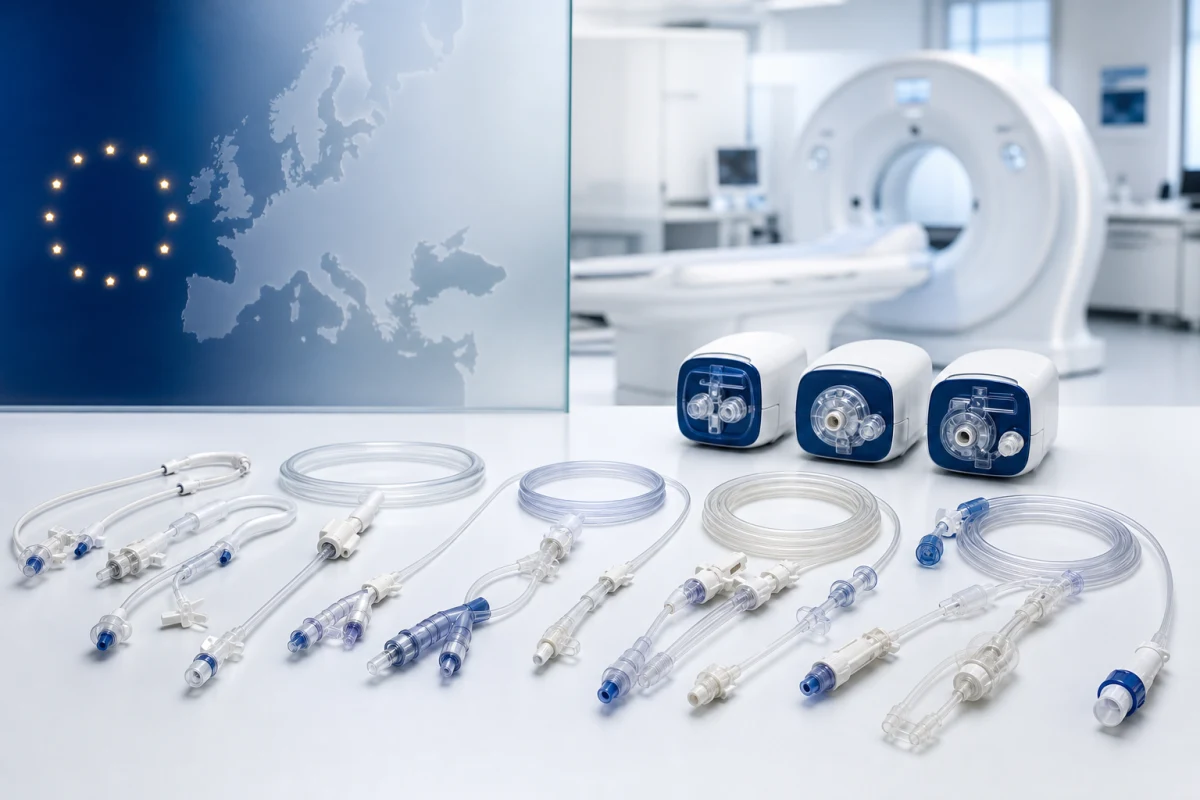
A manufacturer of sterile single-use contrast-injection consumables came to us with a catalog and a plan that fit on one page. It sold the disposables that carry iodinated contrast from a powered injector into a patient — high-pressure syringes, coiled tubes, patient lines with check valves, fill and transfer sets, multi-patient day sets — and it also sold the three injector systems those disposables serve. The EU plan read: one commercial family, one technical file, one certificate, one EUDAMED entry, with several hundred order codes sitting underneath.
The completed program registered twenty-four device groups under our EU representation: twenty-one Class IIa groups covering the tubing and line sets, and three Class IIb groups covering the injection systems, all on the market. Almost none of that architecture existed in the original plan, and the distance between the two is what this case is about.
A catalog organized for purchase orders
The catalog was a sales artifact. It was structured by injector platform, by bundle, by regional pack quantity and by private-label partner, and no one had ever been asked which of those distinctions were regulatory ones. When we requested a list of products for registration, we received a list of things that could be ordered.
The Basic UDI-DI does not work that way. MDCG 2018-1 describes it as the key that connects devices sharing the same intended purpose, risk class and essential design and manufacturing characteristics, and it is independent of packaging and labeling — it never appears on a trade item at all. Platform branding, bundle composition and pack size are not on that list.
The first correction was directional. SKU count and group count are not the same measurement, and much of the catalog's complexity resolves downward rather than upward: under the MDR, a change to the quantity of devices provided in a package requires a new UDI-DI — the model-level identifier printed on the label — and not a new group. A large share of the references the manufacturer expected to become separate regulatory objects were simply additional UDI-DIs inside a group.
The line sets were never Class I
The disposables had been carried for years as ordinary non-invasive tubing, self-declared at Class I. That reading survives only if no other classification rule applies. Rule 2 of Annex VIII classifies non-invasive devices intended for channelling liquids for eventual infusion, administration or introduction into the body as Class IIa where they may be connected to a Class IIa, IIb or III active device. These lines exist in order to be connected to a Class IIb injector.
Two implementing rules closed the remaining escape routes. Accessories are classified in their own right, separately from the device they are used with, so the lines neither inherit the injector's class nor keep Class I by default; and where several rules apply, the strictest one governs. The MDR classification rules put the consumables at Class IIa and brought a notified body into a product line that had never seen one.
This was not only a classification finding. Risk class is one of the three criteria that define a Basic UDI-DI, so correcting the class also invalidated the single-group plan before a single group had been drawn.
One family name, several different regulatory answers
Even at the corrected class, "one family, one group" did not survive contact with the criteria. Alongside intended purpose and risk class, a defined set of attributes sits at group level — whether the device is implantable, active, a reusable surgical instrument, has a measuring function, contains medicinal or human- or animal-derived substances, and whether it is intended to administer or remove a medicinal product. Every device sharing a Basic UDI-DI has to answer all of them identically.
That last attribute broke the family apart. Iodinated contrast agents are medicinal products under EU law, not devices, and the catalog did not treat them uniformly. A patient line sitting in the contrast path, a saline-only line and a fill set that draws from a bottle and never reaches the patient are three different answers to the same question. Intended purpose separated the catalog again, and sterile versus non-sterile presentation separated it a third time.
The opposite mistake would have cost more
Once the manufacturer saw the family fragment, the instinct was to give every catalog reference its own Basic UDI-DI and be safe. We argued against it, because the group is not a database row. It is the unit that everything downstream is measured in.
MDCG 2019-13 defines "device", for the purposes of notified-body sampling, as the device or devices associated with one Basic UDI-DI. The same identifier is what appears on certificates, on the EU Declaration of Conformity, in the technical documentation and in vigilance and post-market forms. Hundreds of groups would have meant hundreds of sampling candidates and hundreds of records to keep true, for distinctions that no rule required.
Over-broad grouping is not free either. Where one group holds many variants, the technical documentation review has to establish how those differences were addressed and whether every one of them meets the requirements. Both errors are paid for; they are just billed by different departments.
So we built a variant matrix rather than a preference. For each candidate boundary in the catalog we asked whether it changed intended purpose, risk class, one of the group-level attributes, or an essential design or manufacturing characteristic — fluid-path material, sterilization method, pressure rating, connector system, or a site change that altered a validated manufacturing process. Differences that were only non-essential, such as length within a series, packaging count or order code, stayed inside a group as separate UDI-DIs. What came out was twenty-one groups across the tubing and line sets and three across the injection systems.
The class split changed different things on each side
The Class IIa and Class IIb halves of one clinical workflow are not two sizes of the same obligation, and the difference lands directly on grouping.
For Class IIa devices, the notified body assesses technical documentation for at least one representative device per category of devices — the MDA and MDN codes used to designate notified bodies. For Class IIb devices it is one representative device per generic device group, the fourth level of the European Medical Device Nomenclature. The buckets are different, so the same certificate covers a different shape of sampling population on each side, and a proportion of the devices in each bucket is expected to be sampled across the life of the certificate.
On the injector side one further rule changed the arithmetic. An active device intended to administer a medicinal product falls under Rule 12, and where it does, the clinical evaluation consultation procedure in Article 54 applies — and MDCG 2019-13 is explicit that clinical evaluation is not subject to sampling, but has to be assessed for every device, meaning for every Basic UDI-DI. Consolidation is therefore worth considerably more on the system side than on the consumable side. That asymmetry, not a desire for tidiness, is why three system groups sit beside twenty-one consumable groups.
Making the certificate, the declaration and the record name the same devices
The sequencing rule caught the manufacturer's plan out. Where a device is subject to conformity assessment, the Basic UDI-DI has to be assigned before the manufacturer applies to the notified body; the notified body then references it on the certificate and confirms in EUDAMED that the registration information is correct. The original plan had treated grouping as a registration formality to be handled after certification.
It cannot be. Certificate scope must unambiguously identify the devices covered, and each certificate identifies and covers all devices associated with the Basic UDI-DI it names. The Declaration of Conformity carries the Basic UDI-DI together with the product and trade name, product code, catalogue number or other unambiguous reference. Change the grouping after the application and you are not editing a database; you are re-opening a certificate.
We therefore settled the architecture upstream and then reconciled three lists that had been maintained by three different teams — certificate scope, declaration references and the EUDAMED device records — until they described the same devices in the same terms.
Artwork does not scale the way records do
Twenty-four records is a bounded number. Label artwork is not. Manufacturer information has to be supplied in the official Union language or languages determined by each Member State where the device is made available, and the authorized representative's name and address must appear on the label, across every reference and the packaging level or levels on which the regulatory label is supplied.
Worse, artwork changes are regulatory events rather than printing events. A new UDI-DI is required for a change to name or trade name, device version or model, single-use labeling, sterile packaging, the need for sterilization before use, the quantity of devices in a package, or critical warnings such as latex or DEHP content. MDCG 2018-1 adds that a colour or language change may require one too where it could cause misidentification, naming connector colour coding as an example — which is exactly how a contrast line signals its pressure rating on a trolley.
For phthalate-plasticized fluid paths these obligations converge. Devices containing CMR or endocrine-disrupting substances above 0.1% by weight must be labelled as containing them, so substituting a resin is simultaneously a label change, a UDI-DI change, and — if it reaches an essential manufacturing characteristic — a group-level question.
What we handed over was a rule, not a spreadsheet
The failure mode after a program like this is a correct database that quietly goes stale, because the people who change products are not the people who own records.
So the deliverable was a change-control rule with three tiers, keyed to the regulation rather than to our project. A change to a data element that does not require a new UDI-DI has to reach the record within thirty days. A change that does require a new UDI-DI has to be in the database by the time the modified device is placed on the market, which makes it a launch dependency, not a follow-up task. And a change to intended purpose, risk class or an essential design or manufacturing characteristic is a Basic UDI-DI question, which is a certificate conversation before it is a database one. Around that sit the standing duties: verifying periodically that the data for marketed devices is still correct, and keeping the list of assigned identifiers with the technical documentation.
If your catalog looks like this one
Three lessons transfer. Decide grouping from a documented variant matrix before you apply for conformity assessment, because after the application the cost of changing your mind is measured in certificate scope. Check the group-level attributes, not only intended purpose and class — for drug delivery consumables in particular, the medicinal-product question alone will often split a family that looks homogeneous on a price list. And budget for the maintenance machine at the same time as the registration, because a variant-heavy catalog generates change constantly and every change has a tier.
If you are mapping a large consumables portfolio onto EU MDR device groups, talk to our team about the architecture before it hardens.
 Case Study · Jul 22, 2026One Endoscopy Platform, Six ANVISA NotificationsRegulatory Update · Nov 26, 2025FDA Pre-RFD Guidance 2025 – How to Prepare a Pre-Request for DesignationBlog · Sep 6, 2026One Device, Three UDI DatabasesBlog · Aug 24, 2026Medical Device Registration Verification 2026Blog · Aug 17, 2026Coronary Stents: Eight Highest-Tier FilesCase Study · Aug 11, 2026Class III Dermal Fillers Under the EU MDRBlog · Aug 10, 2026Surgical Robots: Eight Markets, Eight Regulatory FilesRegulatory Update · Sep 14, 2026COMBINE: Combined-Study Safety ReportingRegulatory Update · Sep 5, 2026China Device GMP: 1 Nov 2026Regulatory Update · Aug 26, 2026Czech FSC Moves to ISZP
Map your catalog onto EUDAMED device groups
Grouping analysis, EU MDR classification, certificate-scope alignment and record maintenance for variant-heavy sterile consumables portfolios.

Basic UDI-DI grouping built from a documented variant matrix
EU MDR classification for line sets, accessories and systems
Certificate scope, declaration and EUDAMED record alignment
Change control: what triggers a new UDI-DI or a new group

Frequently asked questions
Three criteria, and none of them is your catalog structure: devices sharing a Basic UDI-DI must have the same intended purpose, the same risk class and the same essential design and manufacturing characteristics. EUDAMED adds a fixed set of group-level attributes that also have to match, including whether the device is active, implantable, has a measuring function, and whether it is intended to administer or remove a medicinal product. Work from a variant matrix that tests every catalog boundary against those criteria. Differences that are only commercial — order code, pack quantity, regional bundling — belong at UDI-DI level inside a group rather than at group level.
No. Risk class is one of the criteria that define a Basic UDI-DI, so a Class IIa line set and a Class IIb injection system cannot sit in the same group even when they are sold together under one family name. In this program that boundary produced twenty-one Class IIa groups for the tubing and line sets and three Class IIb groups for the systems. The split also changes what the notified body does on each side: Class IIa technical documentation is sampled per category of devices and Class IIb per generic device group, and the clinical evaluation of a Class IIb active device that administers a medicinal product is assessed for every device rather than sampled.
A new UDI-DI is required whenever a change could cause misidentification, and the MDR names several explicitly: name or trade name, device version or model, single-use labeling, sterile packaging, the need for sterilization before use, the quantity of devices in a package, and critical warnings such as latex or DEHP content. Guidance adds colour and language changes where they could mislead, connector colour coding included. A new Basic UDI-DI is a different question: it follows a change to intended purpose, risk class or an essential design or manufacturing characteristic — and because certificates and declarations of conformity name the Basic UDI-DI, that change is a certificate conversation before it is a database update.
Yes. Where a device is subject to conformity assessment, the Basic UDI-DI has to be assigned before the manufacturer applies to the notified body, which then references it on the certificate and confirms in EUDAMED that the registration information is correct. Certificate scope must identify the devices covered unambiguously, and each certificate covers all devices associated with the Basic UDI-DI it names. Deciding grouping afterwards therefore does not mean editing a record; it means re-opening certificate scope, together with the declaration of conformity and the technical documentation that reference the same identifier.
Single Process,
Multiple Markets
When you partner with Pure Global, a single registration process opens doors to multiple countries. Our global subsidiaries make this streamlined path possible.











Let's Talk,
Anywhere You Are.
Whether looking for more information or ready to partner with us, we're here to guide you through every step of the regulatory process.
Contact us