Coronary Stent Global Market Access 2026: Class III Almost Everywhere
Coronary stents sit at the highest regulatory tier across major markets. This report maps four US regulatory objects, the PMA supplement lifecycle, eight market-access files, public register evidence, postmarket limits, government fees and a sequencing plan for manufacturers.
TL;DR
A coronary stent is a highest-tier implant in every major market this report maps. The United States is not the easy outlier it is for orthopedic implants. FDA classifies a bare-metal coronary stent (product code MAF) and a drug-eluting coronary stent (NIQ) as Class III, PMA 12. In the PMA export we analysed on 15 August 2026, those codes plus the absorbable DES code (PNY) produced 2,210 decision records across 37 unique PMA numbers — and zero 510(k)s 34.
Three findings from the registers themselves frame the rest of the paper:
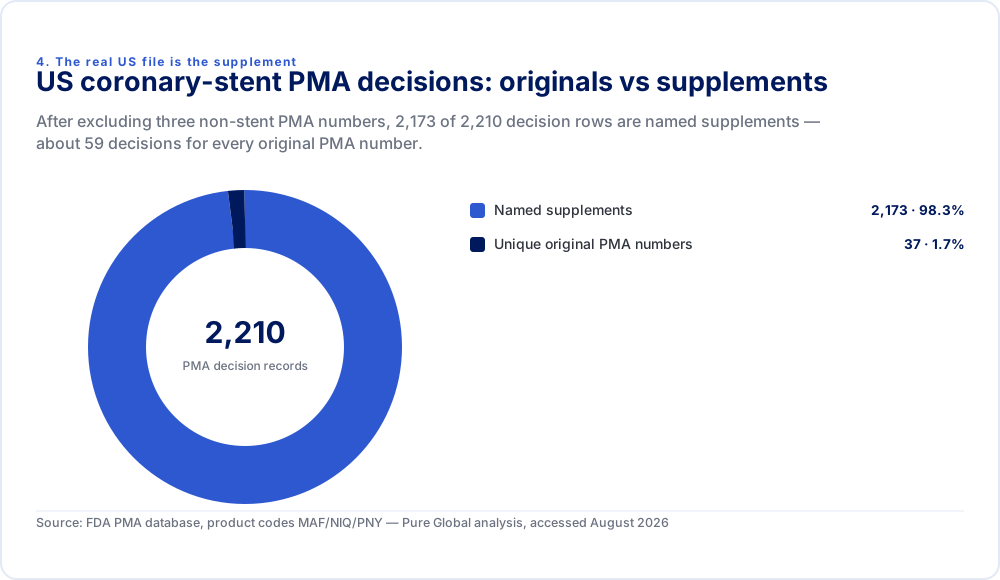
- The US file you will live in is the supplement, not the original approval. After excluding three historically miscoded non-stent PMA numbers, 2,173 of 2,210 decision rows are named supplements. The median PMA number carries 54 decision rows; Promus Element Plus (P110010) carries 208. 1,630 named supplements are process changes at a manufacturer, sterilizer, packager or supplier 3.
- Indication splits are four different US objects. Bare-metal (MAF), drug-eluting (NIQ) and absorbable DES (PNY) are PMA. Covered coronary stents for perforation (NIV) are humanitarian device exemptions — Graftmaster (H000001) and PK Papyrus (H170004) — not PMA DES 56.
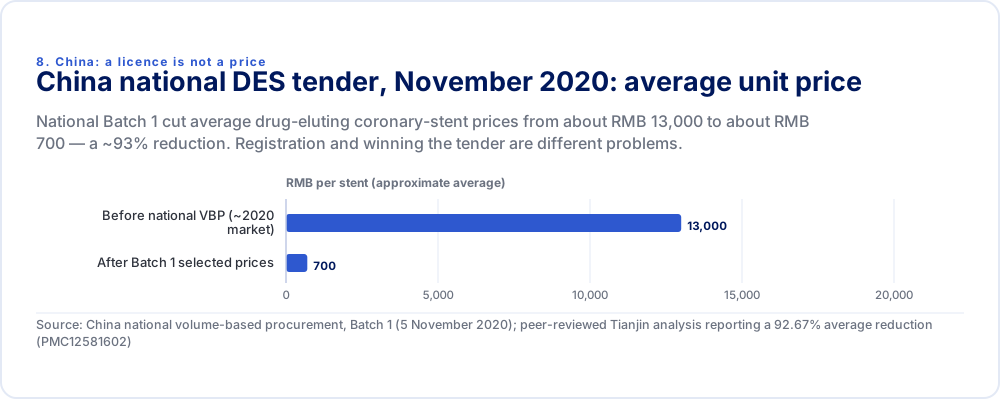
- China can give you a licence and take away the price. National Batch 1 of volume-based procurement, bid in Tianjin on 5 November 2020, cut average DES prices from about RMB 13,000 to about RMB 700 (~93%) 7. A Tianjin interrupted time-series paper reports an average reduction of 92.67%, with selected prices CNY 469–798 7. An NMPA Class III registration without a tender strategy is not a commercial plan.
None of the counts below are unit market shares, procedure rates or safety incidence. They are regulatory records. For the person who has to build the files, the records are the territory.
For a foreign manufacturer, seven of the eight mapped markets require a named local regulatory role; Canada is the exception to that representation model, although importer and licensing obligations still apply. Pure Global's published flat fees put a worked four-market representation program at $9,000 per year 8 — against an FDA PMA review fee of $579,272 in FY2026 8. That $9,000 is representation, not a PMA compilation, not a notified-body quote, and not a promise of approval.
1. The United States is not the orthopedic story
Takeaway: a conventional knee implant can still be a US Class II 510(k). A coronary stent cannot. For MAF, NIQ, PNY and NIV, the 510(k) database in this extract contains zero rows.
Pure Global's July orthopedic hub documented the asymmetry that still surprises first-time implant teams: the same total knee can be Class II in the United States and Class III almost everywhere else 10. Coronary stents invert that sentence.
FDA's product-classification records are blunt. MAF — "Stent, Coronary" — is Device Class 3, submission type PMA, an implanted metal scaffold delivered into a coronary artery or saphenous vein graft 1. NIQ — "Coronary Drug-Eluting Stent" — is the same class and submission type, with a drug coating intended to inhibit restenosis 2. PNY extends the PMA object to an absorbable DES. NIV, the covered coronary stent, is not a PMA code at all: the classification export stores it as unclassified (device_class f) with submission type 6, the humanitarian device exemption 56.
FDA's own intravascular-stent guidance says the quiet part in a table: MAF, and the peripheral cousins NIM through NIP, "require a premarket approval (PMA) application before marketing" 9. Covered (NIV) and drug-eluting (NIQ) devices sit in the same engineering conversation with extra characterisation. There is no 510(k) off-ramp hiding in a footnote.
| PMA decision rows | |
|---|---|
| 1993 | 2 |
| 1994 | 2 |
| 1995 | 1 |
| 1996 | 2 |
| 1997 | 6 |
| 1998 | 21 |
| 1999 | 27 |
| 2000 | 24 |
| 2001 | 35 |
| 2002 | 49 |
| 2003 | 25 |
| 2004 | 23 |
| 2005 | 33 |
| 2006 | 52 |
| 2007 | 53 |
| 2008 | 97 |
| 2009 | 120 |
| 2010 | 133 |
| 2011 | 160 |
| 2012 | 236 |
| 2013 | 134 |
| 2014 | 178 |
| 2015 | 66 |
| 2016 | 103 |
| 2017 | 92 |
| 2018 | 94 |
| 2019 | 84 |
| 2020 | 83 |
| 2021 | 76 |
| 2022 | 53 |
| 2023 | 57 |
| 2024 | 38 |
| 2025 | 30 |
| 2026 | 21 |
Source: FDA PMA database, product codes MAF/NIQ/PNY, core cohort — Pure Global analysis, accessed August 2026
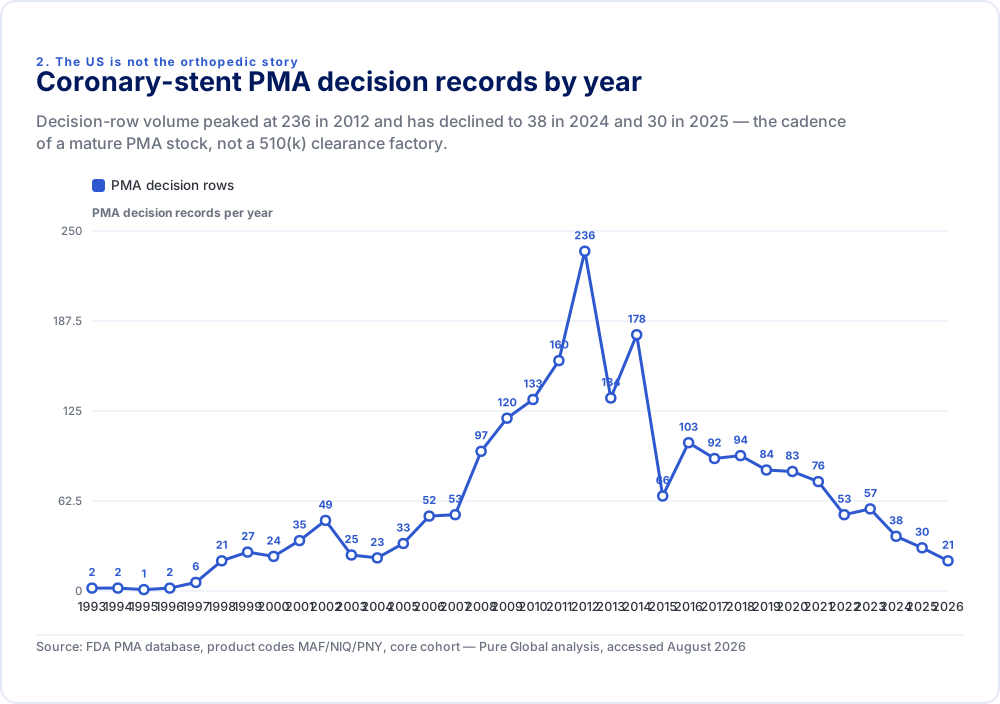
The PMA decision series for the core cohort is the shape of a mature Class III franchise, not a 510(k) factory. The product-code extract held 2,266 PMA rows. We dropped three PMA numbers whose first-row trade names are not coronary stents — P810046 (dilatation catheters), P940019 (iliac Wallstent) and P950020 (cutting balloon) — leaving 2,210 decision rows across 37 unique PMA numbers 3. The remaining 37 may still include related delivery systems coded MAF; that is a residual, not a reason to put the codes back.
Originals in this paper are the earliest decision_date per PMA number in that core set. The dump also contains 37 blank-supplement rows. Do not read a blank 2026 dump date as a new original. The example is P130030 (Rebel): a blank row dated 10 March 2026 sits on a PMA whose first decision is 4 August 2014. Counting dump artefacts as 2026 originals would invent a first-approval wave that the register does not contain.
Decision-row volume peaked at 236 in 2012 and has declined to 38 in 2024 and 30 in 2025, with 21 rows already on the 2026 clock when we pulled the file — a partial year 3. That decline is not "the market died." It is what a stock of 37 original PMA numbers looks like when most of the paper is supplements on platforms that have been on the US market for a decade or more. First approvals themselves cluster: BMS-era numbers through the mid-2000s, the first DES wave (Cypher 2003, TAXUS 2004), a second DES wave in 2011–2017, then a thin tail that still produced original NIQ PMAs in 2021–2022 3.
A 510(k) mental model will mis-price this in two directions at once. It will understate the original evidence burden (clinical investigations under 21 CFR 812, not substantial equivalence to a predicate list). And it will understate the ongoing burden: every process change, labeling change and design tweak that, on a Class II device, might have been a letter-to-file is, here, a numbered supplement with a fee. The orthopedic hub's 16,994-to-~18 split is the contrast, not the template 10.
2. Four US objects: BMS, DES, absorbable, covered
Takeaway: "coronary stent" is four FDA objects. Mixing them in one global claims matrix is how indication language, combination-product rules and HDE volume caps leak into the wrong file.
| Original PMA numbers | |
|---|---|
| MAF bare-metal / coronary stent | 21 |
| NIQ drug-eluting | 15 |
| PNY absorbable DES | 1 |
| NIV covered (HDE, not PMA) | 0 |
Source: FDA PMA database, earliest decision date per PMA number — Pure Global analysis, accessed August 2026
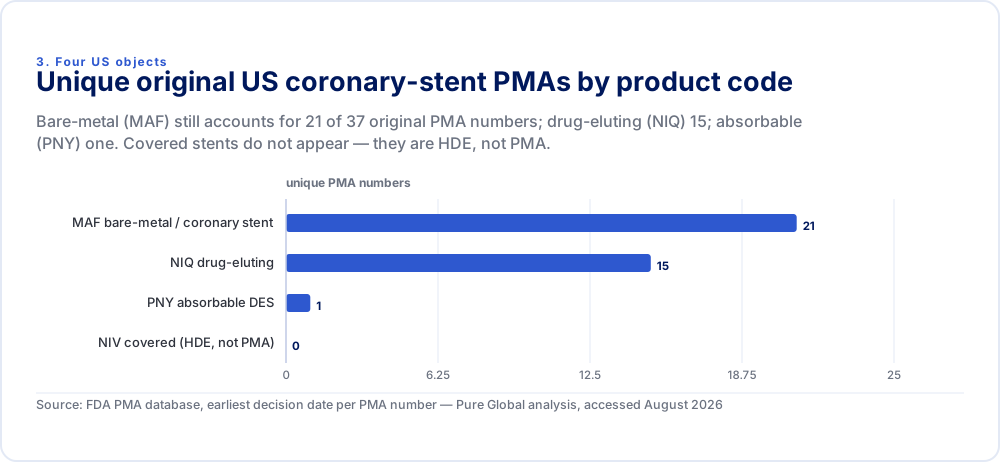
Of 37 unique original PMA numbers in the cleaned cohort, 21 first appear as MAF, 15 as NIQ, and one as PNY — Abbott's Absorb GT1 bioresorbable vascular scaffold, P150023, original decision 5 July 2016 33. NIV contributes zero PMA numbers, because covered coronary stents for free perforation are not in that database.
That split is not historical trivia. It is the claims architecture.
Bare-metal (MAF) is still a live US object. Original MAF numbers run from the Palmaz-Schatz era (P900043, 1994) through later cobalt-chromium and platinum-chromium platforms (Rebel, P130030, first decision 4 August 2014; Pro-Kinetic Energy, P160003, 14 February 2017) 3. A company that only thinks in DES will still meet MAF if it ships an uncoated or nano-coated metal scaffold, a side-branch device (Tryton, P150039), or a legacy BMS line that remains on the books.
Drug-eluting (NIQ) is the modern commercial centre of gravity and 1,386 of 2,210 core decision rows 3. NIQ is also a combination product: a device plus a drug whose job is restenosis, not a separate NDA. The PMA is the marketing application; CMC-like change control on the coating, the dose and the polymer sits inside PMA supplements rather than a parallel drug file. First NIQ originals in this extract include Cypher (P020026, 24 April 2003) and TAXUS Express2 (P030025, 4 March 2004), then the Xience/Promus, Resolute, SYNERGY, Orsiro, EluNIR and BioFreedom generations 3.
Absorbable (PNY) is a one-PMA cautionary object in this extract, not a crowded US class. Absorb GT1 is the only original PNY number. Treat it as proof that FDA will open a distinct code when the mechanism changes — and as a reminder that a PMA number can remain in the historical file after the commercial story has moved on. Do not read a code with ten decision rows as a market.
Covered (NIV) is the object 510(k)-trained teams miss entirely. PK Papyrus (Biotronik, H170004) was approved as an HDE on 14 September 2018 for acute perforations of native coronary arteries and bypass grafts in 2.5–5.0 mm vessels 5. Graftmaster RX (Abbott, H000001) is the older humanitarian covered stent in the same product code 6. An HDE is not a small PMA. It is a different statute: humanitarian use, a probable-benefit standard rather than PMA effectiveness, and a population cap. If your covered stent is a bailout device for perforation, you are not "doing a DES PMA with a membrane." You are asking whether you even belong in PMA.
One more US warning belongs here because the PMA page is public: Advanced Bifurcation Systems' Slender/DIRECT sirolimus-eluting system, P210014, was approved 13 December 2021 and carries a withdrawal date of 14 March 2023 10. Original PMA counts in this paper include numbers that later left the market. The register is not a catalogue of what a hospital can order tomorrow.
3. The real US file is the supplement
Takeaway: 37 original PMA numbers generated 2,173 named supplements. Three-quarters of those supplements are process changes. FY2026 user fees make that cadence expensive even when the clinical story has not moved.
| Decision type | |
|---|---|
| Named supplements | 2,173 |
| Unique original PMA numbers | 37 |
Source: FDA PMA database, product codes MAF/NIQ/PNY — Pure Global analysis, accessed August 2026
A PMA number is a franchise. The original approval is the opening balance. Everything after — a new size matrix, a new sterile packager, a new indication clause, a post-approval study protocol — is a supplement with a reason code and a decision date.
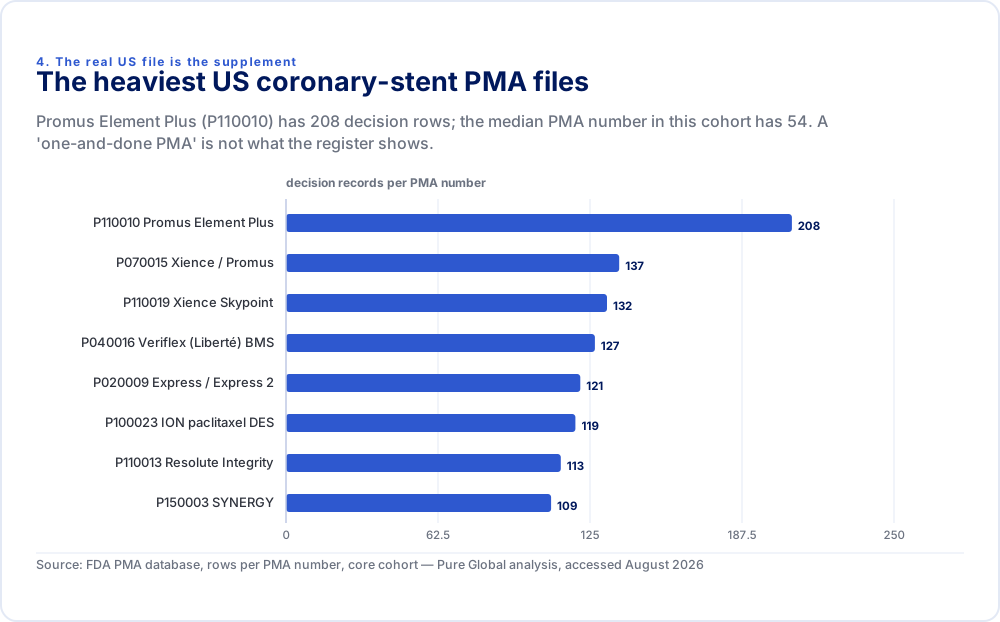
In the core cohort the median PMA number has 54 decision rows; the mean is 59.7 3. That is not "a few tweaks." That is a second career for the original file.
| Rows | |
|---|---|
| P110010 Promus Element Plus | 208 |
| P070015 Xience / Promus | 137 |
| P110019 Xience Skypoint | 132 |
| P040016 Veriflex (Liberté) BMS | 127 |
| P020009 Express / Express 2 | 121 |
| P100023 ION paclitaxel DES | 119 |
| P110013 Resolute Integrity | 113 |
| P150003 SYNERGY | 109 |
Source: FDA PMA database, rows per PMA number, core cohort — Pure Global analysis, accessed August 2026
The heaviest files are household DES names. P110010 (Promus Element Plus) has 208 rows. P070015 (Xience and Promus) has 137. P110019 (Xience Skypoint) has 132. Even a BMS line such as Veriflex/Liberté (P040016) has 127 3. If your regulatory plan assumes "we get the PMA, then we are done," the register is the counter-example.
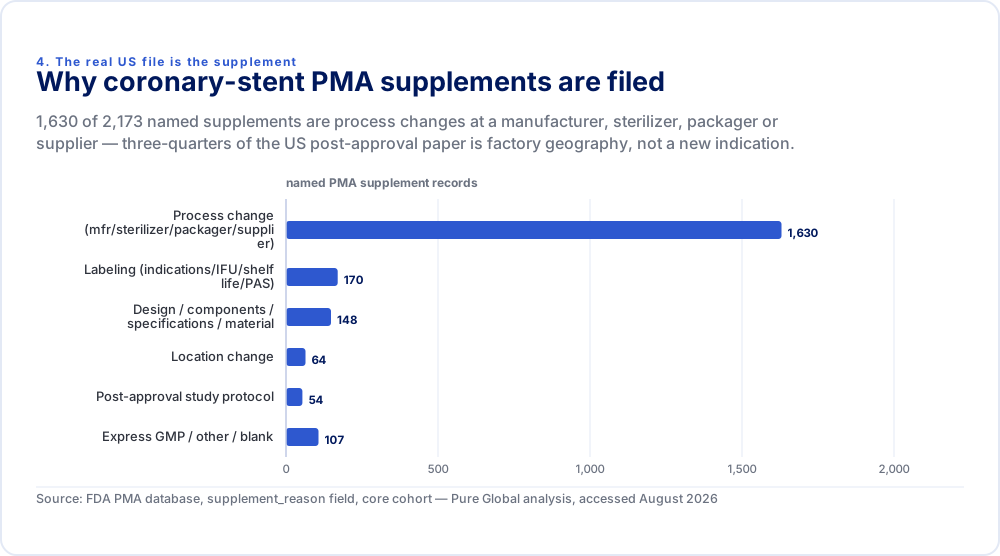
| Supplements | |
|---|---|
| Process change (mfr/sterilizer/packager/supplier) | 1,630 |
| Labeling (indications/IFU/shelf life/PAS) | 170 |
| Design / components / specifications / material | 148 |
| Location change | 64 |
| Post-approval study protocol | 54 |
| Express GMP / other / blank | 107 |
Source: FDA PMA database, supplement_reason field, core cohort — Pure Global analysis, accessed August 2026
The reason codes are more specific than the row count. Of 2,173 named supplements:
- 1,630 — process change at a manufacturer, sterilizer, packager or supplier (75%)
- 170 — labeling (indications, instructions, shelf life, trade name, or post-approval-study labeling)
- 148 — design, components, specifications or material
- 64 — location change
- 54 — post-approval study protocol (OSB or general)
- the remainder — express GMP, other, or blank 3
Read that mix operationally. Most US coronary-stent PMA paper is supply-chain geography. A second sterilizer, a new component supplier, a packager change — each can be a 30-day notice, a real-time supplement, a 180-day supplement or a panel-track supplement depending on the risk of the change. The clinical team does not have to invent a new indication for the file to stay busy. The factory does it for them.
FY2026 user fees price that cadence explicitly 8:
| Submission | Standard fee | Small-business fee |
|---|---|---|
| PMA | $579,272 | $144,818 |
| Panel-track supplement | $463,418 | $115,855 |
| 180-day supplement | $86,891 | $21,723 |
| Real-time supplement | $40,549 | $10,137 |
| 30-day notice | $9,268 | $4,634 |
| Annual Class III periodic report | $20,275 | $5,069 |
| 510(k) (not this route) | $26,067 | $6,517 |
| Establishment registration (annual) | $11,423 | hardship waiver only, not a 75% cut |
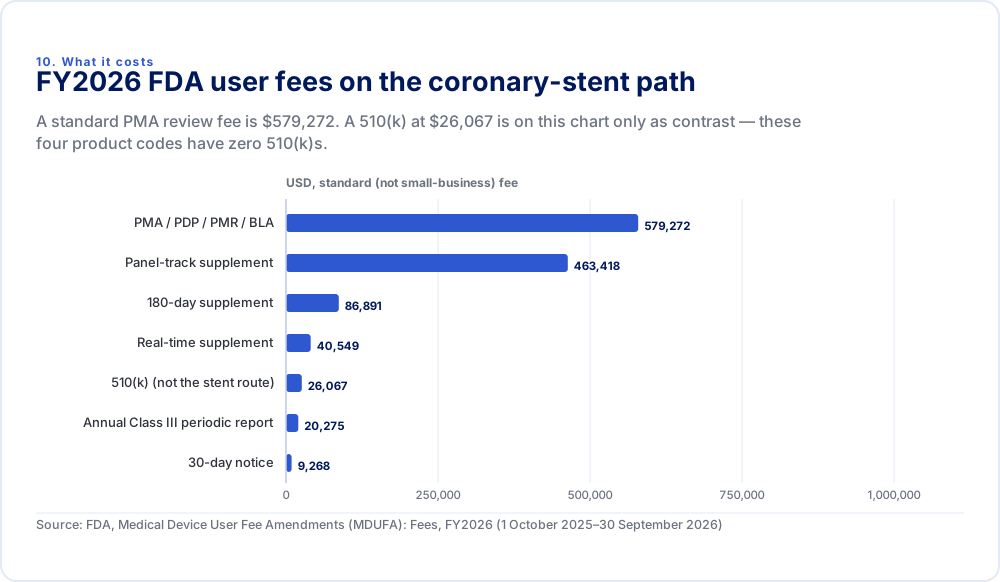
| Standard fee | |
|---|---|
| PMA / PDP / PMR / BLA | 579,272 |
| Panel-track supplement | 463,418 |
| 180-day supplement | 86,891 |
| Real-time supplement | 40,549 |
| 510(k) (not the stent route) | 26,067 |
| Annual Class III periodic report | 20,275 |
| 30-day notice | 9,268 |
Source: FDA, Medical Device User Fee Amendments (MDUFA): Fees, FY2026 (1 October 2025–30 September 2026)
A single panel-track supplement costs more than seventeen standard 510(k)s. A 180-day supplement costs more than three. The 510(k) fee is on this table only so that nobody accidentally budgets it. These four product codes did not generate a 510(k) in the extract we used 4.
The export we used records reason, not MDUFA track. We therefore do not claim that 1,630 process changes were 30-day notices. A carton-printer swap and a coating-site transfer can share a reason string and sit on opposite ends of the fee table in §9. What the reason field does prove is intent: most US coronary-stent PMA activity is the factory and the sterile barrier, not a new randomised trial.
That has a combination-product sting. An NIQ stent is a device plus a drug. A process change that would be "just QMS" on a bare-metal line can be a coating-weight, solvent, or release-profile change on a DES line — still coded process change, still a supplement, still a fee. The 148 design/material rows are the minority that admit the metal or the polymer moved. The 1,630 process rows are where a team that only watches "new indications" will be surprised.
The operational meaning of the fee ladder is not "budget $9,268 times 1,630." It is that FDA prices the same factory event at four different altitudes, and the dump's supplement_reason field does not tell you which altitude you will land on 8. A 30-day notice ($9,268) is the cheap door for specified manufacturing changes that do not affect safety or effectiveness. A real-time supplement ($40,549) is the next step up for certain design and labeling changes FDA agrees to review on a short clock. A 180-day supplement ($86,891) is the expensive ordinary path for significant manufacturing or design changes. A panel-track supplement ($463,418) is what a new indication, or a change that needs advisory-committee review, actually costs — within striking distance of the original PMA fee itself. The annual Class III periodic report ($20,275) is the keep-the-PMA-alive tax, owed whether or not you filed a supplement that year. Establishment registration ($11,423) sits underneath all of it.
Read a second-plant decision against that ladder, not against a 510(k) letter-to-file. Adding a sterilizer or a packager is a process-change reason. Whether FDA takes it as a 30-day notice or a 180-day supplement depends on the risk of the change, not on the reason string. The same physical move then fans out: an EU technical-documentation amendment and notified-body notice, a UKRP correspondence, an ARTG variation through the sponsor, an ANVISA modification through the Brazil holder, and, if Canada is in the set, a Class IV significant-change amendment at CAD 16,251 11. One supplier signature is not one invoice.
Three implications follow.
First, change control is a market-access function, not only a quality function. The same process change that a European site might absorb inside a technical-documentation amendment can be a US fee event and a decision-date event. If you freeze a supplier map after the original PMA "to keep life simple," you have not reduced supplements. You have merely delayed the first wave until the supplier map is no longer true.
Second, indication language is a PMA-supplement decision, not a marketing decision. A labeling supplement for a new lesion subset, a new vessel-diameter range, or a new concomitant-therapy statement is the difference between a sales deck and a misbranded claim. The 170 labeling rows in this cohort are the US system's way of saying that the IFU is a controlled document with a fee.
Third, build a predetermined change vocabulary even if the original PMA did not. FDA now publishes, on some premarket records, whether a predetermined change-control plan was authorised. Coronary-stent PMA pages in this cohort are older than that field's popular use; P210014's public PMA page, for example, reads No on that field 10. Do not assume you inherited a PCCP. If you want size-matrix or supplier flexibility without a 180-day surprise, you negotiate it — in a supplement — rather than discovering the gap when the contract manufacturer moves.
4. Who files — records, not share
Takeaway: Boston Scientific, Abbott and Medtronic together account for 1,880 of 2,210 decision rows (85%). That is how concentrated the paper is. It is not a unit-share number, and the unique-original count is less concentrated than the supplement count.
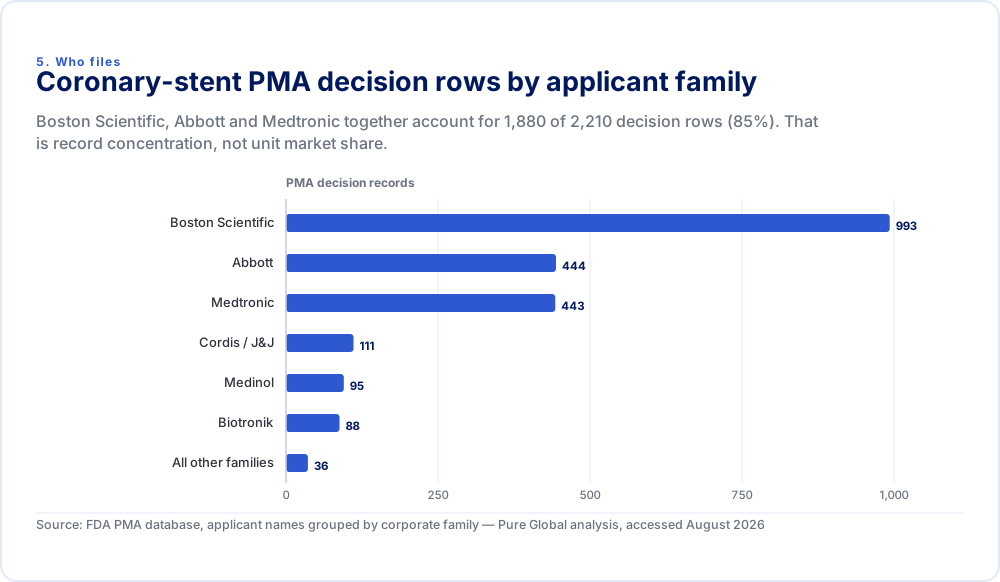
| Decision rows | |
|---|---|
| Boston Scientific | 993 |
| Abbott | 444 |
| Medtronic | 443 |
| Cordis / J&J | 111 |
| Medinol | 95 |
| Biotronik | 88 |
| All other families | 36 |
Source: FDA PMA database, applicant names grouped by corporate family — Pure Global analysis, accessed August 2026
Applicant names in the PMA file are messy — "Boston Scientific Corp" versus "Boston Scientific Scimed, Inc." versus "Boston Scientific Corporation"; "Abbott Vascular" versus "Abbott Vascular, Inc."; "Medtronic Vascular" versus "Medtronic, Ireland." We grouped obvious legal-entity variants into families. After grouping 3:
| Family | Unique original PMA numbers | Decision rows |
|---|---|---|
| Boston Scientific | 11 | 993 |
| Medtronic | 7 | 443 |
| Abbott | 6 | 444 |
| Medinol | 3 | 95 |
| Biotronik | 3 | 88 |
| Cordis / J&J | 2 | 111 |
| All others | 5 | 36 |
The unique-original column is the interesting one for a new entrant. Eleven distinct PMA numbers sit with Boston Scientific, but Medinol, Biotronik, Biosensors, CeloNova, Poseidon/Tryton, Cook and Advanced Bifurcation Systems are also on the original-approval list 3. The US PMA door is not reserved to three logos. What the three logos dominate is the aftermarket of supplements — because they have more SKUs, more plants and more years on the clock. The five "all others" original numbers together produced only 36 decision rows. That is the new-entrant shape in this file: a first PMA is still possible; a 200-row franchise is what a decade of plants and sizes looks like, not what a first approval looks like.
Cordis is the historical warning inside the table: two original numbers, including Cypher, and 111 decision rows. A platform that defined an era still generates paper after the era has moved on.
For a non-US manufacturer the practical reading is narrower. You will not "out-supplement" Boston Scientific. You will be judged on whether your PMA number can absorb the same kinds of process and labeling changes without becoming a second original application. That is a dossier-architecture problem (what is a platform, what is a size, what is a new device) disguised as a legal-entity problem.
5. Eight markets, eight highest-tier files
Takeaway: unlike the orthopedic map, there is no major market in this set where a coronary DES is a middle-class device. The US split is PMA versus HDE. Everywhere else the split is Class III versus Class IV versus Class D — all the top of the local ladder. A foreign manufacturer also needs the applicable local regulatory role in seven mapped markets; Canada uses a different manufacturer/importer licensing structure.
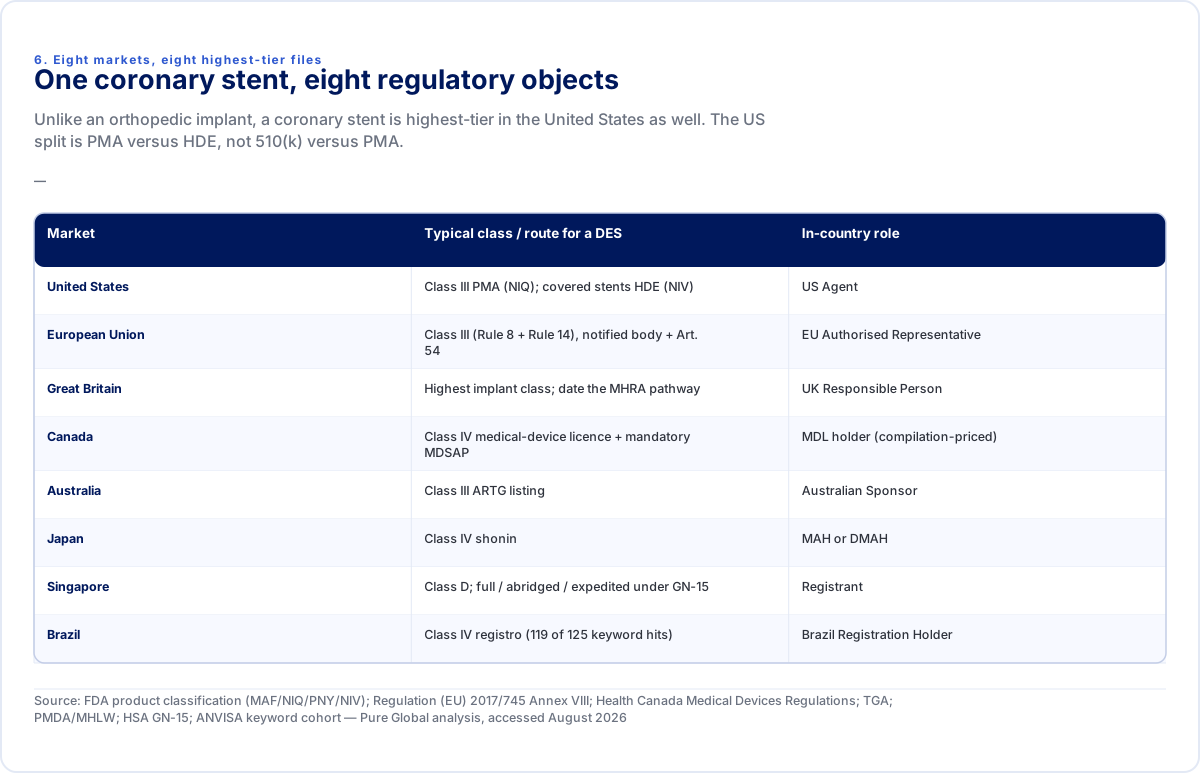
| Market | Typical class / route for a DES | In-country role |
|---|---|---|
| United States | Class III PMA (NIQ); covered stents HDE (NIV) | US Agent |
| European Union | Class III (Rule 8 + Rule 14), notified body + Art. 54 | EU Authorised Representative |
| Great Britain | Highest implant class; date the MHRA pathway | UK Responsible Person |
| Canada | Class IV medical-device licence + mandatory MDSAP | MDL holder (compilation-priced) |
| Australia | Class III ARTG listing | Australian Sponsor |
| Japan | Class IV shonin | MAH or DMAH |
| Singapore | Class D; full / abridged / expedited under GN-15 | Registrant |
| Brazil | Class IV registro (119 of 125 keyword hits) | Brazil Registration Holder |
Source: FDA product classification (MAF/NIQ/PNY/NIV); Regulation (EU) 2017/745 Annex VIII; Health Canada Medical Devices Regulations; TGA; PMDA/MHLW; HSA GN-15; ANVISA keyword cohort — Pure Global analysis, accessed August 2026
European Union. Regulation (EU) 2017/745 Annex VIII Rule 8 classifies implantable devices intended for use in direct contact with the heart or the central circulatory system as Class III. Devices that incorporate a medicinal substance (Rule 14) are also Class III. A DES trips both 12. Class III implantables require notified-body conformity assessment and are generally subject to the Article 54 / Annex IX 5.1 clinical-evaluation consultation procedure unless an Article 54(2) exemption applies. The EU object is not "a 510(k) plus a CE sticker." It is a Class III implantable combination product with a unique device identifier, an EU authorised representative if the manufacturer is not established in the Union, and a post-market clinical follow-up plan that will outlive the launch campaign.
Great Britain. Date the sentence. Current law is still the UK MDR 2002. CE-marked devices may be placed on the Great Britain market until 30 June 2028 for valid MDD certificates and until 30 June 2030 for MDR devices; the government has said it will consult on indefinite CE recognition 13. International recognition of comparable overseas approvals remains policy intent, not a live statute — the draft 2026 regulations were published for comment in May 2026, with the core package expected later and reliance talked about around 2028 13. File the current route; diarise the recheck. The registration fee from 1 April 2026 is GBP 300 per year per level-2 GMDN category 14. A UK Responsible Person is still the in-country role for a manufacturer without a UK establishment. The classification logic — highest-risk implant — has not become Class IIa because the transition dates moved.
Canada. Health Canada's risk-based rules put devices that diagnose, monitor, control or correct a defect of the central cardiovascular system in Class IV 15. A coronary DES is filed on that rung. Class II–IV devices require a Medical Device Licence and a valid MDSAP certificate; ISO 13485 alone does not substitute 1516. From 1 April 2026 the Class IV application fee is CAD 30,713, a significant-change amendment not related to manufacturing is CAD 16,251, a manufacturing-change amendment is CAD 4,470, and the annual right-to-sell fee is CAD 460 1117. Canada's special feature is not a lower class. It is that MDSAP is mandatory, which is why a manufacturer already in FDA/TGA/ANVISA/PMDA MDSAP can recycle the audit — and a manufacturer who is not on MDSAP cannot treat Canada as a cheap add-on. The manufacturing-change fee is the Canadian cousin of the US process-change supplement: cheaper than a significant-change amendment, still a fee event, still a reason not to treat a second sterilizer as a letter-to-file.
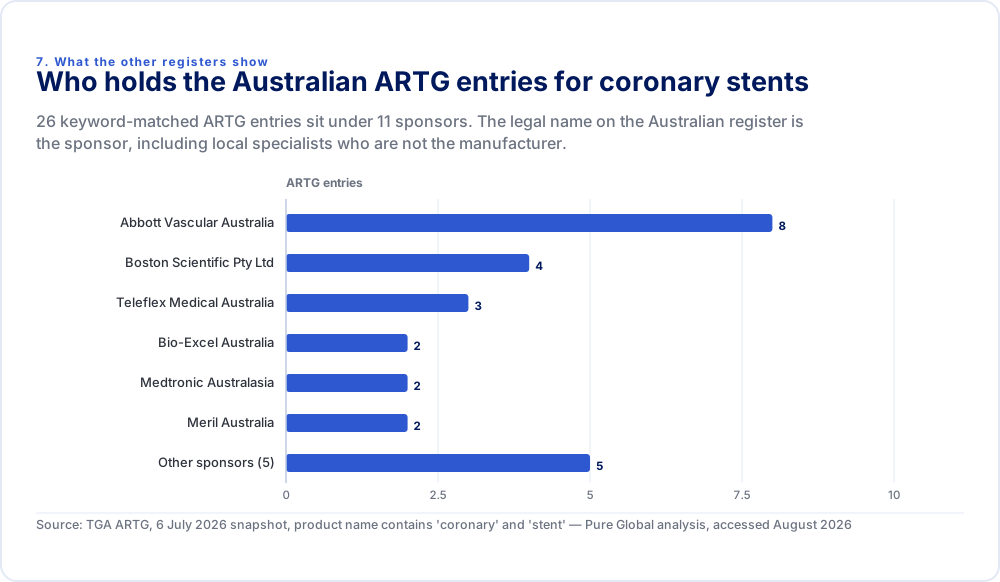
Australia. Implantable devices that sit in the heart or central circulatory system are Class III ARTG listings. A foreign manufacturer places the device through an Australian Sponsor. Our ARTG keyword slice is small (26 entries) but the sponsor column is the finding: the legal name on the register is often a local affiliate or a specialist sponsor, not the US PMA applicant string 18.
Japan. Coronary stents are Class IV specially controlled devices. The route is shonin (MHLW approval after PMDA review), not a third-party certification standard. A foreign manufacturer cannot hold the marketing authorisation; a licensed Japanese MAH or DMAH does, alongside foreign-manufacturer registration and QMS ordinance duties 19. Pure Global does not publish a Japan MAH fee in the Master Price List; that engagement is quote-on-request 8. Do not invent one.
Singapore. HSA's four-tier scheme puts devices in direct contact with the central circulatory system, and devices with a registrable drug in a secondary role, in Class D. A DES is both. GN-15 still offers full, abridged and expedited evaluation depending on prior authorisation at five reference agencies (TGA, Health Canada, EU notified bodies, Japan MHLW, US FDA) — but HSA's own overview excludes implantable devices in direct contact with the central circulatory system, and devices with a registrable drug in a secondary role, from the expedited Class D route 20. Full or abridged is the realistic menu. Reliance shortens the evaluation, not the need for a Singapore Registrant, a CSDT-format dossier, or grouping decisions that will be invoiced per registration.
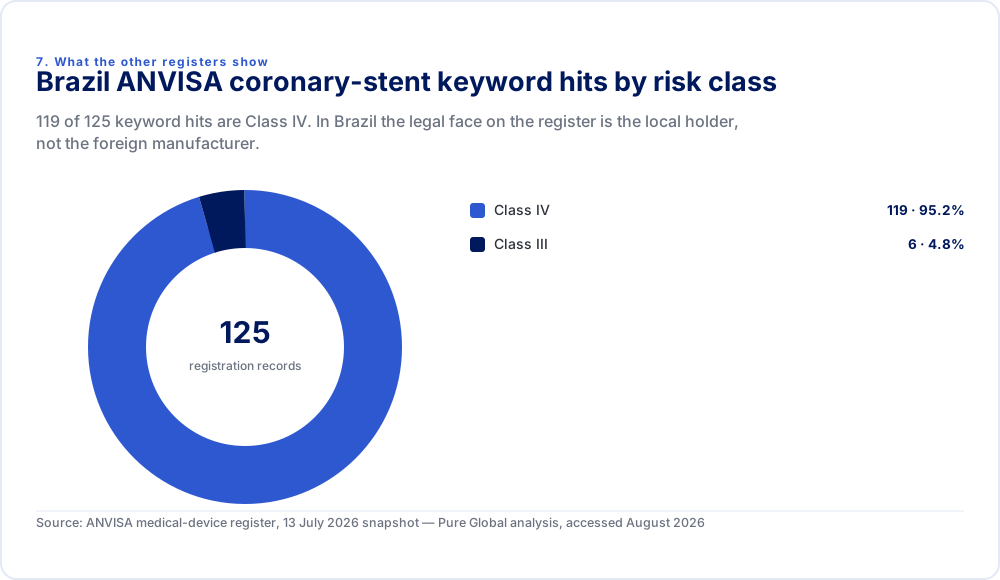
Brazil. RDC 751/2022 splits the world into notificação (Class I/II) and registro (Class III/IV) 21. Coronary stents are not a notification device. In the 13 July 2026 ANVISA extract, a name filter for stent + coron produced 125 records: 119 Class IV and 6 Class III 22. The Brazil Registration Holder is the legal face; B-GMP applies to Class III/IV manufacturing sites. AREE reliance, where available, is a review-time argument, not a class reduction.
For a foreign manufacturer, seven rows require the named local role shown in the map — US Agent, EU AR, UKRP, Australian Sponsor, Japanese MAH, Singapore Registrant or Brazilian registration holder. Canada is the structural exception: it has no equivalent Canadian-representative appointment in this service map. The manufacturer holds the Class IV MDL, while the importer/distributor's MDEL and compliance duties must be allocated separately; Pure Global prices Canadian dossier compilation rather than a representative line 8 23.
Reliance is real and bounded. Singapore will abridge a Class D file off a US PMA, an EU certificate, a Japanese shonin, a Canadian MDL or an Australian ARTG entry when the conditions in GN-15 are met 20. TGA will run an abridged assessment off a comparable reference approval. Brazil's AREE pathway can shorten registro review when the reference dossier matches. None of those routes reclassifies a DES as a middle-risk device or removes a local role where that jurisdiction requires one. China and Japan remain the markets where "we already have FDA" is evidence, not a procedure: NMPA still expects Chinese-language files, type testing and, often, local clinical work; PMDA still expects a Japanese MAH, foreign-manufacturer registration and a Class IV shonin 19.
The biological-evaluation file sits underneath all eight. A permanent blood-contacting implant is a 10993 problem — cytotoxicity is the easy chapter; implantation, hemocompatibility and chronic toxicity are the expensive ones — and we mapped the ISO 10993-1:2025 transition as its own hub rather than duplicating it here. What this paper needs from that adjacent file is only a sequencing warning: do not freeze a US PMA chemical-characterisation plan that the EU notified body will later reject as the wrong generation of 10993-1. One implant, two biological-evaluation languages, if you let the calendars drift.
6. What the other registers actually show
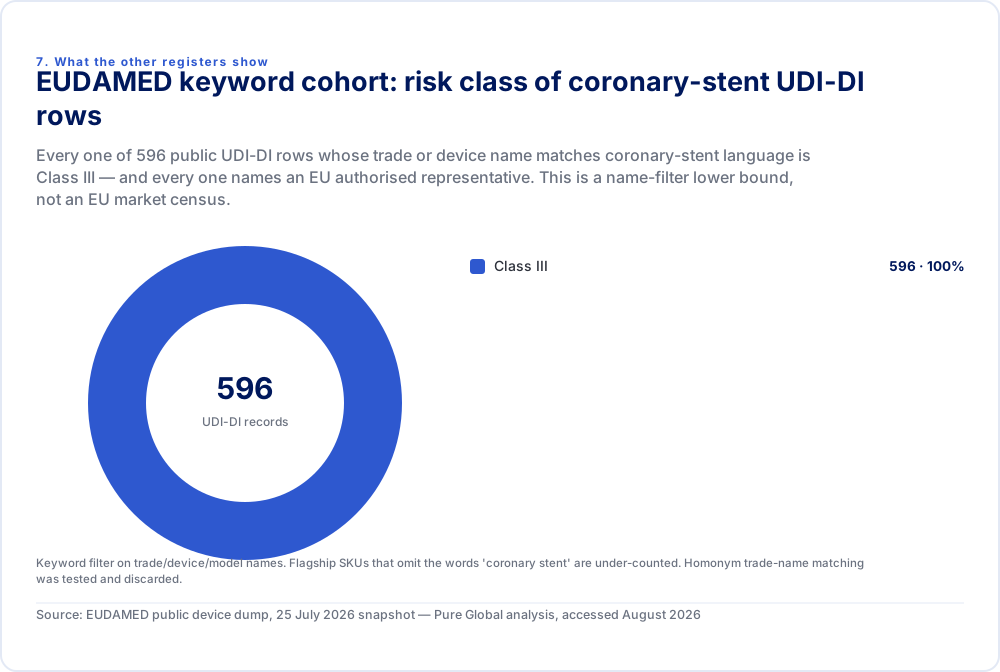
Takeaway: where we can count, the local class is the top class, and the local name on the register is often not the PMA applicant. EUDAMED's keyword slice is 100% Class III and 100% EU AR — and it is a name filter, not a census of XIENCE.
EUDAMED: Class III, and an AR on every keyword row
We scanned the 25 July 2026 public EUDAMED device dump (2,926,029 UDI-DI rows) for trade names, device names or models matching coronary-stent / drug-eluting-stent / bioresorbable-vascular language 24. The hit set is 596 UDI-DI records and 504 Basic UDI-DI groups. UDI registration in the module became mandatory on 28 May 2026; this snapshot is therefore an early mandatory-era floor, not a finished inventory of every DES on the Union market.
| Risk class | |
|---|---|
| Class III | 596 |
Keyword filter on trade/device/model names. Flagship SKUs that omit the words 'coronary stent' are under-counted. Homonym trade-name matching was tested and discarded.
Source: EUDAMED public device dump, 25 July 2026 snapshot — Pure Global analysis, accessed August 2026
Every one of the 596 is Class III. Every one is marked on-the-market. Every one names an EU authorised representative. Manufacturer SRN prefixes in this slice are CN 268, IN 145, US 85, IL 56, CH 38, KR 4. The manufacturer strings that survive a "coronary stent" name filter are led by Shanghai MicroPort (268), Purple MicroPort Cardiovascular in India (144), Medinol (56), Elixir (55), Biosensors Europe (38) and CeloNova (30) 24.
That list is not "the EU DES market." Flagship US PMA trade names — XIENCE, SYNERGY, Resolute Onyx — often do not contain the words "coronary stent" in the public trade-name field, so a keyword filter under-counts them. We tested a second pass on those tokens (Onyx, Synergy, Multi-Link) and threw it away: the tokens collide with dental implants, lighting equipment and capital goods, and the class mix collapsed into Class I. Treat 596 as a lower-bound named-keyword cohort, not an EU census and not a ranking of who sells DES in Europe.
Read the manufacturer table as a filter artefact, then as a representation fact. MicroPort's 268 + 144 Indian affiliate rows dominate this string match because those SKUs are literally named as coronary stent systems. Abbott, Boston Scientific and Medtronic flagship lines are mostly elsewhere in the 2.93 million-row file, under trade names that do not contain the search string. The usable finding is the one that survives the caveat: 596/596 Class III, 596/596 authorised representative, 596/596 on-the-market. If your manufacturing SRN is Chinese, Indian, American, Israeli or Swiss, the European file includes an AR. The register is already showing that choice being made.
The Basic UDI count (504 groups against 596 identifiers) is the grouping decision in miniature: some manufacturers register several sizes or coatings under one group, others do not. Pure Global's EU AR fee is charged per device group 8. How you name the stent in EUDAMED is a commercial choice; how you group it is an annual invoice.
Australia: 26 ARTG entries, 11 sponsors
| Entries | |
|---|---|
| Abbott Vascular Australia | 8 |
| Boston Scientific Pty Ltd | 4 |
| Teleflex Medical Australia | 3 |
| Bio-Excel Australia | 2 |
| Medtronic Australasia | 2 |
| Meril Australia | 2 |
| Other sponsors (5) | 5 |
Source: TGA ARTG, 6 July 2026 snapshot, product name contains 'coronary' and 'stent' — Pure Global analysis, accessed August 2026
The 6 July 2026 ARTG snapshot yields 26 product names containing both "coronary" and "stent," under 11 sponsors and 13 manufacturers. Twenty-three of the 26 names carry eluting or drug-coated language 18. Abbott Vascular Australia holds 8, Boston Scientific Pty Ltd 4, Teleflex Medical Australia 3; the rest include Bio-Excel, Meril Australia, Device Technologies, MicroPort Matrix, Terumo Australia and one-entry specialist sponsors.
Two facts for the file. First, the sponsor is the Australian legal person, including companies that are not the PMA applicant. Second, Indian and Chinese manufacturers (Meril, SMT, MicroPort) already appear as ARTG manufacturers in this small slice — the Australian register is not a closed US-EU club. Keyword filters are lower bounds; they are still directional. Twenty-six entries is not "Australia has 26 stents." It is "26 ARTG rows survived this name filter, 23 of them DES-ish, and 11 sponsors hold them." The commercial question the register answers is who you will contract as sponsor, not how many SKUs a cath lab stocks.
Brazil: Class IV, and the holder is local
| Class | |
|---|---|
| Class IV | 119 |
| Class III | 6 |
Source: ANVISA medical-device register, 13 July 2026 snapshot — Pure Global analysis, accessed August 2026
ANVISA's 13 July 2026 medical-device file has 114,456 rows. The stent + coron filter returns 125. 119 are Class IV; 6 are Class III 22. Country of manufacture is blank on 60 rows; among filled rows the United States leads (21), then Switzerland (10), China (9) and India (7). Brazil-made rows exist (4) but do not dominate.
The holder column is the market-access fact. VR Medical appears on 34 records; Abbott Laboratórios do Brasil on 15; Boston Scientific do Brasil on 10; Auto Suture do Brasil (the Medtronic local face in this file) on 10; Teleflex Medical Brasil on 8 22. Even when the manufacturer string is Medtronic, Inc. or Biosensors Europe, the detentor is a Brazilian company. That is what "Brazil Registration Holder" means in practice: the regulator's counterpart is in Brazil, issues importation letters, and carries the registro. Blank manufacturer-country on 60 of 125 rows is itself a finding — ANVISA's public file is a holder file first. Do not build an origin-of-manufacture story from the 65 filled rows and call it a census.
7. China: a licence is not a price
Takeaway: the first national high-value-consumable tender in China was not hips. It was coronary stents. Average prices fell ~93%. A Class III NMPA certificate that ignores volume-based procurement is a regulatory souvenir.
| Average unit price | |
|---|---|
| Before national VBP (~2020 market) | 13,000 |
| After Batch 1 selected prices | 700 |
Source: China national volume-based procurement, Batch 1 (5 November 2020); peer-reviewed Tianjin analysis reporting a 92.67% average reduction (PMC12581602)
On 5 November 2020 in Tianjin, the national joint procurement office tendered drug-eluting coronary stents as Batch 1. The National Health Commission's English report of the result is the public price path: ten winning varieties, average price down to around 700 yuan from about 13,000 yuan, first-year contracted volume 1.07 million stents, products to be available from January 2021 7. A Tianjin interrupted time-series paper then measures what that national price did in one municipality: selected prices CNY 469–798, average reduction 92.67% 7. RIETI's discussion paper dates the tender to November 2020 and availability to 1 January 2021, and notes US and Chinese winners on the same list 25. We use ~93% / 92.67% as the locked reduction; we do not round it into a different story.
This report does not include a clean NMPA coronary-stent registration census. The NMPA extracts available this week are fragmented, not a tidy table of Class III coronary-stent certificates. That absence is a limitation, not a licence to invent a registration count. The VBP literature is the China lane we can defend.
What VBP does to a global sequence is more important than the percentage.
Registration and the tender are different files. NMPA still treats coronary stents as Class III implantable devices. The tender did not reclassify them as Class II. It reclassified the price. A manufacturer can hold an NMPA certificate and lose the tender, or win at a price that makes the imported cost-of-goods story untrue. A domestic winner still needed a device registration. Market-access teams who stop at "we are Class III approved in China" are answering last decade's question.
The business case has to survive RMB 700. Pre-tender hospital ASPs around RMB 13,000 funded imported COGS, distributor margin and a clinical-support model. At ~RMB 700 the same stack does not fit. Winners accepted a volume contract: the 1.07 million figure is demand the public hospitals committed to buy, not a forecast you can ignore if you win. Lose the tender and the public-hospital channel is largely closed for the contract term even if the NMPA licence is valid. Win it, and you must supply at the awarded price, on the awarded volume, with the awarded specifications. Either outcome is a commercial overlay on top of Class III registration, not a substitute for it.
The orthopedic hub's VBP chapter is the sequel, not the prequel. Joints (Batch 2, 2021) copied a template stents wrote 10. If you already read that paper, do not copy its US-class lesson onto stents — copy its procurement lesson, and remember stents went first.
Unit price is not the hospital bill. A RIETI discussion paper on the national stent VBP reported that average prices fell sharply while some measures of total medical spending and stent utilisation moved the other way 25. That is an economist's finding, not a regulatory one, but it is why "the tender saved the payer 93% per unit" is not the same sentence as "the hospital bill fell 93%." The Tianjin series also saw procurement volume rise after the price cut 7. Plan for more units at a lower price, not the same units at a lower price.
For sequencing: treat China as a two-file country. File one is NMPA. File two is whether you can live inside a national or provincial volume contract. Pure Global's published representation fees do not include a VBP bid strategy, and this article does not pretend they do.
8. Postmarket scale, not incidence
Takeaway: MAUDE holds 153,378 event records against these four product codes. The recall file holds 29, all terminated. Neither number is a rate. Together they explain why a PMA is a lifecycle, not a launch.
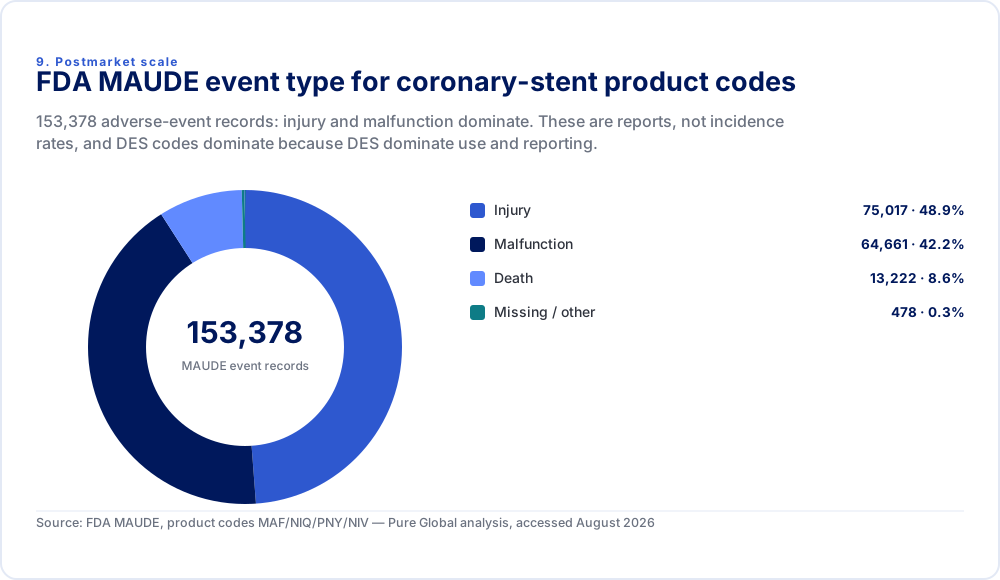
| Event type | |
|---|---|
| Injury | 75,017 |
| Malfunction | 64,661 |
| Death | 13,222 |
| Missing / other | 478 |
Source: FDA MAUDE, product codes MAF/NIQ/PNY/NIV — Pure Global analysis, accessed August 2026
MAUDE, summed across the event extracts we opened on 15 August 2026 26:
| Product code | Event records |
|---|---|
| NIQ (DES) | 128,453 |
| MAF (coronary stent) | 23,316 |
| PNY (absorbable DES) | 930 |
| NIV (covered) | 679 |
| Total | 153,378 |
Event-type mix: Injury 75,017; Malfunction 64,661; Death 13,222; missing or other 478 26. DES codes dominate because DES dominate contemporary PCI and because reporting follows use, litigation, and labeling — not because this table estimates a death rate. Passive surveillance duplicates events, under-counts others, and has no denominator. Anyone who turns 13,222 into a percentage of implants is misusing the file.
The recall extract is the opposite shape: 29 terminated records, 22 of them MAF, 6 NIQ, 1 PNY 27. Root-cause coding is coarse (19 "Other"). The free-text reasons are more informative than the code: sterility-barrier packaging, pyrogen levels in a manifold component, balloons that failed to deflate, broken struts, and at least one field correction because TAXUS Liberté DES had been selected when the operator wanted a bare-metal Liberté 27. That last example is a labeling and inventory-control failure sitting on a PMA platform — exactly the kind of problem a "we already have the PMA" plan does not budget.
Read the two files together as a capacity statement. A US coronary-stent manufacturer needs a complaint system that can absorb a MAUDE-scale reporting culture, a recall decision tree that can distinguish packaging from coating from mix-ups, and a PMA supplement machine that can change a supplier without waiting for a crisis. The 1,630 process-change supplements in §3 are what that capacity looks like on a quiet day.
9. What global registration costs
Takeaway: government fees on this path start at CAD 460 a year to keep a Canadian licence sellable and jump to $579,272 for a standard FDA PMA review. Pure Global's in-country representation is a flat $1,000–$3,000 per market per year. A DES sits at the high-risk tier. The published $15,000–$20,000 510(k) compilation band is contrast, not a quote for this device.
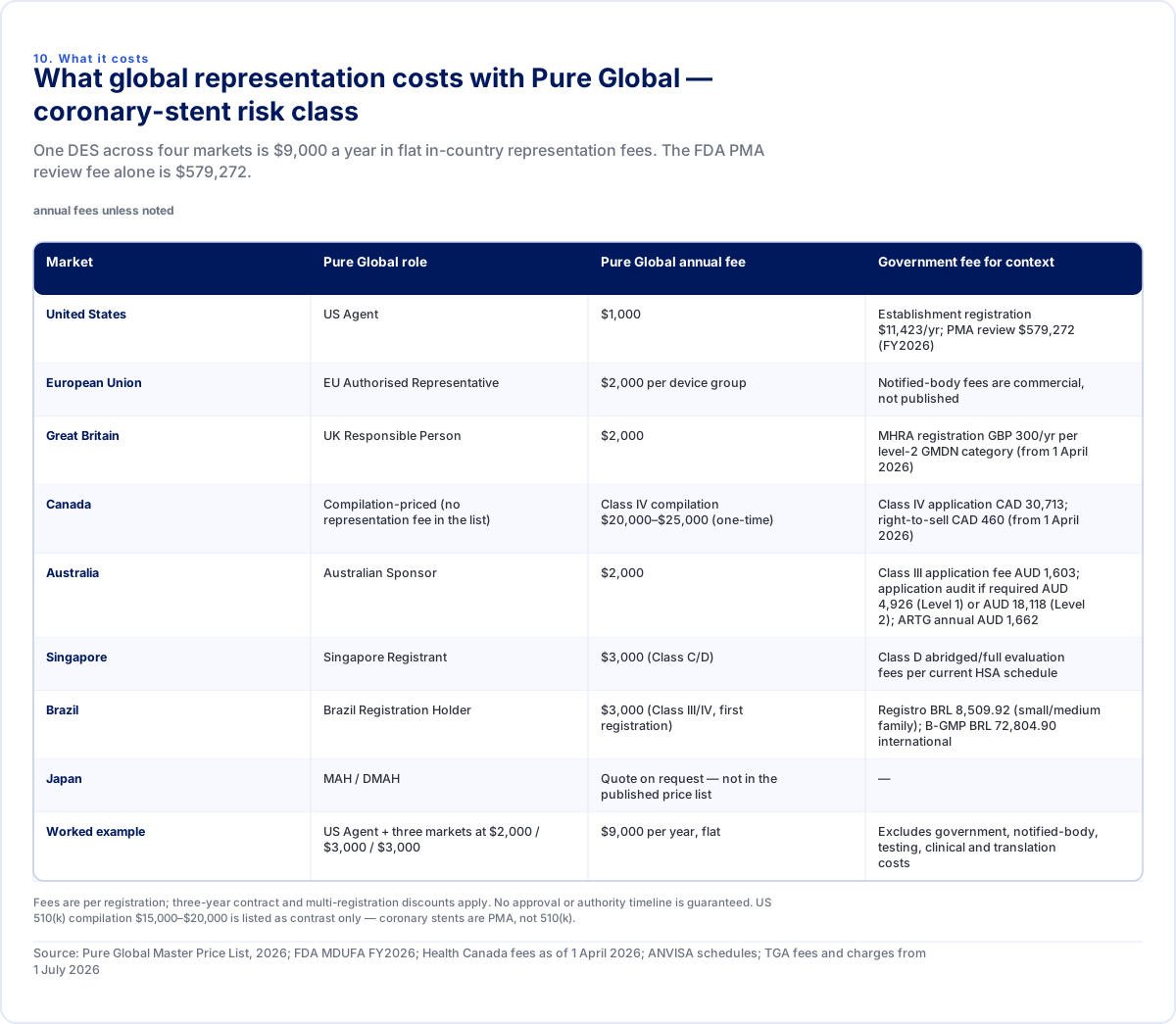
| Market | Pure Global role | Pure Global annual fee | Government fee for context |
|---|---|---|---|
| United States | US Agent | $1,000 | Establishment registration $11,423/yr; PMA review $579,272 (FY2026) |
| European Union | EU Authorised Representative | $2,000 per device group | Notified-body fees are commercial, not published |
| Great Britain | UK Responsible Person | $2,000 | MHRA registration GBP 300/yr per level-2 GMDN category (from 1 April 2026) |
| Canada | Compilation-priced (no representation fee in the list) | Class IV compilation $20,000–$25,000 (one-time) | Class IV application CAD 30,713; right-to-sell CAD 460 (from 1 April 2026) |
| Australia | Australian Sponsor | $2,000 | Class III application fee AUD 1,603; application audit if required AUD 4,926 (Level 1) or AUD 18,118 (Level 2); ARTG annual AUD 1,662 |
| Singapore | Singapore Registrant | $3,000 (Class C/D) | Class D abridged/full evaluation fees per current HSA schedule |
| Brazil | Brazil Registration Holder | $3,000 (Class III/IV, first registration) | Registro BRL 8,509.92 (small/medium family); B-GMP BRL 72,804.90 international |
| Japan | MAH / DMAH | Quote on request — not in the published price list | — |
| Worked example | US Agent + three markets at $2,000 / $3,000 / $3,000 | $9,000 per year, flat | Excludes government, notified-body, testing, clinical and translation costs |
Fees are per registration; three-year contract and multi-registration discounts apply. No approval or authority timeline is guaranteed. US 510(k) compilation $15,000–$20,000 is listed as contrast only — coronary stents are PMA, not 510(k).
Source: Pure Global Master Price List, 2026; FDA MDUFA FY2026; Health Canada fees as of 1 April 2026; ANVISA schedules; TGA fees and charges from 1 July 2026
Most consultancies will not print a number. We do. The source is the Pure Global Master Price List, 2026 (sheet versions through 29 June 2026) 8. Fees track market and risk class, not the word "stent," which is why the dollar figures below match our other market-access hubs even though the government figures do not.
Annual in-country representation (one registration):
| Market | Role | Annual fee |
|---|---|---|
| United States | US Agent | $1,000 |
| European Union | EU Authorised Representative | $2,000 per device group |
| Great Britain | UK Responsible Person | $2,000 |
| Australia | Australian Sponsor | $2,000 |
| Singapore | Registrant, Class C/D | $3,000 |
| Brazil | Registration Holder, Class III/IV | $3,000 (first registration) |
| Canada | No representation line item | compilation-priced (below) |
| Japan | MAH / DMAH | Quote on request |
Included, in the price-list language: preparation and submission of the registration on a reference approval where applicable, modifications, renewals, and correspondence with authorities. Brazil adds translation, importation letters, UDI submissions and B-GMP coordination. A three-year contract applies; early termination pays 50% of the remaining value; on annual contracts the first year is +50%. Multi-registration ladders discount the per-device fee.
Worked example — one DES, four markets. US Agent $1,000 + three markets at the $2,000 / $3,000 / $3,000 tiers = $9,000 per year, flat 8. Assumptions: one registration (or one EU device group) per market; Singapore or Brazil at the high-risk tier; no extra EU groups. Exclusions: government fees, notified-body fees, testing, clinical investigations, translation beyond what a given market's annual fee already covers, and one-time compilation. Actual class and grouping change the quote. No approval or authority timeline is guaranteed.
One-time compilation and consulting 8:
- Regulatory pathway determination (US or EU MDR): $5,000
- EU MDR technical documentation, Class IIb/III: $15,000
- EU MDR CEP-CER compilation and writing, Class IIb/III: up to $30,000
- Canada registration compilation, Class IV: $20,000–$25,000
- US 510(k) compilation: $15,000–$20,000 — not the DES path. It is on this list so a reader comparing a Class II product to a stent can see the compilation gap. A PMA compilation is a different engagement; we do not print a PMA writing fee in the public list, and we will not pretend the 510(k) band covers it.
- Ad-hoc RA support: US $250/hour; EU/UK/Canada/Australia $200/hour; Brazil $150/hour
Government fees, the small or not-so-small number beside ours:
- United States, FY2026: PMA $579,272; establishment registration $11,423/year; supplement ladder as in §3 8
- Canada, from 1 April 2026: Class IV application CAD 30,713; right-to-sell CAD 460/year 1117
- Australia: Class III application fee AUD 1,603 and Class III ARTG annual charge AUD 1,662; an application audit, if required, adds AUD 4,926 (Level 1) or AUD 18,118 (Level 2) 28
- Brazil: Class III/IV registro BRL 8,509.92 (small/medium family); international B-GMP BRL 72,804.90 8
- Great Britain: GBP 300/year per level-2 GMDN category from 1 April 2026 14
- EU notified-body fees: commercial, not a government tariff. Budget them as a third number, larger than our AR fee, smaller than a US PMA review only if you are lucky.
Two pricing interactions are stent-specific.
EU device groups. The AR fee is per device group. A DES family filed as one group and a DES family filed as eight sizes-with-eight-groups are two different annual invoices for a comparable metal tube. Freeze grouping before you freeze the EU quote.
PMA versus 510(k) compilation. Our orthopedic and surgical-robot hubs can honestly lead with a $15,000–$20,000 US compilation range because those products often are 510(k) or De Novo. This hub cannot. The honest US government number for a new coronary DES is $579,272 plus whatever the clinical program costs. Representation at $1,000 a year is still the cheap, necessary layer. It is not the PMA.
A first-year cash sketch, using only published numbers. This is not a quote. It is the arithmetic a board packet can defend from this paper without inventing notified-body or clinical prices. Take one DES, one EU device group, and the four-market representation cut already priced at $9,000:
- FDA PMA review fee $579,272 (standard; small-business $144,818 if you actually qualify) plus establishment registration $11,423 8
- Class III annual report $20,275 if the PMA is already on the clock that fiscal year 8
- Representation $9,000 8
- Pathway determination $5,000; EU MDR technical documentation Class IIb/III $15,000; CEP-CER writing IIb/III up to $30,000; Canada Class IV compilation $20,000–$25,000 if Canada is in year one instead of Brazil 8
- Canada government: Class IV application CAD 30,713 plus right-to-sell CAD 460 if that licence is live 1117
- Australia Class III application fee AUD 1,603 and ARTG annual charge AUD 1,662 if Australia is in the set; budget a separate application-audit fee if TGA requires one 28
- Brazil registro BRL 8,509.92 (small/medium family in the published table) plus international B-GMP BRL 72,804.90 if the site is not already certified 8
- Great Britain GBP 300 per level-2 GMDN category 14
Add, as unquoted lines the public list does not price: notified-body conformity assessment, a first-in-human or IDE program under 21 CFR 812, type testing, translations beyond what a given annual fee already covers, and a China VBP bid. The sketch's job is to stop a team from treating $9,000 as the cost of bringing a DES to four markets. Representation is the cheap, legally required layer. The PMA fee, the CER, the B-GMP and the clinical program are the rest of the iceberg. No approval or authority timeline is guaranteed.
10. Sequencing on the observed clock
Takeaway: freeze the US object (PMA vs HDE, MAF vs NIQ vs PNY) and the change-control map before you pick a first country. Then use reliance markets as evaluation shortcuts, not as class shortcuts. Put China on a parallel commercial track.
A concrete four-market cut of that sequence, using only roles this paper has already priced: United States (PMA) → EU (Class III, one device group) → Singapore (Class D abridged off the PMA) → Brazil (Class IV registro). Representation on that cut is the $9,000 worked example in §9 if Singapore and Brazil sit at the $3,000 tier and the EU is one group 8. Swap Australia for Singapore if the commercial team needs an ARTG listing as the ASEAN reference; swap Canada for Brazil if MDSAP is already in hand and Latin America can wait. The wrong swap is "Canada instead of the PMA" because CAD 30,713 looks smaller than $579,272. Canada is Class IV on top of a clinical package. It does not manufacture the US object.
A sequence that copies a 510(k) playbook — "FDA first, then everyone abridges" — fails here in a specific way. FDA first is often still right, because HSA, TGA and others will take a PMA as a reference approval 2018. What fails is the content of that first file:
- Decide which of the four US objects you are. A covered perforation stent that starts a DES PMA is in the wrong statute. A BMS that is actually a drug-coated stent is in the wrong product code. The intended-purpose sentence (anatomy, drug or no drug, duration, absorbable or not, perforation or de novo lesion) is the classification.
- Write the PMA as if the first supplement is already scheduled. Name the sterilizer, the packager, the coating site, the size matrix and the labeling change process. The register shows 54-row careers. Plan for them.
- Do not assume the EU is a translation of the PMA. Rule 8 + Rule 14, a notified body, Article 54 where applicable, EUDAMED UDI, PMCF, and an AR are a second architecture. Our keyword slice says that architecture is uniformly Class III when the name is a coronary stent 2412.
- Use Canada and Australia as MDSAP/ARTG mechanics, not as easy classes. Class IV + MDSAP and Class III + Sponsor are still highest-tier. They are faster than a first-of-kind PMA only when the evidence already exists.
- Date Great Britain. CE acceptance currently runs to mid-2028 (MDD) and mid-2030 (MDR); reliance is still intent 13. File today's route; diarise the recheck.
- Price Brazil as registro + B-GMP + a local holder, which is what 119 Class IV rows already show 2221.
- Split China. NMPA Class III is necessary. VBP is the price. They do not substitute 7.
- Do not skip Japan because the fee is unpublished. Class IV shonin plus MAH is a real file 19. Ask for the quote.
- Covered stents are a first-country fork, not a DES add-on. If the US object is NIV/HDE, do not sequence as if you will collect Singapore abridged-off-PMA credits. The humanitarian indication (acute perforation, population cap) will not travel as a DES claim 56.
- Keep the biological-evaluation calendar from splitting. A permanent blood-contacting implant is a 10993 file — hemocompatibility and chronic implantation, not a cytotoxicity tick-box. Freeze one core characterisation plan and overlay each regulator's recognised edition; the companion map is the ISO 10993-1:2025 hub. Do not let a US PMA freeze an edition the EU notified body will later reject.
A ten-line readiness gate, replacing a 90-day theatre: (1) intended-purpose frozen as one of the four US objects; (2) supplier/sterilizer/packager map written as a supplement forecast, not a surprise; (3) US pathway determined — PMA versus HDE, with the $5,000 determination priced against a $579,272 mistake 88; (4) clinical package sized to the claim, not to the word "stent"; (5) MDSAP scheduled before Canada; (6) notified body engaged for Rule 8 + Rule 14; (7) EUDAMED actor and UDI current against the May 2026 mandate; (8) representation model chosen per market, with dossier-access and transfer terms in the contract; (9) reference-route sameness controls for Singapore/TGA/AREE; (10) China split into NMPA file and VBP file, with an ASP that survives RMB 700.
Surgical robots, for contrast, remain a US Class II story about architecture codes — mapped separately. So do IVDs, CGMs and AI/SaMD. If someone on the same leadership team is filing a stent and a robot, they need two regulatory objects in their head: a PMA implant and a 510(k)/De Novo platform, not one "Class III-ish" blur.
11. Methodology and limitations
Takeaway: this is a register study plus a procurement overlay. Filters have edges. We report them rather than smoothing them.
- FDA PMA / 510(k) / classification / recall / MAUDE: product codes MAF, NIQ, PNY, NIV. Core PMA cohort drops P810046, P940019 and P950020 after trade-name review. Originals = earliest decision date per PMA number. Blank supplement rows with later dump dates are not treated as new originals (P130030's blank 2026-03-10 row is the example). Access date 15 August 2026 34.
- EUDAMED: 25 July 2026 public dump, 2,926,029 rows, keyword filter on trade/device/model. Homonym trade-name pass discarded 24.
- TGA ARTG: 6 July 2026 snapshot; product_name contains "coronary" and "stent" 18.
- ANVISA: 13 July 2026 file, semicolon, latin-1; NOME_TECNICO or NOME_COMERCIAL contains stent and coron 22.
- China: no NMPA registration census this week; VBP from official reporting and peer-reviewed literature 725.
- ClinicalTrials.gov: the extract available for this snapshot did not yield a usable study table. We do not invent a trial count.
- Fees: FDA MDUFA FY2026 page; Health Canada pages in force 1 April 2026; Pure Global Master Price List 2026 8118.
- Applicant names are identifiers in a regulatory file, not endorsements or a ranking of clinical quality.
- Counts are not rates, not shares, not forecasts.
Frequently asked questions
Is a coronary stent a 510(k) device in the United States?
No. MAF and NIQ are Class III PMA codes 12. The 510(k) extract for MAF, NIQ, PNY and NIV contains zero rows 4. Covered stents (NIV) use the humanitarian device exemption 56.
How is this different from orthopedic implants?
A conventional metal-on-poly knee can still be US Class II 510(k) and EU/China Class III. A coronary DES is highest-tier in the United States too 10. The US trap moves from "which class?" to "which PMA supplement, and which of four objects?"
How many original US coronary-stent PMAs are there?
In our cleaned cohort, 37 unique PMA numbers and 2,210 decision rows, of which 2,173 are named supplements 3. That is not a count of SKUs on hospital shelves today; withdrawn numbers remain in the historical file 10.
What does a PMA supplement cost?
FY2026 standard fees run from $9,268 (30-day notice) to $463,418 (panel-track) on top of the $579,272 original PMA fee, plus $20,275 a year for Class III periodic reporting 8. Most observed supplements in this cohort are process changes 3.
Are covered coronary stents PMA devices?
The two US devices in routine discussion — Graftmaster and PK Papyrus — are HDEs under product code NIV 56. Do not budget them as a DES PMA by default.
Will an FDA PMA let me skip the EU notified body?
No. The Union class is still III under Annex VIII, with a notified body, UDI, AR and, for Class III implantables, Article 54 consultation unless an Article 54(2) exemption applies 1224. A PMA is evidence, not a certificate of conformity.
What did China VBP do to stent prices?
National Batch 1 in November 2020 cut average DES prices on the order of 93% (peer-reviewed Tianjin estimate 92.67%) 7. Registration and winning the tender remain different problems.
What does Pure Global charge to represent a DES abroad?
US Agent $1,000/year; most markets $2,000; Singapore Class D and Brazil Class III/IV $3,000 for the first registration. One product, four markets: $9,000/year in representation fees, excluding government, notified-body, testing, clinical and translation costs 8. Pathway determination is $5,000. We do not guarantee approvals or timelines.
Conclusion: freeze the object, then buy the lifecycle
Three sentences survive the registers.
The United States is Class III. There is no 510(k) story hiding in MAF or NIQ. The orthopedic shortcut does not transfer.
The US work is the supplement. Thirty-seven original numbers, 2,173 named supplements, three-quarters of them process changes, a fee ladder that makes a panel-track supplement cost more than a stack of 510(k)s.
China already ran the price experiment. A licence without a procurement theory is not access.
Pure Global runs global registration programs — pathway determination, dossier compilation, and in-country representation as US Agent, EU Authorised Representative, UK Responsible Person, Australian Sponsor, Singapore Registrant and Brazil Registration Holder — at the flat, published fees above. If you are sequencing a coronary stent across these markets, start with the $5,000 pathway determination: it forces the MAF/NIQ/PNY/HDE question before you spend a PMA-scale government fee on the wrong object. No approval or timeline is ever guaranteed — by us or anyone.
References
- U.S. Food and Drug Administration, Product Classification — MAF, Stent, Coronary; NIQ, Coronary Drug-Eluting Stent; PNY (Absorbable Coronary Drug-Eluting Stent) and NIV (Coronary Covered Stent) in the same Product Code Classification Database — Pure Global analysis, accessed August 2026. MAF/NIQ/PNY: Class 3, PMA. NIV: deviceclass f, submissiontypeid 6 (HDE). accessdata.fda.gov ↩ ↩ ↩
- U.S. Food and Drug Administration, Product Classification — NIQ, Coronary Drug-Eluting Stent, accessed August 2026. accessdata.fda.gov ↩ ↩ ↩
- U.S. Food and Drug Administration, Premarket Approval (PMA) database — Pure Global analysis of product codes MAF, NIQ and PNY, accessed 15 August 2026 (core cohort: 2,210 decision rows, 37 unique PMA numbers). accessdata.fda.gov ↩ ↩ ↩ ↩ ↩ ↩ ↩ ↩ ↩ ↩ ↩ ↩ ↩ ↩ ↩ ↩ ↩ ↩
- U.S. Food and Drug Administration, 510(k) Premarket Notification database — Pure Global analysis of product codes MAF, NIQ, PNY and NIV, accessed 15 August 2026 (zero rows). accessdata.fda.gov ↩ ↩ ↩ ↩
- U.S. Food and Drug Administration, HDE H170004 — PK Papyrus Covered Coronary Stent System, Biotronik AG, decision date 14 September 2018; approval order. accessdata.fda.gov ↩ ↩ ↩ ↩ ↩ ↩
- U.S. Food and Drug Administration, HDE H000001 — Graftmaster RX Coronary Stent Graft System, Abbott Vascular, original decision 10 January 2001, product code NIV; Humanitarian Device Exemption overview. accessdata.fda.gov ↩ ↩ ↩ ↩ ↩ ↩
- National Health Commission of China, China's centralized purchasing leads to 90 percent drop in price of coronary stents, 6 November 2020 — average price about 700 yuan from about 13,000 yuan; first-year volume 1.07 million; availability from January 2021. Peer-reviewed confirmation: Yang Z, Ni L, et al., Impact of volume-based procurement policy on coronary stent use in Tianjin, PMC12581602 / PMID 41185070 — average reduction 92.67%; selected prices CNY 469–798. en.nhc.gov.cn ↩ ↩ ↩ ↩ ↩ ↩ ↩ ↩
- U.S. Food and Drug Administration, Medical Device User Fee Amendments (MDUFA): FY2026 fee schedule, 1 October 2025–30 September 2026, accessed August 2026. fda.gov ↩ ↩ ↩ ↩ ↩ ↩ ↩ ↩ ↩
- U.S. Food and Drug Administration, Non-Clinical Engineering Tests and Recommended Labeling for Intravascular Stents and Associated Delivery Systems, accessed August 2026. fda.gov ↩
- U.S. Food and Drug Administration, PMA P210014 — SLENDER / DIRECT Sirolimus-Eluting Coronary Stent, Advanced Bifurcation Systems, decision date 13 December 2021; withdrawal date 14 March 2023. accessdata.fda.gov ↩ ↩ ↩
- Health Canada, Fees for examining a medical-device licence application — Class IV application CAD 30,713; significant-change amendment CAD 16,251; manufacturing-change amendment CAD 4,470 as of 1 April 2026. canada.ca ↩ ↩ ↩ ↩ ↩
- European Union, Regulation (EU) 2017/745 (MDR) — Annex VIII Rules 8 and 14; Article 54, including the exemptions in Article 54(2). eur-lex.europa.eu ↩ ↩ ↩
- UK Medicines and Healthcare products Regulatory Agency, Regulating medical devices in the UK, last updated 20 February 2026 — CE acceptance to 30 June 2028 (MDD) / 30 June 2030 (MDR); consultation announced on indefinite CE recognition. See also Statement of policy intent: international recognition of medical devices, updated 12 March 2026. gov.uk ↩ ↩ ↩
- UK Medicines and Healthcare products Regulatory Agency, Register medical devices to place on the market, last updated 20 July 2026 — annual registration fee per level-2 GMDN category from 1 April 2026. gov.uk ↩ ↩ ↩
- Health Canada, Guidance on the Risk-based Classification System for Non-In Vitro Diagnostic Devices and About medical devices — four classes; devices that correct a defect of the central cardiovascular system are Class IV; MDL required for Class II–IV; accessed August 2026. canada.ca ↩ ↩
- Health Canada, Medical Device Single Audit Program (MDSAP), accessed August 2026. canada.ca ↩
- Health Canada, Fees for the right to sell licensed Class II, III or IV medical devices — CAD 460 as of 1 April 2026. canada.ca ↩ ↩ ↩
- Therapeutic Goods Administration (Australia), Australian Register of Therapeutic Goods — Pure Global analysis of the 6 July 2026 snapshot (26 coronary-stent keyword entries), accessed August 2026. tga.gov.au ↩ ↩ ↩ ↩
- Pharmaceuticals and Medical Devices Agency (Japan), Regulations and Approval/Certification of Medical Devices — four classes; foreign manufacturers proceed through a Japanese MAH; accessed August 2026. pmda.go.jp ↩ ↩ ↩
- Health Sciences Authority (Singapore), Registration overview of medical devices, accessed August 2026 — full / abridged / expedited routes; five reference agencies; implantable devices in contact with the central circulatory system and devices with a registrable drug in a secondary role excluded from expedited Class D. hsa.gov.sg ↩ ↩ ↩
- ANVISA, Resolução RDC nº 751/2022 — Article 6 (Class I/II notificação) and Article 7 (Class III/IV registro); in force 1 March 2023. anvisalegis.datalegis.net ↩ ↩
- ANVISA, medical-device register — Pure Global analysis of the 13 July 2026 snapshot (125 coronary-stent keyword records; 119 Class IV), accessed August 2026. Consultas ANVISA. consultas.anvisa.gov.br ↩ ↩ ↩ ↩ ↩
- Health Canada, Regulatory requirements for importing medical devices — Class II–IV devices require an MDL; importers/distributors generally require an MDEL, subject to listed exemptions; accessed August 2026. canada.ca ↩
- European Commission, EUDAMED public UDI/Device database — Pure Global analysis, snapshot 25 July 2026 (2.93 million UDI-DI records; 596 coronary-stent keyword hits, all Class III). ec.europa.eu ↩ ↩ ↩ ↩ ↩
- Sun J.Y., Yin T., Liu Z., When State Becomes the Only Buyer: Effects of national volume-based procurement of cardiac stents in China, RIETI Discussion Paper 23-E-065, 2023 — tender November 2020; products available 1 January 2021. rieti.go.jp ↩ ↩ ↩
- U.S. Food and Drug Administration, MAUDE — Pure Global analysis of product codes MAF, NIQ, PNY and NIV, accessed 15 August 2026 (153,378 event records). accessdata.fda.gov ↩ ↩
- U.S. Food and Drug Administration, Medical Device Recall database — Pure Global analysis of the same four product codes, accessed 15 August 2026 (29 terminated records). accessdata.fda.gov ↩ ↩
- Therapeutic Goods Administration (Australia), Fees and charges summary from 1 July 2026 — Class III application fee AUD 1,603; application audit AUD 4,926 (Level 1) or AUD 18,118 (Level 2); Class III ARTG annual charge AUD 1,662. tga.gov.au ↩ ↩
 Market · Jul 24, 2026FDA US Medical Device RegistrationMarket · Jul 24, 2026EU Medical Device Classification & Regulation (MDR/IVDR)Market · Jul 24, 2026MHRA UK Medical Device Registration & ApprovalCase Study · Aug 11, 2026Basic UDI-DI Grouping for Contrast DevicesCase Study · Aug 11, 2026Class III Dermal Fillers Under the EU MDRDevice Type · Jul 20, 2026Cardiovascular Devices Regulation: FDA, EU MDR & GlobalRegulatory Update · Sep 17, 2026FDA Buffy Coat System GuidanceRegulatory Update · Sep 17, 2026HSA GN-15 R14 Registration RequirementsRegulatory Update · Sep 14, 2026COMBINE: Combined-Study Safety ReportingRegulatory Update · Sep 14, 2026MDCG Rule 7: IVD Quality Controls
QMSR Warning Letters 2026: The ISO 13485 Records FDA Named
Four posted FDA warning letters cite ISO 13485:2016 Clause 7.1 and name the missing records. Pull those first, then management-review and audit reports.

ISO 14971 Risk Files: Evidence and Review
Use recall data, regulatory sources and worked examples to review risk controls and the evidence supporting release.
In-Country Representatives and Registration Holders: 2026 Guide
Who holds the file matters when a distributor changes. Compare local roles, handover documents, transfer conditions and the full annual cost before appointing a partner.
Let's Talk,
Anywhere You Are.
Whether looking for more information or ready to partner with us, we're here to guide you through every step of the regulatory process.
Contact us