Class III Dermal Fillers: An EU MDR Program From Scope to PSUR
A hyaluronic acid filler maker planned a documentation project for Europe. Annex XVI qualification, Rule 8 and the Article 54 expert panel turned it into an implant-grade program run by the risk class, not the catalog.
This anonymized case study is built around a real Pure Global registration outcome. Client identity is withheld, and project details have been generalized or reconstructed to illustrate realistic regulatory challenges and solutions. It is not a literal account of one client's private history. Regulatory and pricing information is dated and sourced separately.
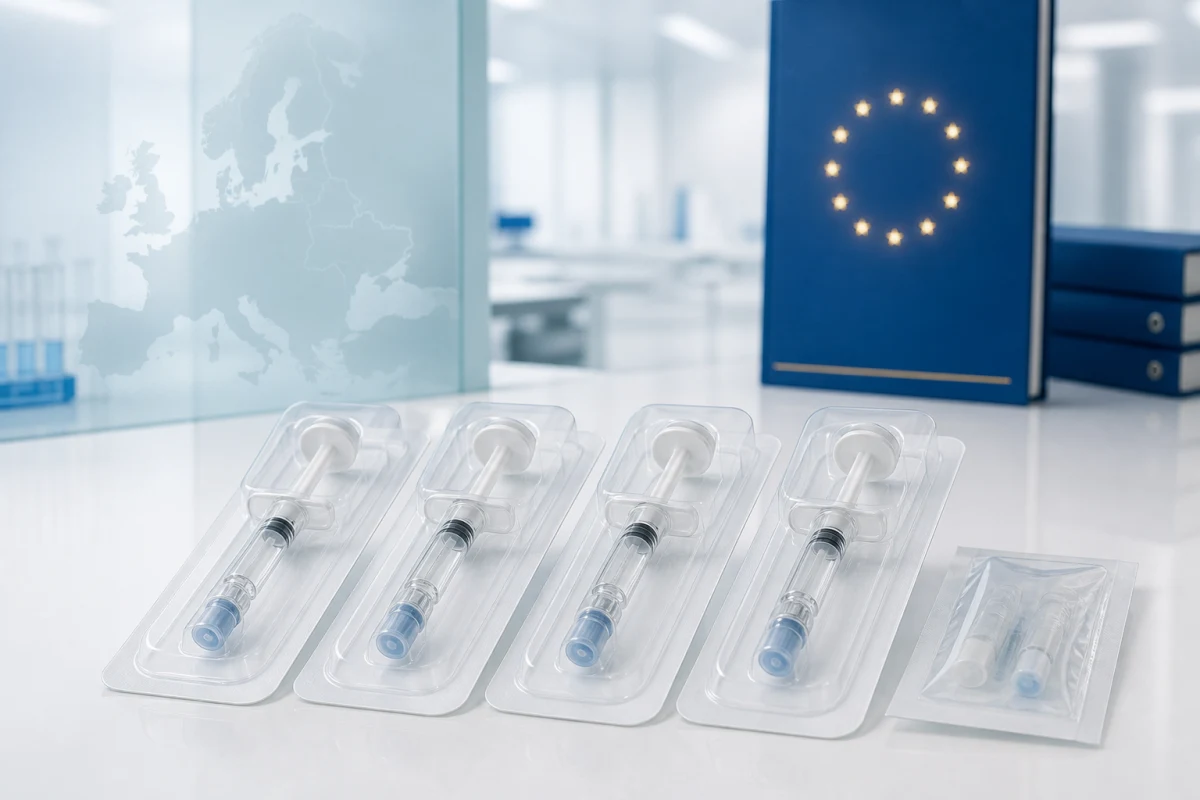
A manufacturer of hyaluronic acid dermal fillers came to us with what it described as a paperwork project. The range sold through aesthetic distributors outside Europe, the production history was long, and the biocompatibility file was thick. The internal plan treated the EU as one submission covering the whole catalog and assumed the existing documents would carry most of the weight.
The plan failed on a single point of EU law. Under the MDR, a gel injected into the face and left there is an implant, and a resorbable one sits in the regulation's highest risk class. What the company had scoped as a filing exercise was an implant-grade certification program.
The catalog was not one regulatory project
Before anything could be classified it had to be qualified. For products without a medical purpose the MDR does not start from the definition of a medical device; it starts from the descriptions in Annex XVI, and MDCG 2023-5 is explicit that qualification precedes classification. Group 3 covers substances and items intended for facial or other dermal or mucous-membrane filling by subcutaneous, submucous or intradermal injection or other introduction, and where a syringe or roller is prefilled, the means of introduction is part of the device rather than an accessory sold alongside it. Our aesthetic devices page sets out the wider Annex XVI framework.
Read against that description, the company's catalog split in two. The volumizing gels were filling products and qualified. The skin-hydration and biorevitalization injectables sold beside them did not: MDCG 2023-5 lists mesotherapy products for biorevitalization, hydration and collagen synthesis among the items that do not qualify as Annex XVI products at all, together with post-treatment serums and micro-needling equipment. Those products had no route into the MDR through group 3 and came out of the launch scope, to be assessed separately under other EU law.
The exercise cut the other way as well. Two product descriptions carried therapeutic-sounding claims about correcting a condition. Left in place, those claims would have moved the products off the Annex XVI track and onto the medical-device track, with a different evidence expectation attached. We drafted one intended-purpose statement per product, had regulatory and commercial sign off on the same sentence, and froze it. Classification, clinical evaluation, labeling and the public summary are all generated from that sentence, and changing it later is expensive.
Resorbable is what made it Class III
The company expected heavy treatment for anything permanent and something lighter for a gel the body breaks down. Rule 8 of Annex VIII works the other way. Implantable and long-term surgically invasive devices are Class IIb unless they have a biological effect or are wholly or mainly absorbed, in which case they are Class III. MDCG 2023-5 applies exactly that split to this product group: permanent dermal fillers Class IIb, resorbable dermal fillers Class III. The product that disappears is the higher class, because absorption is the thing the regulation wants evidence about.
Implantable status came from the MDR's own definition rather than from anything in the marketing. A device totally introduced into the body by clinical intervention and intended to remain in place after the procedure is implantable, and the definition expressly includes devices that are wholly or partially absorbed. That one word carried the implant card, the expert panel and the traceability duties described further down.
A third classification question sat in the company's roadmap: a variant of the base gel with a local anesthetic. Under Rule 14, a device incorporating a substance that would be a medicinal product on its own, acting ancillary to the device, is Class III, and it brings a consultation on that substance into the conformity assessment. We recommended keeping it out of the first submission rather than letting it set the pace for the range; the MDR classification rules answer these questions from the product, not the category name.
Finding a notified body that could take the file
Class III leaves no self-declared route. Certification runs through a notified body, which assesses the quality management system and then assesses the technical documentation for each device. The company's first question was which body would be cheapest. The question that mattered was which bodies were designated for this kind of device at all, since designation is scoped by code and non-active implantable products in the aesthetic groups sit outside many bodies' scope. We shortlisted on scope, then on whether the body was accepting applications for the group.
Scheduling was the second constraint, and it belongs to the notified body's calendar rather than to the manufacturer's launch plan. Capacity has been the binding constraint on European certification programs for years; Regulation (EU) 2026/977 has since set uniform maximum periods for the main stages of conformity assessment, which makes the calendar more predictable without removing the queue. We sequenced the program so the quality system was audit-ready before the technical files were needed, and so the clinical work ran alongside both instead of starting when the notified body asked for it.
The expert panel that was not in the plan
For Class III implantable devices the notified body does not reach its own conclusion on the clinical evaluation alone. Article 54 requires it to run the clinical evaluation consultation procedure: its assessment report goes to a European expert panel, which may issue a scientific opinion before a certificate can be issued.
Two exemptions are commonly assumed here, and neither was available. The exemption for a device modified from one the same manufacturer already markets for the same intended purpose does not reach a non-medical indication, because those indications sat outside the scope of the old directives; an earlier CE mark for a medical-purpose product does not carry across. The exemption for device types whose clinical evaluation principles are set out in a common specification does not apply either, because the common specifications for Annex XVI products do not describe clinical evaluation principles. A small aesthetic line therefore faced the same consultation step as any other high-risk implant, and the company needed that answer before it committed to a launch plan.
Where the equivalence plan ran out
The company's clinical strategy was two sentences long: cite the published literature on hyaluronic acid fillers, and claim equivalence to a well-known CE-marked filler. Both had to go.
For products without a medical purpose, Article 61(9) converts the requirement to show a clinical benefit into a requirement to show performance, then states that clinical investigations shall be performed unless reliance on existing clinical data from an analogous medical device is duly justified. The common specifications and MDCG 2023-6 close most of that door: equivalence between a product with no medical purpose and a medical device generally cannot be completed, because clinical criteria such as the severity and stage of the disease being treated do not exist on the non-medical side. Leaning on another manufacturer's device is harder still, since the MDR requires a contract giving full and ongoing access to that manufacturer's technical documentation, and competitors in this market do not sign one.
What remained was evidence the company could own. We rebuilt the clinical evaluation plan around demonstrable performance and the hazards the common specifications name for this group — migration, inflammation, granuloma, infection, nerve and vascular injury, necrosis, blindness — so the evidence answered the risk file rather than the brochure. Post-market clinical follow-up entered the plan as a source of evidence rather than a form to complete afterwards, which matters here because the specifications also require long-term data on the presence of non-degradable substances.
The label the commercial team did not expect
The common specifications write parts of the label and the instructions for use directly, and they are not written to flatter a brand. The label has to carry the words "non-medical purpose:" followed by a description of that purpose. It has to state, in the largest bold font on the label, that the device may only be administered by appropriately trained healthcare professionals qualified or accredited under national law, and that it is not to be used in anyone under eighteen.
The instructions go further. They must list constituents with concentrations, molecular-weight ranges, particle sizes and degrees of cross-linking, which is formulation detail the company had always treated as proprietary. They must include a separate annex written for lay readers, covering residual risks, undesirable side effects and contraindications, with space for the injector to record the site, number and volume of injections for each person treated. Training on administration and safe use has to be provided and made accessible to users.
Because the device is implantable, and fillers are not among the implant types Article 18 exempts, an implant card and patient information were deliverables as well, in the languages each Member State determines. We built one controlled master set with a translation process around it, retiring the distributor-authored artwork used in other regions.
A public document with the company's name on it
Article 32 requires a summary of safety and clinical performance for Class III and implantable devices. Unlike the technical documentation, it is not a private file: the notified body validates it during the assessment and it is published in EUDAMED. Because patients receive this device directly, it needed a section written for them alongside the section for healthcare professionals.
Two consequences shaped the launch. Any performance statement the company wanted in the public summary had to exist in the technical documentation first, which is where several marketing phrases came out. And the manufacturer owns the translations: the summary and its translations must be in EUDAMED before the device is placed on a given Member State's market. The rollout map, meaning which countries and in what order, stopped being purely a sales decision and became a regulatory deliverable with a language list attached.
What the four groups have to carry
The line is on the European market as four Basic UDI-DI device groups, all Class III, with our EU entity acting as the manufacturer's authorized representative.
The obligations that began at certification do not scale down with the size of the catalog. A Class III device needs a periodic safety update report at least annually. The MDR's end-state is submission through EUDAMED to the notified body, with the body's evaluation available to competent authorities; until the post-market surveillance and vigilance modules become mandatory, the report follows the applicable transitional channel agreed with the notified body. The public summary is updated when the annual clinical evaluation shows that an update is needed. Post-market clinical follow-up runs continuously. Trend reporting under Article 88 covers statistically significant increases in non-serious incidents and expected undesirable side effects, which for an injectable sold into aesthetic clinics rather than hospitals meant building an intake route through customers who run no complaint-handling system of their own. Traceability duties reach the channel too: economic operators must keep the UDI of Class III implantable devices they supply or receive, and Member States must require health institutions to do the same. Our post-market surveillance page describes the system these duties feed.
The company-stage lesson is blunt: this manufacturer's regulatory workload was set by its risk class, not by its product count. Four device groups demand the same clinical, certification, transparency and vigilance machinery as forty would, and a small team either builds that machine or buys it.
If your filler line is heading for Europe
Write the intended purpose first and treat it as a controlled document, because qualification, class, evidence and labeling all descend from it. Assume implant-grade obligations for anything injected and left in place. Check a notified body's designated scope before its price list. Do not build a clinical plan on equivalence to a medical device. And carry the post-market cadence as a permanent operating cost rather than a project closeout. If you are planning a European launch for an aesthetic injectable, talk to our team about the route and the evidence it will need.
 Blog · Jul 13, 2026Aesthetic Devices: The 2026 Global Market-Access MapRegulatory Update · Aug 9, 2026Sri Lanka Aesthetic Device Classes and DeadlineRegulatory Update · Jan 28, 2026Malaysia Medical Device (Designated Medical Device) Order 2026Blog · Aug 24, 2026Medical Device Registration Verification 2026Blog · Aug 17, 2026Coronary Stents: Eight Highest-Tier FilesCase Study · Aug 11, 2026Basic UDI-DI Grouping for Contrast DevicesCase Study · Aug 11, 2026One Balloon-Catheter Line, Two ANVISA RoutesBlog · Aug 10, 2026Surgical Robots: Eight Markets, Eight Regulatory FilesRegulatory Update · Sep 14, 2026COMBINE: Combined-Study Safety ReportingRegulatory Update · Sep 14, 2026MDCG Rule 7: IVD Quality Controls
Take your aesthetic injectable into the EU
From Annex XVI qualification and Class III strategy to clinical evidence, SSCP and PSUR cadence, we run EU MDR programs for filler manufacturers.

Annex XVI qualification and Rule 8 classification
Notified body scope matching and application sequencing
Clinical evaluation, PMCF and SSCP authoring
PSUR, vigilance and EU Authorized Representative cover

Frequently asked questions
Because they are absorbed. Rule 8 of MDR Annex VIII places implantable and long-term surgically invasive devices in Class IIb unless they have a biological effect or are wholly or mainly absorbed, in which case they are Class III. MDCG 2023-5 applies that split directly to this product group: permanent dermal fillers are Class IIb and resorbable fillers are Class III. Injecting a gel that stays in place after the procedure also makes the device implantable under the MDR definition, which is what brings the implant card, the expert panel consultation and the extra traceability duties with it.
Rarely, and not in the way most manufacturers plan. For products without a medical purpose, Article 61(9) requires clinical investigations unless reliance on existing clinical data from an analogous medical device is duly justified, and MDCG 2023-6 explains that equivalence between a non-medical product and a medical device generally cannot be completed, because clinical criteria such as severity and stage of disease do not exist on the non-medical side. Relying on a competitor's device also requires a contract giving full ongoing access to their technical documentation. In practice the evidence has to be evidence the manufacturer can own.
Yes to both, in the normal case. Article 18 exempts a closed list of implant types, such as sutures, staples and dental fillings, and dermal fillers are not on it, so an implant card and patient information travel with the device in the languages each Member State determines. Article 32 requires a summary of safety and clinical performance for Class III and implantable devices; the notified body validates it and it is published in EUDAMED, with a lay-reader section because patients receive the device themselves.
A permanent cadence rather than a closed project. Class III devices need a periodic safety update report at least annually. Until EUDAMED's post-market surveillance and vigilance modules become mandatory, the report follows the applicable transitional channel to the notified body; EUDAMED submission is the MDR end-state. Post-market clinical follow-up runs continuously, the public safety summary is updated when the annual evaluation requires it, and trend reporting covers significant increases in non-serious incidents and expected side effects. For an injectable sold into clinics, the practical challenge is collecting that field data from customers who have no complaint-handling system of their own.
Single Process,
Multiple Markets
When you partner with Pure Global, a single registration process opens doors to multiple countries. Our global subsidiaries make this streamlined path possible.











Let's Talk,
Anywhere You Are.
Whether looking for more information or ready to partner with us, we're here to guide you through every step of the regulatory process.
Contact us