Surgical Robot Global Market Access 2026: One Platform, Eight Regulatory Files
Surgical robots do not follow one regulatory class or one reusable filing. This research report maps the public records across eight markets, showing how architecture drives FDA classification, why one platform becomes dozens of registration objects, where clinical evidence controls the schedule, and what government and in-country representation fees actually cost.
TL;DR
There is no such thing as a "surgical robot" in regulatory law. The FDA routes the machines the industry calls surgical robots through 30 product codes under 14 regulations in 7 CFR parts 1. Japan's PMDA files the same class of hardware under four generic names 2. Great Britain's register spreads it across 25 GMDN categories. The first market-access decision is not which country to file in — it is what, exactly, you are registering.
Five findings from the registers themselves frame this report:
- The US regulation is being written architecture by architecture, right now. Five consecutive regulation numbers — 21 CFR 878.4961 through 878.4965 — are five different robot architectures, and four of the five were created inside eight months of 2024 by De Novo grants 3. The code you will file under may not exist yet.
- A De Novo manufactures the industry's predicate, not just yours. CMR Surgical's De Novo created product code SCV in October 2024; fourteen months later Medtronic's Hugo RAS entered the United States as a routine 510(k) under CMR's code 34. CMR paid a $173,782 De Novo review fee; Medtronic paid $26,067 5.
- One platform is dozens of registration objects, and the grouping is a choice you live with. In the EU register, one soft-tissue platform is registered as 141 device identifiers under 8 device groups; a comparable platform is 13 identifiers under 13 groups 6. In Canada, Medtronic's entire Hugo line sits on one licence while da Vinci's spreads across nine.
- The accessory ecosystem is the postmarket surface. 76.4% of adverse-event reports in FDA's flagship robot code name an instrument or accessory, not the console — one instrument family alone is 61% of the code's entire reported record 7. Thirty third-party companies in twelve countries register drapes, trays, cables and cleaning units that exist only because someone else's robot exists 6.
- Representation is a fork in the road that every register shows being taken. 98.2% of non-EU robot registrants name an EU authorised representative, and just 15 organisations cover the entire cohort 6. Pure Global's flat in-country representation fees put a worked four-market program at $9,000 per year Pure Global pricing — against an FDA De Novo review fee alone of $173,782.
None of the counts in this report are market shares, sales figures or installed-base numbers. They are regulatory records — and for the person who has to build the files, the records are the territory.
1. Why "surgical robot" is not a regulatory class
Takeaway: the FDA regulates robotic surgery through 30 product codes under 14 regulations spread across seven CFR parts — cardiovascular, dental, ENT, gastroenterology-urology, general and plastic surgery, neurology and orthopedics. Every one of them is Class II. Classification follows architecture and clinical application, never the word "robot."
The FDA's own description sets the boundary precisely: robotically assisted surgical (RAS) devices are one type of computer-assisted surgical system, and "the device is not actually a robot because it cannot perform surgery without direct human control" 8. The agency is equally precise about what an authorization is not: it is indication-specific, and FDA "has not granted marketing authorization for any robotically-assisted surgical device system for use in the United States specifically for the prevention or treatment of cancer" — clearances for procedures commonly performed in cancer patients rest on 30-day follow-up, not cancer outcomes 8.
Behind that definitional page sits a taxonomy nobody quotes. Pure Global's sweep of the FDA classification database found 30 product codes carrying dedicated robotic or computer-assisted surgical devices, under 14 regulation numbers in 7 CFR parts 1. All 30 are Class II. FDA's own specialty assignments scatter them: Neurology 14, General & Plastic Surgery 7, Gastroenterology/Urology 4, Dental 2, Cardiovascular 1, Orthopedic 1, ENT 1. Widen the lens to any 510(k) whose device name contains "robot" and the count grows to 124 records across 35 product codes and 12 CFR parts 4.
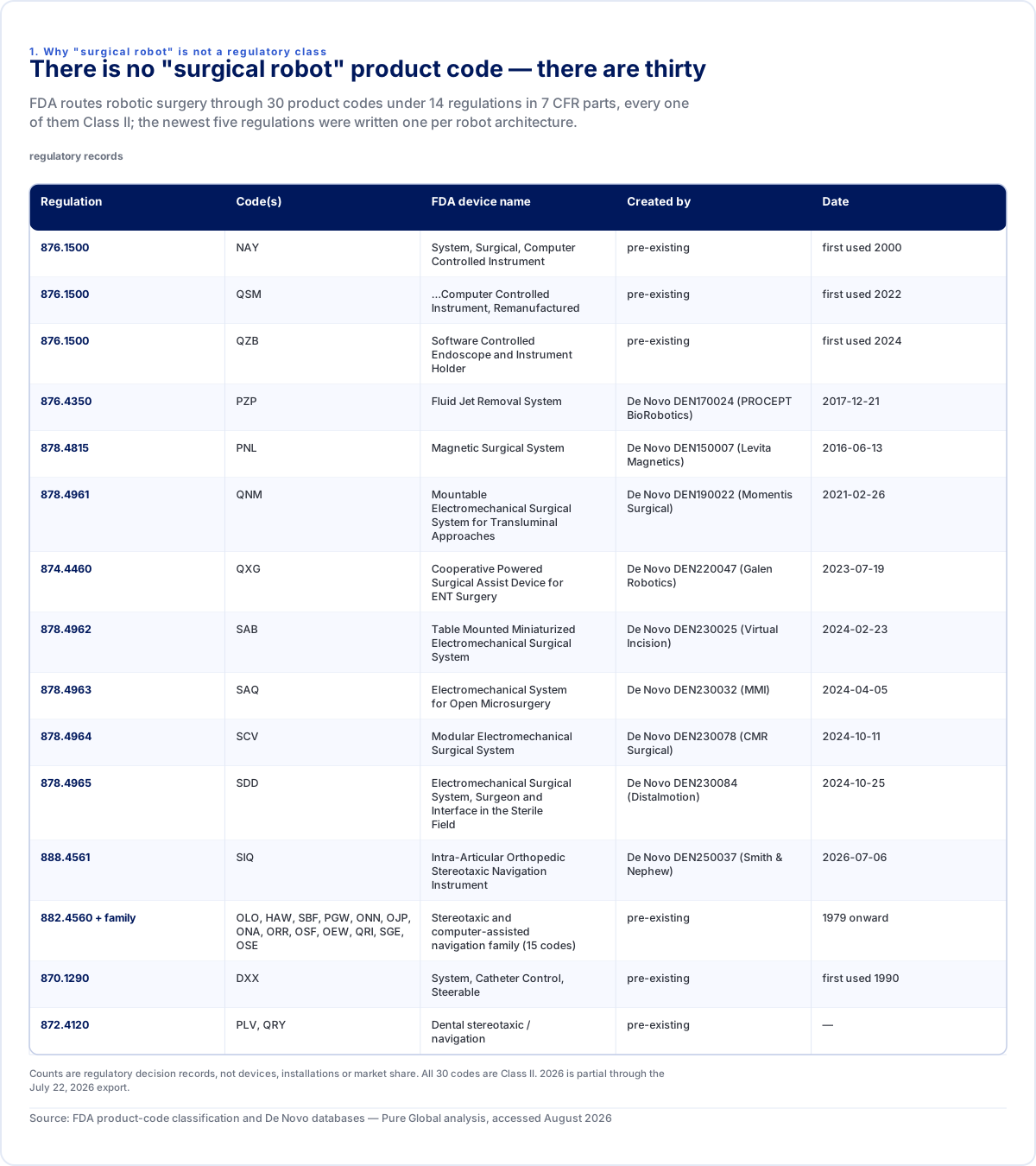
| Regulation | Code(s) | FDA device name | Created by | Date |
|---|---|---|---|---|
| 876.1500 | NAY | System, Surgical, Computer Controlled Instrument | pre-existing | first used 2000 |
| 876.1500 | QSM | …Computer Controlled Instrument, Remanufactured | pre-existing | first used 2022 |
| 876.1500 | QZB | Software Controlled Endoscope and Instrument Holder | pre-existing | first used 2024 |
| 876.4350 | PZP | Fluid Jet Removal System | De Novo DEN170024 (PROCEPT BioRobotics) | 2017-12-21 |
| 878.4815 | PNL | Magnetic Surgical System | De Novo DEN150007 (Levita Magnetics) | 2016-06-13 |
| 878.4961 | QNM | Mountable Electromechanical Surgical System for Transluminal Approaches | De Novo DEN190022 (Momentis Surgical) | 2021-02-26 |
| 874.4460 | QXG | Cooperative Powered Surgical Assist Device for ENT Surgery | De Novo DEN220047 (Galen Robotics) | 2023-07-19 |
| 878.4962 | SAB | Table Mounted Miniaturized Electromechanical Surgical System | De Novo DEN230025 (Virtual Incision) | 2024-02-23 |
| 878.4963 | SAQ | Electromechanical System for Open Microsurgery | De Novo DEN230032 (MMI) | 2024-04-05 |
| 878.4964 | SCV | Modular Electromechanical Surgical System | De Novo DEN230078 (CMR Surgical) | 2024-10-11 |
| 878.4965 | SDD | Electromechanical Surgical System, Surgeon and Interface in the Sterile Field | De Novo DEN230084 (Distalmotion) | 2024-10-25 |
| 888.4561 | SIQ | Intra-Articular Orthopedic Stereotaxic Navigation Instrument | De Novo DEN250037 (Smith & Nephew) | 2026-07-06 |
| 882.4560 + family | OLO, HAW, SBF, PGW, ONN, OJP, ONA, ORR, OSF, OEW, QRI, SGE, OSE | Stereotaxic and computer-assisted navigation family (15 codes) | pre-existing | 1979 onward |
| 870.1290 | DXX | System, Catheter Control, Steerable | pre-existing | first used 1990 |
| 872.4120 | PLV, QRY | Dental stereotaxic / navigation | pre-existing | — |
Counts are regulatory decision records, not devices, installations or market share. All 30 codes are Class II. 2026 is partial through the July 22, 2026 export.
Source: FDA product-code classification and De Novo databases — Pure Global analysis, accessed August 2026
The practical discipline this forces is claim-first, not mechanism-first. Which anatomy and procedures are claimed? Who controls the motion, and where is the primary interface? Which parts enter the sterile field? Are instruments reusable or single-use? Is planning or navigation software device functionality? Two platforms that both "assist surgery" land under different regulations because one holds an endoscope, another cuts bone from a preoperative plan, and a third positions instruments while the surgeon stands at the table. The intended-purpose statement — anatomy, procedure families, users, degree and location of control, instruments, accessories, claims — is the document every classification decision in this report hangs from.
The standards layer is at least stable: FDA recognizes IEC 80601-2-77 (Edition 1.1, consolidated 2023) for basic safety and essential performance of robotically assisted surgical equipment — recognition number 6-510, listed May 2025, replacing the 2019-edition recognition 9. In the EU, classification runs through MDR Annex VIII as interpreted by MDCG 2021-24 — revised in April 2026 — whose Rule 9 examples (surgical lasers, electrosurgical generators and their electrodes) and Rule 11 software tiers are the relevant machinery for a robotic system's energy instruments and planning software 1011. A recognized standard and a classification guidance do not shrink the object; they confirm that the object is plural.
2. The regulation is being written around you
Takeaway: nine De Novo grants have created robot classifications since 2016 — five of them consecutive regulation numbers, four of those five written inside eight months of 2024. The first mover pays $173,782 and does the classification work; the follower files a $26,067 510(k) against the code the first mover created. And neither route decides whether you need clinical evidence.
The modern history of US surgical-robot regulation is nine De Novo decisions 3:
Levita Magnetics' magnetic surgical system (2016) and PROCEPT BioRobotics' fluid-jet system (2017) opened the sequence. Momentis Surgical's transluminal system created 21 CFR 878.4961 in 2021. Galen Robotics took an ENT-specific code in 2023. Then 2024: Virtual Incision's table-mounted miniaturised system (878.4962, February), MMI's open-microsurgery system (878.4963, April), CMR Surgical's modular system (878.4964, October) and Distalmotion's surgeon-in-the-sterile-field system (878.4965, October). In July 2026, Smith & Nephew's spatial surgery system added an orthopedic code. Read the five consecutive regulation numbers together — mounted for transluminal approaches; table-mounted and miniaturised; for open microsurgery; modular; surgeon and interface in the sterile field — and FDA's logic is explicit: architecture is the classification.
For a manufacturer, that has an uncomfortable corollary. Twelve of the twenty-nine product codes in active use first appeared in 2019 or later 4. A predicate strategy built on today's code list can be stale within one filing cycle — in either direction: a code that did not exist when you froze your regulatory plan may be exactly where FDA puts you.
CMR opened the door. Medtronic walked through it.
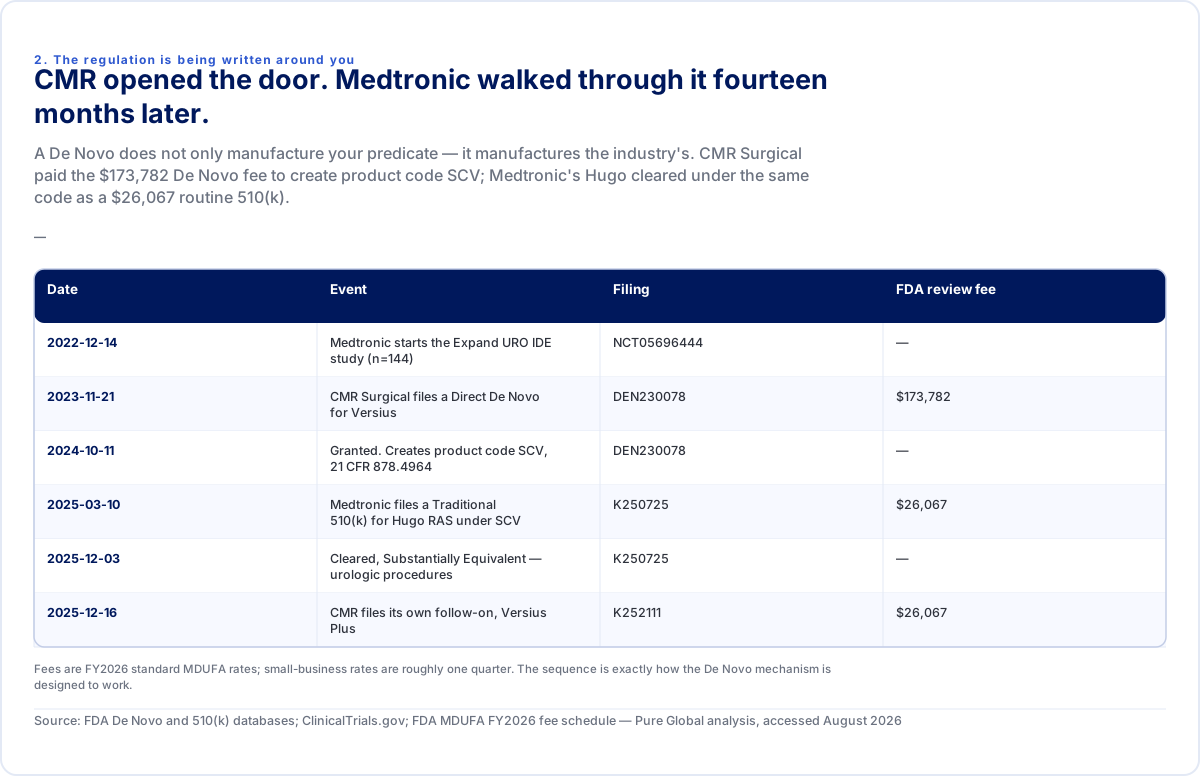
| Date | Event | Filing | FDA review fee |
|---|---|---|---|
| 2022-12-14 | Medtronic starts the Expand URO IDE study (n=144) | NCT05696444 | — |
| 2023-11-21 | CMR Surgical files a Direct De Novo for Versius | DEN230078 | $173,782 |
| 2024-10-11 | Granted. Creates product code SCV, 21 CFR 878.4964 | DEN230078 | — |
| 2025-03-10 | Medtronic files a Traditional 510(k) for Hugo RAS under SCV | K250725 | $26,067 |
| 2025-12-03 | Cleared, Substantially Equivalent — urologic procedures | K250725 | — |
| 2025-12-16 | CMR files its own follow-on, Versius Plus | K252111 | $26,067 |
Fees are FY2026 standard MDUFA rates; small-business rates are roughly one quarter. The sequence is exactly how the De Novo mechanism is designed to work.
Source: FDA De Novo and 510(k) databases; ClinicalTrials.gov; FDA MDUFA FY2026 fee schedule — Pure Global analysis, accessed August 2026
The single most instructive sequence in the public record, with every step verifiable 1213:
- 2022-12-14 — Medtronic starts the Expand URO IDE study: 144 patients, robot-assisted urologic surgery 14.
- 2023-11-21 — CMR Surgical files a Direct De Novo for the Versius system.
- 2024-10-11 — Granted. It creates product code SCV and regulation 21 CFR 878.4964, "modular electromechanical surgical system" 12.
- 2025-03-10 — Medtronic (as Covidien LLC) files a Traditional 510(k) for the Hugo RAS system — under SCV.
- 2025-12-03 — K250725 cleared, Substantially Equivalent, for urologic procedures including prostatectomy, nephrectomy and cystectomy 1315.
- 2025-12-16 — CMR files its own follow-on 510(k) for Versius Plus.
The De Novo review fee in FY2026 is $173,782; the 510(k) fee is $26,067 — a 6.7× multiple 5. CMR paid the larger number and did the classification work. Medtronic cited the result. That is not sharp practice; it is exactly how the De Novo mechanism is designed to work. But it means the De Novo decision is a strategic one: you are not only manufacturing your own predicate, you are manufacturing the industry's. Distalmotion ran the same play in the other direction — its October 2024 De Novo created code SDD, and the company then filed three ordinary 510(k)s against its own code within twenty months, converting each new indication from a $173,782 problem into a $26,067 one 164.
Two more operational numbers fall out of these records. Both observed Direct De Novo reviews for surgical robots ran a shade over ten months — CMR 2023-11-21 to 2024-10-11; Distalmotion 2023-12-15 to 2024-10-25 1216. That is a far more useful planning figure than "De Novo takes longer." And FDA's De Novo database now publishes a "Predetermined Change Control Plan Authorized" field; for the newest modular platform it reads No 12. The mechanism for pre-authorising defined future changes exists, is public per device — and the newest platforms largely do not have one yet. Check the field for any competitor before assuming they do.
The route does not decide the evidence
The most common planning error in this category is treating "510(k)" as a synonym for "no clinical data." Hugo's clearance is the counterexample sitting in FDA's own record: the K250725 file lists the Expand URO IDE study in its Clinical Trials field — a 144-patient study started three years before clearance 1314. The submission itself sat with FDA for just under nine months. The route determined the fee and the predicate logic; the indication determined the evidence. For a new robotic platform seeking a substantive surgical indication, clinical evidence is the schedule — whatever the pathway is called. Medtronic's June 2026 announcement of further 510(k) filings to expand Hugo into general and gynecologic surgery extends the same pattern: each expansion is its own submission with its own evidence question 17.
3. What the clearance record actually shows
Takeaway: the famous NAY cohort — 164 records, 88.4% one company — is real, reverified, and about one seventh of actual filing activity. Concentration is a property of one lineage, not of the field: the stereotaxic and navigation family has 303 applicants and an 8.0% leader, and the modern De Novo family is 60% non-US.
Start with the cohort everyone quotes, because we quote it too — reverified against the July 2026 FDA snapshot, every figure reproducing exactly 4. Product code NAY ("System, Surgical, Computer Controlled Instrument") holds 164 decision records from July 2000 through May 2026: 131 Traditional and 33 Special 510(k)s, 63 records through 2016 and 101 since 2017. Applicant strings normalized to Intuitive Surgical account for 145 of 164 — 88.4%. Only seven applicants have ever held a NAY clearance. Those are regulatory records, not market shares: one platform generates many records across instruments, accessories and software changes. But the lineage story they tell is real — predicate reasoning inside NAY runs through one company's filing history.
The mistake is stopping there. Put the code families side by side 4:
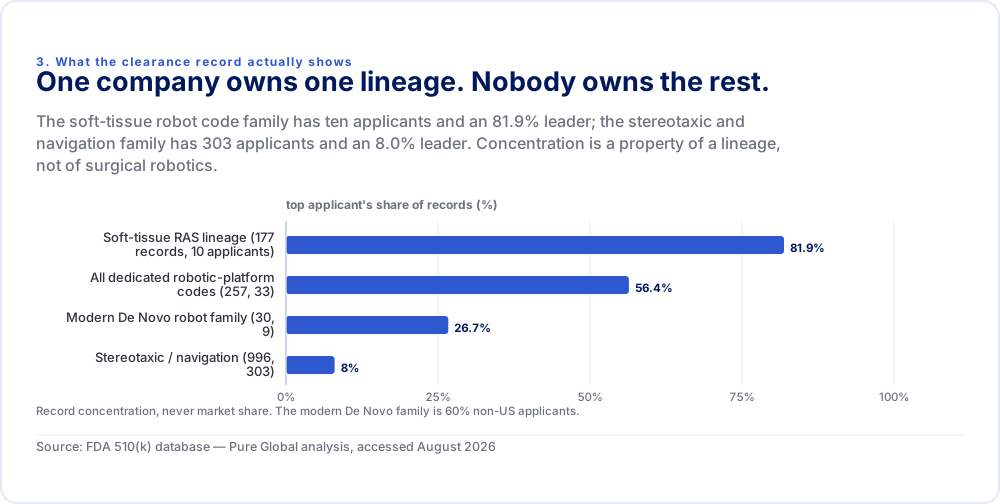
| Top-1 applicant share of records (%) | |
|---|---|
| Soft-tissue RAS lineage (177 records, 10 applicants) | 81.9% |
| All dedicated robotic-platform codes (257, 33) | 56.4% |
| Modern De Novo robot family (30, 9) | 26.7% |
| Stereotaxic / navigation (996, 303) | 8% |
Record concentration, never market share. The modern De Novo family is 60% non-US applicants.
Source: FDA 510(k) database — Pure Global analysis, accessed August 2026
| Cohort | Records | Applicants | Top-1 share |
|---|---|---|---|
| Soft-tissue RAS lineage (NAY + related codes) | 177 | 10 | 81.9% |
| All dedicated robotic-platform codes | 257 | 33 | 56.4% |
| Modern De Novo robot family | 30 | 9 | 26.7% |
| Stereotaxic / navigation family | 996 | 303 | 8.0% |
And put the volumes side by side. In 2020–2024, the stereotaxic and navigation family produced 299 clearances against 44 in the soft-tissue lineage — 6.8 times the filing activity 4. Anyone modelling "the surgical-robot regulatory market" on NAY is looking at a seventh of it. Meanwhile the new De Novo robot codes went from 4 records in 2015–2019 to 11 in 2020–2024 to 15 in 2025–2026 alone — more in nineteen months than in the preceding decade. Across all four code families together, 2025 set the record at 107 clearance decisions 4.
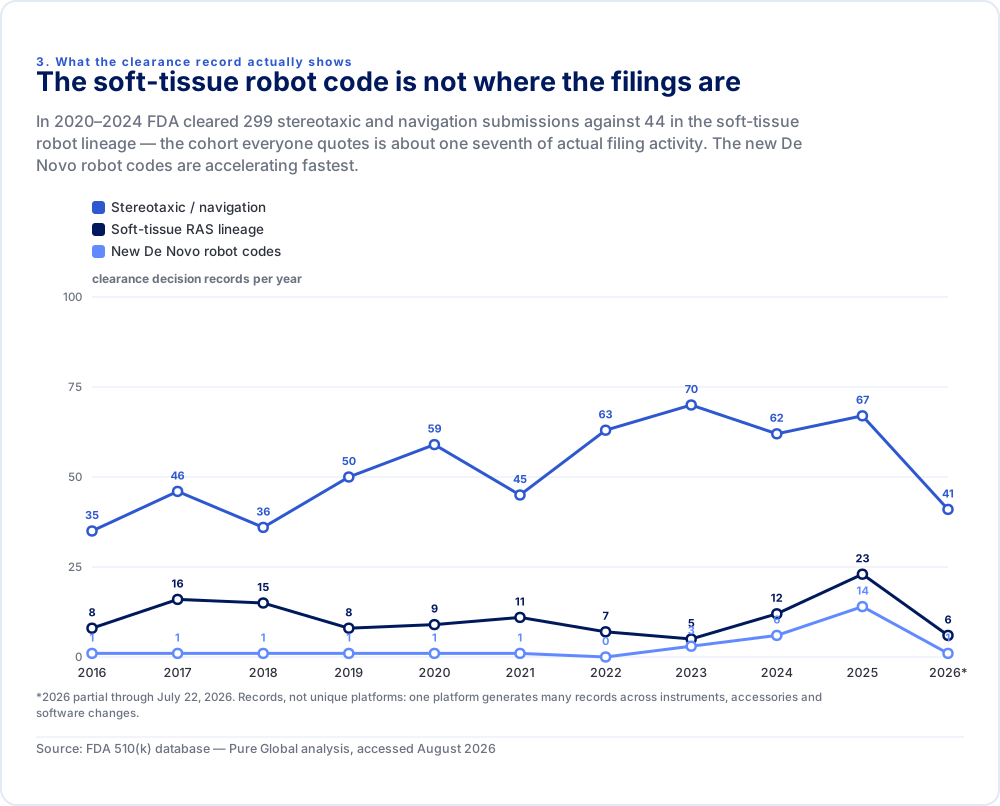
| Stereotaxic / navigation | Soft-tissue RAS lineage | New De Novo robot codes | |
|---|---|---|---|
| 2016 | 35 | 8 | 1 |
| 2017 | 46 | 16 | 1 |
| 2018 | 36 | 15 | 1 |
| 2019 | 50 | 8 | 1 |
| 2020 | 59 | 9 | 1 |
| 2021 | 45 | 11 | 1 |
| 2022 | 63 | 7 | 0 |
| 2023 | 70 | 5 | 3 |
| 2024 | 62 | 12 | 6 |
| 2025 | 67 | 23 | 14 |
| 2026* | 41 | 6 | 1 |
*2026 partial through July 22, 2026. Records, not unique platforms: one platform generates many records across instruments, accessories and software changes.
Source: FDA 510(k) database — Pure Global analysis, accessed August 2026
Applicant origin flips with the lineage, and this is the most encouraging number in the report for a non-US manufacturer: the soft-tissue lineage is 97.2% US-addressed applicants, but the modern De Novo family is 60% non-US — Israel, Italy, Switzerland and Great Britain across nine companies 4. The newest US robot classifications are being created, disproportionately, by companies from somewhere else.
Two pieces of context complete the picture. First, the field's commercial center is real and enormous — roughly 3.15 million da Vinci procedures in 2025, up 18% year over year, on an installed base above 11,000 systems 18 — which is exactly why the regulatory record's diversity surprises people. Second, the market's newest entries keep arriving through the same De Novo door: Johnson & Johnson's Ottava received De Novo authorization on July 22, 2026 for upper-abdominal general surgery, a US-only authorization at this writing 19, and Medicaroid's hinotori — Japan's domestic platform — took its CE mark on July 9, 2026 after roughly 20,000 procedures, moving outward from Asia rather than from the US 20.
Which leads to the myth the registers quietly demolish: "get FDA first and the rest follows." Cross-referencing the EU robot register against the 30 US codes, only 11 of 23 EU-registered robot-platform companies hold any clearance under any of the thirty US robotic and computer-assisted surgery product codes under a matching applicant name 46. (A company may hold US clearances under other codes or entity names — the precise claim is no clearance in these codes.) The EU field is genuinely different, and for half of it, the US was not the first move.
4. One platform, dozens of registration objects
Takeaway: in the EU register, a surgical-robot platform is not one device. It is up to 141 device identifiers spanning three risk classes — or 13, depending on a grouping philosophy you choose once and pay for annually. 71% of robot registrants file across two or more MDR classes. "What class is a surgical robot?" is a malformed question.
EUDAMED, the EU's device register, went from voluntary (October 2021) to mandatory on 28 May 2026, with the deadline for devices already on the market falling around November 2026 2122. Every count below is therefore a floor, not a portfolio inventory — a small EUDAMED footprint means "has not finished registering," never "is not on the EU market." Two months into the mandate, the robot cohort already shows the structure that matters.
657 device-identifier records, under 209 Basic UDI-DIs (device groups), from 24 registrants 6. The extremes are the lesson:
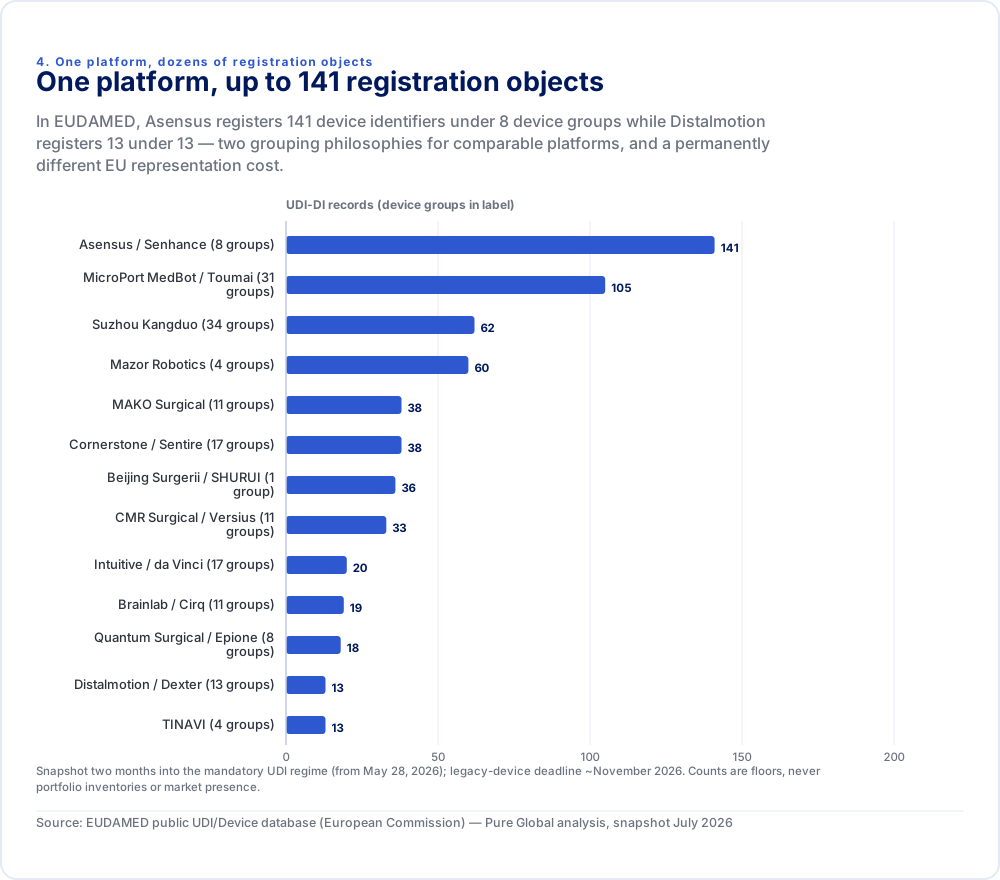
| UDI-DI records | |
|---|---|
| Asensus / Senhance (8 groups) | 141 |
| MicroPort MedBot / Toumai (31 groups) | 105 |
| Suzhou Kangduo (34 groups) | 62 |
| Mazor Robotics (4 groups) | 60 |
| MAKO Surgical (11 groups) | 38 |
| Cornerstone / Sentire (17 groups) | 38 |
| Beijing Surgerii / SHURUI (1 group) | 36 |
| CMR Surgical / Versius (11 groups) | 33 |
| Intuitive / da Vinci (17 groups) | 20 |
| Brainlab / Cirq (11 groups) | 19 |
| Quantum Surgical / Epione (8 groups) | 18 |
| Distalmotion / Dexter (13 groups) | 13 |
| TINAVI (4 groups) | 13 |
Snapshot two months into the mandatory UDI regime (from May 28, 2026); legacy-device deadline ~November 2026. Counts are floors, never portfolio inventories or market presence.
Source: EUDAMED public UDI/Device database (European Commission) — Pure Global analysis, snapshot July 2026
Asensus registers its Senhance platform as 141 device identifiers under 8 device groups — the console plus every arm, instrument, drape and adapter that makes it usable. Distalmotion registers Dexter as 13 identifiers under 13 groups, nearly one-to-one. Between them sit MicroPort MedBot (105 under 31), Suzhou Kangduo (62 under 34), Mazor (60 under 4) and Intuitive (20 under 17, in this snapshot). Same regulation; radically different registration architectures. The raw records make it concrete: one German platform registers its needle holder, Metzenbaum scissors, Maryland dissector, grasper, two sterile endoscope covers, a drape set and the telemanipulator itself as eight separate device groups; CMR registers camera heads with and without near-infrared, 0° and 30° endoscopes, each drape in single and multi-pack form, and an ultrasonic dissector chassis and transducer as distinct identifiers 6.
This is not clerical trivia, for two reasons. First, class: across the 657 records, 38.4% are Class I, 37.7% Class IIa and 23.9% Class IIb — and 17 of the 24 registrants (71%) register across at least two MDR risk classes; nine span three 6. The console, the reusable instrument, the single-use instrument, the drape and the software do not share a class, a conformity route or an evidence burden. (Class III appears in the wider robot ecosystem too — as third-party procedure packs built around robot consumables under MDR Article 22, which take the classification their contents drive 11. Call them procedure packs, never "Class III robot accessories.")
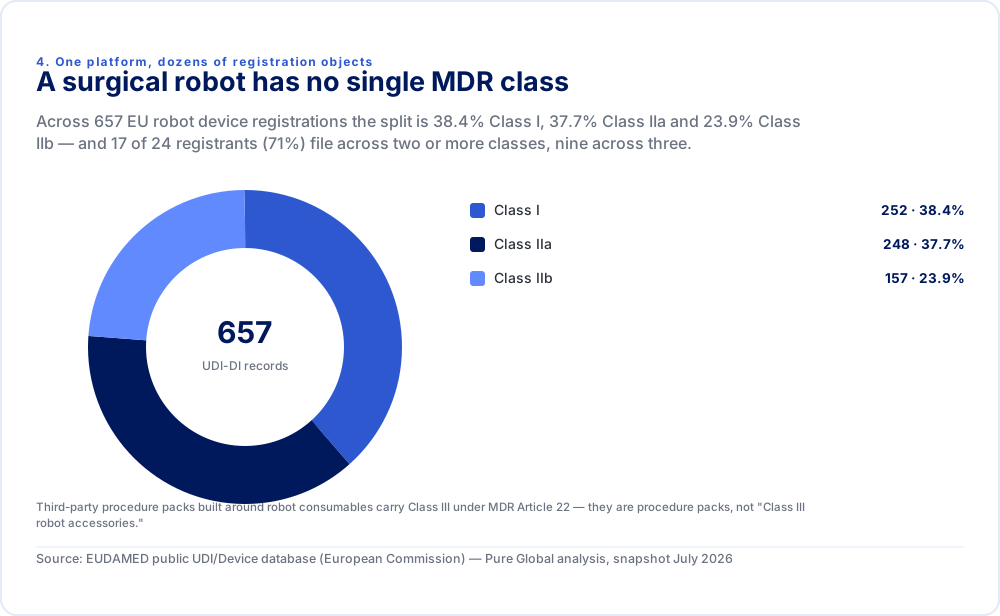
| MDR risk class of robot-platform device records | |
|---|---|
| Class I | 252 |
| Class IIa | 248 |
| Class IIb | 157 |
Third-party procedure packs built around robot consumables carry Class III under MDR Article 22 — they are procedure packs, not "Class III robot accessories."
Source: EUDAMED public UDI/Device database (European Commission) — Pure Global analysis, snapshot July 2026
Second, money: representation and registration fees attach to the objects, not the platform. Pure Global's EU authorised-representative fee is charged per device group; MHRA's annual GB registration fee is charged per GMDN category Pure Global pricing23. The Asensus-versus-Distalmotion choice — 8 groups or 13, or 31, or 4 — is a design decision an RA lead makes early and then pays, every year, in every market whose fee schedule counts objects. Canada makes the same point in licence form: Medtronic's entire Hugo RAS line — console, endoscope adapter, 3D glasses and the rest, 16 device entries — sits on one Health Canada licence, while da Vinci's 23 entries spread across nine 24.
The register also shows who the EU field actually is. Chinese registrants — MicroPort MedBot, Suzhou Kangduo, Cornerstone, Beijing Surgerii, TINAVI — hold 38.7% of EU robot device identifiers, the largest single national bloc, against a soft-tissue US clearance record that is 97.2% US-addressed 64. The two registers describe two different competitive fields; sequencing strategy built on either alone mis-describes the other. The notified-body layer is narrower still: of 3,937 certificates published in EUDAMED's certificates module, just 13 belong to surgical-robot platform manufacturers, spread across seven notified bodies — TÜV SÜD holds seven of the thirteen 25. And ten of those thirteen certificates are amended, supplemented or reissued rather than plain issued: a robot certificate is a living document, modified as the platform changes. Two of the newest arrived within the snapshot's final weeks — Medicaroid's QMS certificate on July 7, 2026 and MicroPort MedBot's on June 17, 2026 25 — the EU's newest robot certificates belong to Asian platforms.
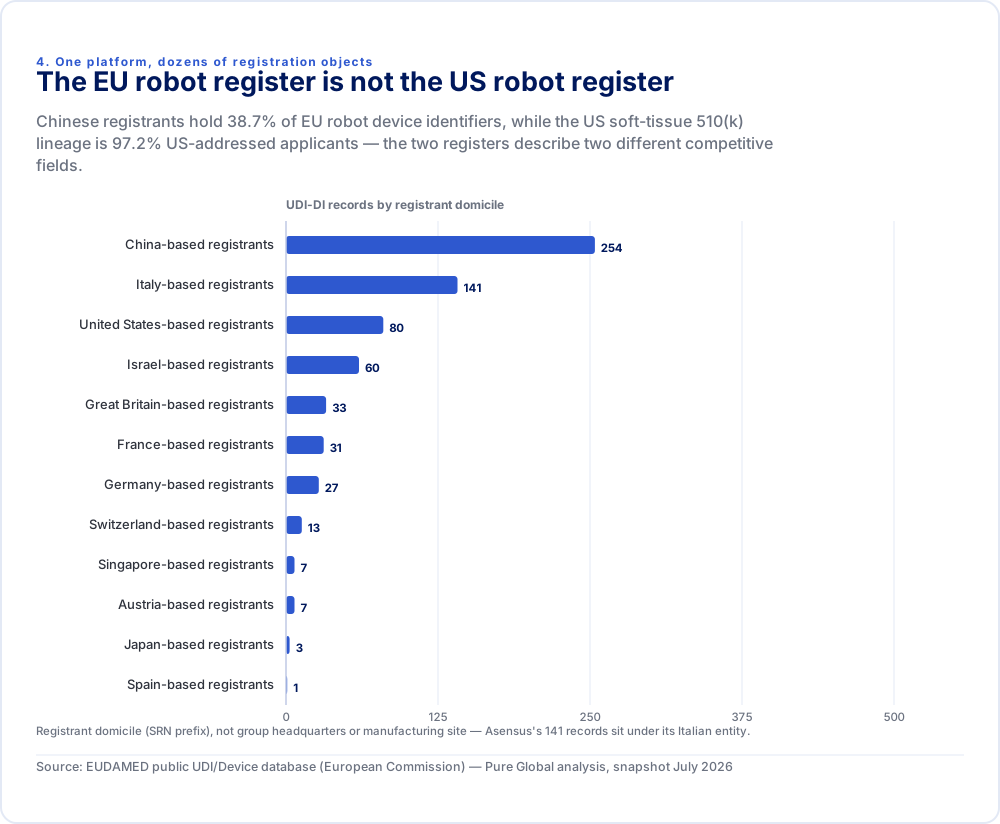
| UDI-DI records | |
|---|---|
| China-based registrants | 254 |
| Italy-based registrants | 141 |
| United States-based registrants | 80 |
| Israel-based registrants | 60 |
| Great Britain-based registrants | 33 |
| France-based registrants | 31 |
| Germany-based registrants | 27 |
| Switzerland-based registrants | 13 |
| Singapore-based registrants | 7 |
| Austria-based registrants | 7 |
| Japan-based registrants | 3 |
| Spain-based registrants | 1 |
Registrant domicile (SRN prefix), not group headquarters or manufacturing site — Asensus's 141 records sit under its Italian entity.
Source: EUDAMED public UDI/Device database (European Commission) — Pure Global analysis, snapshot July 2026
5. Eight markets, eight registers
Takeaway: the same machines are counted in eight incompatible units — product codes, GMDN categories, licences, ARTG entries, registrations, holders, approval numbers. The structure of each register is the planning fact. Never compare the raw counts.
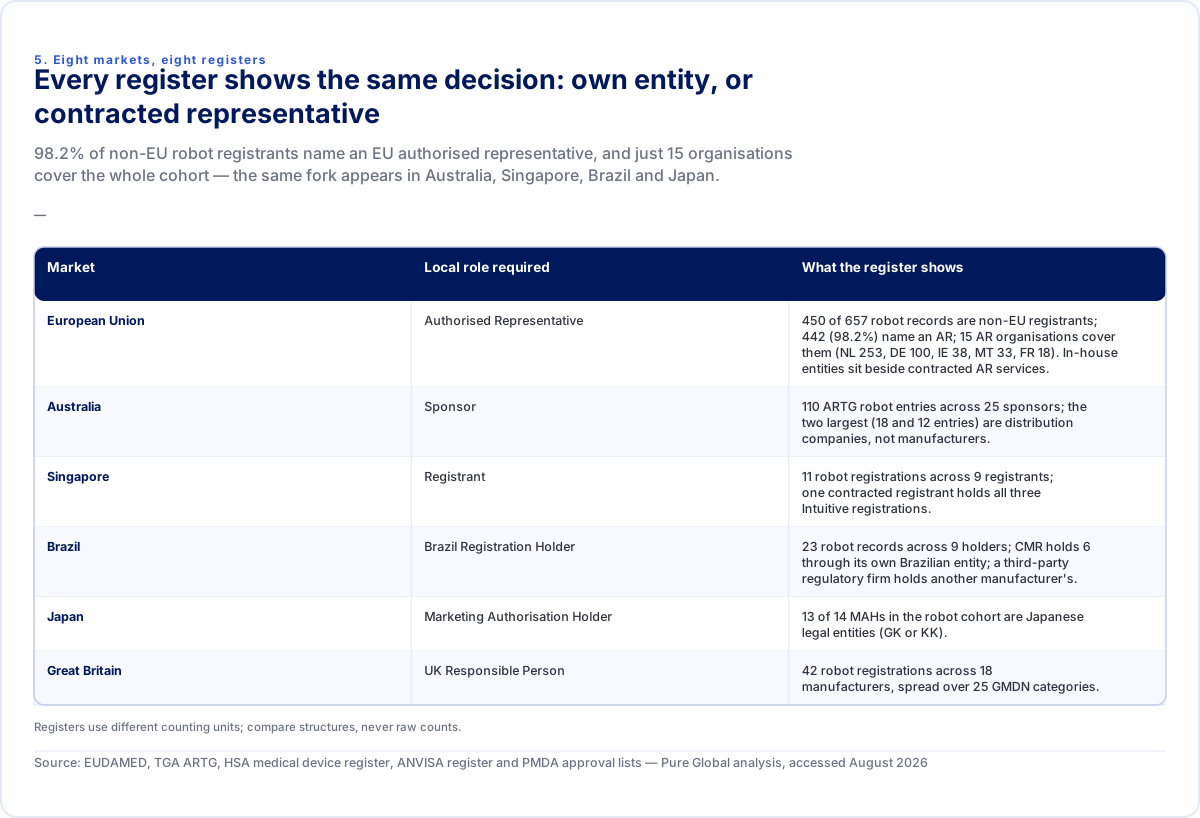
| Market | Local role required | What the register shows |
|---|---|---|
| European Union | Authorised Representative | 450 of 657 robot records are non-EU registrants; 442 (98.2%) name an AR; 15 AR organisations cover them (NL 253, DE 100, IE 38, MT 33, FR 18). In-house entities sit beside contracted AR services. |
| Australia | Sponsor | 110 ARTG robot entries across 25 sponsors; the two largest (18 and 12 entries) are distribution companies, not manufacturers. |
| Singapore | Registrant | 11 robot registrations across 9 registrants; one contracted registrant holds all three Intuitive registrations. |
| Brazil | Brazil Registration Holder | 23 robot records across 9 holders; CMR holds 6 through its own Brazilian entity; a third-party regulatory firm holds another manufacturer's. |
| Japan | Marketing Authorisation Holder | 13 of 14 MAHs in the robot cohort are Japanese legal entities (GK or KK). |
| Great Britain | UK Responsible Person | 42 robot registrations across 18 manufacturers, spread over 25 GMDN categories. |
Registers use different counting units; compare structures, never raw counts.
Source: EUDAMED, TGA ARTG, HSA medical device register, ANVISA register and PMDA approval lists — Pure Global analysis, accessed August 2026
United States. Thirty product codes under fourteen regulations (§1); classification and predicate determine 510(k) versus De Novo (§2). Foreign manufacturers add establishment registration ($11,423 per year in FY2026) and a US Agent 5Pure Global pricing.
European Union. MDR classification by Annex VIII rule, per object (§4); non-EU manufacturers need an authorised representative. The register shows that decision being made: 450 of 657 robot records belong to non-EU registrants, 442 of them (98.2%) name an AR, and just 15 AR organisations cover the entire cohort, concentrated in the Netherlands (253 records) and Germany (100) 6. Both models are visible — in-house EU entities (MicroPort, Stryker for Mako, Medtronic for Mazor, Intuitive) and contracted professional representatives (Suzhou Kangduo through a German AR service; CMR Surgical through a Malta-based one). UDI registration in EUDAMED is mandatory as of 28 May 2026 21.
Great Britain. Current law is the UK MDR 2002: MHRA registration before placing on the GB market, and a UK Responsible Person for non-UK manufacturers 26. CE-marked devices remain acceptable in GB — until 30 June 2028 for expiring MDD certificates and 30 June 2030 for MDR devices 26. The much-discussed international-reliance route is policy intent, not law: the draft 2026 regulations were published for comment in May 2026, expected in force mid-2027, with the international reliance pathway anticipated around 2028 27. Date every GB statement in your plan. The register itself spreads 42 robot registrations across 25 separate GMDN categories from 18 manufacturers — and the taxonomy names components, not platforms: robotic surgical arm system, robotic surgical telemanipulation system, robotic surgical navigation system application software, plus a category apiece for robotic forceps, needle holders, scissors, staplers and irrigation cannulae, reusable and single-use counted separately. The class mix runs Class IIa 18, Class IIb 11, system-or-procedure-pack 8 and Class I 5 23. MHRA's registration fee, from 1 April 2026, is charged per level-2 GMDN category, per year 23. A full-line platform is not one GB fee — the register shows it touching eight or ten categories without trying.
Canada. Four classes; Class II–IV need a Medical Device Licence, and MDSAP certification is integral — Health Canada has completed the transition, and QMS certificates are required for Class II and above 2829. Licence grouping is strategic (§4): 165 robot device entries sit under just 43 licences 24. Fees scale steeply with class — CAD 643 for a Class II application against CAD 14,163 for Class III 30.
Australia. Classification follows intended purpose under rules that mirror the EU's — and TGA's own guidance uses a surgical robot as its worked example, classifying an active device that "specifies particular surgical parameters for robotic assisted cardiac bypass surgery" as Class III 31. Inclusion in the ARTG runs through an Australian sponsor, and the register shows who sponsors actually are: 110 robot entries across 25 sponsors, and the two largest sponsors — 18 and 12 entries — are distribution companies, not manufacturers, ahead of Stryker (13) and Medtronic's local entity (10) 32. The sponsor holds the ARTG entry and the regulatory obligations; most robot makers do not hold their own. Choose that structure deliberately — sponsorship transfers are where Australian market access gets stuck when distribution relationships change.
Japan. A foreign manufacturer markets through a Japanese Marketing Authorization Holder, with approval, certification or notification set by class 2. The register is the FDA's mirror image: where FDA fragments by architecture into 30 codes, PMDA consolidates the same machines under four generic names 2. And the approval is a living licence: 80 robot entries in PMDA's published lists resolve to just 22 approval numbers — the da Vinci X approval number appears nine separate times, once per approved change 2. Your change-control matrix in Japan is a schedule of future public filings. The cadence is accelerating — 16 robot entries in 2025 alone, the busiest year in the lists — and thirteen of the fourteen marketing authorization holders in the cohort are Japanese legal entities: there is no route into Japan that does not begin with one 2. (One honest limit: these are PMDA's generic, improved-without-clinical and remanufactured device lists; the novel-device list is separate, so the cohort is partial by construction.)
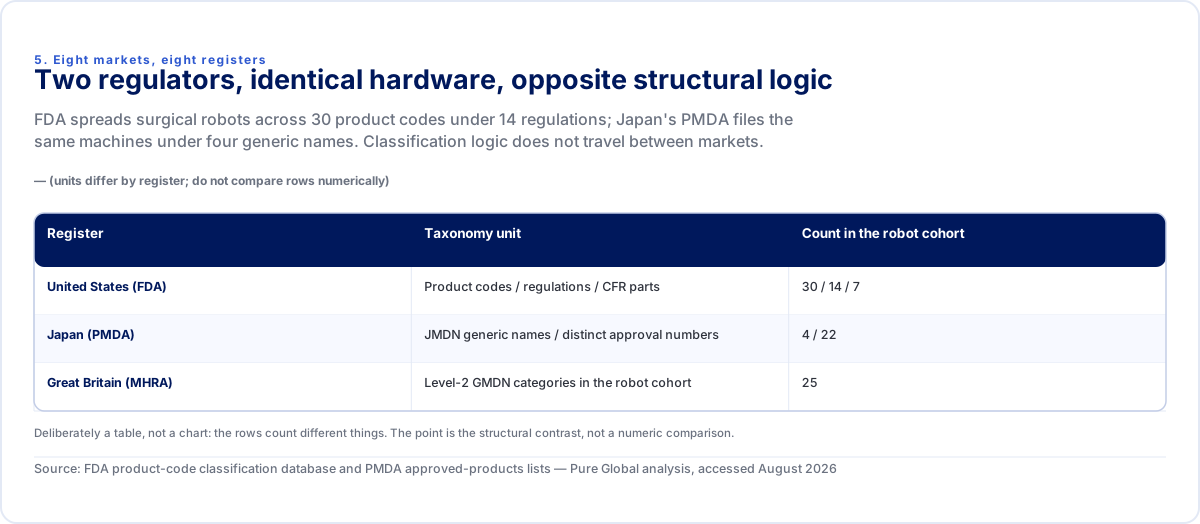
| Register | Taxonomy unit | Count in the robot cohort |
|---|---|---|
| United States (FDA) | Product codes / regulations / CFR parts | 30 / 14 / 7 |
| Japan (PMDA) | JMDN generic names / distinct approval numbers | 4 / 22 |
| Great Britain (MHRA) | Level-2 GMDN categories in the robot cohort | 25 |
Deliberately a table, not a chart: the rows count different things. The point is the structural contrast, not a numeric comparison.
Source: FDA product-code classification database and PMDA approved-products lists — Pure Global analysis, accessed August 2026
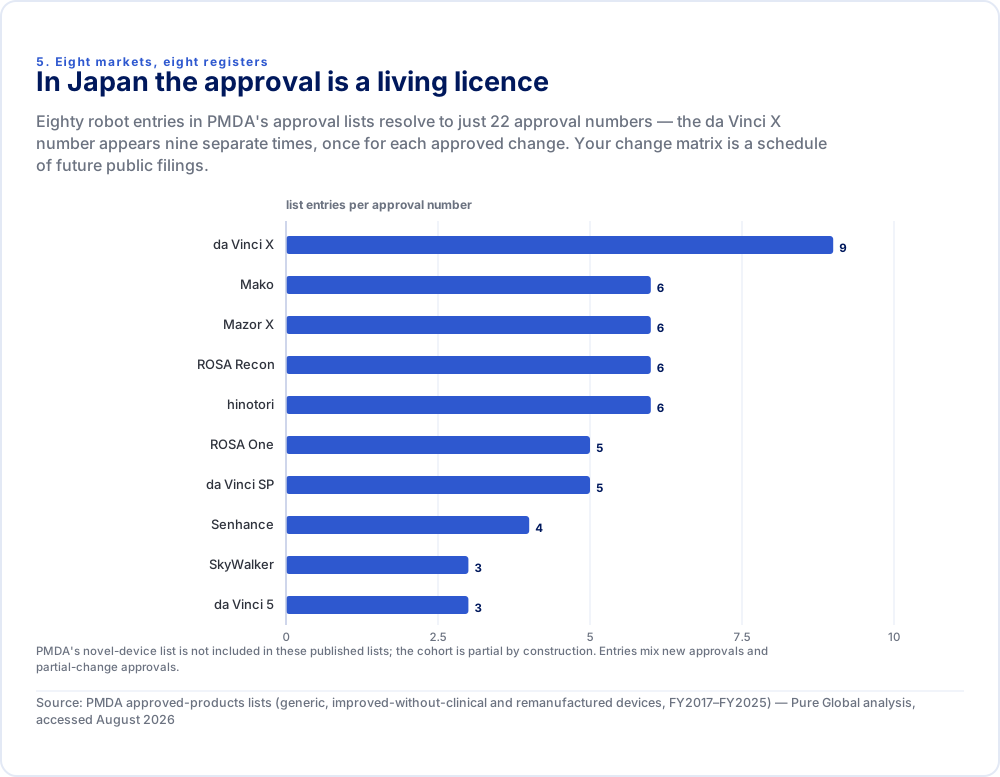
| Entries per approval number | |
|---|---|
| da Vinci X | 9 |
| Mako | 6 |
| Mazor X | 6 |
| ROSA Recon | 6 |
| hinotori | 6 |
| ROSA One | 5 |
| da Vinci SP | 5 |
| Senhance | 4 |
| SkyWalker | 3 |
| da Vinci 5 | 3 |
PMDA's novel-device list is not included in these published lists; the cohort is partial by construction. Entries mix new approvals and partial-change approvals.
Source: PMDA approved-products lists (generic, improved-without-clinical and remanufactured devices, FY2017–FY2025) — Pure Global analysis, accessed August 2026
Singapore. HSA registers Class B–D devices through full, abridged, expedited or immediate routes, with eligibility set by approvals from five reference agencies — Australia's TGA, EU notified bodies, Health Canada, Japan's MHLW and the US FDA 33. The register is small and complete: 11 surgical-robot registrations from 9 registrants — seven Class C, three Class B, one Class D — and every major platform, Western and Asian, is already present: da Vinci, Hugo, Toumai, hinotori, Mako and Mazor instruments among them 34. Three of Intuitive's registrations are held by a contracted local registrant — the representation fork again. Singapore's message for sequencing is that the field treats it as the cheap, fast, reference-driven market it is designed to be.
Brazil. RDC 751/2022 splits the world at Class III: Classes I–II are notificação, Classes III–IV are registro 35. The register shows where robots land: 14 of 23 robot records are Class III 36 — the registro track, the higher ANVISA fee tier, and the higher representation tier. Electromedical equipment also needs INMETRO conformity certification ahead of ANVISA 37. The Brazil Registration Holder controls the registration; CMR holds six records through its own Brazilian entity while a third-party regulatory firm holds another manufacturer's — the same own-entity-or-contracted fork, visible in ANVISA's records.
6. The accessory is the product
Takeaway: the console gets the headlines; the instruments generate the regulatory workload. Three quarters of adverse-event reports in the flagship robot code name an instrument or accessory, recalls outnumber clearances three-to-two, and a thirty-company ecosystem registers accessories for other people's robots — including remanufactured versions of the market leader's instruments.
Postmarket is where the "one platform" illusion costs the most. In FDA's flagship robot code, 248 recall records stand against 164 clearance records — roughly 1.5 postmarket corrective records for every market-entry decision 38. (The recalling firm is the code's dominant holder on 246 of the 248, which reflects who owns the code, not relative quality.) Market entry, in other words, is the smaller half of the regulatory workload; every recall record is notification, correspondence and, in most registered markets, a parallel filing — exactly the lifecycle work an in-country representative carries.
What drives the recalls is the finding. Across roughly 606 recall records in the robotic and computer-assisted surgery codes, FDA's controlled root-cause field reads: device/component/labeling design 34.9%, manufacturing, material and process control 30.6%, software 16.7% — and use error 1.7% 38. For a device category whose public narrative is about surgeons' hands, the recall record says the problems are engineering and change control. Inside the flagship code, "process change control" is the second-largest single cause at 41 records. And the two newest De Novo platforms' first recalls — April 2025 and June 2026 — were both software 38. A platform can be fourteen months past its De Novo and already running a software corrective action. Change control is a launch deliverable, not a year-two project.
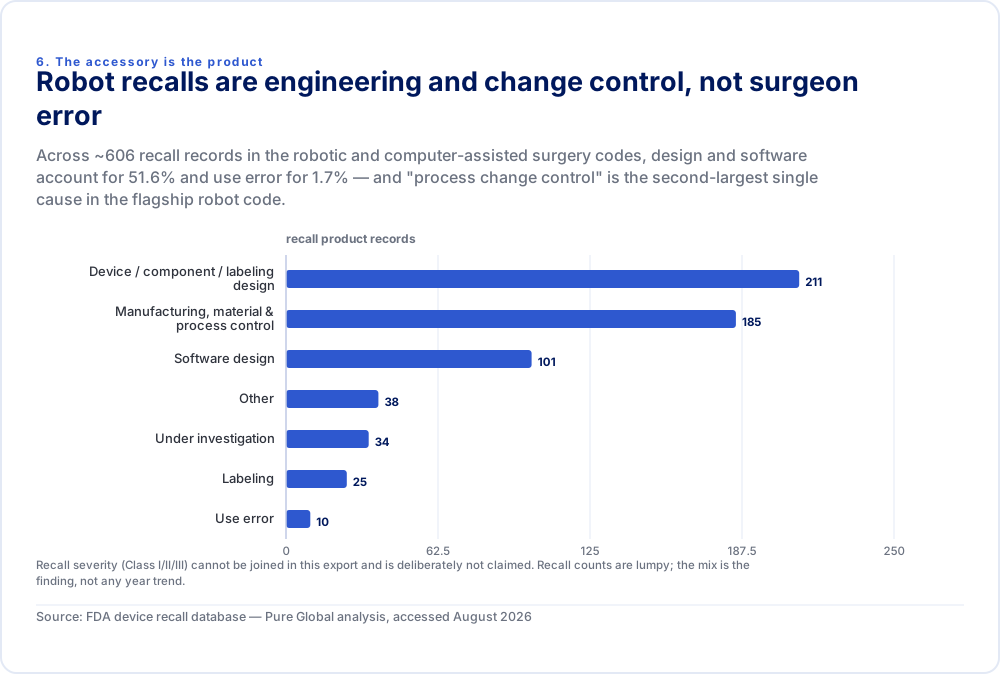
| Recall records by grouped root cause | |
|---|---|
| Device / component / labeling design | 211 |
| Manufacturing, material & process control | 185 |
| Software design | 101 |
| Other | 38 |
| Under investigation | 34 |
| Labeling | 25 |
| Use error | 10 |
Recall severity (Class I/II/III) cannot be joined in this export and is deliberately not claimed. Recall counts are lumpy; the mix is the finding, not any year trend.
Source: FDA device recall database — Pure Global analysis, accessed August 2026
The adverse-event record then relocates the workload. Of roughly 131,000 MAUDE reports in the flagship code, 76.4% name an instrument or accessory rather than the console — and a single wristed-instrument family accounts for 61% of the code's entire reported record 7. Severity distributes the other way: instrument-named reports are 95.5% malfunction and 4.3% injury, while console-named reports carry 20.5% injury (and, stated in prose because it belongs on no shared axis, a 2.9% death share) 7. The instruments generate the volume; the system carries the serious end. Both facts should shape a vigilance plan — and both come with the caveat that brand-name fields are free text, so this is "reports naming an instrument," not "events caused by instruments." MAUDE has no denominator; none of this is a rate, and the code's report volume by year is a reporting artifact, not a safety trend — injury reports have been essentially flat while malfunction reporting grew more than twentyfold.
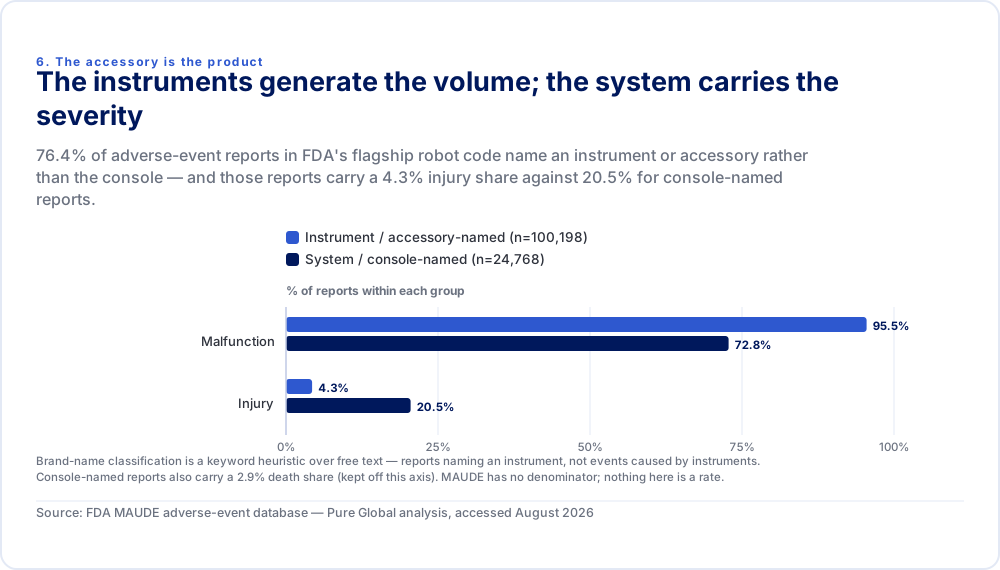
| Instrument / accessory-named (n=100,198) | System / console-named (n=24,768) | |
|---|---|---|
| Malfunction | 95.5% | 72.8% |
| Injury | 4.3% | 20.5% |
Brand-name classification is a keyword heuristic over free text — reports naming an instrument, not events caused by instruments. Console-named reports also carry a 2.9% death share (kept off this axis). MAUDE has no denominator; nothing here is a rate.
Source: FDA MAUDE adverse-event database — Pure Global analysis, accessed August 2026
Then there is the ecosystem the platform did not build. In the EU register, thirty third-party manufacturers in at least twelve countries register devices that exist only because someone else's robot exists — procedure trays and sets, arm drapes, bipolar cables, reprocessing baskets, sterilization pouches "for robotic instruments" 6. The sharpest illustration is a German ultrasonic-cleaner maker that registers separate cleaning units per robot brand — one each for da Vinci 5, da Vinci SP, Versius, Toumai and hinotori — because reprocessing parameters are platform-specific. Reprocessing is not a paragraph in your IFU; it is somebody else's regulatory product line. And in the US, FDA has created a product code specifically for remanufactured robotic instruments and cleared eight submissions from three firms since 2022, six of them in the eighteen months to March 2026 4. Your instrument use-limit logic and reprocessing controls are now a contested regulatory surface, not a private commercial setting.
For the platform manufacturer, the section's conclusion is structural: labeling a device "compatible" is a regulatory claim someone must own; every accessory and instrument family needs its own worst-case rationale (the largest instrument is rarely it — the narrow lumen and the insulated articulation govern validations); and the change-assessment matrix must cover the objects, because that is where the postmarket record says the action is.
7. The clinical-evidence reality
Takeaway: the robotic-surgery literature is vast and it is mostly not yours. 87.4% of interventional trials are investigator-initiated, only one in ten names a specific platform, and fewer than one in ten posts results. Meanwhile the one recent platform to cross the US line did it with a three-year, 144-patient IDE — behind a 510(k).
ClinicalTrials.gov holds 919 interventional robotic-surgery trials; starts have grown from 52 in 2006–2010 to 397 in 2021–2025, with 104 in 2025 alone 39. That growth is real — and almost none of it belongs to manufacturers. 87.4% of the trials are investigator-initiated; industry sponsors 10.2%, and the single largest industry sponsor (20 trials) is out-sponsored by a single university (30) 39. Only 99 trials — 10.8% — name any specific platform in their title, conditions or interventions. Nearly nine in ten study "robot-assisted surgery" as a technique.
That is the honest version of "there is plenty of evidence for robotic surgery." There is — and it was designed to answer surgeons' questions, on other people's devices, with generic technique framing. An MDR clinical evaluation or an FDA submission cannot simply point at it: it carries neither your intended purpose, nor your essential-performance claims, nor, mostly, results at all — just 8.3% of the 919 trials have posted results, median enrolment is 70 patients, and nearly one in ten was terminated or withdrawn 39. Trial registrations are not completions, completions are not publications, and none of it is automatically regulatory evidence.
The demand side is what makes this gap strategic. Robotic technique is now the default in some indications — at least 85% of US radical prostatectomies are performed robotically 40, and robotic adoption in general surgery grew from 1.8% to 15.1% of procedures in the six years to 2018, with inguinal hernia repair going from 0.7% to 28.8% 41. The procedures are mainstream; the platform-specific evidence is scarce; and the regulator's caution stands — FDA has authorized no RAS device specifically for cancer prevention or treatment outcomes 8. Hugo's three-year IDE-to-clearance arc (§2) is what filling that gap for one indication actually looks like 14. Budget for the claim you want, not the pathway you expect: bench accuracy proves a specification, not a clinical benefit, and the sentence "improves surgical outcomes" is a different evidence program from "maintains X millimetres of accuracy in the specified test."
8. What global registration costs
Takeaway: government fees range from CAD 643 to $173,782 depending on route and market; Pure Global's in-country representation is a flat $1,000–$3,000 per market per year, with a worked four-market program at $9,000 — and two of the fee structures price the exact grouping decision §4 described.
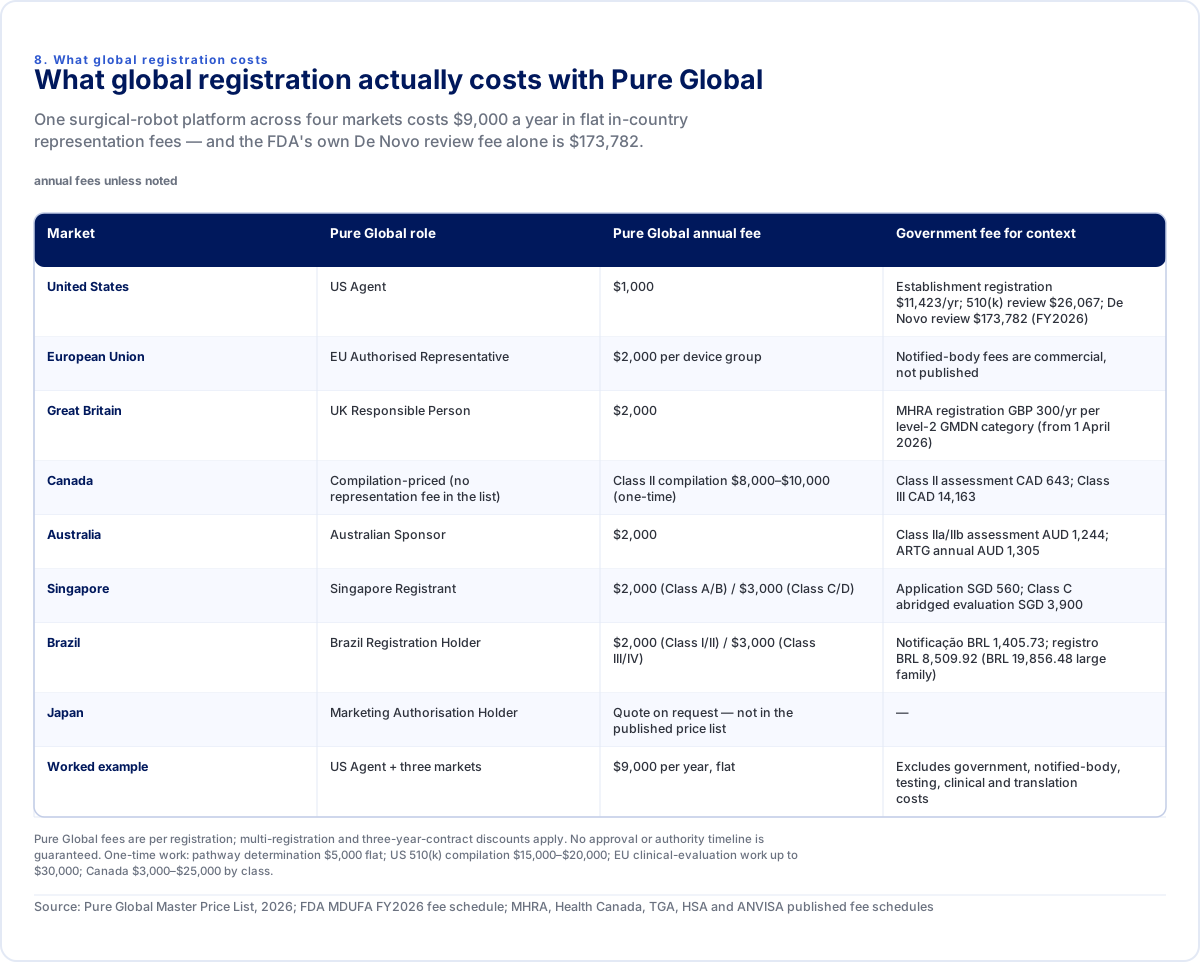
| Market | Pure Global role | Pure Global annual fee | Government fee for context |
|---|---|---|---|
| United States | US Agent | $1,000 | Establishment registration $11,423/yr; 510(k) review $26,067; De Novo review $173,782 (FY2026) |
| European Union | EU Authorised Representative | $2,000 per device group | Notified-body fees are commercial, not published |
| Great Britain | UK Responsible Person | $2,000 | MHRA registration GBP 300/yr per level-2 GMDN category (from 1 April 2026) |
| Canada | Compilation-priced (no representation fee in the list) | Class II compilation $8,000–$10,000 (one-time) | Class II assessment CAD 643; Class III CAD 14,163 |
| Australia | Australian Sponsor | $2,000 | Class IIa/IIb assessment AUD 1,244; ARTG annual AUD 1,305 |
| Singapore | Singapore Registrant | $2,000 (Class A/B) / $3,000 (Class C/D) | Application SGD 560; Class C abridged evaluation SGD 3,900 |
| Brazil | Brazil Registration Holder | $2,000 (Class I/II) / $3,000 (Class III/IV) | Notificação BRL 1,405.73; registro BRL 8,509.92 (BRL 19,856.48 large family) |
| Japan | Marketing Authorisation Holder | Quote on request — not in the published price list | — |
| Worked example | US Agent + three markets | $9,000 per year, flat | Excludes government, notified-body, testing, clinical and translation costs |
Pure Global fees are per registration; multi-registration and three-year-contract discounts apply. No approval or authority timeline is guaranteed. One-time work: pathway determination $5,000 flat; US 510(k) compilation $15,000–$20,000; EU clinical-evaluation work up to $30,000; Canada $3,000–$25,000 by class.
Source: Pure Global Master Price List, 2026; FDA MDUFA FY2026 fee schedule; MHRA, Health Canada, TGA, HSA and ANVISA published fee schedules
Budgets for this category fail by averaging. The honest structure is three layers.
Government fees (the small-to-large number, for context.) FDA's FY2026 schedule: annual establishment registration $11,423; 510(k) review $26,067; De Novo classification request $173,782 (small-business rates roughly a quarter of each) 5. MHRA: GBP 300 per year per level-2 GMDN category from 1 April 2026 23. Health Canada: CAD 643 for a Class II application, CAD 14,163 for Class III 30. TGA, HSA and ANVISA sit between — application fees in the hundreds to low thousands (AUD 1,244 Class IIb application; SGD 560 application plus SGD 3,900 Class C abridged evaluation; BRL 1,405.73 notificação), with Brazil's registro at BRL 8,509.92 and BRL 19,856.48 for a large device family — which a robot console is 42. Government fees exclude notified-body fees, testing, clinical work and translation everywhere.
Pure Global's flat annual in-country representation, per market Pure Global pricing: US Agent $1,000; EU Authorised Representative $2,000 per device group; UK Responsible Person $2,000; Australian Sponsor $2,000; Singapore Registrant $2,000 (Class A/B) or $3,000 (Class C/D); Brazil Registration Holder $2,000 (Class I/II) or $3,000 (Class III/IV). The annual fee includes submission based on a reference approval where applicable, renewals, modifications and authority correspondence; market-specific inclusions vary (Brazil adds required translations, import letters and UDI submissions). Japan MAH service is quoted on request — it is not in the published price list, and we publish no number for it. Multi-registration and three-year-contract discounts apply.
One-time work Pure Global pricing: regulatory-pathway determination $5,000 flat — worth reading against the $147,715 gap between the two FDA review fees it arbitrates. US 510(k) compilation and submission $15,000–$20,000. EU clinical-evaluation work up to $30,000 for Class IIb/III. Canada compilation $3,000–$25,000 by class.
The worked example (identical across our market-access reports): one platform, four markets — US Agent $1,000 plus three markets at $2,000/$3,000/$3,000 — is $9,000 per year, flat Pure Global pricing. Representation fees only; government, notified-body, testing, clinical and translation costs excluded; actual classification and registration count determine the quote. No consultant can promise an approval or an authority timeline, and we do not.
Two of these fee structures price §4's architecture decision directly. The EU representation fee is charged per device group — and the register shows comparable platforms choosing 8 groups or 13 or 31. The MHRA fee is charged per GMDN category — and the GB register shows the robot cohort spread across 25 of them. The technical-file structuring decision made in year one is a recurring invoice, in every market that counts objects.
9. Sequencing, on the observed clock
Takeaway: sequence on evidence leverage and observed timelines, not geography. The registers now supply real clocks: ten-and-a-half-month Direct De Novo reviews, a nine-month 510(k) with a three-year IDE behind it, CE acceptance in GB to 2028/2030, EUDAMED's November 2026 legacy deadline, and reference routes that price earlier approvals.
The wave logic is unchanged — anchor first, leverage second, high-localization last — but the registers replace its guesses with observations:
- Reference leverage is codified, not folk wisdom. Singapore's abridged, expedited and immediate routes are unlocked by approvals from the five named reference agencies, with marketing-history conditions attached 33. An anchor approval is a priced asset; protect its sameness (same device, same indications, same manufacturer) or the route eligibility evaporates.
- The observed clocks: Direct De Novo, twice observed on surgical robots, ~10.5 months 1216; Hugo's Traditional 510(k), just under nine months at FDA — after a three-year IDE 1314. Plan evidence first, review time second.
- GB is a dated decision, not a country checkbox. CE acceptance runs to mid-2028/2030; the reliance framework is intent, targeted ~2028 2627. File the current route; diarise the recheck.
- The EU's administrative clock is now. UDI registration became mandatory 28 May 2026 and legacy devices must be entered by ~November 2026 2122 — and the notified-body shortlist for robots is seven bodies, more than half of it one firm 25.
- MDSAP is a prerequisite, not a parallel task. Canada requires the certificate with the application 29.
A ten-line readiness gate, replacing the 90-day planning theatre: (1) intended-purpose and claims matrix frozen; (2) component/accessory inventory with device-grouping decision costed per market; (3) US code and pathway determined — with the De Novo-vs-predicate landscape checked against codes younger than your plan; (4) clinical-evidence program sized to the claim; (5) QMS/MDSAP certificates scheduled; (6) notified body engaged; (7) EUDAMED actor and UDI registrations current; (8) representation model chosen per market (own entity vs contracted) with data-access and transfer terms in the contract; (9) reference-route eligibility mapped with sameness controls; (10) postmarket and change-control matrix built for the objects, not the platform — because §6 says the objects are where the record is.
10. Methodology and limitations
Takeaway: everything here is reproducible from public registers, and every count is a record count — not a market share, not an installed base, not a rate.
Snapshots. FDA classification, 510(k), De Novo and PMA data: openFDA export of July 22, 2026. FDA recall data: export of July 24, 2026. FDA MAUDE: export of June 8, 2026 (a different date — the recall and event figures are not a matched time series). EUDAMED UDI/device data: full crawl of July 25–26, 2026 (2.93 million records); certificates and NANDO: July 25, 2026. ClinicalTrials.gov: July 25, 2026 snapshot (595,630 studies), cross-checked against the live API on August 7, 2026. National registers: MHRA July 7; Health Canada MDALL July 6; TGA ARTG July 6; HSA July 6; ANVISA July 13; PMDA approval lists FY2017–FY2025. All 2026 figures are partial-year.
Counting units. FDA counts decision records; EUDAMED counts device identifiers and device groups; MDALL counts device entries under licences; the ARTG counts register entries; HSA counts registrations; ANVISA counts notificação/registro records; PMDA counts approval-list entries. These units are not comparable across registers, and none of them measures devices sold, installed or used. Applicant concentration (88.4%, 81.9%) is a property of regulatory records; converting it into market share would be wrong.
Known limits, stated plainly. EUDAMED counts are floors — the module became mandatory two months before our snapshot and the legacy-device deadline is ~November 2026. Recall severity classifications could not be joined to the robot codes in this export, so no Class I/II/III recall claim appears. MAUDE has no denominator; we publish event-type mixes and the instrument/console split, and deliberately publish no per-year report-volume trend because the recent growth is a reporting artifact (injury reports flat while malfunction reporting multiplied). Japan's published approval lists exclude the novel-device category, so the Japanese cohort is partial by construction. A patent lane was attempted and abandoned: the available mirror's coverage ends in 2012, and publishing a "trend" from it would have been misleading — this article contains no IP claims. Brand-name classification in MAUDE is a keyword heuristic over free text. Register concentration statements name companies only as record-holders, never as endorsements or quality judgments.
Frequently asked questions
What FDA product code is a surgical robot?
There is no single code. Thirty product codes under fourteen regulations carry dedicated robotic or computer-assisted surgical devices — NAY is the historic soft-tissue lineage, but the last decade's platforms cleared under codes their own De Novos created (SCV, SDD, SAB, SAQ, QNM), and orthopedic and neurosurgical robots sit in a separate 15-code stereotaxic family 13. Your code follows your architecture and claims, and it may be one that did not exist last year.
Is a surgical robot Class II or Class III?
In the US, all 30 robot-relevant product codes are Class II 1. In the EU there is no single answer by design: across 657 robot device registrations, 38.4% are Class I, 37.7% Class IIa and 23.9% Class IIb, and 71% of manufacturers register across two or more classes 6. Australia's guidance classifies a surgical-parameter-specifying robot Class III 31; Brazil puts 14 of its 23 robot records in Class III 36. The platform has no class; its objects do.
Does an FDA clearance transfer to the EU?
No. The EU requires its own MDR conformity assessment, classification per object, an authorised representative for non-EU manufacturers, and EUDAMED registration 1121. The registers show the fields are genuinely different: only 11 of 23 EU-registered robot-platform companies hold any US robot-code clearance 64. An FDA clearance is useful evidence and a reference asset for reliance routes elsewhere (Singapore names FDA among its five reference agencies 33) — but it transfers nothing automatically.
Do I need a clinical trial for a surgical-robot 510(k)?
Sometimes — the route does not decide the evidence. Medtronic's Hugo cleared as a Traditional 510(k) whose FDA record lists a 144-patient IDE study started three years earlier 1314. Bench and usability evidence carry many accessory and instrument submissions; a new platform seeking a substantive surgical indication should budget for clinical data whatever the pathway label says.
How long does a De Novo take for a surgical robot?
The two recent observed cases — CMR Surgical's Versius and Distalmotion's Dexter — ran 10 months 20 days and 10 months 10 days from receipt to grant, as Direct De Novos 1216. The FY2026 review fee is $173,782, against $26,067 for a 510(k) 5. What the fee buys is a new classification — which then serves as the predicate landscape for everyone, including competitors (§2).
What does it cost to register a surgical robot in multiple countries?
Government fees span three orders of magnitude by route — CAD 643 for a Canadian Class II application to $173,782 for a US De Novo 305. Pure Global's in-country representation is flat and published: US Agent $1,000/year; most markets $2,000, tiered to $3,000 for higher-risk classes; a worked four-market program is $9,000 per year, excluding government, notified-body, testing, clinical and translation costs Pure Global pricing. One-time compilation ranges: US 510(k) $15,000–$20,000; EU clinical-evaluation work up to $30,000; Canada $3,000–$25,000; pathway determination $5,000 flat Pure Global pricing.
Who can be my authorised representative or registration holder abroad?
Either your own local entity or a contracted representative — and the registers show both at scale: 98.2% of non-EU robot registrants name an EU AR, with 15 organisations covering the whole cohort 6; Australia's two biggest robot sponsors are distributors 32; three of Intuitive's Singapore registrations sit with a contracted registrant 34; Japan requires a Japanese MAH — 13 of the 14 in the robot cohort are Japanese legal entities 2. Whichever model you choose, contract for dossier access, change and vigilance workflow, and transfer rights — the representative holds your market access.
Conclusion: register the objects, sequence the evidence
Three takeaways survive every register in this report.
The regulatory object is plural, and you choose its shape. Thirty US codes, four Japanese generic names, 25 GB GMDN categories, 141-or-13 EU identifiers, one-or-nine Canadian licences — the same machines, counted however the register counts and however you group. That grouping decision is technical, made once, and invoiced annually in every market that prices objects.
The classification landscape is moving under your filing. Nine De Novos built the modern US robot taxonomy; four regulations appeared in eight months; the newest code's first follower was the industry's largest competitor, filing at one-seventh the fee. Pathway determination is no longer a form-filling step — it is the highest-leverage $5,000 in the program.
The lifecycle outweighs the launch. Recalls outnumber clearances in the flagship code, three quarters of adverse-event reports name the accessories, certificates live in amended states, and Japan republishes your approval with every change. The file you should build is the one that can absorb change across eight registers at once — which is, precisely, the work.
Pure Global runs global registration programs — pathway determination, dossier compilation, and in-country representation as US Agent, EU Authorised Representative, UK Responsible Person, Australian Sponsor, Singapore Registrant and Brazil Registration Holder — at the flat, published fees above. If you are sequencing a surgical-robot platform across these markets, ask us for the pathway determination first: it is $5,000, it takes the guesswork out of a $173,782 question, and it tells you what your platform actually is, register by register. No approval or timeline is ever guaranteed — by us or anyone.
References
- Product Code Classification Database fda.gov ↩ ↩ ↩ ↩
- PMDA review services pmda.go.jp ↩ ↩ ↩ ↩ ↩ ↩
- De Novo Classification Request database accessdata.fda.gov ↩ ↩ ↩ ↩
- 510(k) Premarket Notification database accessdata.fda.gov ↩ ↩ ↩ ↩ ↩ ↩ ↩ ↩ ↩ ↩ ↩ ↩ ↩
- Medical Device User Fee Amendments (MDUFA): FY2026 fee schedule fda.gov ↩ ↩ ↩ ↩ ↩ ↩
- EUDAMED public UDI/Device database ec.europa.eu ↩ ↩ ↩ ↩ ↩ ↩ ↩ ↩ ↩ ↩ ↩ ↩ ↩
- MAUDE adverse-event database accessdata.fda.gov ↩ ↩ ↩
- Computer-Assisted Surgical Systems fda.gov ↩ ↩ ↩
- Recognized Consensus Standard 6-510: IEC 80601-2-77 Edition 1.1 (2023), robotically assisted surgical equipment accessdata.fda.gov ↩
- MDCG 2021-24 rev.1 — Guidance on classification of medical devices health.ec.europa.eu ↩
- Regulation (EU) 2017/745 on medical devices (MDR) eur-lex.europa.eu ↩ ↩ ↩
- De Novo DEN230078 — Versius Surgical System, CMR Surgical Limited accessdata.fda.gov ↩ ↩ ↩ ↩ ↩ ↩
- 510(k) K250725 — Hugo RAS System, Covidien LLC accessdata.fda.gov ↩ ↩ ↩ ↩ ↩
- NCT05696444 — Expand URO: Medtronic Hugo RAS System in Urologic Surgery clinicaltrials.gov ↩ ↩ ↩ ↩ ↩
- Medtronic announces FDA clearance of Hugo robotic-assisted surgery system for urologic surgical procedures news.medtronic.com ↩
- De Novo DEN230084 — Dexter L6 System, Distalmotion SA accessdata.fda.gov ↩ ↩ ↩ ↩
- Medtronic submits 510(k) filings to expand Hugo robotic-assisted surgery system into general and gynecologic specialties in the United States news.medtronic.com ↩
- Preliminary Fourth Quarter and Full Year 2025 Results isrg.intuitive.com ↩
- Johnson & Johnson Receives FDA Market Authorization in the U.S. for its OTTAVA Robotic Surgical System jnj.com ↩
- Medicaroid wins Europe's CE mark for Hinotori surgical robot medtechdive.com ↩
- EUDAMED UDI/Device registration health.ec.europa.eu ↩ ↩ ↩ ↩
- Regulation (EU) 2024/1860 — phased EUDAMED roll-out; MDR Article 123(3)(d)–(e) eur-lex.europa.eu ↩ ↩
- Register medical devices to place on the market gov.uk ↩ ↩ ↩ ↩
- Medical Devices Active Licence Listing (MDALL) health-products.canada.ca ↩ ↩
- NANDO webgate.ec.europa.eu ↩ ↩ ↩
- Regulating medical devices in the UK gov.uk ↩ ↩ ↩
- Statement of policy intent: international recognition of medical devices gov.uk ↩ ↩
- About medical devices canada.ca ↩
- Medical Device Single Audit Program (MDSAP) — transition complete canada.ca ↩ ↩
- Fees for medical devices canada.ca ↩ ↩ ↩
- Classifying active medical devices tga.gov.au ↩ ↩
- Australian Register of Therapeutic Goods tga.gov.au ↩ ↩
- Registration overview of medical devices hsa.gov.sg ↩ ↩ ↩
- Register search eservice.hsa.gov.sg ↩ ↩
- Resolução RDC nº 751/2022 anvisalegis.datalegis.net ↩
- Consultas ANVISA consultas.anvisa.gov.br ↩ ↩
- Apresentar Certificado de Conformidade Inmetro de dispositivo médico gov.br ↩
- Medical Device Recall database accessdata.fda.gov ↩ ↩ ↩
- the live registry clinicaltrials.gov ↩ ↩ ↩
- Comparing traditional vs. robotic-assisted surgery for prostate cancer news.harvard.edu ↩
- Trends in the Adoption of Robotic Surgery for Common Surgical Procedures jamanetwork.com ↩
- tga.gov.au tga.gov.au ↩
 Market · Jul 24, 2026FDA US Medical Device RegistrationMarket · Jul 24, 2026EU Medical Device Classification & Regulation (MDR/IVDR)Market · Jul 24, 2026MHRA UK Medical Device Registration & ApprovalCase Study · Aug 11, 2026Basic UDI-DI Grouping for Contrast DevicesCase Study · Aug 11, 2026Class III Dermal Fillers Under the EU MDRDevice Type · Jul 20, 2026Surgical Robots: FDA, EU MDR & Registration GuideRegulatory Update · Sep 17, 2026FDA Buffy Coat System GuidanceRegulatory Update · Sep 17, 2026HSA GN-15 R14 Registration RequirementsRegulatory Update · Sep 14, 2026COMBINE: Combined-Study Safety ReportingRegulatory Update · Sep 14, 2026MDCG Rule 7: IVD Quality Controls
ISO 14971 Risk Files: Evidence and Review
Use recall data, regulatory sources and worked examples to review risk controls and the evidence supporting release.

In-Country Representatives and Registration Holders: 2026 Guide
Who holds the file matters when a distributor changes. Compare local roles, handover documents, transfer conditions and the full annual cost before appointing a partner.
One Device, Three UDI Databases (2026): Build the US, EU and China Work Order
Shared identifiers need separate regulatory mappings. Use corrected database evidence, product-specific calendars and a scoped cost breakdown to plan the work.
Let's Talk,
Anywhere You Are.
Whether looking for more information or ready to partner with us, we're here to guide you through every step of the regulatory process.
Contact us