One Device, Three UDI Databases (2026): Build the US, EU and China Work Order
Shared identifiers need separate regulatory mappings. Use corrected database evidence, product-specific calendars and a scoped cost breakdown to plan the work.
TL;DR
A manufacturer taking the same device into the United States, European Union and China should build a shared identifier master with separate regulatory mappings. The coding system can be reusable; the submission records, actor relationships, certificate links and applicability dates still differ. The relevant choice is which fields and responsibilities to settle before packaging and launch commitments become expensive to change 123.
Our reviewed snapshots contain 5,083,948 GUDID primary DI records, 2,926,029 EUDAMED device records and 6,139,557 NMPA product-identifier records. Their sum is 14,149,534 database rows, not distinct devices worldwide. A separate swissdamed snapshot contains 89,790 device UDI-DI records. Each register has its own scope and row structure 4567.
GS1 offers a supported coding route across the three main jurisdictions, but the data cannot justify a single global issuing-agency share. GS1 appears in 88.5% of GUDID records and HIBCC in 13.5%; those record sets overlap. The NMPA issuing-entity field assigns 92.6% of records to GS1. The EU export does not support an equivalent issuer percentage, because many grouping keys are legacy EUDAMED identifiers rather than Basic UDI-DIs 869.
The calendar needs product-level decisions. EUDAMED's relevant modules became mandatory on 28 May 2026, with a 28 November transition for qualifying existing records. Switzerland has a 1 July start and 31 December transition, with vigilance exceptions. China's 2026 expansion adds newly covered Class II devices and Class I IVD reagents produced from 1 June 2027, then remaining Class I devices produced from 1 June 2029 10111213.
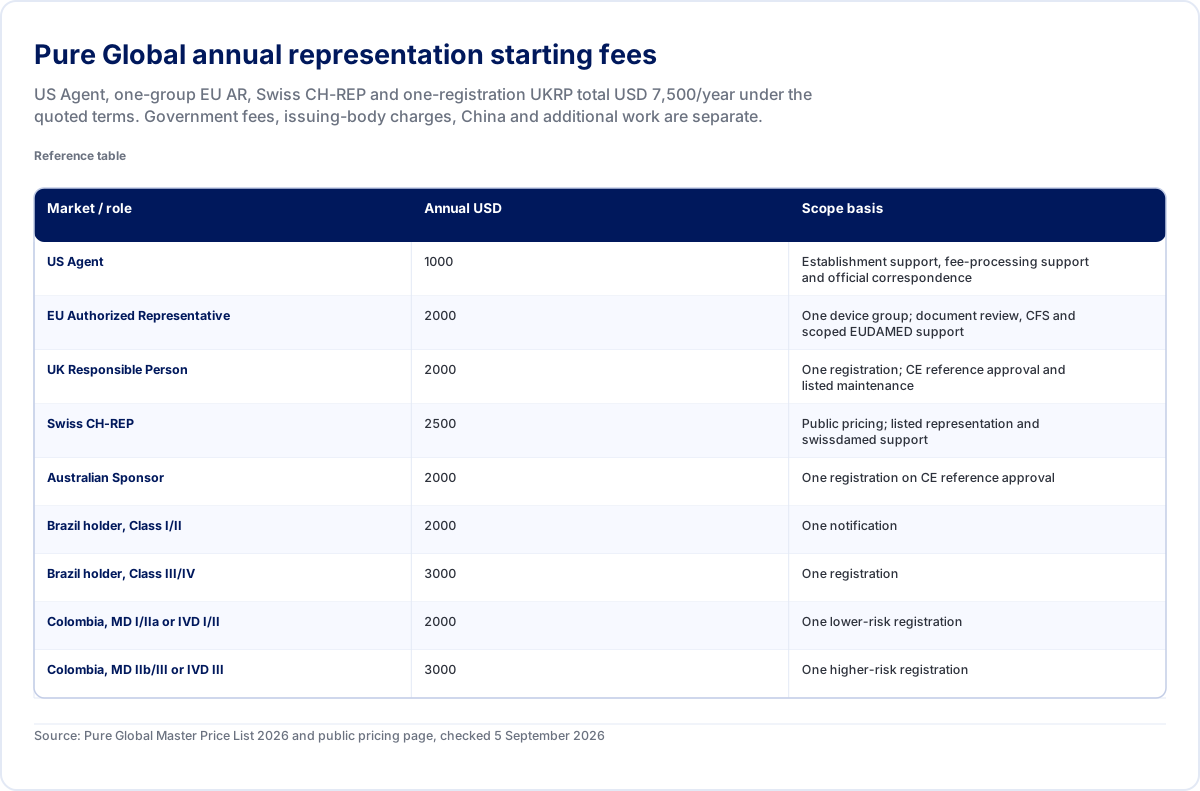
For budgeting, Pure Global's illustrated US Agent, one-group EU AR, Swiss CH-REP and one-registration UKRP fees total $7,500 per year under the quoted terms. That is a representation subtotal, excluding China, government and issuing-body fees and additional technical work. Swissmedic's separate registration charge starts at CHF 200, then CHF 20 for each additional UDI-DI in the year, capped at CHF 10,000 per manufacturer Pricingpublic pricing14.
Start with the submission unit, not the database name
A regulatory team can receive three apparently similar requests: upload the UDI, enter the manufacturer and attach the authorization. The work differs once it reaches a real product catalogue. A box containing multiple devices, a product with several sizes, and a legacy EU device can each require relationships that a flat list of product codes will not capture.
The useful first deliverable is a product-and-packaging master. For each intended market, identify the exact device version or model, the smallest sales package, higher packaging configurations, relevant identifiers and the current registration or conformity route. Assign an owner to the underlying fact rather than copying independent versions into each portal.
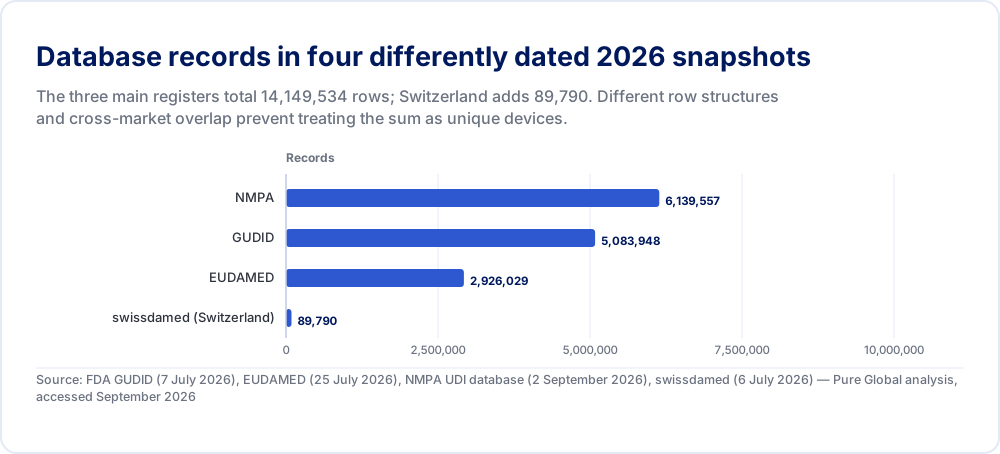
| Database records | |
|---|---|
| NMPA | 6,139,557 |
| GUDID | 5,083,948 |
| EUDAMED | 2,926,029 |
| swissdamed (Switzerland) | 89,790 |
Source: FDA GUDID (7 July 2026), EUDAMED (25 July 2026), NMPA UDI database (2 September 2026), swissdamed (6 July 2026) — Pure Global analysis, accessed September 2026
The relative register sizes illustrate the scale of those administrative systems. They do not rank sales, clinical use, regulatory burden or the number of manufacturers already compliant. A single product family can generate multiple records; one record can contain nested identifiers. The same device may appear across jurisdictions, while differences in applicability and transition dates mean other records appear in only one 456.
GUDID: the primary record contains packaging information
GUDID identifies a base-package device through its primary DI record. Higher-package DIs and their quantities are recorded within that primary record, with the Contains DI Package relationship linking packaging levels. A unit-of-use DI identifies an individual device where the lowest full-UDI package contains multiple devices; it is not a parent-package key. Shipping containers are excluded from the package-DI requirement 15.
This distinction affects the upload design. A product-data team that creates a separate primary record for every outer package can build duplicates or lose the package hierarchy. Instead, distinguish the primary device record from the packaging identifiers it contains. Confirm the physical packaging configuration, unit counts and applicable identifier requirements against the FDA guidance before generating the submission.
The labeler remains responsible for its GUDID data even when a third party submits it. GUDID also differs from FDA establishment registration, device listing and premarket clearance. One completed task should not be used as proof that the others have been completed 116.
EUDAMED: distinguish Regulation devices from legacy identifiers
For devices under the MDR or IVDR, the Basic UDI-DI groups devices according to the applicable criteria and serves as an important regulatory database key. It differs from the UDI-DI identifying a device and its packaging. The Basic UDI-DI is not simply the barcode printed on the retail package 2.
Legacy-device registration introduces a separate naming trap. The Commission's legacy-device guidance uses EUDAMED-DI and EUDAMED-ID where the relevant UDI identifiers are unavailable; a B- prefix identifies the legacy EUDAMED-DI format 9. A dataset field named basicUdi therefore needs interpretation before its contents are counted as Basic UDI-DI families.
Our complete reread found 758,588 distinct grouping keys in the EU export, of which 610,730 (80.5%) start B-. The remaining 147,858 keys are not automatically verified GS1 Basic UDI-DIs. The old shortcut of classifying residual alphanumeric strings as GS1 would turn a legacy identifier convention into a false agency statistic 59.
For implementation, classify the record's regulatory route first. Establish whether it needs a Basic UDI-DI or the applicable legacy identifier structure, then map the actual device identifiers and certificate relationships. Treat the manufacturer's SRN and representative relationships as actor data, distinct from identifier allocation and from commercial model naming.
NMPA: retain the registration or filing relationship
China's UDI platform records product identifiers with information tied to the registrant or filing holder and its registration or filing references. The applicable data submission must be coordinated with the product's China regulatory record and production cohort. Identifier allocation alone is insufficient to establish that relationship 317.
A global device name, Chinese registration name and internal catalogue description may differ for legitimate reasons. The master should retain those names separately and identify which is authoritative for each field. The registration or filing number is a regulatory relationship, rather than a substitute for the product identifier or a universal equivalent of a Basic UDI-DI.
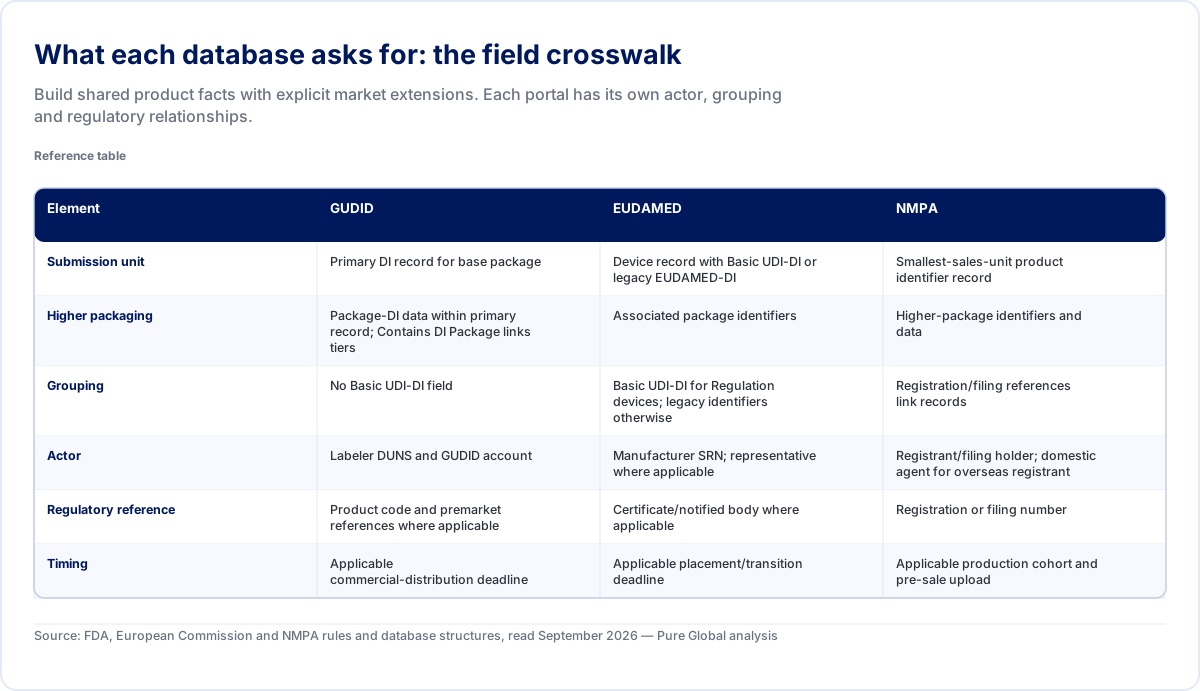
| Element | GUDID | EUDAMED | NMPA |
|---|---|---|---|
| Submission unit | Primary DI record for base package | Device record with Basic UDI-DI or legacy EUDAMED-DI | Smallest-sales-unit product identifier record |
| Higher packaging | Package-DI data within primary record; Contains DI Package links tiers | Associated package identifiers | Higher-package identifiers and data |
| Grouping | No Basic UDI-DI field | Basic UDI-DI for Regulation devices; legacy identifiers otherwise | Registration/filing references link records |
| Actor | Labeler DUNS and GUDID account | Manufacturer SRN; representative where applicable | Registrant/filing holder; domestic agent for overseas registrant |
| Regulatory reference | Product code and premarket references where applicable | Certificate/notified body where applicable | Registration or filing number |
| Timing | Applicable commercial-distribution deadline | Applicable placement/transition deadline | Applicable production cohort and pre-sale upload |
Source: FDA, European Commission and NMPA rules and database structures, read September 2026 — Pure Global analysis
Use the crosswalk to identify dependencies. It does not establish a strictest database that mechanically contains the other two. China adds registration and local-language relationships that the US structure does not supply; Europe adds its grouping and actor relationships. The resulting master needs explicit market-specific extensions.
Choose the issuing system on acceptance and operating fit
The US recognizes GS1, HIBCC and ICCBBA as issuing agencies; the EU designations include GS1, HIBCC, ICCBBA and IFA. The EU renewed its designated issuing entities through 27 June 2029. China's published list identifies GS1 China, the MA-code body and Ali Health 11819.
GS1 standards therefore offer a practical coding route across the three jurisdictions. This is a standards-acceptance observation, not a claim that every existing identifier, label, packaging configuration or data submission can be reused unchanged. Confirm the relevant allocation rules, prefix arrangements and local requirements for the actual portfolio 20.
The issuer percentages need different denominators
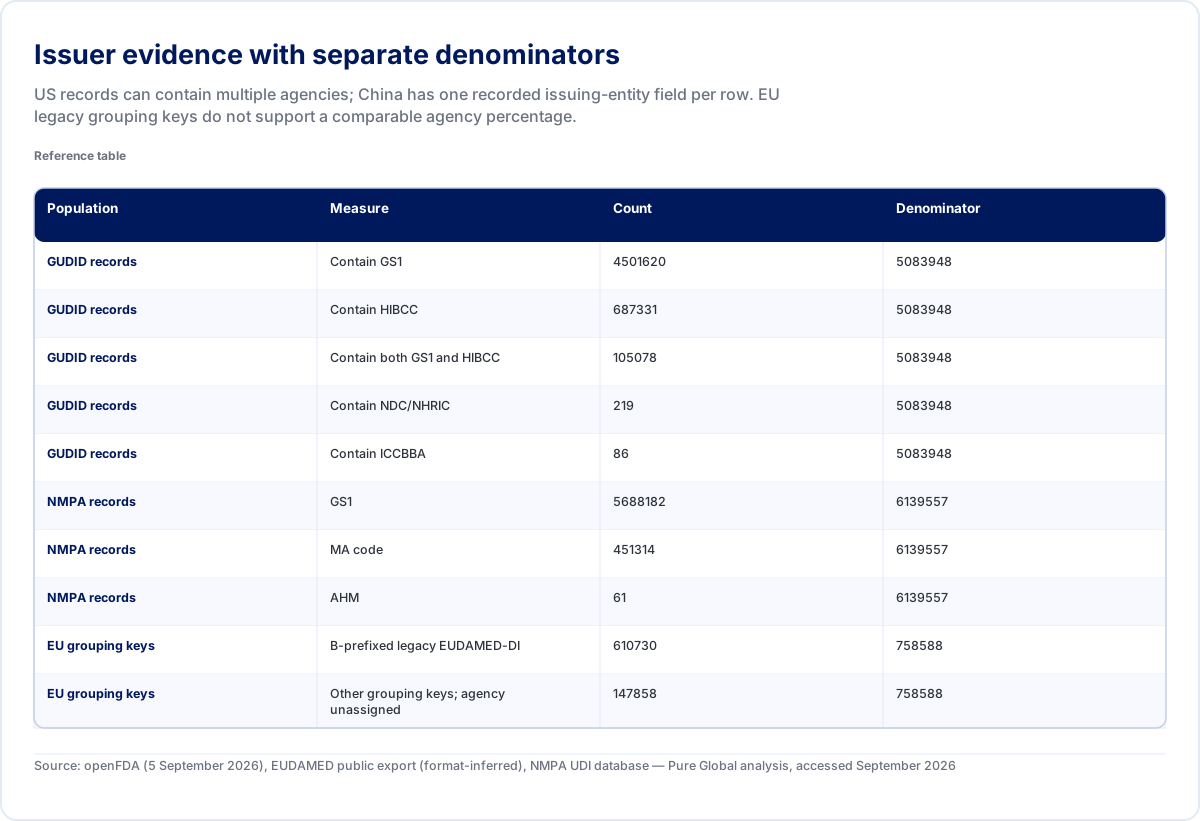
| Population | Measure | Count | Denominator |
|---|---|---|---|
| GUDID records | Contain GS1 | 4501620 | 5083948 |
| GUDID records | Contain HIBCC | 687331 | 5083948 |
| GUDID records | Contain both GS1 and HIBCC | 105078 | 5083948 |
| GUDID records | Contain NDC/NHRIC | 219 | 5083948 |
| GUDID records | Contain ICCBBA | 86 | 5083948 |
| NMPA records | GS1 | 5688182 | 6139557 |
| NMPA records | MA code | 451314 | 6139557 |
| NMPA records | AHM | 61 | 6139557 |
| EU grouping keys | B-prefixed legacy EUDAMED-DI | 610730 | 758588 |
| EU grouping keys | Other grouping keys; agency unassigned | 147858 | 758588 |
Source: openFDA (5 September 2026), EUDAMED public export (format-inferred), NMPA UDI database — Pure Global analysis, accessed September 2026
The openFDA query counts records containing an agency value anywhere in the nested identifiers array. It returns 4,501,620 GS1-containing records and 687,331 HIBCC-containing records out of 5,083,948 records. A separate intersection query finds 105,078 records containing both. Adding the agency buckets and normalizing them to 100% would erase that overlap and change the question being answered 8.
The NMPA issuingEntity field is different: its 6,139,557 rows divide into 5,688,182 GS1, 451,314 MA-code and 61 AHM records. These shares sum to the full Chinese record count. They describe the stored assignments in that field, without independently validating every identifier or its current label use 6.
The EU export contains identifier formats, including legacy forms, that do not support a comparable agency classification. A 14-digit numeric string can be tested for a GTIN check digit, but syntax alone does not establish the registered issuer relationship or the correctness of the underlying product assignment. We therefore leave the EU issuing-agency percentage unreported 5.
Questions to settle before allocating a large catalogue
The choice should account for the manufacturer's existing identifiers, target jurisdictions, packaging complexity, data-system integration and the cost of maintaining allocations. Obtain the issuing body's applicable rules and clarify what happens when a model, packaging level or corporate identity changes. Keep a record of that decision with the product master.
If a company already uses another accepted system in the US or EU, assess the China pathway before assuming a global migration is necessary. The correct decision depends on the portfolio and labeling design. Database prevalence by itself is weak grounds for replacing an established identifier system.
Our judgment is to resolve the intended-market coding route before committing large packaging quantities. At the same time, avoid waiting for every portal account to be approved before doing independent work on device grouping, terminology, packaging and source data. A useful work order separates true submission prerequisites from tasks that can proceed together.
What the database populations reveal about mapping work
The EU export has 2,926,029 device records and 2,902,382 distinct primary-identifier strings. The distinction alone shows why “one row equals one unique model” is unsafe. The whole-file total includes both Regulation and legacy structures 5.
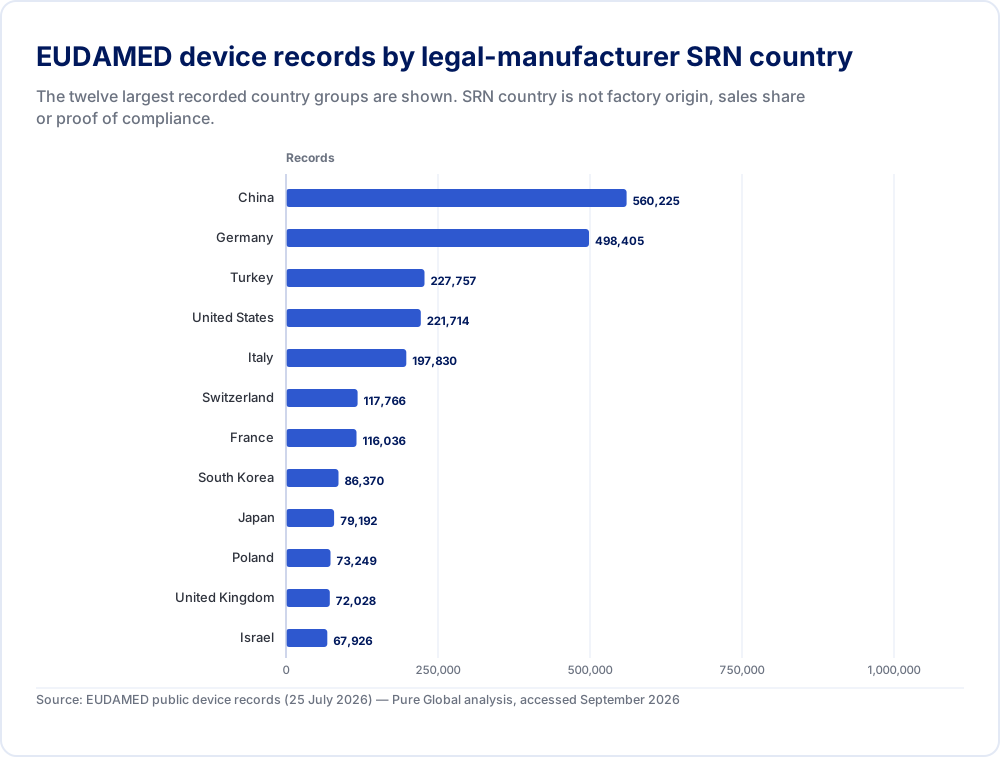
| Device records | |
|---|---|
| China | 560,225 |
| Germany | 498,405 |
| Turkey | 227,757 |
| United States | 221,714 |
| Italy | 197,830 |
| Switzerland | 117,766 |
| France | 116,036 |
| South Korea | 86,370 |
| Japan | 79,192 |
| Poland | 73,249 |
| United Kingdom | 72,028 |
| Israel | 67,926 |
Source: EUDAMED public device records (25 July 2026) — Pure Global analysis, accessed September 2026
The largest legal-manufacturer SRN country grouping in this snapshot is China at 560,225 records, followed by Germany at 498,405. This is the country associated with the recorded manufacturer actor, not factory origin, shipment origin or market share. The chart shows the largest twelve groups and does not exhaust the total 5.
For a manufacturer working through a representative, the useful implication is to check the exact actor relationship. Similar company names, a change of address or a distributor located in another country can create misleading informal matches. Match the recorded actor identifier, mandate and relevant device record rather than inferring the relationship from the brand or country alone.
| Device records | |
|---|---|
| Class I | 1,447,143 |
| Class IIa | 789,875 |
| Class IIb | 430,131 |
| Class III | 119,642 |
| IVD classes A to D | 78,057 |
| Legacy IVD | 60,906 |
| AIMDD | 275 |
Source: EUDAMED public device records (25 July 2026) — Pure Global analysis, accessed September 2026
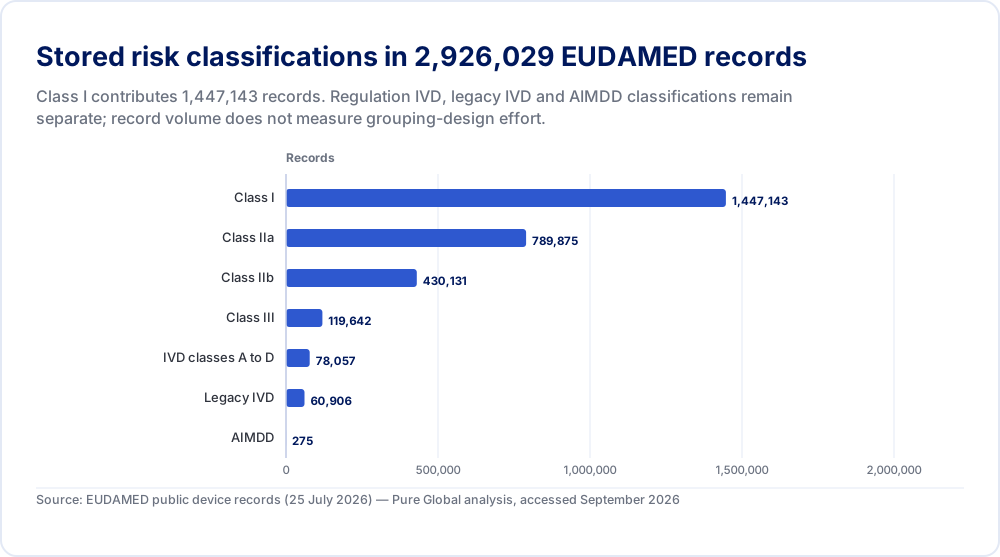
Stored classifications also differ by regulatory route. The EU snapshot contains 1,447,143 Class I records, 789,875 Class IIa, 430,131 Class IIb and 119,642 Class III. IVD classes A through D contribute 78,057 records; legacy IVD classifications contribute 60,906; AIMDD contributes 275. These groups sum to the full export after reparsing all twenty partitions 5.
The proportions do not measure the effort of creating a Basic UDI-DI or prove that low-risk catalogues are harder to maintain. They instead show why an importer needs a classification-and-route field in the master. A transition intended for one device route should not be applied indiscriminately to another.
| Records | |
|---|---|
| Domestic Class III (国械注准) | 3,820,151 |
| Provincial Class II | 1,259,961 |
| Imported, registered (国械注进) | 587,371 |
| Municipal Class I filings | 262,560 |
| Hong Kong, Macao and Taiwan registrations (国械注许) | 166,838 |
| Imported Class I filings (国械备) | 29,574 |
| Other or blank | 13,102 |
Source: NMPA UDI database full release (2 September 2026) — Pure Global analysis, accessed September 2026
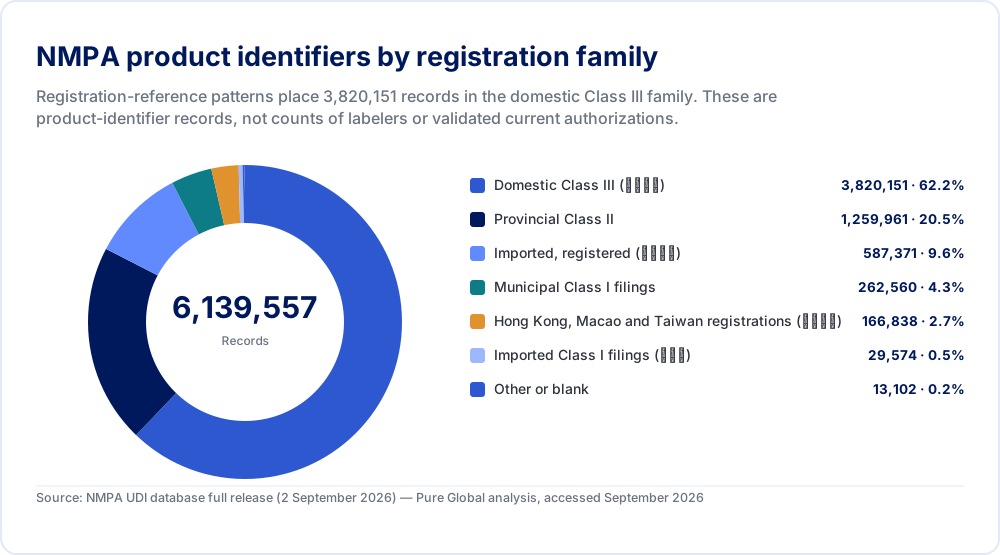
In the NMPA snapshot, registration-number patterns classify 3,820,151 product-identifier records under domestic Class III registrations and 1,259,961 under provincial Class II registrations. Imported registration and imported Class I filing patterns total 616,945 records. The classification is based on the stored reference pattern; it is not a fresh audit of every certificate's validity 6.
Use those patterns as validation aids, not authorization decisions. A mismatch between the uploaded reference and the product's approved China record should be resolved against the actual regulatory documentation. A public entry establishes that identifier information was published. It does not independently establish that a device is lawfully marketed or that every required update has been completed.
Apply the right calendar to the right product cohort
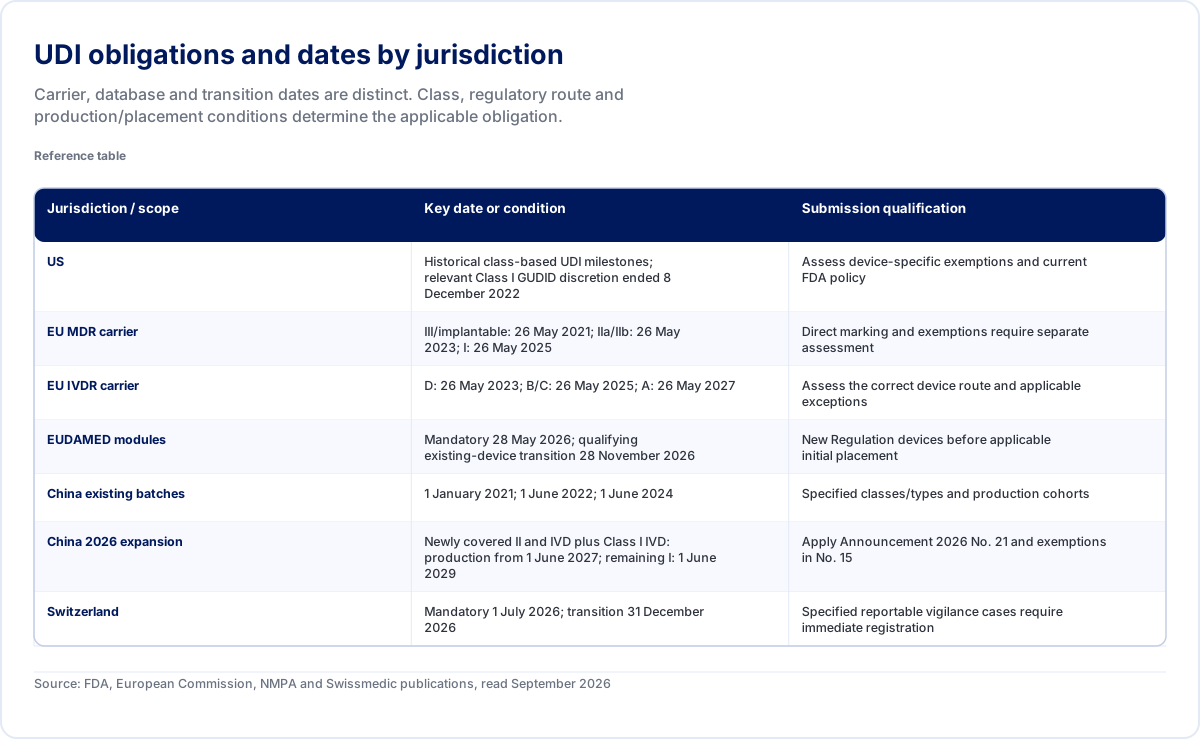
Database availability, mandatory module use, UDI label-carrier dates and direct-marking requirements are separate milestones. A launch checklist that contains one date per country loses distinctions that matter to a real portfolio.
| Jurisdiction / scope | Key date or condition | Submission qualification |
|---|---|---|
| US | Historical class-based UDI milestones; relevant Class I GUDID discretion ended 8 December 2022 | Assess device-specific exemptions and current FDA policy |
| EU MDR carrier | III/implantable: 26 May 2021; IIa/IIb: 26 May 2023; I: 26 May 2025 | Direct marking and exemptions require separate assessment |
| EU IVDR carrier | D: 26 May 2023; B/C: 26 May 2025; A: 26 May 2027 | Assess the correct device route and applicable exceptions |
| EUDAMED modules | Mandatory 28 May 2026; qualifying existing-device transition 28 November 2026 | New Regulation devices before applicable initial placement |
| China existing batches | 1 January 2021; 1 June 2022; 1 June 2024 | Specified classes/types and production cohorts |
| China 2026 expansion | Newly covered II and IVD plus Class I IVD: production from 1 June 2027; remaining I: 1 June 2029 | Apply Announcement 2026 No. 21 and exemptions in No. 15 |
| Switzerland | Mandatory 1 July 2026; transition 31 December 2026 | Specified reportable vigilance cases require immediate registration |
Source: FDA, European Commission, NMPA and Swissmedic publications, read September 2026
For the US, statutory and enforcement-policy dates varied by device class and requirement. The broad historical timetable does not remove applicable exemptions or consumer-health-product policies. Check the FDA's current policy for the specific device and the specific obligation; avoid translating a single enforcement date into “all US UDI work is finished” 21.
For the EU, the four relevant EUDAMED modules became mandatory from 28 May 2026. The Commission's transition guidance gives 28 November 2026 for qualifying existing Regulation and legacy-device registrations. Newly placed Regulation devices follow the applicable pre-placement registration requirement. A missing entry in September therefore requires a product-and-transition assessment before it is called noncompliance 1011.
Carrier deadlines differ between MDR and IVDR classes. For example, the Class I MDR carrier date was 26 May 2025, whereas Class A IVDR has a 26 May 2027 carrier date. Separate direct-marking requirements and exemptions must also be considered. The database milestone should never replace those checks 22.
China's earlier implementation batches began on 1 January 2021, 1 June 2022 and 1 June 2024 for their specified scopes. Announcement 2026 No. 21 extends implementation to newly covered Class II devices, including IVD reagents, and Class I IVD reagents produced from 1 June 2027. Remaining Class I devices enter the production-based requirement from 1 June 2029. Read this alongside the applicable exemptions and the production-date treatment in the 2026 notices 2324171325.
Switzerland's device-registration requirement started on 1 July 2026, with transition to 31 December 2026. Devices involved in the specified reportable vigilance events require immediate registration. Foreign manufacturers do not obtain a separate CHRN merely because their products are registered; the Swiss representative's role and actor record need to be handled correctly 122627.
Publication-year charts are historical fields, not a compliance clock
| Records published | |
|---|---|
| Before 2020 | 1,601 |
| 2020 | 334,825 |
| 2021 | 740,164 |
| 2022 | 1,482,699 |
| 2023 | 824,230 |
| 2024 | 1,048,693 |
| 2025 | 968,447 |
| 2026 (to 2 Sep) | 738,898 |
Source: NMPA UDI database full release (2 September 2026) — Pure Global analysis, accessed September 2026
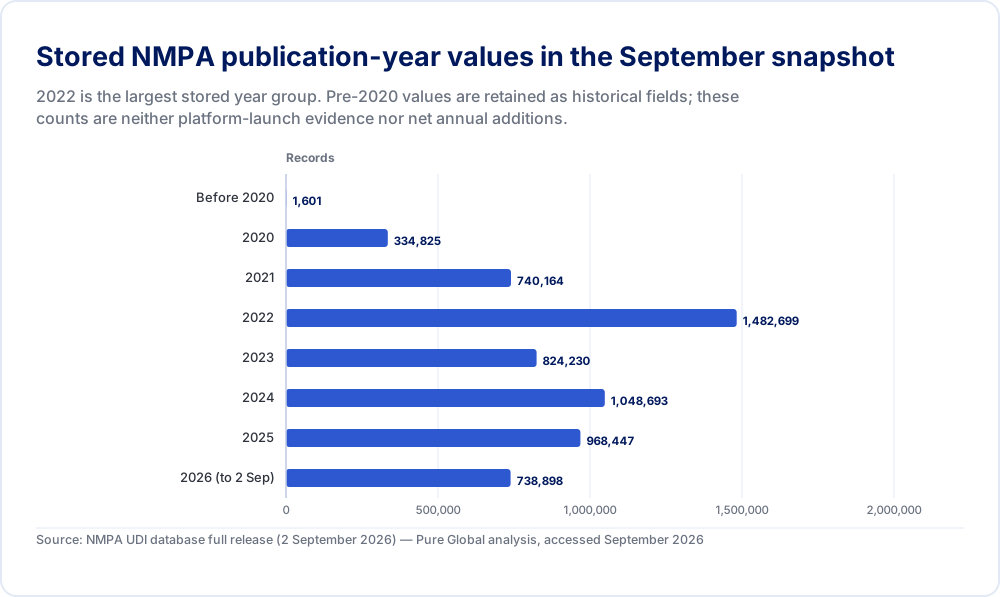
The NMPA snapshot's largest stored publication-year group is 2022, with 1,482,699 records. Its timing overlaps an implementation expansion, but the field alone does not attribute every record to that policy. The 1,601 pre-2020 entries include dates predating the platform's implementation and must be treated as stored historical values rather than platform-launch evidence 6.
| Records published | |
|---|---|
| 2013 | 3 |
| 2014 | 35,259 |
| 2015 | 449,999 |
| 2016 | 762,115 |
| 2017 | 311,442 |
| 2018 | 416,781 |
| 2019 | 421,990 |
| 2020 | 390,003 |
| 2021 | 405,858 |
| 2022 | 612,764 |
| 2023 | 430,630 |
| 2024 | 397,820 |
| 2025 | 360,656 |
| 2026 (to 7 July) | 88,628 |
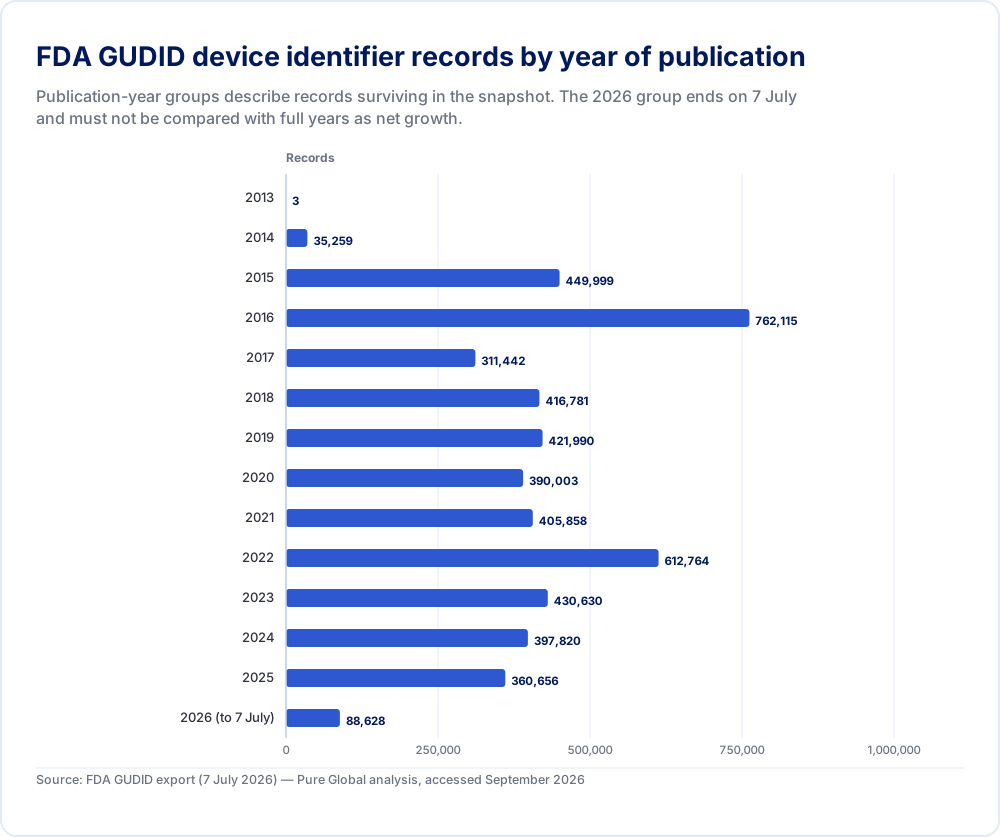
Source: FDA GUDID export (7 July 2026) — Pure Global analysis, accessed September 2026
The GUDID snapshot shows substantial publication-year groups in 2015, 2016 and later years. These are surviving records grouped by their stored publication date, not net annual additions, shipments or newly authorized models. The 2026 bars in both figures cover partial years ending at their respective snapshots. Comparing them with full years as if they represented a slowdown would be misleading 46.
Keep applicability dates in a maintained product-level register. Its fields should include the requirement, legal source, device scope, production or placement condition, transition or exemption, responsible owner and current evidence. A static report supplies the framework and verified dates at publication; the launch team owns changes after that date.
Turn the crosswalk into an accountable work order
Begin with one representative device family before extending the process to the entire catalogue. Select a case that exercises the real packaging and market relationships: more than one package level if applicable, a local registration reference, and the correct EU device route. Do not choose an artificially simple pilot that hides the dependencies the team needs to learn.
The following stages describe deliverables. They can overlap when their inputs are independent; they are not a mandatory worldwide upload sequence.
| Workstream | Deliverable | Acceptance evidence |
|---|---|---|
| Product scope | Market, model/version, classification, route and applicability record | Approved regulatory source and identified production/placement cohort |
| Identifier and packaging design | Device, grouping and package identifiers with unit relationships | Issuer rules, packaging review and consistent internal master |
| Actor and mandate setup | Appropriate accounts, identifiers and representative relationships | Approved actor/account records and agreed responsibilities |
| Field mapping | Market-specific field dictionary and source owner | Valid sample payload reconciled to approved product facts |
| Submission and reconciliation | Accepted records plus public-view check where available | Portal receipt, record identifiers and resolved discrepancies |
| Change control | Named owner, trigger list and update procedure | Test of a controlled change across affected records and labels |
Give each field one accountable source
Product management may own the model and package configuration; regulatory affairs may own intended purpose, classification and authorization references; quality may own the controlled label and change process. The work order should state the actual arrangement rather than assuming the portal operator can decide every field.
Retain the original value and the submitted value when a market requires a different format or language. This makes a later discrepancy explainable. For example, an English commercial name and a Chinese registered name need a deliberate mapping; changing one text field to make them look identical can destroy useful provenance.
Check both acceptance and the published record
A successful file upload is one event in the process. Record the returned identifiers, validation warnings and final status, then reconcile the submitted device against the appropriate public view when available. AccessGUDID, the EUDAMED public portal and NMPA search provide different visibility and update behavior 2856.
FDA's seven-day grace period concerns editing after publication, not a required seven-day delay before information becomes public. Plan the review and update process with that distinction in mind. Account access, submission acceptance and public visibility are related checks, but they should not be collapsed into one checkbox 15.
Keep Swiss uploads and EU updates connected operationally
Swissmedic supports an EUDAMED-compatible XML route, but there is no automatic database synchronization. Reusing a payload format can reduce repeated preparation; it does not remove the Swiss submission, actor responsibility or later update work 27.
For the pilot, make one controlled change and trace its consequences. Identify the source field, whether an identifier changes, which label or package files change, which portals need updates and who closes the reconciliation. This is a practical test of the operating model before the company commits to maintaining thousands of records.
Budget representation, database fees and technical work separately
A useful estimate separates recurring representation, government/database charges, issuing-body fees and project work. Combining them into one “UDI registration fee” can make a quote look comparable while hiding different scopes.
| Market / role | Annual USD | Scope basis |
|---|---|---|
| US Agent | 1000 | Establishment support, fee-processing support and official correspondence |
| EU Authorized Representative | 2000 | One device group; document review, CFS and scoped EUDAMED support |
| UK Responsible Person | 2000 | One registration; CE reference approval and listed maintenance |
| Swiss CH-REP | 2500 | Public pricing; listed representation and swissdamed support |
| Australian Sponsor | 2000 | One registration on CE reference approval |
| Brazil holder, Class I/II | 2000 | One notification |
| Brazil holder, Class III/IV | 3000 | One registration |
| Colombia, MD I/IIa or IVD I/II | 2000 | One lower-risk registration |
| Colombia, MD IIb/III or IVD III | 3000 | One higher-risk registration |
Source: Pure Global Master Price List 2026 and public pricing page, checked 5 September 2026
The Pure Global list and public pricing page state starting representation fees by market, device group or registration. The US Agent line is $1,000 annually; an EU Authorized Representative arrangement starts at $2,000 for one device group; UKRP starts at $2,000 for one registration; the Swiss CH-REP public line is $2,500. Confirm the applicable terms and scope for the portfolio, including the contract-period assumptions Pricingpublic pricing.
The EU list scales from $2,000 for one device group to $4,000 for five groups in $500 increments. Brazil and Colombia have risk-dependent starting lines: the $2,000 Colombian figure applies to one lower-risk registration, while the higher-risk line starts at $3,000. A price copied without its class and registration basis is an incomplete quote public pricing.
Pure Global's quoted representation lines include their specified registration, renewal, modification and correspondence services. The exact list differs by market. The US Agent description does not explicitly promise all GUDID submissions, and EUDAMED support must be reconciled with the agreed work scope; the master list also contains a separate $200/hour EUDAMED support line. Do not assume unlimited migration or remediation work from a short public description Pricingpublic pricing.
The four-market illustration
For one qualifying EU device group and one UK registration, the four annual representation lines add as follows:
| Component | Annual USD |
|---|---|
| US Agent | 1,000 |
| EU Authorized Representative | 2,000 |
| Swiss CH-REP | 2,500 |
| UK Responsible Person | 2,000 |
| Representation subtotal | 7,500 |
This illustration includes the UK as a separate representation market; it does not mean the UK is one of the three databases analyzed in the title. It excludes China, technical dossier work, government and third-party fees, issuing-body charges and any additional scope. Three-year pricing terms and the higher first-year price for an annual contract should be checked against the current public offer Pricing.
Swissmedic's database charge is separate. The published schedule charges CHF 200 for the first UDI-DI registered in a year and CHF 20 for each additional one, capped at CHF 10,000 per manufacturer/year. First invoicing is at 31 December 2026 for on-market entries; later charging concerns newly registered devices, with each invoiced once and updates free. Keep the currency separate from the dollar representation subtotal 14.
One-time compilation is a different scope
For context, the master list gives US 510(k) compilation at $15,000–$20,000 and EU technical-documentation compilation lines of $8,000, $12,000 or $15,000 according to scope. The EU compilation lines exclude writing, gap closure and notified-body interaction and require expert scope confirmation. They must not be sold as a complete conformity-assessment project public pricing.
A budget owner should therefore request a line-by-line quote specifying registration count or device grouping, supplied documentation, translations, submission volume, remediation, account responsibilities, government charges and change support. The technical-file cost guide provides further context for that separate workstream Medical Device Technical File Compilation Cost (2026).
Pure Global's role is to turn the portfolio and target-market plan into that scoped work order. Bring the device list, packaging levels, existing identifiers, authorization references and intended launch dates to the scoping discussion. Those inputs determine the workload more directly than the number of countries printed in a proposal.
Final self-check and interpretation limits
Before approving launch readiness, select the exact device and package configuration in each market. Verify the identifier, actor relationship, classification, registration or certificate reference, intended purpose and current lifecycle status against the controlled source. Resolve discrepancies by record identifier rather than a name-only search.
A missing record can have several explanations: an incorrect search, a different identifier structure, a transition, a scope exclusion, a publication delay or an incomplete submission. Establish which applies. A visible record likewise proves neither market authorization nor complete compliance. The registration-verification guide addresses those broader evidence distinctions Medical Device Registration Verification 2026.
This report combines differently dated snapshots: GUDID on 7 July, EUDAMED on 25 July, NMPA on 2 September and swissdamed on 6 July 2026. The openFDA issuer recheck was retrieved on 5 September with API metadata last updated on 3 August. A fresh Python parse of all twenty EU partitions recovered two rows missed by the original analysis, producing the corrected total of 2,926,029 45687.
Agency fields, grouping keys and country codes have different meanings across those files. US agency buckets overlap; EU grouping keys include legacy EUDAMED-DIs; NMPA certificate-family labels are inferred from stored patterns; SRN countries identify recorded legal actors. No cross-database deduplication of physical devices or corporate entities was performed.
The practical output is a common master with explicit local mappings, an applicability calendar and a costed responsibility matrix. Approve those together. An identifier that scans correctly is valuable, but the launch team still needs the right data, relationship and submission at the right time.
References
- FDA, Global Unique Device Identification Database (GUDID), 2026 - Supports GUDID architecture, labeler account structure, and packaging level data requirements. fda.gov ↩ ↩ ↩
- European Commission, Unique Device Identifier (UDI), 2026 - Supports Basic UDI-DI definition as the main database key and European issuing entity designations. health.ec.europa.eu ↩ ↩
- National Medical Products Administration, NMPA Announcement 2019 No. 66, Rules for Unique Device Identification System (医疗器械唯一标识系统规则), 2019 - Supports China UDI system rules, issuing agency requirements, and registrant upload duties. nmpa.gov.cn ↩ ↩
- FDA, GUDID, 7 July 2026 export; Pure Global analysis of primary DI records and stored publication years. accessgudid.nlm.nih.gov ↩ ↩ ↩ ↩
- European Commission, EUDAMED public device records, 25 July 2026 snapshot; Pure Global complete twenty-partition analysis, corrected to 2,926,029 device records. Grouping keys include legacy EUDAMED-DIs. ec.europa.eu ↩ ↩ ↩ ↩ ↩ ↩ ↩ ↩ ↩
- NMPA, UDI database, full release 2 September 2026; Pure Global analysis of product-identifier records, issuingEntity and registration-reference patterns. udi.nmpa.gov.cn ↩ ↩ ↩ ↩ ↩ ↩ ↩ ↩ ↩
- Swissmedic, swissdamed, 6 July 2026 snapshot; Pure Global analysis of 89,790 device UDI-DI records. swissdamed.ch ↩ ↩
- openFDA, Device Unique Device Identifier API, accessed 5 September 2026 - Supports live GUDID issuing agency counts and commercial distribution status metrics. open.fda.gov ↩ ↩ ↩
- European Commission, Management of legacy devices in EUDAMED, February 2021; B-prefixed EUDAMED-DI and legacy identifier structure. health.ec.europa.eu ↩ ↩ ↩
- European Commission, EUDAMED Overview, 2026 - Supports Commission Decision (EU) 2025/2371 publication on 27 November 2025 and mandatory application from 28 May 2026. health.ec.europa.eu ↩ ↩
- European Commission, EUDAMED transition for certificates and devices, accessed 5 September 2026; mandatory use and existing-device transition dates. health.ec.europa.eu ↩ ↩
- Swissmedic, swissdamed: As of 1 July 2026, Mandatory Registration Applies to Medical Devices and In Vitro Diagnostic Medical Devices, 2026 - Supports mandatory Swiss device registration from 1 July 2026 and transitional deadlines. swissmedic.ch ↩ ↩
- Beijing Medical Products Administration, Implementation of subsequent UDI cohorts, 10 July 2026, implementing NMPA Announcement 2026 No. 21; production cohorts from June 2027 and June 2029. yjj.beijing.gov.cn ↩ ↩
- Swissmedic, Registration fee, accessed 5 September 2026; UDI-DI charges and annual cap. swissmedic.ch ↩ ↩
- FDA, Global Unique Device Identification Database guidance, 17 December 2024, pages 14–16 and 20; primary DI, packaging, unit-of-use and post-publication editing. fda.gov ↩ ↩
- eCFR, 21 CFR Part 830 Unique Device Identification, 2026 - Supports federal standards for UDI data submission and issuing agency accreditation. ecfr.gov ↩
- NMPA, NHC, and NHSA, Announcement 2023 No. 22 on Implementing the Third Batch of Medical Device Unique Identification, 2023 - Supports third batch scope, upload prior to commercial sale, and registration system linkage. nmpa.gov.cn ↩ ↩
- European Commission, Commission Implementing Decision (EU) 2024/2120 Renewing the Designations, 2024 - Supports renewal of the four European issuing entities through 27 June 2029. eur-lex.europa.eu ↩
- Hunan Provincial Medical Products Administration, UDI Issuing Agencies and Rules (医疗器械唯一标识发码机构及规则), 2021 - Supports statutory domestic legal entity accreditation requirements in China (GS1 China, MA Code, Ali Health). mpa.hunan.gov.cn ↩
- GS1, Unique Device Identification (UDI) in Healthcare, 2026 - Supports GS1 GTIN and GMN standards accepted across global medical device regulators. gs1.org ↩
- FDA, UDI Compliance Policies and UDI Rule Compliance Dates, 2026 - Supports United States statutory compliance dates by device class and Class I GUDID enforcement termination date. fda.gov ↩
- European Commission UDI Helpdesk, UDI carrier deadlines, accessed 5 September 2026; MDR and IVDR milestones. webgate.ec.europa.eu ↩
- NMPA, NHC, and NHSA, Announcement 2020 No. 106 on the Implementation of the First Batch of Medical Device Unique Identification, 2020 - Supports first batch scope covering 9 categories and 69 Class III device types from 1 January 2021. nmpa.gov.cn ↩
- NMPA, NHC, and NHSA, Announcement 2021 No. 114 on the Implementation of the Second Batch of Medical Device Unique Identification, 2021 - Supports second batch scope covering remaining Class III medical devices and IVD reagents from 1 June 2022. nmpa.gov.cn ↩
- Shanghai Medical Products Administration, NMPA Announcement 2026 No. 15, 13 March 2026; UDI exemptions, direct marking and software requirements. yjj.sh.gov.cn ↩
- Swissmedic, Deadline for Device Registration in swissdamed, 2026 - Supports transitional deadlines and vigilance reporting exceptions under Swiss law. swissmedic.ch ↩
- Swissmedic, Device registration, accessed 5 September 2026; responsible actors, XML submission and separate database responsibilities. swissmedic.ch ↩ ↩
- National Library of Medicine, About AccessGUDID, 2026 - Supports AccessGUDID public search features, grace period details, and daily update cadences. accessgudid.nlm.nih.gov ↩
 Market · Oct 15, 2026FDA US Medical Device RegistrationMarket · Oct 15, 2026EU Medical Device Classification & Regulation (MDR/IVDR)Market · Oct 15, 2026NMPA China Medical Device Registration & ApprovalCase Study · Aug 11, 2026Basic UDI-DI Grouping for Contrast DevicesCase Study · Aug 11, 2026Class III Dermal Fillers Under the EU MDRRegulatory Update · Oct 17, 2026FDA Toxicology 510(k) ExemptionsRegulatory Update · Oct 17, 2026MHRA DORS Annual FeesRegulatory Update · Oct 11, 2026EU First Device JCA SelectionRegulatory Update · Oct 11, 2026swissdamed Importer Linkage 2027Video · Oct 16, 2026FDA Small Business Determination
Team-NB MDR Documentation: Submission Completeness Checks (2026)
Interpret Team-NB’s notified-body completeness survey correctly and turn MDR technical-documentation guidance into a scoped evidence and submission check.
21 CFR Part 820 to ISO 13485: The QMSR Crosswalk
QMSR cut 21 CFR Part 820 from 31 sections to six and made ISO 13485:2016 the rule. This crosswalk maps every old section to its ISO 13485 clause, marks which mappings FDA stated, lists the FDA-only requirements and shows where a decade of 483 citations now lands.
FDA Cleared vs Approved vs Granted: 510(k), PMA and De Novo
In 2025 FDA cleared 3,198 devices through 510(k), granted 27 De Novo requests and approved 38 original PMAs. This guide explains what each word means legally, how long each route takes, what it costs in FY2027 and how to describe your device's status without misbranding it.
Let's Talk,
Anywhere You Are.
Whether looking for more information or ready to partner with us, we're here to guide you through every step of the regulatory process.
Contact us