Surgical Robots & Instruments: Global Regulation & Registration
From classification and reprocessing validation to submission and post-market surveillance, we take surgical robots, instruments, and electrosurgical devices through every major regulatory system.
For every regulator below we answer the three questions surgical device teams ask first: what class is my system, how long will it take, and what will it cost. Exact current fees and timelines by market live in our pricing calculator.
What is a surgical robot?
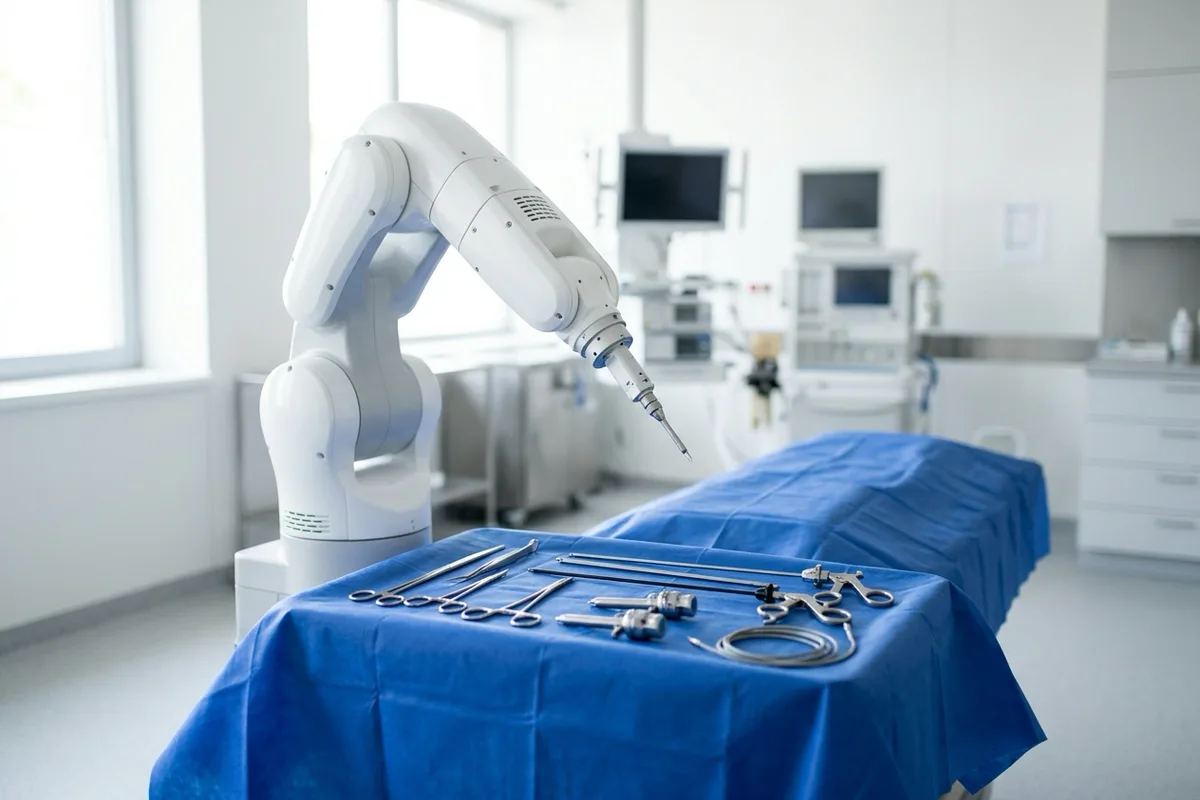
A surgical robot is a computer-assisted surgical system that lets a surgeon operate through small instruments with motion scaling, tremor filtering, and a magnified, often 3D view, rather than by hand. The procedure it enables is called robotic surgery (or robot-assisted surgery), and the platforms themselves are often marketed as robotic surgery systems. The best-known example is the da Vinci system used for laparoscopic soft-tissue procedures, and the category now spans orthopedic and neurosurgical guidance robots, flexible endoluminal platforms, and single-port systems. Almost every cleared system today is teleoperated: the surgeon is in control at every moment, and the robot holds and steadies the instruments rather than acting on its own.
Surgical robots sit at the top of a broader family of surgical devices that this page also covers: the reusable instruments they hold, such as graspers, scissors, and needle drivers; the electrosurgical generators and handpieces that cut and coagulate; and the endoscopes and single-use accessories used alongside them. These are separate device types with their own, usually lower, risk classes, and a robotic program almost always registers several of them together. General-purpose surgical instruments and consumables are regulated too, just at the low-risk end of the scale.
The catch is that every jurisdiction draws the line differently. The same robotic platform is a Class II device in the United States, a Class IIb device in Europe, and a high-class registration in Brazil, while the reusable instruments that go with it can be Class I in one market and Class II in another. That is why a structured classification analysis across your target markets is the first deliverable of any serious surgical robotics program. Every cost below has two parts: the government fee, and our own flat annual service fee per market, from US$1,000 per year in the US (device listing and US Agent representation) and from US$2,000 per year in most other markets. Exact current figures live in our pricing calculator.
FDA surgical robot regulation (United States)
FDA has historically cleared surgical robots through the 510(k) pathway as Class II devices, holding them to human factors, electrical safety, and software expectations rather than to the premarket approval process used for the highest-risk implants. Robotically assisted surgical devices have their own product codes, and the agency has set out its expectations through public workshops and safety communications — including that no robotically-assisted surgical device is cleared for cancer prevention or treatment claims. Those clearances are procedure-specific, so expanding into a new indication means new evidence, and oncology uses such as mastectomy require clinical data under FDA oversight.
- Classification. Most surgical robots are Class II and clear via 510(k) against a predicate; a genuinely novel platform with no predicate goes the De Novo route. The reusable instruments used with the system are typically Class I or Class II, and electrosurgical generators and handpieces are Class II.
- Timeline. A 510(k) typically runs 3 to 9 months end to end including preparation and FDA interaction; a De Novo program plans for 9 to 15 months. A Pre-Submission meeting adds a few weeks up front and routinely saves review cycles later.
- Cost. Government fees: US$28,653 for a standard 510(k) review (US$7,163 for qualified small businesses), plus US$13,785 per year in establishment registration. Our flat US$1,000 per year covers FDA establishment registration and device listing maintenance plus US Agent representation; 510(k) preparation and submission are scoped as a separate project.
AI and autonomy in surgical robots
Almost every cleared system is surgeon-controlled, but AI-assisted features and steps toward task autonomy are the fastest-moving part of the field. When software in a robot analyzes images, plans a resection, or drives a motion on its own, that software function is regulated on its own terms, often as software as a medical device, and an autonomous or adaptive feature can push a submission from a routine 510(k) to a De Novo or a Pre-Submission-led review. FDA's Predetermined Change Control Plan (PCCP) guidance, finalized in December 2024 for AI-enabled device software functions, lets planned model updates be pre-authorized in the original 510(k), De Novo, or PMA instead of each triggering a new submission, so where an AI feature will iterate we build the PCCP into the submission from the start. We scope the software and AI claims early so the hardware clearance and the software pathway move together rather than colliding late.
Start from our United States market page for the full FDA pathway.
EU MDR surgical robot classification and CE marking
Under EU MDR, a surgical robot is an active device placed on the market in its own right, and a notified body sits in the middle of your timeline. The instruments and accessories in the system are classified separately, and reusable surgical instruments carry a specific reprocessing obligation.
- Classification. Surgical robots are typically Class IIb as active surgical devices, and electrosurgical equipment is generally IIb as well. Reusable surgical instruments are Class I, but in the reusable "Ir" sub-category a notified body must review the reprocessing, cleaning, and sterilization aspects even though the rest of the file is self-declared.
- Timeline. Plan 9 to 18 months with a notified body for a first Class IIb certification, driven by notified body capacity and the maturity of your technical documentation and clinical evaluation.
- Cost. There is no central government fee; the money goes to the notified body, typically €30,000 to €70,000 across a first certification cycle and more for higher-risk classes, plus annual surveillance, and to building MDR-grade documentation. Our EU Authorized Representative service is a flat annual fee from US$2,000, capped at US$4,000 as your portfolio grows, and covers EC REP representation, document review, and EUDAMED support; CE-marking work with your notified body is scoped separately.
Notified body strategy should shape your EU plan early; see the European Union market page for the MDR route.
Surgical robot registration in Brazil and Latin America (ANVISA RDC 751)
Brazil is the anchor of any Latin American strategy, classifying devices under RDC 751 on the IMDRF model, and Mexico's COFEPRIS is the region's second gate. Both require a local representative; we act as Brazil Registration Holder without taking control of your registration.
- Classification. RDC 751 uses risk Classes I to IV. A surgical robot generally lands in the higher classes and needs full registro with technical and, where required, clinical evidence, while lower-risk reusable instruments and accessories can use the streamlined notificação route.
- Timeline. Notification is typically a matter of weeks; Class III-IV registration plans for 6 to 12 months. In Mexico, COFEPRIS runs 6 to 12 months on the standard route, faster where reliance on FDA or CE approvals applies.
- Cost. ANVISA government fees: R$1,406 to notify a Class I-II product; Class III-IV family registration runs R$8,510 to R$19,856, plus a one-time international B-GMP certification of R$72,805 where required. COFEPRIS charges MX$16,499 to MX$30,798 per product by class. Our registration service starts at US$2,000 per year, US$3,000 for high-risk classes, in both markets.
Start with the Brazil market page; labeling, instructions for use, and submissions are prepared natively in Portuguese and Spanish.
Surgical robot registration in Asia-Pacific: Singapore first, then ASEAN
Most overseas surgical device teams enter Asia-Pacific through Singapore: HSA works in English, follows the IMDRF model, and rewards a strong FDA or CE dossier with a faster abridged review. A Singapore approval then anchors expansion across ASEAN, including Malaysia, Thailand, Indonesia, Vietnam, and the Philippines, where reliance-friendly frameworks make each additional market incremental rather than a new program. Japan and Korea are the region's big mature prizes with their own systems and languages. China is the largest market but the hardest entry, with local type testing and the longest timelines, so treat it as its own program when the business case justifies it, not as a default stop.
- Classification. Singapore's HSA uses risk Classes A through D; a surgical robot sits in Class C or D, while reusable instruments fall lower. ASEAN members track the same IMDRF-style model. Japan classifies against JMDN codes through PMDA, Korea's MFDS uses Classes I to IV, and China places surgical robots in Class II or III.
- Timeline. HSA abridged evaluation with a reference approval runs 3 to 9 months depending on class; ASEAN registrations run on a similar timeline per market on the back of the same dossier. Japan plans for 9 to 14 months via PMDA, Korea 6 to 12 months including KGMP, and China 12 to 24 months including type testing.
- Cost. Singapore's government fees are light: a SGD 560 application plus SGD 2,010 to SGD 6,250 evaluation by class, and ASEAN peers are similar (Malaysia from MYR 500 plus registration; Thailand THB 3,100 to THB 21,000, with an added expert-review fee where required). China's NMPA fees for imported Class II-III run roughly RMB 210,000 to RMB 310,000 before type testing, and Japan's PMDA review fees start around ¥1 million. Our registration service starts at US$2,000 per year across Singapore and ASEAN, with China, Japan, and Korea quoted flat per market on the same model.
One well-built reference dossier does most of the region's work; sequencing is the strategy. See the Singapore, Malaysia, Thailand, Japan, South Korea, and China market pages.
Surgical robot registration in Saudi Arabia and MENA (SFDA)
The Gulf is one of the fastest-growing regions in our portfolio, and its regulators are built around reliance: a strong FDA, CE, or other reference approval does most of the work when the dossier is assembled correctly. SFDA regulates surgical devices on the IMDRF model and requires a local Authorized Representative.
- Classification. SFDA classifies devices into risk Classes A through D on the IMDRF model, mirroring your reference-market class in most cases; the UAE's MOHAP and other MENA authorities lean on the reference approval's classification.
- Timeline. With a reference approval in hand, SFDA marketing authorization (MDMA) typically closes in 2 to 6 months, and UAE registration runs a similar range. Without a reference approval, expect materially longer.
- Cost. Government fees across the Gulf are modest, generally a few thousand US dollars' equivalent per authority, so the real spend is dossier assembly, Arabic labeling where required, and local representation. We quote MENA registration programs flat per market, on the same transparent model as our calculator markets.
See the Saudi Arabia and UAE market pages.
Evidence, quality system, and lifecycle
A surgical robot is hardware, software, and instruments in one submission, and each part carries its own evidence. We set up an ISO 13485 and FDA QMSR quality system, run the electrical safety and electromagnetic compatibility testing (IEC 60601, including IEC 80601-2-77, the particular standard for robotically assisted surgical equipment) that active surgical equipment needs, and build the human factors and usability engineering file (IEC 62366) that FDA weighs heavily for devices used in the operating room. Biocompatibility (ISO 10993) covers tissue-contacting instruments, reprocessing and sterilization validation covers everything reusable, and cybersecurity documentation covers the software and connectivity that modern robotic systems depend on. Clinical evidence is planned once for reuse across FDA, EU MDR, and other submissions. After launch, change assessments, complaint handling, and vigilance keep every registration current.
Reusable surgical instruments and reprocessing
The instruments and accessories in a surgical program carry their own, lighter registration burden, but reprocessing is where the evidence work concentrates. For surgical instrument manufacturers and suppliers, most markets treat instruments as notification-level registrations, so an entire catalog can be registered efficiently once the reprocessing evidence exists. Reusable instruments have to arrive with validated cleaning, disinfection, and sterilization instructions, and both FDA and EU MDR expect that validation to be demonstrated, not asserted. In the EU this is the specific reason a Class I reusable instrument still involves a notified body. We prepare reprocessing validation, shelf-life, and sterility evidence once and reuse it across markets, so the instrument tray registers alongside the robot rather than lagging behind it.
One program, every major market
A global surgical robotics program is a sequencing problem: pick the anchor market, build the dossier once, and reuse classification analyses, reprocessing and safety evidence, and QMS artifacts everywhere else, for the robot and every instrument that ships with it. We run the full program from a single team, from strategy and submissions to in-country representation and post-market maintenance, with transparent government fees and timelines in our pricing calculator.
 Blog · Aug 10, 2026Surgical Robots: Eight Markets, Eight Regulatory FilesCase Study · Aug 5, 2026EU Authorized Representative for Surgical RobotsRegulatory Update · Sep 16, 2025Switzerland 2025 Update on Good Practices for Endoscope ReprocessingBlog · Oct 14, 2026FDA Cleared vs Approved vs GrantedBlog · Oct 14, 2026FDA Medical Device Classification GuideBlog · Aug 31, 2026Technical File Compilation Cost: Build, Buy, or Hybrid?Case Study · Aug 11, 2026Class III Dermal Fillers Under the EU MDRRegulatory Update · Oct 17, 2026FDA Toxicology 510(k) ExemptionsRegulatory Update · Oct 17, 2026TGA Digital ScribesRegulatory Update · Oct 11, 2026ANMAT Foreign Plant GMP Certificates
How we help surgical device teams
One team runs your surgical robotics program end to end, from classification and reprocessing validation to post-market surveillance in every registered market.

Classification and qualification for robots, instruments, and electrosurgical devices in every target market
510(k), De Novo, MDR technical documentation, and ANVISA registro and notificação dossiers
US Agent, EU Authorized Representative, and Brazil Registration Holder
Reprocessing, sterilization, electrical safety, and human factors validation evidence

Frequently asked questions
A surgical robot is a computer-assisted surgical system that lets a surgeon operate through small instruments with motion scaling, tremor filtering, and a magnified, often 3D view. The surgeon stays in control; the robot holds and steadies the instruments and translates hand movements into precise motion. The best-known example is the da Vinci system for laparoscopic robotic surgery, alongside orthopedic and neurosurgical guidance robots and newer single-port and endoluminal platforms.
Surgical robots span several clinical areas: soft-tissue laparoscopic systems used in urology, gynecology, and general surgery; orthopedic robots that guide joint replacement and spine procedures; neurosurgical and flexible endoluminal platforms; and robotic microscopes and positioning arms. They work alongside a wider family of surgical devices, including the reusable instruments they hold and the electrosurgical generators that cut and coagulate, each of which is registered in its own right.
In the United States, most surgical robots are Class II and clear through the 510(k) pathway, with a genuinely novel platform going De Novo. In the European Union under MDR, a surgical robot is typically Class IIb. The reusable instruments used with the system are usually Class I or II in the US and Class I (the reusable "Ir" sub-category) in the EU, where a notified body still reviews the reprocessing aspects. One system can therefore hold different classes in different markets, which is why classification is the first step of any program.
Typical planning ranges: 3 to 9 months for an FDA 510(k) including preparation, 9 to 18 months for EU MDR with a notified body, 6 to 12 months for ANVISA depending on class, and 12 to 24 months for China's NMPA including local type testing. Reliance routes such as Singapore's abridged evaluation can close in 3 to 9 months depending on class. Sequencing and dossier reuse compress the total program, and our pricing calculator gives per-market estimates.
Directly, rarely: most regulators require their own submission. Practically, yes: markets such as Singapore, Saudi Arabia, and the UAE run reliance or abridged routes that lean on a reference approval, and a well-built FDA or CE technical file supplies most of what every other market needs. We sequence registrations so each approval shortens the next one.
In most major markets, yes, if you have no local entity: a US Agent, an EU Authorized Representative, a Brazil Registration Holder, and a Saudi Authorized Representative, among others. Who holds your registration matters commercially, so we provide representation that keeps every registration under your control.
Almost all cleared surgical robots today are teleoperated, meaning the surgeon controls every motion and the robot adds precision and stability rather than acting on its own. AI-assisted features and steps toward task autonomy are advancing quickly, and when software plans or drives a step on its own it is regulated as a software function in its own right. An autonomous or adaptive feature can move a submission from a routine 510(k) to a De Novo or a Pre-Submission-led review, so the software claims should be scoped early. Not every software update needs a new 510(k): many changes are handled in the quality system with a documented letter-to-file assessment, and an FDA-authorized Predetermined Change Control Plan (PCCP) can pre-clear defined AI model updates so they do not each trigger a new submission.
Reusable instruments are lower risk than the robot itself, usually Class I or II, but they carry a specific reprocessing burden. They must ship with validated cleaning, disinfection, and sterilization instructions, and regulators expect that validation to be demonstrated. In the EU this is the reason a Class I reusable instrument still involves a notified body for its reprocessing aspects. We prepare this evidence once and reuse it across markets so instruments register alongside the system.
Single Process,
Multiple Markets
When you partner with Pure Global, a single registration process opens doors to multiple countries. Our global subsidiaries make this streamlined path possible.











Let's Talk,
Anywhere You Are.
Whether looking for more information or ready to partner with us, we're here to guide you through every step of the regulatory process.
Contact us