Patient Monitoring Devices & Hospital Equipment: Global Regulation & Registration
From classification and 510(k) or MDR submissions to post-market vigilance, we take patient monitors, infusion pumps, ventilators, and hospital equipment through every major regulatory system.
For every regulator below we answer the three questions hospital-equipment and patient-care teams ask first: what class is my product, how long will it take, and what will it cost. Exact government fees and our flat service fees live in the pricing calculator.
What are patient monitoring devices and other hospital equipment?
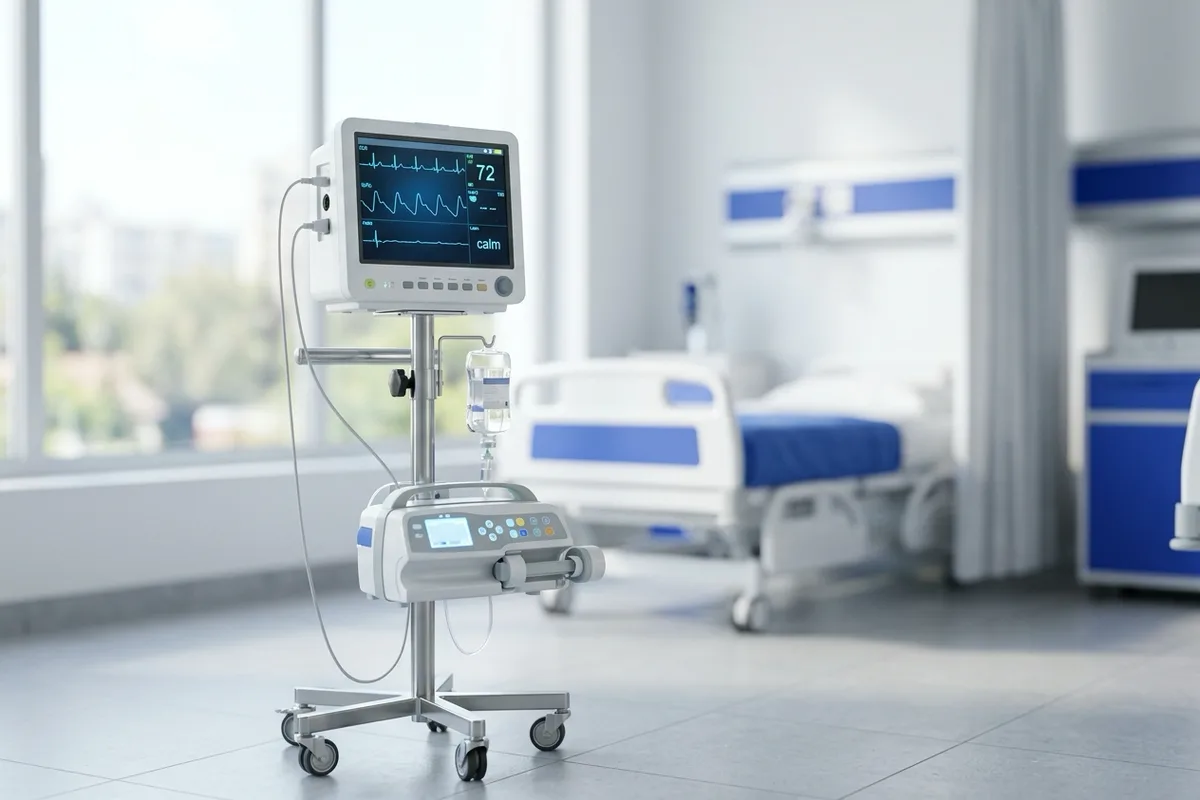
Patient monitoring devices measure a patient's physiological signals — heart rate, blood pressure, oxygen saturation, respiration, and temperature — and display or transmit them so clinicians can act. In hospitals they range from bedside and multi-parameter monitors to central telemetry stations; increasingly they also take the form of remote patient monitoring devices (RPM) — connected blood pressure cuffs, pulse oximeters, ECG patches, and scales that send readings from a patient's home. The wider hospital and patient-care category on this page also covers infusion and syringe pumps, ventilators and anesthesia delivery, hospital beds and patient-handling equipment, patient-warming systems, and wound care dressings.
Two distinctions matter before you file. General wellness and fitness wearables that make no medical claim usually fall outside device regulation, while the same sensor marketed to monitor a diagnosed condition is a regulated device. And where a product streams data to software that interprets it, the hardware and the analysis algorithm are regulated on separate tracks — the algorithm as software in its own right. Every jurisdiction then draws its own risk lines, which is why classification in each target market is the first deliverable of any serious program. Every cost below has two parts: the government fee, and our own flat annual service fee per market, from US$1,000 per year in the US (device listing and US Agent representation) and from US$2,000 per year in most other markets. Current figures live in our pricing calculator.
FDA patient monitoring and hospital equipment regulation (United States)
FDA regulates monitors, pumps, and most hospital equipment through its risk-based framework, and the great majority clear through the 510(k) pathway against an existing predicate. Two things set this category apart: heavy post-market expectations, and a handful of device types — infusion pumps above all — that FDA watches especially closely.
- Classification. Patient monitors, infusion pumps, and ventilators are generally Class II and clear through a 510(k); hospital beds, basic patient-handling equipment, and many wound dressings are Class I or lower-risk Class II, and many hospital beds and basic patient-handling devices are 510(k)-exempt — for those, US market entry is establishment registration and device listing only. Novel device types without a predicate go the De Novo route.
- Timeline. A 510(k) typically runs 3 to 9 months end to end including preparation and FDA interaction; a De Novo for a genuinely new device plans for 9 to 15 months. A Pre-Submission meeting adds a few weeks up front and routinely saves review cycles later, especially for infusion and connected devices.
- Cost. Government fees: US$28,653 for a standard 510(k) review (US$7,163 for qualified small businesses) plus US$13,785 per year in establishment registration. Our flat US$1,000 per year covers FDA establishment registration and device listing maintenance plus US Agent representation; 510(k) preparation and submission are scoped as a separate project.
Remote patient monitoring devices (RPM): FDA classification and clearance
Remote patient monitoring devices are the fastest-growing corner of this category, and the phrase "FDA-approved RPM device" is used loosely. Most RPM hardware — connected blood pressure cuffs, pulse oximeters, weight scales, and single-lead ECG patches — is Class II cleared through a 510(k), with a few lower-risk items in Class I; "cleared," not "approved," is the correct word for these. The measurement algorithm that turns raw signals into a clinical reading can itself be regulated as software, so an RPM product is often two submissions in one. Intended use and clinical claims, not the sensor alone, decide the pathway.
Infusion pumps: heightened FDA scrutiny
Infusion pumps carry a long recall history, so FDA regulates them under a Total Product Life Cycle approach with dedicated 510(k) guidance. Expect deeper design, software (IEC 62304), and human-factors evidence than a typical Class II device, and sometimes simulated-use or clinical data. Alternate controller enabled (ACE) pumps and connected "smart" pumps add interoperability and cybersecurity requirements. Budget a more evidence-heavy submission and a longer preparation phase.
Start from our United States market page for the full FDA pathway.
EU MDR classification and CE marking for patient care devices
Under the Medical Device Regulation (EU 2017/745), active monitoring and therapeutic devices are classified by rule, and a notified body sits in the middle of your timeline for anything above Class I.
- Classification. Most active patient monitors are Class IIa, rising to IIb where readings drive decisions about vital physiological parameters (Rule 10). Active devices that administer or remove medicines or fluids default to Class IIa under Rule 12, rising to IIb where delivery is potentially hazardous — which is why infusion pumps and ventilators sit in Class IIb; closed-loop systems such as sensor-driven infusion pumps are Class III under Rule 22. Wound dressings span Class I to IIb depending on their claims, and basic hospital furniture is often Class I.
- Timeline. Plan 9 to 18 months with a notified body for a first Class IIa or IIb certification, driven by notified body capacity and the maturity of your technical documentation and clinical evaluation.
- Cost. There is no central government fee; the money goes to the notified body — typically €30,000 to €70,000 across a first Class IIa certification cycle, higher for IIb and III, plus annual surveillance — and to building MDR-grade documentation. Our EU Authorized Representative service is a flat annual fee from US$2,000, capped at US$4,000 as your portfolio grows, and covers EC REP representation, document review, and EUDAMED support; CE-marking work with your notified body is scoped separately.
Notified body strategy should shape your EU plan early; see the European Union market page for the MDR route.
Patient care equipment registration in Brazil and Latin America (ANVISA RDC 751)
Brazil anchors any Latin American strategy. ANVISA classifies medical devices by risk under RDC 751/2022 and registers them through the notificação or registro routes; Mexico's COFEPRIS is the region's second gate. Both require a local representative — we act as Brazil Registration Holder without taking control of your registration.
- Classification. RDC 751 follows the IMDRF-style four-class model. Lower-risk Class I-II equipment — many monitors, beds, and basic accessories — qualifies for the streamlined notificação; Class III-IV devices such as infusion pumps and ventilators require full registro with deeper technical evidence.
- Timeline. Notification is typically a matter of weeks; Class III-IV registration plans for 6 to 12 months. In Mexico, COFEPRIS runs 6 to 12 months on the standard route, faster where reliance on an FDA or CE approval applies.
- Cost. ANVISA government fees: R$1,406 to notify a Class I-II product; Class III-IV family registration runs R$8,510-19,856, plus a one-time international B-GMP certification of R$72,805 where required. COFEPRIS charges MX$16,499-30,798 per product by class. Our registration service starts at US$2,000 per year, US$3,000 for high-risk classes, in both markets.
Start with the Brazil market page; labeling, instructions for use, and submissions are prepared natively in Portuguese and Spanish.
Patient care equipment registration in Asia-Pacific: Singapore first, then ASEAN
Most overseas manufacturers enter Asia-Pacific through Singapore: HSA works in English, follows the IMDRF model, and rewards a strong FDA or CE dossier with a fast abridged review. A Singapore approval then anchors expansion across ASEAN — Malaysia, Thailand, Indonesia, Vietnam, the Philippines — where reliance-friendly frameworks make each additional market incremental rather than a new program. Japan and Korea are the region's big mature prizes with their own systems and languages. China is the largest market but the hardest entry — local type testing and the longest timelines — so treat it as its own program when the business case justifies it, not as a default stop.
- Classification. Singapore's HSA uses risk classes A through D, and ASEAN members track the same IMDRF-style model. Japan classifies against JMDN codes through PMDA; Korea's MFDS uses Classes I-IV; China's NMPA places most active monitoring and therapeutic equipment in Class II or III.
- Timeline. HSA abridged evaluation with a reference approval typically closes in 2 to 8 months depending on class (HSA's published targets run 100-220 working days from Class B to Class D); ASEAN registrations typically run 3 to 9 months per market on the back of the same dossier. Japan plans for 9 to 14 months via PMDA (certification routes for lower classes are faster); Korea 6 to 12 months including KGMP; China 12 to 24 months including type testing.
- Cost. Singapore's government fees are light: a SGD 560 application plus SGD 2,010-6,250 evaluation by class. ASEAN peers are similar (Malaysia MYR 500 plus MYR 750-3,000; Thailand THB 3,100-21,000, with expert review THB 53,000 where required). Japan's PMDA review fees start around ¥1 million; China's NMPA fees for imported Class II-III run roughly RMB 210,000-310,000 before type testing. Our registration service starts at US$2,000 per year across Singapore and ASEAN.
One well-built reference dossier does most of the region's work — sequencing is the strategy. See the Singapore, Malaysia, Thailand, Japan, South Korea, and China market pages.
Patient care equipment registration in Saudi Arabia and MENA (SFDA)
The Gulf is one of the fastest-growing regions in our portfolio, and its regulators are built around reliance: a strong FDA, CE, or other reference approval does most of the work if the dossier is assembled correctly. SFDA regulates medical devices across the risk range and requires a local Authorized Representative.
- Classification. SFDA classifies devices into risk classes A through D on the IMDRF model, mirroring your reference-market class in most cases; the UAE's MOHAP and other MENA authorities lean on the reference approval's classification.
- Timeline. With a reference approval in hand, SFDA marketing authorization (MDMA) typically closes in 2 to 6 months; UAE registration runs a similar range. Without a reference approval, expect materially longer.
- Cost. Government fees across the Gulf are modest — generally a few thousand US dollars' equivalent per authority — so the real spend is dossier assembly, Arabic labeling where required, and local representation. We quote MENA programs flat per market, on the same transparent model as our calculator markets.
See the Saudi Arabia and UAE market pages; we cover the wider region under one program.
Evidence, quality system, and lifecycle
Hospital and patient-care equipment lives or dies on post-market performance, and every market weighs it heavily. We set up ISO 13485 and FDA QMSR processes, and build the safety and performance evidence these devices require: electrical safety and electromagnetic compatibility to the IEC 60601 series (including alarm standards such as IEC 60601-1-8 and the infusion-pump standard IEC 60601-2-24, and the home healthcare environment collateral IEC 60601-1-11 for RPM devices used outside the hospital), embedded-software validation to IEC 62304, usability engineering to IEC 62366, and biocompatibility for anything contacting the patient. Connected monitors, smart pumps, and RPM devices also need cybersecurity documentation that satisfies FDA, EU MDR, and IEC 81001-5-1. After launch, this category's real workload begins: complaint handling, adverse-event and vigilance reporting, field safety corrective actions, and the periodic safety updates that keep every registration current.
One program, every major market
A global patient-care program is a sequencing problem: pick the anchor market, build the dossier once, and reuse classification analyses, safety and performance evidence, and QMS artifacts everywhere else. We run the full program from a single team — strategy, submissions, in-country representation, and the heavy post-market maintenance these devices demand — with transparent government fees and timelines in our pricing calculator.
 Regulatory Update · Sep 9, 2026TGA Saline Flush Classification and CDSS ExemptionRegulatory Update · Sep 5, 2026Vietnam Inspection Roadmap (TT 24/2026)Regulatory Update · Oct 29, 2025EU Commission Implementing Decision (EU) 2025/2078 on Harmonised StandardsBlog · Oct 14, 2026FDA Cleared vs Approved vs GrantedBlog · Oct 14, 2026FDA Medical Device Classification GuideBlog · Aug 31, 2026Technical File Compilation Cost: Build, Buy, or Hybrid?Blog · Aug 24, 2026Medical Device Registration Verification 2026Case Study · Aug 5, 2026INVIMA Registration Under a Neutral HolderCase Study · Aug 5, 2026Vietnam IVD Registration for an Oncology AssayRegulatory Update · Oct 17, 2026FDA Toxicology 510(k) Exemptions
How we help hospital and patient-care device teams
One team runs your program end to end, from the first classification memo to post-market vigilance in every registered market.

Classification for monitors, infusion pumps, ventilators, beds, and wound care in every target market
510(k), De Novo, EU MDR technical documentation, and ANVISA registration dossiers
US Agent, EU Authorized Representative, and Brazil Registration Holder
Post-market surveillance, complaint handling, and vigilance reporting across markets

Frequently asked questions
Patient monitoring devices measure and display a patient's physiological signals — heart rate, blood pressure, oxygen saturation, respiration, and temperature — continuously or at intervals so clinicians can act on the readings. In hospitals these are bedside and multi-parameter monitors feeding central telemetry stations; at home they take the form of remote patient monitoring (RPM) devices such as connected blood pressure cuffs, pulse oximeters, ECG patches, and scales. Most are regulated medical devices, typically Class II in the US, because clinical decisions depend on their output.
Typical examples: vital-signs and multi-parameter bedside monitors, pulse oximeters, capnographs, ECG and telemetry systems, fetal monitors, and RPM wearables. The wider hospital and patient-care category also includes infusion and syringe pumps, ventilators and anesthesia delivery, hospital beds and patient-handling equipment, patient-warming systems, and wound care dressings. General wellness and fitness wearables that make no medical claim usually fall outside device regulation.
In the US, patient monitors, infusion pumps, and ventilators are generally Class II and clear through a 510(k); hospital beds and basic patient-handling equipment are often Class I. Under EU MDR most active monitors are Class IIa, rising to IIb where readings drive decisions about vital physiological parameters, and active devices that administer or remove medicines — infusion pumps — are Class IIb. Exact class depends on intended use and the claims you make.
Typical planning ranges: 3 to 9 months for an FDA 510(k) including preparation, 9 to 18 months for EU MDR with a notified body, 6 to 12 months for ANVISA depending on class, and 2 to 8 months in Singapore or the Gulf when a reference approval supports an abridged route. Sequencing and dossier reuse compress the total program, and our pricing calculator gives per-market estimates.
Directly, rarely: most regulators require their own submission. Practically, yes: markets such as Singapore, Saudi Arabia, and the UAE run reliance or abridged routes that lean on a strong FDA or CE approval, and a well-built US technical file supplies most of the documentation everywhere else. We sequence registrations so each approval shortens the next one.
In most major markets, yes, if you have no local entity: a US Agent, an EU Authorized Representative, a UK Responsible Person, and a Brazil Registration Holder, among others. Who holds your registration matters commercially, and we provide representation that keeps every registration under your control.
"FDA-approved" is used loosely here; for most RPM hardware the correct term is "FDA-cleared." Connected blood pressure cuffs, pulse oximeters, weight scales, and single-lead ECG patches are generally Class II devices cleared through a 510(k), with a few lower-risk items in Class I. The algorithm that interprets the raw signals can itself be regulated as software, so an RPM product is often two regulatory tracks in one. Intended use, clinical claims, and reimbursement — not the sensor alone — shape the strategy.
Infusion pumps carry a long history of recalls and use-related errors, so FDA regulates them under a Total Product Life Cycle approach with dedicated 510(k) guidance that asks for extensive design, software, and human-factors evidence, and sometimes simulated-use or clinical data. Alternate controller enabled (ACE) pumps and connected "smart" pumps add interoperability and cybersecurity expectations. Plan for a more evidence-heavy submission than a typical Class II device.
It depends on the change. In the US, FDA expects a documented change assessment: minor changes are handled as a letter to file, while changes that could significantly affect safety or effectiveness — a new alarm algorithm, connectivity module, or patient population — need a new 510(k). Under EU MDR, substantial changes must be reviewed by your notified body before implementation, and connected-device software updates are a frequent trigger. License-holder markets such as Brazil and much of ASEAN require amendment filings, and some changes trigger re-registration. We run one change assessment across every market you sell in, so a single engineering change does not turn into a dozen uncoordinated filings.
Single Process,
Multiple Markets
When you partner with Pure Global, a single registration process opens doors to multiple countries. Our global subsidiaries make this streamlined path possible.











Let's Talk,
Anywhere You Are.
Whether looking for more information or ready to partner with us, we're here to guide you through every step of the regulatory process.
Contact us