A Sports-Medicine Fixation Line Into Colombia, With the Registration in Neutral Hands
One distributor offered to own the INVIMA registration and several others wanted the line. How we placed a mixed-class fixation portfolio under an independent holder, with competing importers authorized beneath it.
This anonymized case study is built around a real Pure Global registration outcome. Client identity is withheld, and project details have been generalized or reconstructed to illustrate realistic regulatory challenges and solutions. It is not a literal account of one client's private history. Regulatory and pricing information is dated and sourced separately.
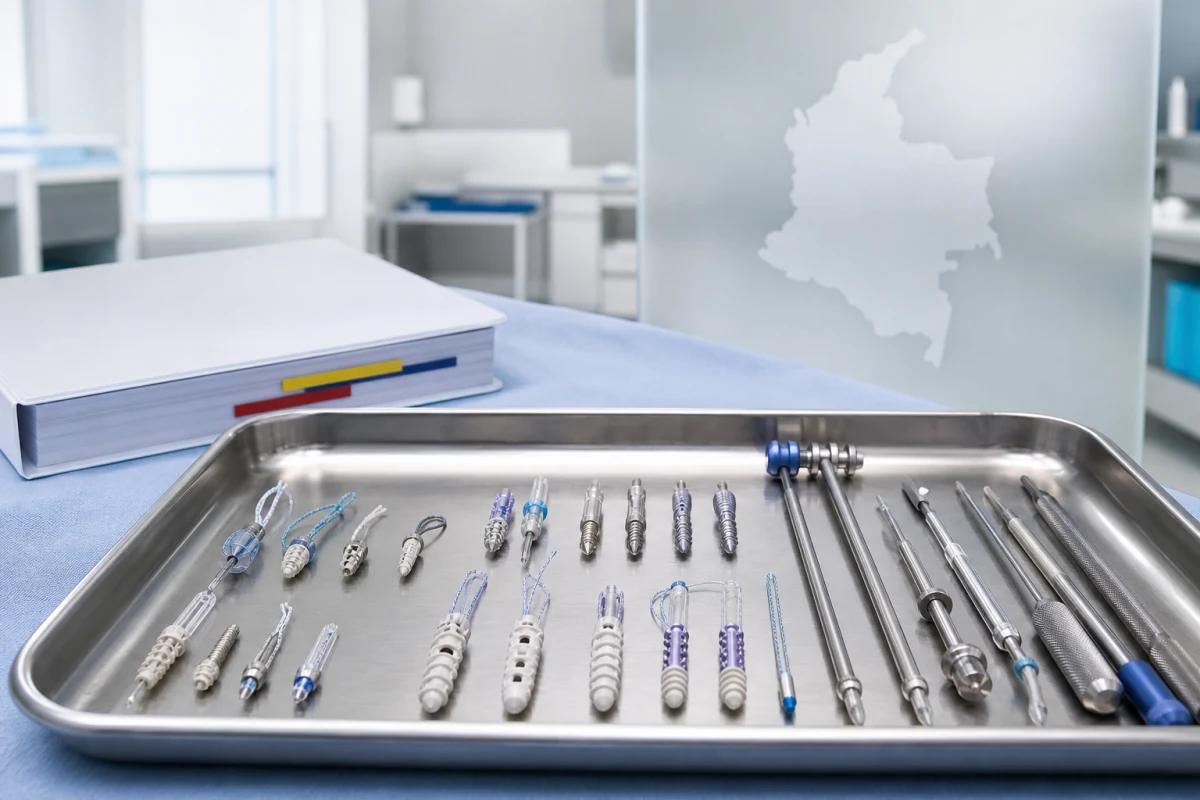
A manufacturer of soft-tissue fixation devices for sports medicine came to us with what it believed was a paperwork question. Its line — suture anchors in metal, PEEK and all-suture constructions, interference screws, ligament fixation hardware, and the sterile arthroscopic blades and burrs the procedures consume — was selling elsewhere, and Colombian distributors were competing to carry it. The largest of them had made a helpful offer: it would obtain the INVIMA registration itself, at its own cost, and begin importing. All the manufacturer had to do was sign the authorization letter.
The offer that would have settled the market on day one
A Colombian registro sanitario is issued in the name of a titular — a holder. Whoever that is owns the authorization, not merely the paperwork behind it. INVIMA's published requirements for transferring one are short and decisive: the only party empowered to assign a registro is its current holder, and the assignment must be signed by both assignor and assignee, identifying the registration and file being transferred.
Read from the manufacturer's side, that means changing distributors later requires the outgoing distributor's signature on a document it has no commercial reason to sign. If it declines, the alternative is filing the line again under a new holder. A replacement importer cannot rely on that new authorization until it is granted, so continuity remains in the incumbent holder's hands — a poor place for the manufacturer to leave a channel decision.
The risk here was sharper still: several distributors wanted this line, so naming one as holder would not have been a decision revisitable at contract renewal. It would have given whoever moved first control of the authorization for as long as that holder declined to transfer it, a dependency created by Decree 4725/2005 rather than by the supply agreement.
A holder with nothing to sell
The manufacturer's second instinct was to incorporate a Colombian subsidiary and hold the registrations itself. That is a legitimate structure, but it was disproportionate to where the company stood. A Colombian subsidiary used only as the titular does not automatically have to be the importer or operate a warehouse. But it does bring permanent corporate, tax and compliance work; and if it also imports or stores the products, those activities add CCAA and establishment obligations. The manufacturer did not need to build that local machinery merely to keep control of the registrations.
We proposed the third structure. Our Colombian entity would take the holder position as an independent titular with no commercial interest in the line, and the distributors would appear where they belong: as named, licensed importers underneath the registrations. Pure Global maintains the Colombian dossier and lifecycle as holder, the manufacturer retains control of its market-access strategy, and the channel keeps the customers; no distributor can hold the authorization hostage. That is the model our in-country representation service exists to run.
One catalogue, two statutory lanes
With the structure settled, the line stopped being one thing. Colombia classifies under rules that follow European MDD logic rather than the US scheme — the mapping we set out on our INVIMA classification page. Applied to this catalogue, the split was clean and consequential. The implants, surgically invasive and intended to remain in the body beyond thirty days, fell in Class IIb. The arthroscopic blades and burrs, surgically invasive but transient, fell in Class IIa.
Colombia attaches a different procedure to each side of that line. Class IIa devices take the automatic route, where authorization issues on a complete application and INVIMA's published term is two business days from filing. Class IIb devices take controlled review, where the technical and legal file is examined before anything is granted and INVIMA's published decision term runs to ninety business days. The evidence expectation differs accordingly: a Class IIb file is read for test reports, risk documentation and clinical support before grant, while a Class IIa file is authorized first and verified afterwards.
The manufacturer had budgeted one submission and one calendar; it now had two of each. And on the automatic route nobody tells you the file is thin until after you are authorized, so the discipline controlled review imposes by deadline has to be imposed voluntarily on the fast lane.
Where the sales bundle disagreed with the grouping rule
The commercial catalogue was organized the way surgeons buy: an anchor "system" spanning materials and sizes, a ligament construct with its fixation hardware, a disposables kit. Decree 4725 groups differently. Devices may shelter under a single registration when they share risk classification, intended use and generic denomination and belong to the same holder and manufacturers — a rule about regulatory identity, not about how a product is sold.
Mapping the catalogue onto that rule before any dossier was written changed what got filed. The families resolved by class and generic denomination rather than by sales bundle, and one tempting shortcut was refused: folding the Class IIa instruments into an implant registration would have dragged a two-business-day product into ninety-day controlled review and welded its future changes and renewals to the implant's.
The document chain that sets the filing date
Nothing in this dossier was as reliably underestimated as the certificates that had to travel. Decree 4725 requires certification from the competent authority of the country of origin that the product is authorized there, with a reference-market certificate where the product is not sold at origin. INVIMA's guidance on the Certificate of Free Sale sets out what the document must carry: product name, manufacturer name, the free-sale declaration, issuance by a competent authority, and — for signatories of the Hague Convention — an apostille, or consularization and legalization otherwise, plus an official translation. Validity is one year unless the document states another term.
Three properties of that chain cost manufacturers time, and all three applied here. The apostille attaches to the source document, not to the translation, so a sworn Spanish translation of a certificate whose original was never apostilled is not a legalized document. The one-year validity gives the chain a shelf life, which means the document calendar is built backwards from the intended filing date rather than forwards from project kickoff. And where more than one legal manufacturing entity of the same group stands behind different products in a line — the situation here — the certificate has to name the manufacturer the dossier names. INVIMA's rule is explicit: affiliates and subsidiaries need a parent-company document evidencing common group membership plus a free-sale certificate in the responsible manufacturer's name, while contract sites absent from the certificate need a manufacturing agreement or a declaration from that manufacturer.
We also checked, per document, whether the paper chain was needed at all: INVIMA's legal office confirmed in 2025 that foreign public documents such as free-sale and good-manufacturing certificates may in defined cases be validated by directing INVIMA to the issuing authority's official electronic source rather than a physical apostilled copy. It is a per-document question rather than a general exemption, and worth asking before a courier is booked.
Approvals start clocks
The registrations issued across both lanes, held by our Colombian entity. That is the point at which a program usually relaxes, and the point at which Colombia starts counting.
Under Decree 4725, the holder of each registration has thirty-six months to commercialize that product, counted from the administrative act that granted it, and failure to do so triggers automatic cancellation, although the decree allows one justified extension if the holder requests it within the prescribed month after the deadline. The clock is per registration, not per line: a portfolio granted in a wave is a wave of independent clocks, and the slow-moving reference at the end of a catalogue is exactly the one nobody is watching. We track those dates from the holder's seat, and the launch conversation is built around which registrations have to move rather than around the line as a whole.
The two-lane structure helped in a way worth naming for anyone planning a similar entry: the automatic-route instruments let us qualify an importer, prove the Spanish supplemental labeling and exercise the warehouse routine while the Class IIb files were still in controlled review, so the first implant shipment was not also the first shipment of any kind.
Several importers, and no gatekeeper
With registrations in neutral hands, the channel became a governance problem rather than a structural one — the trade the manufacturer was buying. Qualifying importers took real work. Each needs its own CCAA, and a certificate already held covers a new device line only where the company notifies INVIMA in writing with the list of devices it intends to import; the certificate runs five years, so its renewal is the importer's duty and the holder's tracking problem. Each importer's Chamber of Commerce certificate also has to show a corporate purpose covering medical device importation — which is where an otherwise capable commercial partner is most often found wanting.
Adding, replacing or amending an importer is a filing, not a courtesy notice: a modification to the registration with its own fee, and INVIMA has confirmed that even a change to an importer's registered address is a formal legal modification rather than an annex to the file. Since 2017 these modifications are granted automatically and verified afterwards, which sounds permissive and is not: where the supporting documentation does not hold up on later review the registration can be suspended, and a suspension left unresolved for three months after notification leads to cancellation. Automatic means approved first and examined later, so the evidence index is built as though it will be read.
One operational consequence surprises manufacturers who think of channel changes as purely commercial events: Colombia's supplemental Spanish label carries the importer's name, as our labeling guidance sets out. Every change to the importer roster is also an artwork change and a stock question, and the sequencing of the two is planned rather than discovered.
What the holder's seat keeps doing
Registration was not the end of the program; it moved the work from the project team to the holder.
Device registrations run ten years from the granting act, and a renewal must be filed at least three months before expiry — later than that and it is processed as a new application, a different dossier on a different calendar. Post-approval changes divide sharply: importers, addresses and commercial details are modifications, while a change touching design, the chemical composition of a material, the energy source or the manufacturing process cannot be a modification at all and requires a new registration — worth knowing before a product revision is scheduled, not after it has shipped.
Two duties sit specifically on the holder. Colombia's unique device identification regime obliges the registration holder to obtain the UDI-DI from a recognized issuing agency and file the semantic report into INVIMA's platform; the final deferred phase, covering Class I and Class IIa records, passed in February 2026, so every class is now in scope. And technovigilance runs on a fixed cadence: serious adverse events reported within seventy-two hours of occurrence, non-serious events consolidated quarterly. With several importers under one holder, that intake has to be a single funnel with one owner — the arrangement that buys commercial flexibility is also the one that most easily loses a report between parties. Our Colombia post-market page carries the detail.
If your line is heading for Colombia
The lesson here is not that distributors are adversaries. It is that the holder position is a structural decision with a long half-life, made once and cheaply at the start — or expensively, later, under someone else's signature. Settle the holder before filing. Classify against Colombian rules rather than carrying a home-market class across. Draw the grouping map before the first dossier, and keep the fast lane out of the slow one. Build the legalization calendar backwards from the filing date. And treat renewals, commercialization clocks, UDI reporting and vigilance as one program owned by one party, because that is how INVIMA sees them.
If the registration question for your Colombian line is still open, talk to our team before you sign the authorization letter.
 Blog · Jul 20, 2026Orthopedic Implants: The 2026 Global Market-Access MapBlog · Aug 31, 2026Technical File Compilation Cost: Build, Buy, or Hybrid?Blog · Aug 24, 2026Medical Device Registration Verification 2026Blog · Aug 17, 2026Coronary Stents: Eight Highest-Tier FilesCase Study · Aug 5, 2026Vietnam IVD Registration for an Oncology AssayCase Study · Jul 22, 2026One Endoscopy Platform, Six ANVISA NotificationsRegulatory Update · Sep 17, 2026FDA Buffy Coat System GuidanceRegulatory Update · Sep 17, 2026HSA GN-15 R14 Registration RequirementsRegulatory Update · Sep 14, 2026Taiwan TFDA Filing and Label ApprovalRegulatory Update · Aug 30, 2026India G.S.R. 743(E) Sterilisation Labels
Bring your device line to Colombia
From Decree 4725 classification to the legalized document chain, we act as your independent INVIMA holder with your own importers named beneath it.

Independent registration holder, so the registro never sits in a distributor's name
Classification and grouping under Decree 4725, across the automatic and controlled routes
Legalized document chain: free-sale certificates, apostille and official translation
Importer authorizations, renewals, UDI semantic reporting and technovigilance

Frequently asked questions
Rarely, and never by default. A registro sanitario is issued in the name of a titular, and INVIMA's requirements for transferring one are unambiguous: only the current holder may assign it, and the assignment must be signed by both the assignor and the assignee. If your distributor is the holder, changing channels later depends on its signature — and if it withholds it, the alternative is registering the line again from the beginning. Where the registro sits is a structural choice: the manufacturer acting through Colombian legal representation, a distributor, or an independent local holder. A manufacturer-controlled structure and an independent holder can both separate market access from the distributor relationship; the independent model avoids creating a local subsidiary solely for that purpose.
Yes. A registration can name several authorized importers, which is what makes an independent holder commercially useful: coverage can expand or change without the registration moving. Each importer must qualify in its own right — a valid CCAA for storage and conditioning, and a Chamber of Commerce certificate whose corporate purpose covers importing and commercializing medical devices. Adding, replacing or amending an importer is a modification filing with its own fee, not a courtesy notice; INVIMA has confirmed that even an importer's change of address is a formal legal modification. Remember that Colombia's supplemental Spanish label names the importer, so every roster change is also a labeling change.
The certificate must name the product and the manufacturer, declare free sale, and be issued by a competent authority in the country of origin — or, where the product is not sold at origin, in an accepted reference market. It must be apostilled where the issuing country is a party to the Hague Convention, or consularized and legalized otherwise, and accompanied by an official translation. Its validity is one year unless the document states another term. Two details cause most rework: the apostille attaches to the source document rather than to the translation, and where several legal manufacturing entities of one group are involved, the certificate has to name the manufacturer the dossier names.
No, and mixed-class lines have to be planned as two projects. Under Decree 4725, Class I and IIa devices take the automatic route: authorization issues on a complete application, with INVIMA publishing a term of two business days from filing, and the file verified afterwards. Class IIb and III devices take controlled review, where INVIMA examines the technical and legal file before granting anything and publishes a decision term of ninety business days. A Class IIb dossier is read for test reports, risk documentation and clinical support before grant. Grouping a Class IIa instrument under a Class IIb implant registration pulls it into the slower route permanently.
Single Process,
Multiple Markets
When you partner with Pure Global, a single registration process opens doors to multiple countries. Our global subsidiaries make this streamlined path possible.











Let's Talk,
Anywhere You Are.
Whether looking for more information or ready to partner with us, we're here to guide you through every step of the regulatory process.
Contact us