Dental Devices: Global Regulation, Classification & Registration
From classification and biocompatibility testing to submission and post-market maintenance, we take dental implants, clear aligners, and restorative products through every major regulatory system.
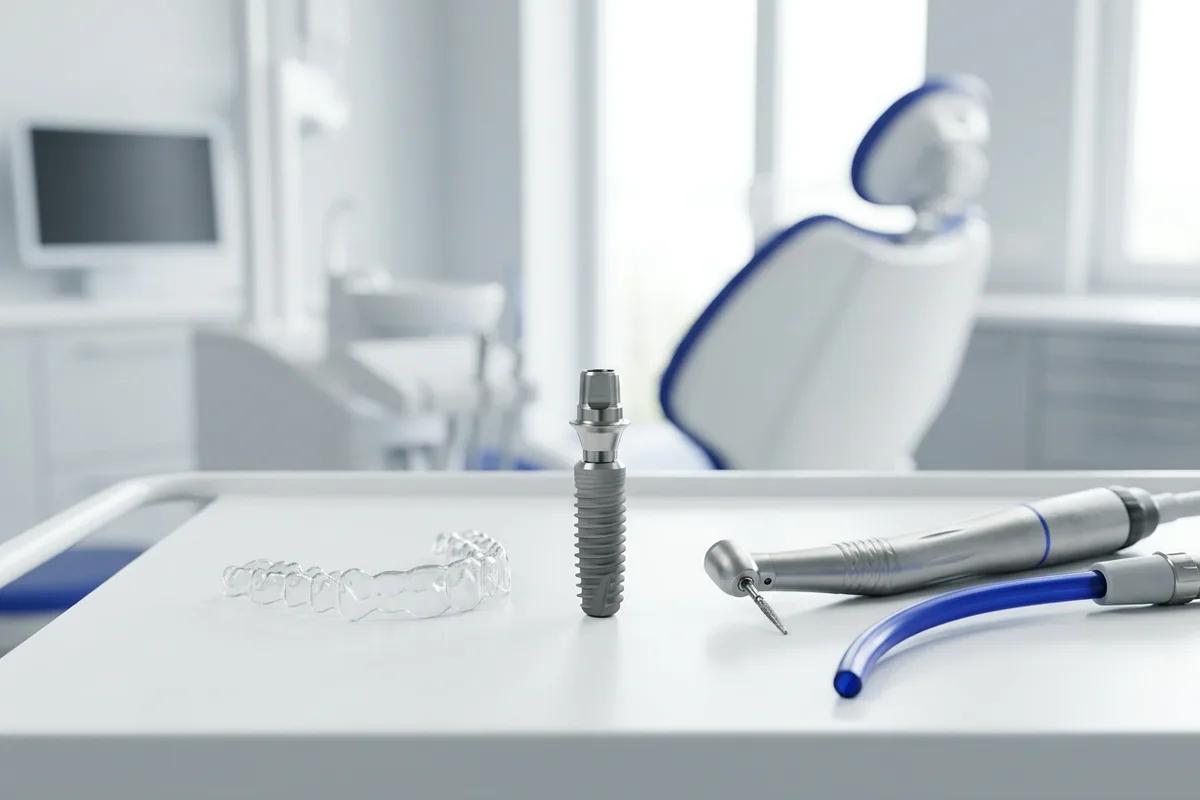
For every regulator below we answer the three questions dental device teams ask first: what class is my product, how long will registration take, and what will it cost. Per-market fees and timelines live in our pricing calculator.
What are dental devices?
Dental devices are the instruments, implants, restorative materials, and equipment used to diagnose, prevent, or treat conditions of the teeth, gums, and jaw. The category is broad: endosseous implants and abutments, clear aligners and other orthodontic appliances, crowns and bridges, filling and impression materials, bone graft substitutes, dental handpieces and lasers, intraoral scanners and dental X-ray units, and oral appliances for sleep apnea and snoring. Regulators treat almost all of these as medical devices, classified by the risk they carry rather than by where they sit in a dental practice.
A few products sit at the edges. Purely cosmetic items with no medical purpose can fall outside device regulation in some markets, while standalone diagnostic software that reads a scan is regulated as software as a medical device rather than as dental hardware. The point for a manufacturer is that every jurisdiction draws its own line: an endosseous dental implant is a Class II device in the United States but Class IIb under EU MDR, and a clear aligner system can be a mass-produced Class II device in one market while a genuinely one-off, lab-made appliance can qualify as a custom-made device on a separate route in another. A structured classification analysis across your target markets is the first deliverable of any serious dental program. Every cost below has two parts: the government fee, and our own flat annual service fee per market, from US$1,000 per year in the US (device listing and US Agent representation) and from US$2,000 per year in most other markets. Exact current figures live in our pricing calculator.
FDA dental device regulation (United States)
FDA regulates dental devices under 21 CFR Part 872, the dedicated dental device regulation, using the same risk-based framework as the rest of CDRH. Most of the category is Class II and clears through a 510(k) against an existing predicate.
- Classification. Endosseous dental implants and their abutments, clear aligners, crowns and bridges, and most restorative and impression materials are Class II and follow the 510(k) route; dental handpieces are Class I (21 CFR 872.4200) but, unusually for Class I, still require a 510(k). Genuinely low-risk items such as some manual instruments sit in Class I, many of them exempt from premarket submission. A qualification and classification memo settles which route applies before you build the file.
- Timeline. A 510(k) typically runs 3 to 9 months end to end including preparation and FDA interaction. A Pre-Submission meeting adds a few weeks up front and often saves review cycles later, especially for a new material or a novel implant surface.
- Cost. Government fees (FY2027): US$28,653 for a standard 510(k) review (US$7,163 for qualified small businesses) plus US$13,785 per year in establishment registration. Our flat US$1,000 per year covers FDA establishment registration and device listing maintenance plus US Agent representation; 510(k) preparation and submission are scoped as a separate project.
Clear aligners and direct-to-consumer orthodontics
Clear aligners are among the most-searched dental products, and they are regulated as Class II devices cleared through a 510(k). The regulatory question that sets them apart is supervision: FDA has cautioned consumers about direct-to-consumer aligners used without an in-person exam and ongoing clinician oversight, and marketing claims are scrutinized accordingly. If your model ships aligners to patients directly, the intended-use statement, clinical support, and complaint handling need to be built for that model from the start, not retrofitted after launch.
Oral appliances for dental sleep apnea and snoring
Mandibular advancement devices and other oral appliances that treat obstructive sleep apnea or reduce snoring are Class II devices with their own product classifications, and the anti-snoring versions are among the highest-intent dental searches. Intended use is what separates a regulated sleep apnea appliance from an over-the-counter anti-snoring aid, and it drives the evidence you have to bring, so define the claim precisely before you choose a pathway.
Start from our United States market page for the full FDA pathway.
EU MDR dental device classification and CE marking
Under the EU Medical Device Regulation (2017/745), dental devices are classified by rules that push most of the category above Class I, which means a notified body sits in your timeline. The dental sector felt the MDR transition sharply because so many long-standing products moved up a class.
- Classification. Endosseous dental implants are typically Class IIb as surgically invasive implantable devices, most restorative and filling materials are Class IIa, and orthodontic aligners generally fall in Class IIa, with custom-made appliances following the separate custom-device route, but note the MDR Article 2(3) carve-out: aligners mass-produced by industrial manufacturing processes (at-scale CAD/CAM), even when made against a clinician's prescription, are not custom-made devices — MDCG 2021-3 treats them as patient-matched devices that must follow the standard CE-marking route, notified body included. The Annex XIII custom route is reserved for genuinely one-off appliances made to a written prescription containing patient-specific design characteristics. Class I dental products still exist but are now the exception. Note that dental amalgam is being phased out entirely in the EU — its use has been banned since 1 January 2025 and its manufacture and import from 1 July 2026 under the amended Mercury Regulation — so mercury-based restoratives are off the table regardless of device class.
- Timeline. Plan 9 to 18 months with a notified body for a first certification, driven by notified body capacity and the maturity of your technical documentation and clinical evaluation. Implantable classes sit at the longer end.
- Cost. There is no central government fee; the money goes to the notified body — typically €30,000 to €70,000 across the first certification cycle, more for implantable Class IIb and III devices — plus annual surveillance and the cost of building MDR-grade documentation. Our EU Authorized Representative service is a flat annual fee from US$2,000, capped at US$4,000 as your portfolio grows, and covers EC REP representation, document review, and EUDAMED support; CE-marking work with your notified body is scoped separately.
Notified body strategy should shape your EU plan early; see the European Union market page for the MDR route.
Dental device registration in Brazil and Latin America (ANVISA RDC 751)
Brazil anchors any Latin American dental strategy. ANVISA classifies devices under RDC 751 on the IMDRF risk model and splits the pathway between a streamlined notification for lower-risk products and a full registration for higher-risk ones; Mexico's COFEPRIS is the region's second gate. Both require a local representative — we act as Brazil Registration Holder without taking control of your registration.
- Classification. Lower-risk dental materials and instruments (Class I-II) generally qualify for the streamlined notificação route, while implantable devices such as endosseous dental implants fall into the higher classes and require full registro with deeper technical and clinical evidence.
- Timeline. Notification is typically a matter of weeks; higher-class registration plans for 6 to 12 months. In Mexico, COFEPRIS runs 6 to 12 months on the standard route, faster where reliance on an FDA or CE approval applies.
- Cost. ANVISA government fees: R$1,406 to notify a Class I-II product; Class III-IV family registration runs R$8,510 to R$19,856, plus a one-time international B-GMP certification of R$72,805 where required for implant manufacturing. COFEPRIS charges MX$16,499 to MX$30,798 per product by class. Our registration service starts at US$2,000 per year (US$3,000 for high-risk classes) in both markets.
Start with the Brazil market page; labeling, instructions for use, and submissions are prepared natively in Portuguese and Spanish.
Dental device registration in Asia-Pacific: Singapore first, then ASEAN
Most overseas dental manufacturers enter Asia-Pacific through Singapore: HSA works in English, follows the IMDRF model, and rewards a strong FDA or CE dossier with a fast abridged review. A Singapore approval then anchors expansion across ASEAN — Malaysia, Thailand, Indonesia, Vietnam, the Philippines — where reliance-friendly frameworks make each additional market incremental rather than a new program. Japan and Korea are the region's big mature prizes with their own systems and languages. China is the largest market but the hardest entry — local type testing and the longest timelines — so treat it as its own program when the business case justifies it, not as a default stop.
- Classification. Singapore's HSA uses risk classes A through D; implants and higher-risk dental devices land in Class C or D, while many materials and instruments sit in A or B. ASEAN members track the same IMDRF-style model, Japan classifies against JMDN codes, and Korea's MFDS uses Classes I-IV.
- Timeline. HSA abridged evaluation with a reference approval closes in 2 to 6 months; ASEAN registrations typically run 3 to 9 months per market on the back of the same dossier. Japan plans for 9 to 14 months via PMDA, Korea 6 to 12 months including KGMP, and China 12 to 24 months including type testing.
- Cost. Singapore's government fees are light: an SGD 560 application plus SGD 2,010 to 6,250 in evaluation by class, and ASEAN peers are similar (Malaysia MYR 500-3,750; Thailand THB 3,100-74,000). Japan's PMDA review fees start around ¥1 million; China's NMPA fees for imported Class II-III run roughly RMB 210,000-310,000 before type testing. Our registration service starts at US$2,000 per year across Singapore and ASEAN.
One well-built reference dossier does most of the region's work — sequencing is the strategy. See the Singapore, Malaysia, Thailand, Japan, South Korea, and China market pages.
Dental device registration in Saudi Arabia and MENA (SFDA)
The Gulf is one of the fastest-growing dental markets in our portfolio, and its regulators are built around reliance: a strong FDA, CE, or other reference approval does most of the work if the dossier is assembled correctly. SFDA regulates dental devices on the IMDRF model and requires a local Authorized Representative.
- Classification. SFDA classifies dental devices into risk classes A through D, mirroring your reference-market class in most cases; implants sit in the higher classes. The UAE's MOHAP and other MENA authorities lean on the reference approval's classification.
- Timeline. With a reference approval in hand, SFDA marketing authorization (MDMA) typically closes in 2 to 6 months, and UAE registration runs a similar range. Without a reference approval, expect materially longer.
- Cost. Government fees across the Gulf are modest — generally a few thousand US dollars' equivalent per authority — so the real spend is dossier assembly, Arabic labeling where required, and local representation. We quote MENA dental programs flat per market, on the same transparent model as our calculator markets.
See the Saudi Arabia and UAE market pages; we run the wider region under one program.
Evidence, quality system, and lifecycle
Dental devices live in the mouth, often in contact with soft tissue, bone, and saliva for years, so biocompatibility is the evidence spine of the category. We plan ISO 10993 and ISO 7405 biological evaluation, materials characterization, and — for implants — mechanical and fatigue testing and sterilization validation, then reuse that evidence across FDA, EU MDR, and Asia-Pacific submissions. Clinical evidence is scoped to the product: a novel implant surface or a new material carries a heavier burden than a well-established restorative. Around all of it we set up ISO 13485 and FDA QMSR processes sized for your release cadence, and after launch we run change assessments, complaint handling, and vigilance so every registration stays current.
One program, every major market
A global dental program is a sequencing problem: pick the anchor market, build the dossier once, and reuse classification analyses, biocompatibility evidence, and QMS artifacts everywhere else. We run the full program from a single team — strategy, submissions, in-country representation, and post-market maintenance — with transparent government fees and timelines in our pricing calculator.
 Case Study · Aug 5, 2026EU Authorized Representative for Surgical RobotsBlog · Oct 14, 2026FDA Cleared vs Approved vs GrantedBlog · Oct 14, 2026FDA Medical Device Classification GuideBlog · Aug 31, 2026Technical File Compilation Cost: Build, Buy, or Hybrid?Blog · Aug 24, 2026Medical Device Registration Verification 2026Case Study · Aug 11, 2026Class III Dermal Fillers Under the EU MDRRegulatory Update · Oct 17, 2026FDA Toxicology 510(k) ExemptionsRegulatory Update · Oct 17, 2026MHRA DORS Annual FeesRegulatory Update · Oct 17, 2026TFDA Clinical Trial E-SubmissionsRegulatory Update · Oct 17, 2026TGA Digital Scribes
How we help dental device teams
One team runs your dental device program end to end, from the first classification memo to post-market maintenance in every registered market.

Classification for implants, aligners, restorative materials, and equipment in every target market
510(k), De Novo, MDR technical documentation, and ANVISA registration dossiers
US Agent, EU Authorized Representative, and Brazil Registration Holder
ISO 10993 biocompatibility and ISO 13485 quality evidence sized for dental release cycles

Frequently asked questions
Dental devices are the implants, instruments, restorative materials, and equipment used to diagnose, prevent, or treat conditions of the teeth, gums, and jaw. The category includes endosseous dental implants and abutments, clear aligners and orthodontic appliances, crowns and bridges, filling and impression materials, bone graft substitutes, dental handpieces and lasers, intraoral scanners and dental X-ray units, and oral appliances for sleep apnea. Regulators treat almost all of these as medical devices classified by risk.
Yes. Endosseous dental implants, abutments, and clear aligners are all regulated medical devices, not consumer products, and they need clearance or registration in each market before sale. In the United States both implants and aligners are Class II devices cleared through a 510(k); in the EU, implants are typically Class IIb and aligners generally Class IIa under MDR. Purely cosmetic products with no medical purpose can fall outside device rules in some markets, which is why classification comes first.
In the United States, endosseous dental implants, clear aligners, and most restorative materials are Class II and follow the 510(k) route; some low-risk manual instruments are Class I. Under EU MDR, dental implants are typically Class IIb, restorative materials Class IIa, and aligners generally Class IIa. The same implant can therefore carry different classes across markets, so we run a classification analysis for every jurisdiction on your list before building submissions.
Typical ranges: 3 to 9 months for an FDA 510(k) including preparation, 9 to 18 months for EU MDR with a notified body, 6 to 12 months for ANVISA depending on class, 2 to 6 months for Singapore's HSA on an abridged route, and 12 to 24 months for China's NMPA with local testing. Sequencing and dossier reuse compress the total program, and our pricing calculator gives per-market estimates.
Directly, rarely: most regulators require their own submission. Practically, yes: markets such as Singapore, Saudi Arabia, and the UAE run reliance or abridged routes that lean on a reference approval, and a well-built FDA or CE dossier supplies most of the technical file everywhere else. We sequence registrations so each approval shortens the next one.
In most major markets, yes, if you have no local entity: a US Agent, an EU Authorized Representative, a Brazil Registration Holder, and an SFDA Authorized Representative in Saudi Arabia, among others. Who holds your registration matters commercially, and we provide representation that keeps every registration under your control.
The device classification is the same — clear aligners are Class II — but the direct-to-consumer model draws extra regulatory attention. FDA has cautioned consumers about at-home aligners used without an in-person exam and ongoing clinician oversight, so intended-use claims, clinical support, and complaint handling have to be designed for that model from the start. The registration route does not change; the evidence and labeling around supervision does.
Mandibular advancement devices and other oral appliances that treat obstructive sleep apnea are Class II devices in the United States with their own product classifications, and CE marking under EU MDR follows the same risk logic. Intended use is decisive: a device that treats diagnosed sleep apnea carries a heavier evidence burden than a simple anti-snoring aid, so the claim you make determines the pathway and the data you need.
It depends on the change. In the US, FDA expects a documented change assessment: minor changes are handled as a letter to file, while changes that could significantly affect safety or effectiveness — a new alloy, ceramic formulation, or indication — need a new 510(k). Under EU MDR, substantial changes to a CE-marked device must be reviewed by your notified body before implementation. License-holder markets such as Brazil and much of ASEAN require amendment filings, and some changes trigger re-registration. We run one change assessment across every market you sell in, so a single engineering change does not turn into a dozen uncoordinated filings.
Single Process,
Multiple Markets
When you partner with Pure Global, a single registration process opens doors to multiple countries. Our global subsidiaries make this streamlined path possible.











Let's Talk,
Anywhere You Are.
Whether looking for more information or ready to partner with us, we're here to guide you through every step of the regulatory process.
Contact us