Onboarding an EU Authorized Representative for a Surgical Robot and Its Class I Catalog
A certified Class IIa robot platform and five self-declared Class I groups reached the EU market under one Article 11 mandate. What the representative had to verify, register and relabel before the first shipment.
This anonymized case study is built around a real Pure Global registration outcome. Client identity is withheld, and project details have been generalized or reconstructed to illustrate realistic regulatory challenges and solutions. It is not a literal account of one client's private history. Regulatory and pricing information is dated and sourced separately.
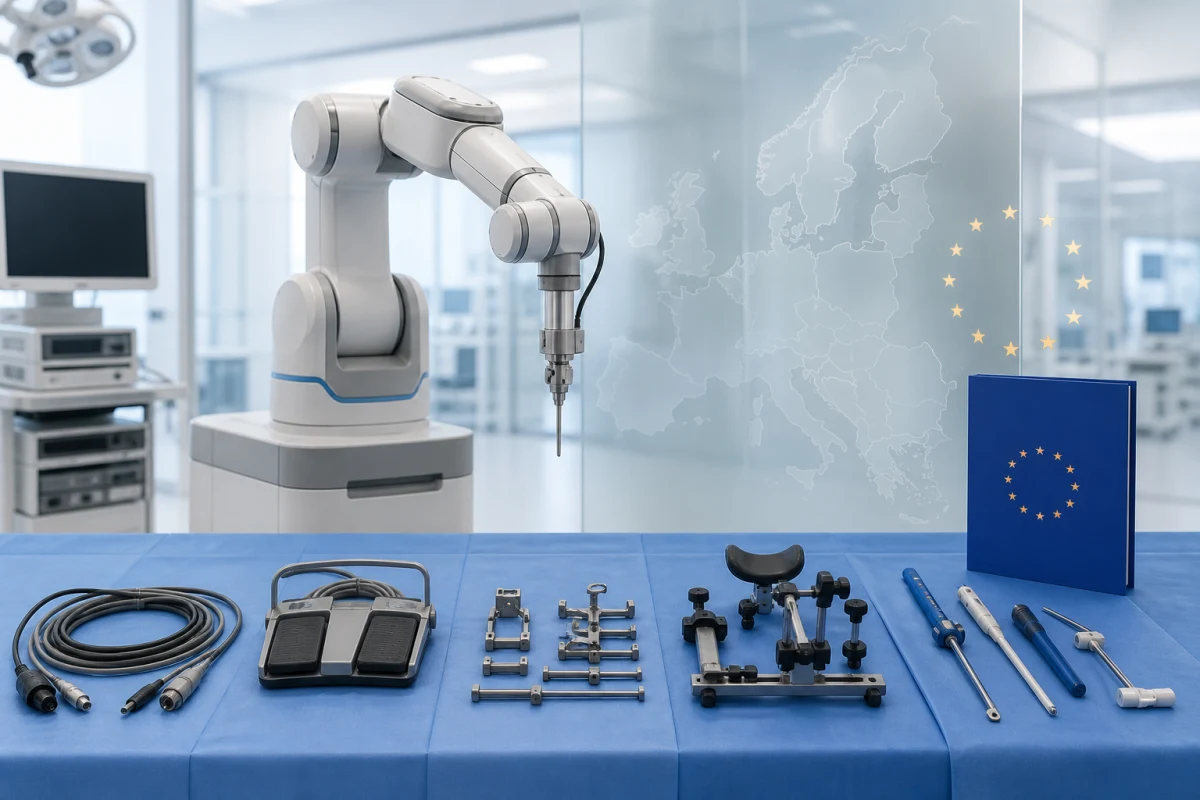
A manufacturer of surgical robotic systems outside the European Union had cleared the milestone it had spent years building toward: its flagship platform held a Notified Body certificate at Class IIa. The commercial plan that followed looked simple: appoint a representative, name a distributor, ship. The regulatory plan behind that sentence was the whole project.
The company was a capable engineering organization whose small regulatory function had spent its recent history on one thing: getting the platform through conformity assessment. The rest of the catalog — five families of instruments and accessories that mount on or are consumed by the robot, self-declared at Class I — was treated as the part that would take care of itself. That assumption is where most of the work turned out to be.
The representative was not the last box on the plan
The manufacturer's first proposal was to let its lead EU distributor act as the authorized representative — free, immediate, and attached to a distribution agreement the company wanted anyway. It also proposed to put only the flagship under the mandate and bring the Class I groups in later, once revenue justified the effort.
Article 11 closes the second half of that plan. A manufacturer not established in a Member State may place devices on the Union market only if it designates a sole authorized representative, under a mandate accepted in writing and effective at least for all devices of the same generic device group. The Class I groups are not exempt because nobody certifies them. Splitting the catalog into a represented half and an unrepresented half was not a phasing decision; it was a decision not to sell half the catalog.
The structural objection mattered more. Tying the mandate to the distributor puts the regulatory relationship inside a commercial one, and when the commercial relationship changes — as it usually does in a first EU market — Article 12 turns that change into a program of its own: a changeover agreement covering dates, document transfer and complaint forwarding, plus every label carrying the old address. Article 11(7) adds a quieter consequence — for a manufacturer outside the EU, the competent authority is the one in the representative's Member State. Choosing a representative chooses the regulator. We were appointed as an independent EU Authorized Representative for the whole catalog, deliberately kept outside the distribution agreement.
What we had to verify before we could accept the mandate
Manufacturers expect the mandate to be paperwork. It is the first substantive examination the catalog gets from outside.
Article 11(3)(a) requires the representative to verify that the EU declaration of conformity and the technical documentation have been drawn up and that an appropriate conformity assessment procedure has been carried out; MDCG 2022-16 expects that verification to be documented in inspectable records. The duty is an existence-and-appropriateness check, not a technical re-review of the file — but Article 11(5) makes the representative jointly and severally liable for defective devices alongside a manufacturer that has not met its Article 10 obligations. Treating verification as a formality means accepting that liability blind, so our review happens before signature.
It found the catalog's first real defect. The manufacturer held a single declaration of conformity: one document listing the platform and all five instrument groups. Annex IV requires a declaration to carry the Basic UDI-DI of the device it covers, that device's risk class, and, where a Notified Body was involved, identification of the certificate issued. Six device groups meant six Basic UDI-DIs, and two conformity routes meant a certificate reference valid for one of them and a class statement wrong for the other five. We rebuilt it as a declaration per device group — the shape the registration records would later demand.
The instruments were not inside the robot's certificate
Behind that declaration sat a more consequential assumption: that the instrument groups took their regulatory status from the platform. They do not. The classification rules apply separately to each device, and accessories are classified in their own right, separately from the device they are used with. A Notified Body certificate covers the devices in its scope and nothing else.
Every group therefore had to be classified on its own evidence, and tested against the Class I carve-outs before self-declaration could be assumed. Article 52(7) pulls a Notified Body back in for Class I devices placed on the market in sterile condition, for devices with a measuring function, and for reusable surgical instruments — limited, in each case, to those aspects. A group supplied sterile would have needed the sterility aspects certified before any declaration could be signed. The reusable-instrument carve-out turned on a definition rather than on practice: the regulation defines a reusable surgical instrument as one intended for cutting, drilling, sawing, clamping, retracting or similar procedures without a connection to an active device, and instruments driven by an active robotic platform fall outside it.
The groups landed where the plan had assumed — five self-declared Class I groups beside the certified Class IIa platform — but the conclusion came from the classification rules, not from the flagship's paperwork. Inherited classification is a claim nobody can defend later.
Five self-declared groups with no file of their own
Self-declaration means no Notified Body is involved. It does not mean less documentation; it means nobody external is scheduled to look at it.
Each group needed the objects the flagship already had: technical documentation to Annexes II and III, a general safety and performance requirements argument answered requirement by requirement, with a written rationale wherever one was marked not applicable, since an unexplained N/A reads as an unexamined gap; a post-market surveillance plan; and a signed declaration. What existed instead was evidence held inside the flagship's technical file, written from the platform's point of view, describing the instruments as parts of a system rather than as devices with intended purposes of their own. Extracting five documentation sets from one began with five intended-purpose statements that could stand alone, because everything downstream resolves from that sentence: classification, declaration, registration record, label.
The catalog also acquired two lifecycle rhythms: a periodic safety update report under Article 86 for the Class IIa platform, and a post-market surveillance report under Article 85 for the Class I groups. Easy to confuse, and easy to leave undone on the side no assessor is scheduled to visit.
Registration is a sequence, and the mandate is its first item
A manufacturer outside the EU cannot register itself in EUDAMED on its own. Its actor registration request identifies a representative that is already registered, carries the mandate dates and a summary of the mandate document, and comes to us to verify before reaching the competent authority of our Member State for validation; the Single Registration Number follows. Until the mandate existed no request could be filed, and everything else — device records, the importer's checks, the artwork — waited behind that number.
Device registration then ran across all six groups: a Basic UDI-DI for each, an EMDN code, the risk class, and for the platform the link to its Notified Body certificate. Each record has to agree with the declaration behind it — where one catalog-wide declaration would have failed a second time — and the legal name on the mandate, the certificate, the declarations and the labels all have to be one identity. Article 11(3)(c) makes the representative verify that the manufacturer has complied with its UDI and device registration obligations, so we check those records rather than receive them. The same sequence now runs against a fixed calendar: the first four EUDAMED modules have been mandatory since 28 May 2026, and devices still being placed on the market must be registered by 28 November 2026.
One line of address text, one catalog of artwork
Annex I requires the label to carry the authorized representative's name and registered place of business whenever the manufacturer's own is outside the Union, in the official language or languages of every Member State where the device is made available. One line of text, and a catalog-wide print project — with the instrument groups carrying the weight of it. A platform ships as a few large items with few labels; five instrument and accessory families ship as many individual references, each with its own carton or pouch label and its own instructions for use. Artwork had been budgeted for the flagship.
The sequence caught the distributor too. An importer must verify, before placing a device on the Union market, that a representative has been designated in accordance with Article 11 and that the device is labeled as the regulation requires. Stock printed without the representative's block is stock an importer cannot lawfully take: the first shipment was gated by artwork rather than by the certificate.
We used the relabeling round to build something the manufacturer did not have — a controlled register mapping every label and instructions-for-use version to its device group, its declaration and its revision. EN ISO 15223-1 gained a 2025 amendment introducing an EU REP symbol alongside EC REP, both usable through a transition running to 17 June 2031, so no symbol change was forced mid-program. A company that cannot say which label revision is on which shelf cannot plan that change either, and the register is what makes a future Article 12 changeover controlled rather than archaeological.
What the mandate looks like once it is running
The first question after signature was whether our regulatory lead could also serve as the manufacturer's own Person Responsible for Regulatory Compliance. The answer is no, and the reason is the design of the role. Article 15 requires the manufacturer to have a PRRC and the representative to have one permanently and continuously at its disposal; MDCG 2019-7 states that these cannot be the same person, and that for a micro or small enterprise the two must not come from the same external organization. A second pair of eyes only exists if it is a second pair.
Steady state is where a mandate is either real or decorative. Every change on the manufacturer's side becomes work on ours — a new instrument reference, a revised intended purpose, an updated certificate — moving through the declarations and into the registration records. We keep available a copy of the technical documentation, the declarations and the certificates for the statutory retention period — ten years after the last device covered by a declaration is placed on the market, fifteen for implantables — and we forward the complaints and incident reports that reach us.
Then there is the obligation nobody advertises: a representative that finds a manufacturer acting contrary to its obligations must terminate the mandate and immediately inform its competent authority and, where applicable, the notified body. A representative able to end the relationship is one whose verification meant something.
If your flagship carries a long accessory tail
The program finished where it was aimed: the Class IIa platform and the five self-declared Class I groups on the EU market under a single mandate, each with its own declaration, documentation set and registration record.
The transferable lessons are about sequence. Appoint the representative before planning around EUDAMED, because outside the EU the registration number waits on the mandate. Keep the mandate out of the distribution agreement, so a commercial change does not become a relabeling program. Classify accessories in their own right, and test the Class I carve-outs before assuming self-declaration. Give the self-declared end of the catalog the documentation nobody external is scheduled to ask for, and budget artwork with the instruments in view, not the flagship.
If you are planning an EU entry with a mixed catalog — one certified system and a tail of self-declared accessories — talk to our team about what the mandate would have to cover.
 Blog · Aug 10, 2026Surgical Robots: Eight Markets, Eight Regulatory FilesRegulatory Update · Sep 16, 2025Switzerland 2025 Update on Good Practices for Endoscope ReprocessingBlog · Sep 6, 2026One Device, Three UDI DatabasesBlog · Aug 24, 2026Medical Device Registration Verification 2026Blog · Aug 17, 2026Coronary Stents: Eight Highest-Tier FilesCase Study · Aug 11, 2026Basic UDI-DI Grouping for Contrast DevicesCase Study · Aug 11, 2026Class III Dermal Fillers Under the EU MDRRegulatory Update · Sep 14, 2026COMBINE: Combined-Study Safety ReportingRegulatory Update · Aug 26, 2026Czech FSC Moves to ISZPRegulatory Update · Aug 26, 2026EU AI Act Annex I Date 2028
Take your catalog into the EU
We act as EU Authorized Representative and run the work behind the mandate: verification, EUDAMED registration, labeling and ongoing Article 11 duties.

Pre-mandate verification of declarations, technical files and certificates
EUDAMED actor registration, SRN and a device record per group
AR labeling and IFU updates in every required Member State language
PRRC coverage, change control and ongoing Article 11 duties

Frequently asked questions
The sequence starts with the mandate. Your authorized representative must already be registered in EUDAMED; your actor registration request then identifies that representative, carries the mandate dates and a summary of the mandate document, and is routed to the representative to verify before the competent authority of the representative's Member State validates it. The Single Registration Number follows that validation. Nothing else can be filed first, which is why the appointment belongs at the head of an EU market-entry plan rather than alongside it.
The statutory duty under Article 11(3)(a) is to verify that the EU declaration of conformity and technical documentation have been drawn up and that an appropriate conformity assessment procedure was carried out — an existence-and-appropriateness check that MDCG 2022-16 expects to be documented in inspectable records, not a technical re-review of the file. Substantive review before signature is a service layer on top of it, and worth asking any prospective representative about directly, because Article 11(5) can make the representative jointly and severally liable where the manufacturer has not met its Article 10 obligations.
Yes. Accessories are classified in their own right, separately from the device they are used with, so they are not covered by the platform's certificate or by its documentation. Each group needs technical documentation to Annexes II and III, a general safety and performance requirements argument, a signed declaration of conformity, a Basic UDI-DI and its own EUDAMED device record. Before assuming self-declaration, check the Article 52(7) carve-outs: devices supplied sterile, devices with a measuring function and reusable surgical instruments still require a Notified Body for those aspects.
The label has to carry the representative's name and the address of its registered place of business whenever the manufacturer's registered place of business is outside the Union, in the official language or languages of every Member State where the device is made available. EN ISO 15223-1 gained a 2025 amendment introducing an EU REP symbol alongside EC REP, with both usable through a transition running to 17 June 2031. Treat it as an artwork and IFU program with a print run attached, and keep a version register: changing representative later re-runs the same work under an Article 12 changeover agreement.
Single Process,
Multiple Markets
When you partner with Pure Global, a single registration process opens doors to multiple countries. Our global subsidiaries make this streamlined path possible.











Let's Talk,
Anywhere You Are.
Whether looking for more information or ready to partner with us, we're here to guide you through every step of the regulatory process.
Contact us