ISO 10993-1:2025 Global Transition Guide: How to Build One Biological Evaluation Plan for Seven Regulatory Systems
ISO 10993-1 changed in 2025, but regulators did not change together. This practical guide maps seven regulatory systems and shows how to build one controlled biological-evaluation core with market-specific overlays.
The standard changed. Regulators did not change together. Here is the practical architecture for building one biological-safety evidence core that can travel without pretending every market is the same.
TL;DR
ISO published the sixth edition of ISO 10993-1 in November 2025. The new edition is reorganised around ISO 14971 risk management, gives more attention to exposure duration, material characterisation and biological-hazard identification, and follows the device across its lifecycle 1. That does not mean a declaration to ISO 10993-1:2025 now works identically everywhere.
- The United States has moved, but only in part. FDA recognised the 2025 edition on 25 May 2026, excluded two elements from recognition, warned about a possible genotoxicity conflict for prolonged-contact devices, and will continue accepting declarations to the 2018 edition until 1 July 2029 2.
- Other regulators are on different clocks. Health Canada currently recognises the 2018 edition 3. China's current GB/T 16886.1-2022 identically adopts ISO 10993-1:2018 4. Current MHRA guidance discusses the 2018 edition, while Great Britain's designated Part 1 is older still 56. Australia treats ISO 10993 as acknowledged state of the art rather than a mandatory route 7. Japan is actively communicating the sixth-edition changes 89.
- A biological evaluation is not a standard test package. It is a risk-management argument connecting device contact and exposure, constituent and process information, existing evidence, chemical characterisation, toxicological assessment, selected biological tests, and clinical and post-market knowledge. Each omitted endpoint needs a rationale just as each commissioned test needs a purpose.
- The reusable unit is one controlled core plus local overlays. Keep the device description, contact model, material/process inventory, evidence map, test reports and gap decisions in a single core dossier. Add an overlay that identifies each regulator's recognised edition, exclusions, guidance, submission format and open questions.
- Count evidence honestly. A text search of a 58,785-row FDA recall export found 112 product rows mentioning biocompatibility, cytotoxicity or biological-test issues. After campaign-level deduplication, that became 25 campaigns; one campaign generated 75 rows. Database rows are not independent failures.
The operational goal is therefore not “pass ISO 10993.” It is: maintain a defensible biological-safety conclusion for the final finished device, then show each regulator how the evidence supports its own requirements.
2026 is a split-version year
The takeaway first: ISO 10993-1:2025 is current internationally, but the regulatory status of Part 1 is jurisdiction-specific. “We comply with the latest edition” and “this regulator accepts our declaration” are different statements.
ISO describes the sixth edition as a complete reorganisation aligned with ISO 14971. It adds or clarifies exposure duration, device and material characterisation, biological-hazard identification and terminology, and it adds annex material explaining why the structure changed 1. This matters because a biological evaluation should now look less like a table copied from an annex and more like the biological portion of the device's risk-management file.
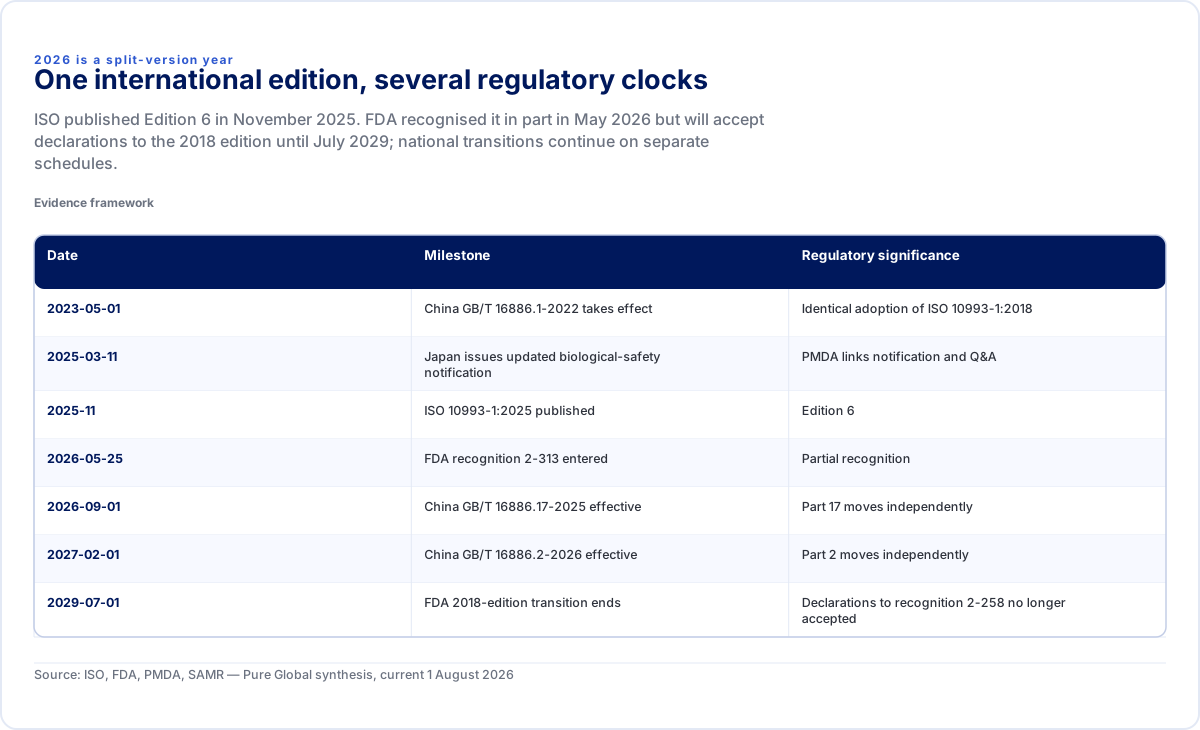
| Date | Milestone | Regulatory significance |
|---|---|---|
| 2023-05-01 | China GB/T 16886.1-2022 takes effect | Identical adoption of ISO 10993-1:2018 |
| 2025-03-11 | Japan issues updated biological-safety notification | PMDA links notification and Q&A |
| 2025-11 | ISO 10993-1:2025 published | Edition 6 |
| 2026-05-25 | FDA recognition 2-313 entered | Partial recognition |
| 2026-09-01 | China GB/T 16886.17-2025 effective | Part 17 moves independently |
| 2027-02-01 | China GB/T 16886.2-2026 effective | Part 2 moves independently |
| 2029-07-01 | FDA 2018-edition transition ends | Declarations to recognition 2-258 no longer accepted |
Source: ISO, FDA, PMDA, SAMR — Pure Global synthesis, current 1 August 2026
The first practical trap is assuming publication synchronises regulation. It does not. A standard can be:
- the latest edition sold by ISO;
- recognised by a regulator in whole or in part;
- designated or harmonised for a legal presumption of conformity;
- cited in a regulator's current guidance;
- adopted as a national standard; or
- useful state-of-the-art evidence without any formal recognition.
Those states are related, but not interchangeable.
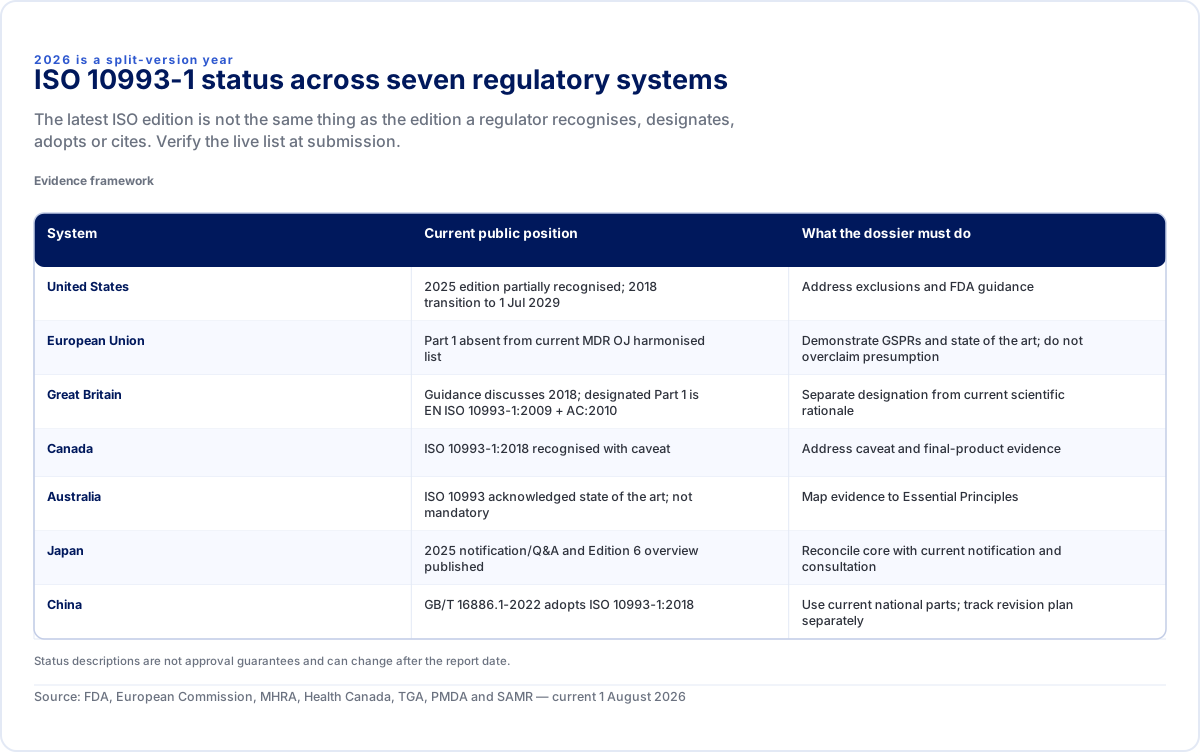
| System | Current public position | What the dossier must do |
|---|---|---|
| United States | 2025 edition partially recognised; 2018 transition to 1 Jul 2029 | Address exclusions and FDA guidance |
| European Union | Part 1 absent from current MDR OJ harmonised list | Demonstrate GSPRs and state of the art; do not overclaim presumption |
| Great Britain | Guidance discusses 2018; designated Part 1 is EN ISO 10993-1:2009 + AC:2010 | Separate designation from current scientific rationale |
| Canada | ISO 10993-1:2018 recognised with caveat | Address caveat and final-product evidence |
| Australia | ISO 10993 acknowledged state of the art; not mandatory | Map evidence to Essential Principles |
| Japan | 2025 notification/Q&A and Edition 6 overview published | Reconcile core with current notification and consultation |
| China | GB/T 16886.1-2022 adopts ISO 10993-1:2018 | Use current national parts; track revision plan separately |
Status descriptions are not approval guarantees and can change after the report date.
Source: FDA, European Commission, MHRA, Health Canada, TGA, PMDA and SAMR — current 1 August 2026
The United States illustrates the nuance. FDA recognition 2-313 covers ISO 10993-1:2025 only partially. It does not recognise the phrase “consumer products” in clause 6.5.11.3 or clause 6.9 on biological risk estimation. FDA says the latter conflicts with its recognised ISO 14971 framework. It also warns that the additional genotoxicity provisions in the sixth edition may not align with the endpoint table in FDA's 2023 guidance for every prolonged-contact device, and it encourages sponsors to contact the review office before beginning evaluation 2. At the same time, FDA built a long transition: declarations to the fifth edition, ISO 10993-1:2018, remain acceptable until 1 July 2029 2.
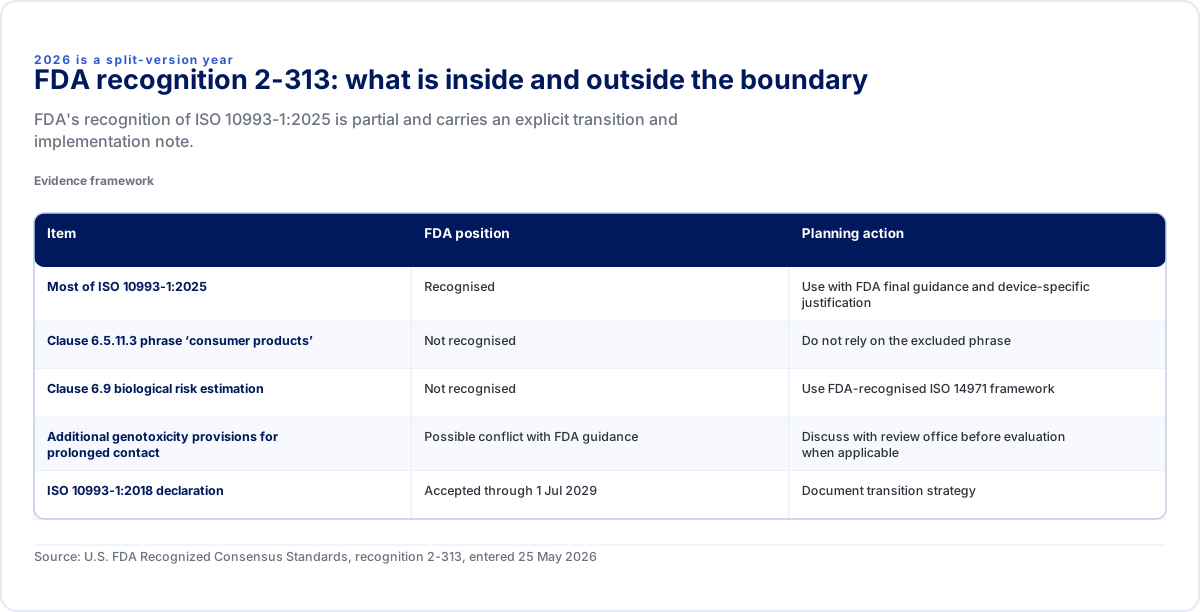
| Item | FDA position | Planning action |
|---|---|---|
| Most of ISO 10993-1:2025 | Recognised | Use with FDA final guidance and device-specific justification |
| Clause 6.5.11.3 phrase ‘consumer products’ | Not recognised | Do not rely on the excluded phrase |
| Clause 6.9 biological risk estimation | Not recognised | Use FDA-recognised ISO 14971 framework |
| Additional genotoxicity provisions for prolonged contact | Possible conflict with FDA guidance | Discuss with review office before evaluation when applicable |
| ISO 10993-1:2018 declaration | Accepted through 1 Jul 2029 | Document transition strategy |
Source: U.S. FDA Recognized Consensus Standards, recognition 2-313, entered 25 May 2026
Europe requires a different distinction. Under MDR Article 8, a presumption of conformity follows a harmonised standard only when its reference is published in the Official Journal 10. The current MDR harmonised list, including the 17 June 2026 update, contains several ISO 10993 parts but no Part 1 reference 11. That does not make ISO 10993-1:2025 unusable. It means a technical file should not claim a Part 1 Article 8 presumption that the list does not provide. The manufacturer still has to demonstrate the General Safety and Performance Requirements and explain how the chosen standard, methods and evidence represent the state of the art.
The correct question is therefore not, “Which ISO edition is globally required?” There is no useful global answer. Ask instead:
- What legal requirement must this submission satisfy?
- Which Part 1 edition or national adoption does the authority currently recognise, designate, cite or expect?
- Is recognition complete, partial or subject to a regulator-specific caveat?
- Does the dossier rely on a declaration of conformity, or does it use the standard as supporting state-of-the-art evidence?
- What changed between the edition used to generate evidence and the edition used to prepare the current submission?
Answer those five questions in a jurisdiction overlay. Do not bury them in a laboratory report.
A test matrix is not a biological evaluation
The takeaway first: testing is one possible evidence source inside the evaluation. The evaluation itself is the documented reasoning that identifies biological hazards, estimates and controls risks, and concludes whether residual biological risk is acceptable for the device's intended use.
The familiar failure pattern begins with a device-contact category and ends with a quote for a panel of tests. That sequence is attractive because it creates a purchase order. It is weak because it skips the decision that the regulator actually needs to audit: why those endpoints, why those test articles, why those extraction conditions, and why the resulting evidence supports the final finished device.
ISO 14971 supplies the governing logic: identify hazards, estimate and evaluate risks, implement controls, evaluate residual risk, and monitor production and post-production information through the device lifecycle 12. ISO 10993-1 applies that logic to biological safety. A Biological Evaluation Plan should therefore begin with the device, the patient and the exposure—not with the name of an assay.
FDA's current public guidance makes the boundary tangible. Its September 2023 final guidance covers PMA, HDE, IDE, 510(k) and De Novo submissions for devices with direct or indirect body contact. It explicitly addresses risk-based decisions about whether testing is needed, chemical assessment, and test-article issues for submicron or nanotechnology components, in-situ-polymerising materials, absorbable materials and certain intact-skin contacts 13. FDA's Biocompatibility Basics page asks reviewers to consider the whole final finished device, including sterilisation, manufacturing processes and residuals—not just a resin grade or supplier certificate 14.
The EU MDR makes the same point through documentation requirements. Annex II requires detailed information about biocompatibility, identification of all materials in direct or indirect contact, test design, complete protocols, analysis methods, summaries and conclusions. It also says that when no new testing is performed, the technical documentation must include the rationale for that decision 10. “No test” can be acceptable. “No decision record” is not.
This leads to a simple working definition:
Biological evaluation is the controlled argument that all reasonably foreseeable biological hazards have been identified and addressed for the final finished device over its intended exposure and lifecycle.
The argument may use supplier data, formulation and processing information, prior device history, literature, chemical characterisation, toxicological risk assessment, in-vitro or in-vivo test data, clinical evidence, complaints and post-market surveillance. The appropriate mix depends on the uncertainty left after each layer—not on a universal panel.
Freeze the exposure model before you buy testing
The takeaway first: a weak contact description contaminates every downstream decision. Freeze a component-level exposure model that captures who contacts what, through which route, how often, for how long and after which processing steps.
“Externally communicating, prolonged contact” is not enough to run a defensible evaluation. It can hide intermittent use, cumulative exposure, indirect fluid paths, accessories, degradation, repeated reprocessing and foreseeable misuse. The sixth edition's stronger treatment of exposure duration makes this more visible, but the operational need is older: the contact model is the input to endpoint selection, extraction design, toxicological dose and market comparison 1.
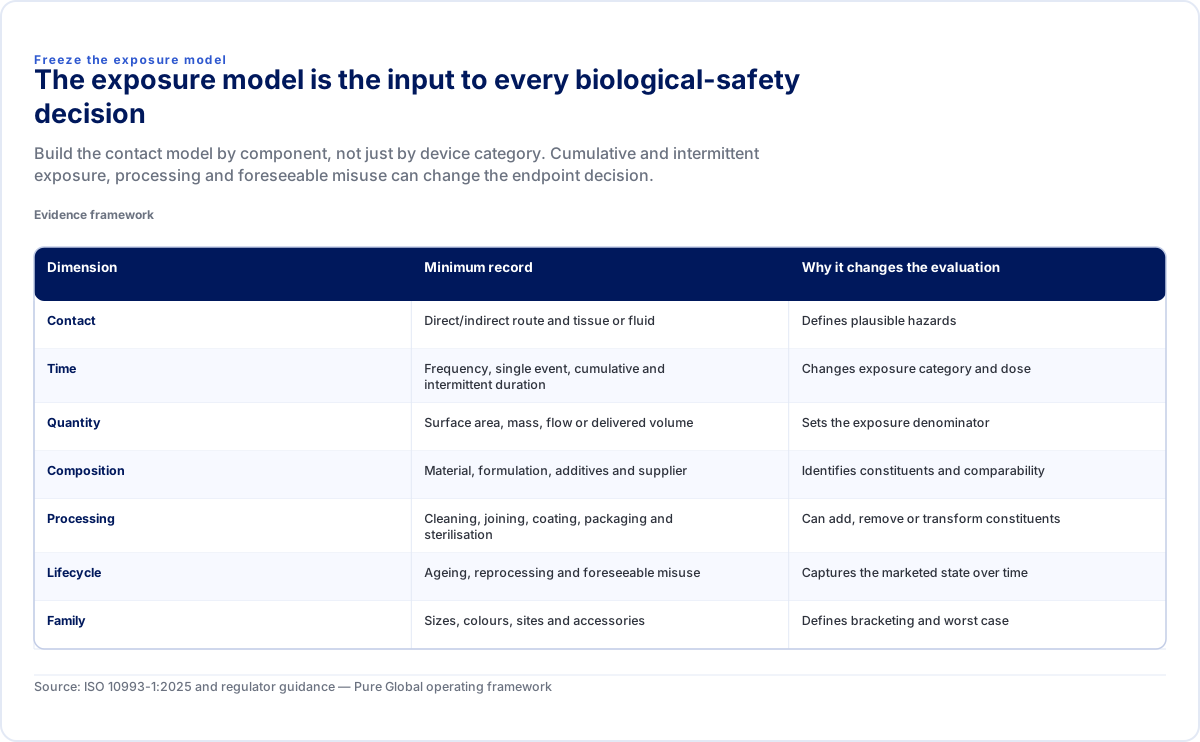
| Dimension | Minimum record | Why it changes the evaluation |
|---|---|---|
| Contact | Direct/indirect route and tissue or fluid | Defines plausible hazards |
| Time | Frequency, single event, cumulative and intermittent duration | Changes exposure category and dose |
| Quantity | Surface area, mass, flow or delivered volume | Sets the exposure denominator |
| Composition | Material, formulation, additives and supplier | Identifies constituents and comparability |
| Processing | Cleaning, joining, coating, packaging and sterilisation | Can add, remove or transform constituents |
| Lifecycle | Ageing, reprocessing and foreseeable misuse | Captures the marketed state over time |
| Family | Sizes, colours, sites and accessories | Defines bracketing and worst case |
Source: ISO 10993-1:2025 and regulator guidance — Pure Global operating framework
Build the exposure model at the component level. For each patient- or user-contacting component, capture:
- component name, drawing and bill-of-material identifier;
- material trade name and full formulation information available under confidentiality;
- supplier, site and relevant supplier-process controls;
- direct or indirect contact route;
- tissue, circulating fluid, gas path or breached/intact surface contacted;
- contact frequency, single-use duration and cumulative duration;
- intermittent-contact pattern and maximum reasonably foreseeable use;
- surface area, mass, flow rate or other exposure denominator;
- whether the component is implanted, absorbable, degradable, coated or drug-containing;
- cleaning, mould release, machining, joining, printing, curing, packaging and sterilisation steps;
- shelf-life state and any reprocessing cycles;
- variants, accessories and device-family relationships; and
- reasonably foreseeable misuse that changes biological exposure.
A separate row should address indirect contact. Fluid-path devices, breathing-gas pathways, delivery systems and instruments that transfer substances to the patient can create biological exposure without remaining in the body. Conversely, software-only or truly non-contact devices may need a short, explicit no-contact rationale instead of a test programme. FDA says that when a device has neither direct nor indirect tissue contact, the submission should state that fact and generally does not need further biocompatibility information 14.
The exposure model must match the labelled use and risk-management file. If the instructions for use allow repeated cycles, the biological evaluation cannot quietly use single-use exposure. If a family contains multiple materials, colours, sizes or manufacturing sites, the plan needs to explain which variation drives exposure and which test article brackets the others. If clinical practice creates repeated short contacts whose total becomes prolonged, write the cumulative pattern rather than selecting the more convenient single-event category.
Treat approval of the exposure model as a design-review gate. Regulatory, toxicology, materials, manufacturing, clinical and quality functions should sign the same version before laboratory work begins. That one control prevents many later arguments over whether the test programme evaluated the device that the company actually intends to sell.
Build an evidence ladder before you open a lab purchase order
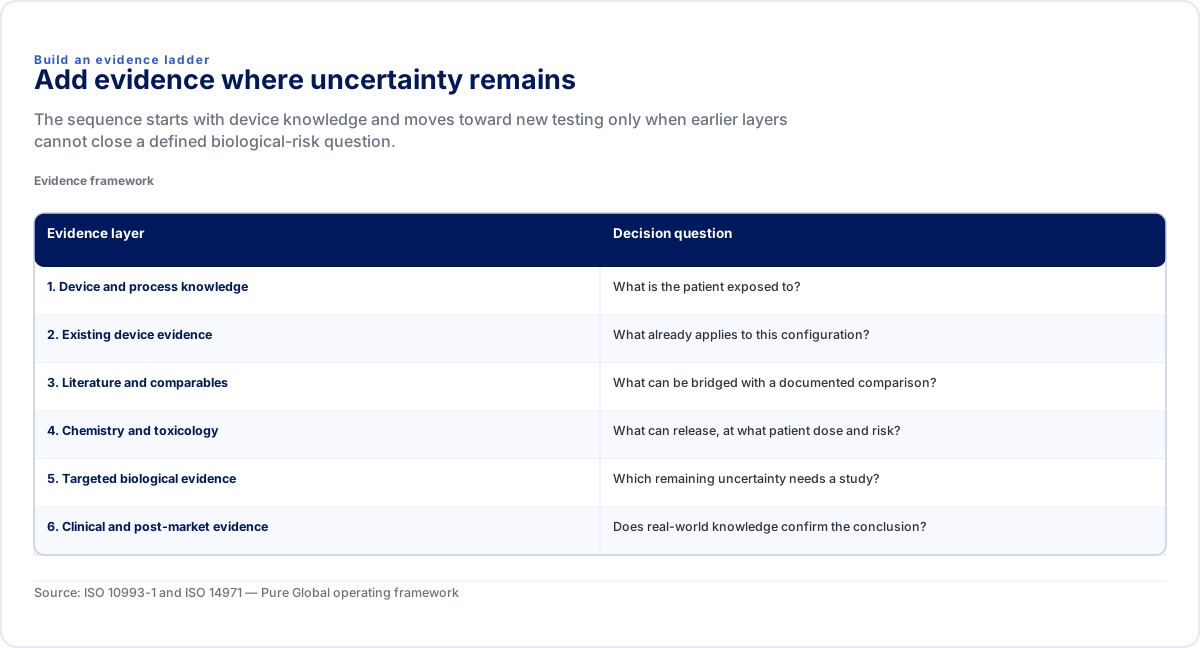
The takeaway first: start with what is known, then add evidence only where uncertainty remains. The order is device knowledge, existing safety evidence, chemical characterisation and toxicology, targeted biological testing, then clinical and post-market confirmation.
| Evidence layer | Decision question |
|---|---|
| 1. Device and process knowledge | What is the patient exposed to? |
| 2. Existing device evidence | What already applies to this configuration? |
| 3. Literature and comparables | What can be bridged with a documented comparison? |
| 4. Chemistry and toxicology | What can release, at what patient dose and risk? |
| 5. Targeted biological evidence | Which remaining uncertainty needs a study? |
| 6. Clinical and post-market evidence | Does real-world knowledge confirm the conclusion? |
Source: ISO 10993-1 and ISO 14971 — Pure Global operating framework
The evidence ladder is not a hierarchy in which chemistry always replaces biology. It is a sequence for reducing uncertainty efficiently.
1. Device and process knowledge
Start with the complete bill of materials, formulation where obtainable, surface treatments, colourants, adhesives, inks, lubricants, cleaning agents, processing aids, packaging contact, sterilisation and shelf-life state. Link every item to the component-level exposure model. Supplier safety data sheets can help identify ingredients, but they are not designed to establish medical-device biological safety. Health Canada says raw-material supplier claims and safety data sheets are insufficient by themselves and expects evidence for the final product after processing and sterilisation 15.
2. Existing device-specific evidence
Inventory previous test reports, chemical studies, toxicological assessments, complaints, clinical experience and post-market data. Record the exact device version, materials, process, site, sterilisation cycle, test article and contact model behind each item. “Same material” is not yet a bridge: a polymer processed at another temperature, with another pigment, cleaning agent, geometry or sterilisation dose may produce a different chemical profile.
3. Literature and comparable-device evidence
Use peer-reviewed literature and legally marketed comparable devices to inform known hazards and test selection. Document comparability rather than asserting it. The useful comparison dimensions are composition, manufacturing, sterilisation, physical form, surface, degradation, contact tissue and exposure—not simply product category.
4. Chemical characterisation and toxicological assessment
Characterise what can release from the final finished device under clinically relevant and exaggerated conditions, then assess identified constituents against patient exposure. ISO 10993-18 and ISO 10993-17 provide the main framework for chemical characterisation and toxicological risk assessment. The output should identify what risk is closed, what uncertainty remains and whether additional targeted testing is warranted.
5. Targeted biological evidence
Where documentary and chemical evidence cannot answer an endpoint, select a method capable of answering the defined question. Record method suitability, acceptance criteria, test-article representativeness, extraction rationale and deviations before the study starts. A passing test does not repair a test article that was not representative.
6. Clinical and post-market evidence
Clinical performance, adverse events, complaints, literature surveillance, recalls and production changes can confirm or challenge the premarket conclusion. ISO 14971 treats production and post-production information as part of lifecycle risk management 12. A Biological Evaluation Report should therefore have a review trigger, not an indefinite expiry date disconnected from change.
At every rung, write one of three conclusions: sufficient, insufficient—next evidence defined, or not applicable—rationale recorded. That converts evidence gathering into controlled decisions and makes the eventual report auditable.
Write the BEP as an executable decision record
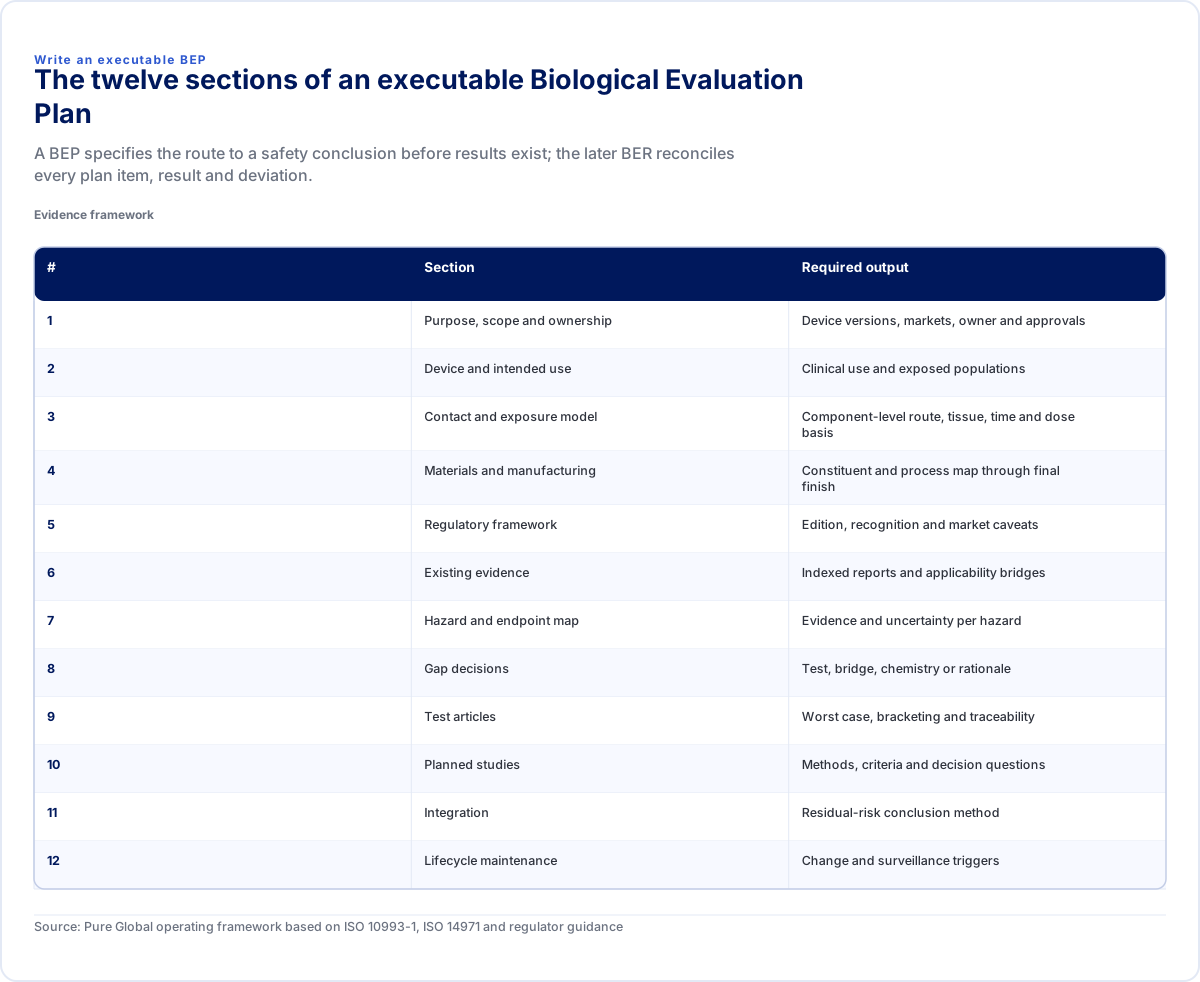
The takeaway first: the BEP should be detailed enough that a qualified laboratory, toxicologist and reviewer can understand exactly what question each activity is intended to answer before the result exists.
| # | Section | Required output |
|---|---|---|
| 1 | Purpose, scope and ownership | Device versions, markets, owner and approvals |
| 2 | Device and intended use | Clinical use and exposed populations |
| 3 | Contact and exposure model | Component-level route, tissue, time and dose basis |
| 4 | Materials and manufacturing | Constituent and process map through final finish |
| 5 | Regulatory framework | Edition, recognition and market caveats |
| 6 | Existing evidence | Indexed reports and applicability bridges |
| 7 | Hazard and endpoint map | Evidence and uncertainty per hazard |
| 8 | Gap decisions | Test, bridge, chemistry or rationale |
| 9 | Test articles | Worst case, bracketing and traceability |
| 10 | Planned studies | Methods, criteria and decision questions |
| 11 | Integration | Residual-risk conclusion method |
| 12 | Lifecycle maintenance | Change and surveillance triggers |
Source: Pure Global operating framework based on ISO 10993-1, ISO 14971 and regulator guidance
A practical BEP can use the following twelve-section architecture.
- Purpose, scope and ownership. Identify device versions, target markets, submission stage, document owner, approvers and relationship to the risk-management plan.
- Device and intended-use description. State indications, users, patient populations, contraindications, clinical environment and reasonably foreseeable misuse relevant to exposure.
- Contact and exposure model. Include the component-level table described above, including cumulative and intermittent exposure.
- Material and manufacturing inventory. Trace materials and constituents through suppliers, sites, processing aids, cleaning, joining, coating, packaging, sterilisation and shelf life.
- Applicable regulatory framework. List the ISO 10993 parts used, edition dates, national adoptions, regulator guidance, recognition exclusions and jurisdiction-specific questions.
- Existing evidence inventory. Index prior tests, chemical data, toxicological assessments, literature, clinical history and post-market data with explicit applicability bridges.
- Biological-hazard and endpoint map. For each relevant hazard or endpoint, show exposure basis, existing evidence, uncertainty and proposed disposition.
- Gap assessment and decision rationale. Explain why evidence is sufficient, why new work is needed, or why an endpoint is not applicable.
- Test-article and worst-case strategy. Define production stage, sterilisation, ageing, family bracketing, surface-area/mass basis, extraction conditions and sample traceability.
- Planned studies and acceptance criteria. State method, standard edition, laboratory requirements, controls, deviations, endpoints, analysis and predefined decision rules.
- Integration and residual-risk method. Explain how chemical, toxicological, biological, clinical and post-market evidence will be weighed and connected back to risk controls.
- Lifecycle maintenance. Define report output, change triggers, surveillance inputs, review frequency, responsibilities and jurisdiction-overlay updates.
Each study line should contain a decision question, not just a test name. For example: “Determine whether polar and non-polar extractables from the maximum-contact finished catheter create an unresolved cytotoxicity hazard after the maximum validated sterilisation dose,” is auditable. “Cytotoxicity—ISO 10993-5” is merely a label.
Acceptance criteria also need to exist before the result. Where a standard supplies criteria, cite the edition. Where toxicological judgement is required, define who will make it and what inputs will be used. Where a regulator-specific issue is unresolved, identify the planned interaction—such as an FDA Q-Submission or notified-body question—rather than allowing a laboratory to decide regulatory strategy by default.
The BEP is not the final safety conclusion. It is the pre-specified route to that conclusion. The later Biological Evaluation Report should reconcile every planned activity, deviation and result against the same endpoint map.
Select endpoints; do not order a panel
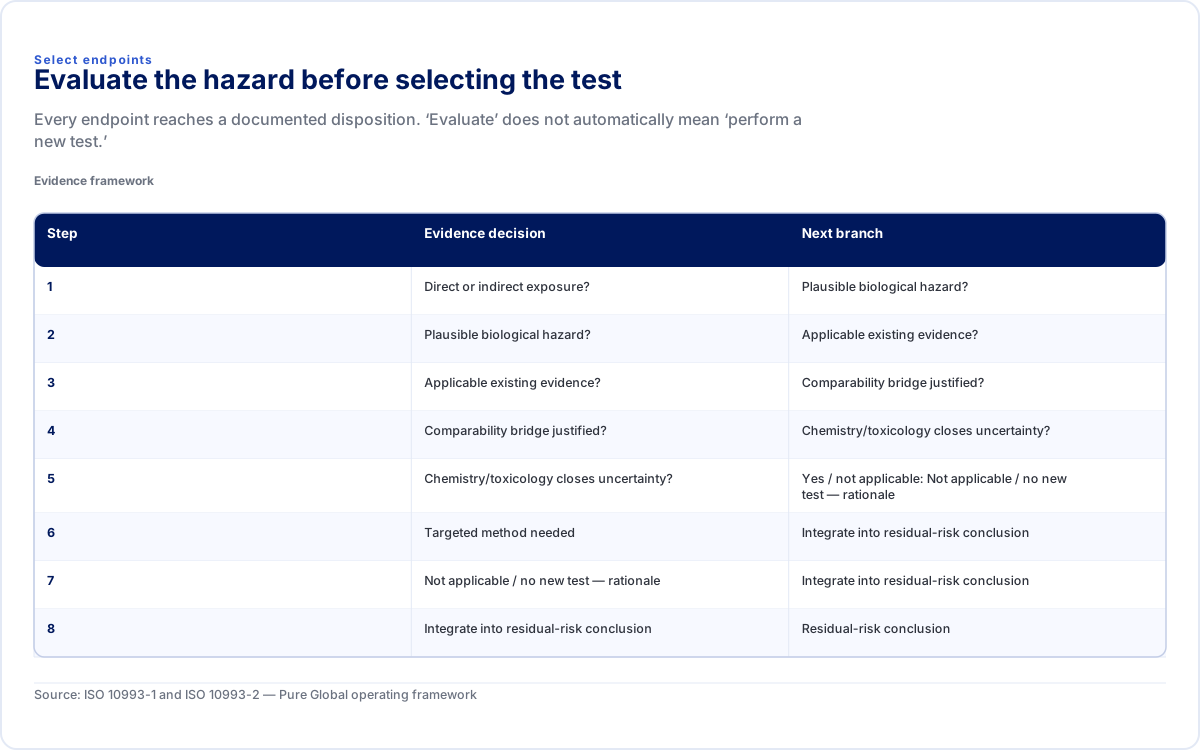
The takeaway first: evaluate every biologically relevant hazard, but do not confuse “evaluate” with “perform a new test.” The output for each endpoint is evidence plus rationale, not automatically an assay.
| Step | Evidence decision | Next branch |
|---|---|---|
| 1 | Direct or indirect exposure? | Plausible biological hazard? |
| 2 | Plausible biological hazard? | Applicable existing evidence? |
| 3 | Applicable existing evidence? | Comparability bridge justified? |
| 4 | Comparability bridge justified? | Chemistry/toxicology closes uncertainty? |
| 5 | Chemistry/toxicology closes uncertainty? | Yes / not applicable: Not applicable / no new test — rationale |
| 6 | Targeted method needed | Integrate into residual-risk conclusion |
| 7 | Not applicable / no new test — rationale | Integrate into residual-risk conclusion |
| 8 | Integrate into residual-risk conclusion | Residual-risk conclusion |
Source: ISO 10993-1 and ISO 10993-2 — Pure Global operating framework
Use a repeatable endpoint decision sequence:
- Is there a direct or indirect biological exposure for this component and use?
- What biological hazard could plausibly arise from the constituent, surface, particle, degradation product, process residual or tissue interaction?
- What is the relevant exposure route, dose, frequency and duration—including cumulative or intermittent contact?
- What existing evidence addresses that hazard for this final device or a justified comparable configuration?
- Are material, process, sterilisation, geometry, surface and exposure differences small enough to bridge?
- Can chemical characterisation and toxicological assessment close the uncertainty?
- If uncertainty remains, which targeted biological method can resolve it with the least additional animal use?
- What result would change the risk-control or market decision?
This approach avoids two opposite errors. The first is over-testing: ordering every endpoint associated with a contact category even when composition, exposure and existing evidence already support a conclusion. Over-testing consumes time, creates animal use, and can generate ambiguous findings unrelated to clinical risk. ISO 10993-2:2022 explicitly promotes reduction, refinement and replacement of animal testing with scientifically valid alternatives 16.
The second is under-evaluation: omitting an endpoint because it is absent from a familiar table while failing to consider a device-specific hazard. Particles, degradation, local physical effects, an in-situ reaction, nanomaterials, novel coatings or repeated intermittent exposure can require analysis beyond a generic category row. FDA's partial-recognition note is particularly relevant for prolonged-contact genotoxicity: the 2025 standard and the 2023 FDA guidance may not align for every device, so the safest plan may be to ask the relevant review office before generating data 2.
For each endpoint, build a one-page record with six fields: hazard, exposure, available evidence, uncertainty, disposition, and market delta. A disposition can be supported by existing data, supported by chemistry/toxicology, addressed by targeted testing, not applicable with rationale, or pending regulator interaction. That one-page format is more portable than a coloured checkmark copied from a matrix.
Choose the final finished test article and the real worst case
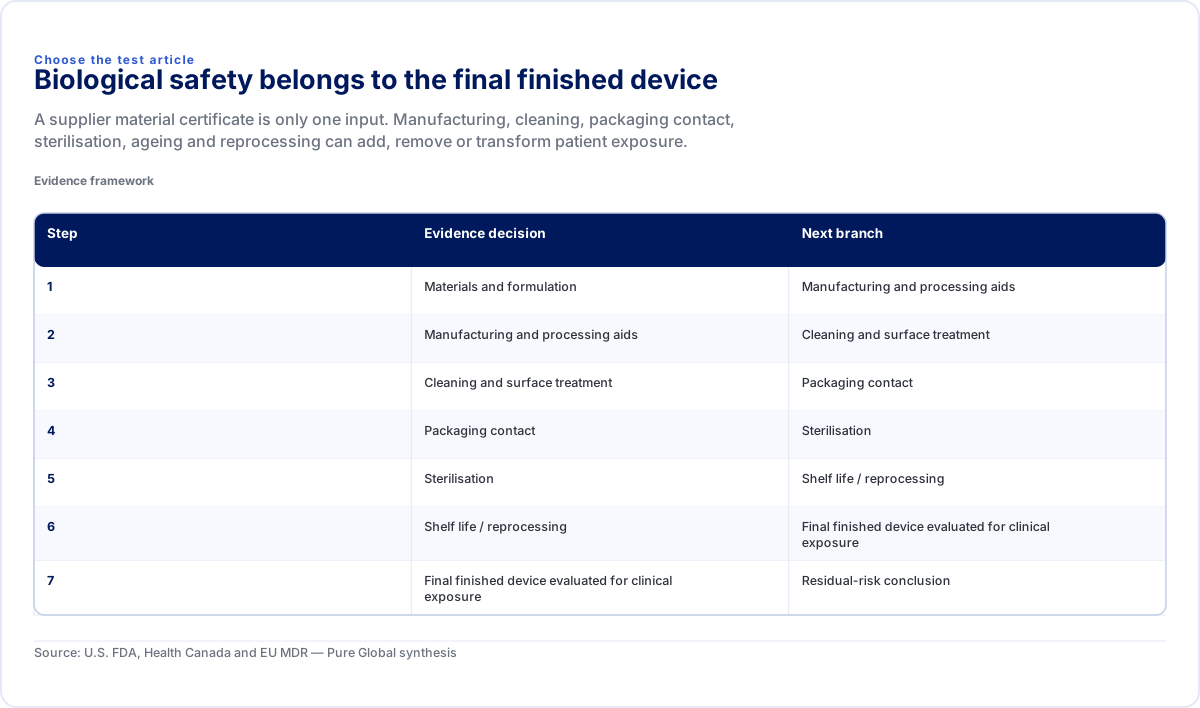
The takeaway first: test the configuration that maximises the relevant biological challenge—not automatically the largest device, newest prototype or easiest sample to obtain.
FDA evaluates the final finished device, including the effects of manufacturing and sterilisation 14. Health Canada similarly asks for evidence on the final product after processing and sterilisation 15. EU MDR Annex II expects all direct- and indirect-contact materials to be identified and the test design and rationale to be documented 10. These expectations converge even when the recognised Part 1 edition differs.
| Step | Evidence decision | Next branch |
|---|---|---|
| 1 | Materials and formulation | Manufacturing and processing aids |
| 2 | Manufacturing and processing aids | Cleaning and surface treatment |
| 3 | Cleaning and surface treatment | Packaging contact |
| 4 | Packaging contact | Sterilisation |
| 5 | Sterilisation | Shelf life / reprocessing |
| 6 | Shelf life / reprocessing | Final finished device evaluated for clinical exposure |
| 7 | Final finished device evaluated for clinical exposure | Residual-risk conclusion |
Source: U.S. FDA, Health Canada and EU MDR — Pure Global synthesis
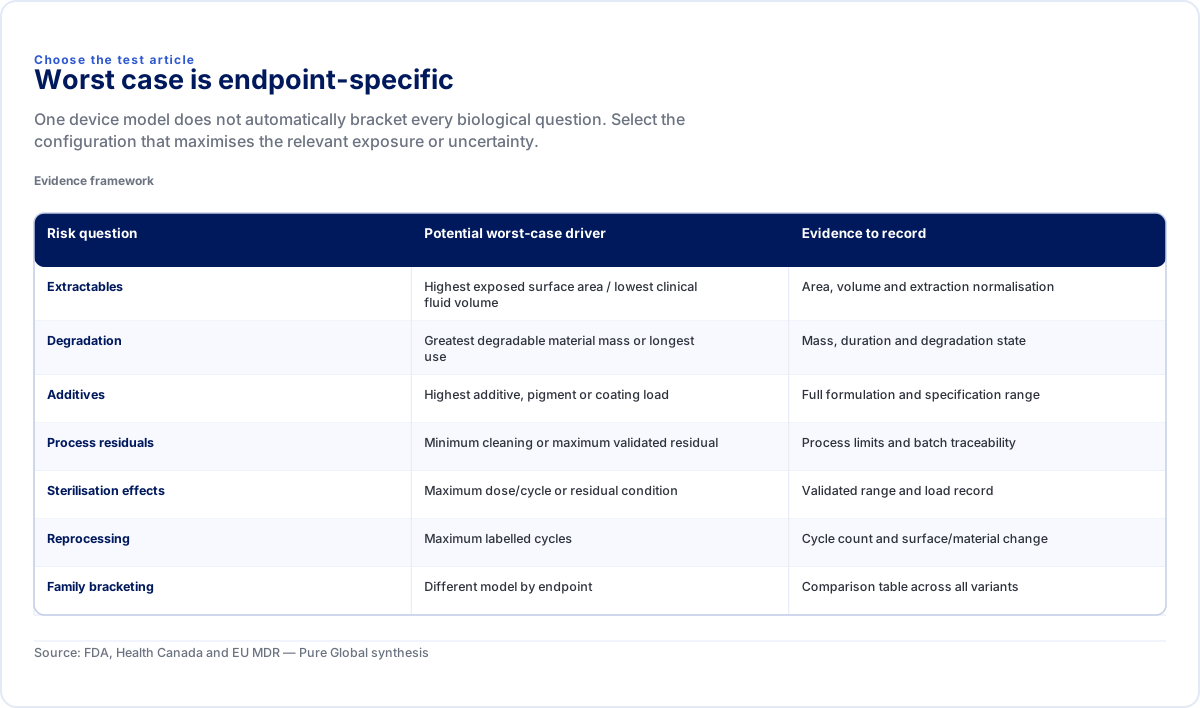
| Risk question | Potential worst-case driver | Evidence to record |
|---|---|---|
| Extractables | Highest exposed surface area / lowest clinical fluid volume | Area, volume and extraction normalisation |
| Degradation | Greatest degradable material mass or longest use | Mass, duration and degradation state |
| Additives | Highest additive, pigment or coating load | Full formulation and specification range |
| Process residuals | Minimum cleaning or maximum validated residual | Process limits and batch traceability |
| Sterilisation effects | Maximum dose/cycle or residual condition | Validated range and load record |
| Reprocessing | Maximum labelled cycles | Cycle count and surface/material change |
| Family bracketing | Different model by endpoint | Comparison table across all variants |
Source: FDA, Health Canada and EU MDR — Pure Global synthesis
Define “final finished” operationally. The article should represent production materials, formulation, supplier controls, manufacturing site and process, cleaning, packaging contact, sterilisation cycle and, where relevant, ageing or reprocessing. If the marketed device will be supplied sterile, a non-sterile moulded component is not automatically representative. If sterilisation can create or remove residues, its validated range belongs in worst-case selection.
Worst case is endpoint-specific:
- the highest surface-area-to-patient-exposure configuration may drive extractables;
- the greatest material mass may drive a degradable or absorbable constituent;
- the darkest or highest-additive colour may drive a formulation question;
- the maximum sterilisation dose or residual limit may drive chemical exposure;
- the minimum cleaning cycle may drive process residuals;
- the maximum reprocessing cycles may drive degradation or surface change;
- the smallest fluid volume may produce the highest delivered concentration; and
- a particular supplier or site may represent the least favourable validated specification.
For device families, build a bracketing table rather than declaring one model universally worst. Map each variant against material, surface area, mass, contact, duration, processing and sterilisation. One model can bracket cytotoxicity while another brackets degradation or implantation. If multiple test articles are needed, say why.
Traceability matters as much as selection. Record lot, date, site, drawing revision, bill-of-material revision, sterilisation load and dose, ageing state, packaging state and deviations. Keep retained samples where appropriate. A regulator cannot evaluate an elegant rationale if the company cannot prove which device was tested.
Use chemistry first without treating chemistry as magic
The takeaway first: chemical characterisation is a powerful way to identify and quantify potential exposure, but it is not a universal substitute for biological evidence, and an analytical list is not a safety conclusion.
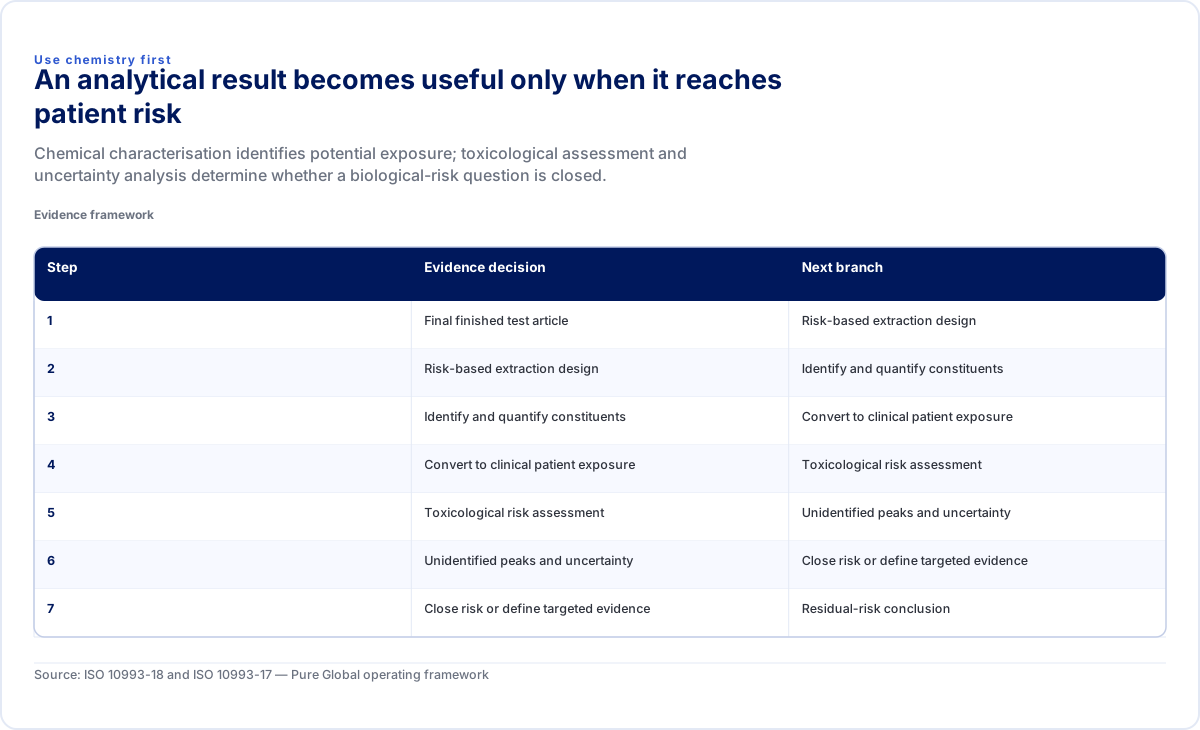
| Step | Evidence decision | Next branch |
|---|---|---|
| 1 | Final finished test article | Risk-based extraction design |
| 2 | Risk-based extraction design | Identify and quantify constituents |
| 3 | Identify and quantify constituents | Convert to clinical patient exposure |
| 4 | Convert to clinical patient exposure | Toxicological risk assessment |
| 5 | Toxicological risk assessment | Unidentified peaks and uncertainty |
| 6 | Unidentified peaks and uncertainty | Close risk or define targeted evidence |
| 7 | Close risk or define targeted evidence | Residual-risk conclusion |
Source: ISO 10993-18 and ISO 10993-17 — Pure Global operating framework
A defensible chemistry-led sequence is:
- define the final finished test article and clinical exposure;
- design extraction to answer the risk question, including polarities, time, temperature and surface-area or mass normalisation;
- establish analytical methods, sensitivity and reporting thresholds;
- identify and quantify detected constituents to the extent scientifically possible;
- convert extract concentration into patient exposure using the clinical use model;
- conduct toxicological risk assessment using appropriate toxicological values and uncertainty factors;
- characterise unidentifiable peaks and analytical uncertainty;
- decide which hazards are closed and which require targeted additional evidence.
This sequence prevents two common category errors. First, a compound detected under exaggerated extraction is not automatically a clinical hazard; dose and route matter. Second, a compound below an analytical threshold is not automatically absent; method capability, sample preparation and uncertainty matter. Toxicological assessment must connect analytical results to patient exposure and the relevant endpoint.
Chemistry is especially valuable for comparing versions, investigating a material or process change, supporting a bridge across a product family and identifying unexpected residues. It can also help reduce unnecessary animal testing. But chemistry may not fully resolve local tissue effects, physical interactions, particulate response, degradation over time, complex mixtures, or hazards for which toxicological thresholds are weak. The plan must state the boundary.
FDA issued a draft guidance on chemical analysis for biocompatibility assessment in December 2024. Because that document remains draft, it should be labelled as such and not treated as current final FDA policy. The controlling US anchors for this report are FDA's September 2023 final ISO 10993-1 guidance and the 2026 standards-recognition page 213.
The best chemistry report is therefore not the one with the most peaks. It is the one that lets the biological evaluator answer: What can reach the patient, at what dose, with what uncertainty, and what must we do next?
Make one core dossier travel across seven regulatory systems
The takeaway first: do not create seven unrelated biological-evaluation files. Maintain one controlled evidence core and seven short overlays that state how each authority treats the standard, the evidence and the submission.
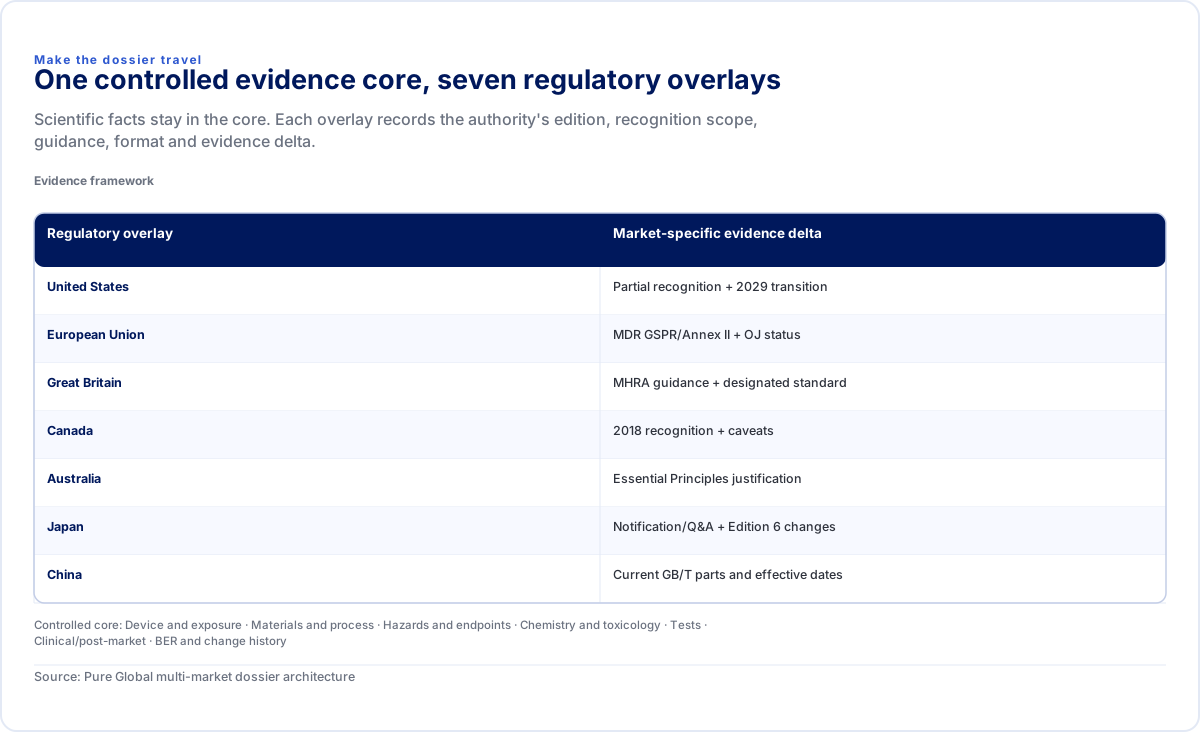
| Regulatory overlay | Market-specific evidence delta |
|---|---|
| United States | Partial recognition + 2029 transition |
| European Union | MDR GSPR/Annex II + OJ status |
| Great Britain | MHRA guidance + designated standard |
| Canada | 2018 recognition + caveats |
| Australia | Essential Principles justification |
| Japan | Notification/Q&A + Edition 6 changes |
| China | Current GB/T parts and effective dates |
Controlled core: Device and exposure · Materials and process · Hazards and endpoints · Chemistry and toxicology · Tests · Clinical/post-market · BER and change history
Source: Pure Global multi-market dossier architecture
The core dossier should hold the stable scientific record:
- device and intended-use description;
- component-level contact and exposure model;
- bill of materials, formulation access strategy and manufacturing/process map;
- biological-hazard and endpoint map;
- existing-evidence inventory and comparability bridges;
- chemical characterisation and toxicological assessments;
- biological test plans and complete reports;
- clinical and post-market evidence;
- final integrated Biological Evaluation Report;
- change history and open issues.
Each jurisdiction overlay should then answer a compact set of questions: applicable law and guidance; recognised/designated/adopted Part 1 edition; recognition exclusions or caveats; accepted standards-declaration route; local submission section and language; regulator-specific endpoint, test-article or GLP expectations; whether pre-submission interaction is advisable; and the exact delta from the core conclusion.
United States
Use FDA's September 2023 final guidance and recognition 2-313. Mark the two non-recognised 2025 elements. For prolonged-contact devices, compare genotoxicity decisions against both the sixth edition and FDA Attachment A; contact the review office when the two do not align 213. Decide explicitly whether the submission relies on a 2025 declaration, a 2018 declaration during the transition, or supporting evidence without a declaration. FDA accepts the 2018 declaration only through 1 July 2029 2.
European Union
Map the evidence to MDR Annex I section 10 and Annex II section 6.1. Identify every direct- and indirect-contact material, include detailed methods and conclusions, and provide a rationale wherever no new test was performed 10. As of the 17 June 2026 list update, do not claim a Part 1 harmonised-standard presumption that is not published in the OJ 11. Explain state of the art and discuss the chosen edition with the notified body early.
Great Britain
MHRA's current guidance still uses the 2018 framework and emphasises that endpoints are evaluations, not mandatory tests. It calls for complete final-device composition, chemical characterisation when information is incomplete and interpretation in the overall risk assessment 5. The current designated-standards notice lists EN ISO 10993-1:2009 plus AC:2010 for Part 1 6. The overlay should distinguish the designated-standard route from the scientific case for using newer methods.
Canada
Health Canada's current list recognises ISO 10993-1:2018 and notes that clause 5.3.2 may require additional testing. It also places exclusions on parts of the in-vitro/stepwise approaches in Parts 10 and 23 3. The overlay should identify those caveats, show final-product evidence after processing and sterilisation, and avoid relying on supplier claims alone 15. Use of recognised standards is voluntary, but an alternate route needs evidence and explanation 3.
Australia
TGA treats ISO 10993 as acknowledged state of the art, not a mandatory single route. A manufacturer may meet or exceed it or justify another approach, while still demonstrating the Essential Principles. TGA specifically expects the evaluation to consider risk analysis, available biological evidence, cleaning/disinfection/sterilisation effects and leachable substances 7. The overlay should therefore focus on the Essential-Principles mapping and justification, not simply a standards certificate.
Japan
PMDA places biological evaluation under ISO 14971 risk management and updated its public materials in 2025, including a notification, Q&A and a sixth-edition change overview 89. The Japanese overlay should reconcile the core dossier with the current notification and consultation expectations and flag sixth-edition changes affecting exposure, characterisation, biological hazards, contact terminology and local tissue effects.
China
China's current Part 1, GB/T 16886.1-2022, identically adopts ISO 10993-1:2018 and has been effective since 1 May 2023 4. A national project is underway to revise Part 1, but a standards plan is not yet an effective replacement 17. Other family parts are changing on their own schedule: Part 17's 2025 edition becomes effective 1 September 2026, while the new Part 2 becomes effective in February 2027 17. The overlay should map each cited family part individually rather than assuming all of GB/T 16886 moved together.
The architecture yields one important governance rule: local overlays may add evidence or explanation, but they must not silently change the scientific facts in the core. If a market question reveals a new hazard or invalid bridge, update the controlled core and assess every market—not just the regulator that noticed it.
Reopen the evaluation when the device or knowledge changes
The takeaway first: a biological-safety conclusion belongs to a defined device state. Material, supplier, process, sterilisation, packaging, shelf-life, use or post-market changes can invalidate the bridge even when the product name stays the same.
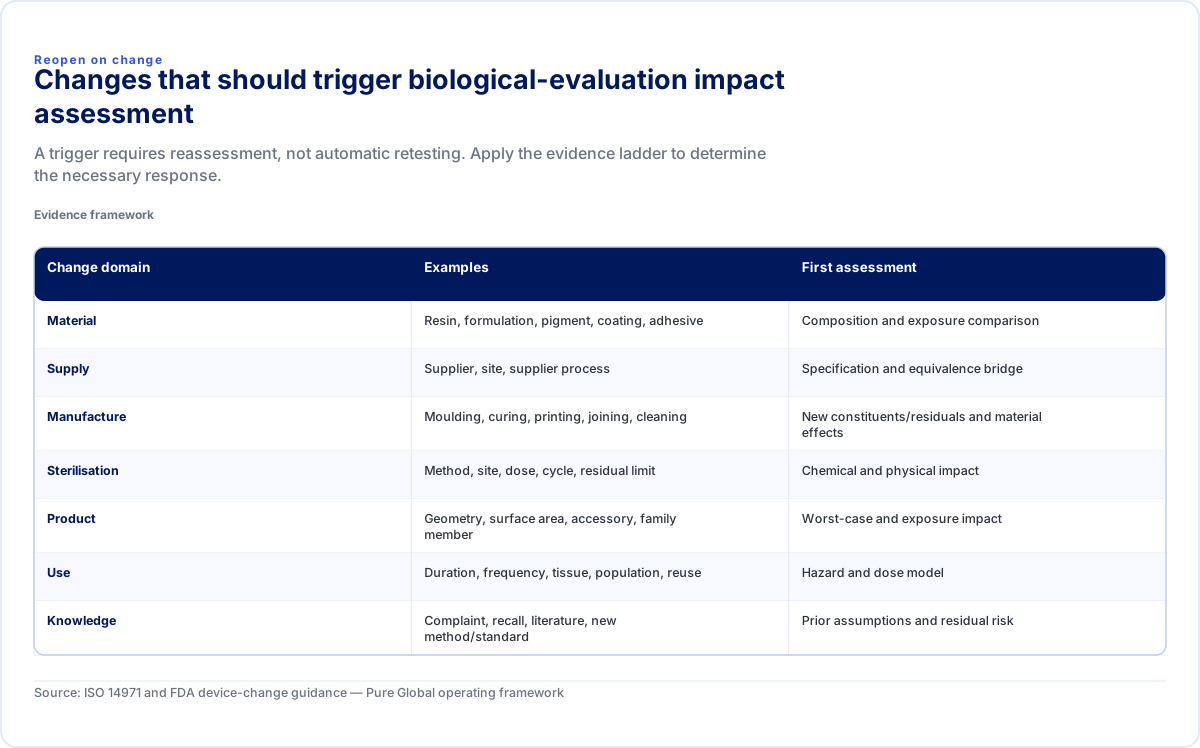
| Change domain | Examples | First assessment |
|---|---|---|
| Material | Resin, formulation, pigment, coating, adhesive | Composition and exposure comparison |
| Supply | Supplier, site, supplier process | Specification and equivalence bridge |
| Manufacture | Moulding, curing, printing, joining, cleaning | New constituents/residuals and material effects |
| Sterilisation | Method, site, dose, cycle, residual limit | Chemical and physical impact |
| Product | Geometry, surface area, accessory, family member | Worst-case and exposure impact |
| Use | Duration, frequency, tissue, population, reuse | Hazard and dose model |
| Knowledge | Complaint, recall, literature, new method/standard | Prior assumptions and residual risk |
Source: ISO 14971 and FDA device-change guidance — Pure Global operating framework
Build a biological-evaluation impact assessment into change control. Triggers include:
- new or changed material, formulation, pigment, additive, coating, adhesive, ink or lubricant;
- supplier, manufacturing site or supplier-process change;
- moulding, machining, printing, curing, welding or surface-treatment change;
- cleaning agent, process parameter or acceptance-limit change;
- sterilisation method, site, cycle, dose or residual-limit change;
- packaging material with direct or indirect device contact;
- shelf-life extension, transport change or new ageing state;
- new size, geometry, surface area, mass, accessory or device-family member;
- new contact tissue, duration, frequency, patient population or reuse claim;
- complaint, adverse-event, recall, literature or toxicology signal;
- analytical-method improvement that exposes previously uncharacterised constituents;
- standard, guidance or recognition change that affects the prior rationale.
FDA's device-change guidance shows why process changes belong on the list. A change in cleaning, disinfection or sterilisation can alter material or performance characteristics and may affect biocompatibility—for example by changing residuals or polymer and coating properties 18. The assessment must therefore examine both new hazards and significantly modified existing risks.
Do not make “retest” the automatic result. Run the same evidence ladder: define the change; compare pre- and post-change composition, process and exposure; use targeted chemistry or other evidence where it can answer the question; assess toxicological and biological impact; decide whether additional testing is necessary; then update the BEP/BER, risk-management file and affected market overlays. A well-designed change assessment can justify no new testing. An undocumented “no impact” checkbox cannot.
Post-market evidence also belongs here. Complaints, adverse events, vigilance, scientific literature, production nonconformities and recalls can challenge assumptions made at launch. Define thresholds and responsibilities for reopening the evaluation. A periodic review calendar is helpful, but event-driven triggers are more important than an arbitrary annual rewrite.
What 112 recall rows really mean
The takeaway first: the FDA recall file contains useful biological-safety signals, but raw record counts exaggerate event frequency. In the current export, 112 matched product rows collapse to 25 campaign groups, and one campaign contributes two-thirds of the rows.
Pure Global analysed a 24 July 2026 export of the FDA recall database containing 58,785 product rows. A transparent free-text screen searched recall reasons and root-cause fields for biocompatibility, cytotoxicity and failed biological-test language. It returned 112 product rows. Deduplicating on recalling firm, event date and reason produced 25 campaign groups. An alternate firm/date/product-code definition produced 26 groups, which shows why the unit of analysis must be declared 19.
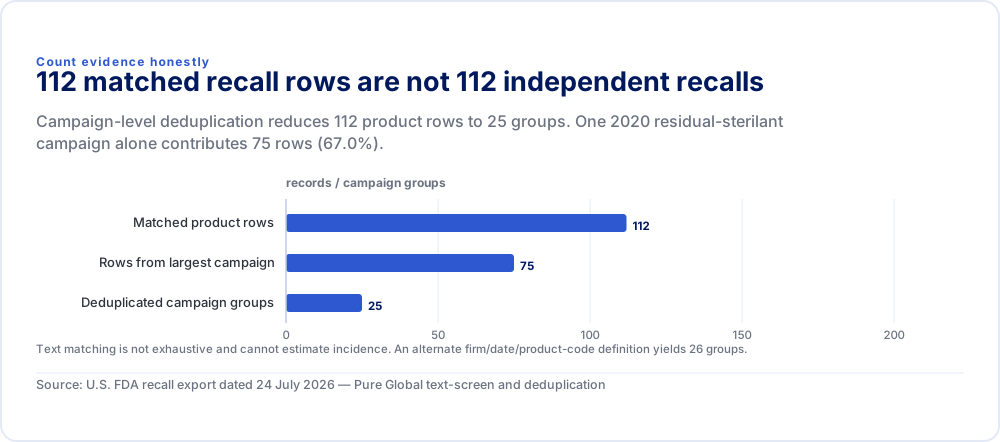
| 112 matched recall rows are not 112 independent recalls | |
|---|---|
| Matched product rows | 112 |
| Rows from largest campaign | 75 |
| Deduplicated campaign groups | 25 |
Text matching is not exhaustive and cannot estimate incidence. An alternate firm/date/product-code definition yields 26 groups.
Source: U.S. FDA recall export dated 24 July 2026 — Pure Global text-screen and deduplication
The concentration is the main lesson. One 2020 campaign related to sterilisation residuals generated 75 of the 112 rows—67.0%. Those rows can represent separate catalogue numbers, sizes, models or distribution records inside one corrective action. Reporting “112 biocompatibility recalls” would therefore create the false impression of 112 independent failures.
The text-matched campaigns span 2008 through 2026. Four appear in 2025–2026, with descriptions involving elevated cytotoxicity, failed routine biocompatibility, a component-related kit issue and a catheter cytotoxicity issue 19. These examples reinforce the change-control themes above: materials and components, process residuals, routine verification and final-system configuration can all matter.
The analysis has strict limits. Free-text screening misses events described with different terms. Root-cause fields can be incomplete or still under investigation. Recall databases do not provide a denominator of devices used, so they cannot establish incidence or compare companies safely. Campaign grouping requires judgement. The output is a signal set and documentation lesson, not a failure rate.
That documentation lesson is valuable: preserve both levels. Keep product-level traceability for affected models, but report campaign-level counts when discussing independent corrective actions. The same principle applies to complaints, adverse events and laboratory deviations. Before a number reaches a board slide or a regulator narrative, define what one record represents.
Budget the market-access layer separately
The takeaway first: the BEP, laboratory programme and toxicology are technical-evidence costs. Regulatory strategy, dossier compilation and legally required local representation are a separate market-access layer. Price them separately so neither is hidden.
A credible biological-evaluation budget has at least five buckets:
- internal materials, engineering, quality and regulatory work;
- laboratory analytical and biological studies;
- independent toxicological assessment;
- regulatory strategy and submission-document compilation; and
- authority, notified-body, translation and in-country-representation costs.
The laboratory number cannot be quoted responsibly until the exposure model and gap assessment exist. Any universal “ISO 10993 package price” risks paying for irrelevant work while missing device-specific uncertainty. Pure Global's published fees cover the regulatory and representation layer, not an unspecified laboratory package.
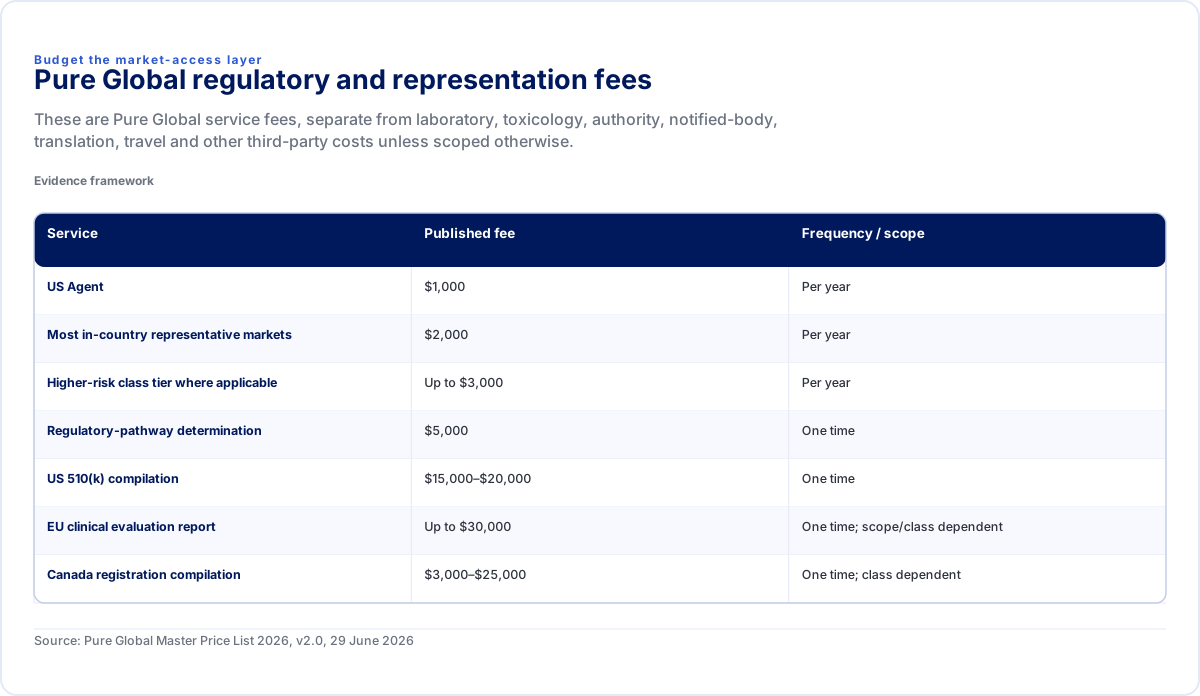
| Service | Published fee | Frequency / scope |
|---|---|---|
| US Agent | $1,000 | Per year |
| Most in-country representative markets | $2,000 | Per year |
| Higher-risk class tier where applicable | Up to $3,000 | Per year |
| Regulatory-pathway determination | $5,000 | One time |
| US 510(k) compilation | $15,000–$20,000 | One time |
| EU clinical evaluation report | Up to $30,000 | One time; scope/class dependent |
| Canada registration compilation | $3,000–$25,000 | One time; class dependent |
Source: Pure Global Master Price List 2026, v2.0, 29 June 2026
Pure Global's Master Price List 2026 quotes US Agent at $1,000 per year and most other in-country-representation markets at $2,000 per year, rising to $3,000 for higher-risk tiers where the price is class-based Pure Global pricing. Representative one-time services include:
- Regulatory-pathway determination: $5,000;
- US 510(k) compilation: $15,000–$20,000;
- EU clinical evaluation report: up to $30,000 depending on scope and class; and
- Canada registration compilation: $3,000–$25,000 depending on class Pure Global pricing.
These are Pure Global service fees. Laboratory testing, toxicology, authority and notified-body fees, translation, travel and other third-party costs are separate unless a written scope says otherwise. The distinction matters: a transparent regulatory fee does not make the scientific programme predictable before the BEP is written.
For a worked representation example, consider a manufacturer maintaining four markets after the technical evidence is complete: US Agent $1,000 + EU Authorised Representative $2,000 + Brazil high-risk Registration Holder $3,000 + South Korea high-risk License Holder $3,000 = $9,000 per year Pure Global pricing.
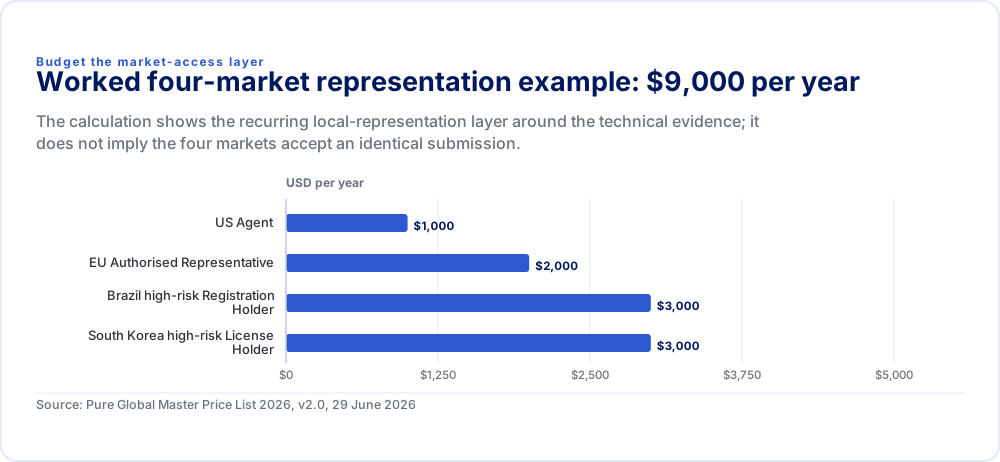
| Annual representation fee | |
|---|---|
| US Agent | $1,000 |
| EU Authorised Representative | $2,000 |
| Brazil high-risk Registration Holder | $3,000 |
| South Korea high-risk License Holder | $3,000 |
Source: Pure Global Master Price List 2026, v2.0, 29 June 2026
The example does not claim those four markets accept one identical submission. They do not. It shows the recurring local-representation layer around a core dossier and its market overlays. A realistic commercial plan should show both numbers: the cost to produce and maintain the evidence, and the cost to submit and legally maintain access in each jurisdiction.
Copy-ready BEP and RFP checklist
The takeaway first: use this list before requesting laboratory quotations. If an item is unknown, ask the laboratory or consultant to price an assumption and its alternative rather than silently choosing for you.
Device and scope
- Intended use, indication, patient population, users and clinical environment are current.
- Device models, accessories, drawings and bill-of-material revisions are listed.
- Target regulatory systems and submission pathways are named.
- Direct and indirect contact are mapped by component.
- Tissue, route, frequency, single-event duration, cumulative duration and intermittent pattern are defined.
- Reasonably foreseeable misuse relevant to biological exposure is recorded.
Materials and processing
- Full formulation information is available or a confidential supplier-access route is defined.
- Colourants, additives, coatings, adhesives, inks, lubricants and processing aids are included.
- Manufacturing sites and critical process ranges are listed.
- Cleaning, packaging contact, sterilisation, shelf life and reprocessing are mapped.
- Supplier and process changes since prior evidence were assessed.
Existing evidence
- Every prior report identifies the actual article, lot, process, sterilisation and standard edition tested.
- Literature and comparable-device evidence include a documented comparability bridge.
- Clinical history, complaints, vigilance and recalls are included.
- Evidence gaps are separated from document-retrieval gaps.
Endpoint and study decisions
- Each endpoint record states hazard, exposure, evidence, uncertainty and disposition.
- “Not applicable” and “no new testing” decisions have written rationales.
- Chemical-characterisation questions and reporting thresholds are defined.
- Toxicological assessment will convert extract results into clinical exposure.
- Each proposed biological study has a decision question and predefined acceptance criteria.
- Animal work is justified against reduction, refinement and replacement alternatives.
Test articles and execution
- Final-finished state is defined, including production process and sterilisation.
- Worst case is justified by endpoint; family bracketing is tabulated.
- Extraction conditions connect to the clinical exposure and uncertainty being tested.
- Article traceability includes lot, drawing/BOM revision, site, cycle, dose and ageing state.
- Deviations and invalid-result rules are agreed before study start.
Regulatory travel and lifecycle
- The core dossier has a controlled owner and change history.
- Each jurisdiction overlay names the current edition/status, caveats and submission delta.
- FDA partial-recognition exclusions and the 2018-to-2029 transition are addressed where relevant.
- EU claims distinguish state of the art from OJ harmonisation.
- Change-control triggers include material, supplier, process, sterilisation, packaging, shelf life, use and post-market signals.
- The Biological Evaluation Report will reconcile every plan item and deviation.
Send the completed checklist with the device contact table and material/process inventory when requesting a quotation. It will produce a more comparable proposal than asking three laboratories for “full ISO 10993 testing,” because each bidder will be pricing the same defined questions.
Conclusion: four decisions to make now
First, choose a regulatory baseline without pretending it is universal. ISO 10993-1:2025 is the current international edition, and FDA has already recognised it in part. Yet several important systems remain on the 2018 edition or older national/designated references. Build the latest scientific logic into the core, then document each regulator's status and caveats in an overlay.
Second, approve the exposure model before approving tests. Component-level contact, cumulative and intermittent duration, processing, sterilisation and variants determine the biological question. A vague contact category produces a vague test programme.
Third, buy evidence to close uncertainty—not a panel. Work up the evidence ladder from device and process knowledge through existing evidence, chemistry, toxicology, targeted testing and clinical/post-market information. Evaluate every relevant endpoint, but require a reason for every new test and every omitted test.
Fourth, maintain one controlled core across markets and changes. A local regulatory question can expose a global scientific gap. A supplier, material, cleaning or sterilisation change can invalidate a prior bridge. Update the core, then reassess every overlay.
Pure Global helps manufacturers determine the market-specific pathway, compile the submission architecture and maintain the required in-country representation around that evidence. If your device is moving from ISO 10993-1:2018 to the 2025 edition—or from one market to seven—the useful first deliverable is not a lab quote. It is a controlled map of the evidence you have, the uncertainty that remains and the regulator-specific decisions ahead.
Talk to Pure Global
Discuss your device and target markets with Pure Global. For current published service pricing, see Pure Global's pricing page.
Frequently asked questions
Is ISO 10993-1:2025 mandatory everywhere?
No. ISO publishes an international standard, while regulators recognise, designate, adopt or use standards under their own legal systems. FDA partially recognised the 2025 edition in May 2026; Health Canada currently recognises the 2018 edition; China's current national Part 1 identically adopts the 2018 edition; and Australia treats ISO 10993 as acknowledged state of the art rather than the only mandatory route 2374.
Can we still use ISO 10993-1:2018 for an FDA submission?
FDA says it will accept declarations of conformity to its recognition of the 2018 edition until 1 July 2029. After that transition it will not accept those declarations 2. The device-specific strategy should still consider current guidance and whether newer scientific issues affect the evaluation.
Does compliance with ISO 10993-1:2025 create EU MDR presumption of conformity?
Not automatically. MDR Article 8 presumption depends on a harmonised-standard reference published in the Official Journal. As of the 17 June 2026 list update, multiple ISO 10993 parts are listed but Part 1 is not 1011. The standard can still support state-of-the-art evidence, but the technical documentation should not claim a Part 1 OJ presumption that is absent.
Do we need every test associated with our contact category?
No universal answer exists. Every relevant biological hazard or endpoint must be evaluated, but evaluation can use existing device evidence, literature, composition, chemical characterisation, toxicological assessment, targeted biological tests, clinical evidence and post-market data. The BEP should explain why each endpoint is supported, tested or not applicable.
Can chemical characterisation replace all biological testing?
No. Chemistry can identify and quantify potential exposure and can support toxicological assessment, bridging and reduction of animal testing. It may not fully address local tissue response, physical interactions, particles, degradation, complex mixtures or uncertainties without adequate toxicological thresholds. Use it to close defined questions and state its limitations.
What is the difference between a BEP and a BER?
The Biological Evaluation Plan defines the scope, hazards, evidence, gaps, methods, test articles, decision rules and lifecycle controls before the work is complete. The Biological Evaluation Report integrates the resulting evidence, reconciles deviations and states the residual biological-risk conclusion. The report should trace back to the plan.
What does “final finished device” mean?
It means the device configuration representative of what will be supplied for use, including relevant manufacturing, cleaning, packaging contact, sterilisation and ageing or reprocessing state. The exact article depends on the risk question and worst-case rationale. A raw material or unsterilised component is not automatically representative 1415.
When can one model bracket a device family?
When a documented comparison shows it is worst case for the endpoint being evaluated across materials, formulation, mass, surface area, contact, processing, sterilisation and exposure. One model may bracket extractables while another brackets degradation or implantation, so a family can require more than one worst-case article.
What changes should reopen the biological evaluation?
Changes to materials, formulation, supplier, site, processing, cleaning, sterilisation, packaging, shelf life, geometry, contact, intended use, reprocessing or patient population can trigger impact assessment. New complaints, recalls, literature, analytical capability, standards or regulator guidance can also reopen it. Reopening does not always mean retesting; it means reassessing evidence and uncertainty.
Why not report 112 biocompatibility recalls from the FDA analysis?
Because 112 is a product-record count, not an independent-event count. Campaign-level deduplication produced 25 groups, and one campaign contributed 75 rows. The correct interpretation depends on the declared unit of analysis. The text search is also not exhaustive and cannot estimate incidence 19.
References
- ISO — ISO 10993-1:2025, Biological evaluation of medical devices—Part 1: Requirements and general principles for the evaluation of biological safety within a risk management process , Edition 6, published November 2025. iso.org ↩ ↩ ↩
- U.S. FDA — Recognized Consensus Standards, recognition 2-313 , ISO 10993-1 Sixth edition; partial recognition, entered 25 May 2026; 2018-edition transition through 1 July 2029. accessdata.fda.gov ↩ ↩ ↩ ↩ ↩ ↩ ↩ ↩ ↩
- Health Canada — List of recognized standards for medical devices , ISO 10993 entries and guidance on voluntary use. canada.ca ↩ ↩ ↩ ↩
- China State Administration for Market Regulation — GB/T 16886.1-2022 , published 15 April 2022, effective 1 May 2023; identical adoption of ISO 10993-1:2018. std.samr.gov.cn ↩ ↩ ↩
- UK Medicines and Healthcare products Regulatory Agency — Biological Safety Assessment , updated 2026. gov.uk ↩ ↩
- UK Secretary of State — Designated standards: medical devices, notice DS-0129-26 , 17 January 2026. assets.publishing.service.gov.uk ↩ ↩
- Australia Therapeutic Goods Administration — Complying with the Essential Principles on the safety and performance of medical devices , biological properties section. tga.gov.au ↩ ↩ ↩
- Japan Pharmaceuticals and Medical Devices Agency — Basic principles for biological safety evaluation required for approval applications for medical devices , updated materials and 11 March 2025 notification/Q&A. pmda.go.jp ↩ ↩
- PMDA Standards Information — ISO 10993-1 Edition 6 overview . std.pmda.go.jp ↩ ↩
- European Union — Regulation (EU) 2017/745 (MDR), Article 8, Annex I section 10 and Annex II section 6.1, consolidated version current 1 January 2026. eur-lex.europa.eu ↩ ↩ ↩ ↩ ↩
- European Commission — Implementing Decision (EU) 2021/1182 on MDR harmonised standards and Implementing Decision (EU) 2026/1231 of 11 June 2026. eur-lex.europa.eu ↩ ↩ ↩
- ISO — ISO 14971:2019, Medical devices—Application of risk management to medical devices . iso.org ↩ ↩
- U.S. FDA — Use of International Standard ISO 10993-1 , final guidance, September 2023. fda.gov ↩ ↩ ↩
- U.S. FDA — Basics of Biocompatibility: Information Needed for Assessment by the FDA . fda.gov ↩ ↩ ↩ ↩
- Health Canada — Non-clinical evidence—Class III non-IVD applications , final-product and biocompatibility evidence. canada.ca ↩ ↩ ↩ ↩
- ISO — ISO 10993-2:2022, Biological evaluation of medical devices—Part 2: Animal welfare requirements . iso.org ↩
- China National Public Service Platform for Standards Information — GB/T 16886 catalogue and revision plans, accessed 1 August 2026. openstd.samr.gov.cn ↩ ↩
- U.S. FDA — Deciding When to Submit a 510(k) for a Change to an Existing Device , current guidance PDF. fda.gov ↩
- U.S. FDA recall database — product-level export dated 24 July 2026; Pure Global text-screen and campaign-level deduplication, analysed 1 August 2026. accessdata.fda.gov ↩ ↩ ↩
 Market · Jul 24, 2026FDA US Medical Device RegistrationMarket · Jul 24, 2026EU Medical Device Classification & Regulation (MDR/IVDR)Market · Jul 24, 2026MHRA UK Medical Device Registration & ApprovalCase Study · Aug 11, 2026Basic UDI-DI Grouping for Contrast DevicesCase Study · Aug 11, 2026Class III Dermal Fillers Under the EU MDRRegulatory Update · Sep 14, 2026COMBINE: Combined-Study Safety ReportingRegulatory Update · Sep 14, 2026MDCG Rule 7: IVD Quality ControlsRegulatory Update · Sep 9, 2026TGA Saline Flush Classification and CDSS ExemptionRegulatory Update · Sep 5, 2026China Device GMP: 1 Nov 2026Video · Sep 11, 2026ISO 15223-1: What Device Labels Need to Say
In-Country Representatives and Registration Holders: 2026 Guide
Who holds the file matters when a distributor changes. Compare local roles, handover documents, transfer conditions and the full annual cost before appointing a partner.
One Device, Three UDI Databases (2026): Build the US, EU and China Work Order
Shared identifiers need separate regulatory mappings. Use corrected database evidence, product-specific calendars and a scoped cost breakdown to plan the work.

Medical Device Technical File Compilation Cost (2026): Build, Buy, or Hybrid?
Technical-file quotes are incomparable until scope, writing, gap closure, reviewer responses, lifecycle maintenance, and authority fees are separated. This report combines public price lines, FDA workload data, EU survey evidence, and a break-even model to show when to build internally, buy a project, or use a hybrid team.
Let's Talk,
Anywhere You Are.
Whether looking for more information or ready to partner with us, we're here to guide you through every step of the regulatory process.
Contact us