China GMP inspections: outsourcing registrants from November 2026
Prepare for 1 November 2026 with a verified comparison of the registrant’s and manufacturer’s minimum inspection chapters, graded requirements and release responsibilities.
TL;DR. China’s revised medical-device GMP and its inspection principles take effect on 1 November 2026. This is a preparation guide, reviewed on 4 October, not a statement that the new rules already apply. For a partial post-market inspection, the minimum chapters named for a registrant or record-filer that contracts production contain 85 items: 22 critical, 40 major and 23 general. The manufacturer’s minimum chapters contain 83 items, including 17 critical. Eleven critical items are shared; another 11 appear only in the registrant’s minimum chapter set and 6 only in the manufacturer’s. These are counts of checklist rows, not observed inspection findings or the number of documents a company must produce. 1 2
The practical question is which evidence a quality lead should prepare and which party owns it. Chapter membership does not transfer a legal duty: item 12.7.2 appears in the registrant’s minimum chapter set but describes the contractor’s production-release responsibility. The registrant needs an effective evidence interface with the contractor, not a second signature pretending to replace that responsibility.
The scope is the production-licence and post-market inspections described by these Chinese principles. International manufacturers should establish their legal role and inspection route before applying this matrix to their circumstances. English summaries below are unofficial; the Chinese text controls. The authority can add relevant chapters, product-specific requirements still apply, and justified inapplicability must be assessed separately. 2 3
The two inspection minimum chapter sets are different packs
The principles call a partial inspection a non-full-item inspection (非全项目检查): an inspection that covers some chapters of the GMP, according to the inspection plan. For that kind of post-market inspection, section 三(二)2 sets a minimum by role. The sentence, in the attachment to 国药监械管〔2026〕14号, reads:
对自行生产注册人、备案人的非全项目检查,至少应当覆盖质量保证、采购与原材料管理、生产管理、质量控制与产品放行、分析与改进等章节;对委托生产的注册人、备案人的非全项目检查,至少应当覆盖质量保证、机构与人员、质量控制与产品放行、委托生产与外协加工、分析与改进等章节;对受托生产企业的非全项目检查,至少应当覆盖质量保证、采购与原材料管理、生产管理、质量控制与产品放行、分析与改进等章节。 2
Rendered: a self-producing registrant or record-filer is inspected, at minimum, on quality assurance, purchasing and raw-material management, production management, quality control and product release, and analysis and improvement. A registrant or record-filer that contracts production is inspected, at minimum, on quality assurance, organisation and personnel, quality control and product release, contract manufacture and outsourced processing, and analysis and improvement. A contract manufacturer is inspected, at minimum, on the same chapters as the self-producer. 2
The clause number is X1.X2.X3. The principles' numbering note says the first component is the chapter, so 12.7.1 is chapter 12 and 11.10.3 is chapter 11. 2 Filtering the 200 risk-level cells by those chapter numbers gives the minimum chapter sets below. Each cell is graded in the attachment: three stars for a critical item (关键项目), two for a major item (主要项目), one for a general item (一般项目). Section 二 prints the checklist as 200 items, 39 critical, 88 major and 73 general. The minimum chapter set figures below count those cells. 2
| Chapter | Registrant minimum chapter set | Manufacturer minimum chapter set | Items | Critical | Major | General |
|---|---|---|---|---|---|---|
| 2 Quality assurance | Yes | Yes | 8 | 4 | 3 | 1 |
| 3 Organisation and personnel | Yes | No | 24 | 6 | 15 | 3 |
| 8 Purchasing and raw materials | No | Yes | 18 | 4 | 5 | 9 |
| 10 Production management | No | Yes | 21 | 2 | 11 | 8 |
| 11 Quality control and product release | Yes | Yes | 24 | 7 | 4 | 13 |
| 12 Contract manufacture and outsourced processing | Yes | No | 17 | 5 | 10 | 2 |
| 14 Analysis and improvement | Yes | Yes | 12 | 0 | 8 | 4 |
Registrant chapters 2, 3, 11, 12 and 14 sum to 85 items: 22 critical, 40 major and 23 general. Critical items add as 4 + 6 + 7 + 5 + 0. Manufacturer chapters 2, 8, 10, 11 and 14 sum to 83 items: 17 critical, 31 major and 35 general. Critical items add as 4 + 4 + 2 + 7 + 0. Chapters 2, 11 and 14 sit on both minimum chapter sets and contain 44 items, 11 of them critical. The two minimum chapter sets together therefore name 124 distinct graded items. 2
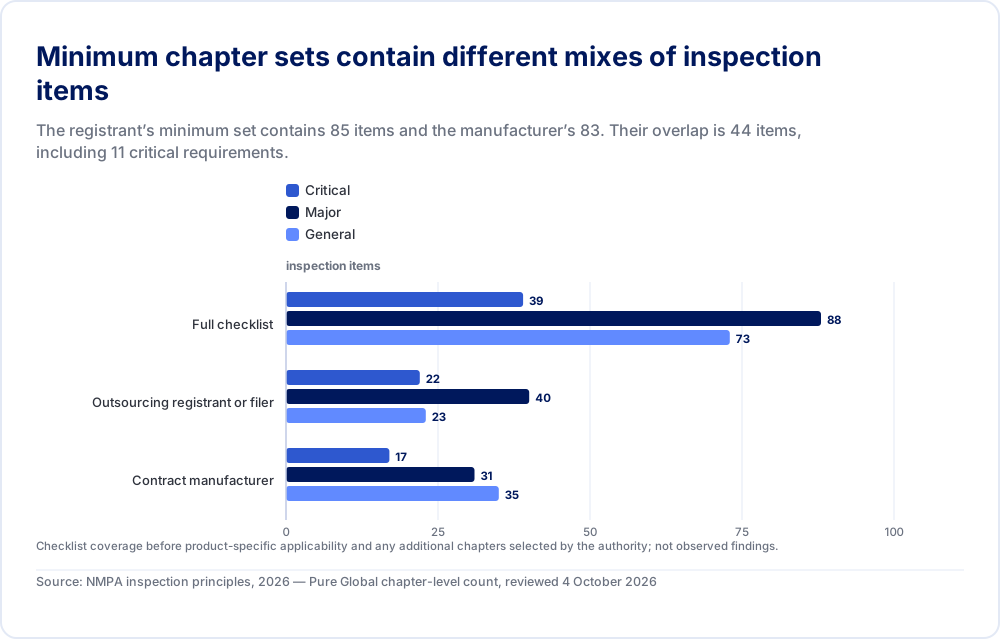
| Critical | Major | General | |
|---|---|---|---|
| Full checklist | 39 | 88 | 73 |
| Outsourcing registrant or filer | 22 | 40 | 23 |
| Contract manufacturer | 17 | 31 | 35 |
Checklist coverage before product-specific applicability and any additional chapters selected by the authority; not observed findings.
Source: NMPA inspection principles, 2026 — Pure Global chapter-level count, reviewed 4 October 2026
The critical split is the part a swapped list gets wrong.
| Where the critical item sits | Count | Clauses |
|---|---|---|
| Both minimum chapter sets, all of them in chapters 2 and 11 | 11 | 2.1.1, 2.2.1, 2.3.1, 2.4.1, 11.1.1, 11.3.1, 11.4.1, 11.6.1, 11.6.2, 11.10.1, 11.10.3 |
| Registrant or filer minimum chapter set only | 11 | 3.1.2, 3.2.1, 3.2.3, 3.5.3, 3.5.4, 3.6.1, 12.1.1, 12.2.1, 12.5.2, 12.7.1, 12.7.2 |
| Manufacturer minimum chapter set only | 6 | 8.1.1, 8.4.2, 8.7.1, 8.9.2, 10.1.1, 10.4.1 |
The manufacturer's 17 critical items are not a subset of the registrant's 22. The registrant-only count is 11, because chapter 3 contributes 6 critical items and chapter 12 contributes 5. The manufacturer-only count is 6, because chapter 8 contributes 4 and chapter 10 contributes 2. The arithmetic difference, 22 minus 17, equals 5, which is 11 minus 6. Using that difference as the number of extra registrant records drops the six manufacturer-only items out of the comparison and understates the registrant-only list. 2
The authority may add relevant chapters in light of the reason for inspection, inspection type and product characteristics. The resulting partial inspection is assessed using the full-inspection outcome rules. The matrix therefore describes minimum planned coverage, with the final scope determined by the authority. 2
Pure Global’s September overview of the inspection principles explains the chapter sets and outcome thresholds. The analysis here adds a clause-level crosswalk and evidence handoff: which graded rows each chapter set contains, where release duties sit, and how to avoid replacing one role’s preparation list with the other’s.
Which inspections use the five-chapter minimum chapter set
Use the 85-item minimum chapter set for a partial post-market inspection of a registrant or filer that contracts production. The same full suspension rules judge that partial inspection. A licence inspection follows its separate scope and outcome provisions.
The notice that issued the principles is 国药监械管〔2026〕14号, signed by the National Medical Products Administration on 14 September 2026. The wording here is the republication by the Shanghai Medical Products Administration, dated 16 September 2026 on that page, which names the NMPA website as its source. 1 A Hong Kong Trade and Industry Department circular reproduces the same notice. 4 Direct retrieval of the NMPA HTML page did not return the notice text. The principles attachment itself was read from the NMPA file. 2
Five points in the notice bound the minimum chapter set.
From 1 November 2026, drug regulatory departments conduct production-licence inspections and post-market supervision strictly under the revised GMP, and judge and dispose of them under these principles. The 2015 on-site principles, 食药监械监〔2015〕218号, are repealed that day. 1 Article 132 of the GMP attachment sets the same date and repeals the 2014 GMP. 3
Before 1 November 2026, licence inspections still use the GMP then in force. The authority also assesses the firm against the revised GMP, using these principles as the reference, and recommends corrections. 1
Pending licence, change and renewal applications switch on 1 November 2026 in two situations only. The first is an application accepted before that date and not yet inspected on site. The second is an application already inspected on site, with no licence decision yet because the firm has not finished rectification. 1
After a Class I device production filing, the authority inspects the filed materials and GMP implementation within three months. A filing made before 1 November 2026 that has not yet had that on-site check is inspected under the revised GMP from that date. 1 The notice describes this as a check of the filing materials and GMP implementation; the five-chapter rule has a separate partial post-market scope.
Provincial authorities plan post-market coverage by product risk and enterprise risk and are instructed to complete full-coverage inspections in stages against the revised GMP. 1 The sources leave the eventual mix of partial and full inspections unspecified.
From 1 November 2026, production of sterile devices, implantable devices, IVD reagents, custom dentures and standalone software must meet the revised GMP and the current annex that applies to that category. The matching inspection principles will be revised and issued separately. 1 Those annex items sit outside this 200-item checklist.
The principles' own scope is wider than the partial-inspection minimum chapter set. Section 一 applies the document to production-licence inspections, including change and renewal, and to every type of post-market supervision. 2 The five-chapter lists appear only inside the partial-inspection rule.
A partial inspection still uses the full suspension gates
A partial inspection is judged by the full-inspection rules. Suspension follows false or deceptive conduct, or at least 3 critical findings, or at least 10 critical-plus-major findings, or at least 20 findings of any grade. The registrant minimum chapter set already contains 22 critical items and 40 major items, so those numeric triggers can be reached inside the five chapters.
Post-market supervision has four conclusions: no nonconformity found (未发现不符合项目), self-correction (自行整改), suspension for rectification (暂停生产整改), and rectification by a deadline (限期整改). 2
The suspension rule is printed as follows:
检查发现存在以下情形之一的,检查结论判定为“暂停生产整改”:①存在虚假、欺骗行为;②关键项目不符合数量3项及以上;③关键项目及主要项目不符合总数量10项及以上;④不符合项目总数量20项及以上。 2
Rendered: the conclusion is suspension for rectification if any one of these is found: false or deceptive conduct; 3 or more critical nonconformities; 10 or more critical-plus-major nonconformities in total; or 20 or more nonconformities of any grade. The authority then requires the inspected enterprise to suspend production. Production resumes after every nonconformity has been corrected and a follow-up inspection passes. 2
The partial-inspection sentence says the result is judged under the full-inspection rules. 2 The same thresholds apply within the selected chapter coverage, including any relevant chapters the authority adds.
The band under the triggers is fixed by the same prose. No nonconformity at all is its own conclusion. No critical or major nonconformity, with general nonconformities fewer than 5 (不满5项), is self-correction, explained in the annual self-inspection report. Every other post-market result is rectification by a deadline. Where that deadline result contains a critical or major nonconformity, the authority assesses product-quality risk and may send the enterprise a risk-warning letter. If the firm misses the deadline for its rectification file, or follow-up finds the correction inadequate, the conclusion becomes suspension. 2
Fewer than 5 means 4 general findings sit in the self-correction band while 5 enter deadline rectification. One critical finding is already outside self-correction. It is also short of the suspension counts, so it is deadline rectification, and the risk-warning sentence can apply because a critical finding is present. The rows below apply those printed thresholds to stated finding counts. These are hypothetical applications of the numeric rules, not inspection results. The examples assume no false or deceptive conduct, no severity reassessment under section 四, and no separate legal violation requiring action. The authority’s full factual and risk assessment remains necessary.
| Findings inside the inspected set | Post-market conclusion under section 三(二)1 |
|---|---|
| None | No nonconformity found |
| 4 general, and no critical or major | Self-correction |
| 5 general, and no critical or major | Rectification by a deadline |
| 1 critical | Rectification by a deadline, with a product-risk assessment and a possible risk-warning letter |
| 2 critical and 7 major | Rectification by a deadline, with that same risk assessment, because critical-plus-major is 9 |
| 3 critical | Suspension for rectification |
| 2 critical and 8 major | Suspension, because critical-plus-major reaches 10 |
| 20 findings of any mix | Suspension |
The registrant minimum chapter set can supply each numeric row without an added chapter. It contains 22 critical items, against a trigger of 3. It contains 22 critical items and 40 major items, 62 in all, against a trigger of 10. It contains 85 graded items, against a trigger of 20. The manufacturer minimum chapter set can supply them as well: 17 critical items, 31 major items, and 83 graded items in total. 2 False or deceptive conduct suspends production with no numeric threshold at all.
Chapter 14 is in both minimum chapter sets. Its 8 major items contribute to the combined 10-item and overall 20-item thresholds. False or deceptive conduct is an independent suspension ground. 2
A licence inspection uses the same three numeric triggers and the separate false-or-deceptive-conduct trigger, with different conclusion names: pass (通过核查), fail (未通过核查), and rectification followed by re-inspection (整改后复查). Section 三(一) governs the licence inspection as a whole. On a licence inspection, no critical or major finding and fewer than 5 general findings is a pass, including a clean inspection. A clean licence inspection receives that same pass conclusion. 2
Where production release and market release sit on the two lists
Items 12.7.1 and 12.7.2 are critical rows in chapter 12, so they sit on the outsourcing registrant or filer's minimum list only. Item 11.10.3 is a critical row in chapter 11, so it sits on both minimum lists.
The GMP already splits the two releases. Article 104, last sentence, says:
委托生产的,产品放行包括生产放行和上市放行。医疗器械注册人、备案人负责上市放行,受托生产企业负责生产放行。 3
Rendered: where production is contracted, product release includes production release and market release. The registrant or record-filer is responsible for market release. The contract manufacturer is responsible for production release.
Article 113 then says who performs each one:
委托方应当建立产品上市放行规程,明确放行标准、条件,对医疗器械生产过程记录、质量控制记录和受托方生产放行文件进行审核,符合标准和条件的,经授权的放行人员签字后方可上市。产品上市放行由委托方自行完成,不得委托其他企业进行。
受托方应当建立生产放行规程,明确生产放行标准、条件,对医疗器械生产过程记录和质量控制记录进行审核,符合标准、条件的,经授权的放行人员签字后方可出厂。 3
Rendered: the delegating party establishes the market-release procedure, sets the release standard and conditions, reviews the production-process records, the quality-control records and the contractor's production-release file, and an authorised person signs before the device is marketed. The delegating party completes market release itself. It shall not entrust market release to another enterprise. The contractor establishes the production-release procedure, reviews the production-process records and the quality-control records, and an authorised person signs before the product leaves the factory.
Article 108 keeps that assignment out of the contract. The parties sign a quality agreement that states each side's rights, duties and responsibilities across the whole production process. The delegating party shall not, by agreement, transfer obligations and responsibilities that the law assigns to it. 3 Pure Global's 5 September 2026 note already states this article 104, 108 and 113 split. The inspection attachment is where those sentences become graded rows, and the chapter rule is where the rows land on a minimum list.
| Clause | Grade | GMP article | Minimum chapter set | What the row requires |
|---|---|---|---|---|
| 11.10.1 | Critical | 104 | Both | A release procedure, confirmation of five release conditions, and a release document signed by an authorised person |
| 11.10.2 | General | 104 | Both | The released product carries a conformity document |
| 11.10.3 | Critical | 104 | Both | Contract manufacture has production release by the contractor and market release by the registrant or filer |
| 12.7.1 | Critical | 113 | Registrant only | The delegating party's market-release procedure, review of the contractor's production-release file, and no delegation of market release |
| 12.7.2 | Critical | 113 | Registrant only | The contractor's production-release procedure and the authorised signature before the product leaves the factory |
Chapter 11 is named for both roles, placing 11.10.3 in both minimum sets. Chapter 12 is specifically named for the outsourcing registrant or filer. Preparation therefore requires its own market-release procedure and access to relevant evidence of the contractor’s production-release procedure. The legal duties remain with the parties identified in each clause. Article 113 requires the contractor to maintain its production-release procedure, and the authority may also add chapter 12 to a manufacturer’s inspection plan. 2 3
The five conditions for release, item 11.10.1, apply to both roles. The authorised person signs only after confirming that every specified process step is complete; the batch production record is complete; the quality-control record is complete, the results meet the requirements, and the record has been signed as required; any nonconforming product, rework, repair, downgraded use or emergency release has been handled as required; and the instructions for use, the labels and their versions, and the unique-device-identification code meet the requirements. 2 3
The 22 critical requirements, chapter by chapter
The registrant or filer pack for a minimum partial inspection is the 22 critical clauses in chapters 2, 3, 11, 12 and 14, together with the 40 major and 23 general clauses in those same chapters, because major and general findings feed the 10-item and 20-item gates.
The critical rows are written out below in the sense of the Chinese item. The other rows are listed with the GMP article they cite, because a deadline file that clears every critical item can still reach suspension on majors and generals. Counts in this section are the same risk-level cells as the minimum chapter set totals. 2
Quality assurance, shared with the manufacturer
Chapter 2 has 8 items: 4 critical, 3 major and 1 general. All 8 are on both minimum chapter sets.
The four critical requirements are the system the rest of the pack hangs from.
- 2.1.1, GMP article 7. The enterprise bears primary responsibility for device quality and safety. It sets quality objectives that meet device quality-management requirements, carries every requirement for safety, effectiveness and quality controllability through the whole running of the system, and sees that the objectives are understood and met.
- 2.2.1, GMP article 8. People, premises, facilities and equipment are sufficient, and they meet the requirements, for those objectives.
- 2.3.1, GMP article 9. A quality-assurance system and a complete set of quality-management documents keep the system running. The item lists nine states the system must secure. Design and development, production management and quality control comply with the GMP. Management responsibilities are clear. Purchased and used materials are correct. Intermediate product is under control. Verification and validation meet requirements. Production and inspection follow the procedures. Each batch or unit is released only after review and approval. Storage, transport and installation protect product quality. Commissioned development, contract manufacture, outsourced processing and outsourced testing stay under control. State (7) is release. State (9) is control of the contracted activity. Both are critical content inside a shared item, before the reader reaches chapter 11 or chapter 12.
- 2.4.1, GMP article 10. A change-control procedure classifies the change by its risk to safety, effectiveness and quality controllability and by the legal requirements, reviews it, and approves it before implementation. Where necessary, the change is verified or validated so that safety, effectiveness and quality controllability hold.
The other four chapter 2 rows are on the registrant minimum chapter set because the whole chapter is named.
| Clause | Grade | GMP article | Requirement |
|---|---|---|---|
| 2.2.2 | Major | 8 | People at each level take part in meeting the quality objectives and carry the corresponding responsibility |
| 2.5.1 | Major | 11 | Continual improvement through quality-data monitoring, change control, adverse-event monitoring, quality-risk review, corrective and preventive action, internal audit and management review |
| 2.6.1 | Major | 12 | A quality-risk system that assesses risk across product realisation, on the law, standards, science and experience, and that verifies and implements the controls |
| 2.7.1 | General | 13 | Life-cycle quality-risk information is collected, and quality-risk management is reviewed periodically |
Three major items in a shared chapter already count toward a trigger of 10. Include their evidence in the same preparation exercise. 2
Organisation and personnel, on the registrant minimum chapter set only
Chapter 3 has 24 items: 6 critical, 15 major and 3 general. This chapter is specific to the registrant’s minimum chapter list. Dropping the manufacturer list in place of the registrant list drops all 6 critical items and all 15 majors.
The six critical requirements concern independence and accountability.
- 3.1.2, GMP article 14. The head of production and the head of quality shall not hold both posts.
- 3.2.1, GMP article 15. The enterprise establishes a quality department matched to the products it produces.
- 3.2.3, GMP article 15. That department performs quality assurance and quality control independently, and it has a veto on product quality.
- 3.5.3, GMP article 18. The legal representative or the principal keeps the management representative, the quality-department head and the product-release reviewer independent of internal interference.
- 3.5.4, GMP article 18. That same person is accountable for device production as a whole, and organises production under the relevant laws, regulations and rules, the mandatory standards, and the registered or filed product technical requirements.
- 3.6.1, GMP article 19. The enterprise appoints one management representative from senior management.
The 15 major items are the qualifications and the duty lists that sit around those six. They are enough, on their own, to reach the 10-item critical-plus-major trigger if 10 of them were found nonconforming. The 3 general items count toward the 20-item total.
| Clause | Grade | GMP article | Requirement |
|---|---|---|---|
| 3.1.1 | Major | 14 | An organisation matched to device production, with department duties, authorities and the quality function defined |
| 3.2.2 | Major | 15 | The quality department takes part in quality-related activities and reviews documents that concern the GMP |
| 3.3.1 | Major | 16 | Enough technical staff, managers, production operators and full-time inspectors, with the qualifications the posts require |
| 3.3.2 | General | 16 | Every post has defined duties, including duties that overlap |
| 3.4.1 | Major | 17 | Key posts include at least the legal representative, the principal, the management representative, the production head, the quality head and the release reviewer. The principal, the management representative, the production head, the quality head and the release reviewer are full-time employees |
| 3.4.2 | Major | 17 | Key-post people know the device laws, have practical quality-management experience, and can judge real production and quality problems |
| 3.5.1 | Major | 18 | The legal representative or principal sets the quality policy and objectives and provides the people, infrastructure and work environment the system needs |
| 3.5.2 | Major | 18 | That person organises management review, assesses the system periodically, and keeps improving it |
| 3.6.2 | Major | 19 | For a Class II or Class III enterprise, the management representative has a device-related bachelor's degree or above, or a mid-level technical title or above. For a Class I enterprise, a device-related junior-college education or above. In principle, three years or more in device quality management or in production or technical management, familiarity with the product, and the ability to do the job |
| 3.6.3 | Major | 19 | The management representative's duties include carrying out the law and the registered or filed requirements, keeping a suitable system running, seeing that product meets release requirements and organising post-market quality-information collection, organising self-inspection, adverse-event monitoring and recall, reporting the system and its improvement needs to the legal representative or principal, and cooperating with inspections, including timely rectification |
| 3.7.1 | Major | 20 | For a Class II or Class III enterprise, the quality-department head has a device-related bachelor's degree or above, or a mid-level professional technical title or above. For a Class I enterprise, a device-related junior-college education or above. The head has three years or more in device production or quality management |
| 3.7.2 | Major | 20 | Duties include conformity of materials and product, organising release review, investigating major deviations and nonconformities, investigating returns, complaints and adverse events, the annual product-quality review, and training the department |
| 3.8.1 | Major | 21 | The production head has a device-related junior-college education or above and three years or more in device production or quality management |
| 3.8.2 | Major | 21 | Duties include production to the process procedures and work instructions, production records that are true, accurate, complete, timely and traceable, maintenance of premises and equipment, and training of the department |
| 3.9.1 | Major | 22 | The release reviewer is a quality-department person or a quality manager at a higher level, trained for release, able to review release, and able to carry that duty independently |
| 3.10.1 | Major | 23 | Everyone whose work affects product quality is trained for the post in the regulations, the duties and the practical skill |
| 3.10.2 | General | 23 | A named department or person runs training, with a system, a plan, records and an assessment of effect |
| 3.11.1 | General | 24 | Health management, and a health file, for people whose work affects product quality, according to the product |
For a contracting registrant, this chapter is the minimum place an inspector looks for the release reviewer's independence. The contractor’s named minimum chapters differ. 2
Quality control and product release, shared with the manufacturer
Chapter 11 has 24 items: 7 critical, 4 major and 13 general. All 24 are on both minimum chapter sets. The seven critical requirements are the inspection system plus the release sheet and the two-release sentence.
- 11.1.1, GMP article 95. A quality-control procedure states the organisation, the inspectors, the methods, sampling, equipment, release and retention samples, and the required tests are finished before release.
- 11.3.1, GMP article 97. Incoming, in-process and finished-product inspection procedures are written from the law, the regulations and rules, the mandatory standards, the registered or filed product technical requirements, the risk, and the firm's ability to assure quality.
- 11.4.1, GMP article 98. The test methods match the performance characteristics.
- 11.6.1, GMP article 100. Inspection is actually carried out to those procedures.
- 11.6.2, GMP article 100. Every batch or unit has an inspection record, and the record supports traceability.
- 11.10.1, GMP article 104. The release procedure, the five conditions quoted above, and a release sheet signed by an authorised person.
- 11.10.3, GMP article 104. For contract manufacture, production release by the contract manufacturer and market release by the registrant or record-filer.
The four major items are inspector qualification (11.2.1, article 96), coverage of the product technical requirements or a confirmed alternative (11.3.2, article 97), investigation of every failed test (11.9.2, article 103), and evaluation of an outside laboratory plus confirmation of its results (11.12.4, article 106). 2
The 13 general items still count toward a total of 20. They are the control of reference materials (11.4.2, article 98), sample management (11.5.1, article 99), the contents of the inspection record (11.6.3, article 100), inspection-equipment control including a stop-use and a look-back when equipment is unfit (11.7.1, article 101), the test environment (11.8.1 and 11.8.2, article 102), a procedure for failed results and the option to retest when the failure came from a test deviation (11.9.1 and 11.9.3, article 103), the conformity document on the released product (11.10.2, article 104), retention samples (11.11.1, article 105), and outsourced testing (11.12.1, 11.12.2 and 11.12.3, article 106). Routine incoming, in-process and finished-product tests are generally kept in house. A test that truly needs conditions or equipment the firm lacks may go to a qualified institution, under a quality agreement. 2 3
Contract manufacture and outsourced processing, on the registrant minimum chapter set only
Chapter 12 has 17 items: 5 critical, 10 major and 2 general. The chapter title is contract manufacture and outsourced processing (委托生产与外协加工). Naming the chapter puts the outsourced-processing rows on this minimum chapter set as well as the contract-manufacture rows.
The five critical requirements are the ones a manufacturer list leaves behind.
- 12.1.1, GMP article 107. Where a device is contract-manufactured, the delegating party's quality system covers the device life cycle. The contractor's system covers the contracted activity.
- 12.2.1, GMP article 108. A quality agreement states each party's rights, duties and responsibilities across production. The delegating party shall not use the agreement to transfer obligations the law assigns to it.
- 12.5.2, GMP article 111. The contractor runs trial production and the related verification and validation. Trial production covers every production step and every quality-control step that was transferred.
- 12.7.1, GMP article 113. The delegating party's market-release procedure, the review of production records, quality-control records and the contractor's production-release file, the authorised signature, and the rule that market release is not given to another enterprise.
- 12.7.2, GMP article 113. The contractor's production-release procedure, the review of production records and quality-control records, and the authorised signature before the product leaves the factory.
For item 12.7.2, the contractor owns the production-release procedure and operating evidence. The registrant should arrange access to the evidence relevant to its oversight and release review. The item’s location in chapter 12 identifies coverage, while its wording identifies the responsible party. 2
The 10 major items are the operating links around that release pair. Two of them, 12.10.1 and 12.10.2, are outsourced processing rather than contract manufacture of the finished device. The GMP defines outsourced processing as entrusting some processes to another enterprise. 3
| Clause | Grade | GMP article | Requirement |
|---|---|---|---|
| 12.1.2 | Major | 107 | The two parties have a communication mechanism that keeps the two systems joined and running |
| 12.3.1 | Major | 109 | Before contract manufacture, the delegating party assesses the contractor on site for production capability, quality assurance and risk management, and confirms the contractor can keep meeting the GMP. During the contract, the delegating party audits and assesses the contractor's system on site at intervals |
| 12.3.2 | General | 109 | The contractor accepts the audit and the supervision, and takes corrective and preventive action on the findings |
| 12.4.1 | Major | 110 | The delegating party has a quality organisation and enough full-time quality staff, plus technicians who know the product, to monitor the contracted activity |
| 12.4.2 | Major | 110 | The contractor's management representative, production head, quality head and release reviewer know the production and quality management of the contracted product |
| 12.5.1 | Major | 111 | The two parties plan the transfer together, so the product technical requirements, material and process requirements, instructions and labels move to the contractor |
| 12.6.1 | Major | 112 | The delegating party notifies the contractor of design changes and purchasing changes and supervises them, and has a way to learn of contractor changes that may affect quality, with a joint assessment |
| 12.6.2 | Major | 112 | The contractor carries out the delegating party's change requirements and feeds back its own change needs |
| 12.8.1 | Major | 114 | The contractor reports, in time, deviations, changes and abnormal conditions that may affect quality, and keeps the handling record |
| 12.9.1 | General | 115 | Where product realisation uses outsourced processing, the enterprise has a control procedure and controls that processing |
| 12.10.1 | Major | 116 | The enterprise manages the outsourced processor at least as a supplier, and assesses processing capability, quality assurance and risk management |
| 12.10.2 | Major | 116 | An outsourced-processing quality agreement states the work, the quality or technical requirements, the acceptance criteria, both parties' responsibilities, and the process, validation, release, change and communication rules |
Ten major items in this chapter are, by themselves, enough to meet a trigger of 10 if all 10 were found nonconforming. Evidence for 12.7.1 and 12.7.2 alone leaves those ten major requirements unaddressed; findings against them still count toward the applicable threshold. 2
Analysis and improvement, shared, with no critical item
Chapter 14 has 12 items, 0 critical, 8 major and 4 general. It is on both minimum chapter sets. Its 8 majors count toward the 10-item trigger, and all 12 items count toward the 20-item trigger.
| Clause | Grade | GMP article | Requirement |
|---|---|---|---|
| 14.1.1 | Major | 121 | Monitoring, analysis and improvement of the product and of the quality system, so the product stays safe and effective and the system keeps running |
| 14.2.1 | General | 122 | A complaint and customer-feedback procedure, with duties, timely investigation and records |
| 14.3.1 | Major | 123 | An adverse-event monitoring system, timely reports, investigation and evaluation, and risk controls where necessary |
| 14.4.1 | Major | 124 | A data-analysis procedure covering collection, control standards, methods and statistics for product quality, adverse events, customer feedback and the running of the system, a quality-risk evaluation report, and use of the analysis as an improvement input |
| 14.5.1 | Major | 125 | A corrective-action procedure aimed at the cause, and a preventive-action procedure aimed at the potential cause |
| 14.5.2 | Major | 125 | The action matches the effect of the problem, is verified as free of an adverse effect, and its effectiveness is confirmed |
| 14.6.1 | Major | 126 | A recall system that collects safety information, investigates and assesses possible defects, recalls defective product, and reports as required |
| 14.7.1 | General | 127 | A procedure for telling the relevant enterprise, user or consumer about safety-related changes |
| 14.8.1 | Major | 128 | An internal-audit procedure that sets the criteria, scope, frequency, people, method, records and the assessment of corrective and preventive action |
| 14.8.2 | General | 128 | An internal-audit plan, the audit, the report, and action on the nonconformities found |
| 14.9.1 | Major | 129 | A management-review procedure and periodic management review, covering quality-risk review, product-quality evaluation, system-change needs, regulatory conformity and the chance to improve |
| 14.9.2 | General | 129 | A management-review report and improvement actions that keep the system suitable, sufficient and effective |
These articles, 121 through 129, are the post-market system inside the minimum chapter set. They are shared with the manufacturer. Read them alongside chapters 3 and 12. 2 3
The six critical items the manufacturer minimum chapter set adds
The manufacturer's 17 critical items are not a subset of the registrant's 22. The two lists share 11, the registrant minimum chapter set has 11 more, and the manufacturer minimum chapter set adds 6, four in chapter 8 and two in chapter 10.
The same minimum chapter list applies to a self-producing registrant or record-filer and a contract manufacturer. Chapters 8 and 10 account for the six critical rows shown below. 2
The six critical items specific to the manufacturer’s minimum chapter set:
| Clause | Grade | GMP article | What the manufacturer minimum chapter set adds |
|---|---|---|---|
| 8.1.1 | Critical | 59 | A purchasing-control procedure. Purchased materials or services meet the specified requirements and meet the applicable law, regulations, rules and mandatory standards |
| 8.4.2 | Critical | 62 | Stop purchasing from a supplier assessed as having a major defect, analyse the risk to the product, and take measures where necessary |
| 8.7.1 | Critical | 65 | Incoming acceptance of raw materials. Check, test or verify them, and only then put them into the warehouse |
| 8.9.2 | Critical | 67 | Retest material past its storage period and use it only if the assessment finds it conforming. Treat material past its expiry as nonconforming product |
| 10.1.1 | Critical | 78 | A production-process control procedure covering operators, equipment, materials and intermediate product, process and work instructions, environment, and in-process inspection or monitoring, and production to that procedure |
| 10.4.1 | Critical | 81 | A production record for every batch or unit, meeting traceability |
Chapter 8 has 18 items in all: 4 critical, 5 major and 9 general. Chapter 10 has 21: 2 critical, 11 major and 8 general. Those 5 and 11 majors, and those 9 and 8 generals, sit on the manufacturer minimum chapter set and not on the registrant minimum. The 11 majors in chapter 10 are already enough to reach the 10-item trigger inside the manufacturer's own chapters. The detailed preparatory matrix above focuses on the registrant’s chapters. The six critical rows are enough to stop the swap in either direction. 2
Obligations beyond minimum chapter coverage
The 22 critical items are the critical rows inside the five named chapters, and the 40 major items beside them are already enough, with those 22, for the numeric suspension triggers to be reached inside the minimum chapter set.
The 11 critical items in neither sentence are 1.1.1, 4.7.1, 5.1.1, 6.4.1, 6.5.1, 7.5.2, 7.6.1, 7.10.1, 9.2.1, 9.4.2 and 9.6.1. Design and development, chapter 7, and verification and validation, chapter 9, account for 6 of the 11. 2
| Clause | Chapter | GMP article | Critical requirement outside both minimum chapter sets |
|---|---|---|---|
| 1.1.1 | 1 General | 3 | A quality system suited to the device and kept running. The system covers commissioned development, contract manufacture, outsourced processing and outsourced testing |
| 4.7.1 | 4 Premises and facilities | 31 | Facilities matched to the product, the process and the external environment, such as air handling, process water, process gas and static control |
| 5.1.1 | 5 Equipment | 36 | Production equipment, inspection instruments and tooling matched to the product and the scale, and kept running effectively |
| 6.4.1 | 6 Documents and data | 45 | A record-control procedure. Records keep design, production, quality control and release traceable, and they are true, accurate, complete, timely, clear, identifiable, retrievable, and protected from damage and loss |
| 6.5.1 | 6 Documents and data | 46 | Where records are electronic, access is controlled, change and deletion are authorised and logged, backups last at least as long as the chapter's retention period, and an electronic signature meets the law |
| 7.5.2 | 7 Design and development | 51 | Design output includes the information purchasing, production, inspection, use and servicing need, and the product technical requirements. Output is verified and approved |
| 7.6.1 | 7 Design and development | 52 | Design transfer, so the output procedures for environment, materials, process and quality control are verified and fit for commercial production, with attention to critical processes and special processes |
| 7.10.1 | 7 Design and development | 56 | Design changes are identified and their effect is assessed. Where necessary they are verified or validated, and approved before implementation |
| 9.2.1 | 9 Verification and validation | 70 | Premises, facilities and main equipment are confirmed. Production and inspection use verified or validated processes, procedures and methods, and stay in that state |
| 9.4.2 | 9 Verification and validation | 72 | Special processes are confirmed. Critical processes are verified |
| 9.6.1 | 9 Verification and validation | 74 | A change in key materials, environment, process, main production or inspection equipment, or test method is verified or validated. A registration change, a filing change or a production-matter report is completed where the rules require it |
Item 1.1.1 is the critical row that says the quality system covers contract manufacture. It is in chapter 1. Neither minimum sentence names chapter 1. The contracting registrant's minimum chapter set still covers that activity through chapter 12, including 12.1.1. The manufacturer's minimum chapter set still covers the release split through 11.10.3. The row lies outside both minimum chapter lists; its underlying quality-system obligation still applies. Chapter-list omission is not an exemption. 2
Section 四 requires the authority to assess severity together with product risk. Linked nonconformities that may create systemic quality-management risk are treated as a critical nonconformity in the quality-assurance chapter. A nonconformity repeated in the previous two inspections may, depending on the circumstances, be raised by one grade. 2 The source does not supply an arithmetic algorithm for adding a new finding while also retaining every underlying finding. Do not double-count on that assumption. Maintain the relationships and inspection history so the authority can assess the actual findings and grades.
Where the conclusion is suspension, the registrant or record-filer assesses product quality and safety risk across the board and recalls the product where necessary. The suspension order itself is addressed to the inspected enterprise. 2 Those are two sentences. The recall sentence names the registrant or record-filer. The stop-production sentence names the enterprise that was inspected.
Article 130 of the GMP says the specification is the basic requirement for device production quality management. Special requirements for particular categories are issued as annexes. An enterprise may determine, from the characteristics of the device it produces, which specific clauses do not apply, and it explains why. 3 The 200-item total and the minimum chapter set totals are checklist sizes before that firm-specific judgment. There is no fixed allowance for excluding a percentage of the checklist. A clause left unmarked still needs the article 130 explanation if the firm treats it as inapplicable. For example, a company considering whether outsourced-processing rows 12.9.1, 12.10.1 and 12.10.2 apply should distinguish finished-device contract manufacture from outsourcing individual processes, review its actual arrangements and justify the conclusion against the device characteristics. The business model alone is not an automatic exclusion.
Turn the crosswalk into an evidence handoff
Use the chapter-by-chapter requirements above as an evidence index for the 22 critical, 40 major and 23 general items. One requirement can need a procedure, operating evidence, an accountable person and retrievable contractor records. Conversely, one controlled document can support several clauses. Record the evidence owner, document version, applicable device or process, storage location and review status. Completion means that evidence is current and consistent with actual practice. 2
Start with a real batch or unit and follow it from production records to quality-control results, contractor production release and the registrant’s market release. Confirm that the people who sign are authorised for the role, that unresolved deviations receive the required handling, and that the market-release reviewer receives the applicable contractor release file. This is a practical review method derived from articles 104 and 113; the sources prescribe the duties, while the sample selection and evidence-index format are the company’s implementation choices. 3
Then test the exception path. A contractor change, an out-of-specification investigation or an incomplete batch record should reach the appropriate owner before a release decision. Compare the actual communication with the quality agreement, change-control procedure and release procedure. Resolve contradictory versions before treating a row as ready. An evidence request should identify the record needed and why, while respecting the parties’ legitimate confidentiality arrangements.
Finally, review prior inspection findings alongside the current evidence. Preserve the relationship between recurring problems and their corrective actions because section 四 expressly allows severity reassessment for repeated findings and linked systemic risks. Record open gaps honestly, with an owner and corrective-action status. An internal “ready” label is a preparation judgment; the authority determines the inspection scope, findings and conclusion. 2
For broader registration context, see the China market page. The inspection counts above remain traceable to the official attachment rather than a service description.
How the 22 and 17 were counted
The graded attachment was read from the NMPA file of the inspection principles on 4 October 2026. The file contains one item table of 200 graded rows. Section 二 prints the checklist size: 200 items, 39 critical (three stars), 88 major (two stars) and 73 general (one star). The grade on each row is that required risk-level cell. A second reading, taking a grade only from a line whose whole content is one, two or three stars, agreed on all 200 clauses. Chapter critical counts are 1, 4, 6, 1, 1, 2, 3, 4, 3, 2, 7, 5, 0 and 0, and they sum to 39. The chapter is the first component of the clause number, which is the rule in the attachment's numbering note, matched to the chapter titles in section 三(二)2. 2
The suspension and licence thresholds in this article are the rules written in section 三. The results table that follows those rules was not used. 2 Release boundaries were read from GMP articles 104, 108, 113 and 130 in the attachment to Announcement No. 107 of 2025, and article 132 for the effective date. 3 Notice points were read from the Shanghai republication and checked against the Trade and Industry Department reproduction of the same NMPA notice. 1 4
The 22, 17, 11 and 6 figures measure checklist coverage. A reader can reproduce them by counting the grade cells for the listed chapters and clause numbers. Actual inspection frequency, applicability, findings and conclusions require company-specific evidence beyond this document analysis.
References
- Shanghai Medical Products Administration. Republication of 国家药监局关于印发医疗器械生产质量管理规范检查指导原则的通知, 国药监械管〔2026〕14号, page dated 16 September 2026, notice signed 14 September 2026, source line identifying the NMPA website. Notice points 一 to 五. Accessed 4 October 2026. yjj.sh.gov.cn ↩ ↩ ↩ ↩ ↩ ↩ ↩ ↩ ↩
- National Medical Products Administration. 医疗器械生产质量管理规范检查指导原则, attachment to 国药监械管〔2026〕14号. Section 一; section 二 grade legend and printed totals; section 三(一) licence conclusions; section 三(二) post-market conclusions and the minimum-chapter sentences; section 四; numbering note; item-table rows 1.1.1 through 14.9.2. Accessed 4 October 2026. nmpa.gov.cn ↩ ↩ ↩ ↩ ↩ ↩ ↩ ↩ ↩ ↩ ↩ ↩ ↩ ↩ ↩ ↩ ↩ ↩ ↩ ↩ ↩ ↩ ↩ ↩ ↩ ↩ ↩ ↩ ↩ ↩ ↩ ↩ ↩ ↩ ↩ ↩ ↩ ↩ ↩
- National Medical Products Administration. 医疗器械生产质量管理规范, attachment to Announcement No. 107 of 2025. Articles 104, 108, 113, 130 and 132, and the definitions and chapter articles cited by the inspection rows. Accessed 4 October 2026. nmpa.gov.cn ↩ ↩ ↩ ↩ ↩ ↩ ↩ ↩ ↩ ↩ ↩ ↩ ↩
- Hong Kong Trade and Industry Department. Circular appendix reproducing 国药监械管〔2026〕14号, including notice points 一 to 五. Accessed 4 October 2026. tid.gov.hk ↩ ↩
 Market · Jul 24, 2026NMPA China Medical Device Registration & ApprovalRegulatory Update · Sep 17, 2026China NMPA GMP Inspection CriteriaRegulatory Update · Sep 5, 2026China Device GMP: 1 Nov 2026Regulatory Update · Jul 1, 2026Malaysia-China Joint Evaluation Pilot Programme 2026Regulatory Update · May 12, 2026Singapore China Health Products MOU 2026 Regulatory UpdateVideo · Jul 21, 2025How to Register a Medical Device in ChinaCase Study · Aug 5, 2026Vietnam IVD Registration for an Oncology AssayMarket · Jul 24, 2026HSA Singapore Medical Device RegistrationMarket · Jul 24, 2026CDSCO India Medical Device Registration & ApprovalVideo · Sep 11, 2026Singapore HSA: How to Choose a Device Route
QMSR Warning Letters 2026: The ISO 13485 Records FDA Named
Four posted FDA warning letters cite ISO 13485:2016 Clause 7.1 and name the missing records. Pull those first, then management-review and audit reports.
ISO 14971 Risk Files: Evidence and Review
Use recall data, regulatory sources and worked examples to review risk controls and the evidence supporting release.
In-Country Representatives and Registration Holders: 2026 Guide
Who holds the file matters when a distributor changes. Compare local roles, handover documents, transfer conditions and the full annual cost before appointing a partner.
Let's Talk,
Anywhere You Are.
Whether looking for more information or ready to partner with us, we're here to guide you through every step of the regulatory process.
Contact us