In Vitro Diagnostics (IVD): Global Regulation & Registration
From qualification and risk classification to submission and post-market performance follow-up, we take IVDs, assays, and companion diagnostics through every major regulatory system.
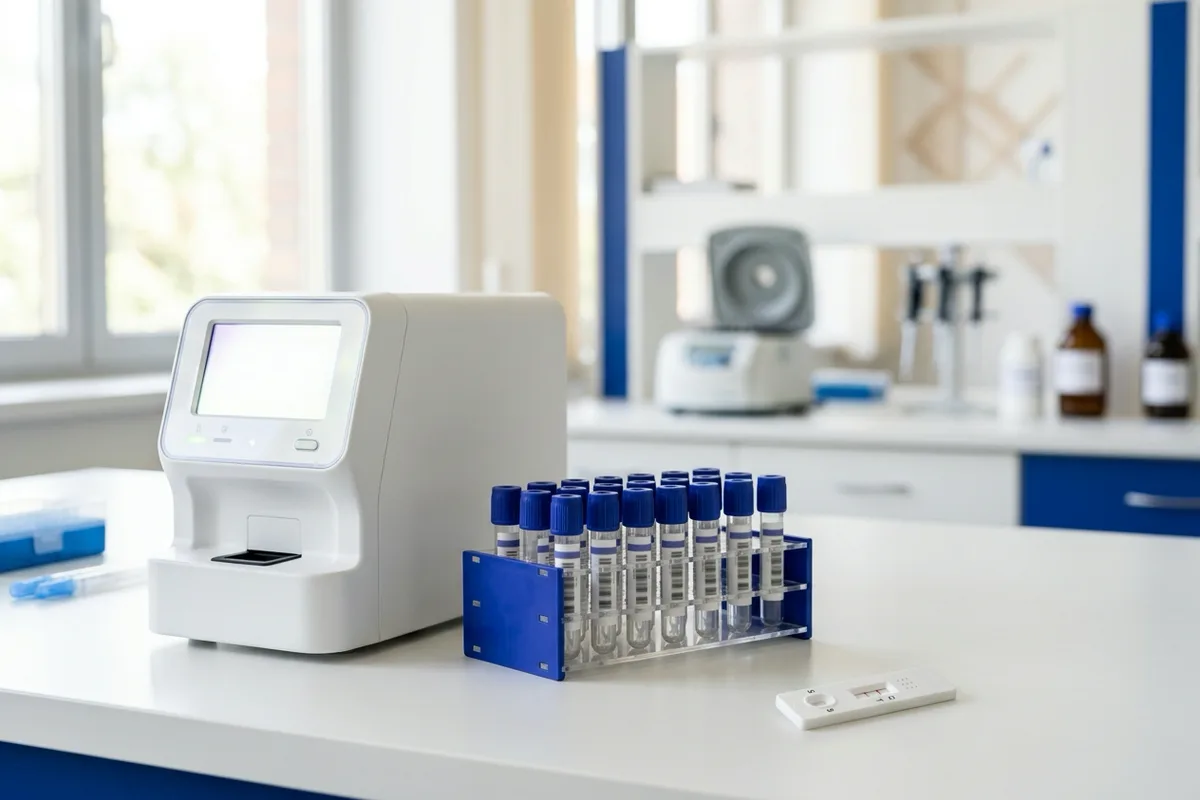
For every regulator below we answer the three questions diagnostics teams ask first: what class is my test, how long will it take, and what will it cost. Exact government fees and our flat annual service fee per market live in the pricing calculator.
What are in vitro diagnostics (IVDs)?
In vitro diagnostics (IVDs) are tests run on samples taken from the body — blood, urine, saliva, or tissue — outside the body, or "in vitro," to detect disease, guide treatment, screen donations, or monitor a condition. The category is broad: blood glucose meters and test strips, pregnancy and fertility tests, rapid antigen and PCR assays for infections such as HIV, hepatitis, or SARS-CoV-2, blood-typing and donor-screening reagents, cancer biomarker panels, next-generation sequencing tests, and the analyzers, instruments, and software that run them. An in vitro diagnostic medical device can be a single-use rapid cassette, a bench-top analyzer, or an entire test system of instrument plus reagents plus software.
Two adjacent terms cause most of the confusion. A companion diagnostic is an IVD whose result decides whether a specific drug is safe or effective for a given patient, so it is developed and reviewed alongside that therapy. A laboratory-developed test (LDT) is an IVD designed, manufactured, and used inside a single laboratory; LDTs currently sit outside FDA's device-registration paths after FDA's 2024 oversight rule was vacated and rescinded. CLIA, often mentioned in the same breath, governs which laboratories may run a test, not how the device itself is registered — the two should not be conflated. The abbreviation IVD also carries unrelated meanings in other fields, but this page is only about in vitro diagnostic devices.
Every jurisdiction draws the risk line differently. The same assay can be a self-certified Class A product in one framework, a Class C device needing a notified body in Europe, and a Class III PMA in the United States — which is why a structured qualification and classification analysis across your target markets is the first deliverable of any serious IVD program. Every cost below has two parts: the government fee, and our own flat annual service fee per market, from US$1,000 per year in the US (device listing and US Agent representation) and from US$2,000 per year in most other markets. Exact current figures live in our pricing calculator.
FDA IVD regulation (United States)
FDA regulates in vitro diagnostics as medical devices on the same risk-based framework as other devices, mostly through CDRH, with CBER handling blood-donor and transfusion-related screening tests. A separate system, CLIA, decides which laboratories may run a given test based on its complexity; it does not replace clearance of the device itself.
- Classification. Most IVDs are Class II and clear through a 510(k); novel tests without a predicate go the De Novo route; the highest-risk assays — many companion diagnostics, HIV and blood-donor screening tests — are Class III and require a PMA. Some low-risk reagents are Class I and exempt, which the qualification memo settles first.
- Timeline. A 510(k) typically runs 3 to 9 months end to end including preparation and FDA interaction; De Novo programs plan for 9 to 15 months; a Class III PMA runs substantially longer and should be planned in years, not months. A Pre-Sub meeting adds a few weeks up front and routinely saves review cycles later.
- Cost. Government fees: US$28,653 for a standard 510(k) review (US$7,163 for qualified small businesses) plus US$13,785 per year in establishment registration; De Novo and PMA run higher. Our flat US$1,000 per year covers FDA establishment registration and device listing maintenance plus US Agent representation; 510(k) preparation and submission are scoped as a separate project.
One caveat sits over the US market: FDA's 2024 rule bringing laboratory-developed tests under device oversight was vacated by a federal court in March 2025 and formally rescinded by FDA in September 2025, so LDTs are not currently subject to FDA device premarket requirements — they remain governed by CLIA — though Congress or FDA could revisit the question.
Companion diagnostics: an IVD tied to a specific drug
A companion diagnostic is reviewed alongside the therapy it guides. In the US, FDA typically clears or approves the companion diagnostic through CDRH — often as a Class III PMA — in coordination with the drug's review, so the test and the label that references it advance together. Plan the diagnostic on the drug's clinical timeline, not after it, because a delayed assay can hold up a launch. The same logic applies in Europe, where a companion diagnostic is a Class C device under IVDR and the notified body must consult the relevant medicines authority before certifying it.
Start from our United States market page for the full FDA pathway.
EU IVDR: in vitro diagnostic classification and CE marking
Europe regulates IVDs under the In Vitro Diagnostic Regulation (Regulation (EU) 2017/746, or IVDR), which has applied since May 2022 and replaced the older IVDD. IVDR classifies tests A through D using seven rules in Annex VIII, and — unlike the old regime, where most products self-certified — the vast majority of IVDs now need a notified body before they can carry the CE mark.
Existing CE-marked IVDs already certified or self-declared under the old IVDD (before 26 May 2022) can stay on the market under extended legacy transition periods added by Regulation (EU) 2024/1860 (in force 9 July 2024): to 31 December 2027 for Class D, 31 December 2028 for Class C, and 31 December 2029 for Class B and sterile Class A — provided there is no significant change of design or intended purpose, an IVDR-compliant QMS was in place by 26 May 2025, and a written agreement with an IVDR notified body was signed by 26 September 2025. New and first-time IVDs get no such extension.
- Classification. Class A covers the lowest-risk products such as general reagents and instruments; Classes B and C cover most patient-facing tests, including many infectious-disease assays, cancer markers, genetic tests, and companion diagnostics (Class C); Class D is the highest risk — screening for transmissible agents in blood and organ donation and high-risk infectious agents — and adds EU reference-laboratory testing. Only non-sterile Class A products self-certify.
- Timeline. Plan 9 to 18 months or more with a notified body for a first Class B or C certification, driven above all by notified body capacity, which remains the binding constraint under IVDR, and by the maturity of your performance evaluation.
- Cost. There is no central government fee; the money goes to the notified body — typically €30,000 to €70,000 across a first certification cycle, higher for Class D — plus annual surveillance, and to building an IVDR-grade performance evaluation. Our EU Authorized Representative service is a flat annual fee from US$2,000, capped at US$4,000 as your portfolio grows, and covers EC REP representation, document review, and EUDAMED support; CE-marking work with your notified body is scoped separately.
Point-of-care and self-testing IVDs
Tests designed for use outside the lab carry extra weight. Under IVDR, self-testing devices are generally pushed up to Class C under Annex VIII Rule 4.1 (with defined exceptions kept at Class B) and must show that a lay user can run them reliably, which means usability and lay-user performance data on top of the analytical file; near-patient (point-of-care) devices are instead classified in their own right under Rule 4.2, by their intended purpose rather than automatically up-classified. In the US, a point-of-care test still needs its FDA clearance, and a separate CLIA waiver determines whether it can be used outside a high-complexity lab. Point-of-care and self-testing programs, in other words, are a classification and human-factors question before they are a distribution one.
Notified body strategy should shape your EU plan early; see the European Union market page for the IVDR route.
IVD registration in Brazil and Latin America (ANVISA RDC 830)
Brazil regulates in vitro diagnostics through ANVISA under RDC 830/2023, which sets IVD risk classification, and anchors any Latin American strategy; Mexico's COFEPRIS is the region's second gate. Both require a local representative — we act as Brazil Registration Holder without taking control of your registration.
- Classification. RDC 830 sorts IVDs into risk Classes I through IV on the international model: lower-risk Class I-II tests follow the streamlined notification (cadastro) route, while Class III-IV tests require full registration (registro) with deeper analytical and clinical performance evidence.
- Timeline. Notification is typically a matter of weeks; Class III-IV registration plans for 6 to 12 months. In Mexico, COFEPRIS runs 6 to 12 months on the standard route, faster where reliance on FDA or CE approvals applies.
- Cost. ANVISA government fees: R$1,406 to notify a Class I-II product; Class III-IV family registration runs R$8,510-19,856, plus a one-time international B-GMP certification of R$72,805 where required. COFEPRIS charges MX$16,499-30,798 per product by class. Our registration service starts at US$2,000 per year, US$3,000 for high-risk classes, in both markets.
Start with the Brazil market page; labeling, instructions for use, and submissions are prepared natively in Portuguese and Spanish.
IVD registration in Asia-Pacific: Singapore first, then ASEAN
Most overseas diagnostics teams enter Asia-Pacific through Singapore: HSA works in English, follows the IMDRF model, has IVD-specific guidance, and rewards a solid FDA or CE dossier with a fast abridged review. A Singapore approval then anchors expansion across ASEAN — Malaysia, Thailand, Indonesia, Vietnam, the Philippines — where reliance-friendly frameworks make each additional market incremental rather than a new program. Japan and Korea are the region's big mature prizes with their own systems and languages. China is the largest market but the hardest entry — local type testing, registration testing of reagents, and the longest timelines — so treat it as its own program when the business case justifies it, not as a default stop.
- Classification. Singapore's HSA classifies IVDs A through D with test-specific guidance, and ASEAN members track the same model under the AMDD. Japan classifies IVDs through PMDA; Korea's MFDS uses its own risk classes; China grades IVD reagents into Classes I, II, and III, with the highest-risk assays facing the deepest review.
- Timeline. HSA abridged evaluation with a reference approval closes in 2 to 6 months; ASEAN registrations typically run 3 to 9 months per market on the back of the same dossier. Japan plans for 9 to 14 months via PMDA; Korea 6 to 12 months including KGMP; China 12 to 24 months including registration testing.
- Cost. Singapore's government fees are light: an SGD 560 application plus SGD 2,010-6,250 evaluation by class, and ASEAN peers are similar (Malaysia MYR 500-3,750; Thailand THB 3,100-74,000). China's NMPA fees for imported Class II-III run roughly RMB 210,000-310,000 before type-testing costs. Our registration service starts at US$2,000 per year across Singapore and ASEAN; Japan, Korea, and China are quoted flat per market on the same model.
One well-built reference dossier does most of the region's work — sequencing is the strategy. See the Singapore, Malaysia, Thailand, Japan, South Korea, and China market pages.
IVD registration in Saudi Arabia and MENA (SFDA)
The Gulf is one of the fastest-growing diagnostics regions in our portfolio, and its regulators are built around reliance: a strong FDA, CE, or other reference approval does most of the work if the dossier is assembled correctly. SFDA regulates IVDs explicitly and requires a local Authorized Representative.
- Classification. SFDA classifies IVDs into risk Classes A through D on the IMDRF model, mirroring your reference-market class in most cases; the UAE's MOHAP and other MENA authorities lean on the reference approval's classification.
- Timeline. With a reference approval in hand, SFDA marketing authorization typically closes in 2 to 6 months; UAE registration runs a similar range. Without a reference approval, expect materially longer.
- Cost. Government fees across the Gulf are modest — generally a few thousand US dollars' equivalent per authority — so the real spend is dossier assembly, Arabic labeling where required, and local representation. We quote MENA registration programs flat per market, on the same transparent model as our calculator markets.
See the Saudi Arabia and UAE market pages; we run the wider region under one program.
Evidence, quality system, and lifecycle
IVDs live and die on performance evidence. Every major framework wants the same three things in some form — analytical performance (does the test measure what it claims, with what sensitivity and specificity), clinical or scientific performance (does the result mean what you say clinically), and stability — and IVDR formalizes all of it as a performance evaluation under Annex XIII. We build that evidence once and reuse it across FDA, IVDR, and APAC submissions, set up an ISO 13485 quality system sized for reagent and instrument manufacturing, and plan the studies so a single well-designed dataset supports multiple markets. For connected analyzers and IVD software that move results across a network, we maintain cybersecurity documentation aligned with FDA and IVDR expectations. After launch, post-market performance follow-up, lot release, and vigilance keep every registration current.
One program, every major market
A global IVD program is a sequencing problem: pick the anchor market, build the performance dossier and quality system once, and reuse the qualification analysis, evidence, and QMS artifacts everywhere else. We run the full program from a single team — strategy, submissions, in-country representation, and post-market maintenance — with transparent government fees and timelines in our pricing calculator.
 Case Study · Aug 5, 2026COFEPRIS IVD Registration for a Reagent MenuCase Study · Aug 5, 2026Vietnam IVD Registration for an Oncology AssayBlog · Jul 27, 2026IVD Global Market Access 2026Blog · Jul 9, 2026How to register medical devices and IVDs in BrazilBlog · Nov 5, 2025Indonesia's Medical Device and IVD Import MarketBlog · Jul 25, 2025MDCG 2025-5 Clarifies EU Rules for IVD Performance Studies Under IVDRRegulatory Update · Oct 17, 2026FDA Toxicology 510(k) ExemptionsRegulatory Update · Sep 14, 2026MDCG Rule 7: IVD Quality ControlsRegulatory Update · Aug 26, 2026EU AI Act Annex I Date 2028Regulatory Update · Mar 25, 2026MDA Participation in WHO Collaborative Registration Procedure for Prequalified IVDs
How we help diagnostics teams
One team runs your IVD program end to end, from the first qualification memo to post-market performance follow-up in every registered market.

Qualification and IVDR risk classification in every target market
510(k), De Novo, PMA, IVDR performance evaluation, and ANVISA RDC 830 dossiers
US Agent, EU Authorized Representative, and Brazil Registration Holder
Companion diagnostic strategy and post-market performance follow-up

Frequently asked questions
IVD stands for in vitro diagnostic. An IVD is a test performed on a sample taken from the body — blood, urine, saliva, or tissue — and examined outside the body ("in vitro," meaning "in glass") rather than on the patient directly. IVDs detect disease, guide treatment choices, screen blood and organ donations, and monitor conditions. In regulatory terms they are a distinct category of medical device, with their own classification rules in most markets.
Everyday examples include blood glucose meters and test strips, home pregnancy tests, rapid antigen and PCR tests for infections such as influenza, HIV, or SARS-CoV-2, cholesterol and blood-chemistry panels, blood-typing and donor-screening reagents, cancer biomarker tests, and genetic and next-generation sequencing tests. The instruments (analyzers), reagents, and software that produce and interpret the result are part of the IVD as well. General laboratory equipment with no diagnostic claim is usually not an IVD.
IVDR (Regulation (EU) 2017/746) classifies IVDs into four risk classes, A (lowest) through D (highest), using seven rules in Annex VIII. Class A covers general reagents and instruments; Classes B and C cover most patient-facing tests, including companion diagnostics at Class C; Class D covers the highest-risk tests, such as screening for transmissible agents in donated blood and organs. Only non-sterile Class A products can self-certify — everything else needs a notified body, which is the main change from the old IVDD.
Typical ranges: 3 to 9 months for an FDA 510(k) including preparation, 9 to 18 months or more for EU IVDR with a notified body, 6 to 12 months for ANVISA depending on class, and 12 to 24 months for China's NMPA with local testing. A Class III PMA or a Class D IVDR device runs longer. Sequencing and dossier reuse compress the total program significantly, and our pricing calculator gives per-market estimates.
Directly, rarely: most regulators require their own submission. Practically, yes: markets such as Singapore and the Gulf run reliance or abridged routes that lean on a reference approval, and a well-built FDA or CE performance dossier supplies most of the technical file everywhere else. We sequence registrations so each approval shortens the next one.
In most major markets, yes, if you have no local entity: a US Agent in the United States, an EU Authorized Representative under IVDR, a Brazil Registration Holder, and an Authorized Representative in Saudi Arabia, among others. Who holds your registration matters commercially, and we provide representation that keeps every registration under your control.
A companion diagnostic is an IVD whose result determines whether a specific drug is safe or effective for a patient, so it is tied to that therapy's approval and label. In the US, FDA typically reviews it through CDRH — often as a Class III PMA — in coordination with the drug's review; under EU IVDR it is a Class C device, and the notified body must consult the relevant medicines authority before certifying it. Because the test and the drug advance together, the diagnostic should be planned on the drug's clinical timeline.
Yes. FDA regulates IVDs as medical devices, mostly through CDRH, with blood-donor and transfusion-screening tests handled by CBER; a separate CLIA system governs which laboratories may run a test. Laboratory-developed tests (LDTs) — tests designed and used within a single lab — are a distinct case: FDA's 2024 rule bringing them under device oversight was vacated by a federal court in March 2025 and rescinded by FDA in September 2025, so LDTs are not currently subject to FDA device premarket review and remain governed by CLIA.
It depends on the change. In the US, FDA expects a documented change assessment: minor changes are handled as a letter to file, while changes that could significantly affect safety or effectiveness — a new analyte, specimen type, or cutoff — need a new 510(k), or a PMA supplement for Class III assays. Under the EU IVDR, significant changes to a certified assay must go to your notified body before implementation. License-holder markets such as Brazil and much of ASEAN require amendment filings, and some changes trigger re-registration. We run one change assessment across every market you sell in, so a single engineering change does not turn into a dozen uncoordinated filings.
Single Process,
Multiple Markets
When you partner with Pure Global, a single registration process opens doors to multiple countries. Our global subsidiaries make this streamlined path possible.











Let's Talk,
Anywhere You Are.
Whether looking for more information or ready to partner with us, we're here to guide you through every step of the regulatory process.
Contact us