21 CFR Part 820 to ISO 13485: The QMSR Crosswalk
QMSR cut 21 CFR Part 820 from 31 sections to six and made ISO 13485:2016 the rule. This crosswalk maps every old section to its ISO 13485 clause, marks which mappings FDA stated, lists the FDA-only requirements and shows where a decade of 483 citations now lands.
TL;DR
Since 2 February 2026, 21 CFR Part 820 has been the Quality Management System Regulation (QMSR). The old Quality System regulation had 31 sections across 15 subparts. The QMSR has six active sections: scope, definitions, incorporation by reference, the core requirement to comply with ISO 13485:2016, record controls, and labeling and packaging controls. Everything else is reserved. The substantive requirements now come from ISO 13485:2016, which section 820.7 incorporates by reference. 1
FDA has not published a section-by-section crosswalk. Its proposed rule offered a subpart-level table, the final rule's preamble maps some sections explicitly, and FDA's QMSR pages point readers to a paid AAMI technical report for the full mapping. 2
This guide gives a complete crosswalk of all 31 old sections. It marks which mappings FDA stated and which are ours, and it lists the FDA-specific requirements ISO 13485 does not cover. It also shows where ten years of FDA Form 483 citations land once you translate them into ISO 13485 clauses.
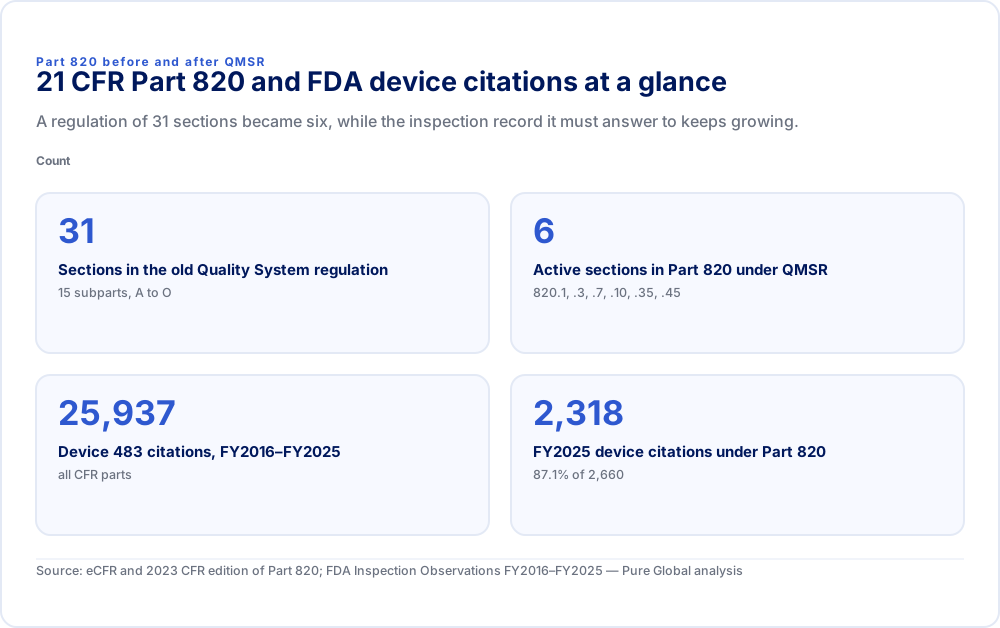
Part 820 before and after QMSR21 CFR Part 820 and FDA device citations at a glanceA regulation of 31 sections became six, while the inspection record it must answer to keeps growing.Count
- Sections in the old Quality System regulation
- 3115 subparts, A to O
- Active sections in Part 820 under QMSR
- 6820.1, .3, .7, .10, .35, .45
- Device 483 citations, FY2016–FY2025
- 25,937all CFR parts
- FY2025 device citations under Part 820
- 2,31887.1% of 2,660
Source: eCFR and 2023 CFR edition of Part 820; FDA Inspection Observations FY2016–FY2025 — Pure Global analysis
What 21 CFR Part 820 contains today
The current Part 820 is short. Read it alongside ISO 13485:2016 and ISO 9000:2015 clause 3, which carry the force of law through incorporation by reference.
| Section | Heading | What it does |
|---|---|---|
| 820.1 | Scope | Applies Part 820 to manufacturers of finished devices, including contract sterilizers, relabelers, remanufacturers, repackers and specification developers. Component manufacturers are excluded. Where ISO 13485 conflicts with the FD&C Act or FDA regulations, the Act and regulations control. |
| 820.3 | Definitions | Adopts ISO 13485 and ISO 9000 definitions, adds terms ISO does not define (batch or lot, component, finished device, HCT/P regulated as a device, remanufacturer) and overrides some ISO terms (device, labeling, implantable medical device, manufacturer, organization, rework, safety and performance). |
| 820.7 | Incorporation by reference | Incorporates ISO 13485:2016 (third edition, 1 March 2016) and clause 3 of ISO 9000:2015. |
| 820.10 | Requirements for a quality management system | Requires a QMS that complies with ISO 13485 and Part 820. Links ISO clauses to FDA's UDI, tracking, MDR and corrections-and-removals rules. Sets design-control applicability, adds traceability for life-supporting and life-sustaining devices, and makes noncompliance adulteration under section 501(h). |
| 820.35 | Control of records | Adds required content for complaint, servicing and UDI records, plus confidentiality marking. |
| 820.45 | Device labeling and packaging controls | Requires examination of labeling and packaging, documented release and controls against mix-ups. |
Sections 820.5, 820.20 to 820.30 and 820.40 are reserved, as are Subparts C to O. 1 The final rule was published on 2 February 2024 and took effect two years later. 3
What QMSR removed or renamed
Several familiar terms are gone from the regulation. The records behind them still exist, under ISO 13485 names.
- DHF, DMR and DHR. FDA did not retain the design history file, device master record or device history record. In the preamble FDA writes that it "eliminated terms associated with these specific record types." The device master record content now sits in the medical device file of ISO 13485 clause 4.2.3. The design history file becomes the design and development file of clause 7.3.10. The device history record becomes the record for each device or batch under clause 7.5.1.
- Management with executive responsibility becomes "top management," as defined in ISO 9000.
- The 820.180(c) exception is gone. Management reviews, quality audit reports and supplier audit reports are now open to inspection. FDA's FAQ says so directly. 4
- The independent design reviewer required by old 820.30(e) is not retained. Clause 7.3.5 governs design reviews instead.
- QSIT. FDA stopped using the Quality System Inspection Technique on 2 February 2026. Inspections now follow Compliance Program 7382.850. 5
- "Design controls" and "design validation" survive in practice but not as regulatory terms. FDA's software guidance now notes that QMSR "does not utilize certain terms, such as 'Design Controls,' and 'Design Validation'." It points to clause 7.3 instead. 6
The complete crosswalk: old QS regulation to ISO 13485:2016
Every old section has a home. In the source column, "FDA" means the QMSR preamble or Compliance Program 7382.850 states the mapping. "Pure Global" means we derived it from the ISO 13485 clause titles and CP 7382.850 Attachment A.
| Old section | Topic | ISO 13485:2016 clause(s) | QMSR provision or note | Source |
|---|---|---|---|---|
| 820.1 | Scope | 1 | 820.1 retained, with component exclusion and a conflict rule | FDA |
| 820.3 | Definitions | 3 (and ISO 9000:2015 clause 3) | 820.3 adds and overrides definitions | FDA |
| 820.5 | Quality system | 4.1, 4.2 | 820.10(a) | Pure Global |
| 820.20 | Management responsibility | 5.1–5.6; 4.2.2 quality manual; 6.1 | Management review records now inspectable | Pure Global |
| 820.22 | Quality audit | 8.2.4 | Audit reports now inspectable | Pure Global |
| 820.25 | Personnel and training | 6.2 | FDA maps qualified-personnel duties in old 820.20(b)(2) and 820.75(b)(1) to 6.2 | FDA (in part) |
| 820.30 | Design controls | 7.3.1–7.3.10; 7.1 for risk management | Applicability in 820.10(c); risk analysis now runs through 7.1; independent reviewer not retained | FDA |
| 820.30(j) | Design history file | 7.3.10 design and development file | DHF term removed | FDA |
| 820.40 | Document controls | 4.2.4 | — | Pure Global |
| 820.50 | Purchasing controls | 4.1.5 outsourcing; 7.4.1–7.4.3 | Supplier audit reports now inspectable | Pure Global |
| 820.60 | Identification | 7.5.8 | — | Pure Global |
| 820.65 | Traceability | 7.5.9.1, 7.5.9.2 | 820.10(d) traceability for life-supporting or life-sustaining devices | FDA |
| 820.70 | Production and process controls | 7.5.1, 6.3, 6.4.1–6.4.2, 7.5.2; 4.1.6 for QMS software | — | Pure Global |
| 820.72 | Inspection, measuring and test equipment | 7.6 | — | Pure Global |
| 820.75 | Process validation | 7.5.6; 7.5.7 for sterilization | — | Pure Global |
| 820.80 | Receiving, in-process and finished device acceptance | 7.4.3, 8.2.6 | — | Pure Global |
| 820.86 | Acceptance status | 7.5.8, 8.2.6 | — | Pure Global |
| 820.90 | Nonconforming product | 8.3.1–8.3.4 | — | Pure Global |
| 820.100 | Corrective and preventive action | 8.5.2, 8.5.3; 8.4 data analysis | FDA maps old 820.100(a)(6)–(7) to 8.2.2, 8.5.2 and 8.3.1 | FDA (in part) |
| 820.120 | Device labeling | 7.5.1 | 820.45 covers label integrity and inspection | FDA |
| 820.130 | Device packaging | 7.5.11 | 820.45 | Pure Global |
| 820.140 | Handling | 7.5.11 | — | Pure Global |
| 820.150 | Storage | 7.5.11 | — | FDA |
| 820.160 | Distribution | 7.5.1, 7.5.9 | 820.10(d) for life-supporting or life-sustaining devices | Pure Global |
| 820.170 | Installation | 7.5.3 | 820.35(b) records where servicing is involved | Pure Global |
| 820.180 | General records requirements | 4.2.5 | 820.35; 820.35(d) confidentiality; 820.180(c) exception removed | FDA |
| 820.181 | Device master record | 4.2.3 medical device file | DMR term removed | FDA |
| 820.184 | Device history record | 7.5.1 record for each device or batch | DHR term removed | FDA |
| 820.186 | Quality system record | 4.2.1, 4.2.2 | — | Pure Global |
| 820.198 | Complaint files | 8.2.2, 8.2.3 | 820.35(a) complaint record content; MDR through 820.10(b)(3) | FDA (in part) |
| 820.200 | Servicing | 7.5.4 | 820.35(b) servicing record content | FDA (in part) |
| 820.250 | Statistical techniques | 8.1, 8.4; 7.4.3 for sampling | — | Pure Global |
FDA's own subpart-level table, in the 2022 proposed rule, found most subparts "substantially similar" to ISO 13485. It flagged document controls, labeling and packaging, records and servicing as areas where FDA would add requirements. Those additions became 820.35 and 820.45. FDA describes that table as "a higher-level mapping," not a requirement-by-requirement analysis. 7
FDA requirements that ISO 13485 alone does not cover
An ISO 13485 certificate does not make a firm QMSR-compliant. These are the FDA-specific obligations to add on top of the standard.
- The four linked FDA rules (820.10(b)). ISO 13485 clause 7.5.8 must be met together with Part 830 (UDI), and 7.5.9.1 with Part 821 (tracking), where tracking applies. Clause 8.2.3 must be met with Part 803 (medical device reporting). Advisory notices under 7.2.3, 8.2.3 and 8.3.3 must also satisfy Part 806 (corrections and removals).
- Design-control applicability (820.10(c)). Clause 7.3 applies to Class II and III devices, Class I devices automated with software and five listed Class I device types. It also applies to investigational devices.
- Traceability for life-supporting and life-sustaining devices (820.10(d)). They must meet the implantable-device traceability of clause 7.5.9.2.
- Complaint record content (820.35(a)). Records for complaints that are investigated or MDR-reportable must include the device name, the date received, any UDI or UPC, the complainant's name, address and phone number, and the nature and details of the complaint. They must also record any correction or corrective action and any reply to the complainant. If you decide not to investigate because a similar investigation exists, document the justification.
- Servicing records (820.35(b)). Record the device name, any UDI or UPC, the date of service, who serviced the device, the service performed, and test and inspection data.
- UDI recording (820.35(c)). "The UDI must be recorded for each medical device or batch of medical devices."
- Labeling and packaging (820.45). Examine labeling for UDI, expiration date, storage and handling instructions before release. Document the release, and control labeling operations to prevent mix-ups.
- FDA definitions and the conflict rule (820.1, 820.3). "Device" and "labeling" carry their FD&C Act meanings. Where ISO 13485 conflicts with FDA law, FDA law controls.
- Inspection, not certification. FDA's FAQ: "A certificate of conformance to ISO 13485 will not exempt a manufacturer from an FDA inspection." MDSAP audit reports can still substitute for routine surveillance inspections. 8
Where ten years of FDA citations land in ISO 13485
We translated every device Form 483 citation from FY2016 to FY2025 into the ISO 13485 clause that now covers it. Five clause families carry almost half of a decade of findings.
FDA's annual Inspection Observations spreadsheets record 25,937 device citations from FY2016 to FY2025. The table below regroups them by clause. Design and development combines old 820.30 in full, including risk analysis under 820.30(g), which now also falls under clause 7.1. 9
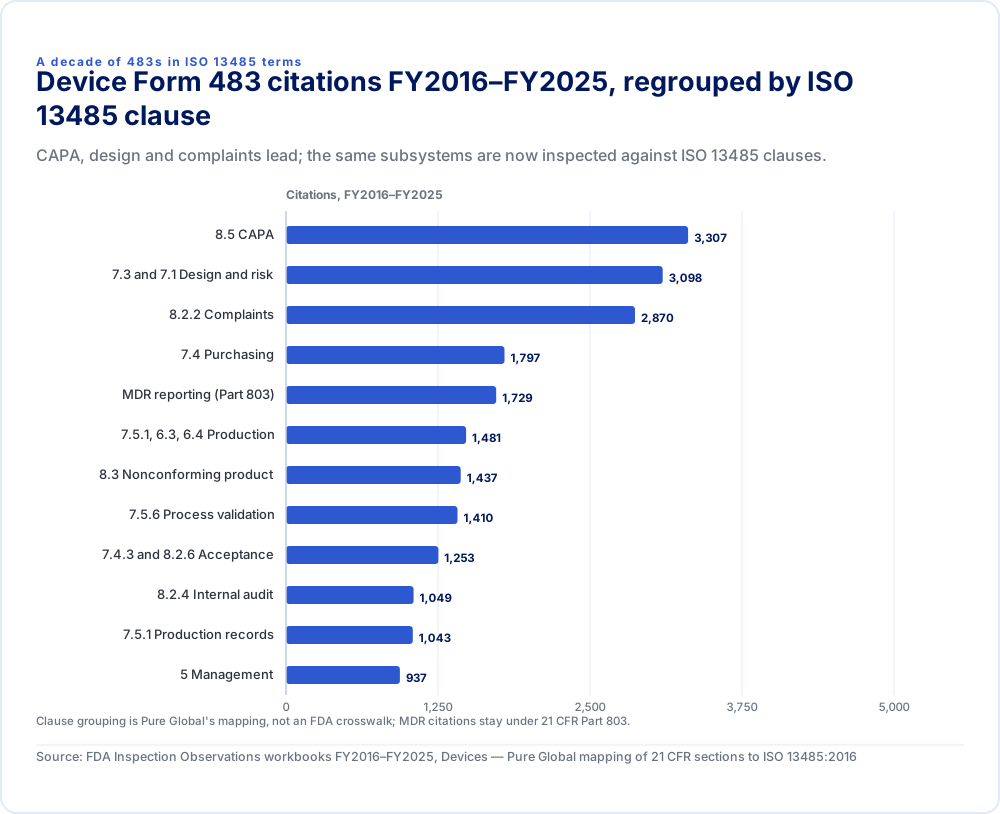
| Citations | |
|---|---|
| 8.5 CAPA | 3,307 |
| 7.3 and 7.1 Design and risk | 3,098 |
| 8.2.2 Complaints | 2,870 |
| 7.4 Purchasing | 1,797 |
| MDR reporting (Part 803) | 1,729 |
| 7.5.1, 6.3, 6.4 Production | 1,481 |
| 8.3 Nonconforming product | 1,437 |
| 7.5.6 Process validation | 1,410 |
| 7.4.3 and 8.2.6 Acceptance | 1,253 |
| 8.2.4 Internal audit | 1,049 |
| 7.5.1 Production records | 1,043 |
| 5 Management | 937 |
Clause grouping is Pure Global's mapping, not an FDA crosswalk; MDR citations stay under 21 CFR Part 803.
Source: FDA Inspection Observations workbooks FY2016–FY2025, Devices — Pure Global mapping of 21 CFR sections to ISO 13485:2016
| ISO 13485 clause family (old section) | Citations FY2016–2025 | Share | FY2025 |
|---|---|---|---|
| 8.5 Improvement and CAPA (820.100) | 3,307 | 12.8% | 342 |
| 7.3 and 7.1 Design and development, with risk analysis (820.30) | 3,098 | 11.9% | 315 |
| 8.2.2 Complaint handling (820.198) | 2,870 | 11.1% | 286 |
| 7.4 Purchasing (820.50) | 1,797 | 6.9% | 190 |
| Part 803 Medical device reporting | 1,729 | 6.7% | 141 |
| 7.5.1, 6.3, 6.4 Production and process controls (820.70) | 1,481 | 5.7% | 155 |
| 8.3 Nonconforming product (820.90) | 1,437 | 5.5% | 132 |
| 7.5.6 Process validation (820.75) | 1,410 | 5.4% | 153 |
| 7.4.3 and 8.2.6 Verification and acceptance (820.80) | 1,253 | 4.8% | 117 |
| 8.2.4 Internal audit (820.22) | 1,049 | 4.0% | 107 |
| 7.5.1 Production records, formerly the DHR (820.184) | 1,043 | 4.0% | 91 |
| 5 Management responsibility (820.20) | 937 | 3.6% | 119 |
Two practical points follow. First, the subsystems FDA cites most are the ones where ISO 13485 and the old regulation were already closest, so transition work alone will not move the numbers. CAPA, complaint and design files have to work in practice. Second, two areas were mostly hidden from investigators before 2026 and are now in scope: internal audits (8.2.4, already 4.0% of citations) and management review (part of clause 5). Investigators can now read the reports themselves, not just check that procedures exist. Our inspection readiness checklist turns this into a preparation plan.
ISO 13485 and 21 CFR 820: the differences that matter in practice
- Risk management runs through the whole QMS. The old regulation mentioned risk analysis only in design validation (820.30(g)). ISO 13485 requires a risk-based approach to QMS processes (4.1.2) and risk management throughout product realization (7.1). FDA's QMSR page says the rule "now specifically requires risk management." ISO 14971 is the usual way to meet it. See our ISO 14971 risk management file guide.
- Software validation reaches the QMS itself. Clause 4.1.6 requires validation of software used in the QMS, such as eQMS, ERP and complaint databases. Clauses 7.5.6 and 7.6 cover production and monitoring software.
- Outsourcing is explicit. Clause 4.1.5 makes the manufacturer responsible for outsourced processes "proportionate to the risk involved," on top of supplier controls in 7.4.
- The medical device file is one file per device type or family. It replaces the DMR, but its contents follow clause 4.2.3: description, intended use, labeling, specifications, production, servicing and installation procedures.
- Records retention. Clause 4.2.5 requires retention for at least the lifetime of the device as defined by the manufacturer, and no less than two years from release.
- "Regulatory requirements" appear throughout ISO 13485. In the US those include Parts 801, 803, 806, 807, 821 and 830. The QMSR links several of them explicitly through 820.10(b).
A QMSR transition checklist
- Re-baseline the quality manual and procedures on ISO 13485:2016, with a crosswalk like the table above as a controlled document.
- Rename and restructure the record types. Index the medical device file, the design and development file, and the device or batch records. Retire DHF, DMR and DHR references, or define them as aliases in your procedures.
- Add the FDA-specific content in 820.10(b) to (d), 820.35 and 820.45 to the relevant procedures and forms, especially complaint and servicing forms.
- Prepare management review and internal audit records for inspection. They are now inspectable, so write them as if an investigator will read them.
- Close the evidence gaps that FDA cites most. That means CAPA effectiveness checks, complaint investigation decisions, risk file updates after post-market events and design-change regulatory assessments.
- Train staff on the new vocabulary and inspection approach, including how CP 7382.850 organizes an inspection into six QMS areas.
FDA's FAQ notes that investigators may review records created before 2 February 2026. It suggests that "a manufacturer may find it useful to complete some type of comparative analysis." Pure Global AI's free QMSR gap analysis is one way to start. 10
How Pure Global helps
We run QMSR gap assessments against ISO 13485:2016 and the FDA-specific provisions, and rewrite procedures and forms for complaints, servicing, labeling and the medical device file. We also prepare teams for inspections under CP 7382.850. For companies already certified to ISO 13485 under MDSAP or the EU MDR, we focus on the FDA additions and on the records that are newly inspectable. See FDA QMSR consulting or contact our team.
How we built the crosswalk and the numbers
- Regulation text: the current eCFR text of Part 820 as of October 2026, and the 2023 edition of 21 CFR Part 820 for the 31 pre-QMSR sections. 11
- "FDA" mappings: taken from the QMSR final-rule preamble (for example its discussion of the DHF, DMR and DHR, storage, labeling, traceability and the records exception) and from CP 7382.850 Attachment A. Rows marked "Pure Global" are our analysis and are not an FDA crosswalk.
- Citation counts: FDA's Inspection Observations workbooks for FY2016 to FY2025, Devices tab. They count citation frequency on 483s issued from FDA's electronic system. We grouped citations by section and, for 820.30, by paragraph.
References
- eCFR — 21 CFR Part 820, Quality Management System Regulation, current text. ecfr.gov ↩ ↩
- U.S. FDA — Quality Management System Regulation (QMSR). fda.gov ↩
- Federal Register — Medical Devices; Quality System Regulation Amendments, final rule, 89 FR 7496, 2 February 2024. federalregister.gov ↩
- U.S. FDA — Quality Management System Regulation: Frequently Asked Questions. fda.gov ↩
- U.S. FDA — Compliance Program 7382.850, Inspection of Medical Device Manufacturers, implemented 2 February 2026. fda.gov ↩
- U.S. FDA — Content of Premarket Submissions for Device Software Functions, guidance with QMSR cover note. fda.gov ↩
- Federal Register — Medical Devices; Quality System Regulation Amendments, proposed rule, 87 FR 10119, 23 February 2022. federalregister.gov ↩
- U.S. FDA — Medical Device Single Audit Program (MDSAP). fda.gov ↩
- U.S. FDA — Inspection Observations, fiscal year spreadsheets FY2006–FY2025. fda.gov ↩
- Pure Global AI — QMSR gap analysis. pureglobal.ai ↩
- govinfo — Code of Federal Regulations, Title 21 Part 820, 2023 edition (pre-QMSR Quality System regulation). govinfo.gov ↩
 Market · Oct 14, 2026FDA US Medical Device RegistrationRegulatory Update · Sep 17, 2026FDA Buffy Coat System GuidanceRegulatory Update · Aug 13, 2026FDA QMSR Warning Letters on Risk and Design ChangesRegulatory Update · Aug 9, 2026FDA FY 2027 Medical Device User FeesRegulatory Update · Jun 2, 2026FDA Human Factors Guidance 2026 Update for Device SubmissionsVideo · Mar 12, 2026How to Register a Medical Device with the US FDAMarket Service · Jul 24, 2026FDA Certificate to Foreign Government (CFG) for Medical DevicesMarket Service · Jul 27, 2026FDA Form 483 and Warning Letter Response ConsultingCase Study · Aug 11, 2026One Balloon-Catheter Line, Two ANVISA RoutesCase Study · Aug 5, 2026COFEPRIS IVD Registration for a Reagent Menu
FDA Cleared vs Approved vs Granted: 510(k), PMA and De Novo
In 2025 FDA cleared 3,198 devices through 510(k), granted 27 De Novo requests and approved 38 original PMAs. This guide explains what each word means legally, how long each route takes, what it costs in FY2027 and how to describe your device's status without misbranding it.
FDA Inspection Readiness Checklist (QMSR)
FDA now inspects device makers under the QMSR and Compliance Program 7382.850. Our analysis of ten years of FDA Form 483 data shows where investigators find problems, and the 12-point checklist turns those findings into records to prepare before the investigator arrives.
FDA Medical Device Classification: Class I, II and III Explained
FDA's October 2026 product code file puts 36.5% of classified codes in Class I, 55.4% in Class II and 8.0% in Class III. This guide explains what each class requires, why class alone does not decide the pathway, and how to confirm your device's class in six steps.
Let's Talk,
Anywhere You Are.
Whether looking for more information or ready to partner with us, we're here to guide you through every step of the regulatory process.
Contact us