FDA Cleared vs Approved vs Granted: 510(k), PMA and De Novo
In 2025 FDA cleared 3,198 devices through 510(k), granted 27 De Novo requests and approved 38 original PMAs. This guide explains what each word means legally, how long each route takes, what it costs in FY2027 and how to describe your device's status without misbranding it.
TL;DR
"FDA cleared," "FDA approved" and "FDA granted" are not synonyms. Each names a different legal decision.
- Cleared means FDA found a device substantially equivalent to a legally marketed predicate through a 510(k).
- Approved means FDA approved a premarket approval (PMA) application after finding valid scientific evidence that the device is safe and effective.
- Granted means FDA granted a De Novo request and created a new Class I or Class II classification for a novel device that has no predicate.
The volumes are lopsided. Pure Global's analysis of the official openFDA exports covers calendar year 2025: FDA decided 3,198 510(k) clearances, granted 27 De Novo requests and approved 38 original PMAs. Clearances were 98.0% of those new marketing authorizations. Over 2016 to 2025 the split is almost identical: 30,669 clearances, 322 De Novo grants and 281 original PMA approvals. 1 2
Getting the word right matters. FDA's regulation says a 510(k) clearance "does not in any way denote official approval of the device," and a claim that creates "an impression of official approval" is misbranding. 3
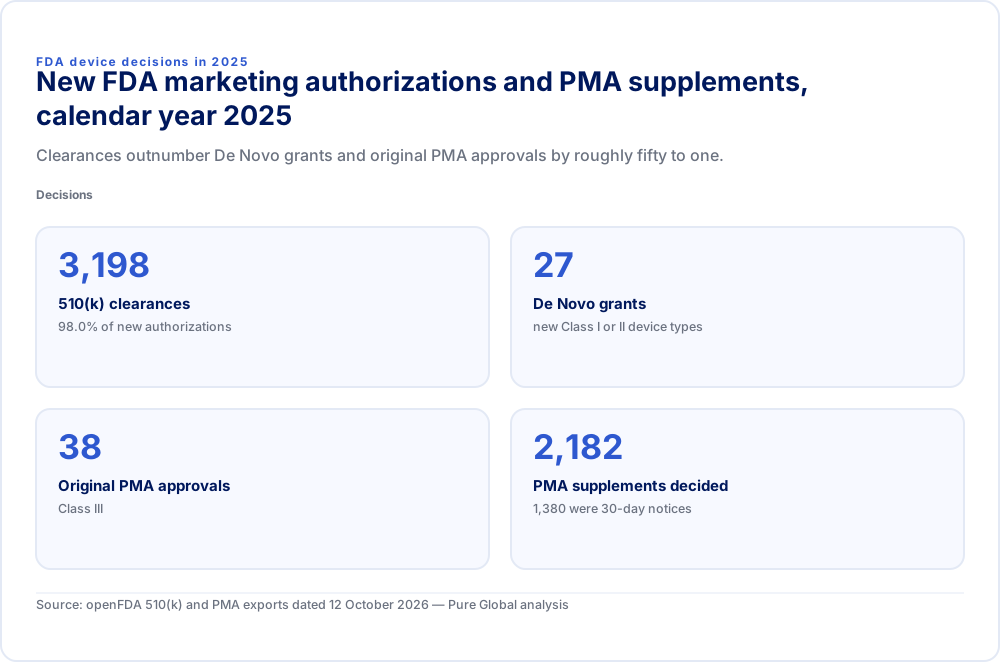
FDA device decisions in 2025New FDA marketing authorizations and PMA supplements, calendar year 2025Clearances outnumber De Novo grants and original PMA approvals by roughly fifty to one.Decisions
- 510(k) clearances
- 3,19898.0% of new authorizations
- De Novo grants
- 27new Class I or II device types
- Original PMA approvals
- 38Class III
- PMA supplements decided
- 2,1821,380 were 30-day notices
Source: openFDA 510(k) and PMA exports dated 12 October 2026 — Pure Global analysis
Cleared, approved and granted in one table
The three outcomes differ in the question FDA answers, the evidence it expects, the fee and the review clock.
| Cleared | Approved | Granted | |
|---|---|---|---|
| Submission | Premarket notification, 510(k) | Premarket approval application, PMA | De Novo classification request |
| Question FDA answers | Is the device substantially equivalent to a legally marketed predicate? | Is there valid scientific evidence that the device is safe and effective? | Can general, or general and special, controls provide reasonable assurance for a new device type with no predicate? |
| Typical device class | Class II, some Class I | Class III | New Class I or Class II type |
| Predicate needed | Yes | No | No; De Novo applies when none exists |
| Creates a new classification | No | No | Yes; the device becomes a predicate |
| FY2027 FDA fee (standard / small business) | $28,653 / $7,163 | $636,732 / $159,183 | $191,020 / $47,755 |
| MDUFA V review goal | 90 FDA days | 180 FDA days (320 with a panel) | 150 FDA days |
| Decisions in 2025 | 3,198 | 38 originals | 27 |
| Median calendar days, receipt to decision, 2025 | 142 (Traditional) | 271.5 | 299 |
Fees apply from 1 October 2026 to 30 September 2027. 4 Review goals are from the MDUFA V commitment letter. "FDA days" exclude time a submission is on hold waiting for the sponsor, so calendar times run longer. 5
What "FDA cleared" means: the 510(k)
A cleared device has been found substantially equivalent to a device already legally on the US market. It has not been found safe and effective on its own evidence.
FDA describes a 510(k) as a submission "to demonstrate that the device to be marketed is as safe and effective, that is, substantially equivalent, to a legally marketed device." It also explains what follows: the submitter must receive an order "which finds the device to be substantially equivalent," and "this order 'clears' the device for commercial distribution." 6
Substantial equivalence means the same intended use as the predicate, plus one of two things. Either the device has the same technological characteristics, or its different characteristics "do not raise different questions of safety and effectiveness" and the data show it is as safe and effective. Clinical data are sometimes needed, but most 510(k)s rely on bench, biocompatibility, software, electrical safety and performance testing against recognized standards.
There are three kinds of 510(k): Traditional, Special and Abbreviated. FDA generally reviews Special 510(k)s, which cover certain changes to a manufacturer's own cleared device, within 30 days. 7 All 510(k)s must use the eSTAR electronic template unless exempted, a rule in force since 1 October 2023. 8
What 2025 looked like in the openFDA export:
| 510(k) type | Clearances in 2025 | Median calendar days | Middle half of decisions |
|---|---|---|---|
| Traditional | 2,655 | 142 | 90 to 231 days |
| Special | 481 | 30 | 27 to 57 days |
| Abbreviated | 41 | 154 | 90 to 261 days |
| Reviewed by an accredited third party | 60 | 27 | not shown, small sample |
Third-party 510(k)s are a subset that overlaps the three types. No FDA user fee is charged when an accredited third party submits the 510(k). 9
If FDA finds a device not substantially equivalent, the device is Class III by default. The applicant may submit a new 510(k), request De Novo classification, petition for reclassification or file a PMA.
What "FDA approved" means: the PMA
Approval is FDA's most demanding device decision. It rests on the applicant's own evidence of safety and effectiveness, not on comparison to a predicate.
FDA calls the PMA "the most stringent type of device marketing application required by FDA." Approval "is based on a determination by FDA that the PMA contains sufficient valid scientific evidence to assure that the device is safe and effective for its intended use(s)." 10 In practice that usually means a pivotal clinical study under an investigational device exemption. FDA also inspects manufacturing before approval and may convene an advisory panel.
PMAs are rare but they never stop generating work. In the openFDA PMA export:
- FDA approved 38 original PMAs in 2025, with a median of 271.5 calendar days from receipt to approval. Over 2021 to 2025 it approved 145 originals, and 61 of them (42%) were cardiovascular devices.
- The same year FDA decided 2,182 PMA supplements. 1,380 were 30-day notices for manufacturing changes, 244 were real-time supplements, 377 were 180-day supplements and 30 were panel-track supplements.
Each supplement type has its own FY2027 fee: $509,386 for a panel-track supplement, $95,510 for a 180-day supplement, $44,571 for a real-time supplement and $10,188 for a 30-day notice. A Class III approval also brings an annual periodic reporting fee of $22,286. The full original PMA fee is $636,732, or $159,183 for a small business with gross receipts of $100 million or less.
Approval attaches to the device, its labeling and its manufacturing process as reviewed. Changes affecting safety or effectiveness need an approved supplement before they are made. 11 PMA devices are also inspected after approval: FDA's inspection program for device manufacturers schedules PMA post-market inspections 8 to 12 months after approval. 12
What "FDA granted" means: De Novo
A De Novo grant authorizes a novel device and, in the same step, creates a new device type that later products can follow through a 510(k).
The De Novo pathway exists for devices of low or moderate risk that have no predicate. Without it they would be Class III by default. FDA calls De Novo "a risk-based classification process," and when it agrees it intends to "grant the De Novo request and establish a new classification regulation for the new device type." 13
The procedure is codified in 21 CFR 860 Subpart D. Its rule took effect on 3 January 2022. Under 21 CFR 860.200(b) a request may follow a not-substantially-equivalent decision on a 510(k). It may also be filed directly when a person determines there is no legally marketed device on which to base substantial equivalence. 14 The statute then makes the granted device a predicate. Devices classified through De Novo "may be marketed and used as predicates for future premarket notification [510(k)] submissions." Since 1 October 2025, De Novo requests must also use eSTAR.
The numbers from FDA's De Novo grants, as published in the openFDA 510(k) export and cross-checked against FDA's De Novo database:
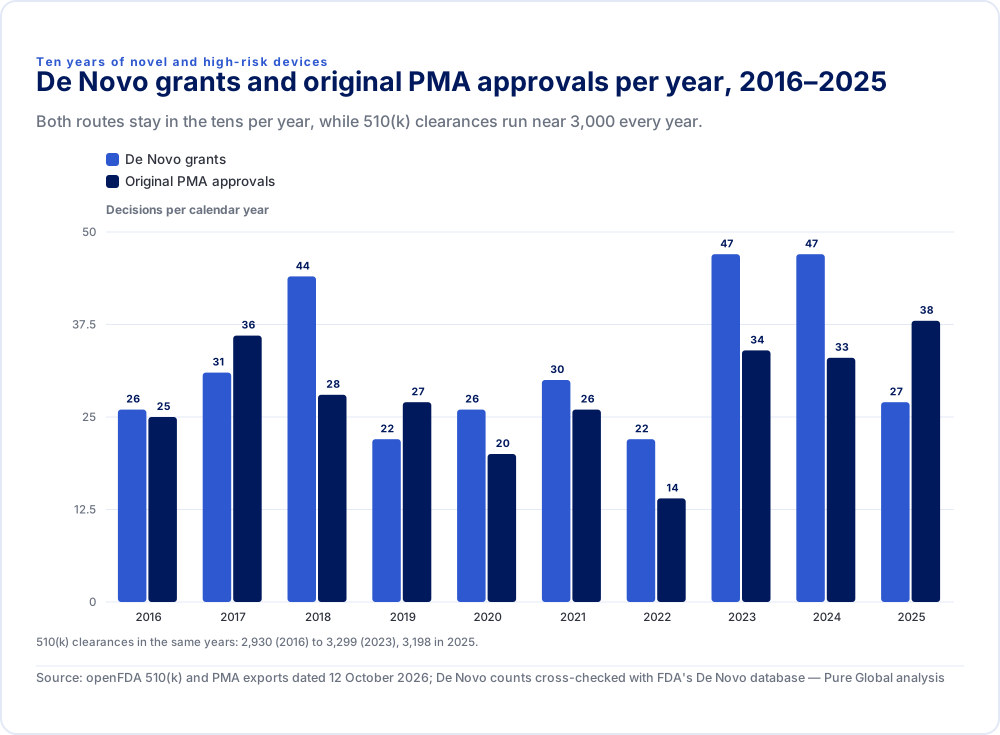
- 322 grants from 2016 to 2025, and 27 in 2025. 2023 and 2024 had 47 each. 15
- From 2021 to 2025, 173 grants took a median of 318 calendar days from receipt to decision. The middle half ranged from 233 to 469 days.
- Neurology (20), general hospital (17), cardiovascular (16) and microbiology (15) led the 2021 to 2025 grants.
One famous example shows why the wording matters. Apple's ECG app is often described as "FDA cleared." FDA's database records it as De Novo DEN180044, decided on 11 September 2018 with the outcome "granted." 16
| De Novo grants | Original PMA approvals | |
|---|---|---|
| 2016 | 26 | 25 |
| 2017 | 31 | 36 |
| 2018 | 44 | 28 |
| 2019 | 22 | 27 |
| 2020 | 26 | 20 |
| 2021 | 30 | 26 |
| 2022 | 22 | 14 |
| 2023 | 47 | 34 |
| 2024 | 47 | 33 |
| 2025 | 27 | 38 |
510(k) clearances in the same years: 2,930 (2016) to 3,299 (2023), 3,198 in 2025.
Source: openFDA 510(k) and PMA exports dated 12 October 2026; De Novo counts cross-checked with FDA's De Novo database — Pure Global analysis
How long each route takes in practice
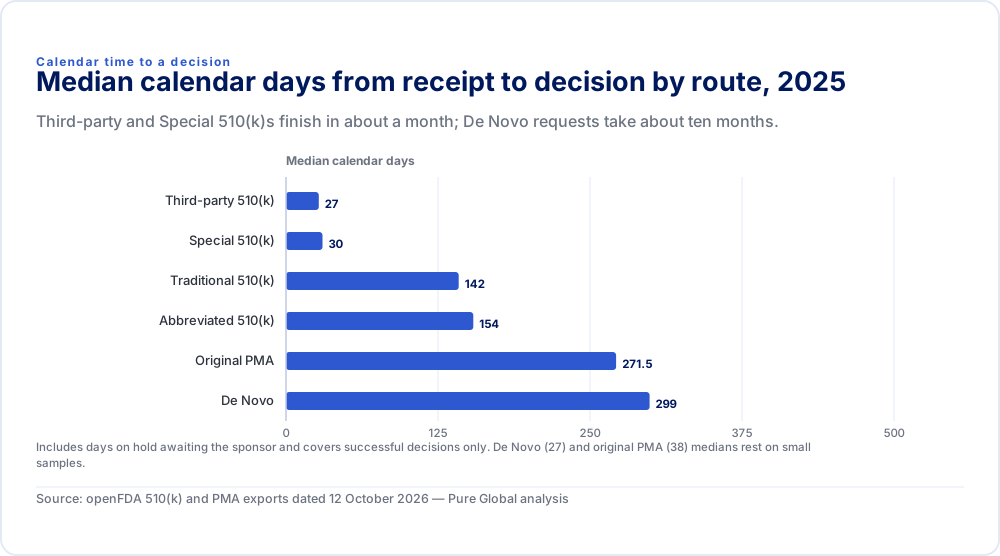
On calendar days from receipt to decision, a Special 510(k) is about ten times faster than a De Novo, and a Traditional 510(k) about half the time of an original PMA.
| Median calendar days | |
|---|---|
| Third-party 510(k) | 27 |
| Special 510(k) | 30 |
| Traditional 510(k) | 142 |
| Abbreviated 510(k) | 154 |
| Original PMA | 271.5 |
| De Novo | 299 |
Includes days on hold awaiting the sponsor and covers successful decisions only. De Novo (27) and original PMA (38) medians rest on small samples.
Source: openFDA 510(k) and PMA exports dated 12 October 2026 — Pure Global analysis
These medians measure total elapsed time, including the days FDA's clock is stopped while the sponsor answers questions. They describe outcomes, not FDA performance. They also include only successful decisions, because the public exports publish clearances, grants and approvals but not refusals or withdrawals. For planning, add preparation time before submission: test programs for a 510(k), and clinical studies for most PMAs and many De Novo requests.
How to choose between 510(k), De Novo and PMA
The route follows from the device's classification and from whether a valid predicate exists. Work through it in this order.
- Find the product code and classification regulation. If a regulation covers your device, its class and exemption status set the default route. Our guide to FDA medical device classification walks through the six steps.
- If the device is Class I or II and not exempt, look for a predicate with the same intended use. A predicate with a different product code, or one cleared for a narrower indication, is a warning sign.
- If no predicate fits and the risk is low or moderate, plan a De Novo. Budget for performance data that can support new special controls. Consider a Pre-Submission first, since FDA charges no fee for it. See our Q-Sub and Pre-Sub guide.
- If the device is Class III, plan a PMA, usually with an investigational device exemption study, and an inspection-ready quality system under the QMSR.
- If you cannot tell, ask. A 513(g) request for information costs $8,596 in FY2027, and FDA intends to respond within 60 days. The answer is not a final classification decision. 17
Our 510(k) consulting and PMA consulting pages describe the submission work for each route.
How to describe your FDA status correctly
Marketing copy, sales decks, labels and investor materials should use the word that matches the decision letter.
| Your device's status | Say | Do not say | Why |
|---|---|---|---|
| 510(k) found substantially equivalent | "FDA cleared" or "510(k) cleared" | "FDA approved" | 21 CFR 807.97: clearance does not denote official approval; implying approval is misbranding |
| PMA approved | "FDA approved" | "FDA cleared" | FDA approves PMA applications |
| De Novo granted | "FDA granted De Novo" or "FDA authorized" | "FDA cleared" or "FDA approved" | FDA grants De Novo requests and creates a new classification |
| 510(k)-exempt, registered and listed | "Listed with FDA," stated as a fact | "FDA approved," "FDA cleared," "FDA certified" | 21 CFR 807.39: registration "does not in any way denote approval" |
| Breakthrough Device designation | "Received FDA Breakthrough Device designation" | Any word implying marketing authorization | Designation speeds review; it is not an authorization |
FDA's consumer guidance is blunt about the last two rows: "The FDA does not issue any type of device registration certificates." It also says a device listing entry "does not denote approval, clearance, or authorization." 18 19
"FDA authorized" is a safe umbrella term. FDA itself writes that a De Novo device "was granted marketing authorization." But use the specific word whenever space allows, because buyers, hospital value-analysis committees and regulators in other countries read the difference.
Statuses that are not cleared, approved or granted
- Breakthrough Device designation. As of 30 June 2026, FDA's device and biologics centers had granted 1,320 Breakthrough Device designations. A designation gives sponsors more interaction with FDA during development. The device still needs a 510(k), De Novo or PMA decision before marketing. 20
- Humanitarian Device Exemption. A humanitarian use device treats or diagnoses a condition affecting not more than 8,000 people in the United States each year. It is approved under an HDE on probable benefit rather than proof of effectiveness, with limits on profit. 21
- 510(k)-exempt. Most Class I and some Class II devices reach the market with registration and listing only. That is lawful marketing, not clearance.
- Registered establishment. Every manufacturer registers annually ($13,785 for FY2027), whatever its devices' status. See our establishment registration guide.
How Pure Global helps
We choose the route, find and defend predicates, prepare eSTAR submissions, and run 513(g) and Pre-Submission requests for 510(k), De Novo and PMA programs. As your US Agent we keep registration and listing current. Our regulatory data team maintains the 510(k), De Novo and PMA records behind this analysis. You can search them in Pure Global AI's free FDA database, which helps when you are screening predicates or benchmarking review times. 22 Contact our team to plan your submission.
How we built the numbers
- Sources: the official openFDA 510(k) and PMA bulk exports dated 12 October 2026. Pure Global's life-science data lake keeps them with SHA-256 lineage. Counts are by calendar year of the decision date.
- 510(k) clearances: K-numbers with a substantially equivalent decision code. The openFDA export publishes cleared 510(k)s only.
- De Novo grants: the DEN records included in the same export, all with the decision code "granted." FDA's De Novo database returned identical counts for 2023 (47), 2024 (47) and 2025 (27).
- Original PMA approvals: PMA numbers with no supplement number and the decision code "APPR." Supplements are counted separately by supplement type.
- Review times: calendar days from the date received to the decision date. Year-to-date 2026 data run through early October and are excluded from the annual comparisons.
References
- openFDA — Device 510(k) API and bulk export, export dated 12 October 2026. open.fda.gov ↩
- openFDA — Device PMA API and bulk export, export dated 12 October 2026. open.fda.gov ↩
- eCFR — 21 CFR 807.97, misbranding by reference to premarket notification. ecfr.gov ↩
- U.S. FDA — Medical Device User Fee Amendments (MDUFA) fees, FY2027 rates effective 1 October 2026. fda.gov ↩
- U.S. FDA — MDUFA V commitment letter, performance goals and procedures FY2023–FY2027. fda.gov ↩
- U.S. FDA — Premarket Notification 510(k). fda.gov ↩
- U.S. FDA — 510(k) Submission Programs: Traditional, Special and Abbreviated. fda.gov ↩
- U.S. FDA — eSTAR Program. fda.gov ↩
- U.S. FDA — 510(k) Third Party Review Program. fda.gov ↩
- U.S. FDA — Premarket Approval (PMA). fda.gov ↩
- eCFR — 21 CFR 814.39, PMA supplements. ecfr.gov ↩
- U.S. FDA — Compliance Program 7382.850, Inspection of Medical Device Manufacturers, implemented 2 February 2026. fda.gov ↩
- U.S. FDA — De Novo Classification Request. fda.gov ↩
- eCFR — 21 CFR 860.200, purpose and applicability of De Novo classification. ecfr.gov ↩
- U.S. FDA — De Novo database. accessdata.fda.gov ↩
- U.S. FDA — De Novo record DEN180044, ECG App, granted 11 September 2018. accessdata.fda.gov ↩
- U.S. FDA — FDA and Industry Procedures for Section 513(g) Requests for Information, guidance revised 23 August 2024. fda.gov ↩
- U.S. FDA — Are there "FDA Registered" or "FDA Certified" medical devices? fda.gov ↩
- eCFR — 21 CFR 807.39, misbranding by reference to establishment registration. ecfr.gov ↩
- U.S. FDA — Breakthrough Devices Program, designations granted as of 30 June 2026. fda.gov ↩
- U.S. FDA — Humanitarian Device Exemption. fda.gov ↩
- Pure Global AI — FDA 510(k) clearance database. pureglobal.ai ↩
 Market · Oct 14, 2026FDA US Medical Device RegistrationRegulatory Update · Sep 17, 2026FDA Buffy Coat System GuidanceRegulatory Update · Aug 13, 2026FDA QMSR Warning Letters on Risk and Design ChangesRegulatory Update · Aug 9, 2026FDA FY 2027 Medical Device User FeesRegulatory Update · Jun 2, 2026FDA Human Factors Guidance 2026 Update for Device SubmissionsVideo · Mar 12, 2026How to Register a Medical Device with the US FDAMarket Service · Jul 24, 2026FDA Certificate to Foreign Government (CFG) for Medical DevicesMarket Service · Jul 27, 2026FDA Form 483 and Warning Letter Response ConsultingCase Study · Aug 11, 2026One Balloon-Catheter Line, Two ANVISA RoutesCase Study · Aug 5, 2026COFEPRIS IVD Registration for a Reagent Menu
21 CFR Part 820 to ISO 13485: The QMSR Crosswalk
QMSR cut 21 CFR Part 820 from 31 sections to six and made ISO 13485:2016 the rule. This crosswalk maps every old section to its ISO 13485 clause, marks which mappings FDA stated, lists the FDA-only requirements and shows where a decade of 483 citations now lands.
FDA Inspection Readiness Checklist (QMSR)
FDA now inspects device makers under the QMSR and Compliance Program 7382.850. Our analysis of ten years of FDA Form 483 data shows where investigators find problems, and the 12-point checklist turns those findings into records to prepare before the investigator arrives.
FDA Medical Device Classification: Class I, II and III Explained
FDA's October 2026 product code file puts 36.5% of classified codes in Class I, 55.4% in Class II and 8.0% in Class III. This guide explains what each class requires, why class alone does not decide the pathway, and how to confirm your device's class in six steps.
Let's Talk,
Anywhere You Are.
Whether looking for more information or ready to partner with us, we're here to guide you through every step of the regulatory process.
Contact us