FDA Medical Device Classification: Class I, II and III Explained
FDA's October 2026 product code file puts 36.5% of classified codes in Class I, 55.4% in Class II and 8.0% in Class III. This guide explains what each class requires, why class alone does not decide the pathway, and how to confirm your device's class in six steps.
TL;DR
The FDA sorts every medical device into Class I, Class II or Class III. The class tells you which controls apply to the device and, in most cases, which premarket submission you need. FDA's product code file dated 12 October 2026 lists 7,096 product codes. Of the 6,576 codes assigned to Class I, II or III, 2,403 are Class I (36.5%), 3,645 are Class II (55.4%) and 528 are Class III (8.0%). 1
Most Class I codes do not need a 510(k): 2,155 of 2,403 are 510(k)-exempt (89.7%). Most Class II codes do: 3,005 of 3,645 require a 510(k) (82.4%). Almost every Class III code, 497 of 528, requires premarket approval (PMA). The market follows the same shape. Of the 3,198 510(k) clearances FDA decided in calendar year 2025, 3,064 (95.8%) were for Class II devices. 2
The class is not the whole answer. A Class I examination glove still needs a 510(k), some Class II devices are exempt, and a novel low- or moderate-risk device with no predicate goes through De Novo. This guide explains the legal definitions, the 2026 numbers, the six-step method we use to confirm a device's class, and how the US classes line up against the EU, Canada, Japan and China.
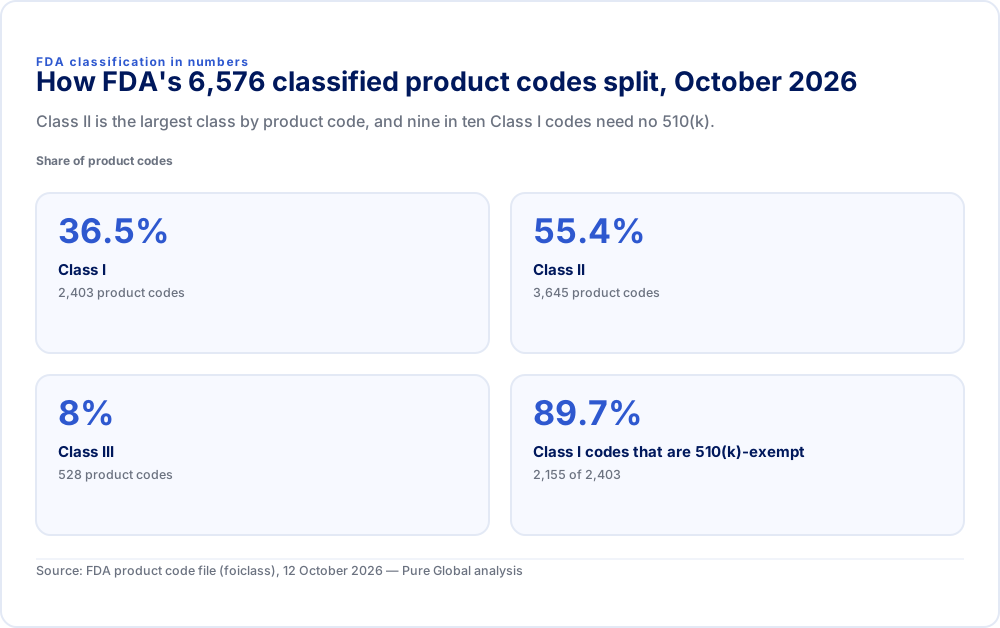
FDA classification in numbersHow FDA's 6,576 classified product codes split, October 2026Class II is the largest class by product code, and nine in ten Class I codes need no 510(k).Share of product codes
- Class I
- 36.5%2,403 product codes
- Class II
- 55.4%3,645 product codes
- Class III
- 8%528 product codes
- Class I codes that are 510(k)-exempt
- 89.7%2,155 of 2,403
Source: FDA product code file (foiclass), 12 October 2026 — Pure Global analysis
What Class I, II and III mean in the law
Class is set by section 513 of the Federal Food, Drug, and Cosmetic Act, and it describes the level of control needed to give reasonable assurance of safety and effectiveness. It is not a ranking FDA assigns by feel. 3
- Class I is a device for which general controls "are sufficient to provide reasonable assurance of the safety and effectiveness of the device."
- Class II is a device for which "general controls by themselves are insufficient" but there is "sufficient information to establish special controls to provide such assurance."
- Class III is a device that cannot be placed in Class I or II and that "is purported or represented to be for a use in supporting or sustaining human life or for a use which is of substantial importance in preventing impairment of human health," or "presents a potential unreasonable risk of illness or injury."
FDA's regulation at 21 CFR 860.3 lists the general controls: adulteration, misbranding, registration, listing and premarket notification, banned devices, notification and other remedies, records and reports including unique device identification, and the general provisions of section 520. The same section defines special controls as including "performance standards, performance testing, postmarket surveillance, patient registries, development and dissemination of guidelines," and similar measures. 4
Two definitions in 860.3 do a lot of work in Class III decisions. A life-supporting or life-sustaining device is one "essential to, or that yields information that is essential to, the restoration or continuation of a bodily function important to the continuation of human life." An implant is a device intended to remain implanted continuously for 30 days or more.
You will often see the classes described as low, moderate and high risk. That is a useful shorthand, but the statute does not use those words. What decides the class is whether general controls alone, general plus special controls, or premarket approval are needed for reasonable assurance of safety and effectiveness.
| Class I | Class II | Class III | |
|---|---|---|---|
| Controls | General controls | General and special controls | General controls and premarket approval |
| Typical premarket route | Exempt; some need a 510(k) | 510(k); some exempt | PMA; HDE for some humanitarian uses |
| Share of classified product codes, Oct 2026 | 36.5% (2,403) | 55.4% (3,645) | 8.0% (528) |
| 510(k)-exempt product codes | 89.7% | 13.3% | None |
| Exempt from most QMSR requirements | 532 codes (22.1%) | 6 codes | None |
| Design controls (ISO 13485 clause 7.3) | Only software-automated devices and five listed device types | Required | Required |
| Examples (product code) | Manual stethoscope (LDE), non-surgical tongue depressor (FMA) | Infusion pump (FRN), radiological image processing software (QIH) | Coronary drug-eluting stent (NIQ), implantable pacemaker pulse generator (DXY) |
| FY2027 FDA fee for the typical route | None if exempt; $28,653 for a 510(k) | $28,653 for a 510(k) | $636,732 for an original PMA |
Fees are standard FY2027 rates for 1 October 2026 to 30 September 2027. Qualifying small businesses pay $7,163 for a 510(k) and $159,183 for a PMA. 5
How many devices sit in each class (October 2026)
FDA's public pages still describe "approximately 1,700 different generic types of devices" grouped into 16 medical specialty panels. The live product code file is a better working count, and it tells a different story. 6
A product code is the three-letter identifier FDA attaches to a device type. It links the device to its classification regulation, its review panel, its submission type and flags such as GMP exemption, implant status and third-party review eligibility. FDA's field definitions for the file are published on its download page. 7
In the file dated 12 October 2026:
- 7,096 product codes exist in total. 6,576 are assigned to Class I, II or III. The rest are not classified, unclassified (mostly pre-amendment devices whose classification was never finalized), or Humanitarian Device Exemption codes.
- Those 6,576 codes point to 2,287 distinct regulation numbers in 21 CFR Parts 862 to 892.
- Class II is now the largest class by product code, at 55.4%. FDA's older consumer pages split devices into 47% Class I, 43% Class II and 10% Class III. Those figures count generic device types in an earlier year. They should not be quoted as a current product code split.
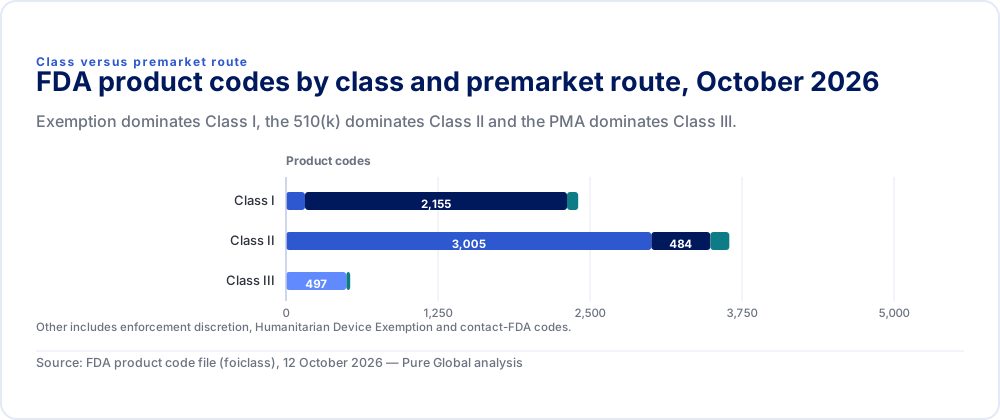
| 510(k) required | 510(k)-exempt | PMA required | Other route | |
|---|---|---|---|---|
| Class I | 156 | 2,155 | 0 | 92 |
| Class II | 3,005 | 484 | 0 | 156 |
| Class III | 0 | 0 | 497 | 31 |
Other includes enforcement discretion, Humanitarian Device Exemption and contact-FDA codes.
Source: FDA product code file (foiclass), 12 October 2026 — Pure Global analysis
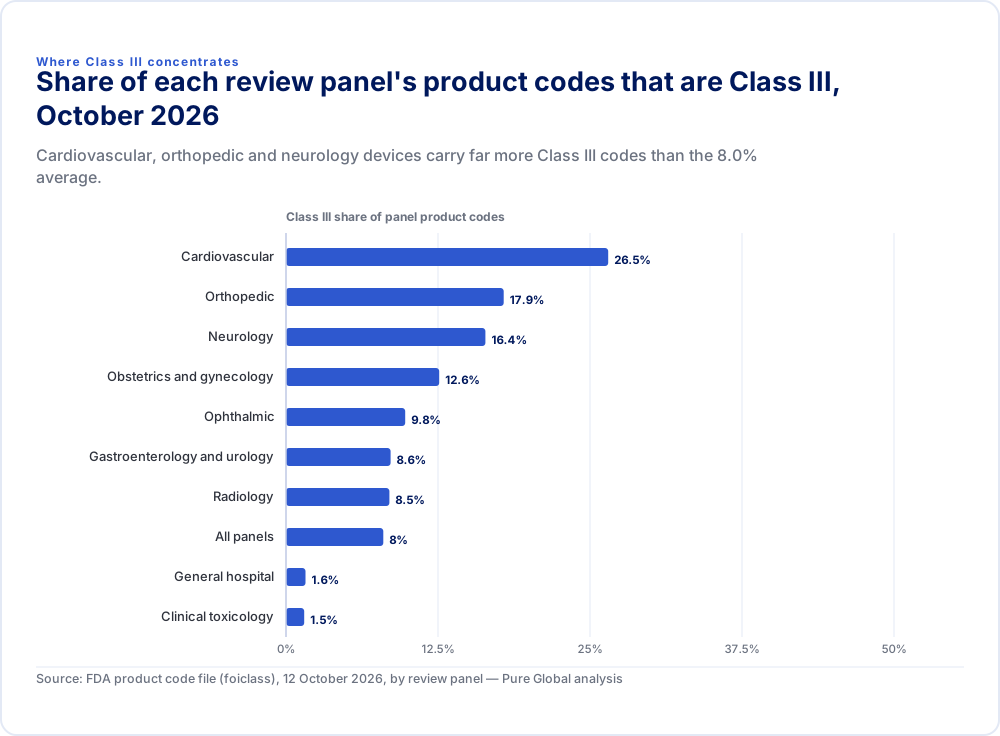
The class mix varies sharply by review panel. Cardiovascular has the highest share of Class III product codes. Clinical toxicology, general hospital and microbiology have very few.
| Class III share | |
|---|---|
| Cardiovascular | 26.5% |
| Orthopedic | 17.9% |
| Neurology | 16.4% |
| Obstetrics and gynecology | 12.6% |
| Ophthalmic | 9.8% |
| Gastroenterology and urology | 8.6% |
| Radiology | 8.5% |
| All panels | 8% |
| General hospital | 1.6% |
| Clinical toxicology | 1.5% |
Source: FDA product code file (foiclass), 12 October 2026, by review panel — Pure Global analysis
Class I devices: general controls, and usually no 510(k)
A Class I device is regulated by general controls only. For about nine in ten Class I product codes that means no premarket submission at all, but it never means no obligations.
Of the 2,403 Class I product codes, 2,155 are 510(k)-exempt, 156 still require a 510(k), 91 are under enforcement discretion and one requires contacting FDA's device evaluation office. FDA's own Classify page uses an older statistic, "approximately 572 or 74% of the Class I devices are exempt." The difference is again generic types versus product codes. 6
Exemption has limits. Each classification part, from 21 CFR 862.9 to 892.9, says an exemption applies "only to the extent that the device has existing or reasonably foreseeable characteristics of commercially distributed devices within that generic type." A new intended use, a different fundamental scientific technology, or certain in vitro diagnostic uses bring the 510(k) requirement back. 8 The statute also withholds the Class I exemption from devices intended for a use "of substantial importance in preventing impairment of human health" or that present "a potential unreasonable risk of illness or injury." 9
Examination gloves are the familiar case. Vinyl and polymer patient examination gloves are Class I under 21 CFR 880.6250, yet they need a 510(k). Polymer exam gloves (LZA) accounted for 24 of the 70 Class I 510(k) clearances FDA decided in 2025.
Exempt does not mean outside the quality system either. Only 532 Class I product codes carry FDA's GMP-exempt flag. Under the Quality Management System Regulation, in force since 2 February 2026, those exemptions are written into each classification regulation and still keep "requirements concerning records and complaint files under § 820.35." 10 Design controls, now ISO 13485 clause 7.3 through 21 CFR 820.10(c), apply to Class I devices only when they are automated with software or fall in one of five listed regulations. 11
Every Class I manufacturer still registers its establishment, lists its devices, pays the annual registration fee ($13,785 for FY2027), meets labeling and UDI rules, and reports adverse events. See our guide to FDA establishment registration and device listing.
Class II devices: special controls and the 510(k)
Class II is where most of the market lives. It covers 3,645 product codes and almost all 510(k) clearances.
Of those codes, 3,005 require a 510(k) (82.4%), 484 are exempt (13.3%) and 155 are under enforcement discretion. Special controls are usually written into the classification regulation itself. They take the form of performance testing, biocompatibility, software and cybersecurity documentation, labeling content or a named special controls guidance document.
Our analysis of the openFDA 510(k) export, mirrored in Pure Global's data lake, shows what Class II looks like in practice in 2025:
- FDA decided 3,198 510(k) clearances. 3,064 were Class II, 70 were Class I and 64 had no class assigned in the record.
- Traditional 510(k)s took a median of 142 calendar days from receipt to decision. The middle half fell between 90 and 231 days. Special 510(k)s took a median of 30 days and Abbreviated 510(k)s 154 days.
- 60 clearances went through FDA's third-party review program, with a median of 27 days. FDA says "approximately half of 510(k)s the FDA receives are eligible for this program," and 1,427 Class II product codes carry the eligibility flag. 12
- 52.3% of the clearances went to applicants outside the United States. China was second to the US with 535.
Calendar days include time the submission sits on hold while the sponsor answers FDA's questions. FDA's own MDUFA V goal is narrower: a decision on 95% of 510(k)s within 90 "FDA days," the days the file is actually under review. 13
Class II is also where De Novo devices land. Of the 173 De Novo requests FDA granted from 2021 to 2025, 172 sit in Class II in FDA's current product code file. Each one becomes a new regulation, and later devices can use it as a predicate. 14
Exemptions are moving in 2026. FDA proposed a new list of Class II devices for 510(k) exemption in February 2026, and no final list had appeared in the Federal Register by October. It finalized exemptions for certain clinical toxicology test systems on 6 October 2026. On 17 September 2026 it published its order denying a petition to exempt radiology computer-aided detection, diagnosis and triage software. 15 Check the current classification regulation before relying on any exemption.
Class III devices: PMA, implants and life-sustaining devices
Class III holds only 8.0% of product codes, but it carries the heaviest evidence burden, the largest FDA fee and the longest reviews.
Of the 528 Class III product codes, 497 require a PMA, 27 require contacting FDA and four are Humanitarian Device Exemption codes. FDA flags 236 of them as implants (44.7%) and 62 as life-sustaining or life-supporting.
383 of the 528 Class III codes have no classification regulation number. Many of them are post-amendments device types: devices first marketed after 28 May 1976 that have no predicate. Section 513(f)(1) places such devices in Class III by operation of law until FDA reclassifies them, for example through a De Novo grant or a reclassification order. Drug-eluting coronary stents (NIQ) and implantable cardioverter defibrillators (LWS) are examples. 3
PMA volumes are small. The openFDA PMA export records 38 original PMA approvals in calendar year 2025, with a median of 271.5 calendar days from receipt to approval. The same year FDA decided 2,182 PMA supplements, 1,380 of them 30-day notices for manufacturing changes. 16
The FY2027 fee for an original PMA is $636,732 ($159,183 for a qualifying small business). Under MDUFA V, FDA aims to decide 90% of original PMAs within 180 FDA days, or 320 FDA days when an advisory panel is involved. 13
Class does not decide the pathway on its own
The class narrows the options. The product code, the exemption text and whether a predicate exists decide the actual route.
| Situation | Route | FY2027 FDA fee (standard) | FDA review goal |
|---|---|---|---|
| Class I or II, exempt, within the exemption limits | Register and list; no premarket submission | $13,785 annual establishment fee | None |
| Class I or II, not exempt, valid predicate exists | 510(k): Traditional, Special or Abbreviated | $28,653 | 90 FDA days |
| Low or moderate risk, no valid predicate, or a not-substantially-equivalent decision | De Novo request | $191,020 | 150 FDA days |
| Class III | PMA | $636,732 | 180 FDA days (320 with an advisory panel) |
| Class unclear | 513(g) request for information | $8,596 | 60 days |
Sources: FY2027 fee notice, MDUFA V commitment letter and section 513(g). A 513(g) response "does not constitute final Agency action," so treat it as written advice, not a classification decision. 17 A Pre-Submission meeting is another way to test a classification rationale, and FDA charges no fee for it. See our Q-Sub and Pre-Sub guide.
For a fuller comparison of the three marketing routes, see our analysis of FDA cleared vs approved vs granted.
How to find your device's FDA class in six steps
The reliable method starts from intended use and ends with a documented rationale. It does not start from the technology.
- Write the intended use and indications for use first. Classification follows what you claim the device does, for whom and in what setting. Two devices with identical hardware can sit in different classes because their claims differ.
- Search the Product Classification Database. Search by the first noun of the device name (FDA names devices as a noun followed by adjectives, so "pump" finds every pump). Shortlist product codes whose definitions match your claims. 18 Pure Global AI offers a free product code lookup built on the same FDA file. 19
- Read the classification regulation itself. Open the 21 CFR section linked from the product code. Read the identification paragraph, the class, any special controls and any exemption. Then read the matching ".9 limitations of exemptions" section for that part.
- Check how FDA has treated similar devices. Search the 510(k), De Novo and PMA databases for the product code. Recent clearances show the predicates, standards and testing FDA has accepted. Predicates from a different product code are a warning sign.
- Test borderline cases before you build the file. Use a Pre-Submission or a 513(g) request when the device straddles two codes, has a novel feature or includes software functions that may fall outside the device definition. Software functions excluded by section 520(o) are not devices at all. FDA revised its clinical decision support guidance in January 2026. 20
- Document the rationale. Record the codes you considered, why you rejected them and how the chosen regulation fits your claims. Inspectors and reviewers ask for this, and it is the first thing to revisit when you change the intended use.
Accessories deserve their own check. In August 2026 FDA proposed a list of accessories suitable for distinct Class I classification, with comments due 16 October 2026. Until that becomes final, an accessory generally takes the classification of its parent device unless FDA has classified it separately. 21
How FDA classes compare with other major markets
FDA's three classes do not map one-to-one onto other systems. Each regulator applies its own rules, and the same device can land one step higher or lower abroad.
| Market | Classes | Basis | Pure Global guide |
|---|---|---|---|
| United States | I, II, III | Device-type regulations in 21 CFR 862–892 | FDA classification consulting |
| European Union | I (including Is, Im, Ir), IIa, IIb, III | 22 rules in MDR Annex VIII | EU MDR classification |
| Canada | I, II, III, IV | Rules in Schedule 1 of the Medical Devices Regulations | Health Canada registration |
| Japan | I, II, III, IV | Risk classes under the PMD Act | PMDA Japan registration |
| China | I, II, III | NMPA classification rules and catalogue | NMPA China registration |
Two patterns cause most surprises. First, software. EU MDR Rule 11 places most diagnostic and therapeutic decision-support software in Class IIa or higher, while comparable US software may be Class II or fall outside the device definition. Second, implants. Several devices that are Class II in the US, such as some orthopedic and dental implants, are Class IIb or III in the EU and Class III in China.
Build one classification memo per market from the same intended use statement. For devices sold in many markets, our FDA and EU approvals guide shows where an FDA or EU decision shortens other reviews.
Common classification mistakes
- Classifying by technology instead of claims. A wearable sensor marketed for general wellness and the same sensor marketed to detect a disease can sit in different places. FDA's general wellness policy was revised in January 2026. 22
- Assuming "Class I" means no quality system. Only 532 of 2,403 Class I product codes carry the GMP-exempt flag. Even those keep complaint and record requirements.
- Assuming exemption covers a new use. The ".9" limitations bring back the 510(k) requirement for a new intended use or a different fundamental technology.
- Calling a cleared device "approved." A 510(k) clears a device. 21 CFR 807.97 says clearance "does not in any way denote official approval," and implying otherwise is misbranding. 23
- Picking a predicate from a different product code. It usually means the classification itself needs another look.
- Treating "FDA registered" as a status. Registration "does not in any way denote approval of the establishment or its products." 24
How Pure Global helps
Pure Global confirms US classification and builds the matching submission strategy. That covers product code selection, exemption analysis, 513(g) and Pre-Submission requests, and 510(k), De Novo and PMA planning. As your US Agent and local team we also maintain registration and listing. Because we work in more than 30 markets, we write one intended use statement and carry it into the EU, UK, Canada, Brazil, Japan, China and others. See FDA classification consulting or contact our team.
How we built the numbers
- Product codes: FDA's foiclass file dated 12 October 2026, filtered to Class I, II and III. Product codes are not the same as FDA's "generic types," so shares differ from FDA's older published percentages.
- 510(k) and PMA figures: the official openFDA bulk exports dated 12 October 2026. Pure Global keeps these in its life-science data lake with SHA-256 lineage. Review times are calendar days from date received to decision date, which include sponsor hold time. They are not FDA days.
- De Novo counts: taken from the openFDA 510(k) export, which includes De Novo grants. We cross-checked them against FDA's De Novo database, which returned the same 27 grants for 2025 and 47 for each of 2023 and 2024.
- Third-party share: clearances where openFDA's third-party flag is "Y".
References
- U.S. FDA — Product code classification file (foiclass.zip), dated 12 October 2026. accessdata.fda.gov ↩
- openFDA — Device 510(k) API and bulk export, export dated 12 October 2026. open.fda.gov ↩
- Legal Information Institute — 21 U.S.C. 360c, classification of devices intended for human use (FD&C Act section 513). law.cornell.edu ↩ ↩
- eCFR — 21 CFR 860.3, definitions for device classification. ecfr.gov ↩
- U.S. FDA — Medical Device User Fee Amendments (MDUFA) fees, FY2027 rates effective 1 October 2026. fda.gov ↩
- U.S. FDA — Classify Your Medical Device. fda.gov ↩ ↩
- U.S. FDA — Download Product Code Classification Files, field definitions. fda.gov ↩
- eCFR — 21 CFR 862.9, limitations of exemptions from section 510(k). ecfr.gov ↩
- Legal Information Institute — 21 U.S.C. 360, registration and premarket notification, including the Class I exemption limit in subsection (l). law.cornell.edu ↩
- eCFR — 21 CFR 880.6230, an example of a QMSR exemption that retains § 820.35 records and complaint files. ecfr.gov ↩
- eCFR — 21 CFR Part 820, Quality Management System Regulation, current text. ecfr.gov ↩
- U.S. FDA — 510(k) Third Party Review Program. fda.gov ↩
- U.S. FDA — MDUFA V commitment letter, performance goals and procedures FY2023–FY2027. fda.gov ↩ ↩
- U.S. FDA — De Novo database. accessdata.fda.gov ↩
- Federal Register — Medical Devices; Exemptions From Premarket Notification: Class II Devices; Request for Comments, 91 FR 5485, 6 February 2026. federalregister.gov ↩
- openFDA — Device PMA API and bulk export, export dated 12 October 2026. open.fda.gov ↩
- U.S. FDA — FDA and Industry Procedures for Section 513(g) Requests for Information, guidance revised 23 August 2024. fda.gov ↩
- U.S. FDA — Product Classification Database. accessdata.fda.gov ↩
- Pure Global AI — US FDA product code lookup and classification database. pureglobal.ai ↩
- U.S. FDA — Clinical Decision Support Software, guidance issued January 2026. fda.gov ↩
- Federal Register — Classification of Accessories Distinct From Other Devices; Proposed List of Accessories Suitable for Class I, 91 FR 53205, 17 August 2026. federalregister.gov ↩
- U.S. FDA — General Wellness: Policy for Low Risk Devices, guidance issued 6 January 2026. fda.gov ↩
- eCFR — 21 CFR 807.97, misbranding by reference to premarket notification. ecfr.gov ↩
- eCFR — 21 CFR 807.39, misbranding by reference to establishment registration. ecfr.gov ↩
 Market · Oct 14, 2026FDA US Medical Device RegistrationRegulatory Update · Sep 17, 2026FDA Buffy Coat System GuidanceRegulatory Update · Aug 13, 2026FDA QMSR Warning Letters on Risk and Design ChangesRegulatory Update · Aug 9, 2026FDA FY 2027 Medical Device User FeesRegulatory Update · Jun 2, 2026FDA Human Factors Guidance 2026 Update for Device SubmissionsVideo · Mar 12, 2026How to Register a Medical Device with the US FDAMarket Service · Jul 24, 2026FDA Certificate to Foreign Government (CFG) for Medical DevicesMarket Service · Jul 27, 2026FDA Form 483 and Warning Letter Response ConsultingCase Study · Aug 11, 2026One Balloon-Catheter Line, Two ANVISA RoutesCase Study · Aug 5, 2026COFEPRIS IVD Registration for a Reagent Menu
21 CFR Part 820 to ISO 13485: The QMSR Crosswalk
QMSR cut 21 CFR Part 820 from 31 sections to six and made ISO 13485:2016 the rule. This crosswalk maps every old section to its ISO 13485 clause, marks which mappings FDA stated, lists the FDA-only requirements and shows where a decade of 483 citations now lands.
FDA Cleared vs Approved vs Granted: 510(k), PMA and De Novo
In 2025 FDA cleared 3,198 devices through 510(k), granted 27 De Novo requests and approved 38 original PMAs. This guide explains what each word means legally, how long each route takes, what it costs in FY2027 and how to describe your device's status without misbranding it.
FDA Inspection Readiness Checklist (QMSR)
FDA now inspects device makers under the QMSR and Compliance Program 7382.850. Our analysis of ten years of FDA Form 483 data shows where investigators find problems, and the 12-point checklist turns those findings into records to prepare before the investigator arrives.
Let's Talk,
Anywhere You Are.
Whether looking for more information or ready to partner with us, we're here to guide you through every step of the regulatory process.
Contact us